

⭐⭐⭐⭐⭐ 4.6/5 — A genuinely different angle on time management: multiply it, don’t just manage it.
Best for: High performers whose success keeps piling on more responsibilities than a to-do list can handle.
Reading time: ~5 hrs to read, 20 min to guide
Difficulty to apply: Moderate — the payoff requires investing more time upfront before it pays off later.
Procrastinate on Purpose in one minute
Managing your time better has a hard ceiling — multiplying it doesn’t. In Procrastinate on Purpose: 5 Permissions to Multiply Your Time, sales-performance trainer Rory Vaden argues that conventional time management, optimizing a fixed 24 hours, can only ever produce marginal gains. Real leverage comes from investing effort now — training someone, building a system, deliberately delaying a lower-value task — so that future time is freed up rather than just squeezed tighter today. The book’s centerpiece is the “Focus Funnel,” a five-step filter that includes an unconventional final step: procrastinating, but only on purpose, and only after everything else has been considered.
Key takeaways
- Time management has a ceiling: optimizing today’s fixed hours can only produce marginal, one-time gains.
- Time multiplication has no ceiling: investing effort now can free up recurring time in every future week.
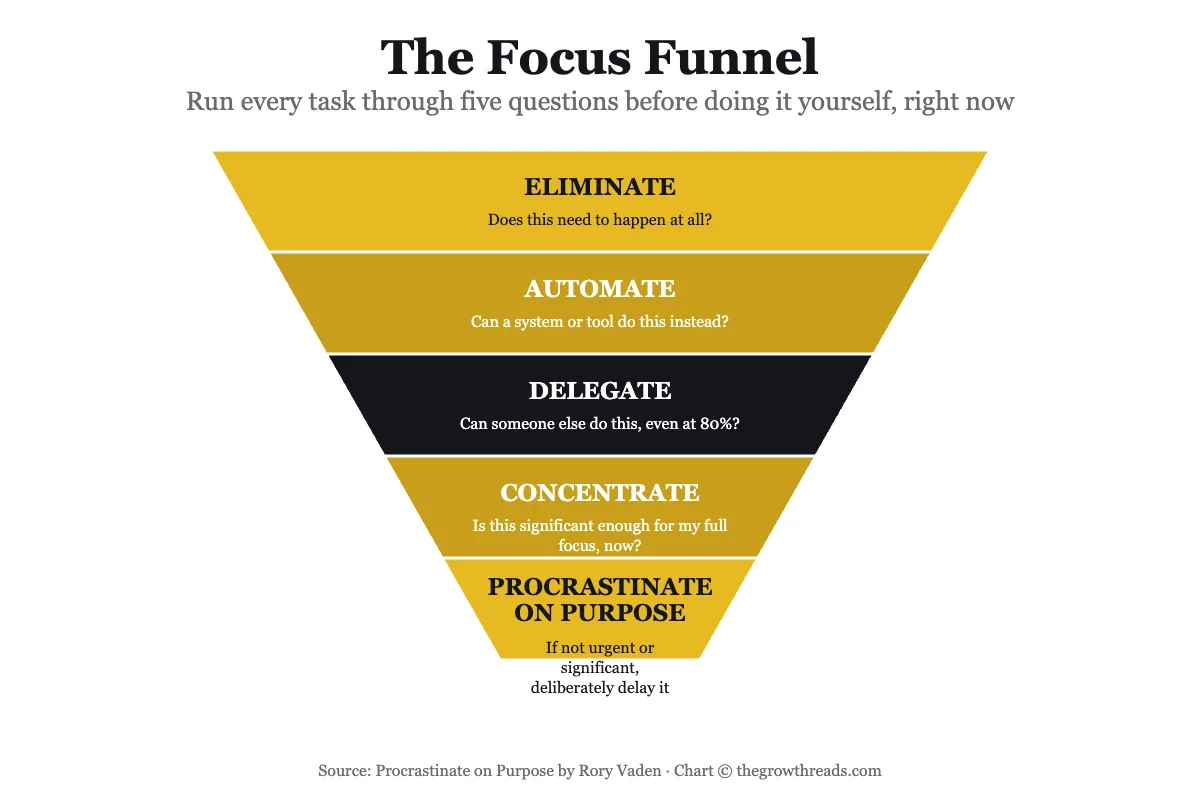
- The Focus Funnel has five steps: Eliminate, Automate, Delegate, Concentrate, and — last — Procrastinate on Purpose.
- Procrastination isn’t always harmful: deliberately delaying a low-significance task, on purpose, is a legitimate strategic choice.
- Significance beats urgency: the real filter for a task isn’t how loudly it demands attention, but how long its impact will matter.
- The 30x Rule: investing roughly 30 times a task’s normal time cost upfront can eliminate it from your plate permanently.
- Delegation requires training, not just handoff: a one-time explanation rarely sticks; repeated, invested training does.
- “Good enough” from someone else beats “perfect” from you: accepting 80% quality from a delegate frees up disproportionate time.
- Priority dilution is a success problem: doing well tends to earn you more responsibilities until everything claims to be a priority.
- The fix is subtraction, not just harder work: eliminating and delegating deliberately, not adding more effort to a longer list.

What is Procrastinate on Purpose about?
Procrastinate on Purpose argues that conventional time management has a hard ceiling, and that real leverage comes from multiplying time — investing effort now to free up recurring future time. Its core tool, the Focus Funnel, filters tasks through eliminate, automate, delegate, and concentrate before allowing deliberate, strategic procrastination as the final, legitimate option.
About the author
Rory Vaden co-founded Southwestern Consulting, a sales-performance and leadership training firm, and built his reputation as a speaker and trainer working directly with sales teams and executives rather than as an academic researcher. His background shows in the book’s approach: rather than leaning on dense citations to peer-reviewed studies, Procrastinate on Purpose draws heavily on personal experience, sales-floor case studies, and illustrative examples from well-known historical figures. That grounding in practical training — teaching real teams to actually change behavior, not just understand a concept intellectually — is part of what shapes the book’s emphasis on repeated, invested training over one-time explanations when it comes to delegation. Explore all Rory Vaden book summaries →
Key concepts at a glance
| Concept | What it means | Use it when |
|---|---|---|
| Time multiplication | Investing effort now to create more available time in the future, not just today | You’ve hit the ceiling of what better daily scheduling can achieve |
| The Focus Funnel | A five-step filter: Eliminate, Automate, Delegate, Concentrate, Procrastinate on Purpose | You need a repeatable way to decide what to do with any given task |
| Procrastinate on Purpose | Deliberately delaying a low-significance task as a strategic choice, not an accident | A task is truly urgent-feeling but not actually significant right now |
| Significance vs. urgency | Judging a task by how long its impact will matter, not how loudly it demands attention | Urgent-feeling tasks keep crowding out what actually matters |
| The 30x Rule | Investing roughly 30 times a task’s normal time cost upfront to eliminate it permanently | A task recurs often enough that training or automating it would pay off |
| Priority dilution | Success adds responsibilities until everything claims to be a priority | Your task list has grown but your actual capacity hasn’t |
| 80% delegation standard | Accepting good-enough work from someone else instead of insisting on personal perfection | Perfectionism is the reason you haven’t delegated a task yet |
Part 1: Why managing time has a ceiling
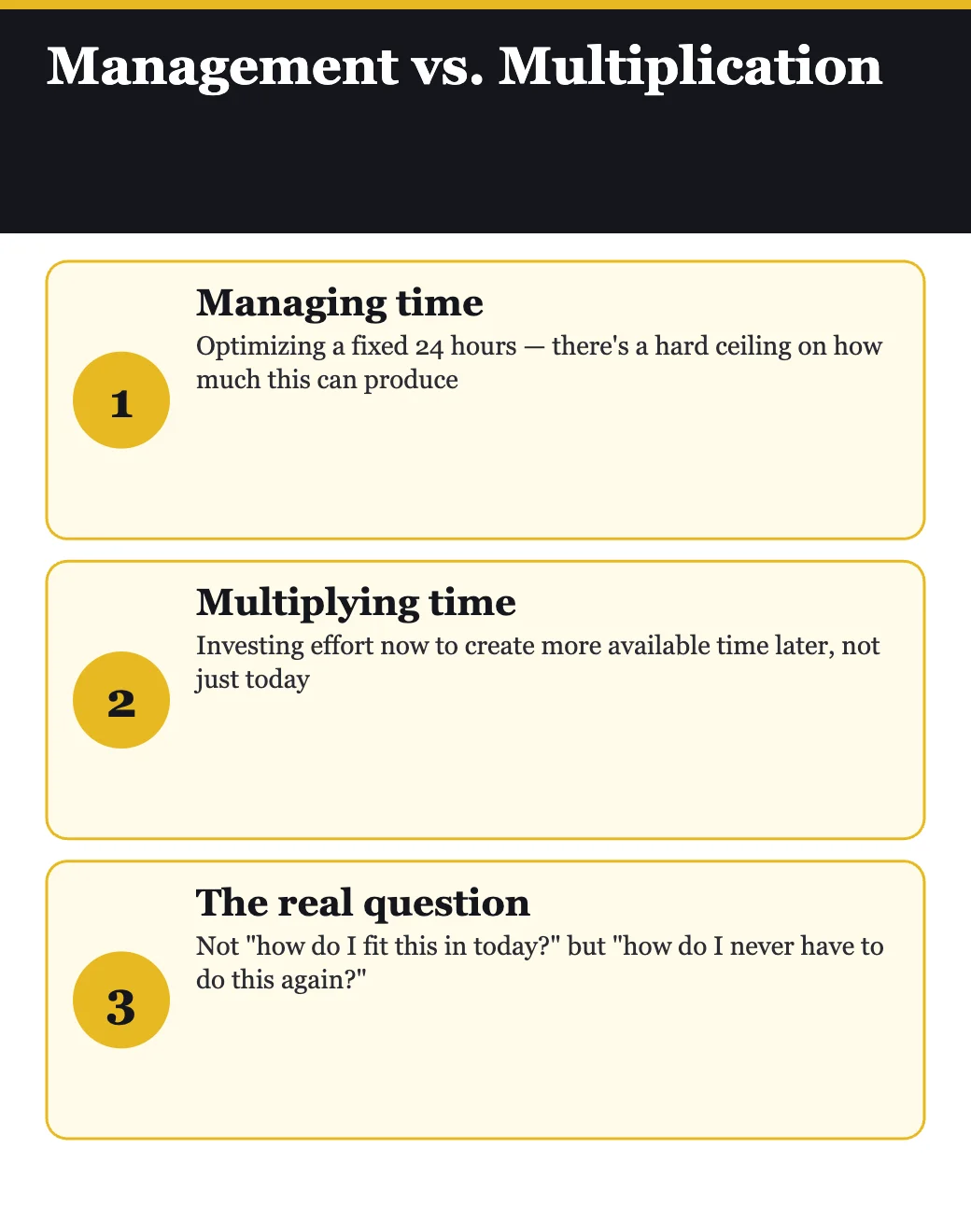
Vaden opens with a distinction that reframes the entire book: managing time and multiplying time are not the same project, even though they’re often talked about interchangeably. Managing time means optimizing how a fixed 24 hours gets used — better scheduling, fewer interruptions, tighter focus. It can genuinely help, but it has a hard mathematical ceiling: there are only so many hours in a day, and no amount of optimization creates more of them. Multiplying time is a different move entirely — it means investing effort today specifically to reduce or eliminate how much time a task will require in the future, which has no equivalent ceiling, since the same investment can pay off across dozens or hundreds of future repetitions.
This reframe changes what counts as a good use of time in the moment. Under pure time management, doing a task yourself, quickly and correctly, often looks like the efficient choice. Under time multiplication, that same choice can be a trap: doing it yourself today guarantees you’ll be doing it again next week, and the week after, while training someone else or building a system costs more time now but removes the task from your plate permanently. The book’s central argument is that most people default to the first framing because it feels more efficient in the moment, even when it’s the more expensive choice over any meaningful time horizon.
Vaden is careful to separate this ceiling from a productivity complaint. The problem isn’t that people manage their hours poorly — most high achievers are already disciplined schedulers. The problem is structural: a calendar can only ever be rearranged, never expanded. Every hour saved on one task is an hour spent on another, which means traditional time management eventually plateaus no matter how good someone gets at it. The way out, he argues, isn’t a better calendar app or an earlier alarm clock — it’s a fundamentally different question. Instead of asking “how do I get this done faster,” the more useful question becomes “should I be the one doing this at all, and if so, when.” That reframing is what the rest of the book is built on, and it’s why the Focus Funnel that follows isn’t a scheduling tool so much as a decision filter applied before scheduling ever begins.
Part 2: The Focus Funnel and the case for strategic procrastination
The Focus Funnel gives this reframe a concrete, repeatable procedure. Every task gets run through five questions in order: can it be eliminated entirely? If not, can it be automated? If not, can it be delegated to someone else? If none of those apply and it’s genuinely significant, it earns your concentrated attention right now. And if it survives all four filters but still isn’t significant or urgent enough to justify immediate attention, the fifth and final permission applies: procrastinate on it, deliberately and on purpose.
This last step is the book’s most distinctive idea, and its title is a deliberate provocation. Ordinary procrastination is passive and reactive — avoiding a task out of discomfort, with no clear plan for when it’ll actually get done. Procrastinating on purpose is the opposite: an active, considered decision that a task genuinely doesn’t deserve attention right now, made after running it through the rest of the funnel, with intent to revisit it later when it becomes more significant or more urgent. The distinction matters because it separates strategic deferral, a legitimate time-multiplication tool, from the avoidance-driven procrastination most productivity advice is trying to eliminate.
What makes the Focus Funnel useful in practice is that it forces a decision at every stage rather than letting a task drift by default into “I’ll just do it myself.” A task that survives Eliminate gets tested against Automate: could a system, template, or piece of software handle this the same way every time without a person re-deciding it? A task that survives that gets tested against Delegate: does this actually require this specific person’s judgment, or just their time? Only what’s left after those two filters reaches Concentrate — the small set of tasks that genuinely benefit from a specific person’s attention and skill. The insight that makes this more than a productivity checklist is that most people skip straight to “how do I get better at doing this” without ever asking whether they should be doing it in the first place. Running a task through the funnel in order — rather than jumping straight to Concentrate — is what keeps a calendar from quietly refilling with work that was never worth a person’s direct attention.
Part 3: The 30x Rule
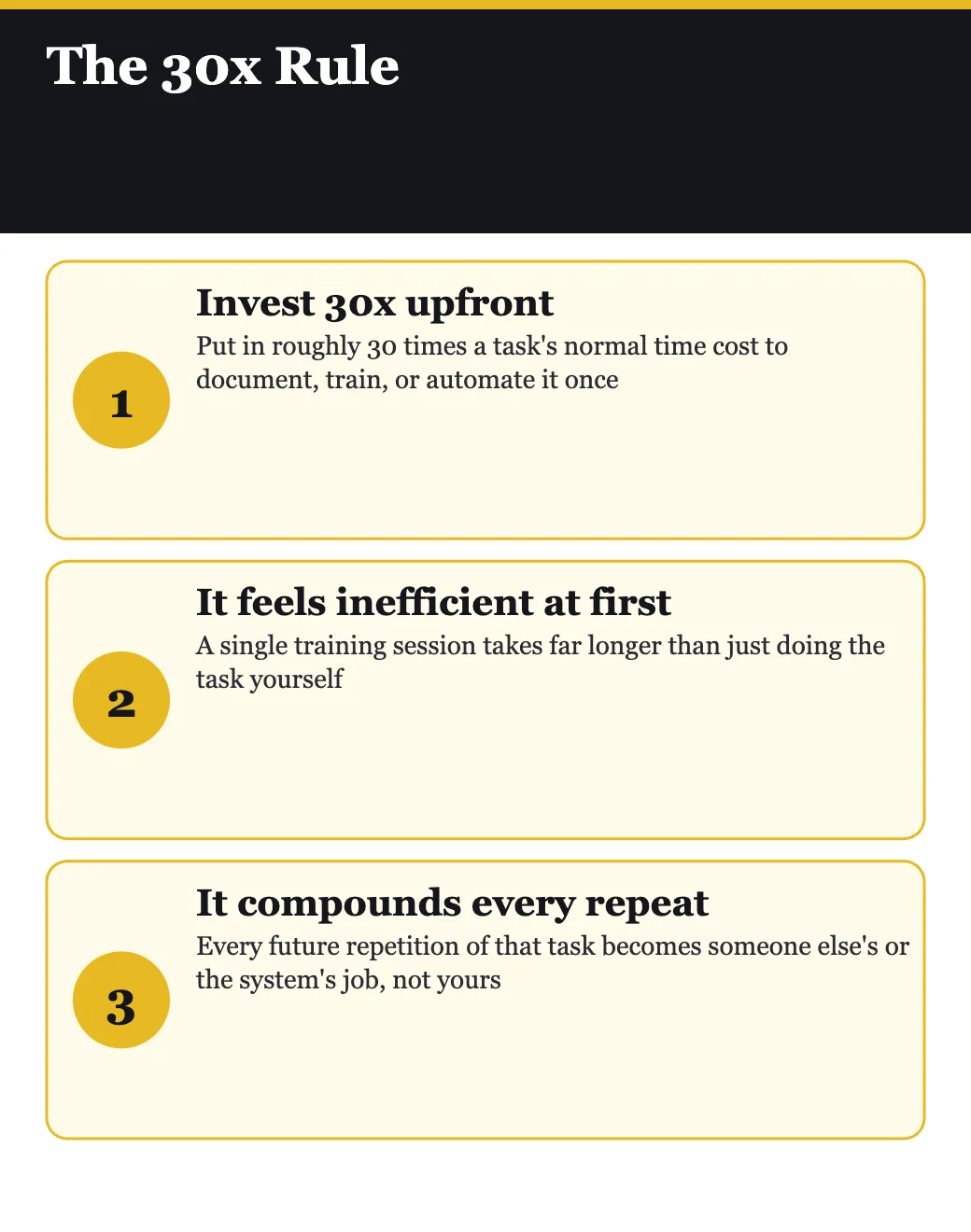
The 30x Rule gives the automate-and-delegate steps of the funnel a concrete number to work from: invest roughly 30 times a task’s normal time cost upfront — documenting it, training someone on it, or building a system to handle it — so that it never has to be done personally again. A five-minute daily task might justify something in the neighborhood of two and a half hours of upfront investment, which sounds wildly inefficient in isolation but pays for itself many times over across weeks and months of repetition that no longer require your direct involvement.
The rule’s real value is psychological as much as mathematical: it gives permission to spend what feels like an uncomfortable amount of time upfront on something that seems trivial in the moment. Without an explicit rule like this, the natural instinct is almost always to just do the five-minute task again today, because thirty minutes or two hours of training feels disproportionate to a task that small. The 30x framing reframes that upfront cost as an investment with a calculable return, rather than an inefficient detour from getting today’s work done.
The math is what makes the 30x Rule stick with readers long after they close the book. Training someone to handle a recurring task might cost thirty times longer than simply doing it yourself once — but that comparison only looks bad if the task is a one-off. Almost nothing worth delegating is a one-off. A task done weekly for a year is done roughly fifty times; a thirty-times investment on day one is repaid many times over by week two. Vaden frames this as a multiplication problem rather than a subtraction problem: doing a task yourself subtracts an hour from today, while investing in someone else’s ability to do it multiplies that hour across every future week the task recurs. The rule isn’t a call to delegate everything regardless of cost — it’s a prompt to actually run the multiplication before defaulting to “it’s faster if I just do it,” which is almost always true in the moment and almost always false across a longer horizon.
Part 4: Priority dilution and the discipline of subtraction
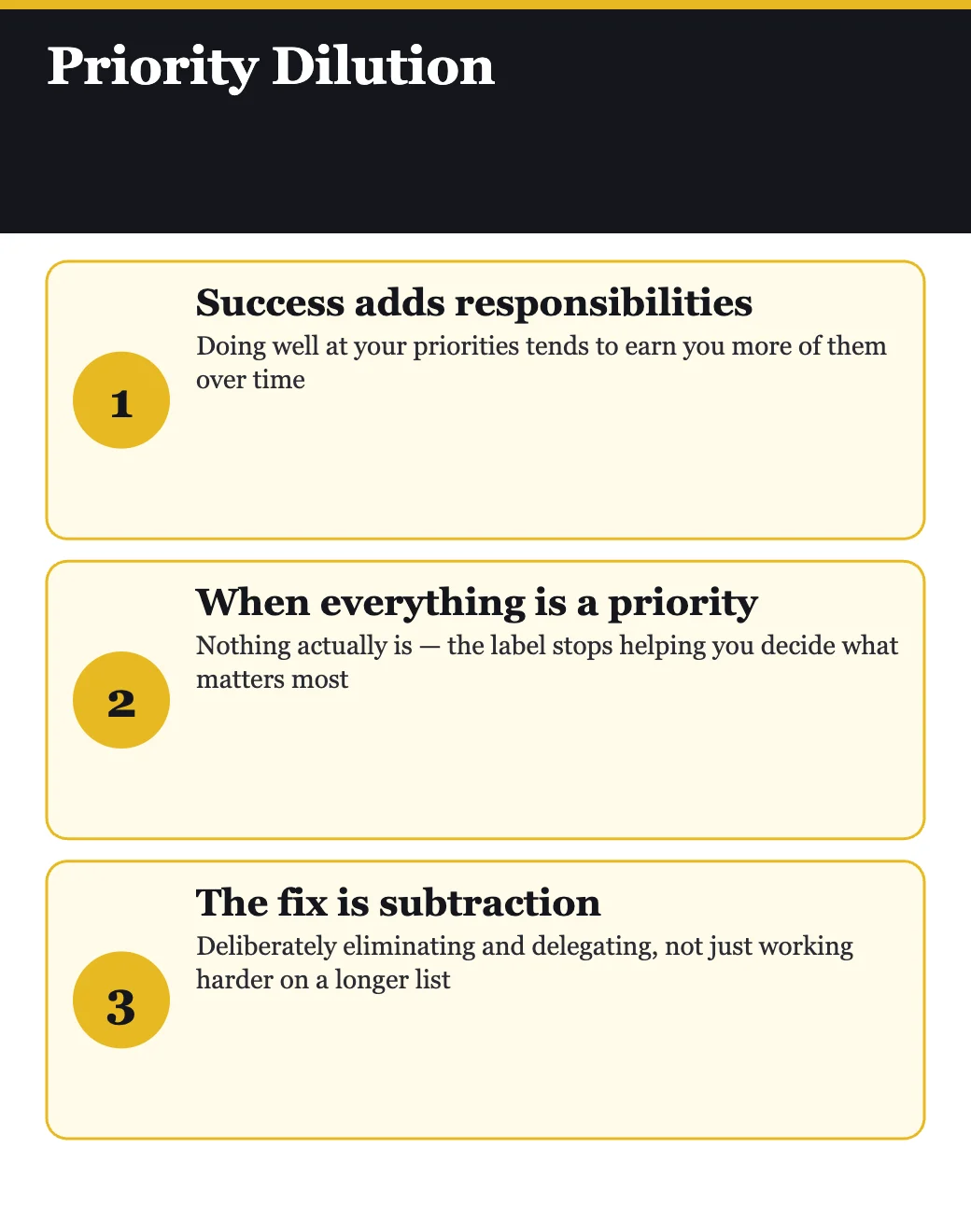
Vaden names a specific pattern common among high achievers: priority dilution, where success itself becomes the source of overload. Doing well at your current responsibilities tends to earn you more of them — a promotion, a new project, additional trust from colleagues who now bring you more requests. Each addition seems reasonable in isolation, but the cumulative effect is a list where everything claims to be a priority, which functionally means nothing is, since the label has stopped helping anyone decide what to actually focus on first.
The book’s proposed fix isn’t working harder or longer to accommodate the growing list — it’s applying the Focus Funnel’s earlier steps more aggressively. Eliminating tasks that don’t need to happen, automating and delegating what can be handled without your direct involvement, and reserving genuine concentration for what’s actually significant, are all forms of deliberate subtraction rather than addition. Priority dilution, in this framing, isn’t solved by better time management on an ever-growing list — it’s solved by making the list smaller in the first place.
Priority dilution is easy to miss because it doesn’t feel like failure in the moment — it feels like being helpful, responsive, and busy. A calendar full of reasonable-seeming commitments can still leave almost no room for the handful of priorities that actually move the needle, simply because each individual “yes” looked small next to everything else already on the list. Vaden’s discipline of subtraction is less about ruthless minimalism and more about running every new commitment through a simple filter before accepting it: does this belong in the top tier of what I’m trying to accomplish, or did it just arrive first and get accepted by default? Subtraction, in his framing, isn’t the opposite of ambition — it’s what makes ambition achievable, because a short list of priorities pursued with focus consistently outperforms a long list pursued with divided attention.
Who is Procrastinate on Purpose best for — and who should read something else first?
This book is best for high performers and managers whose success has generated more responsibilities than a better daily schedule can absorb, and who have the ability to delegate or automate at least some of what’s on their plate. It’s a strong complement to 168 Hours‘s weekly-planning framework, adding a filter for deciding what belongs on the plan in the first place. Readers without delegation authority or budget — solo workers, individual contributors early in their careers — may find the Delegate and Automate steps harder to apply directly, though the Eliminate and significance-over-urgency filtering still transfers.
It’s also worth saying who this book rewards most: people who already have some latitude over their own schedule — team leads, founders, freelancers, and anyone senior enough to say no to a request without immediate consequence. Readers in highly structured, low-autonomy roles will still get value from the underlying mindset shift, but the Delegate and Automate stages of the Focus Funnel will feel more aspirational than immediately actionable until their role changes. That’s not a flaw in the book so much as a reminder that “procrastinate on purpose” is a permission structure, and permission requires a certain amount of authority over your own time to begin with. Readers earlier in their career may get more near-term mileage from pairing this book with something focused specifically on personal habit formation, then returning to Vaden’s framework once they have more say over what lands on their calendar in the first place.
Questions to reflect on
- What’s one task you keep doing yourself that would justify a 30x upfront investment to eliminate permanently?
- Where have you been reacting to urgency instead of judging significance?
- What’s something you’re avoiding out of discomfort, versus something you’d genuinely choose to delay on purpose?
- Has recent success added responsibilities faster than you’ve subtracted anything from your plate?
- What would it look like to accept 80% quality from a delegate instead of insisting on doing it yourself?
🔥 Ready to multiply your time instead of just managing it?
Get Procrastinate on Purpose and run your task list through the Focus Funnel.
How to apply Procrastinate on Purpose (7-day plan)
- Day 1: List your five most time-consuming recurring tasks this week.
- Day 2: Run each through the Focus Funnel: can any be eliminated outright?
- Day 3: For what’s left, ask which could be automated with a tool or simple system.
- Day 4: Identify one task worth a 30x upfront investment — plan a training session or documentation for it.
- Day 5: Deliver that training or documentation, even though it takes longer than just doing the task.
- Day 6: Practice judging one task by significance instead of urgency — deliberately, purposefully delay it if it fails the test.
- Day 7: Review the week — which task took the longest to invest in, and has it already started paying that investment back?
Frequently asked questions
What does “procrastinate on purpose” actually mean?
It means deliberately, strategically delaying a task that has already been evaluated and found to be low in significance or urgency — as opposed to ordinary procrastination, which is passive avoidance of a task out of discomfort with no clear plan to return to it. It’s the final step in the book’s Focus Funnel, applied only after a task has failed to justify elimination, automation, delegation, or concentrated focus.
What is the Focus Funnel?
It’s the book’s five-step decision framework for handling any task: Eliminate (does it need to happen at all?), Automate (can a system do it?), Delegate (can someone else do it, even imperfectly?), Concentrate (is it significant enough for your full attention now?), and finally Procrastinate on Purpose (if none of the above apply, deliberately delay it).
What is the 30x Rule?
It’s a guideline for deciding how much time to invest in automating or delegating a recurring task: roughly 30 times the task’s normal time cost, spent upfront on training, documentation, or system-building. The investment feels disproportionate to a small task in the moment, but pays for itself many times over across future repetitions that no longer require personal involvement.
How is time multiplication different from time management?
Time management optimizes how a fixed 24 hours gets used today, which has a hard ceiling on how much benefit it can produce. Time multiplication invests effort now to reduce or eliminate how much time a task requires in the future, which has no equivalent ceiling since the same investment can pay off across many future repetitions.
What is priority dilution?
It’s a pattern where success itself creates overload: doing well at current responsibilities tends to earn additional ones, until the list has grown so long that everything claims to be a priority — which functionally means the label has stopped helping anyone decide what to focus on. The book’s proposed fix is deliberate elimination and delegation rather than working harder on an ever-growing list.
Does this book require having people to delegate to?
The Delegate and Automate steps of the Focus Funnel are easier to apply with staff, budget, or tools to hand tasks off to, which may limit their direct applicability for solo workers or early-career individual contributors. The Eliminate step and the significance-over-urgency filtering, however, don’t require delegation authority and remain useful regardless of a reader’s circumstances.
Who is Procrastinate on Purpose best for?
It’s best suited to high performers and managers whose success has generated more responsibilities than better scheduling alone can absorb, particularly those with at least some ability to delegate or automate tasks. It pairs well with more general weekly-planning frameworks like 168 Hours, adding a filter for what should be on the plan in the first place.
Related summaries
Explore more time-management guides: 168 Hours · Sidetracked Home Executives · How to Manage Your Home Without Losing Your Mind · see the full Time Management hub for more.
How we analyze books: we read the source material, cross-reference author interviews and published summaries, and build original diagrams and 7-day application plans so every TGR guide adds value beyond the book itself. Read our full methodology.