

★★★★☆ 4.3/5 — A practical, idea-dense toolkit for protecting creative focus from an endlessly reactive day.
Best for: Creative professionals, managers, and anyone whose best work keeps getting crowded out by email and meetings.
Reading time: ~7 hrs to read the full book · 9 min to read this guide
Difficulty to apply: Easy to start, ongoing to sustain — most ideas are single small habit changes.
Manage Your Day-to-Day in one minute
Creativity isn’t a lightning strike — it’s a byproduct of a well-run day. Manage Your Day-to-Day, edited by Jocelyn K. Glei as part of Behance’s 99U book series, gathers essays from roughly twenty creative professionals, psychologists, and entrepreneurs around a single shared claim: the difference between people who produce meaningful creative work consistently and people who only manage it occasionally isn’t talent or inspiration, it’s routine. The book doesn’t argue for one system. Instead it circles the same problem — how reactive, interruption-driven days quietly crowd out deep, original thinking — from a dozen different angles, then hands the reader a toolkit of routines, energy-management principles, and technology habits to take back the hours that matter most.
Key takeaways
- Creativity is a habit, not a mood: waiting to “feel inspired” is a less reliable strategy than simply showing up at the same time each day.
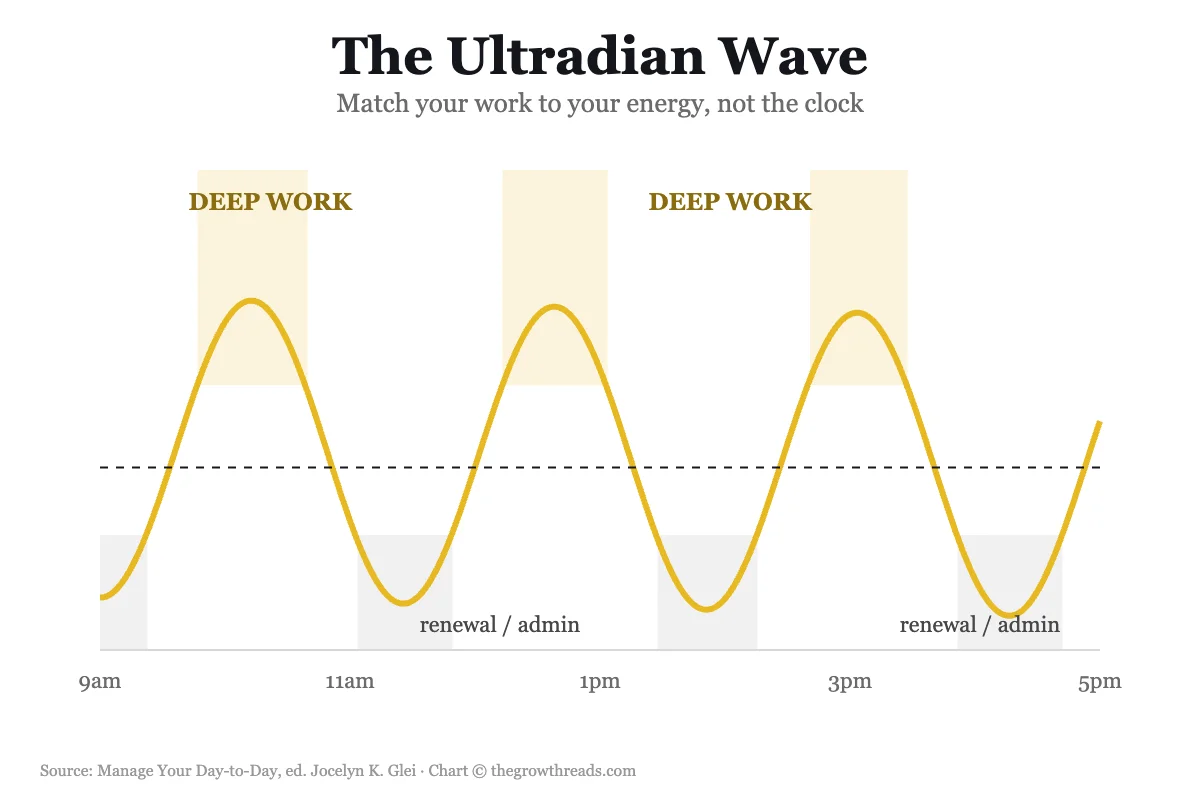
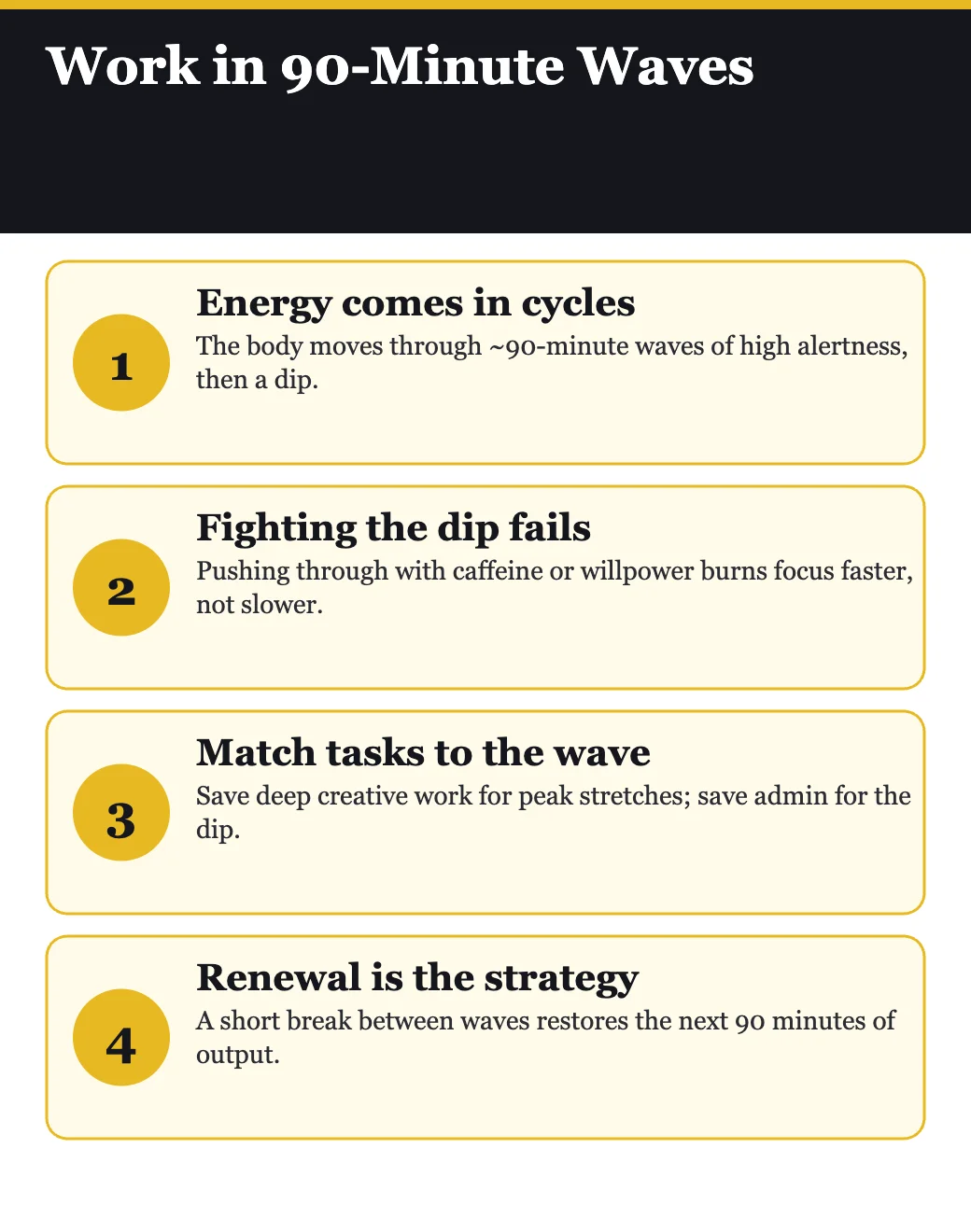
- Energy has a rhythm: the body moves through roughly 90-minute cycles of high and low alertness, and fighting the low points wastes more energy than it saves.
- Protect your peak hours first: schedule the day’s most demanding creative work during your natural high-energy window, not whenever it happens to fit.
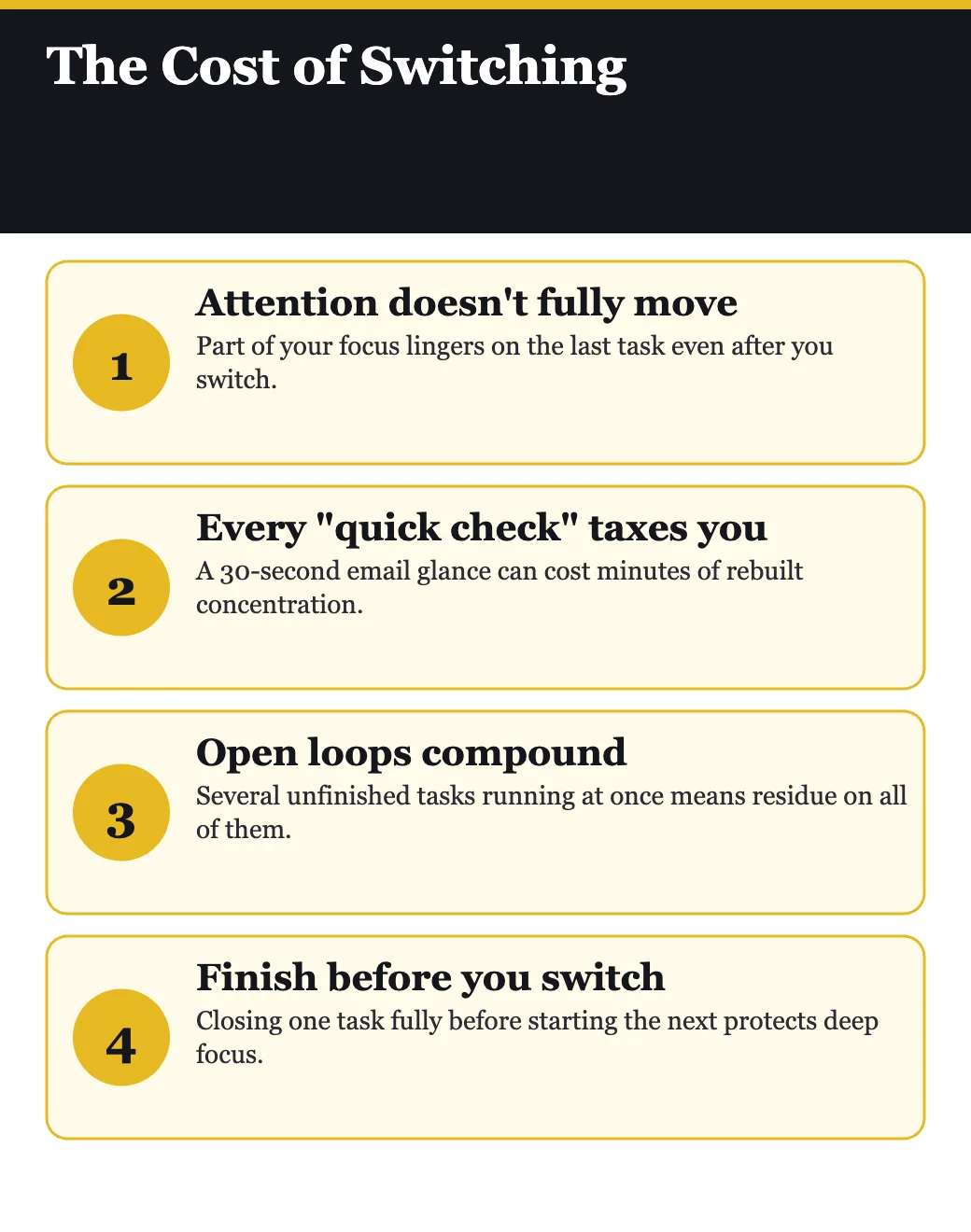
- Attention doesn’t switch cleanly: a portion of your focus lingers on the last task even after you move to a new one — a cost researchers call attentional residue.
- Every “quick check” has a price: glancing at email or messages mid-task can cost several minutes of rebuilt concentration, not just the seconds the glance itself took.
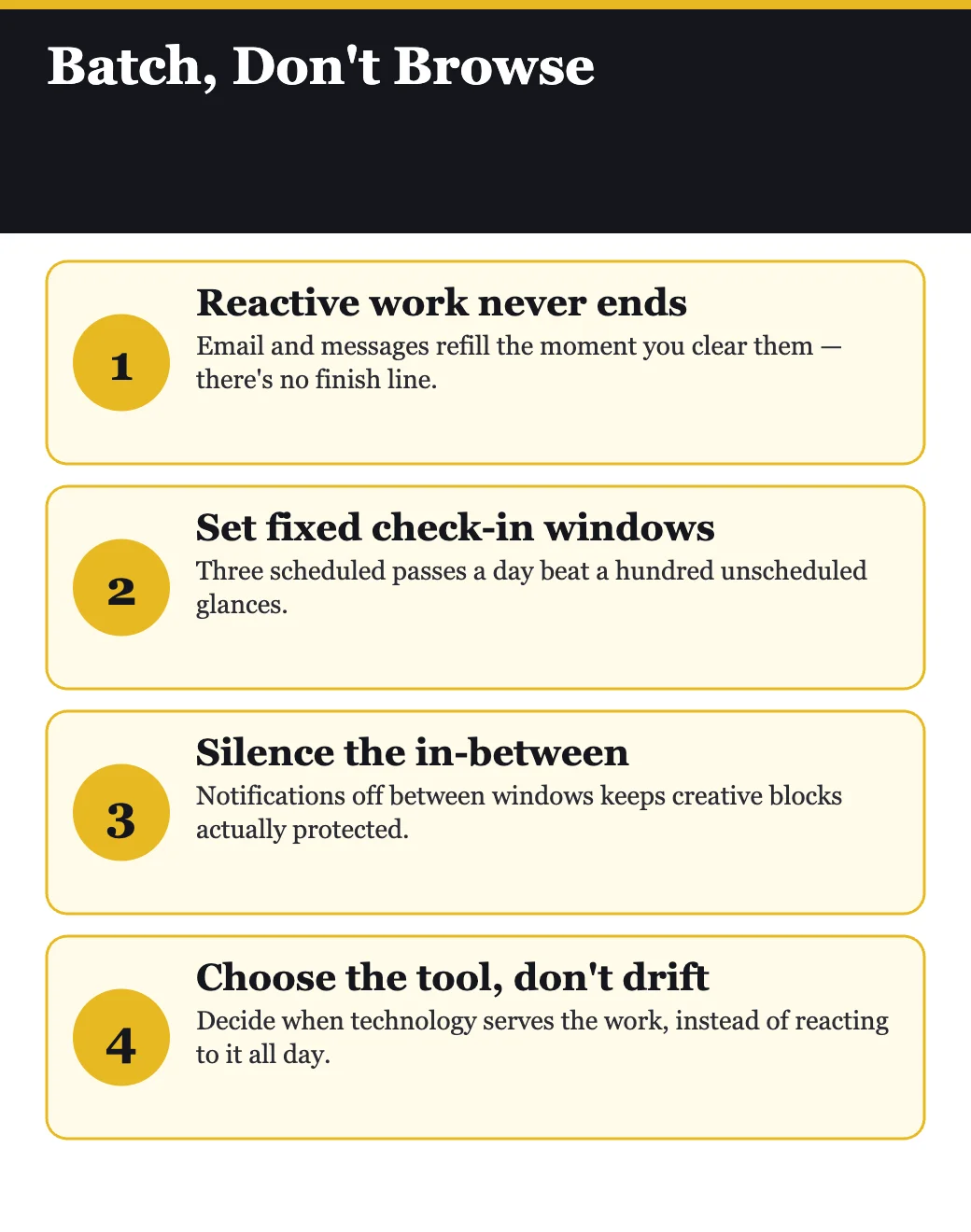
- Reactive work is bottomless: inboxes and notifications will never reach zero on their own, so the goal isn’t to clear them — it’s to contain them.
- Batching beats browsing: checking messages at three fixed times a day protects more focus than checking continuously all day long.
- Renewal is part of the work: deliberate breaks between intense stretches aren’t a lapse in discipline — they’re what makes the next stretch possible.
- Constraints sharpen creative work: a fixed time box or deadline often produces better output than unlimited open time.
- Small routines compound: a five-minute morning ritual, repeated daily, does more for creative output over a year than one heroic all-nighter.
What is Manage Your Day-to-Day about?
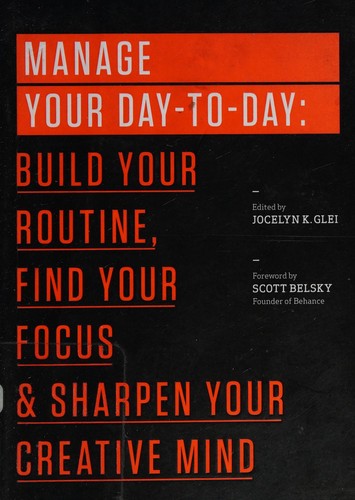
Manage Your Day-to-Day is an edited collection of essays, curated by Jocelyn K. Glei for Behance’s 99U series, that examines how creative professionals can build daily routines, manage energy, and use technology intentionally so that meaningful work survives an otherwise reactive day. Rather than one continuous argument, it offers roughly twenty complementary perspectives on the same core problem: protecting focus.
About the author
Jocelyn K. Glei is a writer and editor who spent years leading Behance’s 99U — a publication and annual conference built around the idea that creativity is a practice, not a personality trait, and that the people who sustain great creative output are usually the ones who’ve built the most deliberate habits around it. Manage Your Day-to-Day was the first book in the 99U series she edited, followed later by Maximize Your Potential and Making Ideas Happen. Rather than writing the book’s advice herself, Glei’s role was curatorial: assembling essays from working creatives, psychologists, and researchers whose day-to-day experience or published research spoke directly to the problem of sustaining focus. The book carries a foreword from Scott Belsky, founder of Behance, and draws on contributions from writers and thinkers including Tony Schwartz, Cal Newport, Gretchen Rubin, Seth Godin, Christian Jarrett, Dan Ariely, Leo Babauta, and Steven Pressfield, among others — giving the collection a range of voices that a single-author book on the same topic couldn’t offer. Explore all Jocelyn K. Glei book summaries →
Key concepts at a glance
| Concept | What it means | Use it when |
|---|---|---|
| Ultradian rhythm | The body’s natural ~90-minute cycle of rising and falling alertness | Planning when to schedule demanding work vs. admin |
| Attentional residue | The lingering cost of focus left behind after switching tasks | Deciding whether to check messages mid-task |
| Conscious computing | Using technology on a schedule you set, rather than reacting to every alert | Regaining control of a day dominated by notifications |
| Renewal | Deliberate rest built between intense stretches of work | Preventing burnout during demanding creative pushes |
| Ritual/routine | A small, repeated sequence that signals “creative work starts now” | Getting past the blank-page moment each day |
| Constraint | A fixed time box or limit that focuses effort | When open-ended time is producing open-ended procrastination |
| Batching | Grouping similar reactive tasks into fixed windows | Handling email, messages, and small requests |
Part 1: Why creativity needs a system, not inspiration
The essays in Manage Your Day-to-Day converge, from different angles, on a claim that runs against the popular image of creativity as a bolt from the blue: reliable creative output comes from structure, not from waiting to feel inspired. Professional writers, designers, and researchers describe the same pattern in their own work — the days they show up at a consistent time, in a consistent way, are the days something usable gets made, regardless of how they felt walking in. Inspiration, in this framing, is a byproduct of starting, not a precondition for it.
This is a deliberately unglamorous claim, and the book leans into that. Several contributors describe stripping the mystique out of their process entirely — reducing “creative work” to a specific time of day, a specific location, and a specific first small action that reliably gets them moving. The value of a routine isn’t that it guarantees a masterpiece every time; it’s that it removes the daily negotiation over whether today is a “good” day to start. A externally-imposed structure, several essays argue, actually protects creative freedom rather than constraining it, because it removes the exhausting decision of when and whether to begin.
What keeps this from reading as one more generic “wake up early and journal” message is the range of contributors. A novelist’s account of a fixed writing hour sits next to a psychologist’s research on willpower depletion, which sits next to a designer’s account of protecting studio time from client calls. The common thread each essay independently arrives at is that a system beats willpower, because willpower is a finite resource that degrades across the day, while a routine, once built, runs largely on autopilot.
This is also why the book resists offering a single template routine for every reader to copy. A novelist’s ideal morning looks nothing like a product designer’s, and a parent fitting creative work around a school run needs a different structure than someone with an uninterrupted eight-hour block. What the essays share isn’t the specific schedule — it’s the underlying commitment to having one at all, and treating it as non-negotiable on the days motivation is low, which is precisely when a routine earns its keep. The collection’s implicit argument is that the specific hour matters far less than the consistency of showing up at it.
Part 2: The Ultradian Rhythm — working with your energy
The clearest single framework in the collection, drawn primarily from Tony Schwartz’s contribution, is the idea of ultradian rhythms: the body cycles through roughly 90-minute stretches of rising and falling alertness throughout the day, not a flat, constant level of energy from 9 to 5. Most calendars ignore this completely, treating every hour as interchangeable. The book’s argument is that this mismatch — a flat schedule imposed on a cyclical body — is a major reason people feel exhausted by 3pm despite not having done anything unusually demanding.
The practical shift is to notice your own pattern rather than fight it. For most people, the first and best window of the day arrives within an hour or two of waking, once they’re alert but before the day’s interruptions have accumulated. A second, usually shorter, window often follows a good lunch and a short break. The book’s advice is to guard the peak windows fiercely for the work that requires real thinking — writing, designing, strategizing — and to deliberately schedule email, routine calls, and low-stakes tasks into the dips, where they’re a much better fit for reduced alertness anyway.
Renewal is presented as the other half of the equation, not an indulgence layered on top of it. A five-to-ten-minute break between ultradian cycles — a short walk, a stretch, even just standing away from the screen — is framed as what makes the next 90-minute stretch productive at all. Several essays note that skipping renewal doesn’t actually buy more output; it just borrows against the next cycle, which arrives already depleted.
Part 3: Attentional residue — protecting focus from switching
Christian Jarrett’s contribution introduces a concept that reframes something most readers already sense but rarely name precisely: attentional residue. When you switch from one task to another, your attention doesn’t move cleanly — a portion of it stays behind, still processing the task you just left. That residue is why a “quick” email check in the middle of writing something difficult doesn’t just cost the fifteen seconds it took to read the message; it costs the several minutes needed to fully re-immerse in what you were doing before.
The book’s treatment of this idea is notable for taking it seriously as a design problem rather than a willpower problem. If residue is real and measurable, then the fix isn’t “try harder to focus” — it’s structural: reduce the number of switches a day actually contains. Several essays recommend finishing a task, or at minimum reaching a clear stopping point, before allowing any interruption in, rather than accepting interruptions the moment they arrive simply because they’re easy to accept.
Dan Ariely’s contribution extends this into the specific trap of email and notifications: the random, unpredictable timing of a reply or a like is what makes checking so compulsive, since intermittent rewards are the most habit-forming kind. The essay’s suggestion isn’t to eliminate checking — that’s unrealistic for almost anyone with a job — but to make it deliberate: decide in advance when checking happens, rather than letting an unpredictable notification decide for you every time.
There’s a subtler point buried in this essay too: the goal isn’t to feel zero pull toward checking, which several contributors admit never fully goes away even for people who’ve practiced this for years. The goal is to build enough structure that the pull doesn’t have to be resisted through willpower in the moment — because by the time a notification appears, the decision about when to look at it was already made earlier that morning, not negotiated fresh every time it buzzes. That shift, from a hundred small daily battles to one decision made once, is what makes the habit sustainable rather than another discipline that quietly erodes by Wednesday.
Part 4: Conscious computing — batching reactive work
The book’s answer to a day dominated by inboxes and notifications is a habit several contributors call conscious computing: using technology on a schedule you set, instead of reacting to whatever arrives whenever it arrives. In practice, this usually means picking two or three fixed windows a day — for instance, mid-morning, after lunch, and late afternoon — and treating everything outside those windows as protected from interruption.
The book is candid that this is a discipline, not a one-time setting change. Notifications are engineered to feel urgent even when almost nothing in them actually is. The essays suggest a few concrete supports: turning off push notifications for anything that isn’t truly time-sensitive, closing email and chat tabs entirely during a focus block rather than trusting yourself not to glance at them, and treating a full inbox as a normal, permanent condition rather than a problem that needs solving today.
Who is Manage Your Day-to-Day best for — and who should read something else first?
This book rewards creative professionals, managers, and anyone whose most valuable work — writing, designing, strategizing, building — keeps losing to email, meetings, and other people’s urgency. Because it’s an anthology, it’s also a good fit for readers who like absorbing an idea from several angles at once rather than following one author’s single argument for 250 pages; short essays make it easy to read a chapter at a time and try one idea before moving to the next. Readers who want a single unified system with one throughline may prefer a single-author book like A High-Performing Mind or a book more narrowly focused on delegation and elimination like Procrastinate on Purpose — both build one continuous framework rather than a set of complementary essays. For readers specifically wrestling with how to fit focused work into an already packed calendar, Off the Clock pairs well with this book’s ultradian-rhythm chapters.
Questions to reflect on
- What time of day do you consistently do your best thinking — and does your calendar currently protect that window, or fill it with meetings?
- How many times today did you check email or messages “just for a second”? What did each check actually cost you afterward?
- Do you have a small, repeatable ritual that signals “creative work starts now,” or does each session start from a blank slate?
- Where in your week could you replace continuous availability with two or three fixed check-in windows instead?
- What would change if you treated renewal — breaks, walks, genuine downtime — as part of the work rather than a break from it?
🔥 Ready to protect your best hours?
Get Manage Your Day-to-Day and start building a routine that survives a busy day.
How to apply Manage Your Day-to-Day (7-day plan)
- Day 1: Track your energy, not just your tasks — jot down a quick 1-5 alertness rating every hour for one full workday.
- Day 2: Look at yesterday’s ratings and identify your natural peak window. Block it on your calendar as “focus — do not book” for the rest of the week.
- Day 3: Build a two-minute starting ritual for creative work — same playlist, same drink, same first small action — and use it before today’s focus block.
- Day 4: Turn off non-essential notifications. Pick three fixed check-in windows for email and messages, and close those apps outside them.
- Day 5: Protect one full ultradian cycle (about 90 minutes) with zero switching — no messages, no tabs, one task only. Take a real break afterward.
- Day 6: Notice one place attentional residue cost you today — a task you returned to after an interruption — and write down what it actually cost in re-focus time.
- Day 7: Review the week. Keep whichever one habit made the clearest difference, and let the rest go for now rather than trying to run all of them at once.
Frequently asked questions
Is Manage Your Day-to-Day written by one author?
No. It’s an edited anthology curated by Jocelyn K. Glei as part of Behance’s 99U book series, gathering roughly twenty essays from creative professionals, psychologists, and entrepreneurs around the shared theme of protecting focus and building sustainable creative routines. It carries a foreword from Behance founder Scott Belsky and includes contributions from writers such as Tony Schwartz, Cal Newport, Gretchen Rubin, Seth Godin, and Dan Ariely. Because it’s a collection rather than a single continuous argument, readers can dip into individual essays without reading the whole book in order.
What is an ultradian rhythm, and why does it matter for productivity?
An ultradian rhythm is a roughly 90-minute cycle of rising and falling alertness that the body moves through repeatedly across a day, distinct from the 24-hour circadian rhythm that governs sleep. The book, drawing on Tony Schwartz’s research, argues that ignoring this cycle — and treating every hour of the workday as equally productive — is a major reason people burn out by mid-afternoon. Scheduling demanding creative work during a natural peak, and lighter administrative work during the dip that follows, works with the body’s rhythm instead of against it.
What is attentional residue?
Attentional residue is the lingering cost of focus left behind when you switch from one task to another before finishing it — part of your attention stays on the abandoned task even as you start the new one. This is why a brief email check in the middle of demanding work costs far more than the few seconds it visibly takes: the real cost is the several minutes needed afterward to rebuild the concentration that was interrupted. The book’s practical response is to reduce the number of switches in a day, rather than trying to switch faster.
What does “conscious computing” mean in this book?
Conscious computing means using email, messaging, and other technology on a schedule you deliberately set, rather than reacting to every notification as it arrives. In practice this usually looks like two or three fixed check-in windows a day, with notifications silenced and inboxes closed outside of them. The book treats this as an ongoing discipline rather than a one-time settings change, since the underlying pull of unpredictable notifications doesn’t go away — it has to be actively managed every day.
Is this book only useful for people in creative jobs?
The essays are written with creative professionals — writers, designers, entrepreneurs — as the primary audience, and many examples come from studio, agency, and freelance settings. That said, the core mechanics — protecting a peak-energy window, minimizing task-switching, batching reactive communication — apply to any job that mixes demanding thinking work with a steady stream of email and meetings, which describes most knowledge work today, not just traditionally “creative” roles.
Does the anthology format make the book harder to follow than a single-author book?
It’s a genuine tradeoff worth naming honestly. Because each essay comes from a different contributor, depth and rigor vary — some pieces lean on personal experience, others on cited research — and there’s no single throughline connecting every chapter into one system. What the format offers in exchange is range: readers get several independent perspectives converging on the same core problem, which can be more convincing, and more adaptable to different work styles, than one author’s single method.
What’s a good first change to make after reading this book?
Most readers get the fastest results from identifying their natural peak-energy window and protecting it on their calendar before anything else — before adopting notification rules, ritual-building, or any of the book’s other ideas. Once that one block is reliably protected, the rest of the book’s suggestions (batching email, building a starting ritual, scheduling renewal) become easier to layer on, because there’s already a working example of the payoff to build from.
Related summaries
Continue exploring focus and time management: Procrastinate on Purpose · Off the Clock · I Know How She Does It · A High-Performing Mind · or browse the full productivity library.
How we analyze books: every summary on The Growth Reads is built from a close reading of the book’s core arguments, cross-checked against the author’s (or, for edited collections, contributors’) other published work and interviews, then structured around practical application rather than just recap. Read our full methodology.