

★★★★☆ 4.1/5 — A results-first productivity system from a man who has run three demanding careers at once, built around the idea that hours worked matter far less than output delivered.
Best for: Ambitious professionals juggling multiple roles, managers who want a fairer way to judge their team’s work, and anyone who reads more than they’d like to admit but retains too little of it.
Reading time: ~6 hrs to read the book itself · ~9 minutes for this summary
Difficulty to apply: Moderate — the goal-cascade and reading techniques take a week or two of deliberate practice before they feel automatic.
Extreme Productivity in one minute
Stop counting hours and start counting results. Robert C. Pozen — who has simultaneously run a mutual fund company, taught at two universities, and advised the U.S. Treasury — argues that the professionals who accomplish the most aren’t the ones who work the longest days. They’re the ones who know exactly what “done well” looks like before they start, who read and write faster because they process information out of strict order, who hand off everything that doesn’t require their specific judgment, and who stop treating meetings, email, and travel as fixed costs of a career. Extreme Productivity is less a time-management book than a results-management book: it asks you to define your priorities so precisely that the hours mostly take care of themselves.
Key takeaways
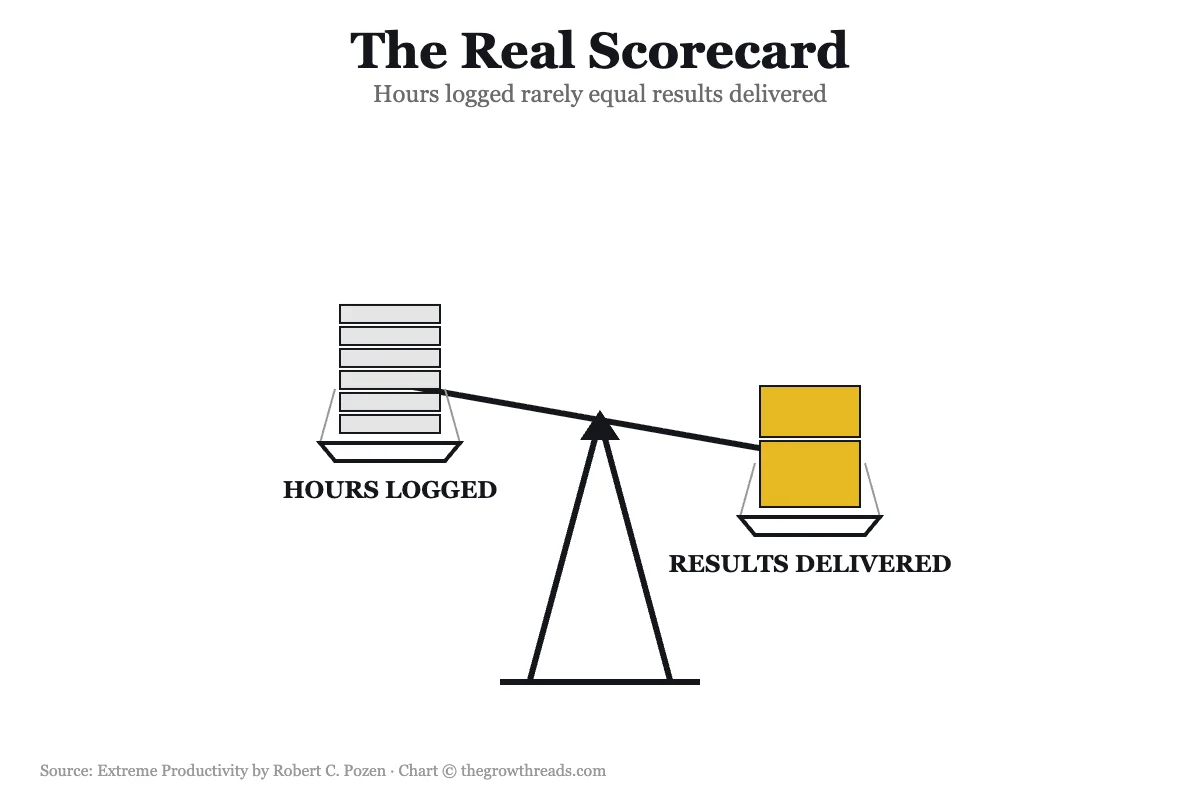
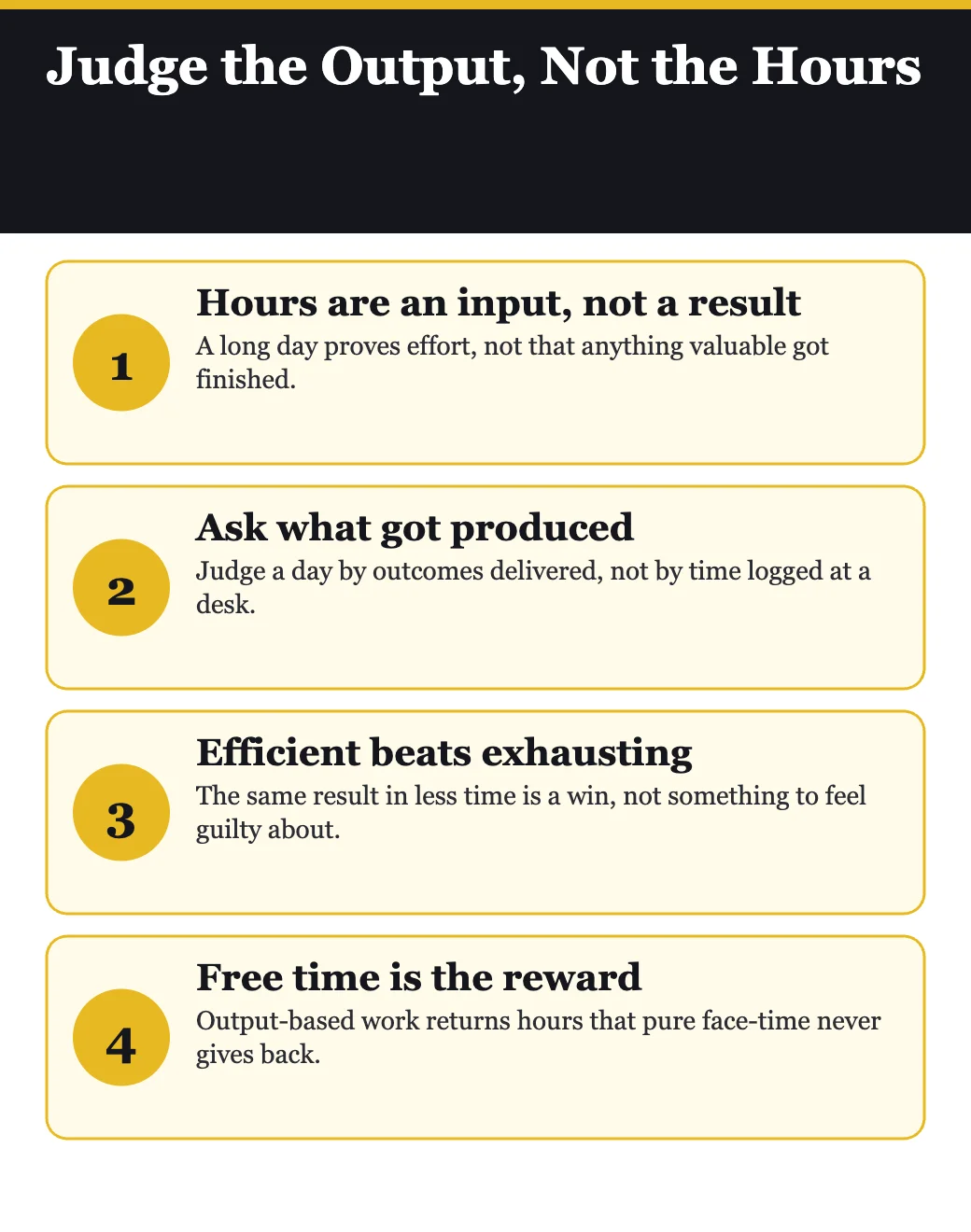
- Judge output, not hours: facetime and long hours are a weak proxy for value; ask what was actually produced.
- Build a goal cascade: set broad career aims, translate them into a handful of annual objectives, then break those into specific, measurable targets.
- Front-load the thinking: a clear plan for a project prevents the single biggest time-waster — reworking something because the goal was never defined.
- Read out of order: skim the introduction and conclusion first, then decide how much of the middle actually deserves full attention.
- Write from an outline, not a blank page: a one-page skeleton before drafting cuts revision time dramatically.
- Delegate the whole task, not just the busywork: hand off both the work and the authority to make related decisions.
- Run meetings like a product: a written agenda, a hard stop, and pre-reading sent in advance turn most meetings from an hour into fifteen minutes.
- Triage your inbox in batches: touch each message as few times as possible and resist checking it continuously through the day.
- Pursue integration, not balance: blend work and personal priorities deliberately instead of pretending they live in separate boxes.
- Protect a few “signature” strengths: spend disproportionate time on the two or three things you do better than almost anyone else, and delegate the rest.
What is Extreme Productivity about?
Extreme Productivity argues that high achievers don’t manage time — they manage output. Robert Pozen distills the habits that let him run a fund company, teach at MIT and Harvard, and publish widely all at once: set precise goals before acting, process information out of order, delegate whole tasks, and run meetings and email in tight, deliberate batches rather than letting them sprawl across the day.
About the author
Robert C. Pozen has spent his career moving between the executive suite, the classroom, and public policy. He served as Vice Chairman of Fidelity Investments, where he oversaw major mutual fund and brokerage operations, and later became Chairman of MFS Investment Management, steering the firm through the 2008 financial crisis. Alongside that, Pozen has held faculty positions at both MIT Sloan School of Management and Harvard Law School, and has advised the U.S. Securities and Exchange Commission and the Treasury Department on retirement and financial-markets policy. His 2011 Harvard Business Review article on how he managed to do so much attracted enough attention that he expanded it into Extreme Productivity. Pozen has also served as a nonresident senior fellow at the Brookings Institution, writing on retirement policy and financial regulation, and has authored several other books on investing and financial markets. That unusual range — finance executive, academic, and policy advisor, often simultaneously — is the credibility the book leans on: these aren’t theories, they’re the operating habits of someone who has had to defend every hour of a genuinely overcommitted calendar. Explore all Robert C. Pozen book summaries →
Key concepts at a glance
| Concept | What it means | Use it when |
| Output over hours | Evaluate work by what it produced, not how long it took | Reviewing your own week or judging a team member’s contribution |
| Aims → Objectives → Targets | A three-level goal cascade from career direction to measurable weekly targets | Setting yearly priorities or planning a big project |
| Out-of-order reading | Reading the introduction and conclusion before deciding how deeply to read the middle | Working through reports, books, or long email threads |
| Outline-first writing | Building a one-page skeleton before drafting a document | Any writing longer than a few paragraphs |
| Whole-task delegation | Handing off both the work and the decision-making authority attached to it | Anything that doesn’t require your unique judgment |
| Agenda-driven meetings | A written agenda, invited-only attendance, and a hard stop time | Any recurring or multi-person meeting |
| Batch processing | Handling email or similar tasks in scheduled blocks instead of continuously | Managing inboxes and routine correspondence |
| Work-life integration | Deliberately blending career and personal priorities instead of separating them | Long-term career and family planning |
Part 1: Results over hours
Pozen opens with a blunt reframe: the number of hours someone logs at a desk tells you almost nothing about what they accomplished. Long hours can mean deep, valuable work — or they can mean a slow reader, a disorganized inbox, and a habit of attending meetings that didn’t need them. He pushes managers to evaluate people (and to evaluate themselves) by output: what got shipped, decided, or resolved, not what time the lights went off. That single shift in what gets measured changes behavior downstream, because people optimize for whatever is actually being judged.
This is also a permission slip. If facetime isn’t the metric, then leaving early on a day when the real priorities are handled isn’t a moral failing — it’s the system working as intended. Pozen is explicit that he does not work unusually long hours; he works unusually deliberately, front-loading the thinking so that execution goes faster later.
The practical corollary is a habit of asking, before starting any task: “What does ‘done’ actually look like, and who is judging it?” Skipping that question is, in Pozen’s telling, the single most common source of wasted hours — not laziness, but starting to execute before the target is clear.
Pozen also argues for a periodic time audit: tracking, for a week or two, exactly where the hours actually go, then comparing that against the aims and objectives you claim matter most. The gap between the two is usually where the fix lives — not in working longer, but in reallocating hours away from low-value defaults (status meetings that could be an email, reading that could be skimmed) and toward the two or three “signature strengths” where your specific judgment genuinely changes the outcome. Everything outside that signature zone becomes a candidate for delegation or elimination.
Part 2: The goal cascade — aims, objectives, targets
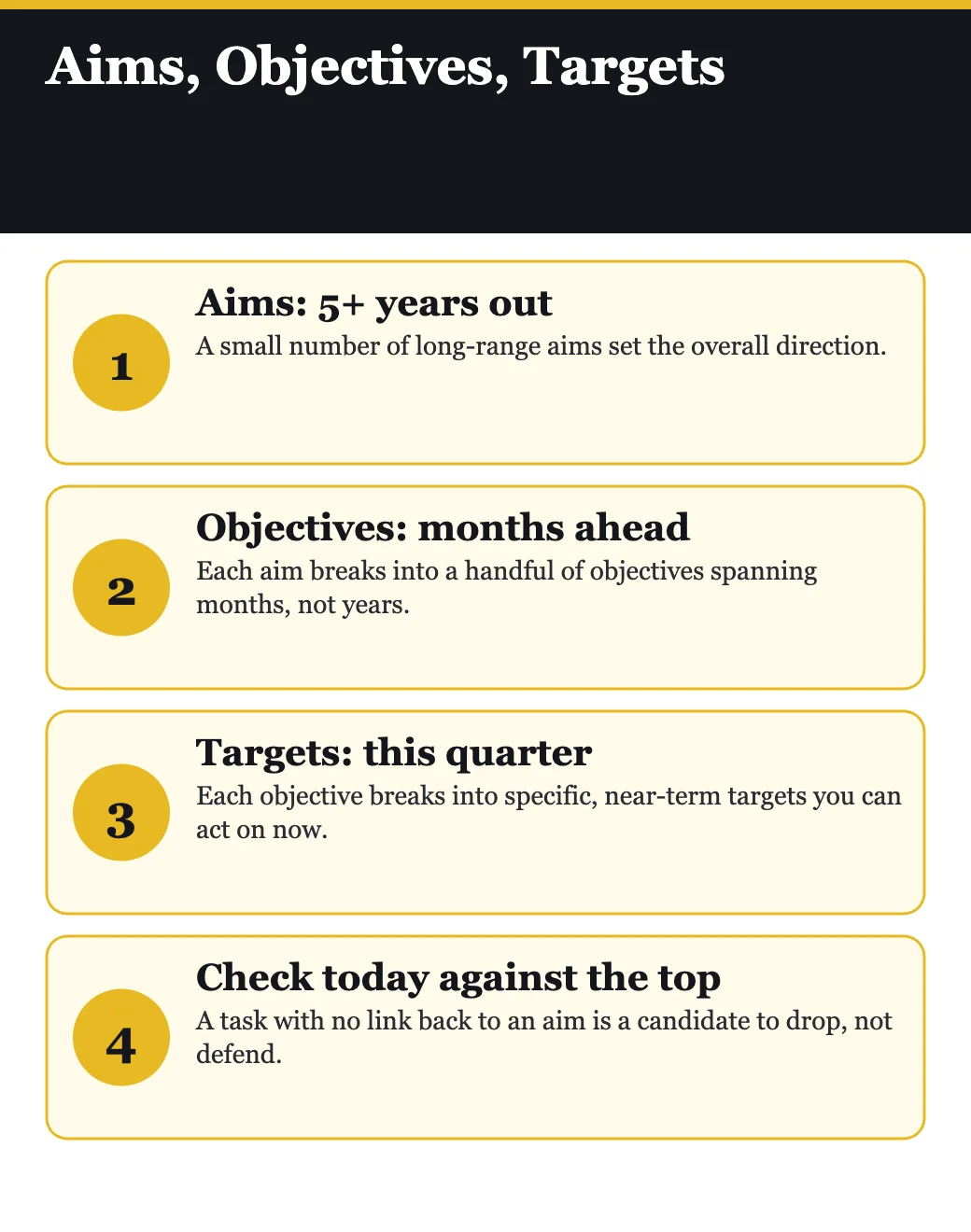
Pozen’s answer to “how do you know what to spend your hours on” is a three-level cascade. At the top sit a handful of broad aims — the two or three things you want your career or your year to stand for. Underneath each aim sit a small number of objectives: concrete, dated priorities for the next twelve months that would meaningfully advance that aim. Underneath each objective sit specific targets — the measurable, near-term actions that make the objective real this week or this month.
The discipline is in the ruthlessness at each level. Pozen argues most people’s real problem isn’t a lack of goals, it’s too many of them, sitting at the same level of importance with nothing to force trade-offs. A cascade with three or four aims and a handful of objectives under each forces the question “does this new request actually serve one of the things I already decided mattered?” — and gives you a legitimate basis for saying no to the ones that don’t.
TGR Note: This cascade rhymes with the “Big Rocks” ordering from Manage Your Day-to-Day and the “targets vs. standards” split in No B.S. Time Management for Entrepreneurs — three independent authors converging on the same idea: decide the few things that matter at a high level before you let a single task onto today’s list.
Part 3: Reading and writing faster without losing the substance
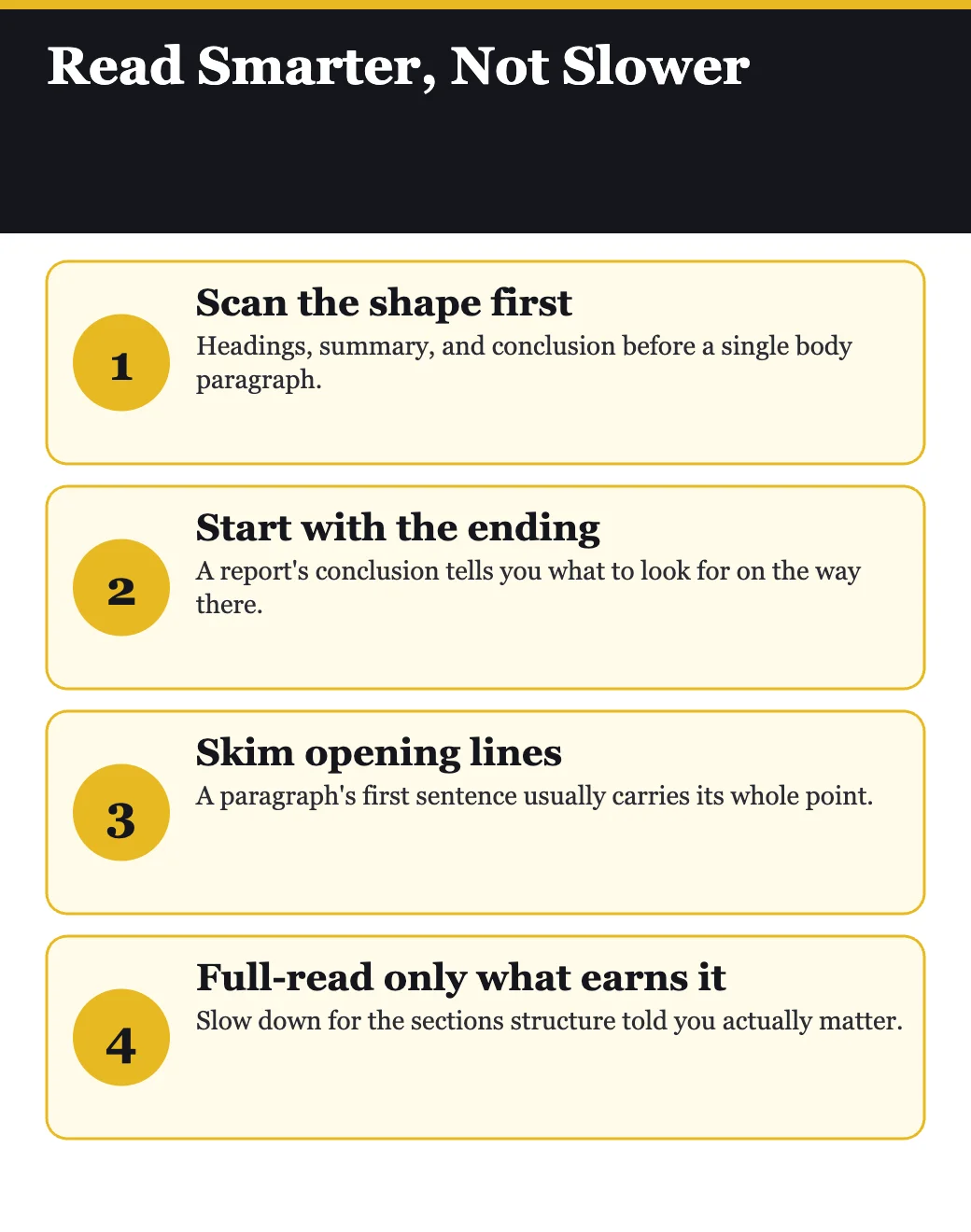
A large share of a knowledge worker’s week is spent processing other people’s words — reports, memos, articles, books — and Pozen treats that as a skill to be engineered, not endured. His reading method is to go out of order: read the introduction and conclusion of a chapter or report first, since that’s usually where the author states the point and the takeaway. Only then decide how much of the middle actually earns a careful read. Headings, topic sentences, and any bolded or bulleted material get priority; long narrative stretches that mostly restate the thesis with examples can often be skimmed or skipped once the point has landed.
The same logic runs in reverse for writing. Pozen starts every substantial document — memo, report, article — from a one-page outline: the main argument, the supporting points, and the order they’ll appear in. Drafting from an outline is faster than drafting from a blank page, and it front-loads the hardest thinking (what’s the actual argument) before the easier work of filling in sentences. It also makes revision cheaper, because structural problems get caught in outline form, before hours have gone into prose that has to be rewritten.
Pozen extends the same out-of-order logic to time most people treat as dead time. Commutes, flights, and waiting rooms become reading or listening windows for lower-priority material, freeing the fresher, higher-focus hours of the workday for the reading and writing that genuinely require concentration. The point isn’t to fill every idle minute — it’s to match the difficulty of the material to the quality of attention available at that moment, rather than defaulting to whatever’s next in the queue regardless of how alert you are.
TGR Note: Pozen’s out-of-order reading pairs naturally with the “two kinds of time” distinction in The Time Trap — treat deep reading as protected, undistracted time, and reserve skimming for the low-value 80% that doesn’t need it.
Part 4: Delegation, meetings, and integrating work with life
Pozen’s delegation rule is stricter than the usual advice to “hand off busywork.” He argues you should delegate the whole task, including the authority to make the decisions that come with it — half-delegating a task while still making every call yourself just relocates the busywork without freeing up any judgment. That requires trusting a capable person with real latitude, and accepting that their approach to a task may not be identical to yours, as long as the result meets the bar.
Meetings get the same output-first treatment as everything else: a written agenda circulated in advance, only the people who genuinely need to be there, and a firm end time. Pozen also pushes attendees to do any necessary reading before the meeting rather than during it, so the room can spend its time deciding rather than getting everyone up to speed. Email gets handled in scheduled batches — a few defined windows a day — rather than as a constant background interruption, which protects the longer, uninterrupted blocks that deep work and careful reading actually require.
Finally, Pozen rejects the idea of a clean line between work and personal life. He argues for integration: letting work flex around a child’s school event and letting personal errands flex around a work deadline, rather than pretending the two never touch. The output-focused mindset makes this easier, because if what matters is the result rather than the hours in the chair, there’s less friction in moving those hours around to fit real life.
On email specifically, Pozen recommends sorting messages into three rough buckets the moment you open them: act now (under two minutes), schedule for a batch window, or delegate to someone else entirely — and resisting the urge to leave anything sitting half-read in the inbox as a vague, unresolved obligation. Combined with fixed batch windows rather than continuous checking, this keeps email from quietly eating the uninterrupted blocks that harder work depends on, without requiring inbox-zero perfectionism.
TGR Note: If whole-task delegation feels uncomfortable at first, 15 Secrets Successful People Know About Time Management has a gentler on-ramp for handing off recurring work in small, low-risk steps.
Who is Extreme Productivity best for — and who should read something else first?
This book is best for people already carrying real responsibility — managers, founders, and senior individual contributors juggling several roles at once — who need a way to decide what to spend their limited hours on, not just how to squeeze more hours out of a day. If you’re mainly struggling with basic daily structure or procrastination rather than prioritization among many legitimate demands, Procrastinate on Purpose is a gentler starting point. If your main pain point is specifically your calendar and meeting load, Manage Your Day-to-Day goes deeper on daily rhythms and creative energy. And if you’re an entrepreneur weighing your own hourly value against what to hand off, No B.S. Time Management for Entrepreneurs offers a more numbers-driven version of the same delegation logic. If you’re earlier in your career and don’t yet have much to delegate, some of the book’s advice — especially the delegation chapter — will land better once you’ve grown into a role with more latitude; in the meantime, the goal-cascade and reading techniques are useful at any career stage.
Questions to reflect on
- If someone judged your last month purely by what you produced — not by hours worked — how would that verdict differ from how you’d judge yourself today?
- What are the two or three “aims” that should actually be shaping your decisions this year, and how many of this week’s tasks genuinely serve one of them?
- Where in your week are you reading start-to-finish out of habit, when skimming for the point would serve you just as well?
- What’s one task you’re still doing yourself that you could delegate in full — work and decision-making authority both — to someone capable?
- Which recurring meeting on your calendar would lose nothing if it had a written agenda and a hard 15-minute limit?
🔥 Ready to judge your week by results instead of hours?
Get Extreme Productivity and build your own goal cascade this week.
How to apply Extreme Productivity (7-day plan)
- Day 1: Write down your 2-3 career “aims” for this year in one sentence each — no tasks yet, just direction.
- Day 2: Under each aim, write 1-2 concrete “objectives” for the next 12 months, and one measurable “target” for this month under each.
- Day 3: Pick one report, article, or book on your list and practice out-of-order reading: intro and conclusion first, then decide what the middle deserves.
- Day 4: Before writing anything longer than an email today, build a one-page outline first — main point, supporting points, order.
- Day 5: Identify one task you’re doing yourself that someone else could own entirely. Delegate the whole thing, decisions included.
- Day 6: Add a written agenda and a hard end time to your next recurring meeting; send any pre-reading 24 hours ahead.
- Day 7: Set two fixed email windows for tomorrow and close your inbox the rest of the day. Review how the week’s targets actually went.
Frequently asked questions
What is the main idea of Extreme Productivity?
The main idea is that output, not hours worked, is the right measure of productivity. Robert Pozen argues that professionals who accomplish the most do so by defining clear goals before acting, processing information efficiently (reading and writing out of strict order), delegating whole tasks rather than fragments, and running meetings and email in tight, deliberate batches. The hours spent matter far less than what those hours actually produced.
What is the Aims, Objectives, Targets framework?
It’s Pozen’s three-level goal cascade. Aims are a handful of broad career or yearly priorities. Objectives are concrete, dated goals for the next 12 months that advance an aim. Targets are the specific, measurable actions that make an objective real this week or month. The cascade forces trade-offs: a new request only earns your time if it clearly serves an aim you already decided mattered.
How does Pozen suggest reading faster without missing important information?
He recommends reading out of order: start with the introduction and conclusion of a chapter, report, or article, since that’s usually where the core point and takeaway live. Only after that do you decide how carefully to read the middle — headings, topic sentences, and bolded material get priority, while long narrative stretches that mainly restate the thesis can often be skimmed.
What does Pozen mean by delegating the whole task?
He distinguishes between handing off busywork while still making every decision yourself, and true delegation — giving someone both the work and the authority to make the decisions attached to it. Partial delegation still consumes your judgment and time; whole-task delegation actually frees it, provided you trust the person enough to accept an approach that may differ from your own as long as the result meets the bar.
Is Extreme Productivity mainly for executives, or does it apply to anyone?
Pozen writes from an executive vantage point, but the core mechanics — setting a goal cascade, reading and writing more deliberately, delegating fully, and running meetings and email in batches — apply to almost any knowledge-work role. The book is most useful once you have some real latitude over your own schedule and at least a little work you can hand to someone else; very entry-level roles may find the delegation chapter less immediately applicable.
What does “work-life integration” mean in this book, and how is it different from balance?
Balance implies keeping work and personal life in separate, evenly weighted boxes. Integration, as Pozen uses it, means letting the two flex around each other deliberately — work bending for a family commitment, personal time bending around a real deadline — rather than pretending a hard line exists. He argues the output-focused mindset makes this easier, since what matters is the result, not which hours of the day produced it.
How is Extreme Productivity different from other time-management books?
Most time-management books focus on scheduling and habits within a fixed set of hours. Pozen’s angle is different: he starts with what “done well” should look like before worrying about the schedule, treating time management as downstream of clear goal-setting. The book also draws heavily on his own experience running multiple demanding careers simultaneously, giving the advice a tested, executive-level texture rather than general productivity theory.
Related summaries
- Manage Your Day-to-Day
- No B.S. Time Management for Entrepreneurs
- The Time Trap
- Procrastinate on Purpose
- Best Productivity Books
How we analyze books: we read the source material, cross-check named frameworks and factual claims against independent sources, and build original diagrams, application plans, and reflection questions rather than reproducing the text. Read our full methodology.