

★★★★☆ 4.5/5 — Basecamp’s founders make the case that workplace chaos, long hours, and burnout are choices, not costs of doing business — and show exactly what they replaced them with.
Best for: Founders, managers, and team leads who set (or influence) how their company works — and anyone who wants language for why the status quo doesn’t have to be normal.
Reading time: ~3 hrs to read the book itself · ~8 minutes for this summary
Difficulty to apply: Easy for individuals to borrow pieces of; harder to apply in full without authority over company policy.
It Doesn’t Have to Be Crazy at Work in one minute
Workplace stress is usually self-inflicted, not inevitable. Jason Fried and David Heinemeier Hansson, the founders of Basecamp, wrote this book as a field report from a company that deliberately chose the opposite of Silicon Valley hustle culture: 40-hour weeks, real vacations, minimal meetings, and a policy of protecting people’s attention as fiercely as their revenue. Their argument isn’t that hard work is bad — it’s that most of the chaos companies treat as unavoidable (constant interruptions, always-on availability, growth at any cost) is a series of choices leadership made, and can unmake.
Key takeaways
- Calm is a deliberate design choice: reasonable hours, enough staff, and realistic expectations don’t happen by accident — they’re built and defended.
- Long hours are a planning failure: if the only way to hit a deadline is overtime, the deadline or the scope was wrong, not the team’s effort.
- Treat interruptions as the real productivity killer, not workload — most “busy” days are actually just fragmented ones.
- Office hours beat open-door policies: scheduled windows for questions protect everyone else’s uninterrupted time.
- Default to async, escalate to sync: written updates first; meetings and real-time chat only when writing genuinely won’t do.
- Make meetings expensive to create: deliberate calendar friction forces organizers to ask if a meeting is really necessary.
- Fixed time, flexible scope: keep the deadline and cut the feature list, instead of keeping the feature list and blowing the deadline.
- Time off is policy, not a perk: sabbaticals and real vacations are scheduled in advance, not earned through burnout.
- Profit beats growth-chasing: a profitable, self-funded company answers to its own judgment, not outside pressure to scale at any cost.
- Treat your company like a product: look for friction and “bugs” in how the organization runs, and fix them the way you’d fix software.
What is It Doesn’t Have to Be Crazy at Work about?
It’s a field report from Basecamp on how to run a company without the chaos, long hours, and burnout that most workplaces treat as normal. Fried and Heinemeier Hansson lay out the specific policies — reasonable hours, protected focus time, minimal meetings, real vacations — that let their team do serious work without sacrificing their lives to it.
About the authors
Jason Fried and David Heinemeier Hansson co-founded Basecamp (originally 37signals) in 1999, building it into a profitable, self-funded project-management and communication tool used by millions, without ever raising venture capital or chasing rapid headcount growth. Heinemeier Hansson is also the creator of the Ruby on Rails web framework, widely used across the tech industry, and has been an outspoken critic of startup culture’s obsession with growth over sustainability. Fried has spent his career writing and speaking about a deliberately contrarian approach to business — profitable, small by choice, and skeptical of hustle as a virtue. This is their second book together after Rework, and it applies the same contrarian, plainly-written style specifically to the question of company culture and how people spend their working hours.
Both authors continue to run Basecamp today, which gives the book an unusual credibility relative to most workplace-culture writing: the policies described aren’t proposals or theory, they’re the operating rules of a company that has used them for years, through growth, product launches, and the ordinary pressure to cut corners when things get busy.
Key concepts at a glance
| Concept | What it means | Use it when |
| The calm company | A business built around reasonable hours, adequate staffing, and realistic expectations | Setting or reviewing your team’s operating norms |
| Company as product | Treating your own organization like software — looking for friction and fixing it | Diagnosing recurring frustrations at work |
| Library rules | Default-quiet office norms; loud conversations move to a private room | Protecting open-plan or shared workspaces |
| Office hours | Scheduled windows when specialists are available for questions | Replacing an always-interruptible open-door policy |
| Async-first communication | Written updates as the default; real-time chat and meetings as the exception | Reducing context-switching across a team |
| Fixed time, flexible scope | Keeping deadlines fixed while letting the feature list flex | Planning projects without resorting to overtime |
| Time off as policy | Sabbaticals and vacations scheduled in advance, not earned through burnout | Designing benefits that actually get used |
Part 1: Calm doesn’t happen by accident
The book opens by rejecting the idea that stress, long hours, and burnout are simply the price of doing serious work. Fried and Heinemeier Hansson argue the opposite: chaos is usually a symptom of specific, identifiable choices — understaffing a team, setting deadlines before scoping the work, treating constant availability as commitment. None of those choices are required to build something good. They’re just common, because most leaders never stop to ask whether the chaos is actually necessary or just familiar.
Basecamp’s answer is to treat “calm” as a design target with the same seriousness as revenue or product quality. That means auditing the company periodically for the habits and policies that quietly generate stress — an overloaded on-call rotation, a meeting that’s outlived its purpose, an unwritten expectation that emails get answered at night — and removing them deliberately, the same way you’d fix a bug in software.
The authors are explicit that this audit never really finishes. New hires bring new habits, growth reintroduces old pressures, and a policy that worked at twenty people can quietly stop working at eighty. Treating calm as a permanent, one-time fix is, in their telling, the same mistake as treating a software product as “done” after its first release — the work is ongoing maintenance, not a single project with an end date.
TGR Note: This “company as product” framing pairs well with the goal-setting discipline in Extreme Productivity — both books treat the way you work as something to be deliberately engineered rather than left to default habits.
Part 2: Long hours are a planning failure
A central, repeated argument: if hitting a deadline requires overtime, something was wrong with the plan, not the team’s effort. The authors are skeptical of the folk wisdom that treats late nights as proof of dedication — in their view, it’s usually proof that the scope was never realistic in the first place, or that staffing didn’t match the actual workload.
Their fix is “fixed time, flexible scope”: pick a deadline and commit to shipping something by then, but let the feature list shrink if needed to actually hit it. This runs counter to how most teams instinctively plan, which is to lock in a feature list first and treat the deadline as the thing that flexes when reality intrudes — usually via unpaid overtime rather than an honest renegotiation. That reframes scope-cutting as a normal, expected part of planning rather than a failure — and removes the pressure that turns a tight schedule into a crunch.
This is a deliberate departure from the more common approach of fixing scope and letting the timeline slip — or worse, fixing both and quietly expecting overtime to close the gap. By making scope the variable instead, the team gets to make an honest trade-off in the open: ship a smaller, finished thing on time, rather than a bloated thing late or a rushed thing on time. The authors argue that customers and stakeholders generally respond better to “here’s what’s ready” than to a blown deadline followed by an apology.
Part 3: Protect attention like it’s the scarce resource it is
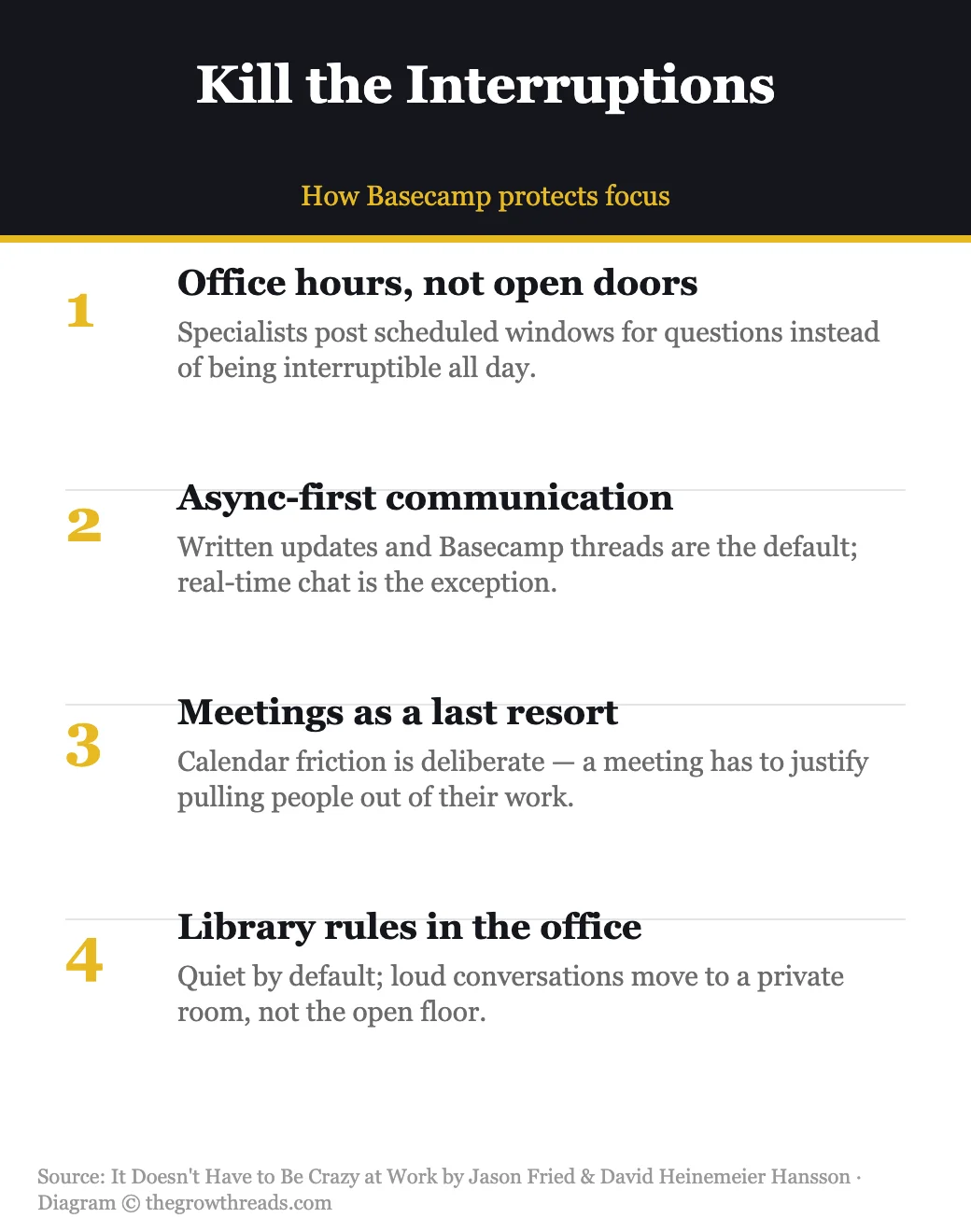
The book treats interruptions, not workload, as the real enemy of getting things done. A day fragmented into fifteen-minute pieces by pings, drop-ins, and “quick questions” produces far less than a day with a few genuinely uninterrupted hours — even if the total hours worked are identical. Basecamp’s response is a set of specific norms: “library rules” for quiet in the office, scheduled “office hours” instead of an always-open door, and a strong default toward asynchronous, written communication over real-time chat or meetings.
Meetings in particular get treated as expensive by design. The authors describe deliberately adding friction to booking one — requiring a stated purpose, limiting attendees to people who genuinely need to be there — so that the default is not to have a meeting rather than the default being to schedule one. They also push back on the reflex to invite people “just in case” — a habit that inflates attendee lists and turns what could be a fifteen-minute decision between two people into an hour-long discussion among eight. Smaller meetings, they argue, aren’t just faster; they tend to produce clearer decisions, because there’s less social pressure to perform agreement or wait for a more senior voice to weigh in first.
The same scrutiny applies to notifications and chat tools generally. The book pushes readers to distinguish between genuinely urgent communication — rare — and everything else, which can wait for a scheduled check-in without harming the work. The authors note that most teams have never actually tested this distinction — they assume everything is urgent because everything has always been treated that way, not because anyone checked what happens if a message waits three hours instead of three minutes. Turning off badges, closing chat outside of dedicated windows, and resisting the reflex to answer instantly are treated less as willpower exercises and more as environment design: remove the constant ping, and the temptation to check it goes with it.
TGR Note: The office-hours idea mirrors the batch-processing habit from Manage Your Day-to-Day — both are ways of converting an unpredictable stream of interruptions into a scheduled, contained block.
Part 4: Build the calm company — hours, hiring, and time off
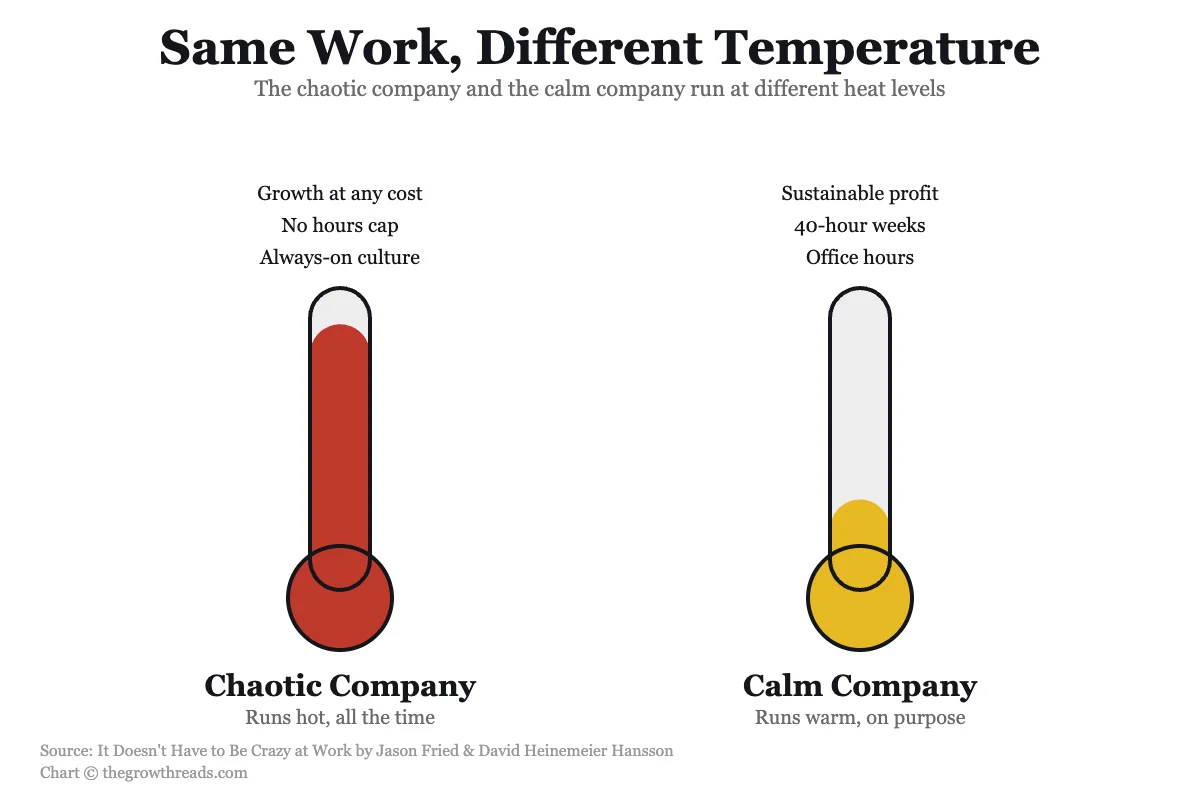
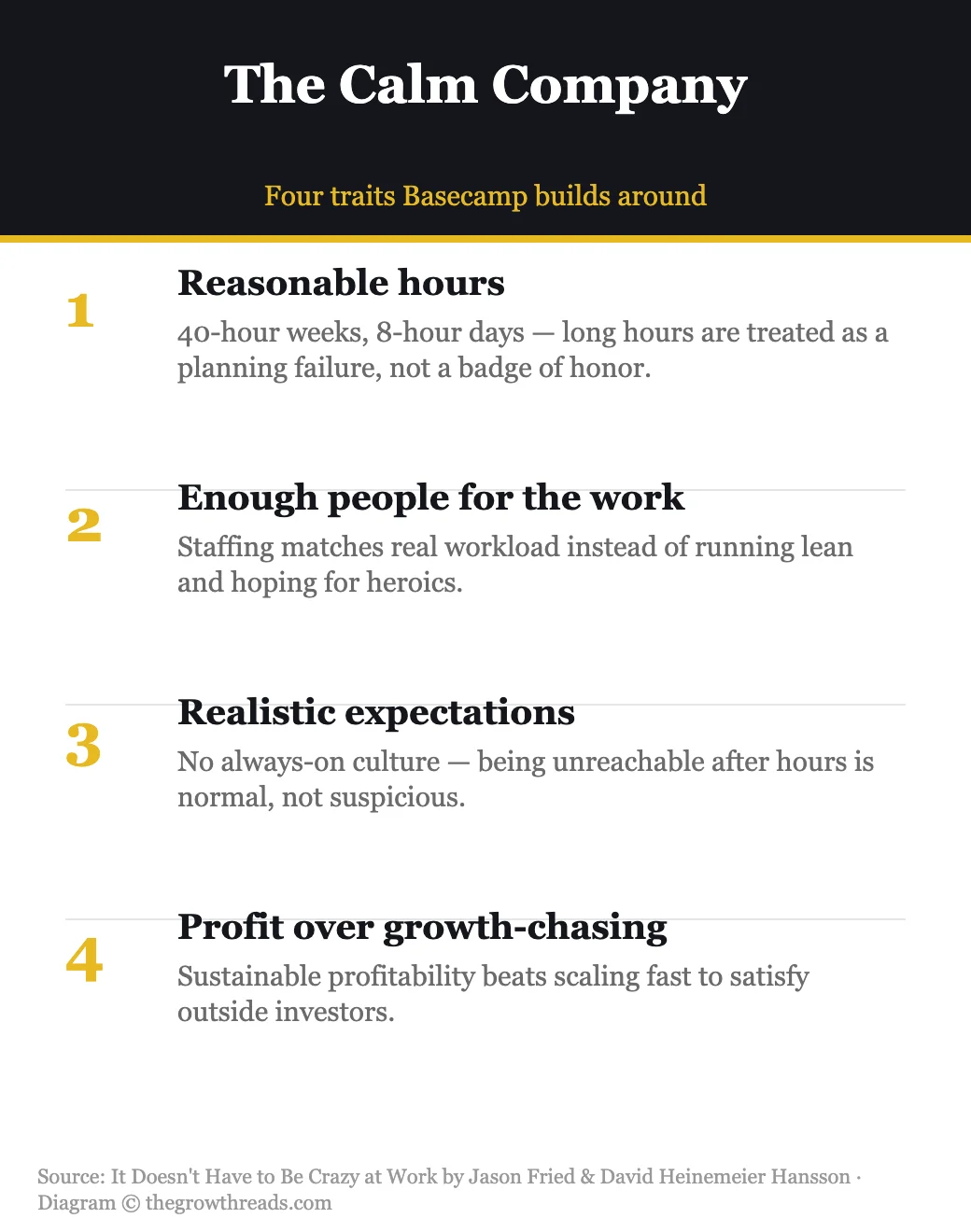
The four traits the authors return to again and again for what makes a company calm rather than chaotic: reasonable hours (an actual 40-hour week, not a nominal one), enough people to do the work without relying on heroics, realistic expectations about what’s achievable, and profit prioritized over growth for its own sake. Because Basecamp is self-funded and profitable, the authors argue they can make decisions based on what’s sustainable for the team rather than what satisfies outside investors chasing rapid scale — a condition they’re candid about being a real enabling factor, not something every company can replicate overnight.
That candor is worth sitting with. The authors don’t pretend every company is one policy change away from calm — a venture-backed startup under pressure to hit aggressive growth targets has real constraints Basecamp doesn’t. But they argue the constraint is usually narrower than leadership assumes, and that even companies without full control over their growth trajectory can still choose how they treat hours, meetings, and interruptions day to day. A team can start small — protecting one afternoon a week, trying async updates on one project — without waiting for permission to overhaul the entire company at once.
Time off gets the same deliberate treatment as everything else: three-day weekends through the summer, a full paid sabbatical every three years, and vacations that mean actually being unreachable, not quietly expected to check in. These aren’t framed as perks to attract talent — they’re framed as policy, scheduled in advance, precisely because waiting for burnout to “earn” rest defeats the purpose.
There’s also a signaling effect the authors highlight: when leadership takes its own sabbaticals and fully disconnects on vacation, it gives everyone else permission to do the same. A time-off policy that looks generous on paper but is quietly undermined by a founder who emails at midnight teaches the opposite lesson to the one intended. Basecamp’s approach only works, they argue, because the people setting the policy also visibly live by it.
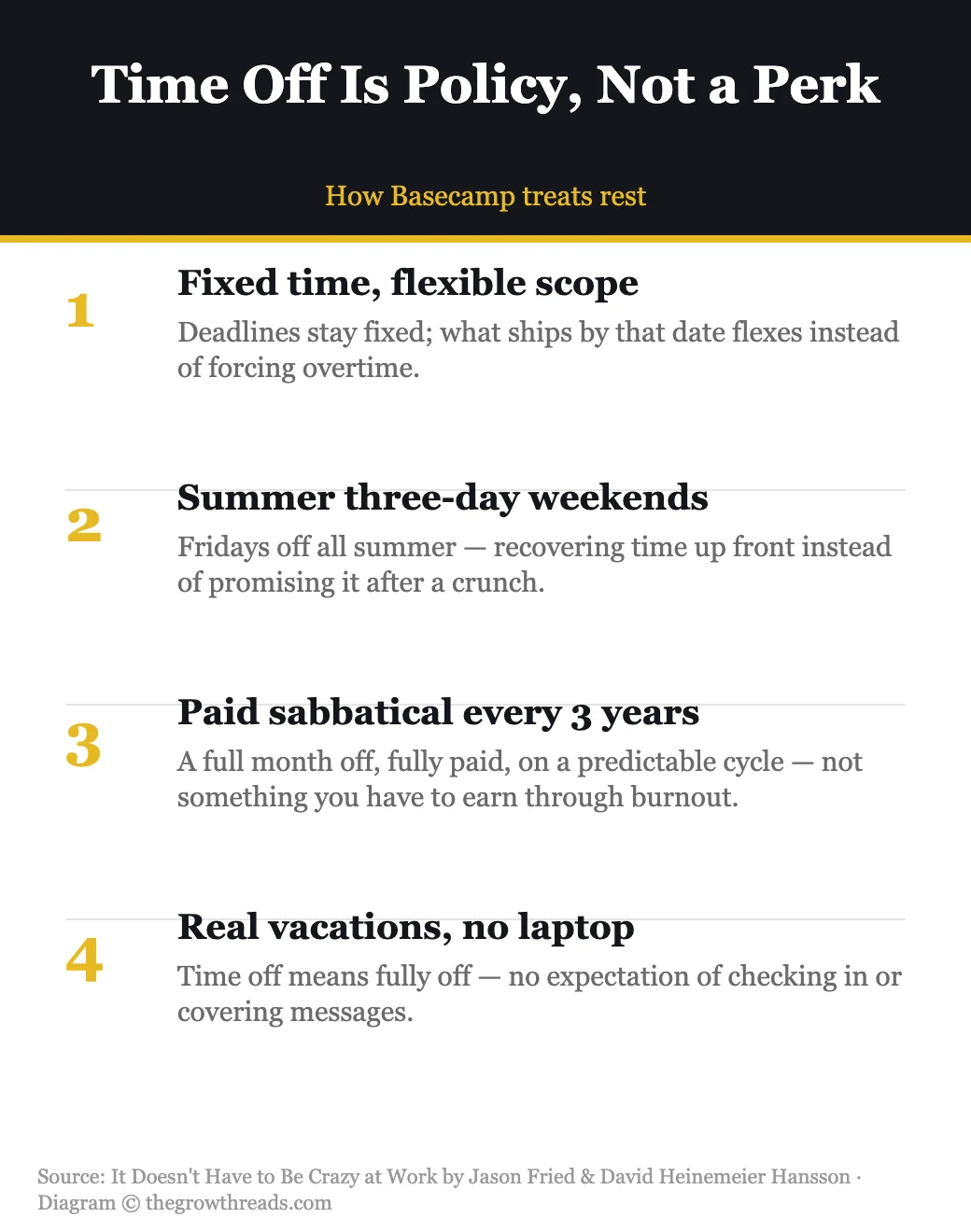
TGR Note: Scheduling rest in advance rather than earning it through burnout is the same principle behind the sabbatical-style thinking in Off the Clock — protected time works best when it’s decided ahead of time, not negotiated in the moment.
Who is It Doesn’t Have to Be Crazy at Work best for — and who should read something else first?
This book is most useful for founders, managers, and team leads who have real influence over how their company or team operates — the policies described here (hours, meeting norms, time off) mostly require someone with authority to set and defend them. If you’re an individual contributor without that authority, you’ll still get value from the language and the specific tactics (async-first updates, protecting focus blocks) but may need to apply them within existing constraints. If your main challenge is personal time management rather than company culture, Extreme Productivity is a better fit. If you’re specifically weighing what your own time is worth and what to delegate as an entrepreneur, No B.S. Time Management for Entrepreneurs tackles that question more directly. If you want the deeper “why” behind treating rest as essential rather than optional, pair this with Off the Clock.
Questions to reflect on
- Which piece of chaos at your workplace do you assume is unavoidable — and is it actually a choice someone made and could unmake?
- If a deadline required overtime last month, was the deadline wrong or was the scope wrong?
- How much of your day gets fragmented by interruptions you could redirect to a scheduled window instead?
- Does your team’s default response to a new problem tend to be “let’s meet,” and what would it take to make that the last resort instead of the first?
- When did you last take time off that was genuinely unreachable, with no expectation of checking in?
🔥 Ready to build a calmer way of working?
Get It Doesn’t Have to Be Crazy at Work and start with one policy this week.
How to apply It Doesn’t Have to Be Crazy at Work (7-day plan)
- Day 1: List three things at work you treat as unavoidable chaos. For each, ask: whose decision made this normal?
- Day 2: Pick one recurring meeting and add friction — a required agenda, a smaller invite list, or a hard end time.
- Day 3: Try replacing one real-time conversation with a written async update instead.
- Day 4: Block a 2-hour “library rules” window on your calendar — no chat, no meetings, uninterrupted work only.
- Day 5: If you manage others, pick one deadline this month and ask whether scope, not effort, should flex to meet it.
- Day 6: Set an “office hours” window for whatever role makes you most interruptible, and protect the rest of your day.
- Day 7: Schedule one real block of time off in advance — even a single unreachable afternoon — rather than waiting to need it.
Frequently asked questions
What is the main argument of It Doesn’t Have to Be Crazy at Work?
The main argument is that workplace stress, long hours, and burnout are usually the result of specific, changeable choices — understaffing, unrealistic deadlines, constant interruptions — rather than unavoidable costs of doing serious work. Jason Fried and David Heinemeier Hansson use Basecamp as a working example of a company that deliberately chose calm over chaos, and lay out the specific policies that made it possible.
What is the “calm company” concept?
It’s the book’s central framework: a business built around reasonable hours, adequate staffing for the actual workload, realistic expectations, and profit prioritized over aggressive growth. The authors treat these as deliberate design choices that have to be built and defended, not a natural byproduct of running a good business.
What does “fixed time, flexible scope” mean?
It’s Basecamp’s approach to deadlines: the date stays fixed, and the feature list or scope of the work flexes to fit it, rather than the reverse. Instead of blowing a deadline (or forcing overtime) to fit a fixed scope, the team ships what’s realistically possible by the date and treats the rest as a future iteration.
Can you apply this book’s ideas without being a founder or executive?
Some of it, yes — tactics like defaulting to async written updates, protecting a block of uninterrupted time, and pushing back gently on unnecessary meetings can be adopted individually. But many of the book’s core policies (company-wide hours, sabbaticals, meeting norms) require the authority to set policy, which is a genuine limitation for readers without that influence.
What are “library rules” and “office hours” in this book?
“Library rules” refers to a default-quiet office norm — conversations stay low-key, and anything louder moves to a private room instead of disrupting the open floor. “Office hours” refers to scheduled windows when a specialist is available for questions, replacing an always-open-door policy that makes someone interruptible all day.
Is this book only relevant to tech or software companies?
The specific examples are drawn from Basecamp, a software company, but the underlying principles — protecting focus time, treating long hours as a planning failure, scheduling rest in advance — apply to most knowledge-work settings. A law firm, a design studio, or a customer-support team can all apply the same underlying logic even though their day-to-day tools and workflows look nothing like a software company’s. Readers in other industries may need to adapt the specific tactics (like async written updates) to their own workflows.
How is this book different from the authors’ first book, Rework?
Rework is a broader manifesto about running an unconventional, self-funded business. It Doesn’t Have to Be Crazy at Work narrows the focus specifically to company culture and daily working conditions — hours, meetings, interruptions, and time off — with more granular, implementable detail on how Basecamp actually structures a calmer workday.
Related summaries
- Extreme Productivity
- Manage Your Day-to-Day
- Off the Clock
- No B.S. Time Management for Entrepreneurs
- Best Productivity Books
How we analyze books: we read the source material, cross-check named frameworks and factual claims against independent sources, and build original diagrams, application plans, and reflection questions rather than reproducing the text. Read our full methodology.