

★★★★☆ 4.4/5 — A fast, list-driven survey of what nearly 300 high achievers actually do with their calendars.
Best for: Readers who want a quick, habit-level tour of time management rather than one deep theoretical framework.
Reading time: ~3 hrs to read the full book · 8 min to read this guide
Difficulty to apply: Easy — most habits are small, immediate changes to how you use a calendar.
15 Secrets Successful People Know About Time Management in one minute
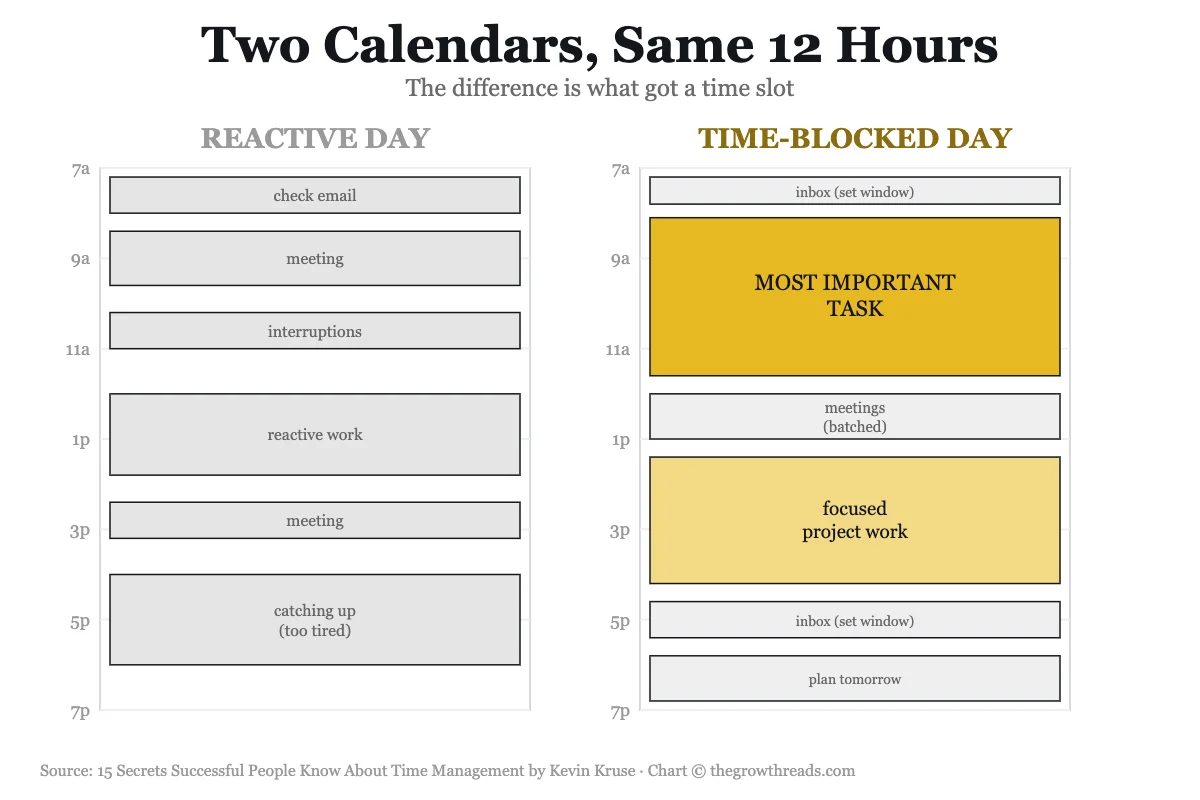
The most productive people you’ll ever study don’t manage a to-do list — they manage a calendar. Kevin Kruse built this book from surveys and interviews with roughly 288 high achievers — 7 billionaires, 13 Olympic athletes, 29 straight-A students, and 239 entrepreneurs — looking for what they actually do differently with their time. His finding, distilled across fifteen short chapters, isn’t a single unifying system so much as a consistent pattern: nearly everyone in his sample schedules their priorities into fixed blocks of time rather than hoping a loose list of intentions gets done, protects one Most Important Task per day, and treats their calendar — not their memory or their willpower — as the tool that actually gets things finished.
The book reads less like one author’s manifesto and more like a field report from nearly 300 very different lives, which is exactly what gives its recurring patterns their credibility.
Key takeaways
- Calendars beat to-do lists: a task with no scheduled time slot competes with everything else and usually loses.
- Pick one Most Important Task daily: a single priority, done during your highest-energy hours, beats a long list of equally-weighted items.
- You get 1,440 minutes a day, no more: the number never changes regardless of income or title, and unused minutes don’t roll over.
- Apply the 80/20 rule to your activities: a small share of what you do drives most of your results — find it and protect it.
- Say no by default: successful people in the survey declined far more often than they accepted.
- Avoid unnecessary meetings: several respondents described minimizing meetings unless a clear decision or deliverable was on the line.
- Batch or “theme” similar work: grouping similar tasks into dedicated blocks reduces the cost of switching between different types of work.
- Build a consistent morning routine: many respondents protect the first part of the day before checking email or messages.
- Process email in set windows: rather than checking continuously, batch it into a few scheduled passes.
- Touch it once: handle anything under about five minutes immediately instead of re-reading and deferring it repeatedly.
What is 15 Secrets Successful People Know About Time Management about?
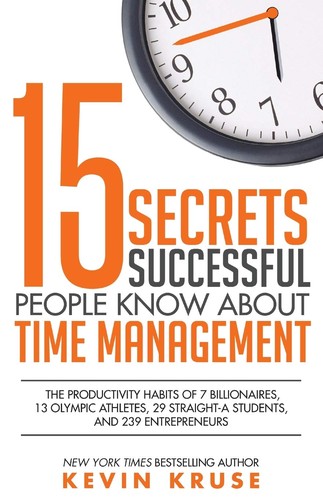
15 Secrets Successful People Know About Time Management is Kevin Kruse’s survey-based look at how nearly 300 billionaires, Olympic athletes, straight-A students, and entrepreneurs actually manage their time. Rather than offering one theoretical system, it distills recurring, practical habits — calendar-blocking, single daily priorities, disciplined mornings, and deliberate boundaries — into fifteen short, applicable chapters.
About the author
Kevin Kruse is a serial entrepreneur who has built and sold multiple technology and training companies, and is the founder and CEO of LEADx, a leadership development platform. He’s also a longtime Forbes contributing columnist on leadership and productivity, and the author of several other books, including Great Leaders Have No Rules, co-written with Travis Bradberry. His background as a founder who’s had to run companies without unlimited time or staff gives the book’s central question — how do genuinely high-performing people actually spend their days — a practical, business-grounded angle rather than a purely academic one. Explore all Kevin Kruse book summaries →
That entrepreneurial vantage point also shows in the book’s format itself. Rather than a long, argument-driven narrative, Kruse structures the book as fifteen short, independently readable chapters — closer to a field guide than a manifesto. Each secret can be read, and applied, in isolation, which suits readers who want to try one habit this week without committing to an entire philosophy first. It’s a format choice that mirrors the book’s own advice: small, discrete, immediately actionable units rather than one large undertaking that has to be swallowed whole before it delivers any value.
Key concepts at a glance
| Concept | What it means | Use it when |
|---|---|---|
| Calendar over to-do list | Scheduling tasks into fixed time blocks instead of an open-ended list | Anything you keep re-adding to tomorrow’s list |
| Most Important Task (MIT) | One clearly chosen daily priority, done first or during peak energy | Deciding what actually gets your best hours |
| 1,440 minutes | The fixed daily minute budget everyone shares, regardless of status | Reframing how “free” a request for your time really is |
| 80/20 rule | A small share of activities usually drives most of your results | Deciding what to keep doing vs. cut |
| Theming/batching | Grouping similar tasks into dedicated blocks or days | Reducing the cost of switching between different types of work |
| Touch it once | Handling short tasks immediately instead of deferring them repeatedly | Clearing quick admin without letting it pile up |
The table above is a quick reference, not a substitute for seeing how these ideas actually play out — the next four parts walk through where each one comes from and how Kruse’s respondents applied it in practice.
Part 1: What nearly 300 high achievers have in common
Kruse’s method is the book’s most distinctive feature: rather than proposing a single theory of productivity, he surveyed and interviewed a wide cross-section of people whose results are hard to argue with — Olympic athletes competing at the highest physical level, straight-A students juggling demanding course loads, entrepreneurs running growing companies, and a handful of billionaires. The subtitle’s own numbers anchor the sample: 7 billionaires, 13 Olympic athletes, 29 straight-A students, and 239 entrepreneurs.
What emerges isn’t a single unifying framework so much as a consistent pattern across very different fields. People who compete for Olympic medals and people who run fast-growing companies rarely read the same productivity books or use the same software, yet Kruse found striking overlap in how they actually structure a day — protecting blocks of time for their top priority, minimizing unstructured interruption, and treating their calendar as the real decision-making tool rather than a passive record of what already happened.
What makes the cross-field comparison persuasive is precisely that these groups have no reason to copy each other. An Olympic swimmer isn’t reading entrepreneurship blogs for training tips, and a straight-A student isn’t studying billionaire biographies for exam strategy. When people with completely different goals, different pressures, and different definitions of success independently converge on the same handful of habits — protect one priority, schedule rather than list, guard your calendar from interruption — that convergence is more convincing than any single expert’s opinion could be on its own. It suggests these aren’t habits specific to entrepreneurship or athletics, but something closer to a general property of how sustained high performance actually works.
Part 2: Calendar over to-do list
The book’s most repeated finding is also its simplest to apply: a to-do list with no scheduled time is optional in a way a calendar block isn’t. An item on a list competes for attention against everything else on the list, with nothing forcing it to actually happen today rather than sliding, quietly, to tomorrow. A block on a calendar, by contrast, behaves like a meeting — it has a start time, an end time, and an implicit social expectation that it gets honored.
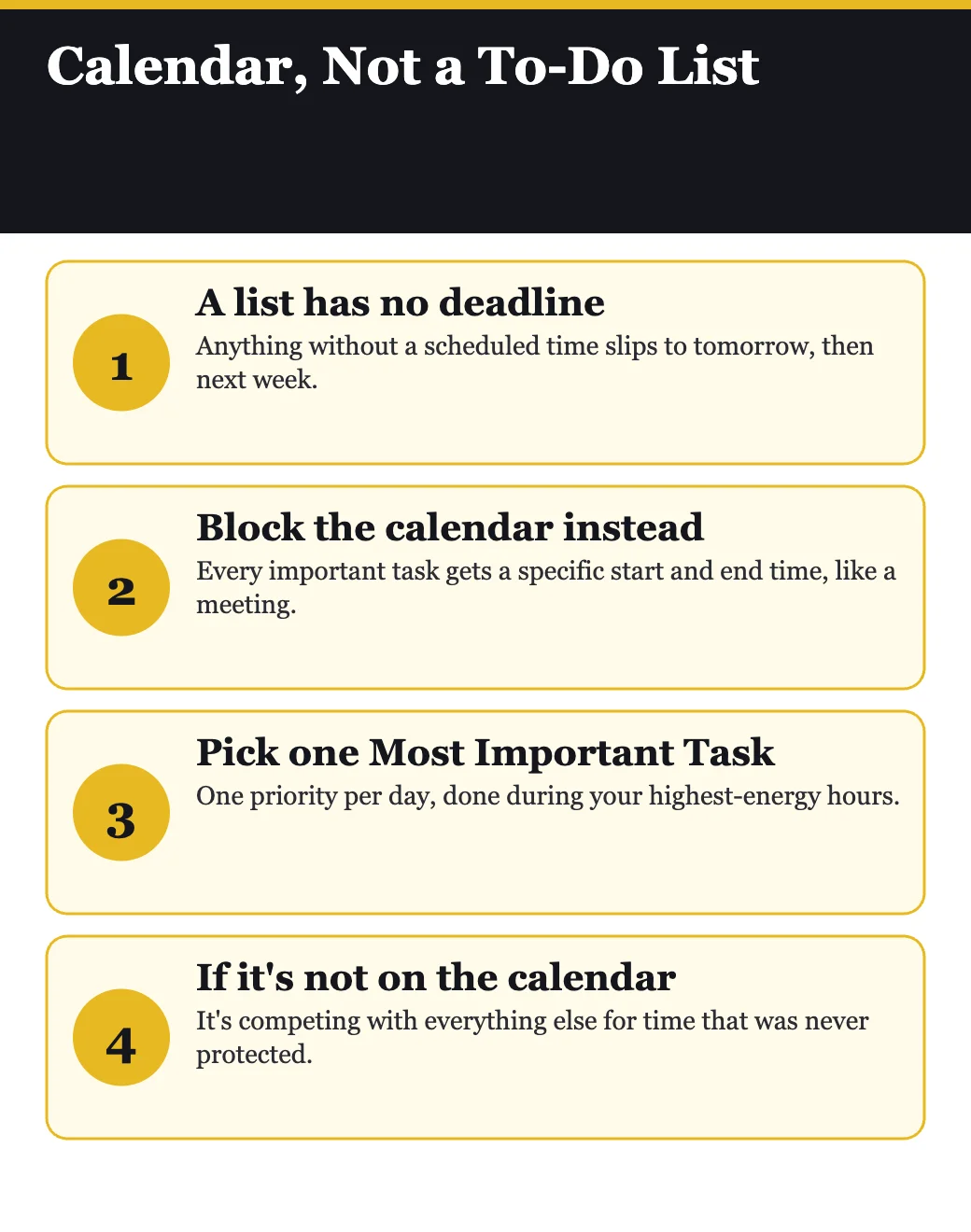
Layered on top of calendar-blocking is the idea of a single daily Most Important Task — one item, chosen in advance, that gets the day’s highest-energy window before anything reactive is allowed to compete for it. The respondents Kruse surveyed didn’t try to conquer an entire list before lunch; they protected one priority fiercely and let everything else fit in around it, which turns out to be a far more reliable way to make consistent progress on what actually matters.
None of this requires elaborate software or a complicated system to start. The mechanism is almost aggressively simple: open a calendar, name tomorrow’s one priority, and give it a block before the day’s inbox has a chance to set the agenda instead. The book’s evidence suggests the simplicity is a feature, not a limitation — the respondents Kruse surveyed weren’t using unusually sophisticated tools, they were consistently applying an unusually simple rule.
There’s a subtle psychological benefit to this approach that the book only gestures at directly but is worth naming: a single protected priority removes the low-grade anxiety of an ever-present, never-shrinking list. When everything is theoretically equally important, nothing gets your full attention, and the list itself becomes a background source of stress independent of whatever’s actually on it. Naming one task as today’s Most Important Task, and letting everything else genuinely wait, gives the rest of the day permission to be less urgent than it feels — which, paradoxically, often makes people more effective at the secondary tasks too, since they’re no longer being approached in a scattered, half-attentive state.
Part 3: The 1,440-minute budget
Kruse frames every day as a fixed budget of 1,440 minutes — a number that doesn’t change whether you’re a first-year employee or a billionaire, and one that never rolls over unused minutes into tomorrow. Once time is framed this explicitly as a budget rather than an abstract resource, requests for it start to look different: a “quick 15-minute call” is a specific, nameable withdrawal from a fixed and non-renewable total, not a free favor with no real cost.
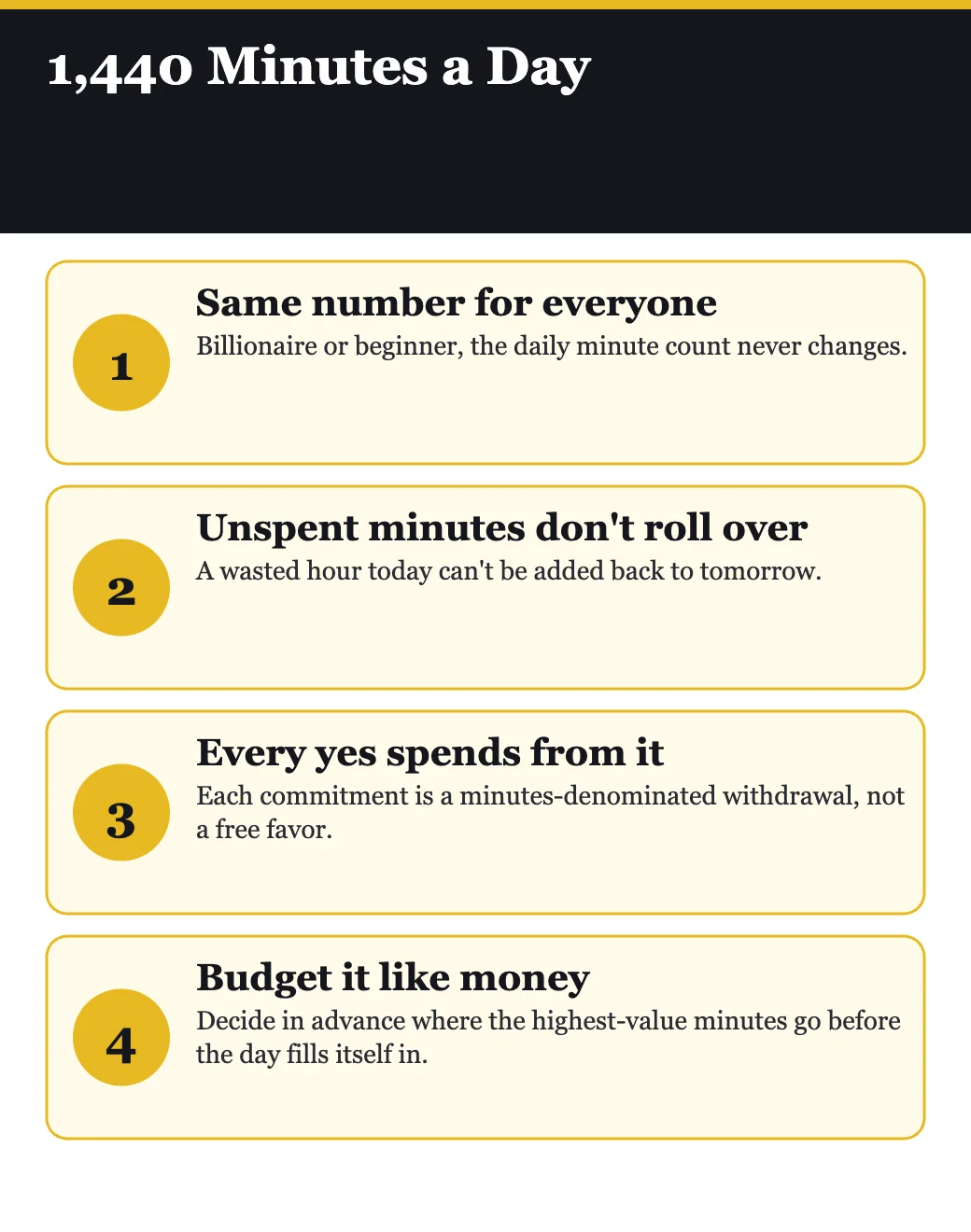
This framing pairs naturally with the 80/20 rule the book also applies to daily activity: a relatively small share of what fills most people’s 1,440 minutes actually drives a proportional share of their results. Once the highest-value 20 percent is identified, the practical move is to protect those minutes first and let lower-value activity compete for whatever’s left over, rather than treating every minute of the day as equally worth defending.
The 1,440-minute framing also does something useful for how people evaluate their own past days, not just future requests. Instead of a vague sense of “today felt busy” or “today felt productive,” the budget framing invites a more specific accounting: which activities actually drew down the day’s fixed total, and did the highest-value 20 percent get spent where it mattered, or did it quietly leak into the same low-value defaults as every other day. Respondents in Kruse’s survey who reviewed their calendars this way — after the fact, not just before — reported catching patterns of waste that a purely forward-looking to-do list never would have surfaced, since a list only shows what’s planned, never what actually happened to the time.
Part 4: Boundaries, batching, and touching it once
A recurring theme across Kruse’s interviews is a comfort with saying no that most readers don’t naturally have. Respondents across all four groups — athletes, students, entrepreneurs, billionaires — described declining far more requests, invitations, and opportunities than they accepted, on the logic that every yes is a withdrawal from the same fixed 1,440-minute budget everyone else is drawing from too. Meetings in particular came up repeatedly as something to minimize by default, reserved for situations with a genuine decision or deliverable on the line rather than a routine status update.
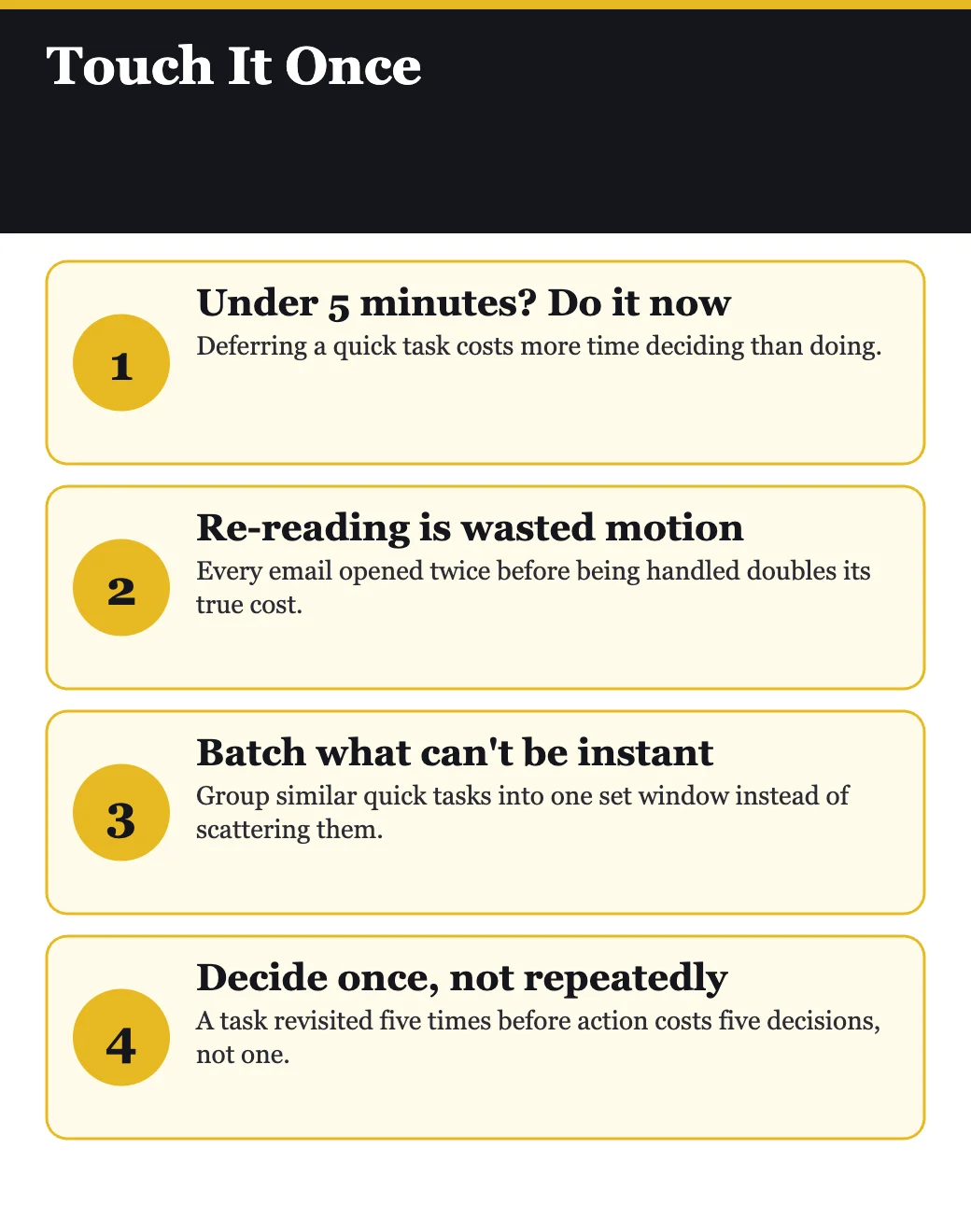
Two smaller habits round out the picture: batching similar tasks into dedicated blocks or days rather than scattering them throughout the week, and the “touch it once” principle — handling anything that takes under about five minutes immediately, rather than opening it, deferring it, and reopening it again later. Re-deciding whether to act on the same small task multiple times, Kruse notes, often costs more cumulative time and mental energy than simply finishing it the first time it’s in front of you.
Saying no consistently enough for it to actually protect your calendar takes more than good intentions in the moment — it takes a standing sense of which categories of request get an automatic no, decided ahead of any specific ask. Several of Kruse’s respondents described exactly this: a general policy against unpaid “pick your brain” calls, a default decline on same-day meeting requests, a rule against committing to anything during a protected morning block regardless of who’s asking. The specific boundary matters less than having one decided in advance, since a boundary invented fresh each time a request arrives is far more likely to bend under a persuasive enough ask than one that was already settled before the conversation started.
Who is 15 Secrets Successful People Know About Time Management best for — and who should read something else first?
This book is a good fit for readers who want a fast, concrete tour of time-management habits without committing to one dense theoretical framework — its short, list-driven chapters make it easy to try one idea at a time. Because it’s built from survey findings across a wide range of high achievers rather than one author’s personal system, it works well as a habit inventory to sample from. Readers who want a single deeply developed framework rather than a broad survey of habits may prefer Procrastinate on Purpose for delegation and elimination, or Manage Your Day-to-Day for a more research-grounded look at energy and attention.
It’s also worth being honest about the format’s tradeoff: because each of the fifteen secrets gets relatively brief treatment, readers looking for deep, citation-heavy justification behind every habit may find the book thinner than they’d like on the “why,” even where the “what” is clear and well-illustrated by real examples. That’s less a flaw than a deliberate choice — the book optimizes for breadth and quick applicability over exhaustive depth on any single idea, which is exactly what makes it a fast, useful survey rather than a slow, comprehensive one.
Questions to reflect on
- Which items on your to-do list have been carried over for more than three days without ever getting a scheduled time slot?
- What is tomorrow’s one Most Important Task, and does your calendar currently protect a specific block for it?
- If every commitment cost a visible chunk of your fixed 1,440 minutes, which recent “yes” would you reconsider?
- Which recurring meeting on your calendar has no clear decision or deliverable attached to it?
- What’s one small task you’ve opened and deferred more than once this week, instead of finishing it the first time?
🔥 Ready to run your day like a calendar, not a list?
Get 15 Secrets Successful People Know About Time Management and start blocking your priorities today.
How to apply 15 Secrets Successful People Know About Time Management (7-day plan)
- Day 1: Move three items off tomorrow’s to-do list and onto your calendar as specific, timed blocks instead.
- Day 2: Choose tomorrow’s one Most Important Task tonight, and schedule it into your highest-energy window before anything else fills that slot.
- Day 3: Track every request for your time today and mentally price it against your fixed 1,440 minutes. Notice which ones you’d decline if the cost were explicit.
- Day 4: Say no to one meeting or request that has no clear decision or deliverable attached to it.
- Day 5: Pick two similar small tasks (emails, calls, admin) and batch them into one dedicated block instead of scattering them through the day.
- Day 6: Practice “touch it once” for a full day — handle anything under five minutes immediately instead of deferring it.
- Day 7: Review the week. Keep whichever single habit made the clearest difference, and build next week’s calendar around it from the start.
Frequently asked questions
Who did Kevin Kruse actually study for this book?
Kruse surveyed and interviewed roughly 288 high achievers across four very different groups: 7 billionaires, 13 Olympic athletes, 29 straight-A students, and 239 entrepreneurs. The goal was to find time-management habits that held up across fields as different as elite sport, academics, and business, rather than habits specific to any one type of success.
What does “calendar, not to-do list” mean in practice?
It means giving important tasks a specific, scheduled block of time — a start and an end — rather than leaving them as an open-ended item on a list. A list item competes with everything else on the list and can slide indefinitely; a calendar block behaves more like a meeting, with an implicit expectation that it gets honored rather than deferred.
What is a “Most Important Task” (MIT)?
It’s a single, clearly chosen daily priority — one task, decided in advance, that gets your highest-energy time block before reactive work or interruptions can claim it. The book’s respondents consistently protected one MIT rather than trying to make equal progress across a long list of same-priority items.
Is this book based on rigorous research or personal anecdotes?
It’s survey and interview-based rather than a controlled academic study, drawing on self-reported habits from a large but self-selected sample of high achievers. That means the patterns are genuinely consistent across a wide range of successful people, but the methodology can’t fully rule out survivorship bias — these are habits observed in already-successful people, not proven causes of that success.
Are all of this book’s habits realistic for someone without a lot of flexibility or support?
Some habits — like extensive delegation or a fully protected morning routine — assume a degree of schedule flexibility or support that not every reader has. The core mechanics (a single daily priority, scheduling rather than listing, batching similar tasks) scale down reasonably well to constrained schedules, even if the fuller version described by some billionaire or entrepreneur respondents isn’t immediately achievable for everyone.
How is this book different from other time-management books?
Rather than presenting one author’s personal system, it’s built from surveying nearly 300 people across four unrelated fields — sport, academics, entrepreneurship, and extreme wealth — looking for what habits hold up across all of them. That breadth is the book’s main distinguishing feature, though it also means each individual habit gets a shorter treatment than a single-topic book would give it.
What’s a good first habit to try from this book?
Most readers see the fastest results from simply choosing tomorrow’s one Most Important Task tonight and scheduling it into a specific block before the day fills in around it. That single change — treating one priority as a calendar commitment rather than a list item — tends to make the book’s other suggestions, like batching and saying no, easier to layer on afterward.
Related summaries
Continue exploring focus and time management: Manage Your Day-to-Day · No B.S. Time Management for Entrepreneurs · Procrastinate on Purpose · Off the Clock · or browse the full productivity library.
How we analyze books: every summary on The Growth Reads is built from a close reading of the book’s core arguments, cross-checked against the author’s other published work and interviews, then structured around practical application rather than just recap. Read our full methodology.