

★★★★☆ 4.2/5 — The foundational time-management book that named the traps most later books just repackaged.
Best for: Managers and executives who want the original, survey-based source behind decades of later time-management advice.
Reading time: ~5 hrs to read the full book · 8 min to read this guide
Difficulty to apply: Moderate — some fixes are personal habits, others require changing how your team operates.
The Time Trap in one minute
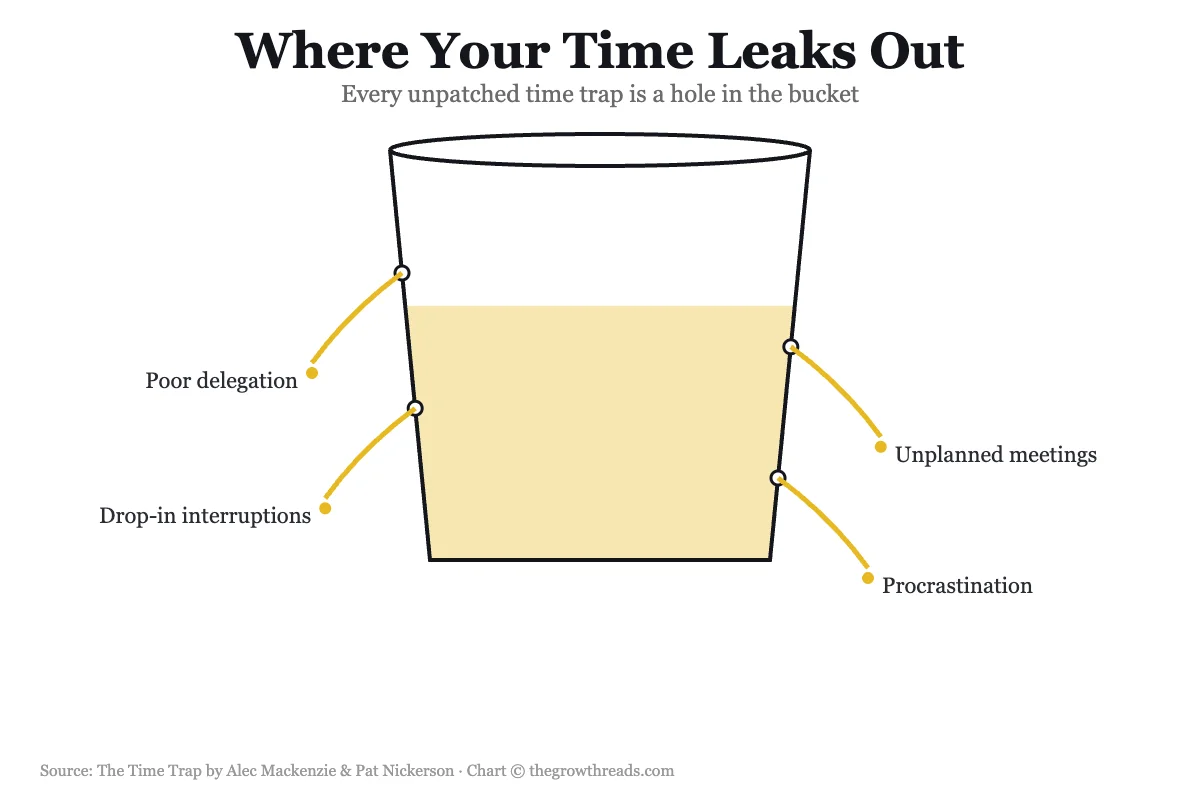
Long before “time management” was a genre, Alec Mackenzie was surveying working managers to find out exactly where their time actually went. First published in 1972 and updated across four editions — the current one with co-author Pat Nickerson — The Time Trap is built on decades of accumulated survey data from managers describing their own recurring time wasters. Its central, still-influential move is a simple but important distinction: some time traps are self-generated, rooted in personal habits like procrastination or difficulty saying no, while others are environmental, built into how an organization runs its meetings, delegates work, and handles interruptions. Fixing the wrong kind with the wrong tool, Mackenzie argues, is why so many time-management efforts fail.
More than fifty years and four editions later, that basic diagnostic move — sort the problem correctly before reaching for a solution — remains the book’s most useful and most frequently borrowed idea, even by readers who’ve never opened it themselves.
Key takeaways
- Time traps have two sources: self-generated (procrastination, disorganization) and environmental (poor delegation, crisis-driven culture) — they need different fixes.
- Diagnose before you treat: a personal willpower fix won’t solve a systemic organizational problem, and vice versa.
- Interruptions are manageable, not inevitable: an open-door policy without limits invites constant interruption by design.
- Meet drop-in visitors away from your desk: a stand-up conversation naturally runs shorter than one where everyone sits down.
- Batch phone calls and messages: a set window for returning calls beats answering every one as it arrives.
- Delegation fails without authority: handing off a task without real decision-making power just delays the problem coming back to you.
- Define “done” before you delegate: a clear outcome lets someone else own the process without you checking in constantly.
- Poorly run meetings are a top time trap: without a clear agenda and endpoint, meetings expand to fill whatever time is available.
- Urgency isn’t the same as importance: reacting to whatever feels urgent crowds out work that’s actually valid and valuable.
- Track your time before diagnosing it: most people’s sense of where their day goes is inaccurate until they actually log it.
What is The Time Trap about?
The Time Trap is Alec Mackenzie’s survey-based study of what actually steals time from working managers, first published in 1972 and now in its fourth edition with co-author Pat Nickerson. It organizes recurring “time traps” into self-generated habits and environmental, organizational patterns, offering distinct fixes for each rather than treating all time loss as a single willpower problem.
About the author
R. Alec Mackenzie was an internationally known management consultant, writer, and speaker on time management, who conducted seminars on the topic in dozens of countries over his career. The Time Trap, first published in 1972, was his best-known work and one of the earliest books to bring systematic, survey-based thinking to time management for a business audience — years before the modern productivity-book genre existed. He authored roughly a dozen additional books on time and goal management over the following decades. Pat Nickerson, who co-authored the current fourth edition, brought the book’s survey data and examples into a more contemporary business context while preserving Mackenzie’s original framework and voice, updating chapters on communication and technology to reflect how work has changed since 1972. Explore all Alec Mackenzie book summaries →
What comes through most clearly across both authors’ contributions is a consistent methodological discipline: neither relies on personal anecdote alone to make the book’s claims. Mackenzie’s original research and Nickerson’s updated material both lean on accumulated survey responses from real working managers describing their own time problems in their own words, then organized into recurring categories. That grounding is part of why the book reads less like one consultant’s opinion and more like a long-running field study — a distinction worth keeping in mind when comparing it to newer books built primarily around a single author’s personal system.
Key concepts at a glance
| Concept | What it means | Use it when |
|---|---|---|
| Self-generated time traps | Time loss rooted in personal habits, like procrastination or trouble saying no | Diagnosing a problem that starts with you |
| Environmental time traps | Time loss built into how an organization runs — poor delegation, crisis culture | Diagnosing a problem that starts with the system |
| Drop-in visitors | Unscheduled interruptions that expand to fill however much time is offered | Setting boundaries around your availability |
| Delegation with authority | Handing off both the task and the real power to make decisions about it | Preventing delegated work from bouncing back to you |
| Poorly run meetings | Meetings without a clear agenda or endpoint | Auditing recurring meetings on your calendar |
| Urgency vs. validity | What feels urgent isn’t always what’s actually important | Deciding what to act on first |
Part 1: Two kinds of time traps
Mackenzie’s foundational contribution — one that shaped decades of later time-management writing, often without credit — is the distinction between time traps you create yourself and time traps your environment creates for you. Procrastination, disorganization, and an inability to say no are self-generated: they start and end with individual habits, and no amount of organizational restructuring fixes them. Crisis-driven management, poor communication, and weak delegation systems are environmental: they’re baked into how a team or company operates, and no individual habit change fully solves them while the underlying system stays broken.
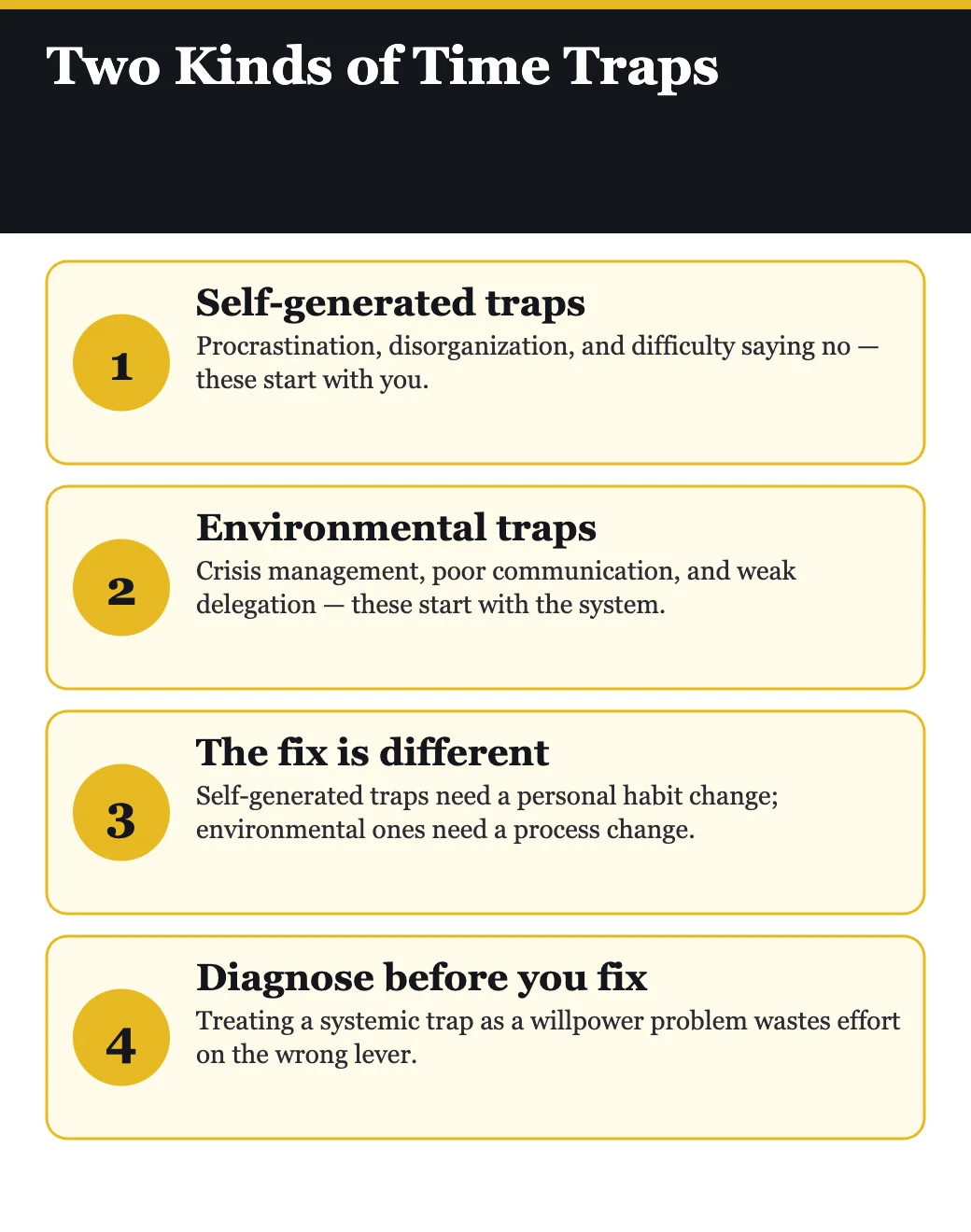
This distinction matters because it changes where you look for a fix. Someone stuck in a self-generated trap benefits from personal accountability tools — tracking their actual time use, setting a deadline, breaking a habit loop. Someone stuck in an environmental trap, by contrast, can track their own time obsessively without much improving, since the underlying cause was never within their individual control to begin with. Someone stuck in an environmental trap needs a different kind of intervention entirely — a new meeting policy, a clearer delegation process, a team-wide agreement about interruption norms. Mackenzie’s survey data suggested most people are dealing with a mix of both, which is exactly why generic advice (“just be more disciplined”) so often fails to move the needle on problems that are actually systemic.
What’s striking about revisiting this framework decades after it was first published is how little the underlying categories have changed, even as the specific technology around them has changed enormously. The 1972 edition worried about paper memos and rotary phones; the current edition worries about email volume and video calls. But procrastination is still procrastination, an authority-less delegation still bounces back, and a meeting without an agenda still expands to fill its slot. Mackenzie’s survey-based method captured something closer to a stable feature of how organizations and individuals actually behave than a snapshot of a particular decade’s office technology — which is a large part of why the book has stayed in print, through four editions, for more than fifty years.
Part 2: Taming interruptions and drop-in visitors
Mackenzie’s research treated interruptions not as an unavoidable cost of being available, but as a largely self-inflicted pattern shaped by how openly you signal your availability. An open door with no visible limits reads, to nearly everyone, as an invitation — and most people will take it, not out of malice, but because nothing has told them otherwise. The fix isn’t becoming unreachable; it’s making the boundaries of your availability as clear and visible as an open door currently makes your unavailability invisible.
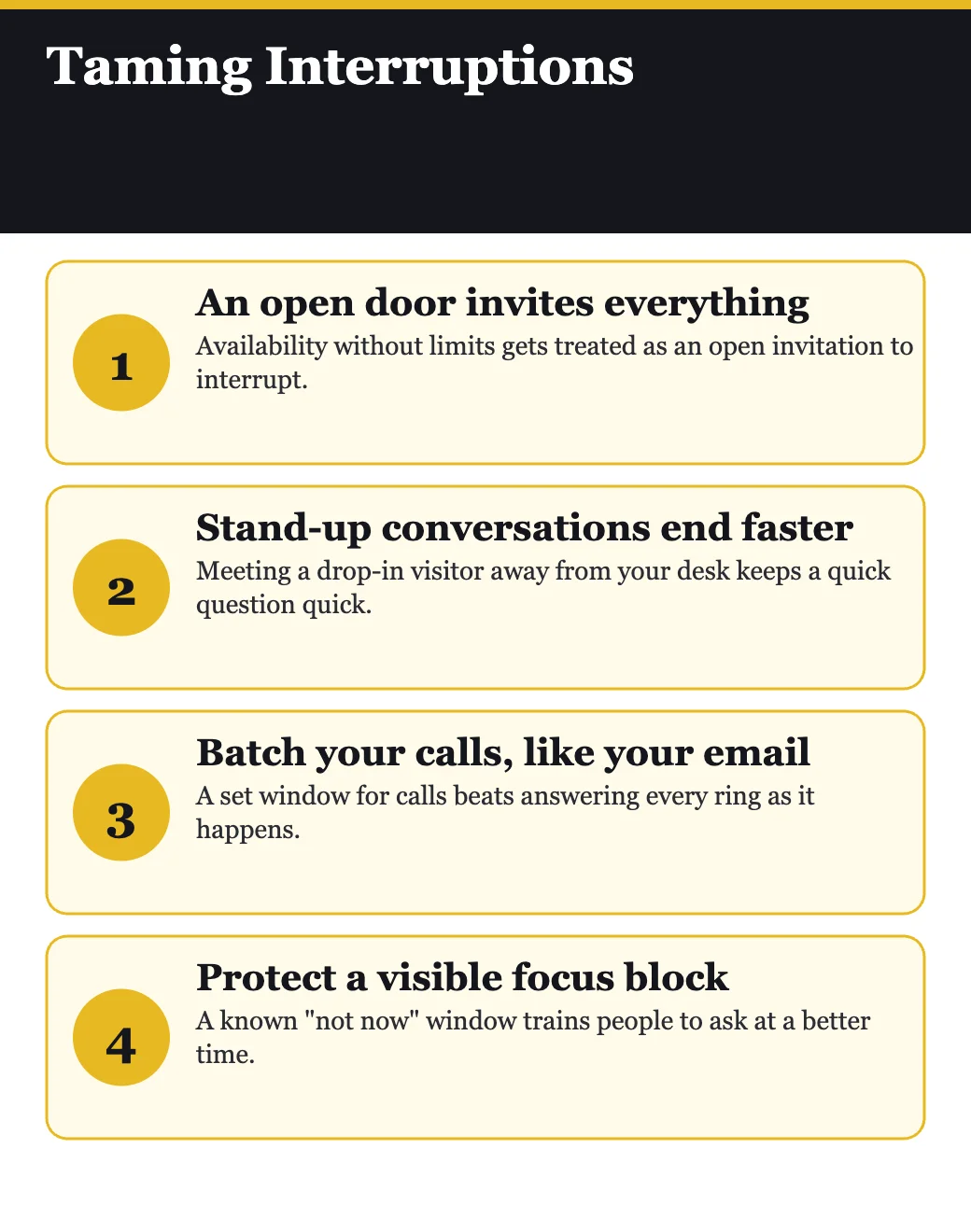
One of the book’s more practical, still-relevant tactics addresses drop-in visitors specifically: meet them standing up, away from your own desk, rather than inviting them to sit down in your space. A conversation held standing naturally runs shorter — there’s no chair pulling someone into settling in for a longer chat, and stepping out to meet them keeps you, not them, in control of when the exchange ends. The same logic extends to phone calls and messages: batching them into a defined window, rather than answering the moment they arrive, keeps reactive communication from setting the pace of your entire day.
None of this requires becoming unavailable or unhelpful — Mackenzie is careful to frame it as a boundary-setting problem, not an anti-social one. The colleagues and visitors who currently interrupt freely aren’t doing anything wrong by the standards you’ve implicitly set; they’re simply responding to the availability you’ve signaled, whether or not you meant to signal it that openly. Changing the signal — a visible focus block, a standing-conversation habit, a defined call window — changes the behavior around it without requiring anyone to feel rejected or unwelcome. The fix is almost entirely about clarity, not coldness.
Part 3: Delegation that actually works
Mackenzie’s treatment of delegation zeroes in on why so much of it fails in practice: tasks are handed off without the authority needed to actually complete them. A manager who says “take care of this” without transferring real decision-making power hasn’t delegated the task — they’ve delegated the busywork while keeping the actual authority, which guarantees the task eventually bounces back for a decision only the original manager can make.
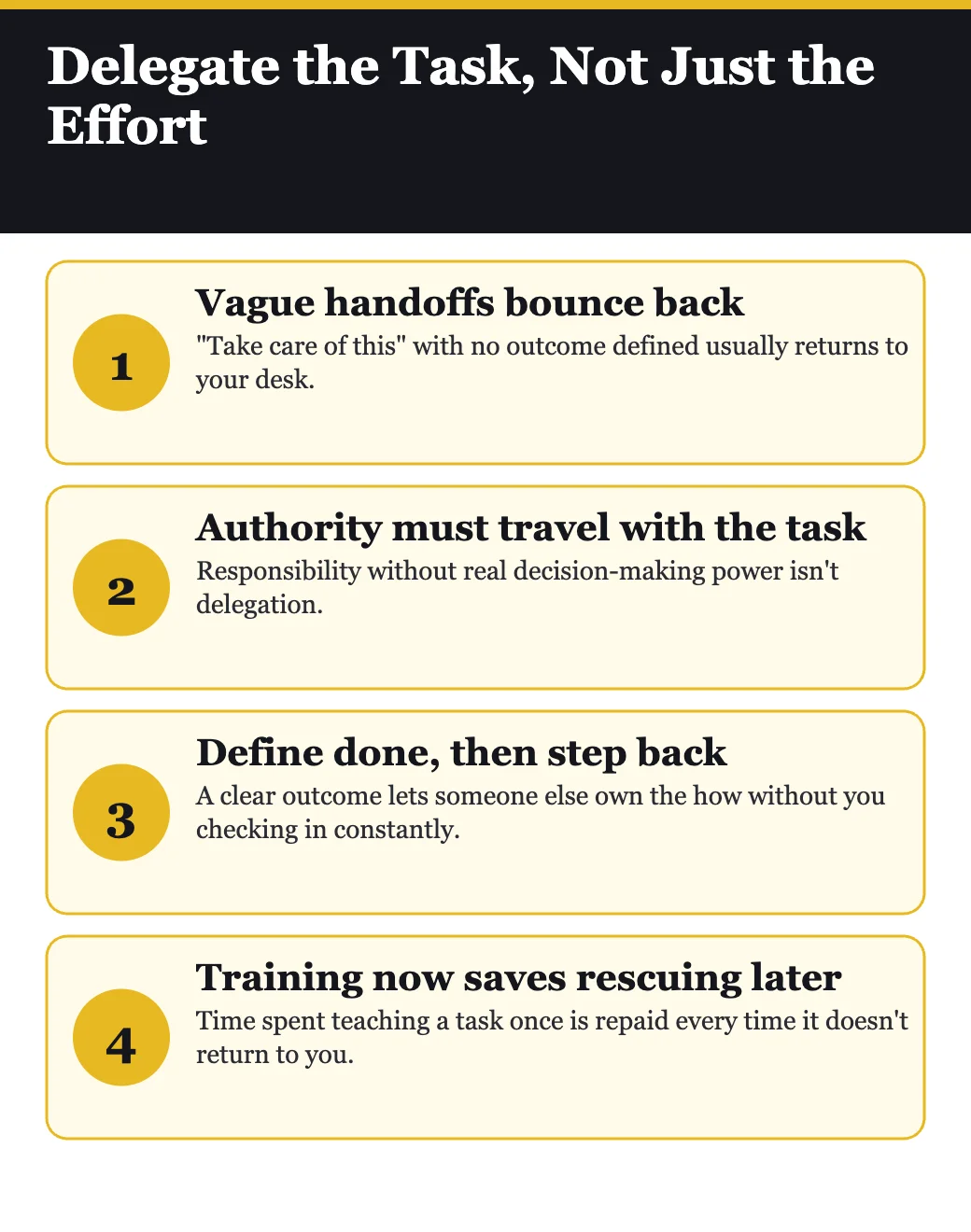
The fix Mackenzie proposes is defining what “done” looks like clearly enough that the person taking on the task can own the process, not just the labor. Time spent up front clarifying the outcome and confirming real authority is time that pays back every time the task doesn’t return to your desk for a decision. Skipping that step to save a few minutes upfront, the book argues, is one of the most consistently underestimated time traps managers fall into — the shortcut costs far more than the careful handoff would have.
It’s a small upfront investment against a much larger recurring one, and the math almost always favors slowing down at the handoff over speeding through it.
Part 4: Meetings, urgency, and validity
Poorly run meetings show up repeatedly in Mackenzie’s survey data as one of the most consistently cited time traps across industries and decades — a pattern that hasn’t meaningfully changed since 1972 despite endless advice aimed at fixing it. His diagnosis is structural: a meeting without a clear agenda, a defined endpoint, and an explicit purpose expands to fill whatever time is scheduled for it, regardless of how much actual business gets accomplished inside that window.
Underneath the meetings problem sits a more general distinction the book returns to repeatedly: urgency and validity are not the same thing, and the two get confused constantly. An urgent request demands attention right now; a valid one actually deserves it. Plenty of what fills a manager’s day is urgent without being valid — a demanding email, an unplanned call, a meeting invite with no clear agenda — and reacting to urgency by default is one of the most reliable ways to spend a day busy without spending it well.
The practical test Mackenzie proposes is simple to state and harder to apply consistently: before reacting to something that feels urgent, pause long enough to ask whether it’s also valid — whether it actually connects to a real priority, or just arrived with enough noise to feel like one. Requests dressed up with urgency (an “ASAP” in the subject line, a same-day deadline invented after the fact) are especially prone to this confusion, since urgency is easy to manufacture and hard to argue with in the moment. A manager who trains themselves to ask the validity question first, even briefly, reclaims a meaningful share of a day that would otherwise be spent entirely on other people’s priorities.
Who is The Time Trap best for — and who should read something else first?
This book rewards managers and executives dealing with organizational, not just personal, time pressure — its survey-based approach to systemic time traps like poor delegation and meeting culture is still one of the clearest treatments available, more than fifty years after it first appeared. Readers curious about the original source behind ideas that show up, uncredited, across decades of later productivity writing will find this book particularly worthwhile. Readers looking for a more contemporary voice or a narrower personal-habit focus may prefer 15 Secrets Successful People Know About Time Management for a modern survey approach, or No B.S. Time Management for Entrepreneurs for a more contemporary, blunt take on similar ground.
It’s also fair to say this book asks a bit more patience of a modern reader than newer titles do — the prose reflects its era more than a book published in the last few years would, and some of its office-culture assumptions (secretaries, physical paperwork, in-person drop-in visitors) will feel more historical than directly applicable to a fully remote team. Readers willing to translate those specifics into their modern equivalents — a Slack message instead of a knock on the door, a shared doc instead of a paper memo — will find the underlying diagnosis holds up remarkably well despite the dated surface details.
Questions to reflect on
- Which of your recurring time problems are actually self-generated, and which are built into how your team or organization operates?
- Does your availability have visible limits, or does an open door invite interruption by default?
- Think of a task you delegated recently that came back to you — did the person have real authority to finish it, or just the labor?
- Which recurring meeting on your calendar has no clear agenda or defined endpoint?
- What filled your day today that was urgent but not actually valid or important?
🔥 Ready to patch your time traps?
Get The Time Trap and start telling self-generated traps from environmental ones.
How to apply The Time Trap (7-day plan)
- Day 1: Log your actual time use in 30-minute increments for one full workday, without editing or judging it as you go.
- Day 2: Review yesterday’s log and sort each time trap into self-generated or environmental. Notice which category dominates.
- Day 3: Set one visible boundary around your availability — a closed-door block, a “focus” calendar status — and hold it for the day.
- Day 4: Meet one drop-in visitor standing, away from your desk, instead of inviting them to sit down.
- Day 5: Revisit one task you delegated recently. Confirm the person has real authority to finish it, not just the labor.
- Day 6: Audit one recurring meeting on your calendar. Give it a clear agenda and end time, or cancel it.
- Day 7: Review the week. Pick one self-generated and one environmental fix to keep practicing, and let the rest wait.
Frequently asked questions
What’s the difference between self-generated and environmental time traps?
Self-generated time traps come from personal habits — procrastination, disorganization, difficulty saying no — and respond to individual accountability tools like time-tracking and deadlines. Environmental time traps are built into how an organization operates — poor delegation systems, crisis-driven culture, meeting overload — and require systemic fixes rather than personal willpower. Mackenzie’s core argument is that misdiagnosing one as the other wastes effort on the wrong solution.
Is this book still relevant since it was first published in 1972?
The core framework — the self-generated versus environmental distinction, and the underlying causes of interruptions, poor delegation, and meeting overload — has held up well, since it’s rooted in organizational behavior rather than specific technology. The current fourth edition, co-authored with Pat Nickerson, updates communication-related chapters for email and modern office life, though the overall framing still reflects a traditional office/executive environment more than a fully remote or freelance one.
How is this different from more modern time-management books?
Many later, more popular time-management books build on ideas Mackenzie first organized and named in 1972 — the underlying concepts of interruption management, delegation with authority, and urgency-versus-importance appear, in various forms, throughout the genre that followed. Reading this book gives you the original, survey-based source material behind decades of later advice, though its business/executive framing is less contemporary in tone than newer titles.
Why does the book treat drop-in visitors as a real time management problem?
Because unscheduled interruptions expand to fill however much time is offered, and an open, unstructured door signals unlimited availability whether or not that’s intended. Mackenzie’s research treats this as a solvable pattern rather than an unavoidable cost of being approachable — a specific tactic like meeting visitors standing, away from your desk, is one concrete fix the book offers for keeping a quick question quick.
Does this book work for people who don’t manage a team?
Much of the book’s framing assumes a traditional managerial role with direct reports, meetings to run, and tasks to delegate, so some chapters apply more directly to people managers than individual contributors. That said, the core self-generated versus environmental distinction, along with the treatment of interruptions and urgency-versus-validity, applies to almost any work situation, even without a formal delegation relationship.
What makes Mackenzie’s approach different from just listing generic productivity tips?
The book is built on decades of accumulated survey data from working managers describing their own actual time wasters, rather than one author’s personal opinion about what should be a problem. That empirical grounding is part of why its core categories have proven durable across editions and decades — they were derived from what people actually reported losing time to, not from theory alone.
What’s a good first step after reading this book?
Most readers get the clearest early insight from logging their actual time use for a single day and then sorting what they find into self-generated versus environmental categories, exactly as the 7-day plan above suggests. That one exercise usually reveals which type of trap dominates a reader’s specific situation, which makes every other suggestion in the book easier to apply with the right tool for the right problem.
Related summaries
Continue exploring focus and time management: No B.S. Time Management for Entrepreneurs · Procrastinate on Purpose · 15 Secrets Successful People Know About Time Management · Manage Your Day-to-Day · or browse the full productivity library.
How we analyze books: every summary on The Growth Reads is built from a close reading of the book’s core arguments, cross-checked against the author’s other published work and interviews, then structured around practical application rather than just recap. Read our full methodology.