

★★★★☆ 4.3/5 — A practical, research-grounded case that joy at work isn’t fluffy — it’s a performance lever.
Best for: Managers, team leads, and anyone shaping workplace culture, from a two-person team to a large org.
Reading time: ~6 hrs to read the book, 12 min for this guide.
Difficulty to apply: Easy to start — most hacks are small, but consistency across a team takes real leadership.
Eat Sleep Work Repeat in one minute
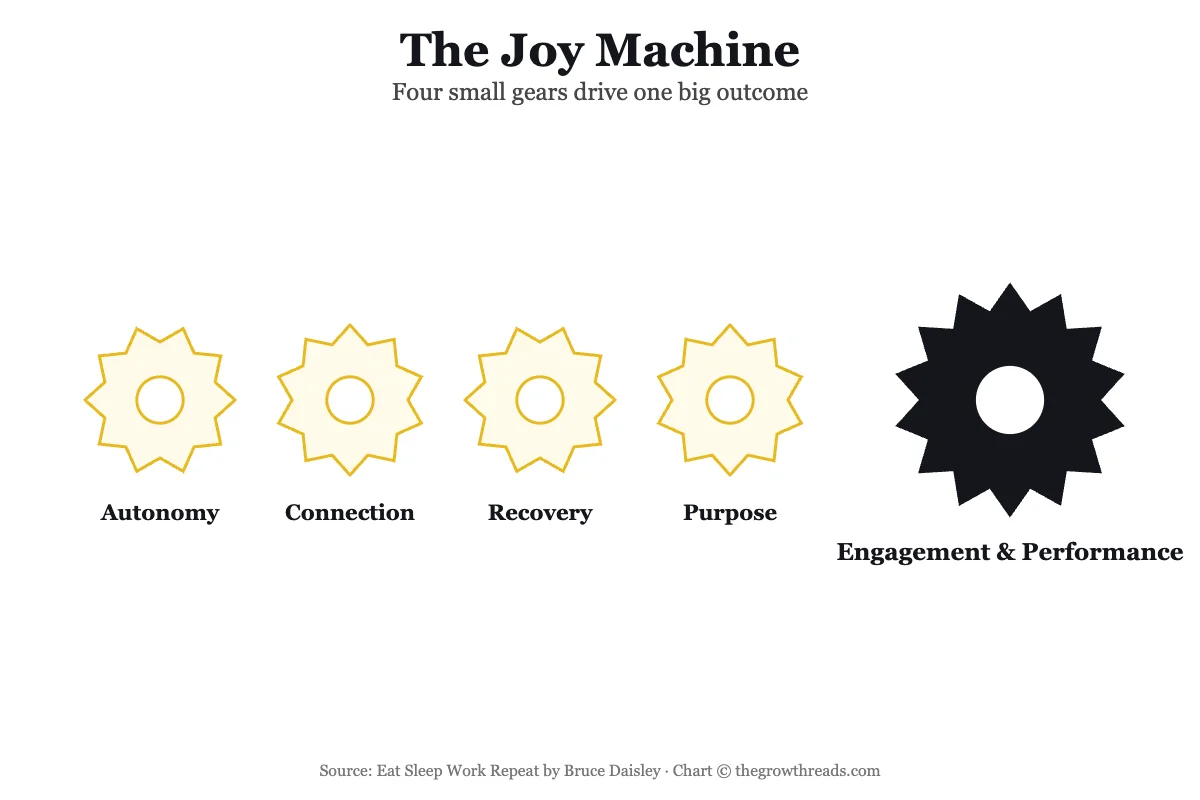
The happiest teams aren’t happy because work is easy — they’re happy because their workplace culture actively protects the conditions joy needs to survive. Bruce Daisley, former VP of Twitter for Europe, the Middle East, and Africa, spent years studying what separates thriving teams from burned-out ones, and the answer surprised him: it’s rarely about perks, salary, or even workload. It’s about small, protectable conditions — autonomy, genuine human connection, real recovery, and a sense of purpose — that get quietly eroded by “always-on” culture, back-to-back meetings, and open-plan distraction. Eat Sleep Work Repeat distills this research into 30 concrete, testable hacks any team can try, from batching email to starting meetings with a human check-in. The book’s real contribution is reframing workplace joy from a nice-to-have into a measurable, buildable system — one that any manager, not just a Silicon Valley executive, can start improving this week.
Key takeaways
- Joy predicts performance: engaged, happy teams consistently outperform disengaged ones, even accounting for skill and workload.
- Autonomy matters more than perks: control over how work gets done beats free snacks or ping-pong tables.
- Connection is a performance lever, not a distraction: casual social bonds at work correlate with better collaboration and output.
- Always-on culture quietly destroys recovery: constant email and Slack availability erodes the rest that performance depends on.
- Meetings are usually the biggest time-waster: most meetings could be shorter, fewer, or replaced with async updates.
- Small rituals rebuild culture fast: a 60-second check-in or a protected no-meeting block changes team dynamics quickly.
- Leaders set the norm by modeling it: a manager who logs off on time gives everyone else permission to do the same.
- Laughter and play aren’t wasted time: teams that laugh together report higher trust and psychological safety.
- Walking and movement boost creative thinking: a short walk outperforms another cup of coffee for an afternoon slump.
- Change doesn’t require a reorg: most of the 30 hacks can start with one team, without waiting for company-wide buy-in.
What is Eat Sleep Work Repeat about?
Eat Sleep Work Repeat is Bruce Daisley’s research-backed guide to rebuilding joy at work through 30 concrete hacks covering autonomy, connection, recovery, and purpose. It argues that engagement — not perks or longer hours — is the real driver of team performance, and shows managers how to protect the small conditions joy depends on.
About the author
Bruce Daisley spent over a decade in senior leadership roles at Twitter, most notably as Vice President for Europe, the Middle East, and Africa, where he became known for studying workplace culture as seriously as growth metrics. Before Twitter, he held senior roles at Google and YouTube, giving him a rare inside view of workplace dynamics across multiple major tech companies. He now writes and speaks widely about work culture and hosts a podcast exploring the science of engagement, drawing on both his corporate leadership experience and a wide body of academic research to make his recommendations concrete and testable rather than purely theoretical. Explore all Bruce Daisley book summaries →
Key concepts at a glance
| Concept | What it means | Use it when |
|---|---|---|
| Engagement | The degree to which people feel invested in and energized by their work | Diagnosing why performance lags despite skilled, hardworking people |
| Always-on culture | The expectation of constant availability via email and chat | Explaining chronic fatigue despite reasonable working hours |
| Psychological safety | Feeling safe to speak up, disagree, or fail without punishment | A team is quiet in meetings but has real concerns privately |
| Recovery | Genuine rest that restores focus and energy, not just time off the clock | Designing breaks that actually help, not just checking a box |
| Team rituals | Small, repeated practices that build connection and trust | A team feels disconnected despite frequent meetings |
| Joy at work | A measurable sense of engagement and satisfaction, not just the absence of stress | Setting a real target for culture initiatives beyond “reduce burnout” |
Part 1: Why joy beats perks
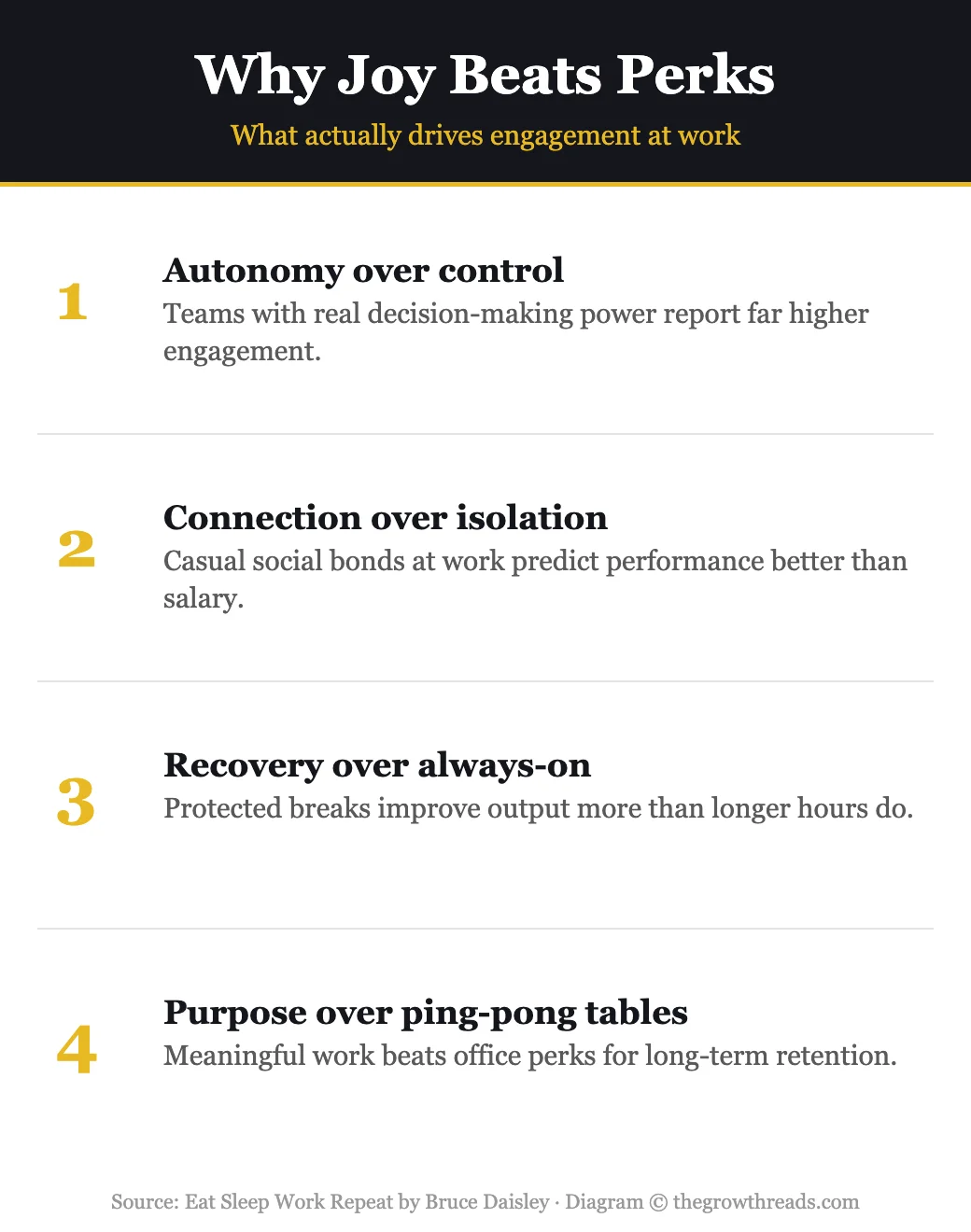
Daisley opens by dismantling a common assumption in workplace culture: that free lunches, foosball tables, and other visible perks are what create a great place to work. His research points elsewhere — toward autonomy, connection, recovery, and purpose as the real, measurable drivers of engagement. Perks can be pleasant, but they don’t move the needle on how people actually feel about their work day to day.
This reframing matters because it changes where leaders should spend their attention. Instead of asking “what amenity should we add next,” the more useful question becomes “what’s quietly draining autonomy, connection, or recovery on this team right now?” That’s a harder question, but it’s the one the data actually supports.
Part 2: Breaking the always-on habit
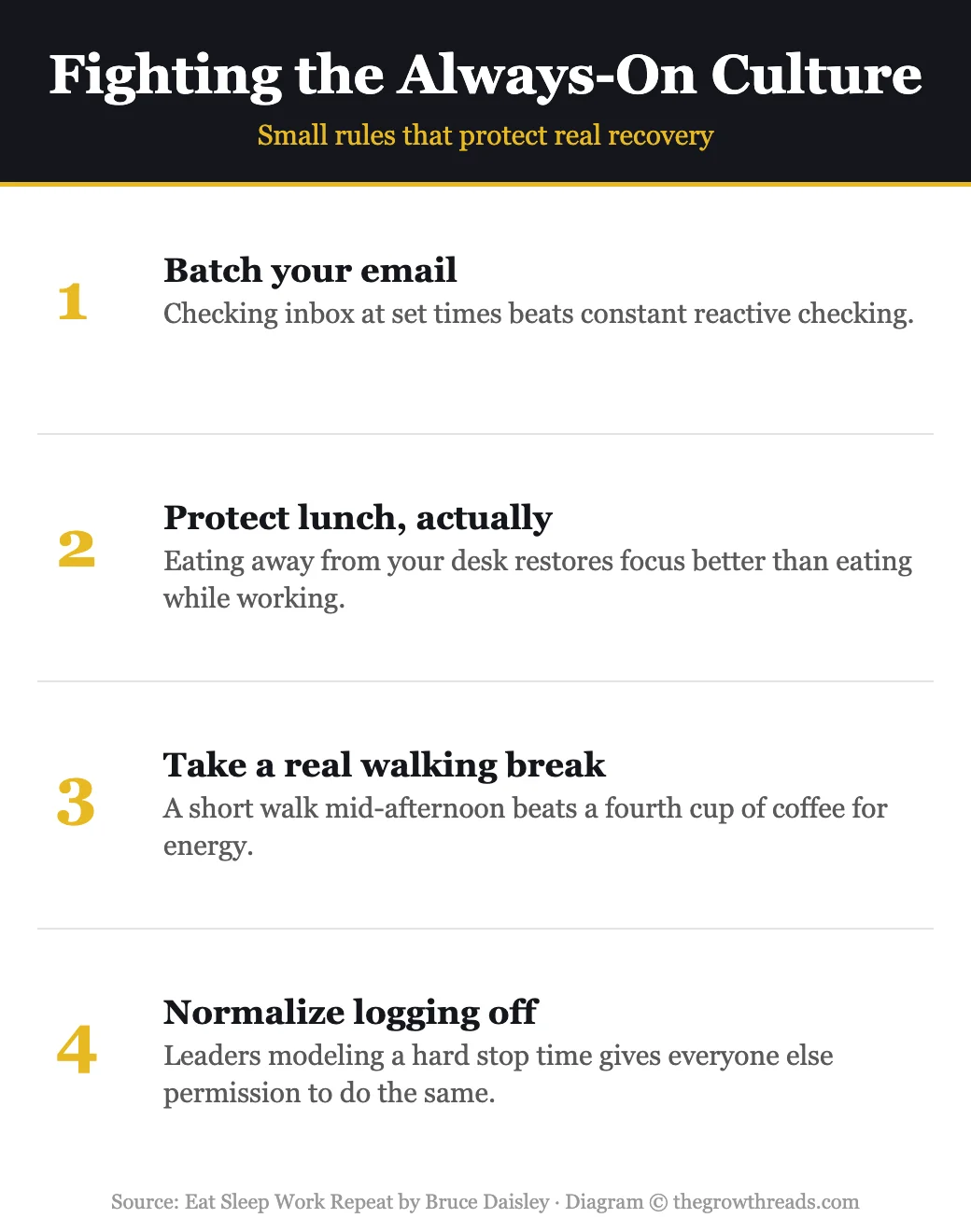
The book treats constant availability as one of the most damaging, and most fixable, culture problems. Email and chat notifications train people into a reactive, fragmented attention state that never allows real recovery, even during nominal off-hours. Daisley is specific about the fix: batching email checks instead of reacting to every notification, protecting a genuine lunch break away from the desk, and taking short walking breaks that restore energy better than more caffeine.
None of these require a policy overhaul — they’re individual and team-level habits. But Daisley is clear they work best when modeled from the top: a manager who visibly logs off at a set time gives everyone else on the team permission to do the same, without anyone having to ask.
Daisley backs this up with a specific example from his own time at Twitter: a team that started closing meetings five minutes early to give people a real buffer between calls saw a measurable drop in reported stress within weeks. The change cost nothing and required no budget — it simply required someone to decide the default meeting length was wrong and change it.
Part 3: Rebuilding connection on purpose
Remote and hybrid work, and even busy in-office schedules, quietly strip out the casual, unplanned social contact that used to happen by default — a hallway chat, a shared lunch, a few minutes before a meeting starts. Daisley argues this isn’t a soft loss; it measurably damages trust and collaboration over time. The fix isn’t forcing more social events, which often feel obligatory and awkward, but building small, low-friction rituals into work that already happens.
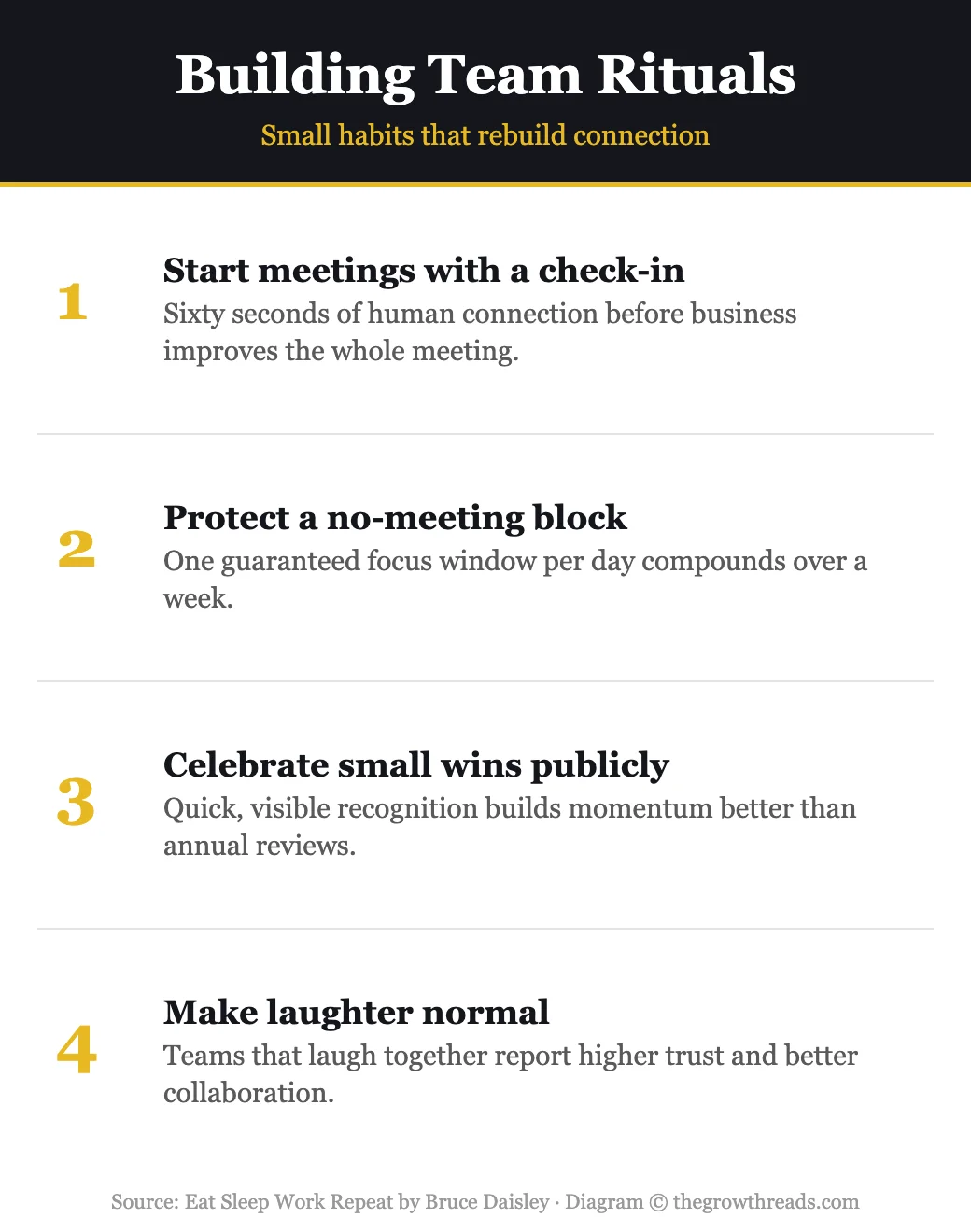
A 60-second check-in at the start of a meeting, a public shout-out for a small win, or normalized laughter in team spaces all rebuild the same kind of connection that used to happen automatically. These rituals cost almost nothing in time but compound into meaningfully higher trust over weeks and months.
Part 4: Starting without a reorg
One of the book’s most practical strengths is that almost none of its 30 hacks require executive sign-off or a company-wide policy change. A single team lead can start a meeting check-in ritual, protect a no-meeting block, or model logging off on time without waiting for permission from above. Daisley designed the hacks this way deliberately, since waiting for top-down culture change often means waiting indefinitely.
That doesn’t mean leadership buy-in is irrelevant — broader changes, like formal flexible hours or meeting-free days company-wide, do need support from above. But the book’s central, encouraging claim is that meaningful culture change can start small, with one team, this week, rather than requiring a full organizational overhaul before anything improves.
He also addresses a common objection directly: won’t looser structure around meetings and email hurt output? The research he cites says the opposite — teams that protect recovery and autonomy consistently ship more, not less, because focused, well-rested attention produces better work than fragmented, exhausted attention ever can. The apparent tradeoff between “protecting people” and “getting results” mostly dissolves once you look at the data honestly.
Who is Eat Sleep Work Repeat best for — and who should read something else first?
Eat Sleep Work Repeat is best for managers and team leads who want concrete, testable ways to improve engagement without waiting for a company-wide initiative. It’s also useful for individual contributors looking to protect their own recovery and connection at work.
If your focus is personal burnout rather than team culture, start with Can’t Even instead. If you’re building a business rather than managing an existing team, Company of One is the more targeted read. And if you want a broader personal productivity system to pair with these team-level hacks, Zen to Done is a strong complement.
Questions to reflect on
- Which of the four levers — autonomy, connection, recovery, or purpose — is weakest on your team right now?
- How often do you check email or chat reactively versus at set, batched times?
- What’s one team ritual you could start this week that costs less than five minutes?
- Are you personally modeling the boundaries you want your team to follow?
- Which recurring meeting could become shorter, less frequent, or fully async?
🔥 Ready to bring joy back to your team?
Get Eat Sleep Work Repeat and start with one hack this week.
How to apply Eat Sleep Work Repeat (7-day plan)
- Day 1: Rate your team on autonomy, connection, recovery, and purpose to find the weakest lever.
- Day 2: Start batching email into two or three set check times instead of reacting constantly.
- Day 3: Take a real lunch break away from your desk and a short walking break in the afternoon.
- Day 4: Open your next team meeting with a 60-second personal check-in.
- Day 5: Protect one no-meeting block on your calendar and hold it firmly.
- Day 6: Publicly recognize one small win from a teammate.
- Day 7: Model logging off at a set time and notice whether others follow.
Frequently asked questions
What is the main argument of Eat Sleep Work Repeat?
Bruce Daisley argues that joy and engagement at work are the real drivers of team performance, not perks or long hours, and offers 30 research-backed, concrete hacks covering autonomy, connection, recovery, and purpose that any team can start using immediately.
Do you need to be a manager to use this book?
No — while many hacks work best when modeled by leadership, individual contributors can apply plenty on their own, like batching email, protecting a real lunch break, or starting a small team ritual within their own scope of influence.
Does this book apply to remote and hybrid teams?
Yes, and arguably more so — remote and hybrid work strips out casual, unplanned social contact by default, which makes the book’s advice on deliberately rebuilding connection through small rituals especially relevant.
How is this different from general workplace wellness advice?
Most workplace wellness content focuses on individual stress management. This book focuses on structural and cultural conditions — autonomy, connection, recovery, purpose — that a team or manager can actually change, rather than putting the burden solely on individual coping.
Can one team member really change team culture without leadership support?
To a meaningful degree, yes — most of the 30 hacks are designed to start with one person or one team without requiring company-wide buy-in, though broader changes like formal policy shifts do eventually need support from leadership.
Is the advice backed by real research, or just personal opinion?
Daisley draws on a substantial body of workplace psychology and organizational research, combined with his own experience leading teams at Twitter, Google, and YouTube, which gives the recommendations both academic grounding and practical, tested credibility.
What’s the single most useful idea to take from this book?
That joy at work is buildable through small, specific, testable actions — autonomy, connection, recovery, and purpose — rather than something that either exists naturally on a team or doesn’t.
Related summaries
- Can’t Even by Anne Helen Petersen
- Company of One by Paul Jarvis
- Zen to Done by Leo Babauta
- Peak Performance by Brad Stulberg & Steve Magness
- Best Productivity Books
How we analyze books: our team reads each title in full, cross-references the author’s other published work and interviews, and builds original diagrams and application plans rather than summarizing chapter by chapter. Read our full methodology.