

★★★★★ (4.6/5) — Growth doesn’t come from stress alone. It comes from stress plus real rest, applied on purpose.
Best for: Athletes, founders, and high achievers who keep pushing harder without seeing better results, and want the science behind why that backfires.
Reading time: ~7 hrs to read (304 pages) · ~20 min to skim this guide
Difficulty to apply: Moderate — it means deliberately building rest into a schedule that currently has none.
Peak Performance in one minute
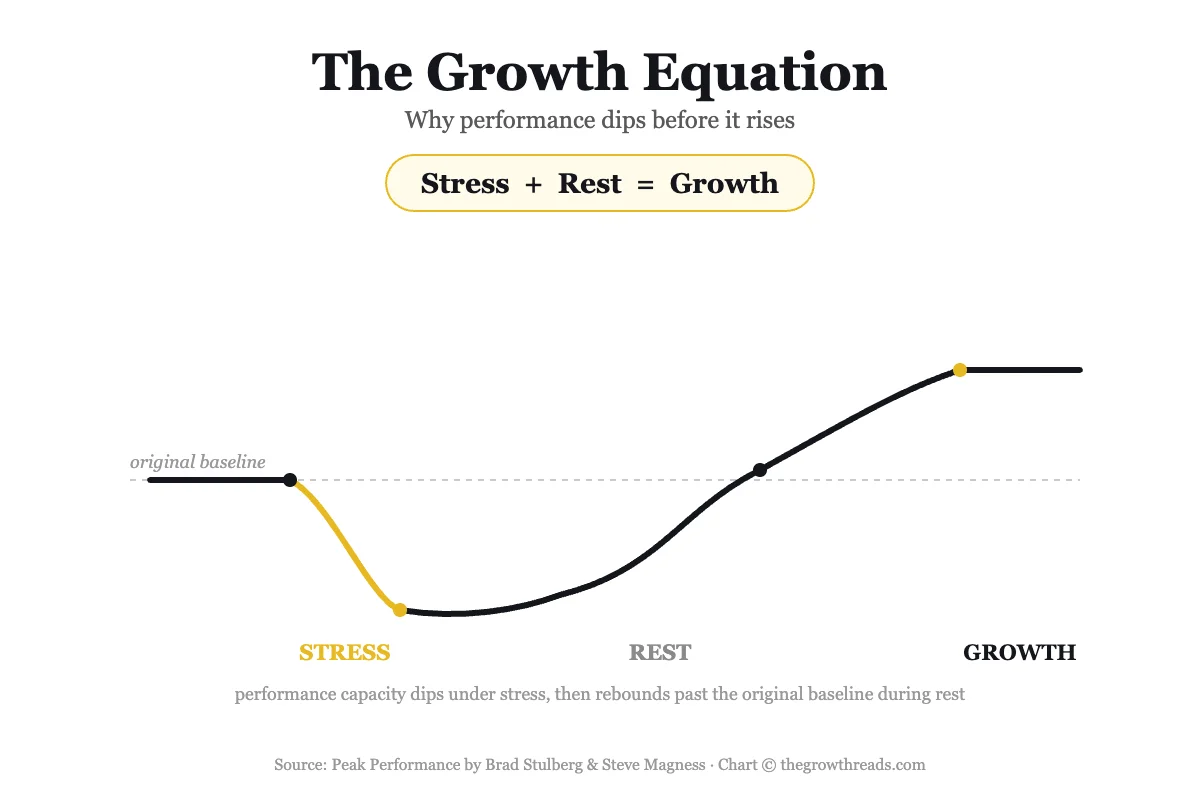
Pushing harder is not the same as getting better — and past a certain point, it’s the opposite. Brad Stulberg, a former McKinsey consultant turned performance writer, and Steve Magness, an exercise physiologist and elite running coach, combine sports science, psychology, and case studies from athletes, artists, and executives into one formula: Stress + Rest = Growth. Neither stress nor rest alone produces adaptation. It’s the specific combination — a stimulus just beyond your current ability, followed by genuine recovery — that builds real capacity. The book maps out how to prime yourself for hard efforts, find the intrinsic purpose that sustains motivation longer than willpower can, and structure the recovery that actually makes the stress pay off instead of just accumulating as fatigue.
Key takeaways
- The Growth Equation: Stress + Rest = Growth — the book’s core formula, and it holds across sports, art, and knowledge work alike.
- Not all stress builds you: only stress paired with genuine recovery produces adaptation; unrecovered stress just accumulates as damage.
- Prime yourself before big efforts: a consistent pre-performance routine frees up mental energy for the work itself instead of burning it on decisions.
- Purpose beats willpower: an intrinsic reason for the work sustains effort far longer than willpower or external rewards ever do.
- Manageable overload works best: a stimulus just past your current ability beats a rare, heroic, maximal push every time.
- Fatigue is information, not weakness: persistent tiredness, irritability, or a plateau are signals to rest, not signs to grind harder.
- Recovery has to be deliberate: real sleep, real unplugging, and genuine rest activities — not passive screen time mistaken for rest.
- Community normalizes rest: mentors and peers who openly back off make it easier for you to actually take recovery seriously.
- Single-task the recovery too: full presence during rest matters as much as full presence during effort.
- Sustainable beats heroic: consistent, well-recovered effort compounds further over time than sporadic, unsustainable pushes.
What is Peak Performance about?
Peak Performance, by Brad Stulberg and Steve Magness, distills sports science and psychology into one formula for growth: Stress + Rest = Growth. Drawing on research and case studies from elite athletes, artists, and executives, the authors show that sustainable high performance comes from cycles of manageable stress paired with genuinely deliberate recovery — not from grinding harder.
About the authors
Brad Stulberg spent years as a McKinsey consultant before shifting to writing about performance, health, and the science of sustainable success; he now coaches executives and athletes and writes a widely read newsletter on the same themes. Steve Magness is an exercise physiologist and elite-level running coach who has trained Olympic-caliber athletes and worked inside the world of competitive distance running, giving him a research-grounded, inside view of how real athletes actually push their limits and recover. The two paired their complementary backgrounds — one in organizational psychology and writing, one in physiology and coaching — to write Peak Performance (2017), which translates lab research and elite-sport case studies into a framework usable by anyone chasing sustainable growth, not just athletes. They later co-authored a follow-up on building mental toughness, Do Hard Things.
Key concepts at a glance
| Concept | What it means | Use it when |
|---|---|---|
| The Growth Equation | Stress + Rest = Growth; neither alone produces adaptation | Deciding how to structure a demanding project or training block |
| Priming | A consistent pre-performance routine that reduces decision fatigue | You’re about to start a big, high-stakes effort |
| Purpose | An intrinsic reason for the work that outlasts willpower | Motivation keeps fading despite external rewards |
| Manageable overload | A stimulus just beyond current ability, not a maximal one-off push | Designing a challenge that should actually build capacity |
| Fatigue as signal | Persistent tiredness or a plateau means recover, not push harder | Results stall despite putting in more effort |
| Deliberate recovery | Sleep, unplugging, and full-presence rest activities | Planning the days around a hard stress period |
| Community support | Mentors and peers who normalize both pushing and backing off | Building a sustainable environment around your goals |
Part 1: The Growth Equation — why stress alone isn’t enough
Stulberg and Magness ground their argument in a principle exercise physiologists have understood for decades: the body adapts to stress during recovery, not during the stress itself. A hard workout creates microscopic damage in muscle tissue; it’s during the rest that follows that the tissue rebuilds, slightly stronger than before. Push again before that rebuilding finishes and you don’t get stronger — you get injured. The authors extend this same logic, backed by research on the general adaptation syndrome first described by endocrinologist Hans Selye, well beyond the gym: writing, studying, leading a team, and building a business all follow the identical pattern. A demanding stimulus followed by real recovery builds capacity. A demanding stimulus followed by more demand just builds fatigue.
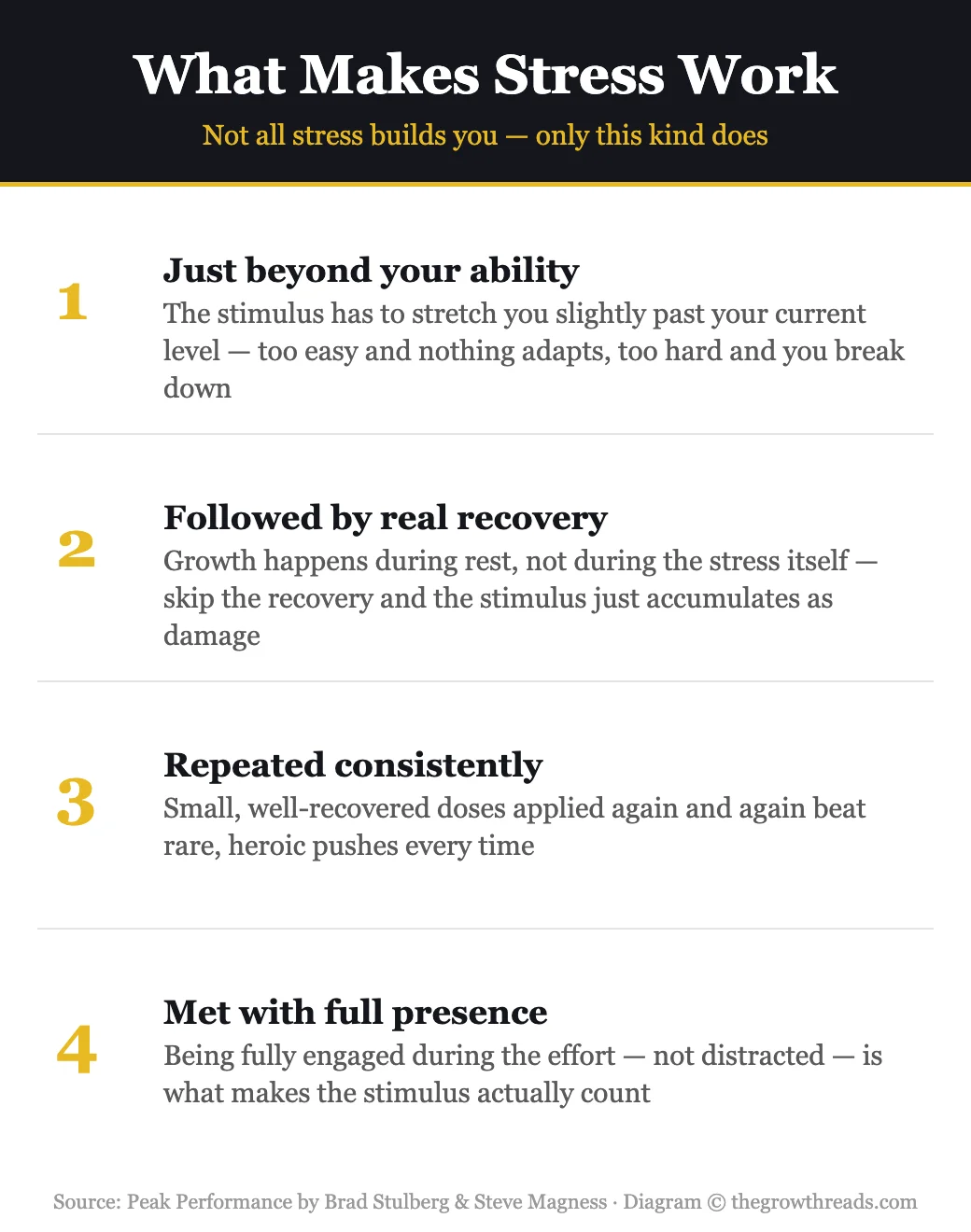
What makes stress productive, rather than merely depleting, comes down to a few specific conditions the authors return to throughout the book. The stimulus needs to sit just beyond your current ability — challenging enough to require real effort, not so overwhelming that it produces panic instead of adaptation. It needs genuine recovery afterward, not a return to a different kind of demand. And it needs to be repeated consistently, in manageable doses, rather than saved up for rare, heroic pushes that leave you flattened for a week afterward.
TGR Note: This “manageable dose, repeated consistently” logic is the same engine behind the energy-management ideas in Time Rich — sustainable systems beat sporadic heroics in both books.
Part 2: Priming and purpose — preparing to push hard
Before the stress itself, Stulberg and Magness spend real time on how elite performers get ready for it. Priming is the first piece: a consistent pre-performance routine — the same warmup, the same short ritual, the same first small task — that removes decision-making from the equation right when focus is most needed. Elite athletes rely on this constantly, and the authors argue knowledge workers can borrow the same trick: a two-minute ritual before a hard writing session does real cognitive work by signaling to the brain that it’s time to focus, before a single word gets written.
The second piece is purpose. Drawing on self-determination theory and its distinction between intrinsic and extrinsic motivation, the authors show that people who connect their hard work to an internal sense of meaning sustain effort through setbacks that would derail someone motivated purely by external rewards like money, status, or approval. This isn’t a call to find grand, world-changing purpose in every task. It’s a case for knowing your actual “why” clearly enough that it survives the inevitable days when the stress outweighs the reward.
TGR Note: The purpose-over-willpower argument pairs well with Solving the Procrastination Puzzle, which tackles the emotional side of why willpower alone so often fails us.
Part 3: When pushing harder backfires
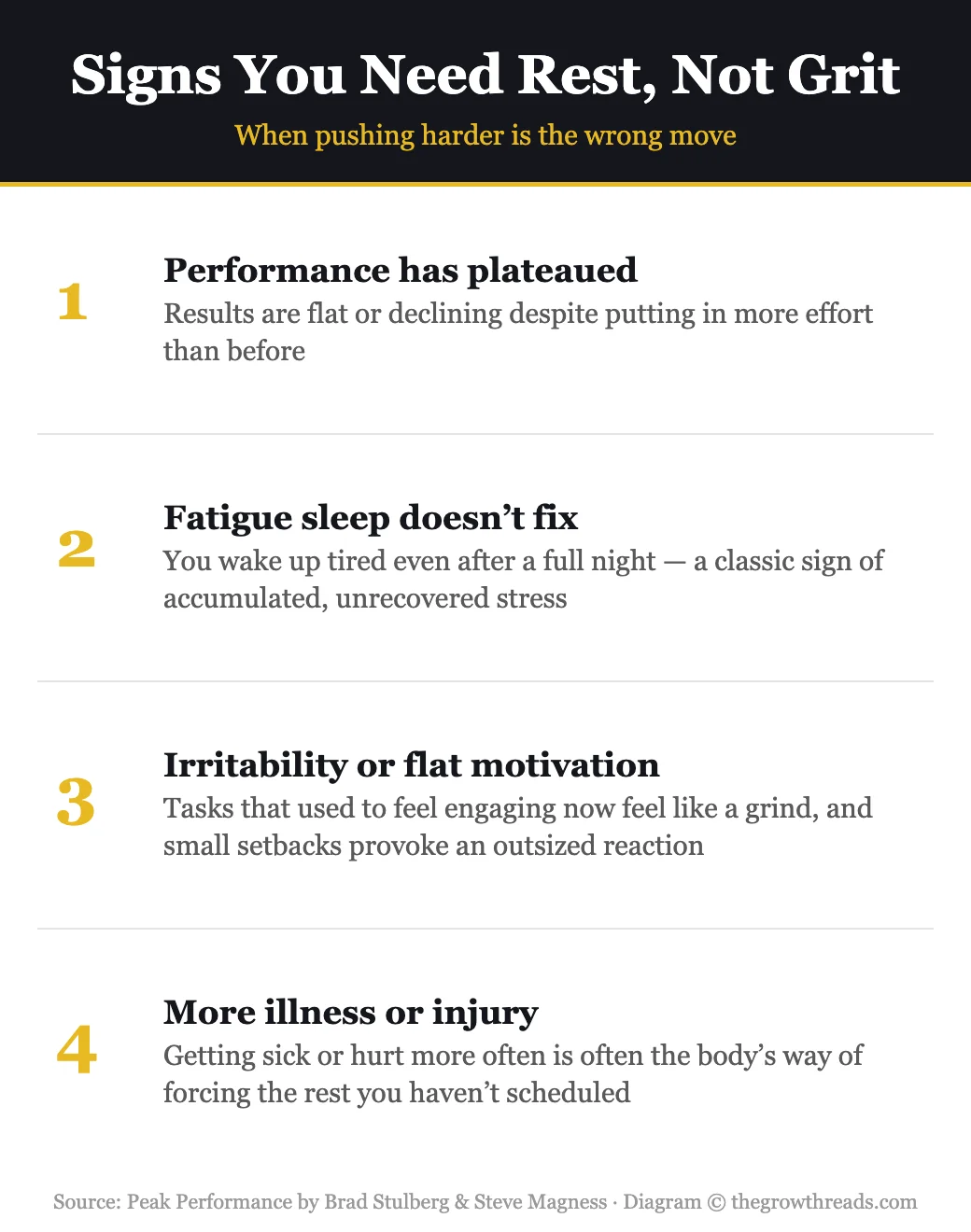
The book’s most useful diagnostic section covers what happens when stress accumulates without enough recovery to match it — a state athletes call overtraining and everyone else usually just calls burnout. The warning signs are consistent whether the “training” is a marathon block or a demanding quarter at work: performance plateaus or declines despite more effort, fatigue that a full night’s sleep doesn’t resolve, irritability and flattened motivation for tasks that used to feel engaging, and a noticeable uptick in getting sick or injured. Stulberg and Magness are direct about why this matters: these symptoms are usually read as evidence that more effort or more discipline is needed, when they’re actually the body and mind signaling the opposite.
The fix the authors propose isn’t stopping altogether — it’s recalibrating the stress-to-rest ratio before it does lasting damage. That means noticing the signals early, rather than waiting for a full collapse to force the issue, and treating a deliberate pull-back as a legitimate part of the training plan rather than a failure of it.
TGR Note: If this pattern sounds familiar, The Ruthless Elimination of Hurry covers the same “always-on” trap from a slower-living angle rather than a performance-science one.
Part 4: Building the recovery system
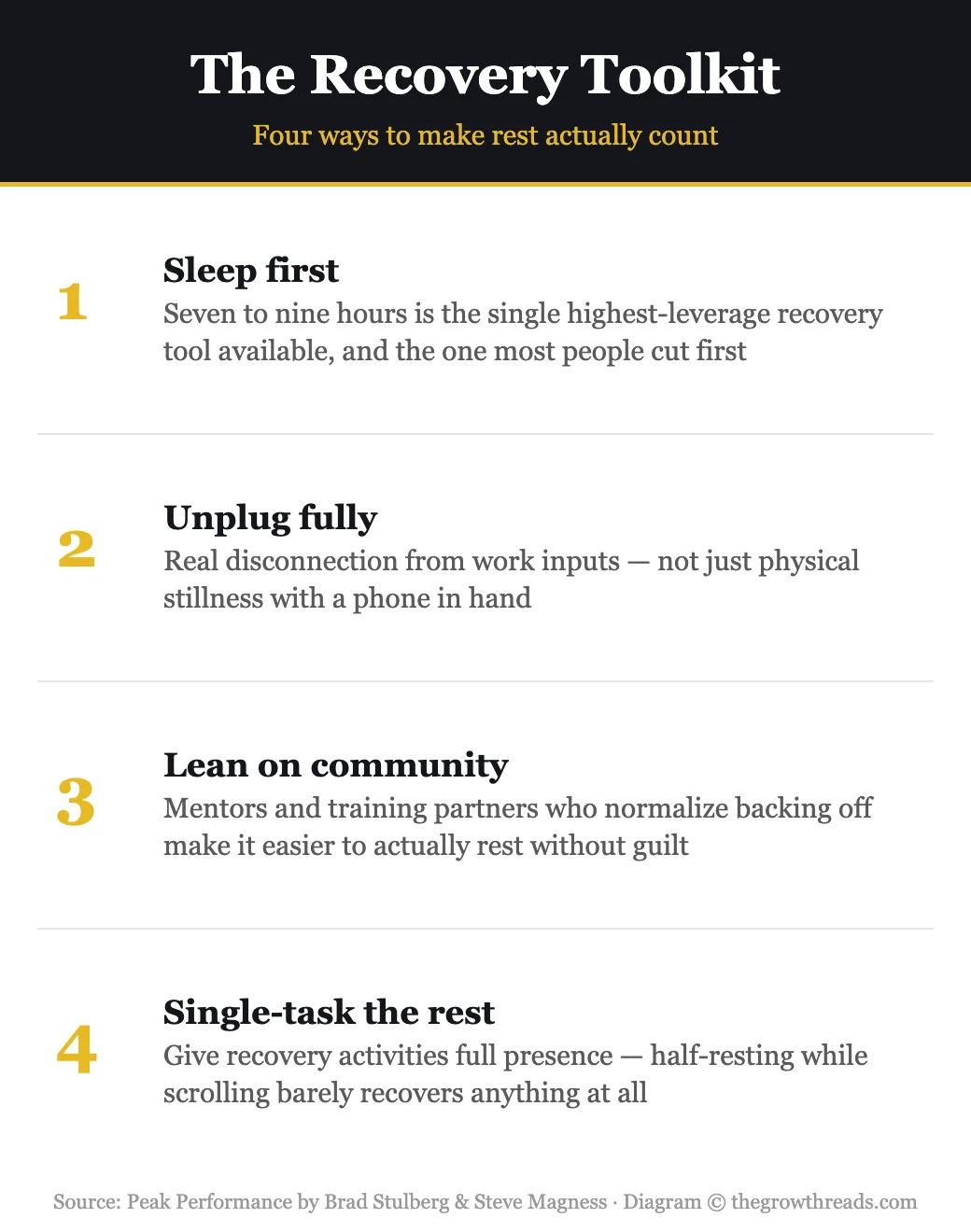
The final section turns recovery from a vague intention into an actual system. Sleep gets top billing — seven to nine hours, treated as the single highest-leverage recovery tool available, and usually the first thing cut when life gets busy. Unplugging is the second pillar, and the authors are specific about what counts: real disconnection from work inputs, not physical stillness with a phone still in hand generating the same low-grade stress as being at a desk. The third pillar is community — mentors, coaches, and peers who model backing off as a normal, even necessary, part of high performance, which makes it dramatically easier to actually rest without guilt. The last piece ties back to priming: giving recovery activities the same single-tasked, fully present attention given to hard efforts, since half-resting while distracted barely recovers anything at all.
TGR Note: Sleep as non-negotiable infrastructure is a theme that shows up across nearly every book we’ve covered in this collection, including Time Rich — it’s rarely the exciting takeaway, but it’s consistently the highest-leverage one.
Who is Peak Performance best for — and who should read something else first?
Peak Performance is best suited to athletes, founders, and executives chasing ambitious goals who keep hitting diminishing returns from sheer effort, and who want the underlying science rather than just encouragement to “take a break.” If what you need first is a concrete system for finding and protecting time itself, Time Rich is the more tactical starting point. If your real obstacle is emotional avoidance rather than an overtraining pattern, Solving the Procrastination Puzzle addresses that directly. And if the whole framing of optimizing performance feels exhausting in itself, The Ruthless Elimination of Hurry offers a gentler entry point into slowing down.
Questions to reflect on
- Where have you been pushing harder lately without seeing better results — and what would recalibrating the stress-to-rest ratio look like there?
- What’s your actual “why” for your current biggest goal — is it intrinsic, or borrowed from someone else’s expectations?
- Do you have a priming ritual before your hardest work, or does every session start from a cold, distracted state?
- Which of the overtraining warning signs — plateaued results, persistent fatigue, irritability, getting sick more often — sound familiar right now?
- Who in your life or work models backing off as a legitimate, even necessary, part of high performance?
🔥 Ready to build sustainable growth instead of burnout?
Grab a copy of Peak Performance and start applying the Growth Equation this week.
How to apply Peak Performance (7-day plan)
- Day 1: Notice one place you’ve been pushing harder without better results — that’s a signal to investigate, not a personal failing.
- Day 2: Build a two-minute pre-work priming ritual — same seat, same starting task — and use it before your hardest work today.
- Day 3: Write down your actual “why” for your current biggest goal, and check whether it’s really yours or borrowed from someone else.
- Day 4: Design tomorrow’s hardest task to sit just beyond your current ability, not a repeat of something you’ve already mastered.
- Day 5: Protect seven to nine hours of sleep tonight with no exceptions, and notice how it changes tomorrow’s focus.
- Day 6: Fully unplug for one recovery activity today — no phone, no multitasking, just the activity itself.
- Day 7: Tell one person your plan to deliberately back off this week, so someone else helps normalize the rest with you.
Frequently asked questions
What is the Growth Equation in Peak Performance?
The Growth Equation is the book’s central formula: Stress + Rest = Growth. Neither stress nor rest alone produces adaptation or improvement. A demanding stimulus — physical, creative, or intellectual — followed by genuine recovery is what builds real capacity over time. Skip the rest and stress just accumulates as fatigue or injury; skip the stress and there’s nothing to adapt to in the first place. The formula applies to athletic training, creative work, and professional growth alike.
Is Peak Performance only useful for athletes?
No. While Steve Magness’s background is in elite distance running and much of the book’s research comes from sports science, the authors are explicit that the same growth mechanism applies to writers, executives, students, and anyone doing demanding cognitive or creative work. The case studies span professional athletes, artists, and business leaders, and the practical advice — priming, purpose, manageable overload, deliberate recovery — is written to generalize well beyond sport.
How much rest does the book recommend?
The book doesn’t prescribe one universal amount, since the right ratio depends on the intensity of the stress involved. What it does insist on is that recovery needs to be proportional to the stress applied and genuinely restorative rather than passive — seven to nine hours of sleep as a baseline, plus real unplugged time rather than screen time mistaken for rest. The core principle is matching recovery to load, not hitting a fixed number.
What’s the difference between good stress and bad stress, according to the book?
Good stress sits just beyond your current ability, is followed by genuine recovery, and is repeated in manageable, consistent doses. Bad stress is either too far beyond your current capacity to produce adaptation rather than overwhelm, or it’s stress that never gets a real chance to recover before the next demand arrives. The difference isn’t the intensity of the stress itself — it’s whether recovery is built into the cycle around it.
Does Peak Performance address burnout specifically?
Yes, extensively, though it frames burnout through the lens of overtraining — a mismatch between stress applied and recovery received, sustained long enough to produce plateaued performance, persistent fatigue, irritability, and increased illness or injury. The book’s proposed fix is catching this pattern early through its warning signs and deliberately recalibrating the stress-to-rest ratio, rather than waiting for a full collapse to force the issue.
What are some quick, practical takeaways from Peak Performance?
Three are easy to start today: build a short, consistent priming ritual before your hardest work; treat persistent fatigue or a performance plateau as a signal to rest rather than push harder; and protect genuinely unplugged recovery time — sleep and real disconnection — with the same seriousness you’d give an important meeting.
How does Peak Performance compare to Atomic Habits or Deep Work?
Atomic Habits focuses on building the small, consistent behaviors that compound into results. Deep Work focuses on protecting and structuring focused effort itself. Peak Performance sits alongside both but zooms out further, addressing the full cycle of stress and recovery that determines whether any habit or focused-work practice is sustainable over months and years rather than just an intense week or two before burnout resets progress to zero.
Related summaries
- Time Rich by Steve Glaveski
- Solving the Procrastination Puzzle by Timothy A. Pychyl
- The Ruthless Elimination of Hurry by John Mark Comer
- Best Productivity Books
How we analyze books: our summaries are researched from the author’s published work, interviews, and reputable secondary sources, then structured around practical application rather than critique. Read our full methodology.