

★★★★☆ 4.4/5 — The definitive diagnosis of why an entire generation feels perpetually, structurally exhausted.
Best for: Millennials (and the managers, partners, and parents of millennials) who suspect their exhaustion isn’t a personal failing.
Reading time: ~7 hrs to read the book, 12 min for this guide.
Difficulty to apply: Moderate — the insights land instantly, but undoing the habits takes real practice.
Can’t Even in one minute
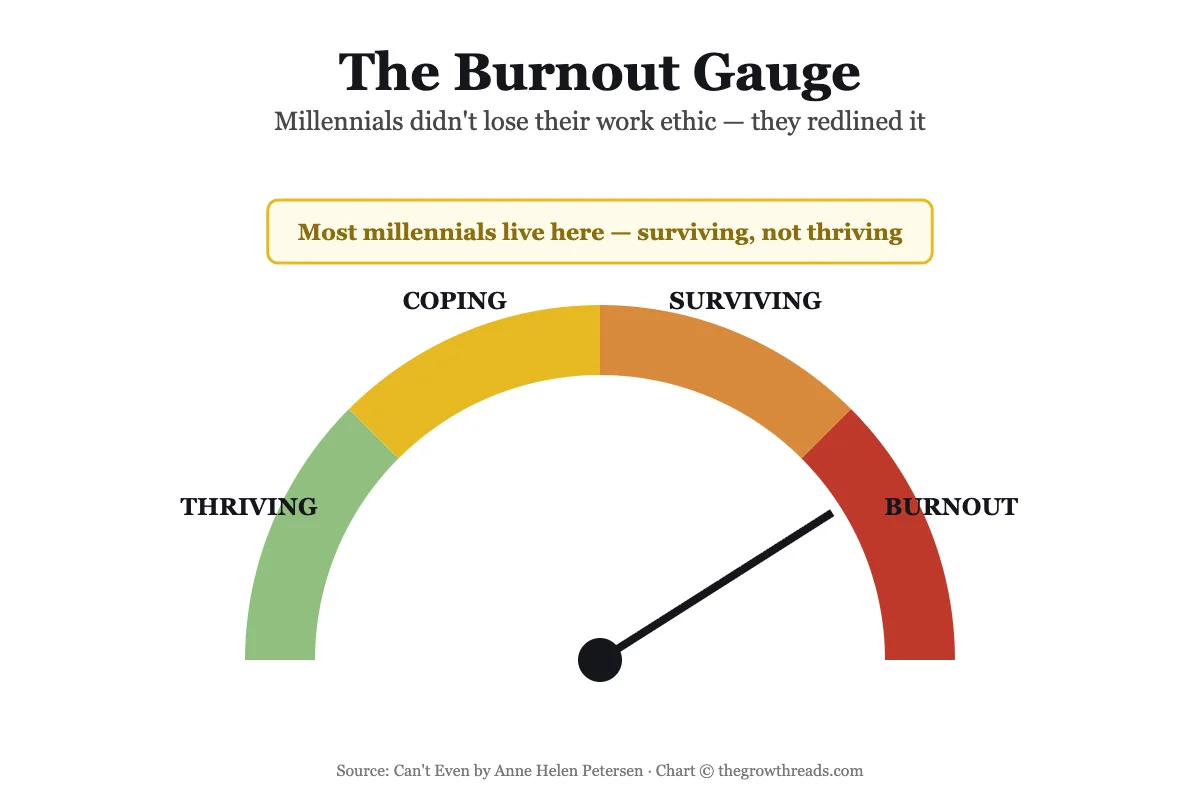
Millennial burnout isn’t a mood — it’s an operating condition, and it was built on purpose. Anne Helen Petersen, expanding on her viral 2019 BuzzFeed essay, argues that millennials were raised to optimize every hour of childhood into a résumé, sent into a labor market that broke its promises, and handed technology that turned the remaining scraps of leisure into more work. The result is a generation stuck in “errand paralysis” — unable to do the simplest task, like renewing a license or mailing a package, because they are simply out of the reserves it takes to start. Can’t Even doesn’t offer a five-step fix for burnout because burnout, in Petersen’s telling, isn’t an individual glitch. It’s the predictable output of childhoods engineered for achievement, an economy that quietly shifted risk onto workers, and a culture that rebranded exhaustion as passion. The book’s real gift is naming the condition precisely enough that readers stop blaming themselves for a system working exactly as designed — and can start building the boundaries that make daily life livable again.
Key takeaways
- Burnout is structural, not personal: chronic exhaustion is the predictable result of economic and cultural forces, not a character flaw or a time-management failure.
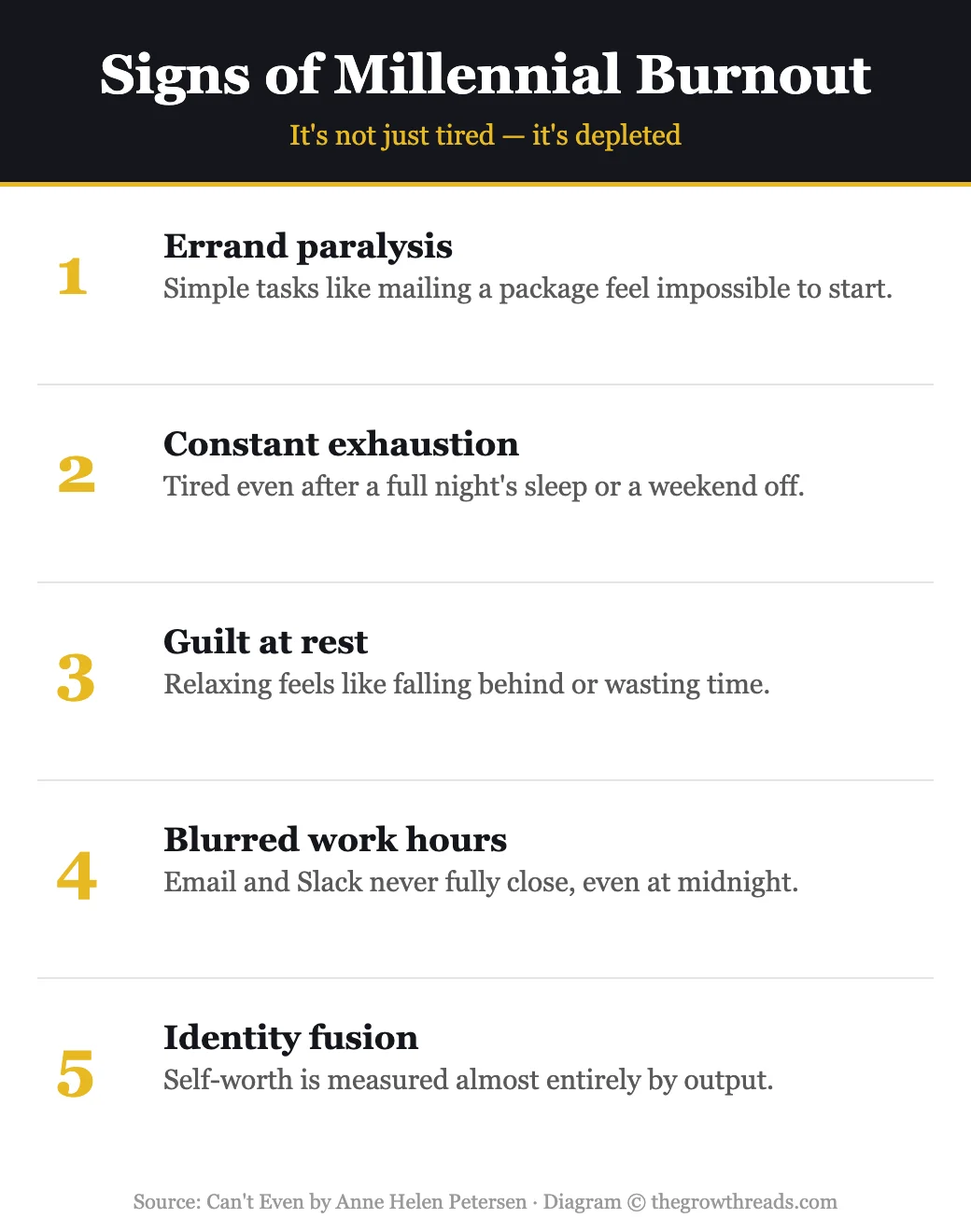
- Errand paralysis is a real symptom: the inability to complete simple tasks — a phone call, a form, a return — signals depleted reserves, not laziness.
- Childhood got optimized: résumé-building activities replaced unstructured play, teaching millennials early that rest has to be earned.
- The gig economy shifted risk downward: stable jobs with benefits were replaced by flexible, precarious work that off-loads risk onto individuals.
- “Do what you love” is a trap: workism convinces people to accept exploitation because the work is framed as identity, not just a job.
- Technology erased the boundary between on and off: smartphones turned every unclaimed minute into potential work time.
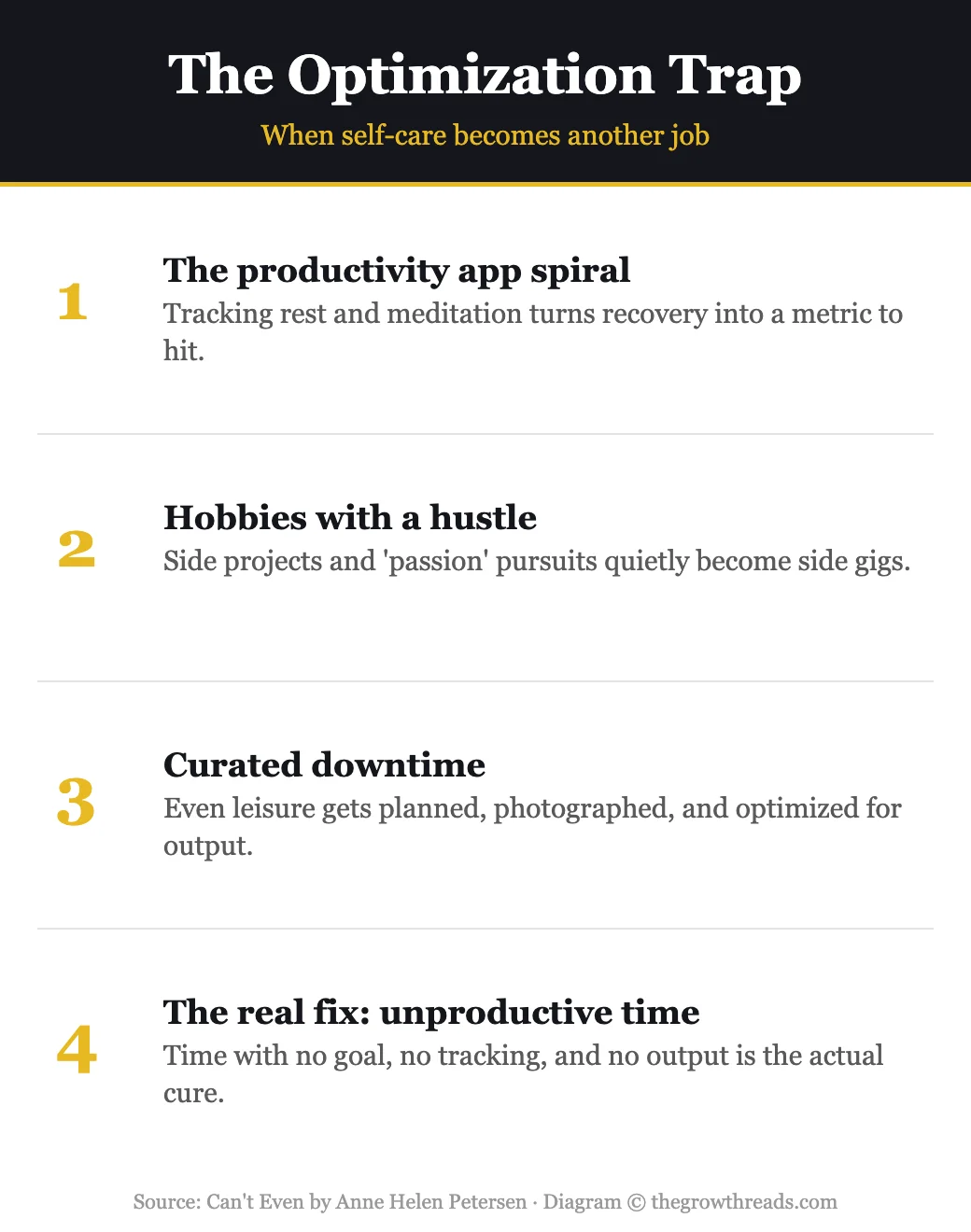
- Self-care can become another job: optimizing rest, tracking meditation, and curating downtime just adds a new layer of performance.
- Millennials were sold a broken promise: work hard, get credentialed, and stability follows — a bargain the 2008 recession and rising costs quietly voided.
- Burnout is collective, so the fix is partly collective: naming the condition out loud, at work and at home, is the first step toward changing it.
- Individual boundaries still matter: systemic diagnosis doesn’t mean personal action is pointless — small, enforced boundaries reclaim real hours.
What is Can’t Even about?
Can’t Even is Anne Helen Petersen’s argument that millennial burnout is a structural condition, not a personal one — built from optimized childhoods, a broken economic bargain, precarious gig work, and technology that erased any boundary between “on” and “off.” It explains why so many millennials feel perpetually exhausted and unable to complete basic tasks, and reframes that exhaustion as a rational response to real conditions, not a flaw to fix alone.
About the author
Anne Helen Petersen is a journalist and culture writer best known for her viral 2019 BuzzFeed News essay “How Millennials Became the Burnout Generation,” which became the seed for this book. She holds a PhD in media studies from the University of Texas at Austin, where her research focused on celebrity gossip and cultural criticism. Before BuzzFeed, she taught media studies and wrote for outlets covering pop culture and labor. She now writes the widely read newsletter Culture Study, where she continues reporting on work, burnout, rural America, and the systems shaping everyday life. Her reporting blends academic rigor with an accessible, conversational voice, which is a large part of why the original essay resonated so widely before it became this book. Explore all Anne Helen Petersen book summaries →
Key concepts at a glance
| Concept | What it means | Use it when |
|---|---|---|
| Errand paralysis | Inability to start simple tasks because reserves are depleted | A form sits unopened for weeks and you don’t know why |
| Workism | Treating work as identity and meaning, not just income | You feel guilty taking a full lunch break or a real vacation |
| The optimization of childhood | Structured, résumé-building activities replacing free play | Reflecting on why rest feels like it must be “earned” |
| Precarity | Chronic instability in jobs, healthcare, and housing | Explaining why gig or contract work feels exhausting beyond the hours worked |
| Shadow work | Unpaid tasks tech and employers quietly shift onto individuals | Self-checkout, DIY IT support, or “personal branding” eats your evening |
| Errand-list optimization | Turning rest and self-care into another tracked, measured task | A meditation app streak feels more stressful than calming |
| Collective burnout | Recognizing exhaustion as shared, not isolated, to reduce shame | Naming the condition out loud with a team or family |
Part 1: How childhood became a résumé
Petersen traces millennial burnout back further than the first job — to childhood itself. Where prior generations had unstructured after-school hours, many millennials were raised inside a schedule of enrichment: travel soccer, debate club, volunteer hours, SAT prep, all pursued not for enjoyment but for how they would look on a college application. The message, absorbed early and often, was that time only counts if it’s producing something visible. Rest had no line item, so it came to feel unearned, even suspicious.
This is not a critique of any individual parent’s choices — Petersen is clear that parents were responding rationally to a college admissions arms race and a shrinking margin for error. But the downstream effect was a generation that entered adulthood already fluent in self-optimization and already uneasy with unscheduled time. That unease doesn’t disappear once the college acceptance letter arrives; it just finds a new target, whether that’s a job title, a side hustle, or a curated Instagram grid.
Part 2: The broken bargain of workism
The traditional deal — study hard, get credentialed, and a stable career with benefits follows — quietly stopped being true for millennials, even as the cultural script kept insisting it was. Wages stagnated relative to the cost of housing and education, and the 2008 recession hit many millennials right as they entered the job market, permanently denting their earning trajectories. Rather than update the deal, work culture rebranded itself: instead of a paycheck, work became a “passion,” a “calling,” something you should be grateful to do even when it doesn’t pay enough to live on.
Petersen calls this workism, and she’s careful to show how it recruits willing participants. Loving your job, or being told to love it, makes it much harder to object to unpaid overtime, unclear boundaries, or “opportunities” that are really just more unpaid work. The gig economy formalized this shift, replacing salaried stability with flexible, on-demand labor that moves risk — of illness, slow seasons, and no benefits — from the company onto the individual, all while marketing itself as freedom.
Part 3: When rest becomes another task
One of the book’s sharpest observations is how thoroughly self-care itself got colonized by the same optimization logic it was supposed to counter. Meditation apps track streaks. Wellness culture markets rest as a productivity hack — sleep better so you can perform better — rather than as something valuable in its own right. Even hobbies aren’t safe: a “passion project” quietly becomes a side gig with an audience to grow and metrics to hit.
Petersen’s answer is blunt: the fix isn’t a better-optimized version of rest, it’s genuinely unproductive time — time with no tracker, no goal, and no output to show for it. That’s uncomfortable for anyone raised to believe unaccounted-for time is wasted time, which is precisely why she treats it as a skill to rebuild rather than a switch to flip.
Part 4: Naming it out loud
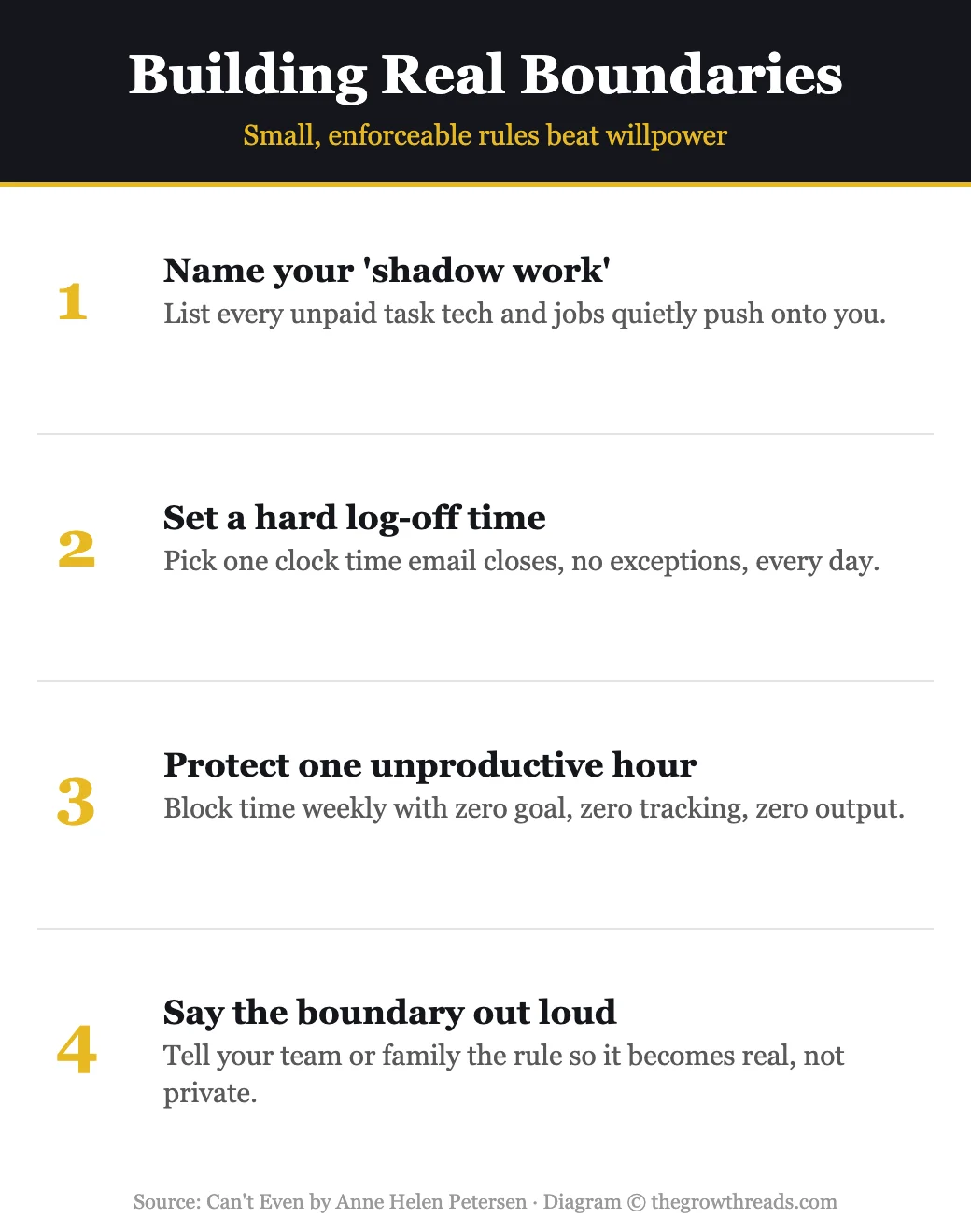
Because Petersen frames burnout as structural, she resists offering a tidy individual fix — but she doesn’t leave readers with nothing to do, either. The first real move, in her account, is naming the condition precisely, out loud, to the people around you: a manager, a partner, a team. Shame thrives in silence, and much of millennial burnout is quietly assumed to be a personal failing until someone says otherwise. Once it’s named as shared and structural, boundaries stop feeling like excuses and start feeling like reasonable requests.
From there, she points toward both collective and individual levers: pushing for saner workplace norms where possible, and, at the personal level, protecting specific hours and rituals that don’t get negotiated away. Neither cancels the other out. The system-level diagnosis doesn’t make the personal boundary-setting pointless; it makes it sustainable, because it’s no longer propped up by self-blame that erodes the moment things get busy.
Who is Can’t Even best for — and who should read something else first?
Can’t Even is best for millennials who feel chronically depleted and have quietly wondered if something is wrong with them specifically, as well as managers, partners, and parents who want to understand that exhaustion instead of dismissing it. It’s also valuable for anyone in a caregiving or service profession where “do it for the passion” rhetoric masks real overwork.
If you’re looking for a step-by-step personal productivity system rather than a cultural diagnosis, start with Zen to Done instead. If your exhaustion is more about a racing inner critic than external structural pressure, Chatter is the more targeted read. And if you want a performance-science lens on sustainable effort rather than a cultural-critique one, Peak Performance is the better starting point.
Questions to reflect on
- Which of your current habits were shaped by “optimized childhood” thinking — the sense that time only counts if it produces something?
- Where in your life has “do what you love” been used to justify unpaid or unreasonable demands on your time?
- What does genuinely unproductive time look like for you, with no tracker and no goal attached?
- Who could you name your burnout to out loud this week, instead of carrying it silently?
- What is one boundary you could set and actually enforce, rather than just intend?
🔥 Ready to understand your own burnout?
Get Can’t Even and see your exhaustion as a system, not a personal failure.
How to apply Can’t Even (7-day plan)
- Day 1: Write down every task you’ve been avoiding — the errand-paralysis list — without judging why.
- Day 2: Pick one item from that list and do only that one thing, then stop for the day.
- Day 3: List your “shadow work” — unpaid tasks tech or your job quietly pushes onto you.
- Day 4: Set one hard log-off time and hold it, even if work feels unfinished.
- Day 5: Block one hour of genuinely unproductive time — no tracker, no goal, no output.
- Day 6: Name your burnout out loud to one person — a manager, partner, or friend.
- Day 7: Choose one boundary from this week to keep permanently, and tell someone so it’s real.
Frequently asked questions
What is the main argument of Can’t Even?
Anne Helen Petersen argues that millennial burnout is a structural condition produced by optimized childhoods, a broken economic bargain, precarious gig work, and technology that erases the boundary between work and rest — not a personal failing or a time-management problem individuals can simply fix alone.
What does “errand paralysis” mean?
It’s the experience of being unable to complete a simple task — mailing a package, making a call, filling out a form — not from laziness but because your reserves are so depleted that even a small task feels like more than you can start.
Is Can’t Even only about millennials?
The book focuses on millennials because Petersen traces specific generational forces — the 2008 recession, rising education costs, and optimized childhoods — but the underlying dynamics of workism and shifted risk apply to later generations facing similar pressures too.
Does the book offer practical solutions, or is it just diagnosis?
It leans heavily toward diagnosis, and some readers wish for more concrete steps. Petersen does point toward naming burnout collectively and protecting specific boundaries, but she deliberately avoids a tidy fix, since she sees the causes as structural rather than personal.
How is this different from general books about workplace stress?
Most stress and productivity books treat burnout as an individual problem to manage with better habits. Petersen instead argues burnout is a rational response to real economic and cultural conditions, which reframes the goal from “manage your stress better” to “understand why the stress exists.”
Some of the generational claims in the book have been debated — should that concern readers?
Some critics note that generational framing can overgeneralize across class, race, and geography. That’s a fair caveat, and readers should treat the generational lens as one useful frame rather than a universal law — the practical insights about workism, precarity, and boundary-setting hold up regardless.
What’s the single most useful idea to take from this book?
That burnout isn’t a sign of personal weakness to hide, but a shared condition worth naming out loud — which makes boundary-setting feel legitimate instead of like an excuse, and opens the door to both personal and collective change.
Related summaries
- Chatter by Ethan Kross
- Peak Performance by Brad Stulberg & Steve Magness
- Zen to Done by Leo Babauta
- Stillness Is the Key by Ryan Holiday
- Best Productivity Books
How we analyze books: our team reads each title in full, cross-references the author’s other published work and interviews, and builds original diagrams and application plans rather than summarizing chapter by chapter. Read our full methodology.