

★★★★☆ 4.4/5 — A refreshing, practical case for building a business around a life, not the other way around.
Best for: Freelancers, solopreneurs, and small-team founders questioning whether “grow at all costs” is actually the goal.
Reading time: ~6 hrs to read the book, 12 min for this guide.
Difficulty to apply: Moderate — the mindset shift is quick, but resisting growth pressure takes ongoing discipline.
Company of One in one minute
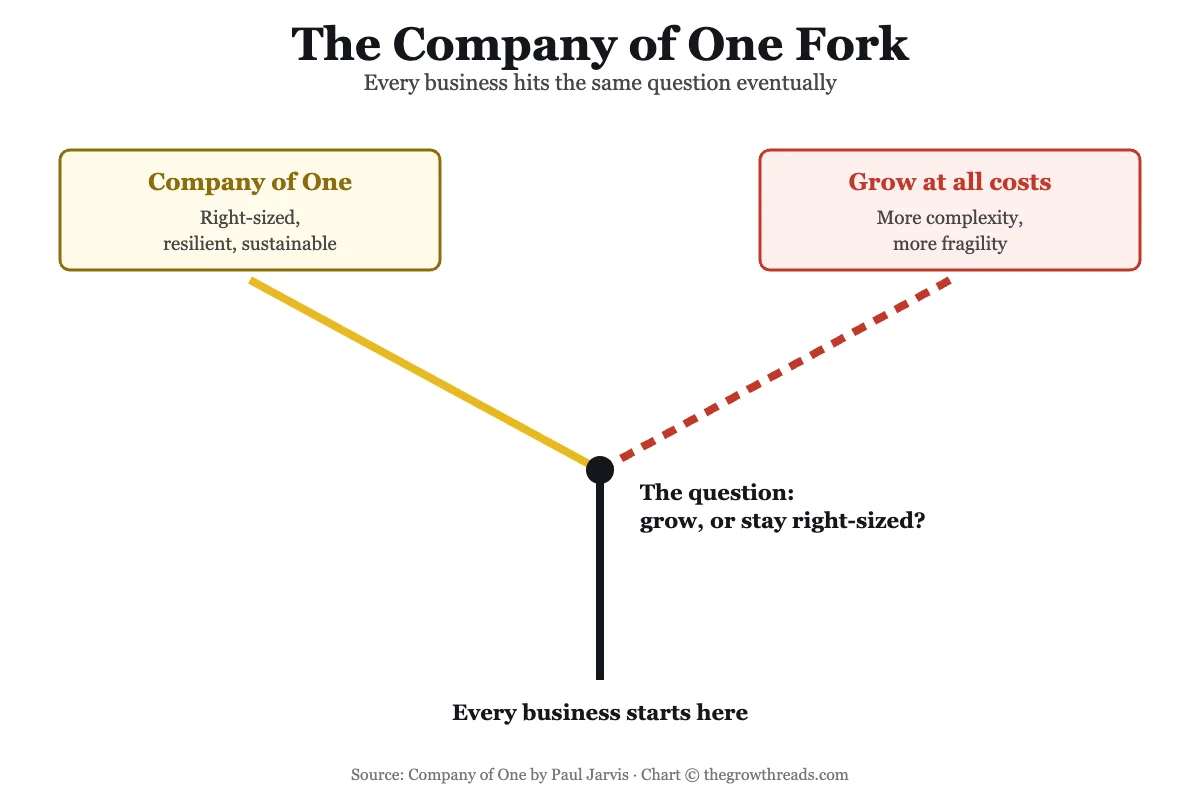
What if the healthiest goal for your business isn’t bigger, but better-fitted to the life you actually want? Paul Jarvis, a designer and long-time solo consultant, challenges the default assumption that growth is always the right next move. Drawing on his own decades of staying deliberately small and profitable, plus interviews with dozens of other “companies of one,” he argues that scaling up trades away exactly the things that made a business worth building in the first place: autonomy, quality, and resilience. Instead of asking “how do I grow?” Jarvis pushes readers to ask “how big is enough?” — then design systems, automation, and customer relationships around that number instead of an ever-expanding one. The book isn’t anti-ambition; it’s anti-growth-by-default. Staying small, done on purpose, can be the most resilient and personally sustainable path a business ever takes.
Key takeaways
- Growth isn’t automatically good: more staff and overhead add fragility, not just capability.
- “Enough” is a number you choose: define the specific revenue that funds the life you want, then stop chasing past it.
- Resilience beats scale: a lean, adaptable company of one can pivot faster than a large organization.
- Automate before you hire: systems and tools should absorb repeatable work before headcount does.
- Diversify income, not headcount: multiple smaller revenue streams cushion shocks better than one big client.
- Own the relationship with your audience: a direct connection with customers outlasts any single platform’s algorithm.
- Every “yes” has a cost: new clients, features, and commitments should be audited against your defined “enough.”
- Quality often survives better at a smaller scale: service and craft are easier to protect without rapid scaling pressure.
- A no-growth quarter is a valid strategy: deliberately holding size steady can be as strategic as expanding.
- The right size is personal: there’s no universal answer — it depends on the life you’re actually trying to build.
What is Company of One about?
Company of One is Paul Jarvis’s argument that businesses should question growth as a default goal and instead define “enough” — a specific size that supports the life and quality the owner actually wants. It shows how automation, diversified income, and direct customer relationships let a deliberately small business be more resilient and sustainable than one chasing constant expansion.
About the author
Paul Jarvis is a designer, writer, and longtime independent consultant who spent over two decades working for himself, including as a designer for clients like Mercedes-Benz and Warner Music before shifting fully into writing and building small software products. He co-created ConvertKit’s early alternative, Fathom Analytics, while continuing to run lean, deliberately unscaled businesses rather than pursuing venture funding or rapid headcount growth. His firsthand experience staying small and profitable for decades — rather than academic theory — is the foundation the book’s advice is built on, which gives its arguments a practical, tested credibility. Explore all Paul Jarvis book summaries →
Key concepts at a glance
| Concept | What it means | Use it when |
|---|---|---|
| Company of one | A business deliberately kept small rather than scaled by default | Questioning whether your next hire or expansion actually serves your goals |
| Enough | The specific revenue number that funds your desired life, defined on purpose | Deciding when to stop chasing more and start protecting what you have |
| Resilience | The ability to absorb shocks without collapsing | Weighing a big new client against the risk of overdependence |
| Automation over headcount | Using systems and tools to handle repeatable work instead of hiring | A task keeps recurring and eating time you’d rather spend elsewhere |
| Owned audience | A direct relationship with customers, independent of any platform | Building an email list or community instead of relying only on social reach |
| Right-sizing | Matching business size to personal goals, not market potential | Evaluating whether “bigger” is actually solving a real problem for you |
Part 1: Questioning growth as the default
Jarvis opens by naming an assumption so common it rarely gets questioned: that a healthy business must keep growing. He traces this expectation to venture-funded startup culture, where growth isn’t just preferred but required to satisfy investors — a dynamic that has nothing to do with most small and solo businesses, yet still shapes how they’re expected to think about success. The book’s first move is simply permission: it’s legitimate to build something that stays the same size on purpose.
This isn’t a case against ambition. Jarvis is explicit that a company of one can still be ambitious about quality, impact, or income — it just decouples ambition from headcount and scale. The real question the book wants readers to sit with isn’t “how do I grow?” but “growth toward what, and at what cost?”
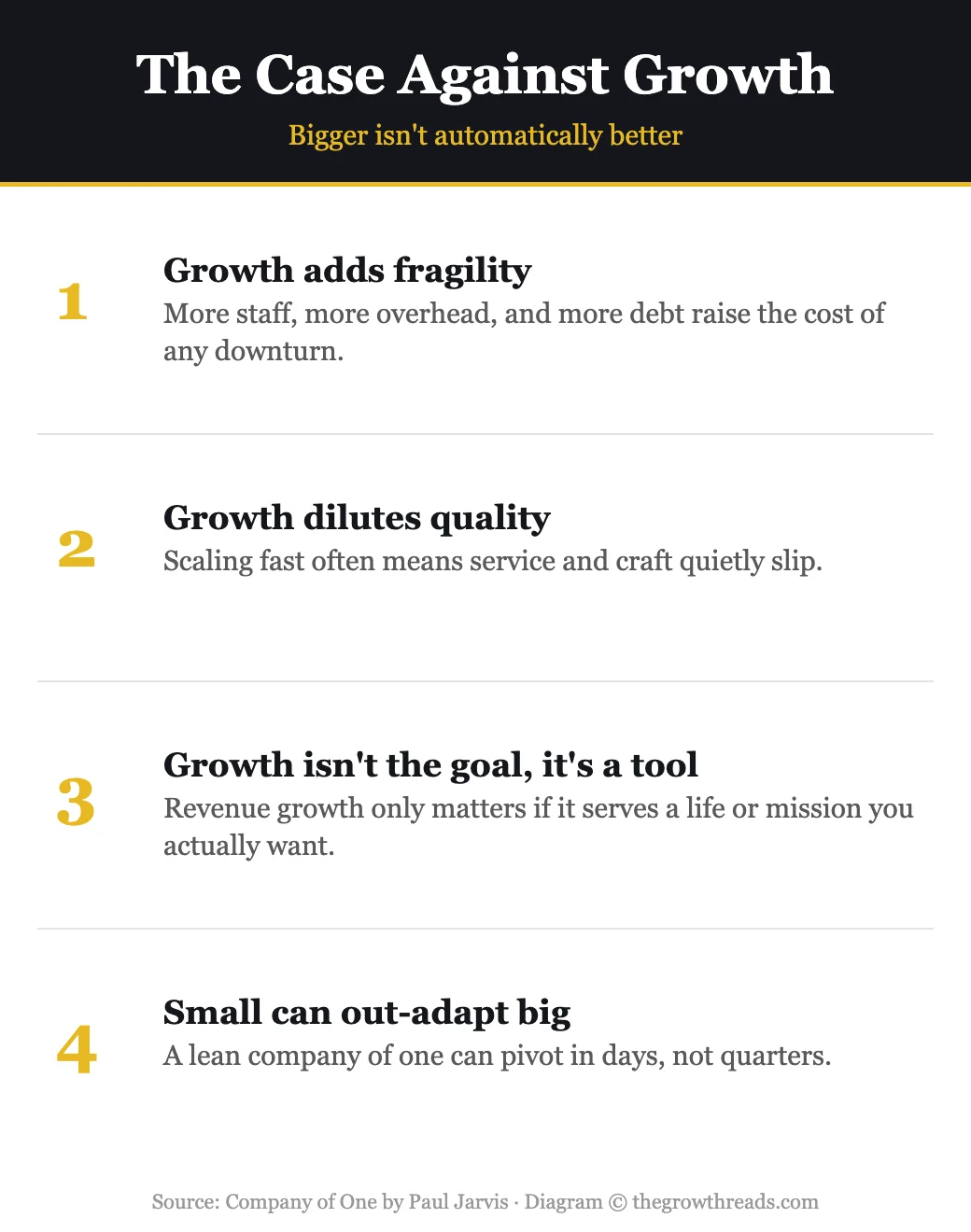
Jarvis also pushes back on the idea that staying small means staying stagnant. He profiles several companies of one that kept refining their offer, raising prices, and deepening expertise for years without ever adding headcount — proof that “not growing bigger” and “not improving” are entirely different things. The goal isn’t to freeze in place; it’s to grow in depth, quality, and mastery instead of only in size.
Part 2: Building resilience instead of scale
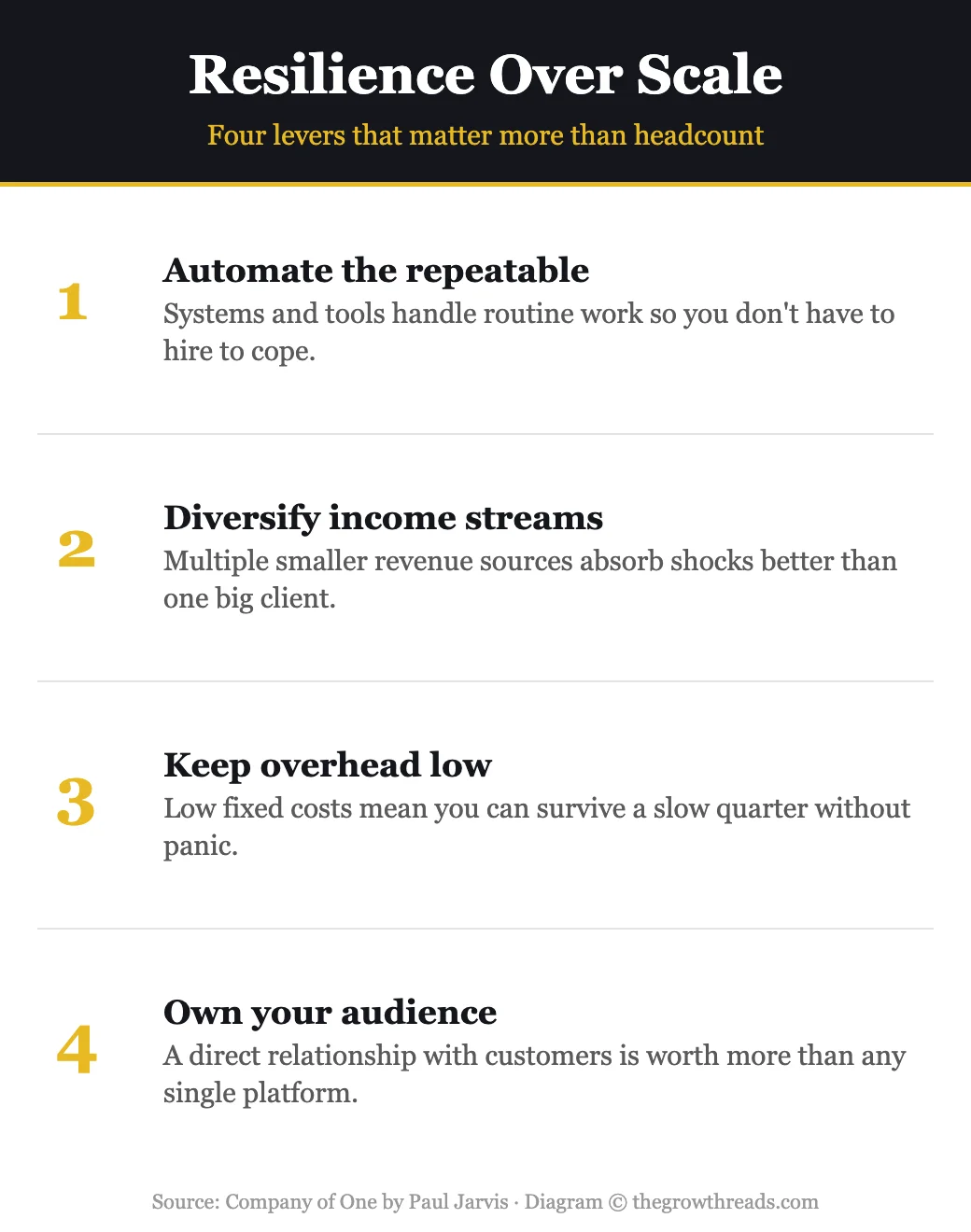
Once “enough” replaces “more” as the goal, the book pivots to how to make a small business durable rather than merely small. Automation is the first lever: routine, repeatable tasks should go to systems and tools before they go to new hires, since headcount adds ongoing cost and management overhead that a good system doesn’t. The second lever is income diversification — several smaller, independent revenue streams absorb a lost client far better than one dominant contract does.
The third and most overlooked lever is owning the relationship with your audience directly, rather than renting it from a platform. An email list or direct community survives an algorithm change or platform policy shift; a following built entirely on a single social network does not. Jarvis treats this as risk management as much as marketing — diversifying not just income, but the channels that generate it.
Part 3: Protecting quality at a small scale
A recurring theme is that rapid scaling and quality are often in direct tension. Jarvis walks through examples of businesses that scaled fast and watched service, craft, or customer relationships quietly erode in the process — not from bad intentions, but because scale itself changes what’s possible to maintain. A founder who once knew every customer personally can’t do that at ten times the size, no matter how much they want to.
Staying small preserves the option to keep standards high because there’s simply less to coordinate and less that can silently slip. That doesn’t mean every company of one automatically has better quality — it means quality is easier to protect deliberately when growth pressure isn’t constantly forcing tradeoffs.
Part 4: Designing your right size on purpose
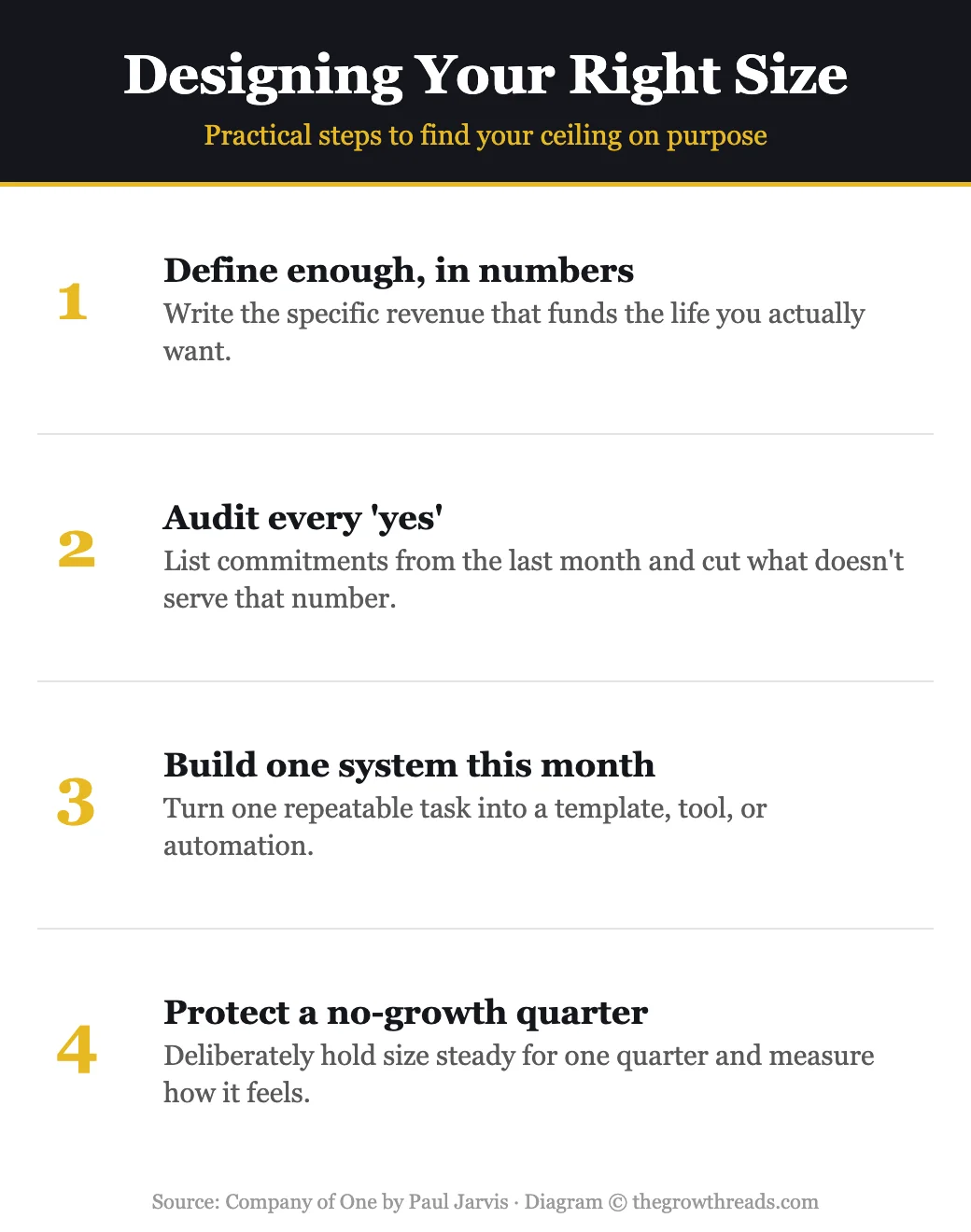
The book’s most actionable section walks through how to actually define and defend a right size. It starts with putting a real number on “enough” — the specific revenue that funds the life you want, not an abstract aspiration. From there, every new opportunity, client, or feature request gets evaluated against that number rather than against generic ambition.
Jarvis also recommends periodically auditing existing commitments, since scope tends to creep in even for companies that never intended to grow. A genuinely radical suggestion he makes is protecting a deliberate no-growth quarter — holding size steady on purpose, then paying attention to how that actually feels, rather than assuming more is always better without ever testing the alternative.
He’s also candid about the tradeoffs: staying small usually means a lower ceiling on total revenue and less market dominance than an aggressively scaled competitor might achieve. For readers who genuinely want to build the next major platform company, this book’s advice isn’t the right fit — and Jarvis says so directly rather than pretending small is the universally superior choice. The case he makes is narrower and more useful than that: for most solo founders and small teams, the tradeoffs of scaling rarely get weighed honestly against what’s actually lost, and this book exists to make sure that weighing happens on purpose.
Who is Company of One best for — and who should read something else first?
Company of One is best for freelancers, consultants, and small-team founders who feel pressure to scale but suspect it might not actually serve them. It’s also useful for anyone questioning whether “more clients” or “more revenue” is really the right next goal.
If you’re specifically dealing with burnout rather than business strategy, start with Can’t Even instead. If you want a concrete personal productivity system to support whatever size business you choose, Zen to Done is the more targeted read. And if your focus is sustainable performance rather than business sizing specifically, Peak Performance is the better starting point.
Questions to reflect on
- What specific number would represent “enough” revenue to fund the life you actually want?
- Which recent business decision was driven by growth-by-default rather than a real need?
- Where does your business currently depend on one client, platform, or channel more than is safe?
- What’s one repeatable task you could automate this month instead of planning to hire for it?
- What would you protect about your work right now that faster growth would put at risk?
🔥 Ready to design your right-sized business?
Get Company of One and build resilience instead of chasing scale.
How to apply Company of One (7-day plan)
- Day 1: Write down the specific revenue number that would fund the life you actually want.
- Day 2: List every current client, commitment, or project and flag anything that doesn’t serve that number.
- Day 3: Identify one repeatable task and start building a system or automation to handle it.
- Day 4: Check your income sources — note how dependent you are on any single client or platform.
- Day 5: Start or strengthen one owned channel, like an email list, independent of any platform.
- Day 6: Say no to one opportunity that doesn’t serve your defined “enough.”
- Day 7: Block a no-growth week on your calendar and notice how holding steady actually feels.
Frequently asked questions
What is the main argument of Company of One?
Paul Jarvis argues that businesses should question growth as an automatic goal and instead define a specific “enough” — a size that funds the life the owner wants — then build resilience through automation, diversified income, and owned customer relationships rather than through constant expansion.
Is this book against growing a business?
No — it’s against growing by default without questioning why. Jarvis is clear that ambition and ongoing improvement are fine; the book simply argues growth should be a deliberate choice serving a real goal, not an assumed requirement for a business to be considered successful.
Who is a “company of one” in practice?
It can be a literal solo freelancer or consultant, or a small team that has deliberately chosen not to scale headcount further, relying instead on systems, automation, and focused offerings to serve more customers without proportionally growing staff.
How is this different from typical startup or business growth books?
Most business books assume growth is the goal and focus on how to achieve it faster. This book questions that premise directly, making the case that staying deliberately small can be a more resilient and personally sustainable strategy than scaling.
Does the book give concrete steps, or is it mostly philosophy?
Both — it opens with the philosophical case against growth-by-default, then moves into concrete practices: automating repeatable work, diversifying income, owning your audience, and periodically auditing commitments against a defined “enough.”
Can this advice work for a business that isn’t solo?
Yes, with adjustment — the core principles of resilience, automation, and defining “enough” apply to small teams too, though a team will need to define that “enough” collectively rather than around one person’s individual life goals.
What’s the single most useful idea to take from this book?
That “how big is enough?” is a more useful question than “how do I grow?” — defining a real number turns an open-ended, anxiety-inducing goal into a concrete target you can actually design a business, and a life, around.
Related summaries
- Can’t Even by Anne Helen Petersen
- Zen to Done by Leo Babauta
- Peak Performance by Brad Stulberg & Steve Magness
- The Time Paradox by Philip Zimbardo & John Boyd
- Best Productivity Books
How we analyze books: our team reads each title in full, cross-references the author’s other published work and interviews, and builds original diagrams and application plans rather than summarizing chapter by chapter. Read our full methodology.