

★★★★☆ (4.2/5) — GTD’s structure, minus the overwhelm: ten small habits, added one at a time.
Best for: Anyone who has tried and abandoned a complex productivity system before and needs something that actually survives a busy week.
Reading time: ~1.5 hrs to read (80 pages) · ~15 min to skim this guide
Difficulty to apply: Easy — that is the entire point of the book.
Zen to Done in one minute
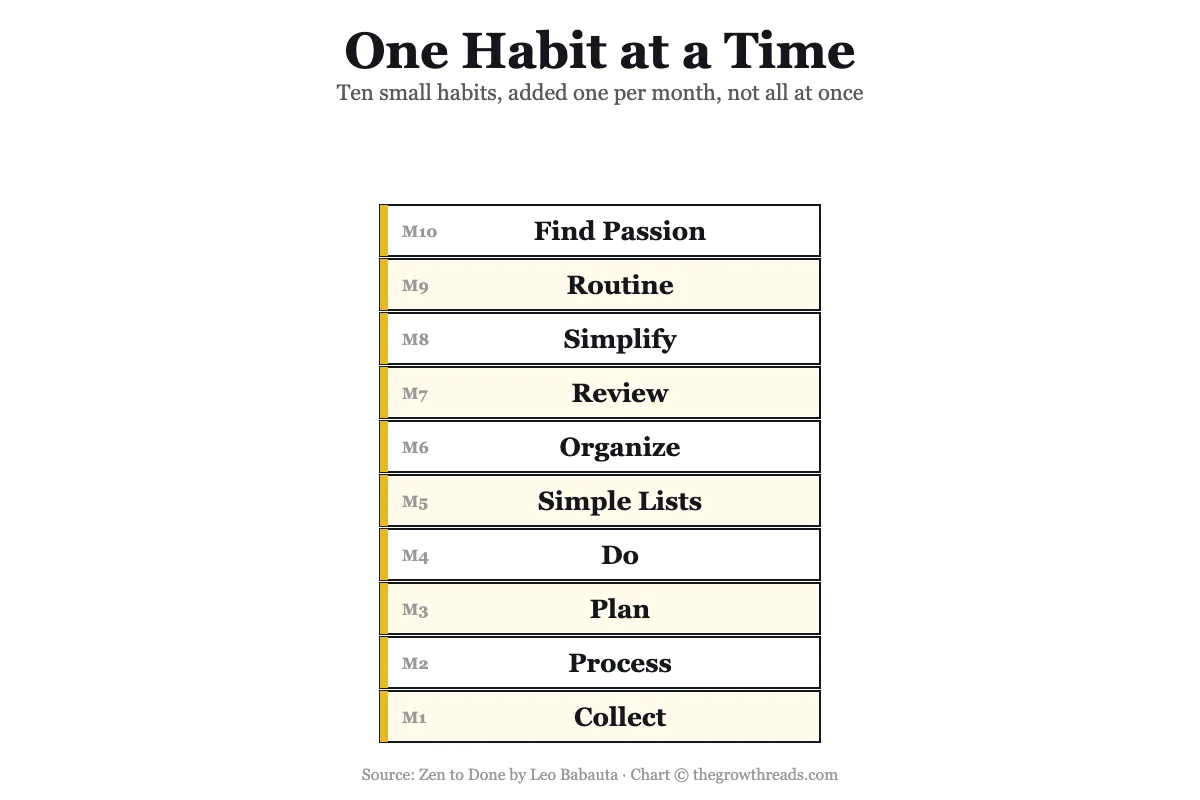
Most productivity systems fail not because they’re wrong, but because they ask for too much change at once. Leo Babauta, creator of the blog Zen Habits, built Zen to Done (ZTD) as a direct response to burning out on David Allen’s Getting Things Done — a system he respected but could never sustain because it asked him to overhaul his entire workflow simultaneously. ZTD keeps GTD’s most useful mechanics — a single capture inbox, a next-action mindset, a weekly review — and strips out the rest, then adds Babauta’s real innovation: implementing the resulting ten habits one at a time, roughly a month apart, so each one is fully automatic before the next gets introduced. The result is a slower start but a system with a far higher survival rate.
Key takeaways
- Complexity kills systems, not intentions: the simplest system you’ll actually run beats the best one you’ll abandon within a month.
- One habit at a time: install each ZTD habit for about a month before adding the next one on top of it.
- Collect everything in a single inbox: a scattered capture system defeats the purpose of capturing anything at all.
- Process on a fixed schedule: decide the next action for each item at a set time, not whenever you happen to feel like it.
- Pick one to three MITs daily: a short list of Most Important Tasks beats an unranked wall of to-dos.
- Single-task with a timer: divided attention quietly degrades every task it touches.
- Keep lists short and plain: an elaborate system is itself a source of friction, not a solution to it.
- Review weekly, without exception: the review is what keeps the whole system honest over time.
- Simplify before you optimize: cut commitments first, and only then organize what’s left.
- Passion sustains a system past willpower: aligning the work inside it with what you actually care about is what makes it stick for years, not weeks.
What is Zen to Done about?
Zen to Done, by Leo Babauta, simplifies David Allen’s Getting Things Done into ten small, plain-language habits — covering capture, planning, single-tasking, and weekly review — and introduces them one at a time, roughly a month apart, so the system actually survives daily use instead of collapsing under its own complexity.
About the author
Leo Babauta is the creator of Zen Habits, one of the web’s longest-running and most widely read blogs on simplicity, habit change, and mindful productivity, which he started in 2007 after overhauling his own health and work habits from a self-described disorganized, overweight, and indebted starting point. That personal transformation, built habit by habit rather than all at once, became the template for his writing and later for Zen to Done (2008), which he wrote specifically as an alternative to Getting Things Done after finding GTD’s full system too demanding to sustain as a real, lasting habit. Babauta has since written extensively on minimalism, mindfulness, and behavior change, but Zen to Done remains his most direct, mechanical productivity text — a short, practical distillation rather than a philosophy. Explore all Leo Babauta book summaries →
Key concepts at a glance
| Concept | What it means | Use it when |
|---|---|---|
| One habit at a time | Installing a single new habit for about a month before adding the next | Any system you’ve abandoned within the first few weeks before |
| The single inbox | One place, not several, that captures every task and idea as it arrives | Ideas and commitments are scattered across notebooks, apps, and memory |
| MITs | One to three Most Important Tasks chosen before the day starts | Your to-do list is long but nothing on it feels prioritized |
| Single-tasking | Full attention on one task at a time, often with a timer | Constant task-switching is leaving nothing fully finished |
| The weekly review | A short, fixed check-in on lists, goals, and open loops | Small commitments keep slipping through the cracks unnoticed |
| Simplify before organize | Cutting commitments first, then organizing what remains | An elaborate system feels like more work than the tasks it tracks |
| Passion alignment | Connecting the work inside the system to what you actually care about | Motivation to keep up the system is fading despite it technically working |
Part 1: Why Zen to Done exists
Babauta is candid about ZTD’s origin: he loved the logic of Getting Things Done — capture everything, clarify next actions, organize by context, review weekly — but found himself falling off the system every few months, not because the ideas were wrong but because adopting all of GTD’s practices simultaneously was simply too much behavior change at once. Anyone who has tried to overhaul their entire workflow in a single weekend and watched it unravel by the following Friday will recognize the pattern. The problem, as Babauta diagnoses it, was never GTD’s content. It was the all-at-once implementation.
ZTD’s fix is almost embarrassingly simple: take GTD’s most valuable mechanics, drop everything that adds complexity without adding proportional value, and then introduce the resulting habits one at a time, spending roughly a month on each before adding the next. A habit installed in isolation, with nothing competing for the same reserve of willpower, is far more likely to become automatic than ten habits adopted in a single ambitious week.
TGR Note: This same one-thing-at-a-time logic is echoed in Peak Performance‘s case for manageable, repeated doses of stress over rare, heroic pushes — small and sustainable consistently beats large and unsustainable.
Part 2: The four foundation habits
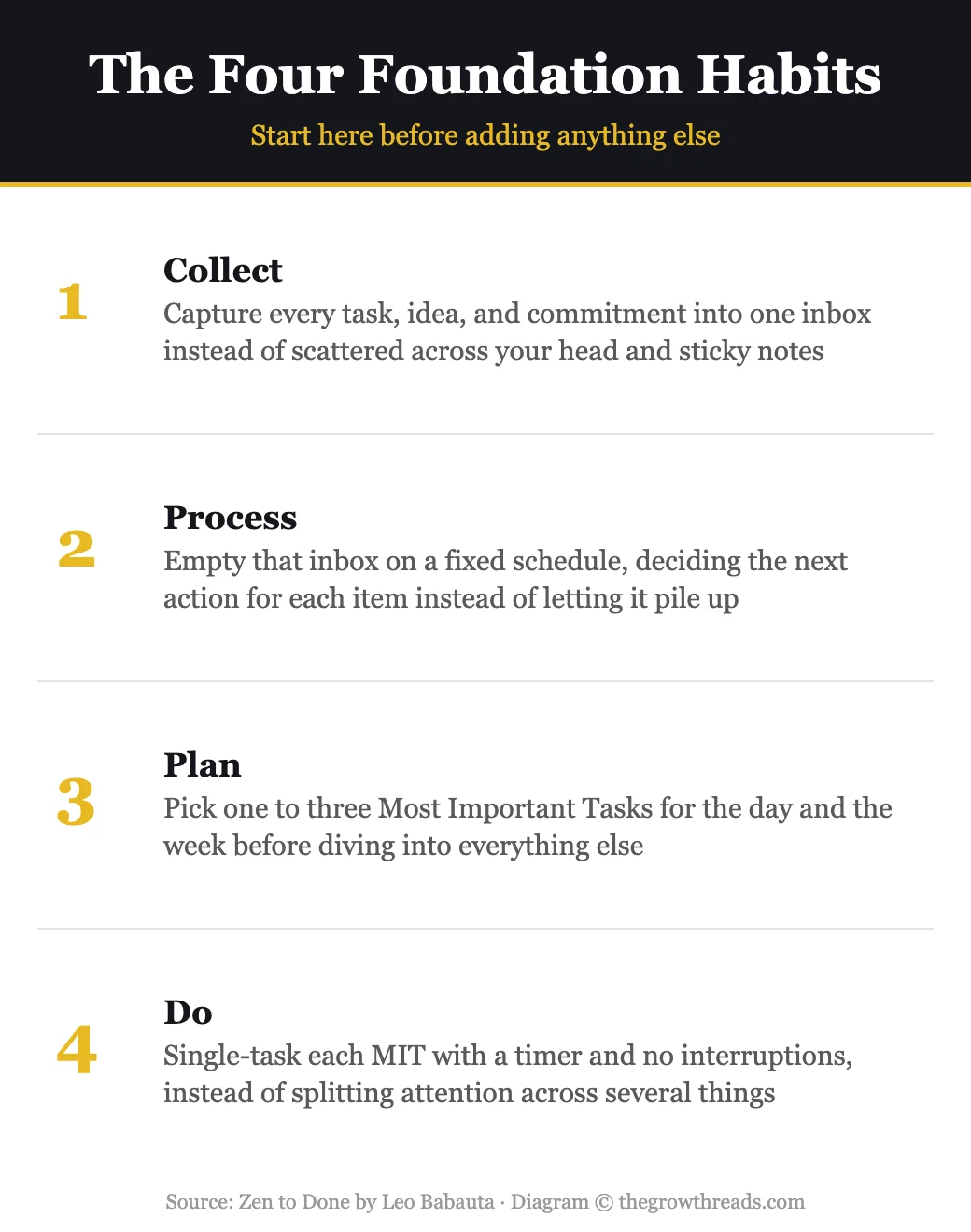
ZTD’s first four habits form a minimal but complete loop, and Babauta recommends mastering all four before touching anything else. Collect means capturing every task, idea, and commitment into a single inbox the moment it appears, rather than trusting memory or scattering notes across five different places. Process means emptying that inbox on a predictable schedule and deciding, for each item, what the next concrete action actually is. Plan means choosing one to three Most Important Tasks before the day gets going, so effort has a clear target instead of drifting toward whatever feels urgent in the moment. And Do means single-tasking each MIT, often with a timer running, protected from the interruptions that would otherwise fragment it.
TGR Note: Picking a short, ranked daily list rather than a long unranked one is the same discipline behind the MIT-style planning in Time Rich.
Part 3: The next three habits
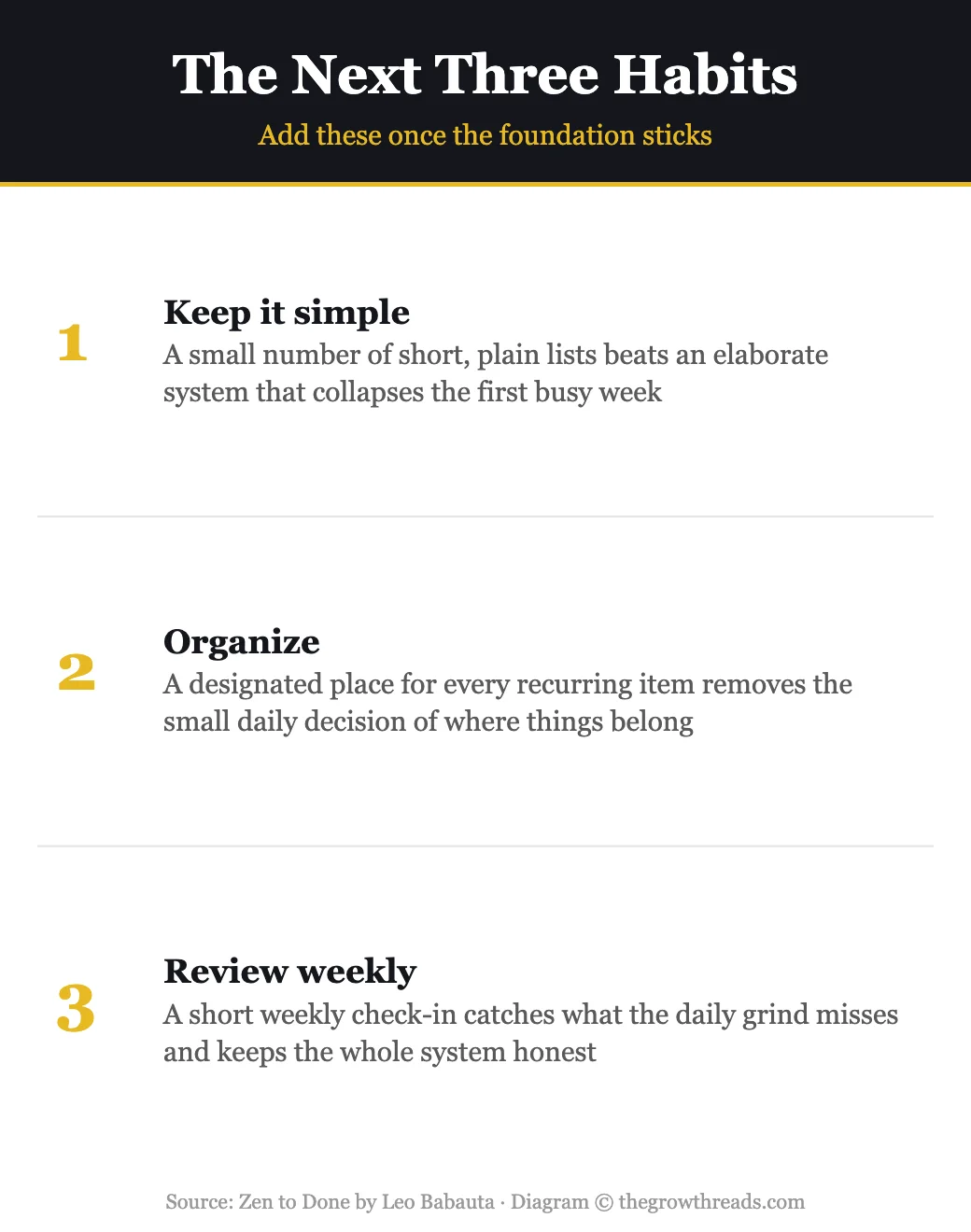
Once the foundation is automatic, Babauta adds three habits aimed at making the system durable rather than just functional. Keeping lists simple means resisting the pull toward an elaborate, feature-heavy setup — a handful of short, plain lists survives a chaotic week far better than a sprawling system with a dozen categories and tags. Organizing means giving every recurring item a fixed home, so filing something away stops being a decision made fresh every single time. And the weekly review — a short, protected block to look back over the past week and ahead to the next — is what catches the small commitments that daily execution alone tends to miss.
TGR Note: A fixed weekly review is one of the most consistently recommended habits across every productivity book in this collection — simple, unglamorous, and disproportionately effective.
Part 4: The final three habits
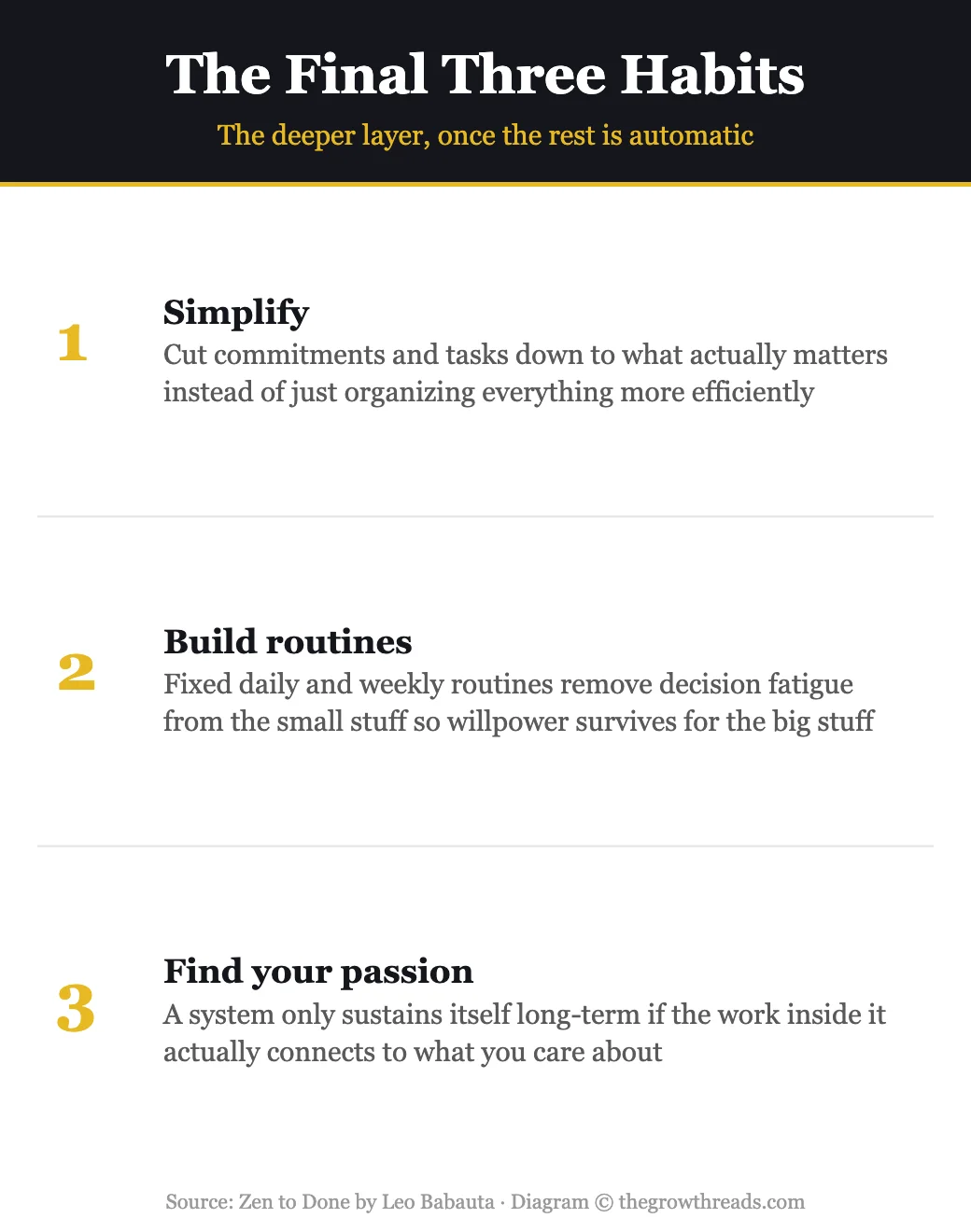
The last layer moves beyond mechanics into something closer to philosophy, and Babauta treats it as advanced work precisely because it requires the earlier habits to already be solid. Simplify asks you to cut commitments and tasks down to what genuinely matters, rather than just organizing an ever-growing pile more efficiently — the goal is a shorter list, not a better-labeled long one. Routine locks in fixed patterns for recurring decisions, freeing up willpower that would otherwise be spent re-deciding the same small things every day. And find your passion is Babauta’s closing argument for why any of this lasts: a system only survives long-term if the work running through it actually connects to something the person doing it cares about, because no amount of habit architecture outlasts genuine disinterest in the work itself.
TGR Note: The passion-alignment idea pairs well with Peak Performance‘s case for intrinsic purpose sustaining effort longer than willpower ever can.
Who is Zen to Done best for — and who should read something else first?
Zen to Done is best suited to readers who have already tried a more elaborate productivity system, GTD included, and abandoned it within a few weeks — the book’s entire value proposition is a lower-friction path to the same underlying discipline. If you haven’t tried a system yet and want a broader, more research-driven case for structuring your time first, Time Rich is a good starting point. If your real obstacle is sustaining hard effort without burning out rather than organizing tasks, Peak Performance addresses that more directly. And if scattered, reactive days are the core complaint, Stillness Is the Key tackles that from a calm-and-clarity angle rather than a systems one.
Questions to reflect on
- What is the most elaborate productivity system you’ve tried and abandoned — and what specifically made it collapse?
- Do you currently have one inbox for capturing tasks and ideas, or are they scattered across several places?
- What would change about tomorrow if you picked just one to three Most Important Tasks before it started?
- Which single ZTD habit, installed alone for a month, would make the biggest difference in your current routine?
- Does the work inside your current system actually connect to something you care about, or is it running on willpower alone?
🔥 Ready to build a system that actually sticks?
Grab a copy of Zen to Done and start with just the first habit.
How to apply Zen to Done (7-day plan)
- Day 1: Set up a single capture inbox — physical or digital — and move every scattered note and task into it.
- Day 2: Empty that inbox once, deciding a concrete next action for every item inside it.
- Day 3: Pick one to three Most Important Tasks before you open email or messages.
- Day 4: Single-task your top MIT with a timer running and every notification silenced.
- Day 5: Cut one list down to the essentials — delete or defer anything that isn’t genuinely active.
- Day 6: Schedule a recurring weekly review slot on your calendar, even just fifteen minutes.
- Day 7: Choose the one ZTD habit you’ll actually commit to for the next month, and write it down somewhere visible.
Frequently asked questions
What is Zen to Done and how is it different from GTD?
Zen to Done (ZTD) is Leo Babauta’s simplified adaptation of David Allen’s Getting Things Done. It keeps GTD’s most useful mechanics — a single capture inbox, deciding next actions, and a weekly review — but strips out much of GTD’s added complexity, and introduces the resulting ten habits one at a time, roughly a month apart, rather than all at once. The core difference isn’t the ideas; it’s the implementation pace, which Babauta designed specifically to be easier to sustain long-term.
Do I need to read Getting Things Done first?
No. Zen to Done is written to stand on its own, and Babauta explains the relevant mechanics as he introduces each habit. Familiarity with GTD can add useful context for why certain choices were made, but it isn’t required to use the book or implement its system.
How long does it take to fully implement Zen to Done?
Babauta recommends roughly one habit per month, which puts full implementation of all ten habits at around ten months. This is intentional rather than a limitation — the slow pace is the entire mechanism that makes each habit stick, and rushing multiple habits at once reproduces the exact failure mode ZTD was designed to avoid.
What are the ten ZTD habits?
In order: Collect, Process, Plan, Do, Simple (trusted) lists, Organize, Review, Simplify, Routine, and Find Your Passion. The first four form a minimal but complete productivity loop; the next three make the system durable; the final three move from mechanics into sustaining the system long-term through simplification and genuine motivation.
Is Zen to Done still relevant, or is it outdated?
The book predates most modern task-management apps, but its habits are tool-agnostic — Collect, Process, Plan, and Do work identically whether the inbox is a paper notebook or a phone app. The core insight, that implementation pace matters more than system sophistication, hasn’t aged at all, and if anything applies more directly now given how many more productivity apps and systems compete for attention today.
What are some quick, practical takeaways from Zen to Done?
Three are easy to start today: set up one single inbox for everything instead of several scattered ones; choose just one to three Most Important Tasks before starting the day; and commit to installing only one new habit at a time, giving each roughly a month before adding another.
How does Zen to Done compare to Atomic Habits?
Atomic Habits provides the general psychology of how habits form and compound, applicable to any behavior. Zen to Done is a specific, pre-built set of ten productivity habits, sequenced for you, with the one-at-a-time installation logic already baked in. Someone who has read Atomic Habits will recognize why ZTD’s pacing works; someone who hasn’t can still follow ZTD’s sequence without needing the underlying theory first.
Related summaries
- Time Rich by Steve Glaveski
- Peak Performance by Brad Stulberg & Steve Magness
- Stillness Is the Key by Ryan Holiday
- Best Productivity Books
How we analyze books: our summaries are researched from the author’s published work, interviews, and reputable secondary sources, then structured around practical application rather than critique. Read our full methodology.