

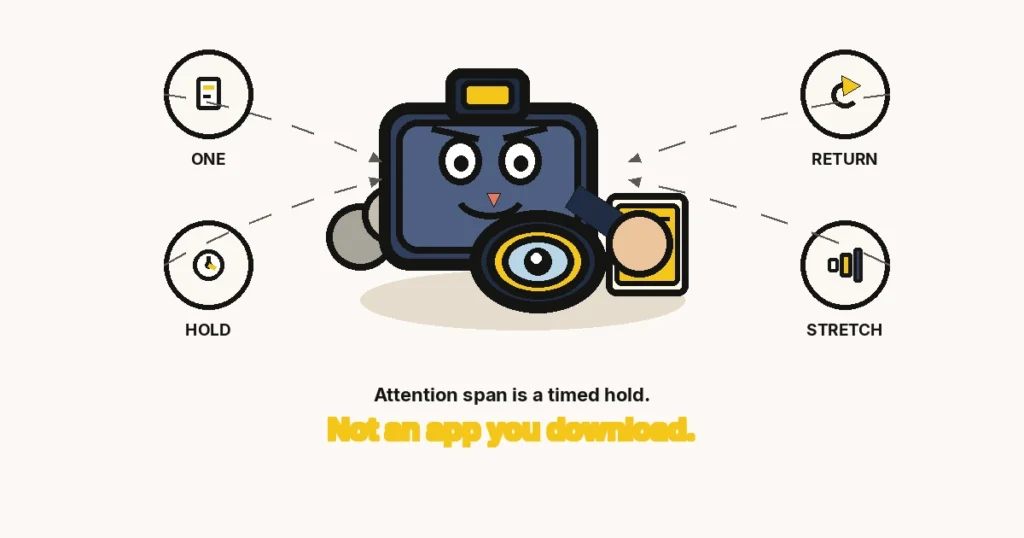
How to increase your attention span is to pick one unfinished task, put the phone in another room, run a timed hold you can actually finish, then write a return line and stretch the next session by two minutes. It is a trained window, not a goldfish number and not a brain-training app (Simons et al., 2016).
Key takeaways
- Leroy (2009) found unfinished work leaves attention residue on the next task, which is why this page starts by parking everything except one job.
- Ward, Duke, Gneezy and Bos (2017) found the mere presence of a smartphone reduced available cognitive capacity even when people did not use the phone.
- Stothart, Mitchum and Yehnert (2015) found a phone notification still pulled attention when it was not answered.
- Simons and colleagues (2016) reviewed brain-training programs and found little far transfer to general cognition — so this how-to does not sell an attention app.
- The sister page owns causes and fixes. This URL owns one timed hold, plus the two-minute stretch.
What increasing attention span actually is (and what it isn’t)
How to increase your attention span, on this page, is a work method: pick one unfinished task, park the rest, put the phone in another room, run a timed hold you can finish, write a return line if you get pulled, then stretch the next hold by two minutes. It is not a personality transplant. It is not an eight-second goldfish number. It is not a clinical test, not an ADHD protocol, and not a brain-training app. Petersen and Posner (2012) already split attention into alerting, orienting, and executive networks. This URL trains the usable window of uninterrupted work, not a single score.
That job is narrower than “have better focus.” The parent, how to focus better, owns the broader focus system. The sister, short attention span, owns causes and everyday fixes. Attention span meaning owns the definition. Barbara Oakley’s A Mind for Numbers is the book for the other half of the picture: focused mode as a timed practice, with diffuse mode as the rest, not as a mood you wait to feel. Related reading on productivity systems and summaries sits under the same roof. This page ends when the hold is timed and the next session is two minutes longer.
How is this different from the definition, the short-span page, or single-tasking?
This page trains one timed hold; attention span meaning owns the term; short attention span owns causes and fixes; single tasking is the one-channel rule. Four jobs. Four pages. If the last task is still occupying the next one, that is attention residue. If the cost is running two jobs at once, that is multitasking. If the pull is the phone itself, phone distraction and how to reduce screen time are the cousins. This page ends at the stretch, not at a new identity.
Why the window still collapses
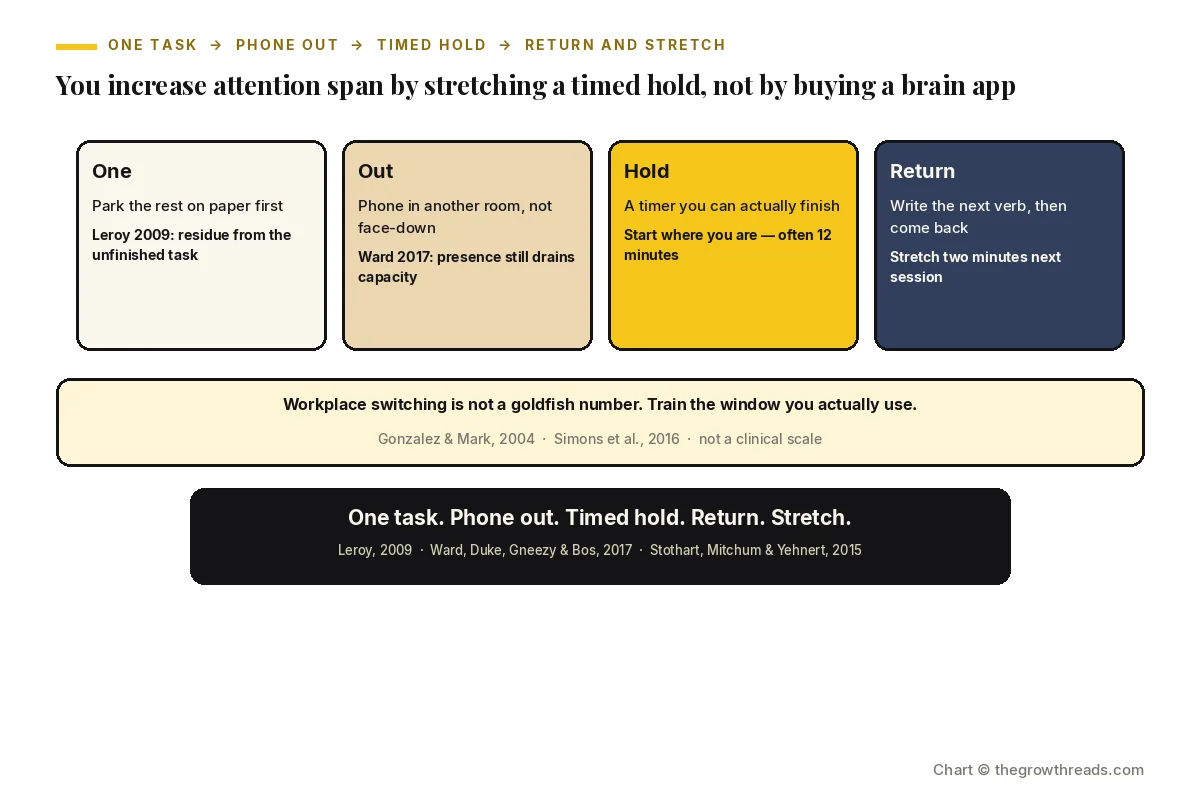
The window still collapses because the last task is unfinished, the phone is in the room, a ping you do not answer still costs, and untimed work turns into a flick. Leroy (2009) is the first motor: people who had not closed a prior task carried attention residue into the next one. A ready-to-resume plan reduced that residue in her experiments. If you have not parked the rest, the hold has two jobs. That is why this page starts with one line, not with a longer morning routine.
The second motor is the device that is not even being used. Ward, Duke, Gneezy and Bos (2017) assigned smartphone owners to keep the phone on the desk, in a pocket or bag, or in another room, then measured available cognitive capacity. Capacity was lower when the phone was present, even when people did not check it. Face-down on the desk is still in the room. Step 2 is another room.
The third motor is the alert. Stothart, Mitchum and Yehnert (2015) found that receiving a cell-phone notification impaired performance on an attention task even when participants did not answer. Silence for the hold is not a lifestyle speech. It is the cost of an unanswered ping. If the ping pile is the whole day, that is notification overload. This page is only the hold.
The four triggers, in the order you can actually pull them
- Open previous. The last task has no parking line. Leroy (2009). Step 1 writes one unfinished job and parks the rest.
- Phone in the room. Ward et al. (2017). Step 2 puts it out. Digital distraction is the wider cousin; this step is the device you can carry.
- Unanswered ping. Stothart et al. (2015). Step 4 silences notifications for the hold only.
- No container. Gonzalez and Mark (2004) observed information workers switching working spheres on the order of minutes, not hours. That is a busy office, not a cognitive ceiling. Step 3 puts a timer on the window you actually use. Ophir, Nass and Wagner (2009) is why a heavy media-multitasking habit is a correlate of weaker filtering in the lab, not a diagnosis and not a reason to skip the timer.
Why a collapsed window costs more than it feels like
A collapsed window feels like “I am just checking,” and it is often a second job: the same switch running in the background while the work that needed the hold sits still. Mark, Gudith and Klocke (2008) interrupted people during a document task. Interrupted participants worked faster and reported more stress, more effort, more frustration. They compensated. Speed was not free. That paper is one lab task, not your whole week. It is still why Step 5 writes a return line instead of pretending the ping was free.
Gonzalez and Mark (2004) is why the bill is not “I have an eight-second brain.” Their field notes described working spheres visited for on the order of ten minutes before a switch. That is an office with other people, email, and walk-ins. It is not a goldfish statistic, and it is not a clinical span. Related reading on productivity systems and summaries helps because no single hold owns every kind of work. This page is the timed window, then the stretch.
The honest limit: there is no randomised trial of this exact six-step sequence. Leroy 2009 is lab switching. Ward 2017 is one set of cognitive tests with phones placed in rooms. Stothart 2015 is notification without answering. Ophir 2009 is correlational media-use groups. Simons 2016 is a review that cuts the other way: commercial brain-training does not reliably buy general attention. Oakley is a teaching book, not a trial. Train the hold anyway. Skip the app.
The four collapses — and the fix for each
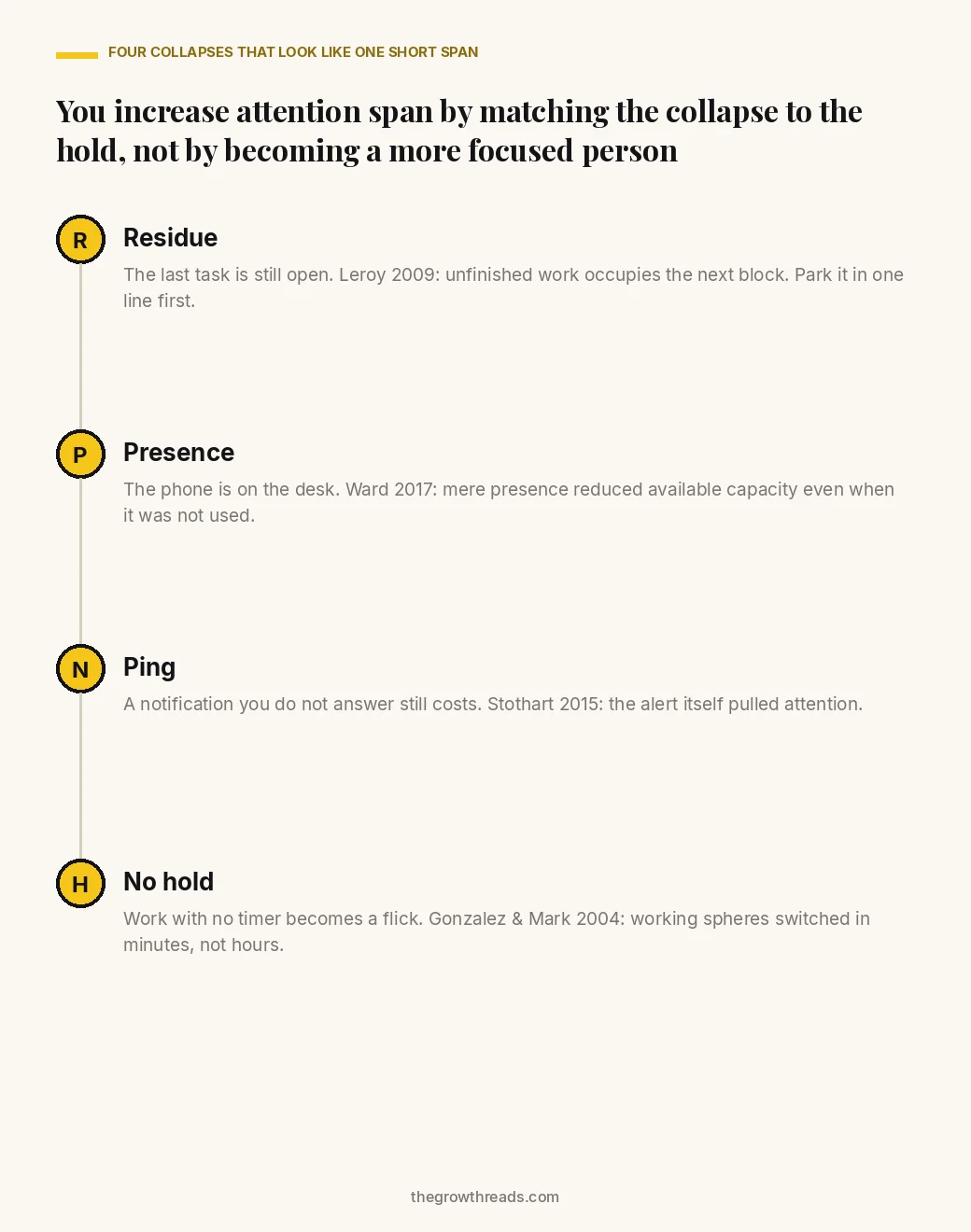
Most “just focus” speeches fail because they pull the wrong lever. Match the collapse to the hold that fits, then pull that one.
| Collapse | What it looks like | The trigger that is winning | The fix that works |
|---|---|---|---|
| Residue | The last task is still open in your head while you start the next one | Unfinished work occupying the next block — Leroy (2009) | Write one job and a parking line for the rest (Step 1) |
| Presence | The phone is on the desk, even face-down, even on silent | Mere presence draining capacity — Ward et al. (2017) | Another room, not the desk (Step 2) |
| Ping | You did not answer, and the hold still broke | The alert itself — Stothart et al. (2015) | Silence notifications for the hold only (Step 4) |
| No hold | Work with no timer becomes a flick between tabs | Untimed switching in a busy office — Gonzalez & Mark (2004) | A timer you can actually finish (Step 3), then a two-minute stretch (Step 6) |
How to increase your attention span: the 6-step system
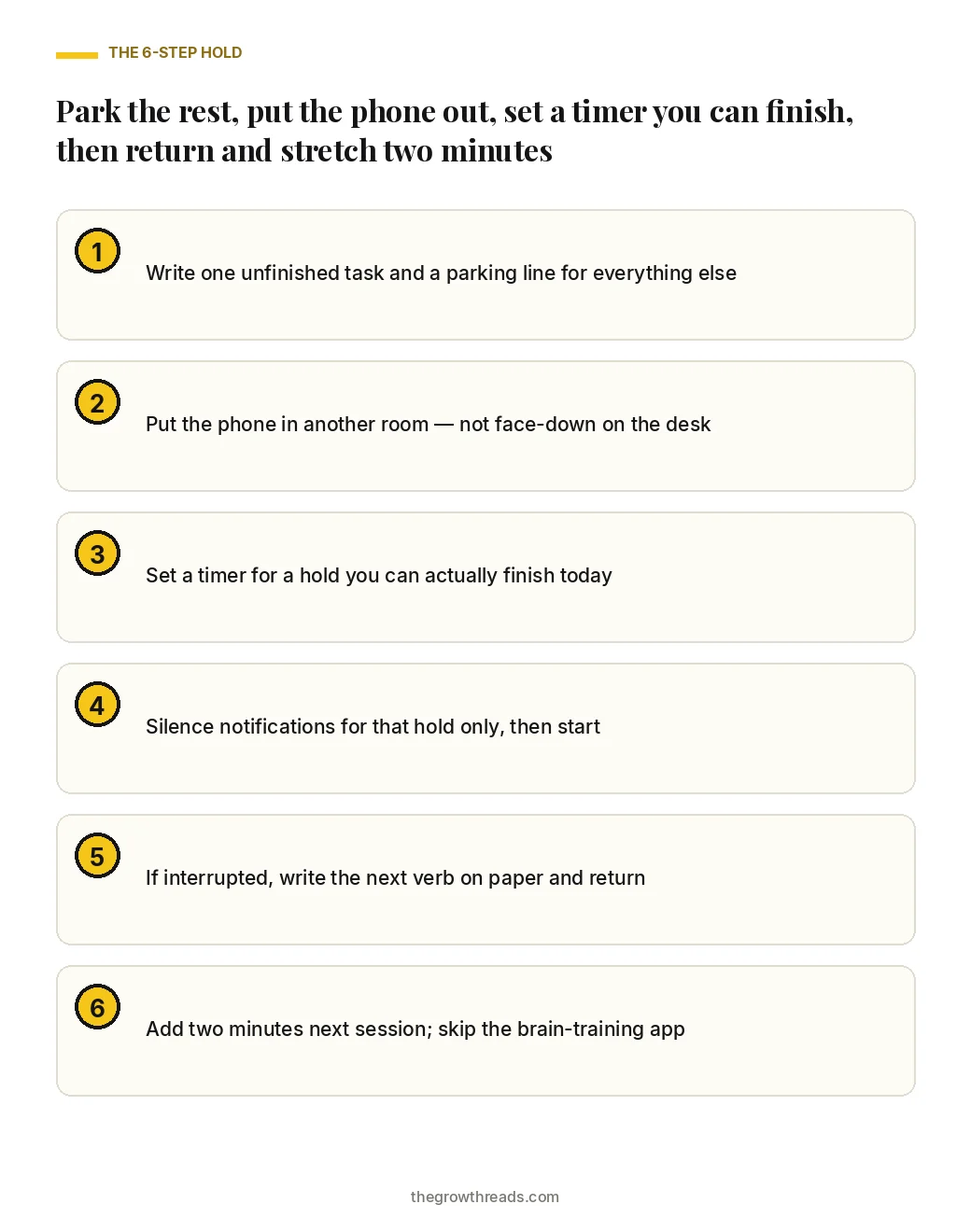
Increase your attention span by parking the rest, putting the phone out, setting a timer you can finish, silencing pings for that hold, writing a return line if you get pulled, then stretching the next session by two minutes. Do not start by becoming a more focused person. Do not wait for a week with no other work. Do not mash this with how to focus better as if the parent system were the hold, or with short attention span as if naming the causes were the same as stretching the window. Those pages still apply when you need the system, or the diagnosis of the collapse. This sequence is for when one live block is still flicking.
Step 1 — Write one unfinished task and a parking line for everything else
On paper, write the one job a stranger could score: “Draft the intro through the second example,” “Reconcile last week’s numbers,” not “get focused.” Under it, one parking line for the rest: “Email, slides, and the Slack thread wait until the timer.” Leroy (2009) is the test: unfinished work leaves residue. A ready-to-resume plan reduced that residue in her studies. If the sentence still sounds like a mood, you have not named the task. The parent page, how to focus better, is the wider system. This step is one line, dated. If staying on a named job is the whole problem, how to stay on task is the cousin. One sentence. Then the phone.
Step 2 — Put the phone in another room — not face-down on the desk
Leave the sentence. Move the phone. Another room, not the far corner of the same desk, not in a bag on the chair. Ward, Duke, Gneezy and Bos (2017) is why the distinction matters: available capacity dropped when the phone was present, even unused. Face-down is still present. If the pull is the screen as a whole evening, that is how to reduce screen time or phone distraction. This step is only the hold. Sit on Step 2 until the device is physically gone. Oakley’s A Mind for Numbers treats focused mode as a practice you protect, not a feeling you wait for. The other room is how you protect it.
Step 3 — Set a timer for a hold you can actually finish today
Write the minutes. Start where you are. If the last honest hold was twelve minutes, set twelve, not fifty. Gonzalez and Mark (2004) described working spheres that switched on the order of minutes in a live office. That is the wild baseline, not the goal and not a goldfish limit. Oakley popularises a short focused block plus a break as the practice for focused mode. This page does not need a branded tomato. It needs a timer you will not bargain with at minute four. A hold you fail is not training. A hold you finish is. Then silence.
Step 4 — Silence notifications for that hold only, then start
Do not redesign your whole phone. Silence the hold. Stothart, Mitchum and Yehnert (2015) is why: the notification itself pulled attention when it was not answered. Desktop badges count. If the pile is the day, notification overload is the page. If you are trying to run two channels at once, that is multitasking and single tasking. This step is one hold. Start when the timer is running and the badges are off. Ophir, Nass and Wagner (2009) is the honest correlate: heavy media multitaskers filtered worse in the lab. That is not a verdict on your character. It is why one channel is the hold, not a second tab “just in case.”
Step 5 — If interrupted, write the next verb on paper and return
The hold will get hit. Write the next verb before you stand up: “Finish the second example,” not “I was in the middle of something.” Leroy (2009) is why a resume plan matters. Mark, Gudith and Klocke (2008) is why pretending the interruption was free is the expensive story: people compensated with speed and paid in stress. A return line is cheaper than a heroic restart. If the interruption is a thought that will not park, that is already on attention residue. One line. Then back to the same task until the timer. Do not found a new system from one knock.
Step 6 — Add two minutes next session; skip the brain-training app
Log the hold you finished. Next session, add two minutes, not twenty. Stop adding when quality drops or you start bargaining. Simons, Boot, Charness, Gathercole, Chabris, Hambrick and Stine-Morrow (2016) reviewed commercial brain-training and found little evidence of far transfer to general cognition. This page will not sell you a dual n-back as a span extender. The stretch is the same work, slightly longer. If the work itself is a deep block rather than a training hold, what deep work actually means and flow state are the cousins — different jobs. This step is two minutes on the same kind of hold. Watch the log for a week. That delay is not a reason to buy an app at 23:00.
What to do when the afternoon is already gone
When the afternoon is already flicking, do not restart from a blank personality: pick the current leader, park the rest in four lines, run one twelve-minute hold, and keep tonight’s reopen as a new session tomorrow. A new comparison of apps at 23:00 is how a scattered day gets a second week. You are allowed to be annoyed. You are not required to found a new identity.
If you have not named the task at all, do Step 1 tonight and skip the poetry. If the stall is a ritual you cannot choose to skip, that is the next section, not a timer. This page’s job that evening is only: the sentence on paper, the phone in another room, and one hold you can finish. Leroy’s parking line still applies when you are late. Especially then.
Common mistakes
- Calling the flick a character flaw. Gonzalez and Mark (2004) described an office, not a goldfish. Name the hold, not the verdict.
- Leaving the phone face-down on the desk. Ward et al. (2017) is why presence still costs. Another room.
- Answering “just this ping.” Stothart et al. (2015) is why the alert itself is the tax. Silence the hold.
- Setting a fifty-minute timer you will bargain with at minute four. A failed hold is not training. Start where you are.
- Buying a brain-training app as the work. Simons et al. (2016) is why far transfer is the wrong bet. Stretch the same hold.
- Mashing this with the causes page. Short attention span owns causes and fixes. This page owns one timed hold.
When it is more than a habit
A six-step hold will not fix a clinical attention condition, a medical sleep problem, or a night that is standing in for a conversation about the job — those are different problems, and this page is the wrong tool for them. If you cannot choose a hold even when you want to, that is outside a productivity how-to. We will not list signs, name a disorder, or walk a clinical scale. Talk to a clinician rather than adding an eighth step. The live page how to be productive with ADHD is the work-and-habits version of that adjacent keyword, not a diagnosis. Ophir’s media-multitasking groups are a lab correlate, not a test you should take at 1 a.m. A timer on a draft is the work version. A quiz you found after midnight is not a system, and it is not ours to interpret.
The evidence behind this system
The studies below are the residue, phone-presence, notification, workplace-switching, interruption, media-multitasking, attention-networks, and brain-training literature that makes a parked task plus a timed hold a reasonable method. None of them is a trial of this exact six-step sequence.
| Study | Design & size | Finding | What we used it for |
|---|---|---|---|
| Petersen & Posner (2012), Annual Review of Neuroscience | Review of the attention-networks account (alerting, orienting, executive) twenty years on | Attention is a set of networks, not one span score | Definition: this page trains a work window, not a clinical measure |
| Leroy (2009), Organizational Behavior and Human Decision Processes | Lab experiments on switching between unfinished and new tasks; attention residue as the mechanism | Unfinished work occupied the next task; a ready-to-resume plan reduced residue | Steps 1 and 5: park and write the next verb |
| Gonzalez & Mark (2004), CHI | Field observation of information workers and their working spheres | Working spheres were visited for on the order of minutes, not hours, before a switch | Step 3’s wild baseline; not a goldfish number and not a cognitive ceiling |
| Ward, Duke, Gneezy & Bos (2017), Journal of the Association for Consumer Research | Experiments assigning phone location (desk, bag/pocket, other room) and measuring available cognitive capacity | Mere presence of one’s smartphone reduced available capacity even when unused | Step 2: another room, not face-down on the desk |
| Stothart, Mitchum & Yehnert (2015), Journal of Experimental Psychology: Human Perception and Performance | Lab tasks with cell-phone notifications that participants did not answer | The notification itself impaired attention performance | Step 4: silence the hold; answering is not the only cost |
| Mark, Gudith & Klocke (2008), CHI | Lab document task with interruptions vs none | Interrupted people worked faster and reported more stress, effort, and frustration | Step 5: a return line instead of a heroic restart; compensation is not free |
| Ophir, Nass & Wagner (2009), PNAS | Lab cognitive-control tasks comparing heavy vs light media multitaskers (self-reported media use) | Heavy media multitaskers filtered irrelevant information more poorly | Step 4’s one-channel hold; correlational, not a diagnosis |
| Simons, Boot, Charness, Gathercole, Chabris, Hambrick & Stine-Morrow (2016), Psychological Science in the Public Interest | Extensive review of commercial brain-training claims and transfer evidence | Little convincing evidence of far transfer to general cognition | Step 6: stretch the same hold; do not buy an attention app |
Frequently asked questions
How do you increase your attention span this week?
Write one unfinished task and a parking line for the rest. Put the phone in another room. Set a timer for a hold you can actually finish, often twelve minutes if that is the honest last window. Silence notifications for that hold only. If you get pulled, write the next verb and return. Next session, add two minutes. Leroy described residue from unfinished work. Ward and colleagues found a present phone still costs. Simons and colleagues found brain-training apps do not buy general attention. Do it on one live block this week, not as a new personality, and do not wait for a morning when nothing else is due.
Is this the same as having a short attention span?
No. The short-attention-span page owns causes and everyday fixes: what a collapsed window looks like, and the levers that usually sit underneath. This page trains one timed hold. You can need both in one month. You should not mash them into one speech. If you are naming why the afternoon flicks, use the sister page. If a draft, a reconciling job, or a study block is still open on your desk, stay here, write the sentence, and run the hold. The test is whether one block still has no timer on it. A causes page that leaves the hold untimed is a second article, not a stretch.
How long should the first hold be?
As long as you can finish without bargaining, and no longer. Gonzalez and Mark observed working spheres that switched on the order of minutes in a live office. That is a description of a busy workplace, not a cognitive ceiling and not an eight-second goldfish number. If yesterday’s honest window was twelve minutes, set twelve. Oakley treats a short focused block as practice for focused mode. A fifty-minute timer you will negotiate at minute four is not training. Finish one hold. Then Step 6 adds two minutes. The log, not a branded tomato, is the stretch.
Does leaving the phone face-down on the desk count?
No. Ward, Duke, Gneezy and Bos assigned phones to the desk, a pocket or bag, or another room, then measured available cognitive capacity. Capacity was lower when the phone was present, even when people did not use it. Face-down is still present. Face-down on silent is still present. Another room is the step. If the evening is the whole screen, that is the reduce-screen-time page. This how-to is only the hold. Put the device out. Then start the timer. A pocket on the same chair is a weaker version of the same presence.
Will a brain-training app increase my attention span?
Not as a general skill, on the evidence this page is willing to cite. Simons, Boot, Charness, Gathercole, Chabris, Hambrick and Stine-Morrow reviewed commercial brain-training programs and found little convincing far transfer to general cognition. Narrow practice can improve the practiced task. That is not the same as buying a longer work window. This how-to stretches the same hold by two minutes. It will not sell you dual n-back as a span extender. If an app is a timer, that is a clock. If an app promises a new brain, that is the claim the review did not support.
What if I keep getting interrupted?
Then you are missing Step 5’s return line, not a new personality. Write the next verb before you stand up, then come back until the timer. Mark, Gudith and Klocke found interrupted people worked faster and paid in stress and effort. Compensation is not free. Leroy found a resume plan reduced residue from unfinished work. Notification overload is the cousin page if the pile is the whole day. This page’s job is one hold. If you reopen a second channel because the feeling changed, that is a second job the parking line was meant to block. Keep the timer as written.
Is this for ADHD or a clinical attention test?
No. This is a productivity how-to for everyday work holds: the draft, the reconciling job, the study block. It is not a diagnosis, not a symptom list, and not a clinical protocol. Ophir, Nass and Wagner compared media-multitasking groups in the lab; that is a correlate, not a test you should take. Petersen and Posner described attention networks, not a quiz. If you cannot choose a hold even when you want to, this page is the wrong tool — talk to a clinician rather than adding an eighth step. We will not list signs. The ADHD work-habits page is adjacent, not a diagnosis here.
Will this six-step system give me a longer attention span forever?
No, and the evidence does not say it will. The studies on this page map residue, phone presence, unanswered notifications, workplace switching, interruption cost, a media-multitasking correlate, attention networks, and a brain-training review. They are not a trial of this sequence. Gonzalez and Mark is a field office. Simons is a review that cuts against the app. An untimed afternoon is a bout. Next week needs the same sentence, or a new one if the task changed. Use it for the next live hold. Do not use it as a promise you will never flick, and do not use it as a medical protocol.
Related reading on The Growth Reads
The book behind the hold
- A Mind for Numbers summary & review — Barbara Oakley on focused versus diffuse mode and timed practice; the book cousin of a protected hold, not a brain-training manual
Related articles
- How to focus better
- Short attention span
- Attention span meaning
- Attention residue
- Single tasking
- Multitasking
- Notification overload
- Phone distraction
- How to reduce screen time
- How to stay on task
- What deep work actually means
- What flow state actually is
Go deeper
How this article was researched
The Growth Reads editorial team writes from primary sources: the books, and the peer-reviewed literature behind the claims. Every study cited above was read in the original publication or its published abstract, and every figure is quoted with its design, sample and effect so you can judge its weight. Where a finding is limited — a field office, a lab switch, a phone-location experiment, a correlational media-use split, a review that cuts against brain-training, or a six-step hold with no trial of its own — we say so.
How we work: every article on The Growth Reads is built from the books in our library plus the research they rest on, and is reviewed and date-stamped when the evidence changes. Read our full methodology.
Sources
- Petersen, S. E., & Posner, M. I. (2012). The attention system of the human brain: 20 years after. Annual Review of Neuroscience, 35, 73–89. doi:10.1146/annurev-neuro-062111-150525
- Leroy, S. (2009). Why is it so hard to do my work? The challenge of attention residue when switching between work tasks. Organizational Behavior and Human Decision Processes, 109(2), 168–181. doi:10.1016/j.obhdp.2009.04.002
- Gonzalez, V. M., & Mark, G. (2004). “Constant, constant, multi-tasking craziness”: Managing multiple working spheres. In Proceedings of the SIGCHI Conference on Human Factors in Computing Systems (pp. 113–120). ACM. doi:10.1145/985692.985707
- Ward, A. F., Duke, K., Gneezy, A., & Bos, M. W. (2017). Brain drain: The mere presence of one’s own smartphone reduces available cognitive capacity. Journal of the Association for Consumer Research, 2(2), 140–154. doi:10.1086/691462
- Stothart, C., Mitchum, A., & Yehnert, C. (2015). The attentional cost of receiving a cell phone notification. Journal of Experimental Psychology: Human Perception and Performance, 41(4), 893–897. doi:10.1037/xhp0000100
- Mark, G., Gudith, D., & Klocke, U. (2008). The cost of interrupted work: More speed and stress. In Proceedings of the SIGCHI Conference on Human Factors in Computing Systems (pp. 107–110). ACM. doi:10.1145/1357054.1357072
- Ophir, E., Nass, C., & Wagner, A. D. (2009). Cognitive control in media multitaskers. Proceedings of the National Academy of Sciences, 106(37), 15583–15587. doi:10.1073/pnas.0903620106
- Simons, D. J., Boot, W. R., Charness, N., Gathercole, S. E., Chabris, C. F., Hambrick, D. Z., & Stine-Morrow, E. A. L. (2016). Do “brain-training” programs work? Psychological Science in the Public Interest, 17(3), 103–186. doi:10.1177/1529100616661983