

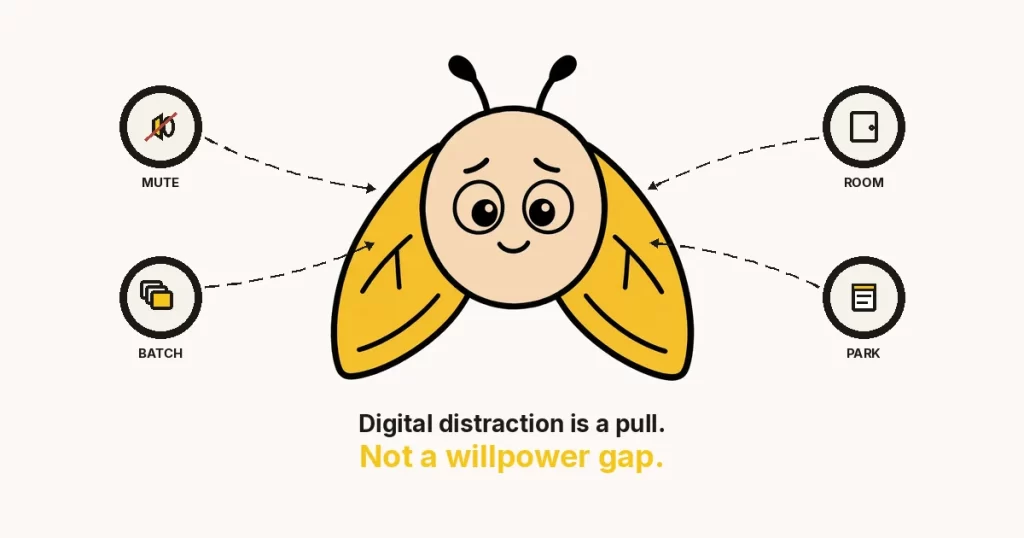
Digital distraction is the attention tax of screens, tabs, and alerts inside the work — laptop, tablet, watch, and phone — not a willpower gap and not the same problem as a silent phone on the desk. A ping you never open still starts a switch. Distance plus fewer channels is the cheap fix.
Key takeaways
- A cell-phone notification you never answer can disrupt a sustained-attention task about as much as taking the call or writing the text (Stothart, Mitchum & Yehnert, 2015, n = 166 analysed).
- Ward, Duke, Gneezy and Bos (2017) found a desk-versus-other-room drop on working memory in 520 students; Ruiz Pardo and Minda’s 2022 preregistered replication (n = 383) did not find it — treat mere presence as contested, not as a law.
- Interrupted knowledge workers often finish the original task faster, with no drop in quality, by paying in stress, frustration, time pressure and effort (Mark, Gudith & Klocke, 2008, n = 48).
- Leaving Task A unfinished keeps attention residue on A, and Task B suffers; parking a next action is how you close a loop you did not finish (Leroy, 2009).
- The cheap company version of this is the same as the cheap personal version: fewer channels treated as work, and a device that is not the loudest object on the desk — the argument in Michael Hyatt’s Free to Focus.
What digital distraction actually is
Digital distraction is the attention tax of every screen, tab, and alert that can steal a switch while you work — laptop, tablet, watch, and phone together — not a character flaw and not a phone-only page. That is the whole URL. The search phrase sounds like a moral test. The useful version is a channel problem: too many devices allowed to interrupt, too close, with too many unfinished files left open underneath.
This URL sits under the live Focus parent, how to focus better. The parent owns the beam: focus is the near-total absence of task-switching. This child owns the digital version of the switch — the pull from the kit that sits inside a modern desk. Do not collapse it into the sister page phone distraction. That page is the smartphone: nearby, pinging, or in reach. This page is the wider class. A Slack badge on a laptop and a tap on a watch are the same tax on a different screen.
Michael Hyatt’s Free to Focus is the book this row points at: focus as a scheduling choice about which inputs get a slot, not as a personality upgrade. Keep the calendar if it fits. Do not import the book as a diagnosis of anyone’s brain.
What digital distraction is not
It is not phone distraction, notification volume, leftover attention after a switch, or a count of hours on a screen. Mixing those four is how this page would steal four live URLs.
Phone distraction is the handset. Distance is the cheap fix there because the evidence is about a phone on a desk. Notification overload is the volume of pings — how many channels are allowed to speak. Attention residue is what stays behind after you leave Task A for Task B, even if no device spoke. Average screen time for adults is a hours-and-attention count, not a switch-tax page, and not children’s screen-time guidance. How to reduce screen time is the method sibling for cutting hours. This page is the mechanism underneath those hours: why a digital environment keeps stealing the next two minutes.
It is also not multitasking. Multitasking is the cost of trying to hold two jobs at once. Digital distraction is one of the reasons you keep being offered the second job. The sister single tasking page is what you do once the second job has been refused. Flow state is what a quiet channel environment sometimes makes room for. None of those pages is this one.
Why the pull wins
The pull wins because a digital channel is built to reopen a loop, and reopening a loop is cheaper for the device than closing one is for you. That is a design fact before it is a character fact. Rubinstein, Meyer and Evans (2001) split a switch into two executive stages: shift the goal, then activate the new rules. Both take time. A badge does not care. It only needs to start the first stage. You pay for both.
Once that is in the room, four pulls do the rest of the work. They look like four different vices. They are four versions of the same switch.
The four pulls, not a willpower gap
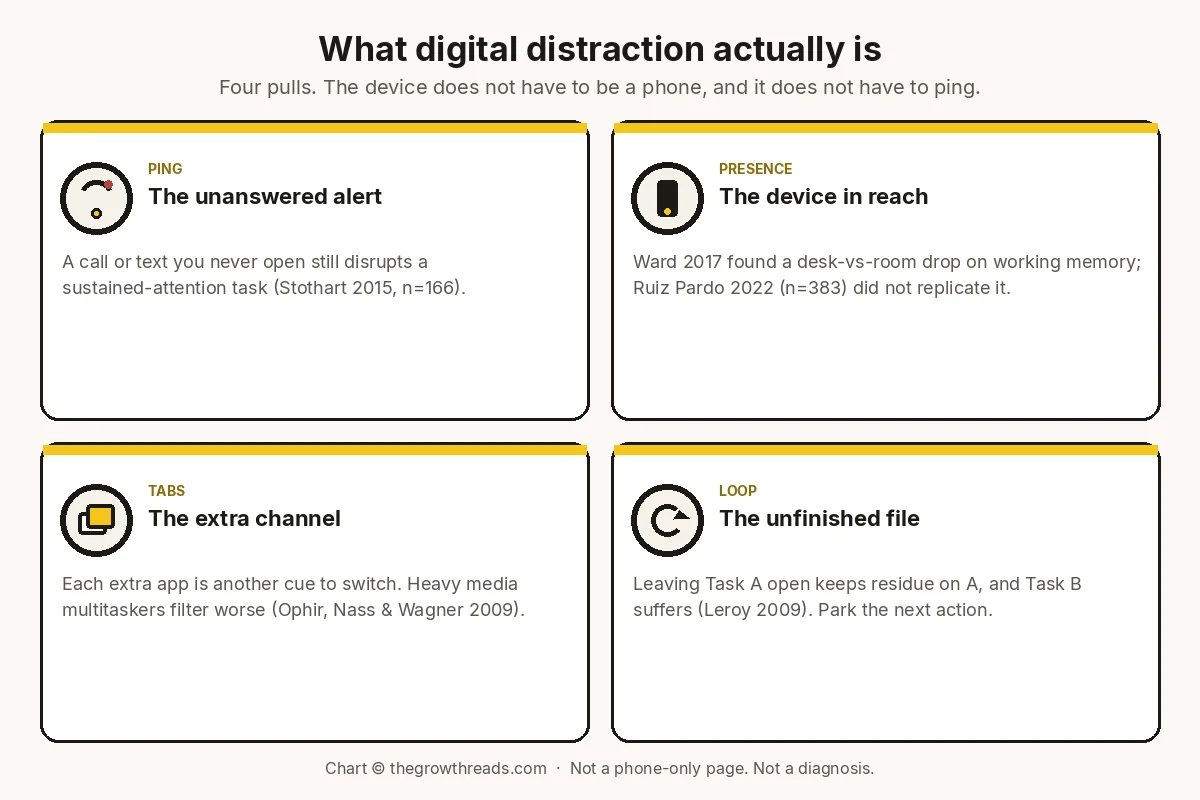
- Ping. Cary Stothart, Ainsley Mitchum and Courtney Yehnert (2015) put 212 Florida State undergraduates on a Sustained Attention to Response Task and sent some of them a call or a text they were not allowed to answer. After exclusions (mostly people who touched the phone, or whose phone was off), 166 remained. Notifications alone disrupted performance; the size of the hit was in the same range as studies where people actually take the call or write the text. You do not have to open the message. Knowing it arrived is enough to start the goal-shift. That is why mute is a real move and not a complete one: a visible badge on a laptop is a ping with the sound off.
- Presence. Adrian Ward, Kristen Duke, Ayelet Gneezy and Maarten Bos (2017) ran two experiments on the “brain drain” hypothesis: that the mere presence of your own smartphone occupies limited-capacity resources even when you do not use it and do not report thinking about it. Experiment 1 analysed 520 smartphone owners. A desk-versus-other-room contrast showed lower available working memory and fluid intelligence when the phone sat on the desk; a planned linear trend ran desk → bag → other room. Most people in every condition said the location had not affected them. Experiment 2 (n = 275) found the working-memory hit again and no hit on a go/no-go attention task. Then Ana Ruiz Pardo and John Paul Minda (2022) ran a preregistered direct replication of experiment 2 with 383 analysed students and found no location effect on OSpan or go/no-go. Say that out loud. Presence is a live hypothesis with a failed replication, not a settled tax you can bill to every silent laptop. The practical move still has a cheap side: out of reach is a better default than face-down, because the ping evidence does not need the presence evidence to be true.
- Tabs. Each extra app is another cue that can start Rubinstein’s first stage. Eyal Ophir, Clifford Nass and Anthony Wagner (2009) compared heavy and light media multitaskers and found the heavy group worse at filtering irrelevant environmental stimuli. That is a small student lab, not a law about your seventeenth Chrome tab. It is still the right picture of the desktop: more channels, more things the filter has to ignore. Attention span is the duration you can hold. This page is the environment that keeps resetting the clock. How to stay on task is the sister move once the extra channels are shut.
- Loop. Sophie Leroy (2009) showed in two experiments that people do not fully leave Task A when they start Task B, especially if A is unfinished. Completion alone is not enough; some time pressure on A helped people actually disengage. Digital work manufactures unfinished A’s: a half-written email, a Slack thread, a tab you “just want to check.” The parked next action — one sentence of where you stopped — is how you stop A from riding into B. That is the same residue the attention residue page owns. This page’s job is to say the unfinished file is one of the four digital pulls, not a separate moral failure.
The counter-case, stated once: none of this shows that every silent device on every desk lowers working memory. Ruiz Pardo and Minda (2022) is the sentence that should kill the slogan version of “brain drain.” Ward 2017 is still a real study (n = 520 / 275, desk versus other room, partial η² in the .02 range — small). Stothart’s unanswered notification is a different, cleaner hit. Mark’s interruption cost is stress, not minutes. If your job is on-call medicine, “put the phone in another room” is the wrong sentence. If the only channel you silenced is Instagram while Slack still speaks from the laptop, you did not collect the benefit. You moved the moth.
Why it costs more than it feels like
It costs more than it feels like because the switch feels like a second, and the bill is paid in speed, residue, and the next hour’s worse mood. Gloria Mark, Daniela Gudith and Ulrich Klocke (CHI 2008) interrupted 48 people during an email task. Interrupted subjects often finished faster, with no quality drop, by working harder — more stress, frustration, time pressure and effort. That is the hidden receipt. You still sent the email. You paid in a body that is now worse at the next file. A day of digital distraction can look “productive” on a sent-items count and still be a more expensive day.
Kostadin Kushlev, Jason Proulx and Elizabeth Dunn (CHI 2016) assigned 221 adults from the general population to a week of maximised phone interruptions (alerts on, phone in reach) and a week of minimised ones (alerts off, phone away). People reported more inattention when alerts were on; that inattention tracked lower self-reported productivity and well-being. This is a work-and-habits finding in a general sample. It is not a clinical ADHD result, not a symptom list, and not a diagnosis of anyone reading this page. The useful sentence is narrower: a week of louder channels felt like a week of worse attention. That is the same purchase as Mark’s speed-for-stress trade, measured as a feeling instead of as a stopwatch.
There is a second, quieter cost: you spend the hour you bought. A “focus block” that opens on a laptop with eighteen badges is not a failed moral test. It is a failed purchase. You paid with calendar time and bought the same switch-tax the rest of the day already sells. Reducing screen time can cut the hours. This page is the reason the remaining hours still scatter if the channels stay loud. The productivity hub collects the cluster; this child stays on the digital pull.
Nearby ideas that are not this one
Several neighbouring phrases share a SERP with digital distraction and answer a different question. Mixing them is how this page would steal a phone URL, a notification URL, or a screen-time URL, none of which it is allowed to be.
| Phrase | What it actually is | Not this page |
|---|---|---|
| Digital distraction | The switch-tax of screens, tabs, and alerts inside the work | This URL |
| Phone distraction | A smartphone that is nearby, pinging, or in reach | Sister: phone distraction |
| Notification overload | Too many channels allowed to speak | Notification overload |
| Attention residue | Task A still occupying working memory after you start Task B | Attention residue |
| Multitasking | The cost of holding two jobs at once | Multitasking; the refusal is single tasking |
| Screen time | Hours on screens, especially in adults’ workdays | Average screen time for adults; method at how to reduce screen time |
A C-tier keyword on a hard SERP still has to tell the truth about its own neighbours. The honest sentence is not “delete every app.” It is “digital distraction is the pull; phone, ping volume, residue, and hours are four other pages.”
What actually shrinks the pull
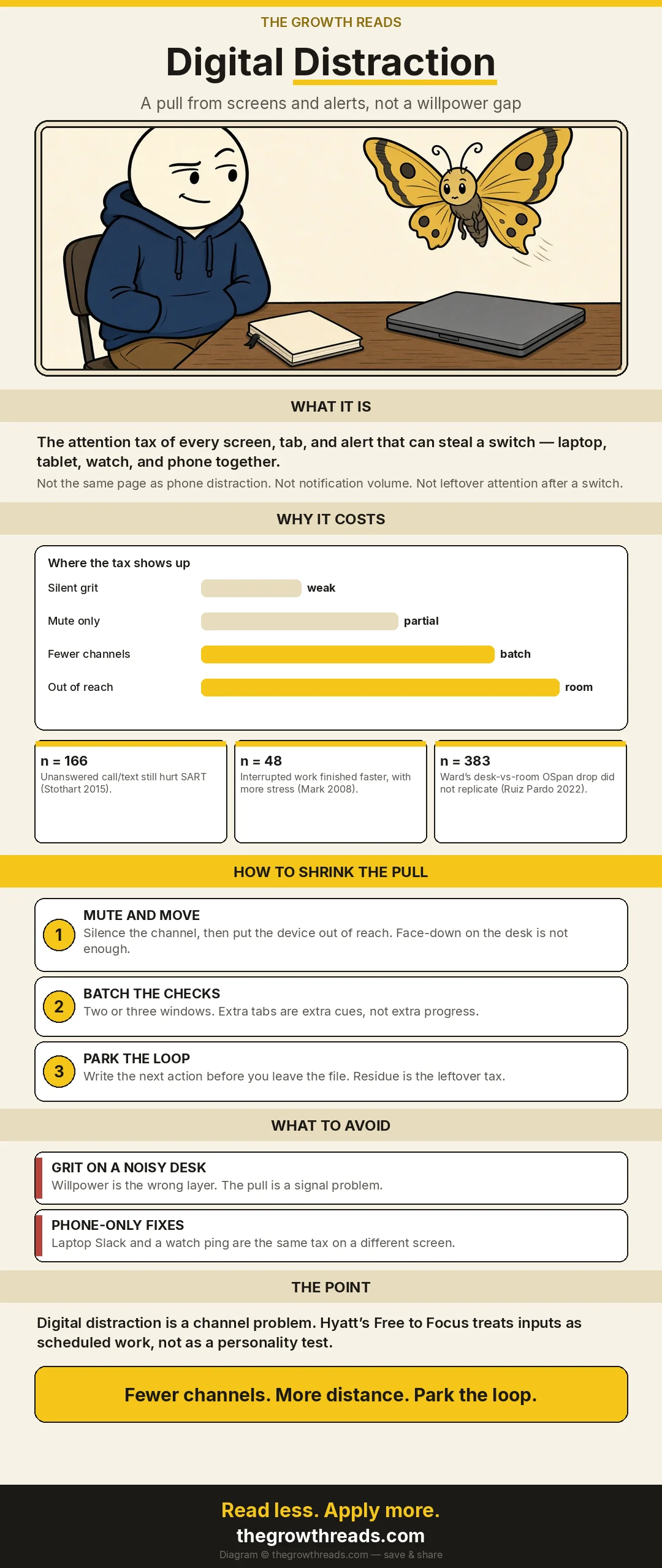
The pull shrinks when fewer channels are allowed to speak, the remaining devices sit farther away, checks are batched, and unfinished files get a parked next action — not when you collect more grit. This is a play-slot page, so there is no numbered step ladder. The parent how to focus better already owns the system. What follows is the receipt for the digital version, so you can tell whether you collected the thing the search query named.
Mute the channel. Stothart’s hit does not require you to pick up the phone. A visible laptop badge is a ping with the sound off. Kushlev’s week of alerts-off is the same move at calendar scale. Mute is not a personality. It is a setting.
Move the device. Ward’s original finding is contested; Ruiz Pardo is why you should not preach “brain drain” as a law. Out of reach is still a cheap default, because it also kills the ping you would have seen. Face-down on the desk is the expensive costume of that default. The sister phone distraction page is the handset version of the same move. This page adds the laptop, the tablet, and the watch. A phone in another room plus Slack on the laptop is a moth with a new lamp.
Batch the checks. Two or three windows beat a channel that is always open. Extra tabs are extra cues. Ophir’s heavy media multitaskers filtered worse; you do not need that small lab to justify closing the seventeenth tab. You need it to stop calling the extra tab “research.” Hyatt’s Free to Focus treats inputs as scheduled work. That is the adult version of batching: email is a job with a slot, not a weather system that happens to you.
Park the loop. Leroy’s residue is the leftover tax. One sentence of where you stopped, written before you leave the file, is enough. Completion helps; a next action helps more. Then the rest of the day can look like everyone else’s day. The benefit was the quiet channel, not a costume you wear until lunch. Flow sometimes shows up in that quiet. It is not required for the purchase to have been worth it.
Common mistakes
Most failed anti-distraction projects buy a setting and skip the channel, the distance, or the loop.
- Grit aimed at a noisy desk. Willpower is the wrong layer. The pull is a signal problem. Mark’s interrupted workers still finished. They paid in stress.
- Phone-only fixes. A handset in another room plus a loud laptop is the same tax. Phone distraction is a sister, not a substitute.
- Mute without distance. Stothart’s unanswered notification still hit. A silent badge is a ping you can see.
- Leaving the file open “for a second.” Leroy’s residue does not care that you meant to come back. Park the next action or A rides into B.
- Counting hours and ignoring switches. Screen time is a different ruler. A four-hour block with forty switches is not a quiet block.
- Treating a failed replication as a licence to keep every device on the desk. Ruiz Pardo is a limit on Ward, not a limit on Stothart, Mark, or Leroy.
- Using this page as a diagnosis. This is a work-and-habits page. Persistent inability to attend across contexts is a different professional. We do not diagnose it here.
When grit is the wrong tool
Grit is the wrong tool when the channel is still allowed to speak, when the job is on-call, or when the actual problem is not digital. An emergency-room shift, a trading desk, and a parent waiting on a school call are not failing a “phone in another room” test. They have different buildings. Hyatt’s calendar still helps there — it just cannot delete the on-call channel.
It is also the wrong tool when the leak is sleep, a pile of unmade decisions, or a life that does not fit. If the first hour is already exhausted, fewer badges will not invent attention. How to focus better is the parent for the wider system. This page stops at the digital pull. And if the scatter is constant across paper, walking, and screens, that is outside this URL. We do not write the clinical version.
The evidence behind this
| Study | Design and size | Finding | What we used it for |
|---|---|---|---|
| Stothart, Mitchum & Yehnert, 2015 | SART; 212 recruited, 166 analysed; call / text / no-notification | Unanswered notifications disrupted sustained attention on the order of active phone use | The ping does not have to be opened |
| Ward, Duke, Gneezy & Bos, 2017 | Two experiments; n = 520 and n = 275 students; desk / bag / other room | Desk phone associated with lower OSpan (and, in exp. 1, fluid intelligence); no go/no-go hit in exp. 2 | The presence hypothesis — and why it is quoted |
| Ruiz Pardo & Minda, 2022 | Preregistered replication of Ward exp. 2; 453 recruited, 383 analysed | No location effect on OSpan or go/no-go | The counter-case: mere presence is not a law |
| Mark, Gudith & Klocke, 2008 | CHI experiment; n = 48; interrupted email task | Interrupted work often finished faster, with more stress, frustration, effort | The hidden receipt: speed paid in mood |
| Leroy, 2009 | Two experiments on task switching | Unfinished Task A leaves residue that impairs Task B | Park the loop; completion is not always enough |
| Rubinstein, Meyer & Evans, 2001 | Four task-switching experiments | Switch cost splits into goal-shift then rule-activation | Why a badge is expensive even when it is short |
| Kushlev, Proulx & Dunn, 2016 | Within-subjects weeks; n = 221 general-population adults | Alerts-on week: higher self-reported inattention, tracking lower productivity | A louder week feels like a worse-attention week — not a diagnosis |
| Ophir, Nass & Wagner, 2009 | Lab comparison of heavy vs light media multitaskers | Heavy group worse at filtering irrelevant environmental stimuli | Extra channels are extra things the filter has to ignore |
Frequently asked questions
What is digital distraction?
Digital distraction is the attention tax of screens, tabs, and alerts that can steal a switch while you work — laptop, tablet, watch, and phone together. It is not a personality verdict and not the same as phone distraction, which is the narrower tax of a smartphone that is nearby or pinging. A Slack badge on a laptop and a watch tap are the same class of pull. The cheap response is fewer channels and more distance, not more grit aimed at a noisy desktop. An unanswered ping can still start a switch; an unfinished file can still ride into the next one.
Is digital distraction the same as phone distraction?
No. Phone distraction is the handset: nearby, pinging, or in reach. Digital distraction is the wider class that includes the laptop, the tablet, and the watch. Distance is still the cheap move for a phone. It is not enough if Slack keeps speaking from the screen you write on. The two pages should link, not collapse. Treat a phone in another room plus a loud laptop as a moth with a new lamp, not as a finished fix. The sister URL owns the handset; this URL owns the kit.
Does a silent laptop still count as digital distraction?
It can, if a badge is visible or a tab is still offering a second job. Stothart’s unanswered notification hit people who never touched the phone. Mute without hiding the badge is a partial move. Ward’s “mere presence” finding is contested — Ruiz Pardo and Minda did not replicate the desk-versus-room OSpan drop — so do not preach a silent closed laptop as a proven working-memory tax. Do preach the visible badge and the extra tab. Those are switches with better evidence than the slogan version of brain drain.
Why do notifications cost so much if I never answer them?
Because a notification starts a goal-shift even when you refuse the second job. Rubinstein, Meyer and Evans split a switch into shifting the goal and then activating new rules; both take time. Stothart, Mitchum and Yehnert sent calls or texts during a sustained-attention task and found disruption without interaction, in 166 analysed students. You paid for the first stage. Mute removes some of those starts. Batching the rest into two or three windows stops the rest of the day from being a sequence of first stages you never asked for.
Is the “brain drain” of a nearby phone a proven fact?
No. Ward, Duke, Gneezy and Bos (2017) found a desk-versus-other-room drop on working memory in student samples of 520 and 275. Ruiz Pardo and Minda (2022) ran a preregistered replication of the second experiment with 383 analysed students and found no location effect. Treat mere presence as a live, contested hypothesis. The cleaner digital-distraction hits are the unanswered ping (Stothart), the interruption’s stress bill (Mark), and the unfinished loop (Leroy). Out of reach is still a cheap default. It is not a law of working memory.
How is digital distraction different from multitasking?
Multitasking is the cost of trying to hold two jobs at once. Digital distraction is one of the reasons you keep being offered the second job. Close the extra channels and you still have to refuse to start two files. That refusal is single tasking, which is a live sister page. Digital distraction is the environment; multitasking is the attempt; attention residue is what the first file leaves in the second. Three URLs, one afternoon. Mixing them is how a SERP turns into a mush of willpower advice.
What is the fastest way to shrink digital distraction?
Mute the loudest channel, put the remaining devices out of reach, and park a next action on the file you are leaving. That is mute, room, and loop in one pass. Batching the rest into two or three check-windows is the fourth move and takes a calendar, not a minute. Hyatt’s Free to Focus is the book version of that calendar: inputs get a slot instead of a personality test. Do not skip the laptop. A phone in another room with Slack still speaking is not the fast fix. It is a costume of the fast fix.
Is digital distraction a sign of ADHD?
This page does not diagnose anyone. Kushlev, Proulx and Dunn (2016) found that a week of louder phone alerts raised self-reported inattention in 221 adults from the general population. That is a work-and-habits result, not a clinical finding, and not a symptom list. Persistent inability to attend across paper, walking, and screens is a different professional. We do not write that version here. The useful question on this URL is whether your channels are allowed to speak too often, too close, with too many files left open.
Sources
- Stothart, C., Mitchum, A., & Yehnert, C. (2015). The attentional cost of receiving a cell phone notification. Journal of Experimental Psychology: Human Perception and Performance, 41(4), 893–897. https://doi.org/10.1037/xhp0000100
- Ward, A. F., Duke, K., Gneezy, A., & Bos, M. W. (2017). Brain drain: The mere presence of one’s own smartphone reduces available cognitive capacity. Journal of the Association for Consumer Research, 2(2), 140–154. https://doi.org/10.1086/691462
- Ruiz Pardo, A. C., & Minda, J. P. (2022). Reexamining the “brain drain” effect: A replication of Ward et al. (2017). Acta Psychologica, 230, 103717. https://doi.org/10.1016/j.actpsy.2022.103717
- Mark, G., Gudith, D., & Klocke, U. (2008). The cost of interrupted work: More speed and stress. In Proceedings of the SIGCHI Conference on Human Factors in Computing Systems (pp. 107–110). ACM. https://doi.org/10.1145/1357054.1357072
- Leroy, S. (2009). Why is it so hard to do my work? The challenge of attention residue when switching between work tasks. Organizational Behavior and Human Decision Processes, 109(2), 168–181. https://doi.org/10.1016/j.obhdp.2009.04.002
- Rubinstein, J. S., Meyer, D. E., & Evans, J. E. (2001). Executive control of cognitive processes in task switching. Journal of Experimental Psychology: Human Perception and Performance, 27(4), 763–797. https://doi.org/10.1037/0096-1523.27.4.763
- Kushlev, K., Proulx, J., & Dunn, E. W. (2016). “Silence your phones”: Smartphone notifications increase inattention and hyperactivity symptoms. In Proceedings of the 2016 CHI Conference on Human Factors in Computing Systems (pp. 1011–1020). ACM. https://doi.org/10.1145/2858036.2858359
- Ophir, E., Nass, C., & Wagner, A. D. (2009). Cognitive control in media multitaskers. Proceedings of the National Academy of Sciences, 106(37), 15583–15587. https://doi.org/10.1073/pnas.0903620106
Related reading on The Growth Reads
Books. Michael Hyatt’s Free to Focus is the unused review this row spends: inputs as scheduled work, not as a personality test.
Articles. Up to the Focus parent how to focus better. Across to phone distraction, notification overload, attention residue, multitasking, and how to reduce screen time.
Hub. The cluster lives on the productivity hub.
How this article was researched
Eight peer-reviewed sources, each opened at the DOI or the PDF before a number was written down. Sample sizes and exclusions are the authors’ own (Stothart 166 of 212; Ward 520 / 275; Ruiz Pardo 383 of 453; Mark 48; Kushlev 221). The Ward presence effect is reported with its 2022 non-replication in the same breath. Kushlev’s inattention finding is treated as a general-population work result, not as a clinical ADHD page. No book title is used as this article’s title. The down-link is the unused Free to Focus review, not an over-linked Deep Work or Indistractable URL.
Limits. Most of the lab samples are students. Mark’s faster-interrupted-work result is one email task in 48 people. Ophir’s media-multitasking contrast is a small lab, not a tab-count law. Presence remains contested. This page does not measure your devices, and it does not diagnose attention disorders.
Method: locked TGR v3 play template. Focus parent. No HowTo schema. Last checked 17 September 2026.