

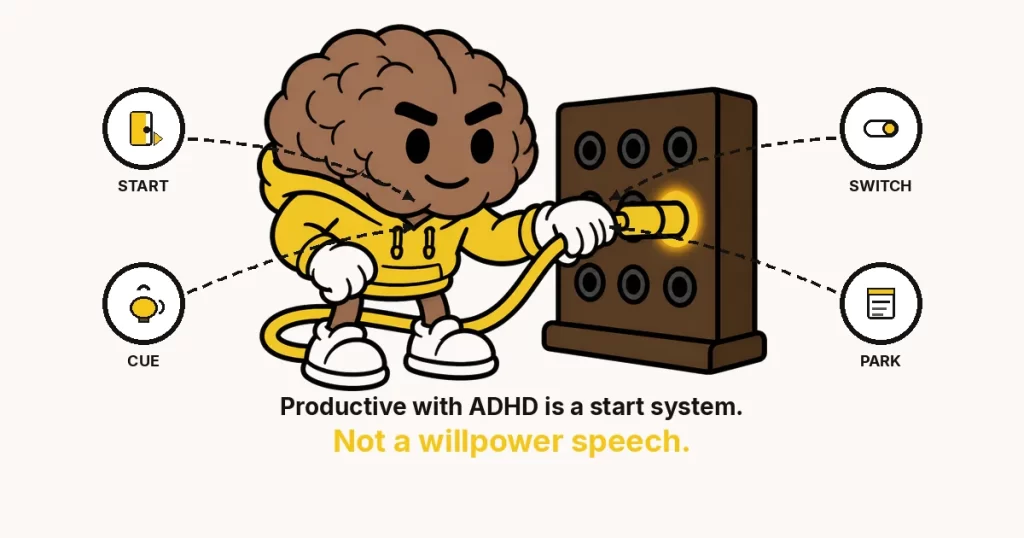
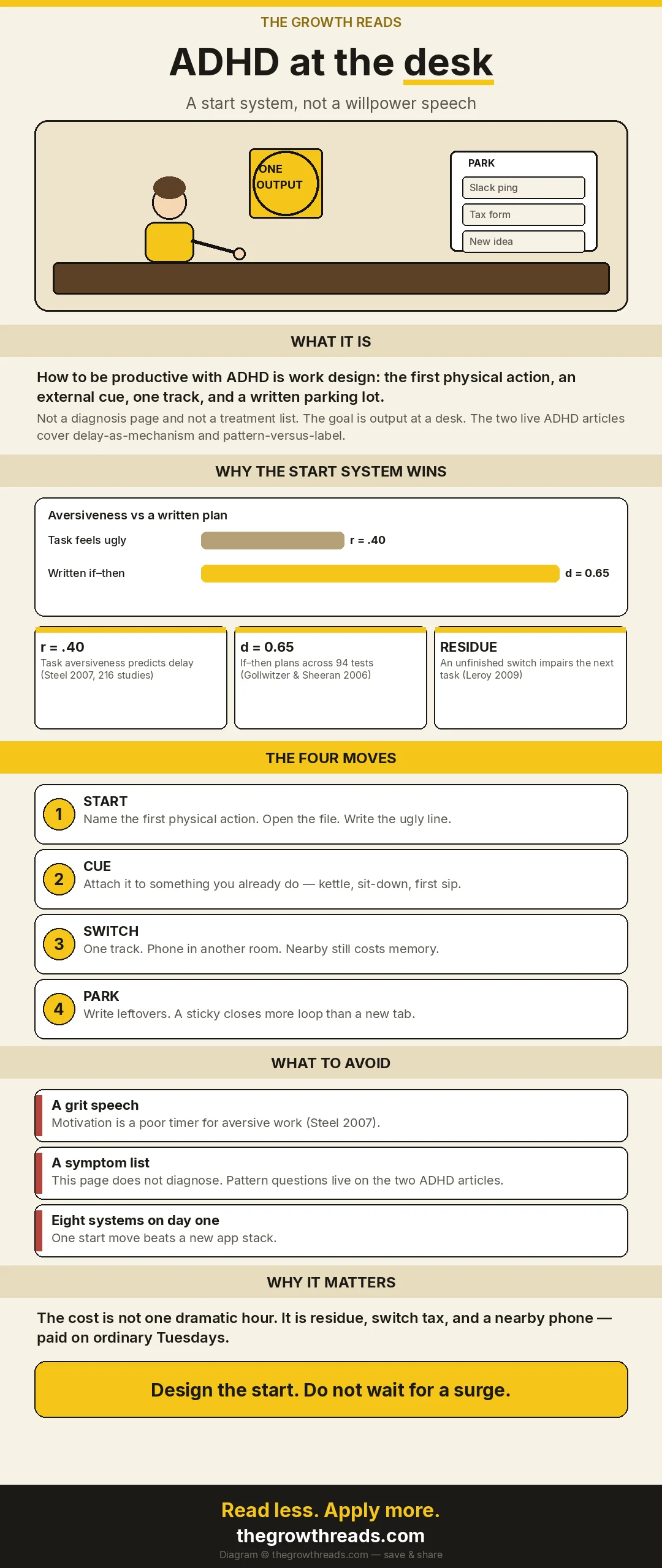
How to be productive with ADHD is a start system, not a willpower speech. The work version designs the first physical action, an external cue, a single track, and a written parking lot for leftover loops. It does not diagnose anyone, list clinical symptoms, or prescribe treatment. The goal is output at a desk, not a clinic label.
Key takeaways
- How to be productive with ADHD is a desk-design problem: shrink the first physical action and attach it to a cue you already run, instead of waiting for a motivation surge (Gollwitzer, 1999).
- How aversive a task feels is one of the strongest predictors of delay — Steel’s 2007 meta-analysis put the correlation with task aversiveness at r = .40 across 216 studies.
- Switching away from unfinished work leaves attention residue that measurably impairs the next task; a written close-out of where you stopped does part of what completion would have done (Leroy, 2009).
- A phone sitting nearby reduces available working memory even when it stays unused, and the cost is largest for people who feel most dependent on the phone (Ward, Duke, Gneezy & Bos, 2017).
- Written, self-imposed deadlines raise follow-through versus an open-ended intention to “get to it later” (Ariely & Wertenbroch, 2002).
What does it actually mean to be productive with ADHD?
How to be productive with ADHD, on this page, means designing the start of a work block so output happens without a motivation surge. The search sits next to clinic pages. The useful version is a desk question: the first physical action, the cue that launches it, the number of tracks you keep open, and the written place leftover loops go. None of that is a diagnosis. None of it is a treatment list.
The parent page on how to overcome procrastination already treats delay as a mechanism, not a moral score. This article is the narrower work-habits child: what to change at the desk when starting is expensive and switching is cheap. It does not repeat the two live ADHD articles. ADHD procrastination covers delay as a mechanism. Is procrastination a sign of ADHD covers pattern versus a one-off stall. Those pages stay those pages.
The sister in the same Procrastination cluster is productive procrastination — useful work that still avoids the named task. A start system is the opposite move: one named output, then the smallest physical action that makes that output real. Busy adjacent work is not the same as a start.
Kendra Adachi’s Gentle is the unused review for this row because the book treats capacity and the actual week as design constraints, not as a character test. The desk version of that argument is the start system below. Chris Bailey’s Hyperfocus is the attention-mode companion: one track, then a written scatter list for the rest. Neil Fiore’s The Now Habit is the anti-guilt companion: delay as a work pattern you can redesign, not a verdict on the person.
How is this different from trying harder?
Trying harder waits for a feeling. A start system waits for a cue and a first move you can do in under two minutes. Peter Gollwitzer’s 1999 implementation-intention paper is the mechanism: an if–then that names a situation and a concrete action (“After I sit down with the coffee, I will open yesterday’s draft and write the next ugly sentence”) outperforms a goal that only names the outcome. Gollwitzer and Paschal Sheeran’s 2006 meta-analysis of 94 tests put the average effect at d = 0.65. That is not a personality upgrade. It is a written link between a cue you already run and a first action small enough to start cold.
Piers Steel’s 2007 meta-analysis of procrastination — 216 studies — found task aversiveness among the strongest correlates of delay (r = .40). The ugly task does not become likable because you gave yourself a pep talk. The useful move is to shrink the first contact with the ugly part until contact is cheaper than avoidance. The live two-minute rule page is the same idea in habit language. Here the two minutes are the start of the named output, not a new system.
Why does a willpower speech fail at the desk?
A willpower speech fails at the desk because delay is predicted by how aversive the task feels, not by how loudly you announced the goal. Steel’s 2007 review is blunt on this: the tasks people put off are the ones they dislike, find boring, or expect to feel bad doing. Fuschia Sirois and Timothy Pychyl’s 2013 review then framed procrastination as a short-term mood repair — you escape the feeling now and accept a later cost. A speech that says “just push through” argues with the feeling. The feeling usually wins the first thirty seconds, which is when the start either happens or does not.
That is why this page refuses a grit lecture. Grit can matter over months. It is a poor timer for the first contact with a dull deck. The start system treats those thirty seconds as a design problem: make the first action smaller than the escape, attach it to a cue that already happens, and give leftover loops a written tray so they stop nominating themselves as the next tab.
Occupational writing about adult ADHD at work — Marios Adamou and colleagues’ 2013 review in BMC Psychiatry — keeps returning to the same layer this page can actually use: the room, the task shape, and the interruptions, not a louder inner coach. That paper is a review of occupational issues, not a trial of a start system, and it is not a treatment protocol. We use it only as a reminder that work design shows up when the question is output, not as a clinic checklist.
The four work-design misses
Four everyday misses make starting expensive: no first action, no cue, too many tracks, and no parking lot. They are work-design misses, not a symptom list.
- No first action. “Work on the deck” is a project. “Open slide three and write the title in ugly words” is a start. Gollwitzer’s if–then needs a verb you can do with your hands. If the next move is still a mood, it is not a start.
- No cue. An intention that floats until you “feel ready” has no situation to fire in. The cue can be boring: sit-down, first sip, opening the laptop lid. The point is that it already happens on a workday. You are not adding a ritual. You are borrowing one.
- Too many tracks. Joshua Rubinstein, David Meyer and Jeffrey Evans modelled task switching in 2001 as two executive stages — goal shifting, then rule activation — and showed both take measurable time, especially when the new task is unfamiliar. Every extra live tab is another unpaid switch. One named output is the track. Everything else is a candidate for the parking lot.
- No parking lot. Sophie Leroy’s 2009 attention-residue experiments showed that leaving Task A unfinished leaves part of attention attached to Task A, and that residue drags Task B. A sticky that says where you stopped and what the next action is does not finish Task A. It gives the loop a place to sit that is not working memory.
Why does a broken start system cost more than it feels like?
A broken start feels free because the avoided ten minutes never appear on a timesheet, while the bill shows up as residue, switch tax, and a nearby phone. Leroy’s residue finding is the quiet one: you can believe you have moved on and still be paying for the last open loop. Rubinstein, Meyer and Evans add the switch tax itself — goal shift plus rule reload — which you pay again every time a ping or a half-started tab wins the next thirty seconds.
Adrian Ward, Kristen Duke, Ayelet Gneezy and Maarten Bos then showed, in 2017, that the phone does not have to ring to cost you. Across two laboratory studies, available working memory and fluid intelligence dropped as the phone moved from another room, to a pocket or bag, to the desk in sight — even among people who never touched it. The effect was largest for people who described themselves as most dependent on the phone. “Silent, face-down, six inches from the keyboard” is still the near condition in that design. Distance is the cheaper fix.
Dan Ariely and Klaus Wertenbroch’s 2002 precommitment studies add the planning layer. Students who could set their own binding deadlines for papers finished more of the work, and did better work, than students who had only a final deadline — even though the flexible students could have chosen the same late date. An open-ended “I’ll get to it when I’m in the zone” is the condition that underperformed. A written, earlier stop-date is a start system in calendar form.
Two honest caveats. Steel’s r = .40 is a meta-analytic correlation, not proof that making a task prettier will make any one person start. Ward’s phone studies are laboratory working-memory tasks, not a week of client work. Gollwitzer and Sheeran’s d = 0.65 averages many if–then tests; a vague “if I feel focused, then I will be productive” is not the plan those tests reward. This page claims a direction — design the start — not a guarantee.
The honest cost, then, is a stack of smaller, named taxes: aversiveness that predicts delay (Steel), a mood-repair escape that steals the first thirty seconds (Sirois and Pychyl), a residue that outlasts the switch (Leroy), a switch cost that grows with unfamiliar rules (Rubinstein, Meyer and Evans), and a phone that taxes memory by sitting there (Ward and colleagues). The productivity library on this site is built on that kind of mechanism, not on a louder speech.
What does a start system look like?
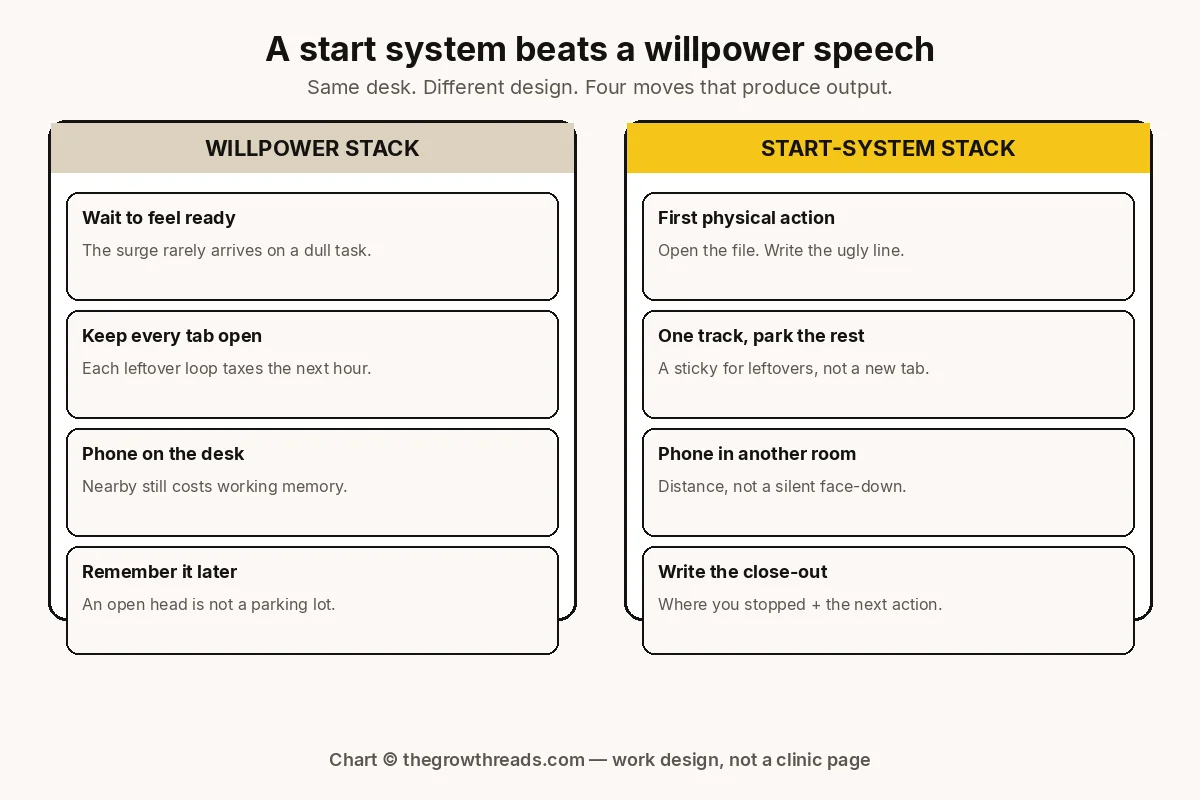
A start system is four moves you can see on the desk: a first physical action, a cue you already run, one track, and a written parking lot. It is not a types chart and not a seven-step ladder. It is a comparison of the stack you already run with the stack the evidence actually supports.
| Move | Willpower stack | Start-system stack | What the evidence implies |
|---|---|---|---|
| Start | Wait to feel ready, then “work on the deck.” | Name the first physical action. Open the file. Write the ugly line. | If–then plans need a verb you can do when the cue hits (Gollwitzer, 1999; Gollwitzer & Sheeran, 2006). |
| Cue | Start when the mood arrives. | After sit-down / first sip / laptop lid — the action fires. | The situation is what makes the plan automatic. A floating intention has no situation. |
| Switch | Every tab stays live. Phone on the desk, silenced. | One named output. Phone in another room. Leftovers go to Park. | Switching has a two-stage tax (Rubinstein, Meyer & Evans, 2001). Nearby phones still cost memory (Ward et al., 2017). |
| Park | “I’ll remember.” A new tab for each leftover. | One sticky: where you stopped + the next action. Then leave it. | Unfinished work leaves residue; a written close-out gives the loop a seat that is not working memory (Leroy, 2009). |
Run the comparison on yesterday, not on an ideal Monday. If the morning was a willpower stack, pick one cell to flip today — usually Start or Park. Four flips on day one is how the system becomes another abandoned app. Adachi’s Gentle is useful here as a capacity check: the week you actually have, not the week the speech assumed. Bailey’s hyperfocus / scatterfocus split is the Switch/Park pair in book language. Fiore’s unschedule is a calendar version of the same idea — protect start blocks instead of filling the day with guilt.
What are the common mistakes?
The common mistakes all put the speech back in charge and leave the desk the same. They look industrious. They do not change the first thirty seconds.
- Buying a new capture app instead of naming the first action. A prettier inbox is still not “open slide three.” The shiny-object move is how a start system dies on day one.
- Writing an if–then that still names a mood. “If I feel focused, then I will be productive” is a hope. “After I sit down with the coffee, I will open the draft” is a plan Gollwitzer would recognise.
- Silencing the phone and leaving it in sight. Ward, Duke, Gneezy and Bos’s near condition is the desk. Distance is the condition that protected memory.
- Keeping six live tracks and calling it energy. Rubinstein, Meyer and Evans’s tax is paid on each switch. One output is the track. The rest belong in Park.
- Skipping the close-out because you “know where you were.” Leroy’s residue finding is that knowing is not the same as releasing the loop. Write the next action. Then leave.
- Turning this page into a clinic quiz. This article does not list clinical symptoms, does not diagnose, and does not treat. Pattern questions belong on the two live ADHD articles, not in a homemade checklist.
When is this not a desk problem?
This is not a desk problem when the question you actually have is diagnosis, treatment, or whether a life-wide pattern is ADHD — those questions do not belong on a productivity start page. We will not list clinical symptoms here. We will not recommend medication, therapy protocols, or a self-score. If those are the questions, they belong with a qualified clinician, and the two live articles on this site that already handle the adjacent searches: ADHD procrastination and is procrastination a sign of ADHD.
Adamou and colleagues’ 2013 occupational review is the edge of what a work-habits page can honestly touch: workplaces sometimes need adjustments to the room and the task shape. That is still not a treatment list, and it is not a substitute for clinical care. The start system above is for a Tuesday at a desk. It is not a verdict on anyone’s health, and it does not become one if the search query contains the letters ADHD.
What does the evidence actually show?
The evidence on this page is about delay, plans, residue, switching, and a nearby phone — not about diagnosing or treating ADHD. The table is the working, not a clinic handout.
| Study | Design and size | Finding | What we used it for |
|---|---|---|---|
| Steel (2007) | Meta-analysis, 216 studies of procrastination correlates | Task aversiveness correlated with delay at r = .40 | Why a willpower speech loses to an ugly first step |
| Gollwitzer (1999); Gollwitzer & Sheeran (2006) | Theory paper plus meta-analysis of 94 if–then tests | Implementation intentions improved goal attainment, average d = 0.65 | Why the start needs a cue and a verb, not a vibe |
| Leroy (2009) | Two laboratory experiments on switching before completion | Unfinished Task A left attention residue that impaired Task B | Why Park is a written close-out, not “I’ll remember” |
| Rubinstein, Meyer & Evans (2001) | Four experiments modelling executive stages of a switch | Goal shifting then rule activation both take time, more so on complex tasks | Why one track beats six live tabs |
| Ward, Duke, Gneezy & Bos (2017) | Laboratory working-memory and fluid-intelligence tasks; phone location varied | Capacity dropped as the phone moved closer, even when unused | Why silent-on-the-desk is not the fix |
| Ariely & Wertenbroch (2002) | Student paper/proofreading tasks with self-set versus final-only deadlines | Binding earlier deadlines raised completion and quality versus a single end date | Why a written stop-date beats “when I’m in the zone” |
| Sirois & Pychyl (2013) | Review of procrastination as short-term mood regulation | Delay often functions as an escape from the present feeling | Why the first thirty seconds are a design problem, not a character test |
| Adamou et al. (2013) | Occupational review of adults with ADHD at work | Workplace design and task shape recur as practical issues | Why this page stays on the desk and refuses a treatment list |
Frequently asked questions
How do you be productive with ADHD at work?
How to be productive with ADHD at work, on this page, is a start system: name one output, attach the first physical action to a cue you already run, keep one track, and write leftovers in a parking lot. That is desk design, not a clinic protocol. It does not diagnose anyone and it does not replace clinical care. If the question you actually have is whether a life-wide pattern is ADHD, use the two live ADHD articles on this site and a qualified clinician — not a productivity checklist.
Is being productive with ADHD just about trying harder?
No. Trying harder waits for a feeling. Steel’s 2007 meta-analysis found task aversiveness among the strongest correlates of delay. Sirois and Pychyl (2013) describe delay as a short-term mood repair. A speech argues with the feeling; the feeling usually wins the first thirty seconds. A start system changes those thirty seconds: a cue, a verb you can do with your hands, one track, and a written close-out. Gollwitzer and Sheeran’s if–then results are about that kind of plan, not about becoming a more forceful person.
What is a start system?
A start system is four visible moves. Start: the first physical action on a named output. Cue: a situation that already happens — sit-down, first sip, laptop lid. Switch: one track, with the phone far enough away that it is not the near condition in Ward and colleagues’ 2017 design. Park: a written note of where you stopped and what happens next, so leftover loops stop living in working memory. It is the opposite of waiting to feel ready. It is also the opposite of opening a sixth tab and calling the scatter energy.
Does body doubling count as a start system?
Body doubling — working in the presence of another person — can be an external cue, the same way a sit-down or a kettle can be a cue. This page does not treat it as a therapy and does not claim a clinical trial for it. If another person in the room is what makes the first action cheaper, use it as a cue: “After we sit down, I open the file.” If it becomes a social hour with no named output, it is another track. The test is still the first physical action, not the company.
Should I use a timer to be productive with ADHD?
A timer is useful when it protects one track. It is noise when it becomes a new system you have to manage. Ariely and Wertenbroch’s 2002 result is about a written, binding stop — a deadline you can see — not about a brand of timer. If a twenty-five-minute window makes the first action cheaper, use it. If setting up the timer is how you avoid opening the file, skip it. The start system can run with a kettle and a sticky. It does not require a new gadget.
Is this the same as ADHD procrastination?
No. ADHD procrastination is the mechanism page: why delay and ADHD searches travel together, without turning that into a moral failure. This page is the desk page: what to change so a work block produces output. Is procrastination a sign of ADHD is the pattern page. Three searches, three jobs. Repeating those two articles here would not make anyone more productive at 10 a.m. The start system is the job this URL owns.
Can I use this without a diagnosis?
Yes. This is a work-habits page. The start system does not require a label, and using it is not a diagnosis. People delay ugly tasks, pay a switch tax, and lose working memory to a nearby phone whether or not anyone has ever used the letters ADHD about them. If you came here because a search mixed those letters with productivity, you can still run Start, Cue, Switch, and Park. If you came here looking for a clinic verdict, this is the wrong page, and we will not invent one.
When should I stop treating this as a desk problem?
Stop treating it as only a desk problem when the question is diagnosis, treatment, or a life-wide pattern that a productivity article cannot see. We do not list clinical symptoms here. We do not recommend medication or a therapy protocol. Those questions belong with a qualified clinician. On this site, the adjacent articles are ADHD procrastination and is procrastination a sign of ADHD. The start system can still be useful on a Tuesday. It does not become a substitute for care because the URL contains ADHD.
Sources
- Steel, P. (2007). The nature of procrastination: A meta-analytic and theoretical review of quintessential self-regulatory failure. Psychological Bulletin, 133(1), 65–94. https://doi.org/10.1037/0033-2909.133.1.65
- Gollwitzer, P. M. (1999). Implementation intentions: Strong effects of simple plans. American Psychologist, 54(7), 493–503. https://doi.org/10.1037/0003-066X.54.7.493
- Gollwitzer, P. M., & Sheeran, P. (2006). Implementation intentions and goal achievement: A meta-analysis of effects and processes. Advances in Experimental Social Psychology, 38, 69–119. https://doi.org/10.1016/S0065-2601(06)38002-1
- Leroy, S. (2009). Why is it so hard to do my work? The challenge of attention residue when switching between work tasks. Organizational Behavior and Human Decision Processes, 109(2), 168–181. https://doi.org/10.1016/j.obhdp.2009.04.002
- Rubinstein, J. S., Meyer, D. E., & Evans, J. E. (2001). Executive control of cognitive processes in task switching. Journal of Experimental Psychology: Human Perception and Performance, 27(4), 763–797. https://doi.org/10.1037/0096-1523.27.4.763
- Ward, A. F., Duke, K., Gneezy, A., & Bos, M. W. (2017). Brain drain: The mere presence of one’s own smartphone reduces available cognitive capacity. Journal of the Association for Consumer Research, 2(2), 140–154. https://doi.org/10.1086/691462
- Ariely, D., & Wertenbroch, K. (2002). Procrastination, deadlines, and performance: Self-control by precommitment. Psychological Science, 13(3), 219–224. https://doi.org/10.1111/1467-9280.00441
- Sirois, F., & Pychyl, T. (2013). Procrastination and the priority of short-term mood regulation: Consequences for future self. Social and Personality Psychology Compass, 7(2), 115–127. https://doi.org/10.1111/spc3.12011
- Adamou, M., Arif, M., Asherson, P., Aw, T.-C., Bolea, B., Coghill, D., … Young, S. (2013). Occupational issues of adults with ADHD. BMC Psychiatry, 13, 59. https://doi.org/10.1186/1471-244X-13-59
Related reading on The Growth Reads
The books behind this
- Gentle summary & review — Adachi on capacity and the week you actually have; the down-link for this page
- Hyperfocus summary & review — Bailey on one track and a written scatter list
- The Now Habit summary & review — Fiore on delay as a work pattern, not a verdict
Related articles
- How to overcome procrastination — the Procrastination parent: delay as a mechanism
- Productive procrastination — the sister: useful work that still avoids the named task
- ADHD procrastination — delay as a mechanism, not a moral failure
- Is procrastination a sign of ADHD — pattern versus a one-off stall
- The two-minute rule — shrink the first contact until starting is cheaper than avoidance
Go deeper
How this article was researched
The Growth Reads editorial team writes from primary sources: the books themselves and the peer-reviewed literature behind the claims. The procrastination meta-analysis, implementation-intention results, attention-residue experiments, task-switching model, smartphone-presence studies, precommitment deadlines, and mood-repair review above were checked against the original papers or their published abstracts and are quoted with study design and, where the source supports it, the direction and size of the effect. Gentle, Hyperfocus, and The Now Habit are labelled as practitioner or popular syntheses, not as trials that a start system treats ADHD.
This article is a work-and-habits page about start systems versus willpower speeches. It does not diagnose, treat, or list clinical symptoms, and nothing above is intended as medical advice.
How we work: every article on The Growth Reads is built from the books in our library plus the research they rest on, and is reviewed and date-stamped when the evidence changes. Read our full methodology.