

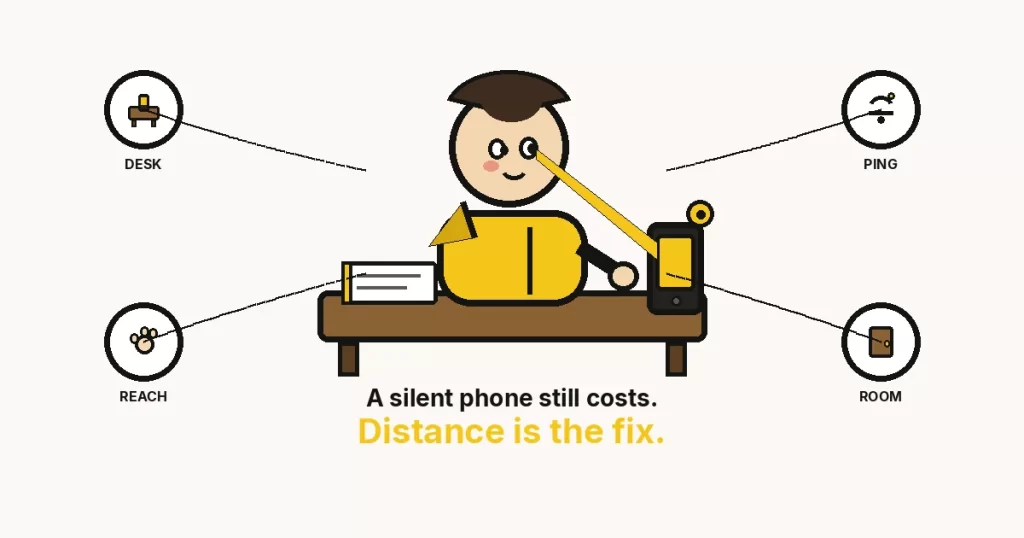
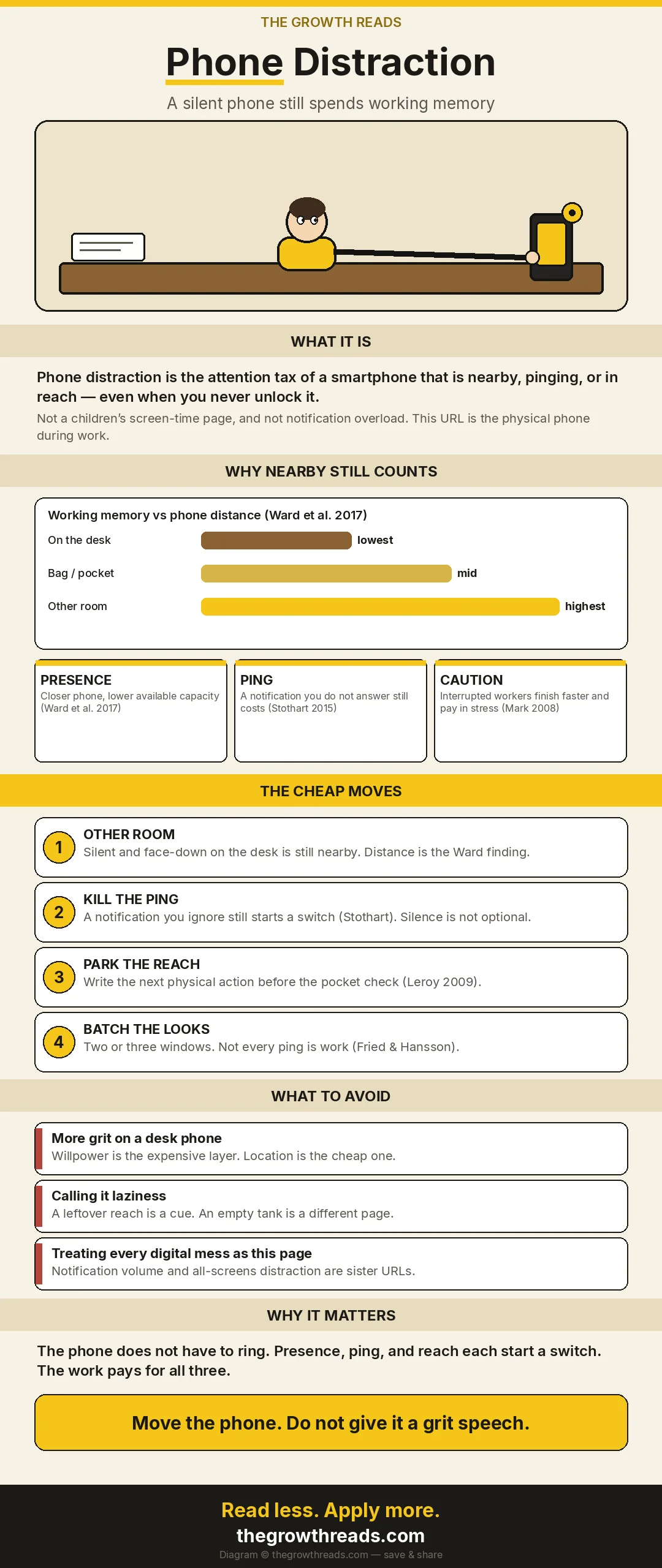
Phone distraction is the attention tax of a smartphone that is nearby, pinging, or in reach — even when you never unlock it. A silent phone on the desk still spends working memory. A notification you do not answer still starts a switch. Distance is the cheap fix; grit aimed at a desk phone is the expensive one.
Key takeaways
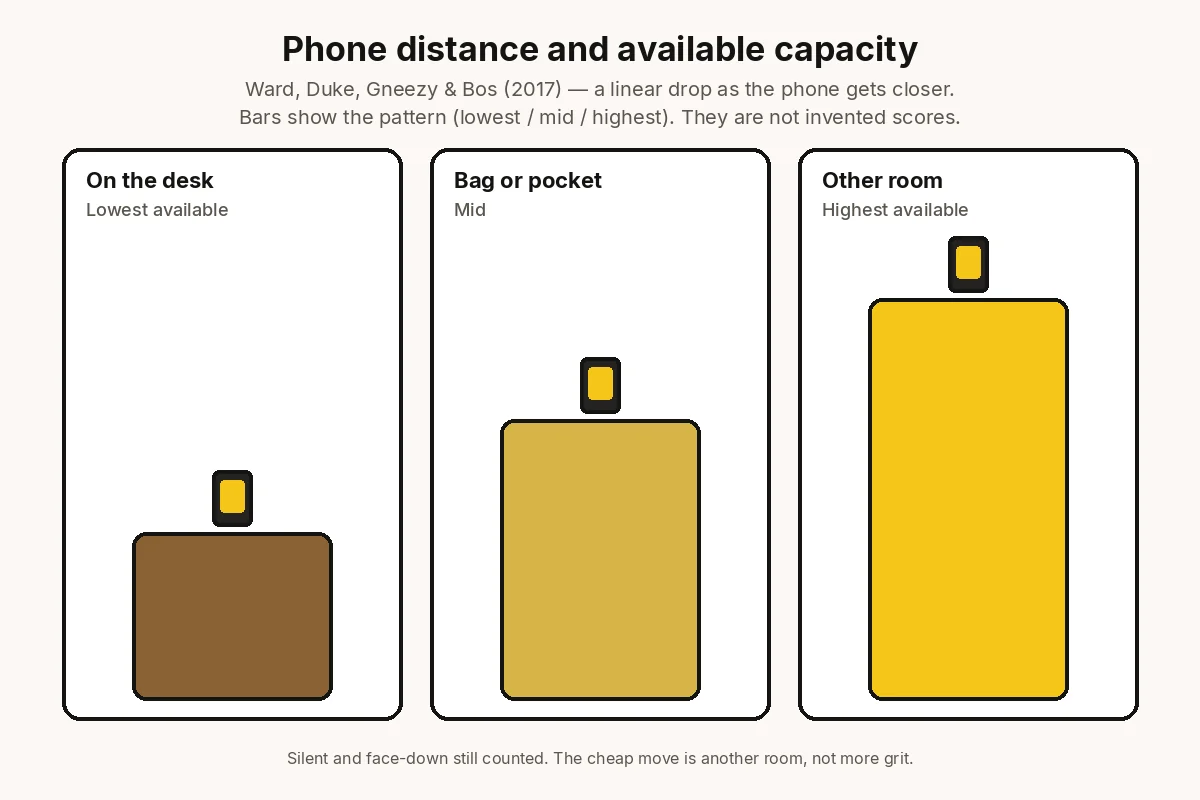
- A smartphone on the desk reduces available working memory and fluid intelligence even when it stays silent and untouched; the drop shrinks as the phone moves to a bag and then to another room (Ward, Duke, Gneezy & Bos, 2017).
- Receiving a cell-phone notification you never answer can disrupt a sustained-attention task about as much as taking the call or writing the text (Stothart, Mitchum & Yehnert, 2015).
- Switching away from an unfinished file leaves attention residue that impairs the next task; a parked next action is how you close the loop you did not finish (Leroy, 2009).
- Interrupted knowledge workers often finish in similar time by speeding up, and they pay for that speed in stress, frustration, and effort (Mark, Gudith & Klocke, 2008).
- The cheap company version of this is the same as the cheap personal version: fewer pings treated as work, and a phone that is not the loudest object on the desk — the argument in Fried and Hansson’s It Doesn’t Have to Be Crazy at Work.
What phone distraction actually is
Phone distraction is the attention tax of a smartphone that is nearby, pinging, or in reach during a work block — even when you never unlock it. The everyday search wants a willpower story. The useful version is a location story. A phone on the desk is a competitor for working memory. A ping you do not answer is still a switch. A hand that already knows the pocket is a cue, not a character trait.
That is why this page sits under Focus, next to the cluster’s live parent how to focus better, rather than under a health silo or a screen-time silo. Focus, on this site, is the near-total absence of task-switching. Phone distraction is one of the cheapest ways a switch gets started. The sister volume problem is notification overload. The sister one-target practice is single tasking. The join between two files is attention residue.
This is a work-and-desk page on the productivity library. It is not children’s screen-time guidance, not eye-health advice, not a diagnosis, and not a treatment list. It does not score addiction. It does not tell you that you have a disorder because you reached for a pocket. The question is narrower: where is the phone, what signal is it allowed to send, and what file is open when the hand moves.
A one-off look with no desk, no ping, and no pocket cue is a glance. Repeat the glance in the same chair at the same hour and it starts to become a leftover loop — the neighbour page on bad habits examples. Do not paste a leftover-loop story onto a phone that is simply sitting there. Presence has its own bill. Ward’s group measured that bill in people who never touched the device.
Phone distraction vs notification overload
Notification overload is how many signals arrive; phone distraction is where the device sits while you try to do one thing. You can silence every app and still pay the presence tax if the phone stays next to the keyboard. You can also keep a quiet phone in another room and still drown in Slack on a laptop. Those are neighbours. They are not the same file.
Stothart’s notification finding sits on the border. The ping is a signal. The phone is the object that carries it. Kill the ping and you still have a location. Move the phone and you still have laptop badges. How to reduce screen time owns the hours on glass. How to stay on task owns holding one target once the room is quieter. This URL owns the portable interrupt you can walk into another room.
The named unused review on this row is Fried and Hansson’s It Doesn’t Have to Be Crazy at Work. Their calm-company argument is not a lab trial. It is the organisational version of the same cheap move: stop treating every ping as work, and stop designing a day that requires a phone on every desk to feel “responsive.” Use it as the down-link, not as a second study.
Why the phone still wins
The phone still wins because three cheap cues beat one expensive intention: presence, ping, and reach. Intention says “I will not look.” The desk says “I am still here.” The badge says “something happened.” The pocket says “you already know the path.” Rubinstein, Meyer and Evans (2001) modelled the switch itself as two stages — goal shifting, then rule activation. Both take time. The phone is unusually good at starting that sequence without asking whether the current file is finished.
Leroy’s 2009 attention-residue work is the unglamorous part. The expensive moment is not only the glance. It is coming back to Task B while Task A is still unnamed. Completing A helps when you actually disengage. “I’ll just check” keeps the first file running in working memory. The second file pays for that. Why does my memory suck is the sister complaint when the day feels like Swiss cheese. Often the cheese is switches, not a failing brain.
Ophir, Nass and Wagner (2009) then showed that heavy media multitaskers were worse, not better, at filtering irrelevant information in a quiet lab. That study is correlational. It does not prove that phones cause a weaker filter. It does warn against treating constant switching as training. Practising interruption is a poor way to get good at what deep work actually means.
The four cues
- Presence. Ward, Duke, Gneezy and Bos (2017) tested 520 undergraduates on working-memory and fluid-intelligence tasks with their own smartphone in another room, in a bag or pocket, or on the desk. Capacity dropped in a straight line as the phone got closer. People did not have to touch it. Silent still counted. Face-down still counted. Thornton, Faires, Robbins and Rollins (2014) had already shown a smaller mere-presence effect with a phone on the table during harder tasks. The object is the cue.
- Ping. Stothart, Mitchum and Yehnert (2015) used a sustained-attention-to-response task with 221 undergraduates. A notification the person did not answer produced an attention decrement in the same range as actually responding. Kushlev, Proulx and Dunn (2016) then compared a week of usual notifications with a week of having them turned off; people reported more inattention when the pings were on. That is self-report about work attention, not a diagnosis and not a symptom list.
- Reach. The pocket, the unlock, the “just check” after a send. This is the leftover-loop cousin: a stable context still starting last week’s action. If the chair and the unlocked phone are the training set, “use more willpower at 11:40” is a speech aimed at a cue. Park the next physical action before the hand moves. That is residue management, not a new personality.
- Room. The cheap inverse of presence. Another room was the best of Ward’s three locations. A bag beat the desk. The walk is the intervention. Charging the phone in the kitchen overnight is the same idea at the other end of the day — the reason how to wake up early if you sleep late keeps the alarm from being the first unlock.
Why it costs more than it feels like
A single glance feels free because it is fast; the bill is residue, a faster-and-more-stressed finish, and a day that never quite enters one file. Mark, Gudith and Klocke (2008) interrupted people during work and watched them compensate. They often finished in comparable time by speeding up. The hidden invoice was higher stress, frustration, time pressure, and effort. Completion-time metrics miss that invoice. The person does not.
Ward’s proximity drop is the invoice you pay before the glance. Stothart’s notification drop is the invoice you pay for a signal you ignore. Leroy’s residue is the invoice you keep paying after you have already “moved on.” Stack those three and a morning of trying to be productive at home can look busy and still produce one half-started draft. Home is not the problem. A phone on the kitchen table next to the laptop is a desk by another name.
| Where the phone is | What the evidence says | What people usually do instead | The cheaper move |
|---|---|---|---|
| On the desk | Lowest available working memory and fluid intelligence of Ward’s three locations, even when silent and untouched | Flip it face-down and call that “off” | Another room. Face-down is still the desk |
| Bag or pocket | Middle of the Ward line — better than the desk, worse than another room | Keep it on the body “in case something urgent happens” | A bag in another room beats a pocket you can reach without standing |
| Other room | Highest available capacity of the three. Distance, not grit, is the condition | Wait until you “feel focused,” then walk | Walk first. Write the next action if you must leave a file open (Leroy) |
| Ping on, any location | A notification you do not answer still disrupts sustained attention (Stothart) | Leave badges on and promise not to look | Silence for the block. Volume belongs on the notification-overload page |
Two honest caveats. Ward’s sample is undergraduates in a lab, not a month of your job. The linear proximity pattern is the usable finding; this page does not invent percentage scores for “how much smarter you get in the kitchen.” Kushlev’s notification week used self-report scales that overlap everyday language for inattention. We use it as a work-attention finding. We do not use it as a diagnosis, a symptom list, or a treatment.
The organisational cousin is the always-on desk. Fried and Hansson’s It Doesn’t Have to Be Crazy at Work argue that a company can decide fewer things are emergencies. That is not a peer-reviewed trial. It is the same cheap layer: stop designing a day that requires a glowing rectangle within reach to feel like work is happening. Pair it with a written if-then if you need the walk to stick — implementation intentions is the sentence “After I sit down, the phone goes in the other room.”
Common mistakes
- Calling a desk phone “off” because it is face-down. Ward’s worst location was the desk. Orientation was not the fix. Distance was.
- Leaving badges on and promising not to look. Stothart’s people did not look. They still paid. Silence is the layer, not a more mature stare.
- Giving a grit speech to a leftover reach. If the same chair still starts the unlock, that is a cue. Leftover loops are not laziness, and they are not this URL’s presence tax either. Name which one you have.
- Pasting an empty-tank story onto a nearby phone. Burnout vs laziness is motivation versus depletion at work. This page is a location problem. Do not diagnose depletion. Do not treat it. Do not add a longer phone-rules list to an empty week.
- Treating every digital mess as this page. notification overload owns volume. Screen time owns hours. A later row will own all-screens distraction. This URL is the physical phone during a block.
- Switching files with the first one still unnamed. Residue is how a “quick check” becomes a foggy return. Write the next physical action, then walk. Staying on task is what you do after the room is quieter.
- Using the phone as the morning alarm and then wondering why the first hour is already switched. Charge it in another room. The morning parent is how to build a morning routine.
When it is more than a habit
A workplace default that still starts from a desk phone is a focus question; a pattern that takes over sleep, money, or safety is a different conversation and this page is not that conversation. The phone-distraction frame is for ordinary blocks: the silent rectangle next to the keyboard, the badge you do not answer, the pocket check after a send. It is not a diagnosis, not a treatment list, and not a stand-in for help with compulsive use or anything that is harming health or relationships.
If the phone is nearby and a two-minute walk is available, this page applies. If the thing you want to stop is bigger than a slot on a workday, stop asking this URL for a laziness test or a grit plan. The honest next step is a qualified person, not a tighter streak and not a longer rules list. This article does not diagnose, does not treat, and does not list clinical symptoms.
The evidence behind this
The usable evidence is a proximity drop, a notification-without-answering drop, a residue finding, and an interruption-stress finding — not a willpower score.
| Study | Design and size | Finding | What we used it for |
|---|---|---|---|
| Ward, Duke, Gneezy & Bos (2017) | 520 undergraduates; working-memory and fluid-intelligence tasks; own phone in another room, bag/pocket, or on the desk | Available capacity dropped in a straight line as the phone got closer, including when it stayed silent and untouched | Presence is a location tax. Distance is the cheap fix |
| Stothart, Mitchum & Yehnert (2015) | 221 undergraduates; sustained-attention task; notification vs call/text vs control | A notification people did not answer disrupted attention on the order of actually responding | The ping starts the switch. Silence is not optional |
| Leroy (2009) | Lab task-switching; unfinished vs finished first tasks; attention residue on the second task | An unfinished first task left residue that impaired the next one; finishing plus real disengagement helped | Park the next action before the pocket check |
| Mark, Gudith & Klocke (2008) | Field / lab interrupted knowledge work | Interrupted people often finished in similar time by working faster, with more stress, frustration, and effort | Why a “quick glance” can still produce a finished file and an expensive day |
| Thornton, Faires, Robbins & Rollins (2014) | Lab; phone present vs absent during attention tasks of varying difficulty | Mere presence of a phone impaired the harder tasks | A second, smaller presence finding. Not a copy of Ward’s three locations |
| Ophir, Nass & Wagner (2009) | Lab contrast of heavy vs light media multitaskers | Heavy multitaskers filtered irrelevant information worse, including in a quiet room | Correlational warning: switching is a poor training plan. Not causal proof |
| Kushlev, Proulx & Dunn (2016) | Two studies; a week of usual notifications vs a week with them off | People reported more inattention when notifications stayed on | Work-attention self-report only. Not a diagnosis, not a symptom list |
| Rubinstein, Meyer & Evans (2001) | Four lab experiments modelling executive control during task switches | A switch has two stages — goal shift, then rule activation — and both take measurable time | Why a “tiny” glance is still a full switch, not a free look |
Frequently asked questions
What is phone distraction at work?
Phone distraction is the attention tax of a smartphone that is nearby, pinging, or in reach during a work block — even when you never unlock it. Presence spends working memory (Ward, Duke, Gneezy and Bos, 2017). A notification you do not answer still starts a switch (Stothart, Mitchum and Yehnert, 2015). It is not children’s screen-time guidance, not a diagnosis, and not the same page as notification overload. Name the location of the phone before you give the person a grit speech.
Is a silent phone on the desk still a distraction?
Yes. Ward’s 2017 lab put phones in another room, in a bag or pocket, or on the desk. Available working memory and fluid intelligence dropped in a straight line as the phone got closer, including when people never touched it. Silent and face-down still counted. The cheap move this finding points to is another room, not a more serious face-down. A bag is better than the desk. Another room is better than a bag.
Does a notification you ignore still cost attention?
Yes. Stothart, Mitchum and Yehnert (2015) had people do a sustained-attention task while their own phone sat out of reach. A notification they did not answer produced an attention drop in the same range as actually taking a call or writing a text. The switch starts at the signal, not at the unlock. Silence is not a personality upgrade. It is how you stop paying for a message you were never going to answer in that block.
How is phone distraction different from notification overload?
Notification overload is the volume of pings. Phone distraction is the physical device: on the desk, in the pocket, in the hand. You can silence every app and still pay the presence tax if the phone stays next to the keyboard. You can also keep a quiet phone in another room and still drown in Slack on a laptop. The sister page owns the volume. This page owns the location. Do not paste one fix onto the other problem.
Is checking your phone the same as laziness?
No. Laziness is a motive story told after the reach. Phone distraction is a location problem and a cue: the desk, the ping, the pocket. A leftover unlock that fires from the same chair is the neighbour leftover-loop page, not a character verdict. If the tank is empty rather than the phone nearby, that is burnout versus laziness — motivation versus depletion — and a different URL. This page does not score laziness and does not diagnose depletion.
Where should the phone go during deep work?
Another room is the condition that left the most capacity on the table in Ward’s proximity test. A bag or pocket sat in the middle. The desk was the worst of the three. Face-down and silent on the keyboard is still the desk. Pair the move with a written next action if you have to leave a file open — residue stays when the first task is unfinished (Leroy, 2009). Do not wait for a 5 a.m. identity to make the walk.
Is phone distraction the same as too much screen time?
No. Screen time is hours on glowing glass. Phone distraction is the interrupt during a block you already sat down to do. A two-hour focused edit with the phone in another room can still be a high-screen day. A forty-minute draft with the phone on the desk can be a low-screen day that still never quite starts. The screen-time page owns the hours. This page owns the switch. Do not treat a location problem as a weekly minutes target.
Can you train yourself to ignore a desk phone?
You can get better at not unlocking it. That is not the same as not paying for it. Ward’s drop showed up in people who never touched the phone. Stothart’s drop showed up in people who never answered the ping. Practice at ignoring a signal you can still see and hear is expensive. Moving the phone and killing the ping is cheap. Use grit on the work, not on a device you could have left in the kitchen.
Sources
- Ward, A. F., Duke, K., Gneezy, A., & Bos, M. W. (2017). Brain Drain: The Mere Presence of One’s Own Smartphone Reduces Available Cognitive Capacity. Journal of the Association for Consumer Research, 2(2), 140–154. doi:10.1086/691462
- Stothart, C., Mitchum, A., & Yehnert, C. (2015). The attentional cost of receiving a cell phone notification. Journal of Experimental Psychology: Human Perception and Performance, 41(4), 893–897. doi:10.1037/xhp0000100
- Leroy, S. (2009). Why is it so hard to do my work? The challenge of attention residue when switching between work tasks. Organizational Behavior and Human Decision Processes, 109(2), 168–181. doi:10.1016/j.obhdp.2009.04.001
- Mark, G., Gudith, D., & Klocke, U. (2008). The cost of interrupted work: more speed and stress. In Proceedings of the SIGCHI Conference on Human Factors in Computing Systems (pp. 107–110). doi:10.1145/1357054.1357072
- Thornton, B., Faires, A., Robbins, M., & Rollins, E. (2014). The mere presence of a cell phone may be distracting. Social Psychology, 45(6), 479–488. doi:10.1027/1864-9335/a000216
- Ophir, E., Nass, C., & Wagner, A. D. (2009). Cognitive control in media multitaskers. Proceedings of the National Academy of Sciences, 106(37), 15583–15587. doi:10.1073/pnas.0903620106
- Kushlev, K., Proulx, J., & Dunn, E. W. (2016). “Silence Your Phones”: Smartphone notifications increase inattention and hyperactivity symptoms. In Proceedings of the 2016 CHI Conference on Human Factors in Computing Systems (pp. 1011–1020). doi:10.1145/2858036.2858359
- Rubinstein, J. S., Meyer, D. E., & Evans, J. E. (2001). Executive control of cognitive processes in task switching. Journal of Experimental Psychology: Human Perception and Performance, 27(4), 763–797. doi:10.1037/0096-1523.27.4.763
Related reading on The Growth Reads
The books this page draws on
- It Doesn’t Have to Be Crazy at Work summary — fewer pings treated as work; the organisational version of a phone that is not on every desk
Related articles
- How to focus better — this cluster’s parent: remove the switch, do not add willpower
- Notification overload — the sister: volume of pings, not the location of the phone
- Single tasking — one target once the room is quieter
- Attention residue — the unpaid bill after an unfinished switch
- How to reduce screen time — hours on glass, not the interrupt during a block
- How to stay on task — holding the file after the phone has left the desk
- Burnout vs laziness — the neighbour split: motivation versus depletion, not a nearby phone
Go deeper
How this article was researched
The Growth Reads editorial team writes from primary sources: the books themselves and the peer-reviewed literature behind the claims. Every study cited above was read in the original publication or its published abstract, and every figure is quoted with its design, sample and effect so you can judge its weight rather than take ours. Where a finding is correlational, self-report, a lab contrast with students, or a field study of interrupted work, we say so in the body rather than in a footnote. This page does not invent a willpower score, because none of the cited papers measured one.
This article is a work-and-habits page. It is phone distraction as a location and signal problem — not a burnout health page, not medical advice, not a diagnosis, and not a treatment plan. A pattern that is harming sleep, money, safety, or relationships is outside this URL.
How we work: every article on The Growth Reads is built from the books in our library plus the research they rest on, and is reviewed and date-stamped when the evidence changes. Read our full methodology.