

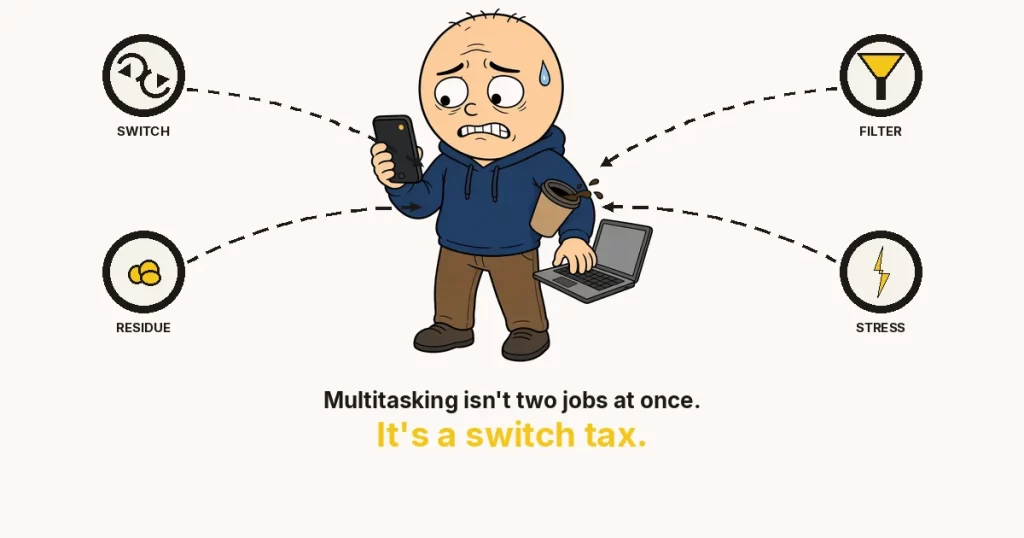
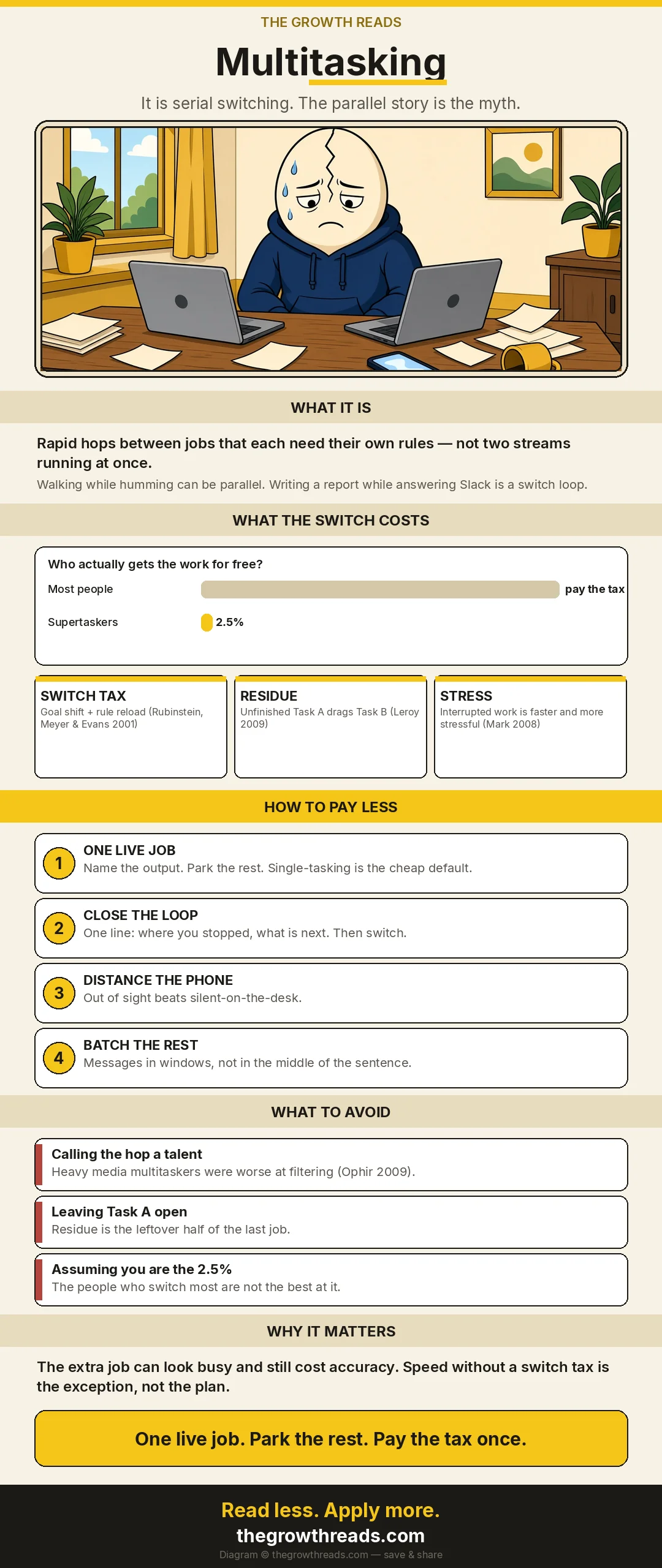
Multitasking is almost never two jobs running at once — it is rapid serial switching, and each switch costs time, leftover attention, and accuracy. Heavy media multitaskers are worse, not better, at filtering the extra stream. A tiny slice of people show no dual-task drop in the lab; treating yourself as one of them is how the tax stays invisible.
Key takeaways
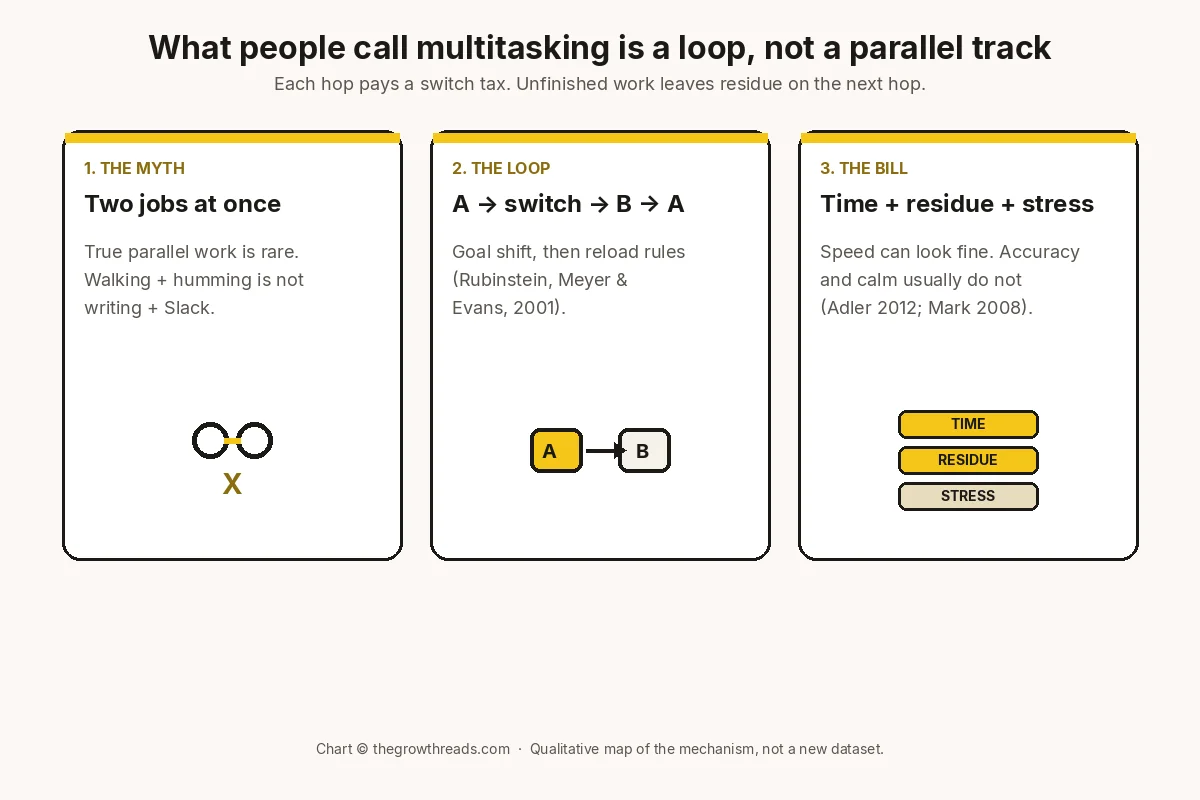
- What people call multitasking is usually serial task-switching: executive control has to shift the goal and then reload the new rules, and that tax grows with how complex the next task is (Rubinstein, Meyer & Evans, 2001).
- Heavy media multitaskers performed worse, not better, on a lab test of task-switching, largely because they were less able to filter irrelevant information once it was in view (Ophir, Nass & Wagner, 2009). That comparison is correlational — it does not prove the habit caused the filter to weaken.
- Switching away from an unfinished task leaves attention residue that measurably drags the next one; finishing the first task helps, but only when it is paired with enough time pressure to actually disengage (Leroy, 2009).
- Interrupted knowledge workers often finish in similar time by speeding up — and they pay for that speed in higher stress, frustration, time pressure and effort (Mark, Gudith & Klocke, 2008).
- About 2.5% of a 200-person sample showed no dual-task drop in a driving-plus-span test (Watson & Strayer, 2010). The people who multitask the most are not the ones who are best at it (Sanbonmatsu, Strayer, Medeiros-Ward & Watson, 2013).
What multitasking actually is
Multitasking, in the way most knowledge work uses the word, is not two jobs running in parallel — it is a rapid hop from one rule-set to another. You leave the sentence you were writing, you load the rules for the Slack thread, you answer, then you try to reload the sentence. The second job did not run underneath the first. It replaced it, briefly, and then had to be replaced in turn.
Joshua Rubinstein, David Meyer and Jeffrey Evans modelled that hop in 2001 across four experiments. Executive control did two sequential jobs on every switch: goal shifting (deciding to do the new thing) and rule activation (loading the specific rules the new thing requires). Switch costs grew when the next task’s rules were more complex, and they shrank when people got a cue that a switch was coming. Those two effects added rather than traded off, which is what you would expect if they were two separate stages, not one blob of “trying harder.”
That is why the word is so slippery. Walking while humming can be close to parallel, because one of those streams is a well-practiced motor routine. Writing a report while answering messages is not that. It is two attention-demanding jobs taking turns, each one kicking the other off the processor. How to focus better is the parent page for the beam that makes any one of those jobs possible. This page is the cost of pretending you can run two beams at once.
Multitasking vs task switching
Task switching is the mechanism; multitasking is the story people tell about it. In the lab, a switch is a controlled change from Task A to Task B, often with a cue and a measurable delay. In an office, the same mechanism hides inside a tab, a ping, or a self-check. The hop still has to happen. The story (“I’m good at doing two things”) is what makes the tax feel like a skill.
Sophie Leroy’s 2009 experiments added the part the stopwatch misses. When people left Task A unfinished, a residue of attention stayed attached to it and dragged performance on Task B. Finishing Task A helped — but only when it came with enough time pressure to actually disengage. Completion without that pressure was not enough to clear the first job from working memory. That leftover is the same attention residue problem, written here as the bill attached to the hop rather than as its own page.
The rare exception
A small slice of people really can dual-task some hard pairs without a measurable drop — and that slice is not a plan you should bet a workday on. Jason Watson and David Strayer tested 200 people in a high-fidelity driving simulator, pairing driving with a demanding auditory operation-span task. The vast majority got worse at both. Five people — 2.5% of the sample — showed no dual-task decrement, and scored in the top quartile on the single-task versions as well. Monte Carlo simulations suggested that frequency was not a fluke. It is also not a training target. It is a tail of the distribution.
David Sanbonmatsu, Strayer, Nathan Medeiros-Ward and Watson then asked who actually does the extra jobs. In 277 students, media-multitasking and self-reported phone-use-while-driving were negatively correlated with real multi-tasking ability on an operation-span test, and positively correlated with how good people thought they were. Impulsivity and sensation-seeking predicted more switching, not more skill. The people most likely to keep a second live job going were not the people most able to carry it.
Why the switch keeps winning
The switch wins because the second job is usually easier, louder, or more socially urgent than the first — not because it is more important. A ping is a finished packet. The report is an open loop. The brain will take the closed packet. That is not a diagnosis. It is a design problem: two live jobs, one of which can answer in ten seconds.
Rachel Adler and Raquel Benbunan-Fich tested discretionary switching in 2012 with a custom tabbed application. People who could hop between tasks at will showed an inverted-U on productivity (medium switchers completed more than both the locked-in sequential group and the heaviest switchers) and a falling line on accuracy (more switching, more errors). The metric you pick changes the story. If you only count “how much got ticked,” a moderate hop-rate can look like a win. If you count whether the work is right, the extra hops are a leak.
That is the honest middle, and it is the counter-case this page has to name. Adler and Benbunan-Fich did not find that every extra switch is pure loss on every measure. They found that the cheap-looking middle of the curve still costs accuracy, and that the high end costs both. A workday that feels “productive” because many tabs moved can still be a worse day for the thing that had to be correct.
Self-interruption does the rest. You do not need a colleague. You need a moment of friction in the hard job and a second screen that will take you. Ophir, Nass and Wagner’s heavy media multitaskers were more susceptible to interference from irrelevant stimuli in the room and from irrelevant items in memory. Practising the hop did not look like training. It looked like a weaker filter. Again: correlational. People who already filter poorly may also be the people who keep more streams on. Either way, the office version of the habit is the same move — keep a second job live — and single-tasking is the sister practice of refusing that second live job.
Why it costs more than it feels like
A single hop feels free because it is fast. The bill is a stack of smaller, documented costs that never send an invoice. Rubinstein, Meyer and Evans put a time tax on the hop itself. Leroy added an attention tax that outlasts the hop. Gloria Mark, Daniela Gudith and Ulrich Klocke put a stress tax on interrupted knowledge work: in their 2008 study, interrupted people finished in less time with no drop in quality by working faster — and they reported significantly more stress, frustration, time pressure and effort. The work still shipped. The person doing it paid in a currency no completion-time chart captures.
Accuracy is the quiet leak. Adler and Benbunan-Fich’s falling line is the version you feel at 4 p.m. as “I touched everything and nothing is quite done.” Medium switching can raise the count of completed widgets and still raise the error rate. If your job is a widget count, you will defend the hops. If your job is a sentence that has to be right, you will not.
Two honest caveats. Ophir, Nass and Wagner compared people who already differed in habitual media use, so the study cannot prove that multitasking caused worse filtering. And Watson and Strayer’s 2.5% is a lab tail on one dual-task pair (driving plus auditory span), not a licence to keep Slack open on a report. Name the exception; do not staff a team as if everyone is in it.
Put together, the cost is not one dramatic percentage you should tattoo on a slide. It is a time tax, a residue tax, a stress tax, and — for the heaviest switchers — a filtering tax that shows up even in a quiet lab. The productivity hub is where those costs sit next to the other six parents. This page owns the hop.
Four uses of the word, compared
Most arguments about multitasking fail because the speakers are using four different words. The play-slot version of this page does not diagnose you into types. It names the pattern so you can stop defending the wrong one.
| What people call it | What is usually happening | Parallel? | What it costs |
|---|---|---|---|
| True dual-task | A well-practiced motor routine plus a light second stream (walking and humming) | Closest to yes | Low, until the second stream gets hard |
| Rapid switching | Two attention-demanding jobs taking turns (report + Slack) | No — serial hops | Time tax + residue + stress (Rubinstein; Leroy; Mark) |
| Interleaved batching | You finish or park a chunk, then hop on purpose | No, but the hops are fewer | You pay the tax at the boundary, not in the sentence |
| Media multitasking | Several streams on at once as a default (messages, video, tabs) | No | Weaker filtering in heavy users, correlational (Ophir et al., 2009) |
The office fight is almost always row two dressed up as row one. If you can name the output of the live job in one sentence, you are in a position to park row two. If you cannot, you are not multitasking. You are stalling with extra tabs. Task batching is the nearby method for grouping the hops so they happen on a schedule instead of inside the sentence.
How to pay the tax less
You do not need a talent for dual-tasking. You need fewer live jobs, and a cheaper way to leave the ones you cannot finish. This is not a numbered how-to system and it is not a clinical protocol. It is the same load rule as single-tasking, written from the cost side.
Name one output before you touch the keyboard. “Draft the second section, 400 words, does not have to be good.” That sentence is Rubinstein’s goal-shift, paid once on purpose instead of paid every time you re-decide what the tab is for.
When you have to leave before the job is finished, spend fifteen seconds writing where you stopped and the next physical action. Leroy’s residue is the open loop. A written marker is not magic, and it is not a substitute for finishing. It is the cheapest way we have to tell working memory that the loop is parked, not abandoned. Then hop.
Put the phone somewhere that is not the desk. The parent page covers the distance finding in full. Here it is enough to say: a silent phone face-down next to the keyboard is still a second live job, because the job is “be ready.” Notification overload is the volume problem; this page is the hop those volumes force.
Batch the rest. Two or three windows for messages, not a check at every friction point. Adler and Benbunan-Fich’s accuracy line is the reason: more discretionary hops, more errors, even when the widget count looks fine. If a colleague needs you in the middle of a sentence, you still hop — you just stop pretending the hop was free.
Common mistakes
The mistakes are almost all stories that hide the hop.
- Calling the hop a talent. Heavy media multitaskers were worse at the lab switch test, not better (Ophir, Nass & Wagner, 2009). Skill is the wrong word for a weaker filter.
- Leaving Task A open on purpose. Residue is the leftover half of the last job (Leroy, 2009). Park it in one line, then leave.
- Assuming you are the 2.5%. Watson and Strayer’s supertaskers were a tail, and Sanbonmatsu et al. found that the people who switch most overrate their ability.
- Counting speed as proof. Mark, Gudith and Klocke’s interrupted workers were faster and more stressed. Completion time can hide the bill.
- Defending moderate switching with the inverted-U. Adler and Benbunan-Fich’s medium group completed more and still lost accuracy. Pick the metric that matches the job.
- Keeping a second screen “just in case.” A live second job is the hop, whether you touch it or not. One live job is the cheap default; what deep work actually means is the designed hard hour that needs that default.
- Using flow as an excuse to juggle. Flow state is a match of challenge and skill in one channel. A second live job is how you knock the channel over.
When it is more than a personal habit
Sometimes the second live job is not a personal vice. It is how the system is staffed. If five projects are all “in progress,” the hops are policy. Gene Kim, Kevin Behr and George Spafford’s The Phoenix Project is the factory version of the same tax: too much work-in-process, too many starts, not enough finishes. Wait time explodes, even when everyone looks busy. The personal fix (one live job) still helps. It cannot outrun a board that keeps opening new jobs.
That is also the limit of this page. It is a work-and-habits article about the cost of the hop. It is not a clinical page, not a diagnosis, and not a treatment plan. If the stall is that you cannot start at all, that is a different problem than a second live job — and it has its own URL. If the stall is that you cannot choose, that is a decisions page. This URL owns the extra job that keeps interrupting the first.
The evidence behind this
The evidence is a stack of lab and field studies that agree on the hop and disagree on how pretty the middle of the curve looks. None of them measured your Tuesday. Together they are enough to retire the parallel story.
| Study | Design and size | Finding | What we used it for |
|---|---|---|---|
| Rubinstein, Meyer & Evans, 2001 | Four experiments; task alternation vs repetition; cues, complexity, familiarity varied | Switch costs rose with rule complexity and fell with cuing; the two effects were additive (goal shift + rule activation) | The time tax on the hop itself |
| Ophir, Nass & Wagner, 2009 | Media Multitasking Index; heavy vs light groups compared on cognitive-control tasks | Heavy media multitaskers were more distractible and worse at a task-switching test | The filter tax — flagged as correlational, not causal |
| Leroy, 2009 | Two experiments on switching between work tasks | Unfinished Task A left residue that hurt Task B; finishing helped only with time pressure to disengage | Why parking the loop beats abandoning it |
| Mark, Gudith & Klocke, 2008 | Empirical study of interrupted knowledge work (CHI) | Interrupted people finished faster with no quality drop, and reported more stress, frustration, time pressure and effort | The stress tax that completion-time hides |
| Adler & Benbunan-Fich, 2012 | Controlled experiment; sequential vs discretionary tab-switching | Inverted-U for productivity; falling line for accuracy as switching rose | Why a “busy” middle can still leak errors |
| Watson & Strayer, 2010 | 200 people; driving simulator + auditory OSPAN | 2.5% showed no dual-task drop (“supertaskers”) | The named exception — a tail, not a target |
| Sanbonmatsu, Strayer, Medeiros-Ward & Watson, 2013 | 277 students; MMI, OSPAN, impulsivity, sensation-seeking | More switching tracked worse ability and inflated self-ratings | Why the people who hop most are not the people who hop well |
Frequently asked questions
What is multitasking?
Multitasking, in ordinary knowledge work, is the attempt to keep two attention-demanding jobs live at once. What actually happens is serial task-switching: you leave one rule-set, load another, then try to reload the first. Rubinstein, Meyer and Evans showed that each of those hops has a measurable executive-control cost. True parallel work exists in a narrow band of well-practiced pairs. Writing plus messaging is not in that band. It is a loop that feels like a talent because the hop is fast.
Is multitasking bad?
It is expensive more often than it is parallel. Interrupted workers in Mark, Gudith and Klocke’s 2008 study still finished, by speeding up, and they paid in stress. Adler and Benbunan-Fich found that extra discretionary hops can raise a productivity count and still drop accuracy. Heavy media multitaskers in Ophir, Nass and Wagner’s 2009 comparison were worse at filtering, not better — a correlational result, not a moral one. The useful question is not “is it bad.” It is “which job had to be right, and did the hop make that job worse.”
Does multitasking work?
Sometimes the widget count goes up. That is Adler and Benbunan-Fich’s inverted-U: medium switchers completed more than people locked into a pure sequence and more than the heaviest switchers. Accuracy still fell as switching rose. So “it works” depends on the metric. If the job is a count of touched items, a moderate hop-rate can look like a win. If the job is a sentence, a figure, or a decision that has to be correct, the extra hops are a leak you will not see on a busy-looking board.
What is the difference between multitasking and task switching?
Task switching is the lab name for the hop: leave Task A, load Task B. Multitasking is the everyday name for keeping both jobs apparently live. The mechanism is the same executive-control sequence Rubinstein, Meyer and Evans described — goal shift, then rule activation. Residue is the extra bill when Task A was unfinished (Leroy, 2009). People argue past each other when one of them means walking-plus-humming and the other means report-plus-Slack. Name the pair before you defend it.
Can anyone actually multitask?
A few people can carry some hard pairs without a measurable drop. Watson and Strayer found 2.5% of a 200-person sample with no dual-task decrement on driving plus an auditory span test. That is a real tail, and it is not a training plan. Sanbonmatsu and colleagues found that the people who report the most multi-tasking are not the people who score best at it, and they overrate their own ability. Build the day for the 97.5%. If you happen to be in the tail, you will still write a better report with one live job.
Why do I keep multitasking if I am worse at it?
Because the second job is usually easier, louder, or more socially urgent than the first, and because people who switch a lot overrate how good they are at it (Sanbonmatsu et al., 2013). Impulsivity and sensation-seeking predicted more switching, not more skill. A ping is a closed packet. The report is an open loop. You do not need a personality story. You need fewer live jobs, and a written park for the one you cannot finish before you hop.
How do I stop multitasking at work?
Cut the number of live jobs, do not add willpower. Name one output. Park the rest in one line so residue has somewhere to go. Put the phone out of sight. Batch messages into windows. That is the same load rule as single-tasking, written from the cost side. If the board keeps opening new jobs, the hops are policy — The Phoenix Project is the factory version of too much work-in-process. A personal one-live-job rule still helps. It cannot outrun a system that never finishes.
Is checking your phone multitasking?
Yes, if another attention-demanding job was live. Checking the phone is a hop: goal shift, rule reload, then an attempt to reload the first job, often with residue if the first job was unfinished. A notification you never touch can still be a second live job, because the job is “be ready.” Distance is cheaper than silence on the desk. If no other job was live, it is just a check. The tax starts when two jobs share the same minute.
Sources
- Rubinstein, J. S., Meyer, D. E., & Evans, J. E. (2001). Executive control of cognitive processes in task switching. Journal of Experimental Psychology: Human Perception and Performance, 27(4), 763–797. https://doi.org/10.1037/0096-1523.27.4.763
- Ophir, E., Nass, C., & Wagner, A. D. (2009). Cognitive control in media multitaskers. Proceedings of the National Academy of Sciences, 106(37), 15583–15587. https://doi.org/10.1073/pnas.0903620106
- Leroy, S. (2009). Why is it so hard to do my work? The challenge of attention residue when switching between work tasks. Organizational Behavior and Human Decision Processes, 109(2), 168–181. https://doi.org/10.1016/j.obhdp.2009.04.002
- Mark, G., Gudith, D., & Klocke, U. (2008). The cost of interrupted work: More speed and stress. In Proceedings of the SIGCHI Conference on Human Factors in Computing Systems (pp. 107–110). https://doi.org/10.1145/1357054.1357072
- Adler, R. F., & Benbunan-Fich, R. (2012). Juggling on a high wire: Multitasking effects on performance. International Journal of Human-Computer Studies, 70(2), 156–168. https://doi.org/10.1016/j.ijhcs.2011.10.003
- Watson, J. M., & Strayer, D. L. (2010). Supertaskers: Profiles in extraordinary multitasking ability. Psychonomic Bulletin & Review, 17(4), 479–485. https://doi.org/10.3758/PBR.17.4.479
- Sanbonmatsu, D. M., Strayer, D. L., Medeiros-Ward, N., & Watson, J. M. (2013). Who multi-tasks and why? Multi-tasking ability, perceived multi-tasking ability, impulsivity, and sensation seeking. PLOS ONE, 8(1), e54402. https://doi.org/10.1371/journal.pone.0054402
Related reading on The Growth Reads
The books behind this
- The Phoenix Project summary & review — too much work-in-process is the factory version of the same hop tax
Related articles
- How to focus better — the parent page: remove the switch instead of adding willpower
- Single-tasking — the sister: one live job, park the rest
- Attention residue — the leftover Task A that sits on the next hour
- Task batching — hops on a schedule, not inside the sentence
- Notification overload — the volume that forces the hop
- What flow state actually is — one matched channel; a second live job knocks it over
- What deep work actually means — a designed hard hour that needs the cheap default
Go deeper
- Productivity hub — the six parents, including Focus
- Focus parent — how to focus better
How this article was researched
This page is a work-and-habits article about the cost of the hop, not a clinical page. The mechanism comes from peer-reviewed studies on task switching, media multitasking, attention residue, interrupted work, discretionary switching, and the small dual-task tail. We name the correlational limit on Ophir, Nass and Wagner, the metric split in Adler and Benbunan-Fich, and the 2.5% exception in Watson and Strayer so the parallel story cannot hide behind a lab tail. The Phoenix Project is the named unused review for this queue row because work-in-process is the organisational version of too many live jobs. We did not diagnose, treat, or list clinical symptoms.
How we work: every article on The Growth Reads is built from the books in our library plus the research they rest on, and is reviewed and date-stamped when the evidence changes. Read our full methodology.