

★★★★☆ 4.4/5 — A practical, optimistic playbook for building human-AI teams, not just automating tasks.
Best for: Managers, team leads, and anyone redesigning how work gets done alongside AI tools.
Reading time: ~6.5 hrs to read the book · 14 min to read this summary.
Difficulty to apply: Moderate — the ideas are simple, but reimagining a process takes real cross-team work.
Human + Machine in one minute
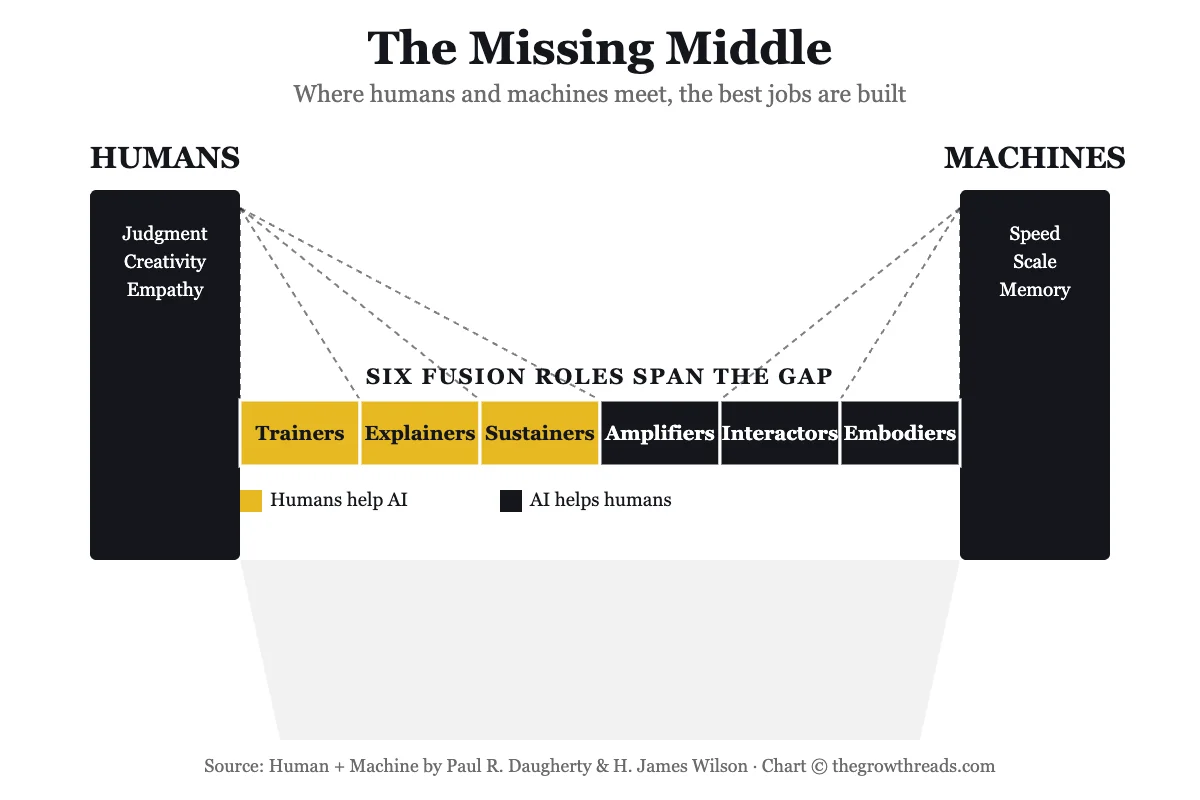
The companies winning with AI aren’t the ones automating the most jobs — they’re the ones building the most “missing middle” jobs, where people and AI do together what neither could do alone. Paul R. Daugherty and H. James Wilson, two Accenture research leaders, spent years studying how 1,500 organizations actually put AI to work. Their finding cuts against the popular “robots vs. humans” narrative: the biggest productivity gains don’t come from replacing people with machines, they come from redesigning the process itself so humans and AI hand work back and forth in real time. That hybrid zone — too fluid for a flowchart, too important to ignore — is what they call the missing middle, and it’s where six brand-new hybrid job categories are emerging. Human + Machine is a manager’s field guide to finding that middle in your own team.
Key takeaways
- Redesign the process, not just the task. The biggest AI gains come from rethinking a whole workflow, not bolting a model onto the old one.
- The “Missing Middle” is where the value hides. New hybrid activities — training, explaining, sustaining — emerge between pure-human and pure-machine work.
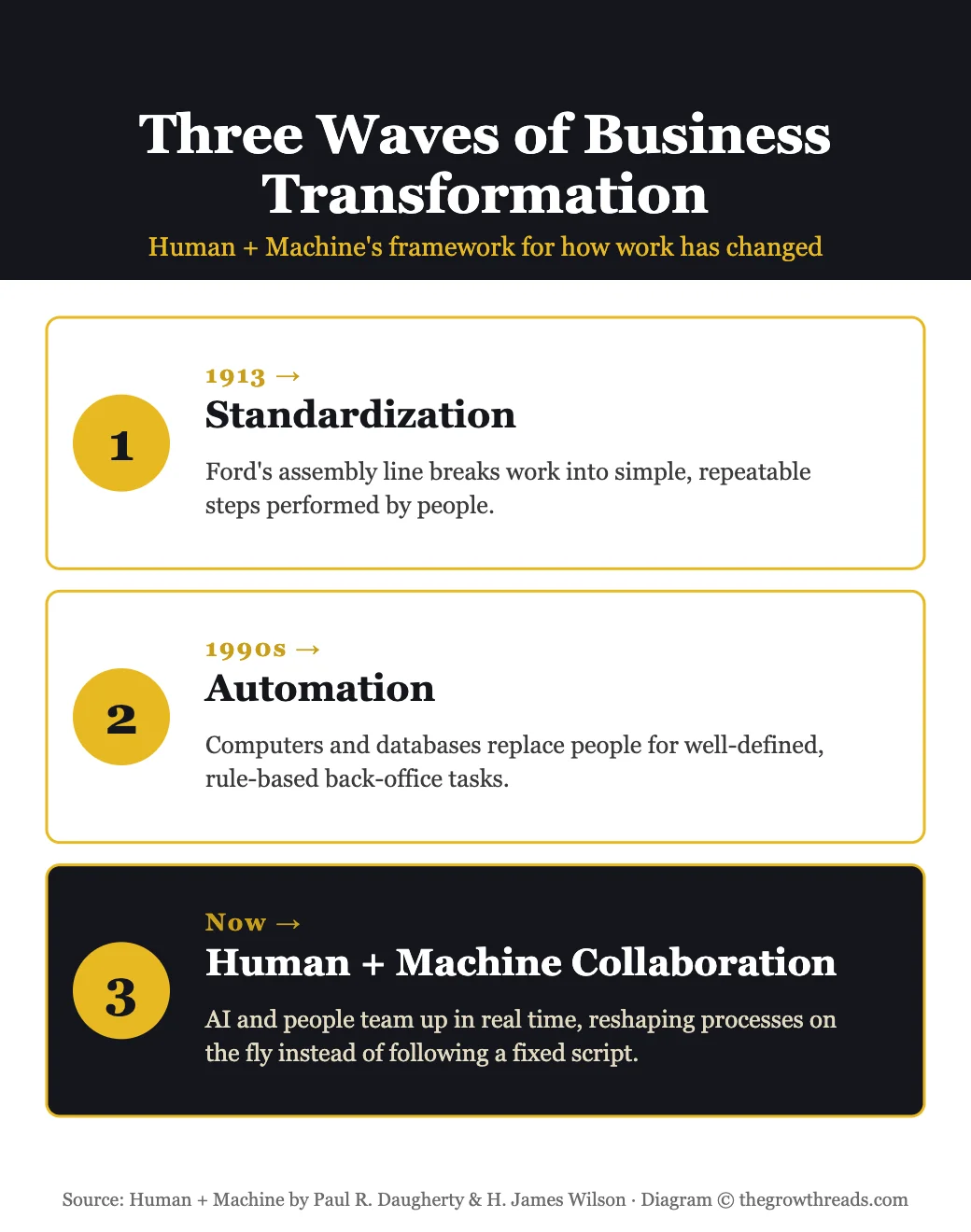
- Three waves are reshaping business. Automation, augmentation, and full human-machine collaboration each demand different skills and org design.
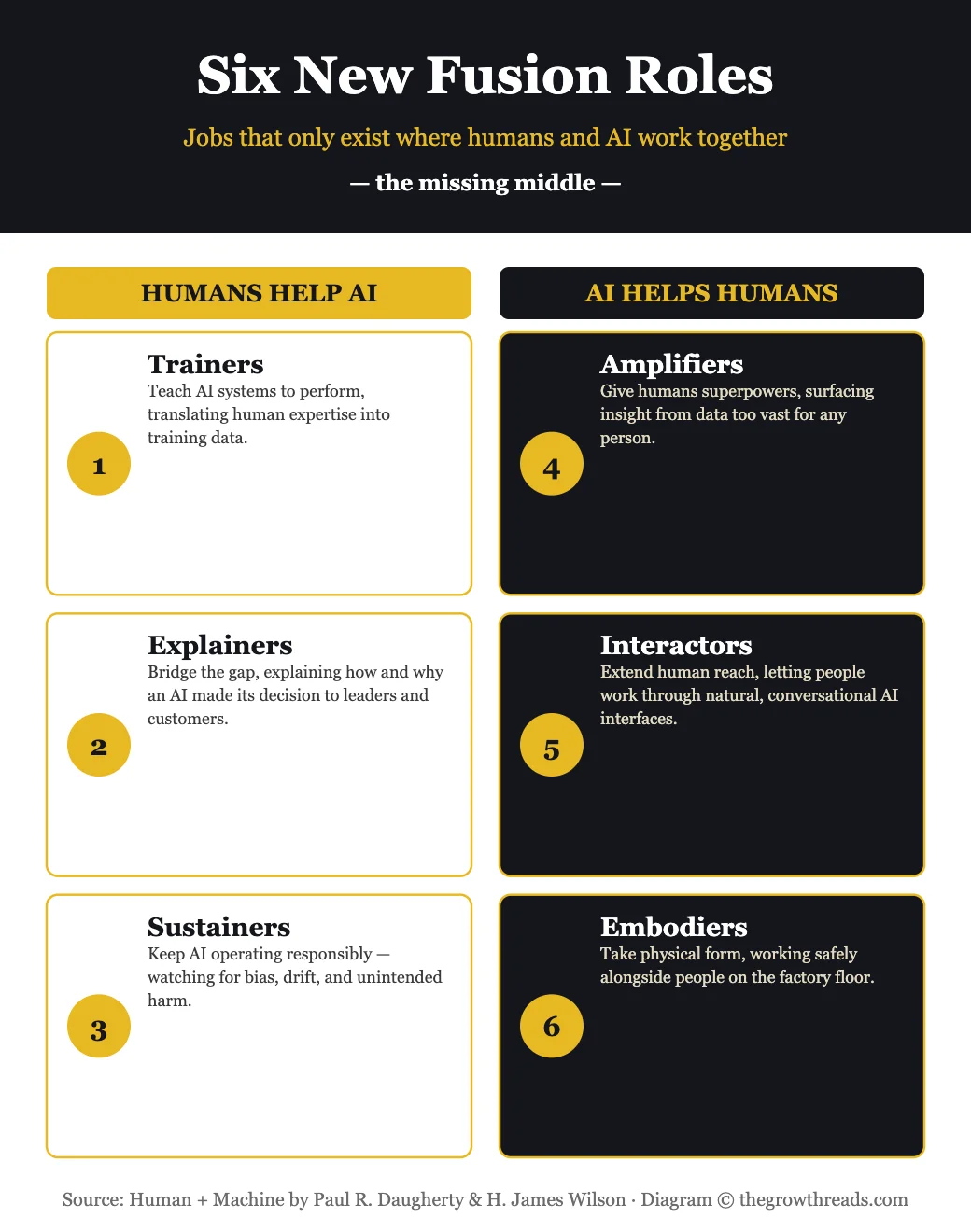
- Six new fusion roles are emerging. Trainers, explainers, sustainers, and their machine-side counterparts now sit inside everyday teams.
- Eight “fusion skills” separate leaders from laggards. Reciprocal apprenticing and intelligent interrogation matter as much as technical fluency.
- MELDS is the scaling framework. Mindset, Experimentation, Leadership, Data, and Skills predict which companies move past pilot purgatory.
- Rehumanize the time AI frees up. Redirect saved hours toward judgment, creativity, and relationship work machines can’t do.
- Start small, then scale deliberately. One well-chosen pilot with real process redesign beats a dozen shallow AI experiments.
What is Human + Machine about?
Human + Machine is a business book about how organizations actually get value from AI: not by automating people out of jobs, but by redesigning processes so humans and AI collaborate in a fluid “missing middle.” Drawing on research across 1,500 companies, it identifies six new hybrid job roles and a five-part leadership framework (MELDS) for adopting AI responsibly and productively.
Drawing on Accenture’s own research and case studies across more than 1,500 companies, the authors argue most organizations are stuck applying AI to old processes instead of building new ones — and that the businesses pulling ahead are the ones redesigning work around a genuine human-machine partnership, not just adding a chatbot to an existing workflow.
About the author
Paul R. Daugherty is Accenture’s Chief Technology and Innovation Officer, where he leads the company’s AI strategy globally and oversees its Accenture Labs research facilities. He joined Accenture in 1986, became a partner in 1999, and has played a central role in the firm’s shifts into cloud, big data, and AI-driven services — while also chairing Accenture’s Global CIO Council and advocating for gender equality and STEM inclusion in tech. Explore all H. James Wilson book summaries →
H. James Wilson is Managing Director of Information Technology and Business Research at Accenture Research, based in San Francisco. Before Accenture, he led research and innovation programs at Bain & Company and Babson Executive Education. A longtime contributor to Harvard Business Review and The Wall Street Journal, Wilson studies how emerging technologies change worker and organizational performance, and previously co-authored The New Entrepreneurial Leader.
Key concepts at a glance
| Concept | What it means | Use it when |
|---|---|---|
| The Missing Middle | The hybrid zone of tasks that require both human judgment and machine capability | Mapping which parts of a process should be redesigned, not just automated |
| Third Wave | The current era of business transformation: adaptive, real-time human+AI collaboration | Explaining why old automation playbooks fall short with AI |
| Fusion Skills | Eight human capabilities that make AI collaboration work, from rehumanizing time to judgment integration | Deciding what to teach your team before rolling out a new AI tool |
| Trainers / Explainers / Sustainers | Three new human-side roles that teach, translate, and police AI systems | Staffing an AI initiative beyond just data scientists and engineers |
| Amplifiers / Interactors / Embodiers | Three new machine-side roles that extend human reach, senses, and capability | Scoping what an AI tool should actually be built to do for your team |
| MELDS | Mindset, Experimentation, Leadership, Data, Skills — the five leadership shifts AI adoption requires | Building a responsible, org-wide AI rollout plan |
| Reimagining vs. Automating | The distinction between redesigning a process around AI vs. bolting AI onto the old process | Evaluating whether a proposed AI project will actually move the needle |
Part 1: The Third Wave
Daugherty and Wilson frame business history as three waves. The first wave was standardization — Taylorism, assembly lines, rigid processes built for consistency. The second wave was automation — software and robotics replacing discrete, repeatable tasks. The third wave, now underway, is collaboration: AI and humans working the same process together, each doing what they do best, in workflows deliberately redesigned for that partnership.
Most companies stall in the second wave. They treat AI as a faster, cheaper way to do the old task — automate the invoice-matching step, chatbot-ify the support queue — without asking whether the process itself should change. The authors’ research across dozens of large companies found the biggest performance gains only appeared once leaders redesigned the surrounding workflow, not just the task the AI touched.
Stitch Fix offers a cleaner example: the company’s styling algorithm narrows thousands of items down to a shortlist, but a human stylist makes the final call and writes the personal note customers actually read. Neither side could deliver the same experience alone — the algorithm can’t read taste and context, and a stylist alone couldn’t sort thousands of SKUs in seconds. That division of labor, deliberately designed rather than defaulted into, is what the authors mean by third-wave collaboration.
Part 2: Reimagining the Process, Not Just the Task
The book’s central diagnostic tool is the “Missing Middle” — the space between purely human activities and purely machine activities where new hybrid work lives. In a redesigned process, humans train AI systems with examples and feedback, explain AI outputs to customers and regulators, and sustain the system by monitoring for drift and unintended consequences. Machines, in turn, amplify human cognitive strengths, interact with customers at scale, and embody physical tasks through robotics.
A used case from BMW illustrates the point: rather than automating quality inspection outright, the company paired machine vision (fast, tireless pattern detection) with human inspectors (context, judgment on ambiguous cases) — and then added a “missing middle” role where technicians retrained the vision model on the edge cases it kept flagging. Inspection accuracy and speed both improved, because the process changed, not just the tool.
Rolls-Royce applied the same logic to jet engine maintenance: sensors stream data continuously (the machine side), while engineers interpret unusual patterns and decide on maintenance action (the human side) — and a new “missing middle” analyst role tunes the alerting thresholds so engineers see fewer false alarms over time. The result was fewer unscheduled groundings, achieved by redesigning who does what, not by automating the engineers away.
Part 3: Six New Jobs, Eight New Skills
As the Missing Middle fills in, entirely new job categories emerge. The authors identify six recurring “fusion roles”: trainers (teach AI systems using human examples), explainers (translate AI decisions for humans), sustainers (monitor AI systems for drift, bias, and errors), plus their machine-side counterparts — amplifiers, interactors, and embodiers, which extend human reach rather than replace it.
Succeeding in these roles requires what the authors call the eight “fusion skills”: rehumanizing time, responsible normalizing, judgment integration, intelligent interrogation, bot-based empowerment, holistic melding, reciprocal apprenticing, and relentless reimagining. None of these are coding skills — they’re closer to coaching, translation, and quality judgment, which is why the authors argue this shift favors generalists as much as specialists.
The authors are candid that fusion skills are learnable, not innate — reciprocal apprenticing in particular is a habit, not a talent. A customer service rep who spends fifteen minutes a week reviewing where the AI system got a response wrong, and feeding corrections back, is practicing exactly this skill. Over months, that small habit compounds into a materially better-trained system and a more AI-literate employee.
Part 4: Leading the Transition — the MELDS Framework
Scaling past a single successful pilot requires five organizational capabilities, which the authors condense into MELDS: Mindset (leaders treat AI as a collaborator to design around, not a tool to bolt on), Experimentation (rapid, low-stakes pilots with real process redesign built in), Leadership (visible executive sponsorship and new governance for AI decisions), Data (a data foundation and pipeline mature enough to support real-time collaboration), and Skills (deliberate investment in the eight fusion skills across the workforce).
Companies weak on any one dimension tend to get stuck in “pilot purgatory” — dozens of promising proofs-of-concept that never scale into production. The authors’ research suggests Leadership and Skills are the two most commonly neglected, since most early AI investment goes toward Data and Experimentation instead.
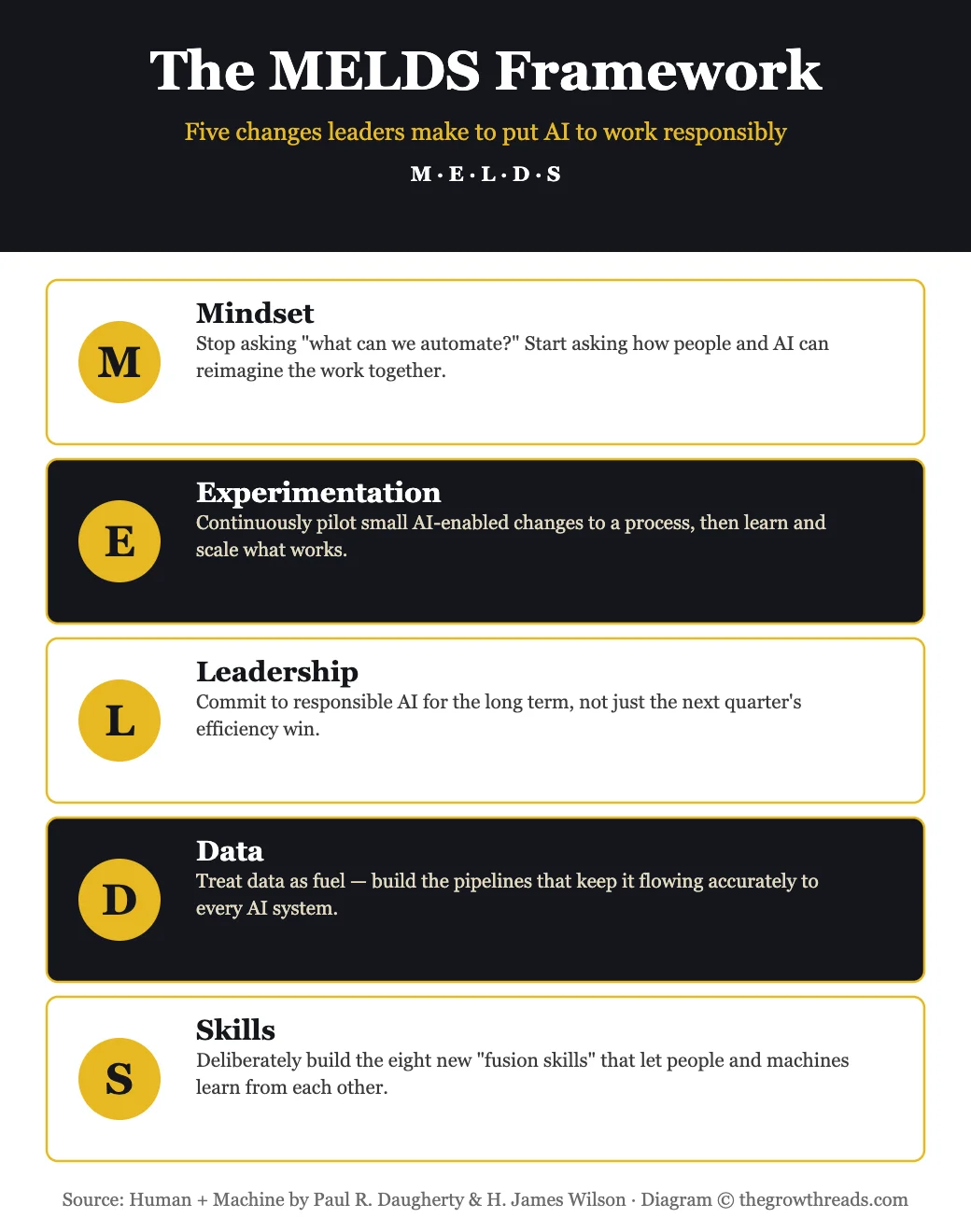
Mindset is the capability the authors return to most often, because it’s the one leaders most often skip. Companies that treat their first AI pilot as a one-off IT project rarely build the muscle to scale a second or third; companies that treat it as a rehearsal for a new way of working — however small the pilot — tend to compound their gains, project by project, faster than competitors expect.
Who is Human + Machine best for — and who should read something else first?
Best for: managers and executives who need to redesign a team’s workflow around AI, not just adopt a new tool. If you lead a function — operations, customer service, product — and want a framework for where humans and machines each add the most value, this is your book.
Read Co-Intelligence first if you want individual, day-to-day prompting habits rather than organizational redesign.
Read The Inevitable first if you want the broader 12-year technology forecast before drilling into workplace application.
Read Power and Prediction alongside it if you want the economic reasoning behind why point solutions underperform redesigned systems.
Questions to reflect on
- Which process in your team still treats AI as a bolt-on rather than a redesign?
- Where might a “missing middle” role — someone who trains, explains, or sustains an AI system — already be needed on your team?
- Which of the eight fusion skills is your weakest, and what’s one way to practice it this month?
- Are you further along in Mindset, Experimentation, Leadership, Data, or Skills — and which lags furthest behind?
- What’s one task you could rehumanize by freeing it from busywork AI could handle instead?
How to apply Human + Machine (7-day plan)
- Day 1 — Map one process. Pick a single recurring workflow on your team and write out every step, noting which are done by a person and which (if any) already involve a tool.
- Day 2 — Find your missing middle. Circle any step where a person is doing something a well-designed AI tool could do faster, and any step where an AI tool alone would miss context only a human has.
- Day 3 — Name a fusion role. Pick one team member and identify which of the six fusion roles (Trainer, Explainer, Sustainer, Amplifier, Interactor, Embodier) best matches work they’re already informally doing.
- Day 4 — Run a tiny experiment. Following the “E” in MELDS, pilot one small AI-assisted change to the process you mapped on Day 1 — nothing company-wide, just one team, one week.
- Day 5 — Check your data supply chain. Ask whether the AI tool you’re piloting has accurate, current data flowing into it — and who’s responsible for keeping it that way.
- Day 6 — Debrief with judgment integration in mind. Review the pilot: where did the AI’s output need a human override, and why? Write down the pattern so it can be taught to others.
- Day 7 — Decide: automate, redesign, or leave alone. For the process you mapped, make an explicit call — don’t let it drift back to “the way we’ve always done it” by default.
Frequently asked questions
Is Human + Machine outdated now that ChatGPT and generative AI have taken off?
Published in 2018, it predates today’s large language models, but its core argument holds: the biggest gains come from redesigning how work is done, not just adding a smarter tool. Generative AI has made “fusion skills” like reciprocal apprenticing more relevant, not less. Treat the software examples as dated; treat the MELDS framework and Missing Middle concept as more applicable today than when it was written.
Does this apply to small businesses, or only large enterprises?
The case studies lean on large companies (BMW, Stitch Fix, Rolls-Royce) because those have public AI transformation stories, but the ideas scale down. A five-person team can apply “redesign the process” to one workflow — support triage, content drafting, scheduling — without enterprise infrastructure. The 7-day plan below is written so a solo founder or small team can run it in a week.
What’s the difference between “human + machine fusion” and just “automation”?
Automation replaces a step in an unchanged process. Fusion means redesigning the process itself so humans and machines each do what they’re better at, often creating a “missing middle” of new activities — like training a model or explaining its output to a customer — that didn’t exist before. Automation subtracts a step; fusion adds a new way of working.
How is this different from Ethan Mollick’s Co-Intelligence?
Co-Intelligence is a hands-on, individual guide to working with AI chatbots day-to-day. Human + Machine is broader and organizational — redesigning processes and job roles across a company, with a leadership framework (MELDS) rather than personal prompting habits. Read Co-Intelligence for individual AI habits; read this book for restructuring a team or workflow.
What exactly are the “eight fusion skills”?
The human capabilities the authors found most valuable working alongside AI: rehumanizing time, responsible normalizing, judgment integration, intelligent interrogation, bot-based empowerment, holistic melding, reciprocal apprenticing, and relentless reimagining. The infographic in Part 3 of this summary covers the six new fusion roles that put these skills into practice.
Do I need to be technical or a data scientist to apply these ideas?
No. The book targets business leaders and managers, not engineers — the biggest bottleneck to AI adoption is process and organizational design, not technical skill. Knowing what AI is good at (and where it still fails) matters more than knowing how a model is built. The 7-day plan focuses on process mapping and role redesign, neither of which requires coding.
What is the MELDS framework, and do I need to be a senior executive to use it?
MELDS stands for Mindset, Experimentation, Leadership, Data, and Skills — the five capabilities that separated companies scaling AI successfully from those stuck in pilot purgatory. A team lead can apply a scaled-down version too: adopt an experimentation mindset, run one pilot, model good AI habits, get one dataset in order, and build one fusion skill.
Related summaries
- Co-Intelligence by Ethan Mollick — an individual-level companion to this book’s organizational lens.
- Superagency by Reid Hoffman — a more opportunity-focused take on AI and work.
- Power and Prediction by Ajay Agrawal, Joshua Gans, and Avi Goldfarb — why point-solution AI underperforms redesigned systems.
- Browse all AI & Technology book summaries →
Related Technology Summaries
Empire of AI Summary & Review: What AI’s Rise Actually Costs
Prediction Machines Summary & Review: The Simple Economics of Artificial Intelligence
Scary Smart Summary & Review: How to Shape What AI Learns From Us
Team Human
The Book of Why Summary & Review: How to Think in Causes, Not Just Correlations