

★★★★☆ 4.1/5 — A sweeping, statesman-level case that AI is a philosophical rupture on the scale of the Enlightenment, not just another technology.
Best for: Readers who want the geopolitical and philosophical stakes of AI, not a technical or product-level view.
Reading time: ~4 hrs read, 13 min guide
Difficulty to apply: Moderate — the ideas are macro-level, best applied through informed civic and organizational thinking.
The Age of AI in one minute
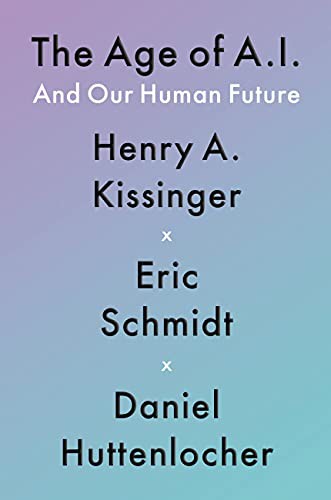
The last time a technology changed how humans access truth this fundamentally, it took a century of religious wars to sort out the consequences. Henry Kissinger, Eric Schmidt, and Daniel Huttenlocher, an unusual trio combining statecraft, technology, and computer science, argue that AI represents a rupture in human reasoning as profound as the printing press or the Enlightenment: a new way of processing and generating knowledge that humans didn’t design to understand fully and can’t simply opt out of.
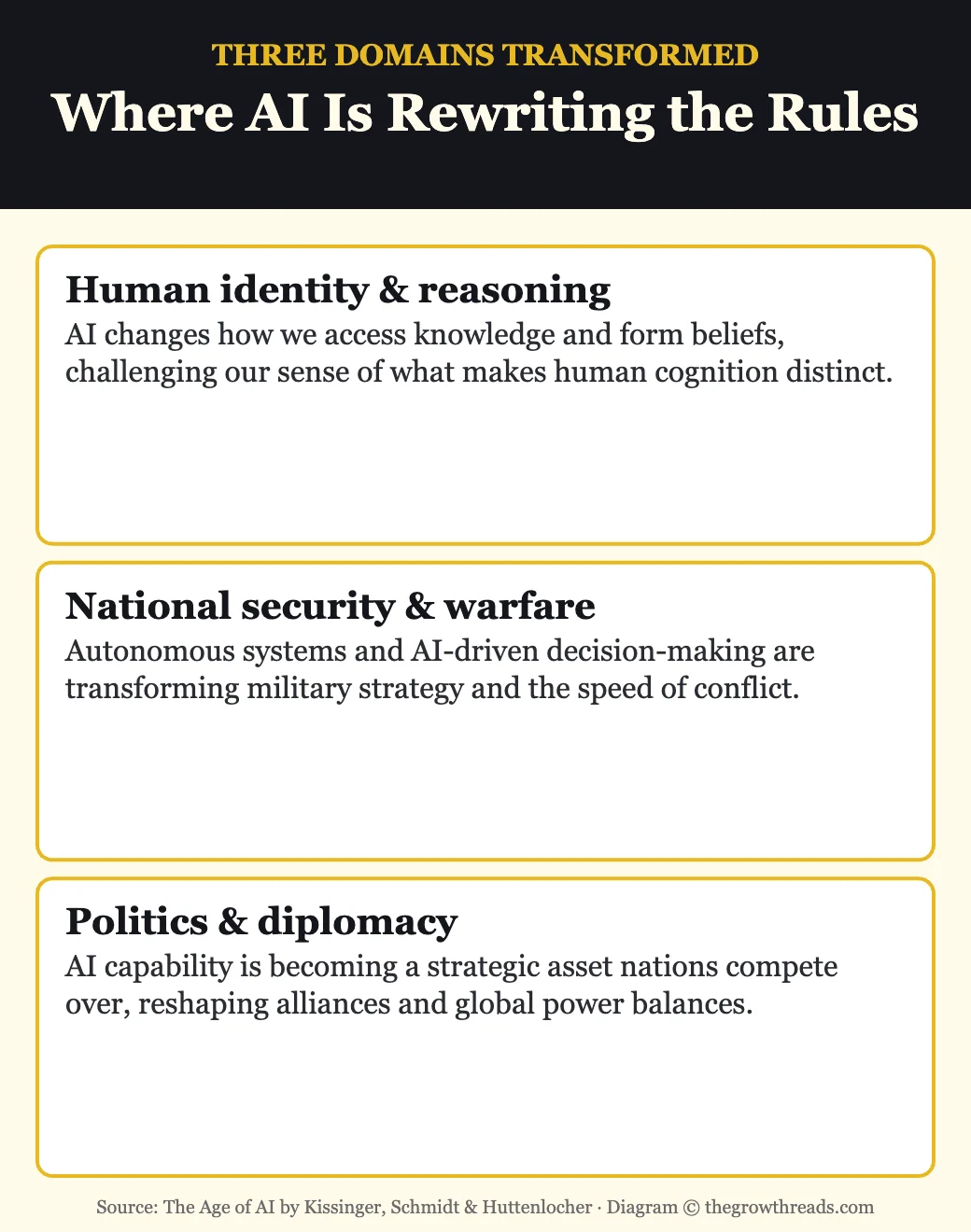
Rather than a product review of specific AI tools, the book operates at the level of civilization: what happens to human identity, national security, and international politics when a non-human form of reasoning becomes embedded in decision-making everywhere at once.
Key takeaways
- AI is a philosophical rupture, comparable to the printing press or the Enlightenment in how it changes human access to knowledge.
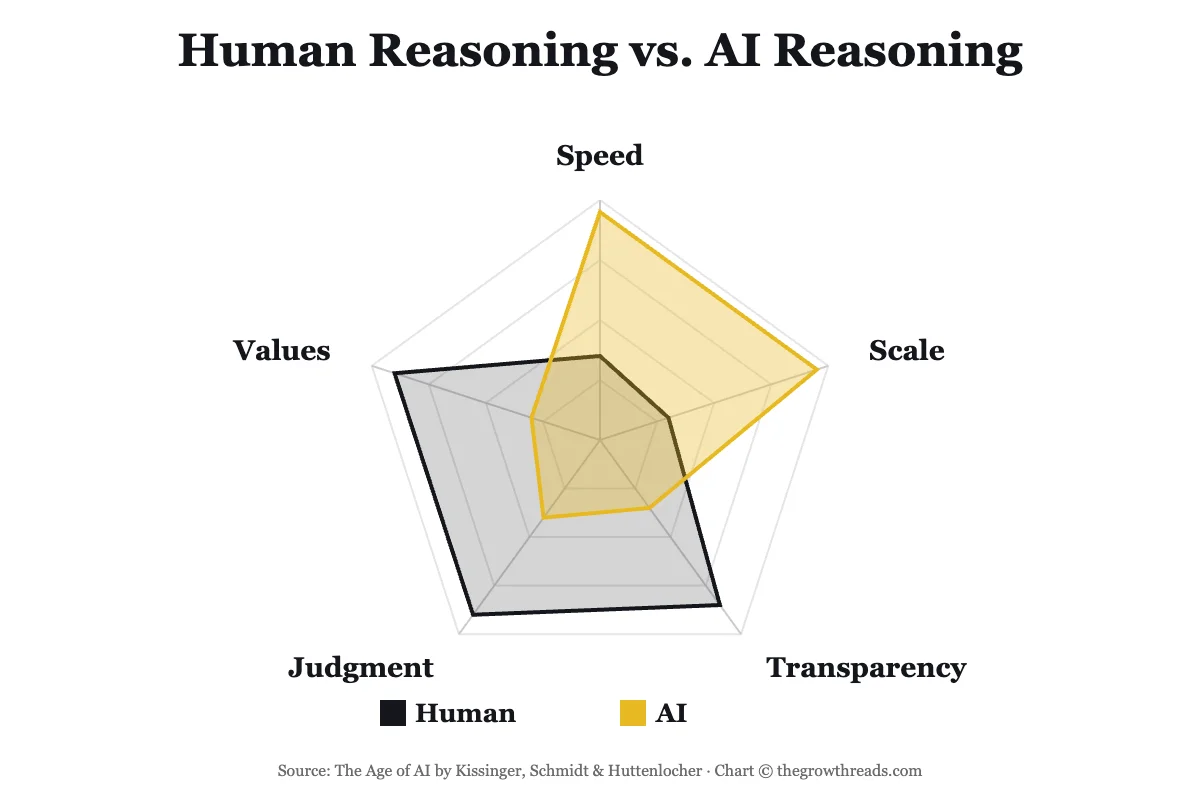
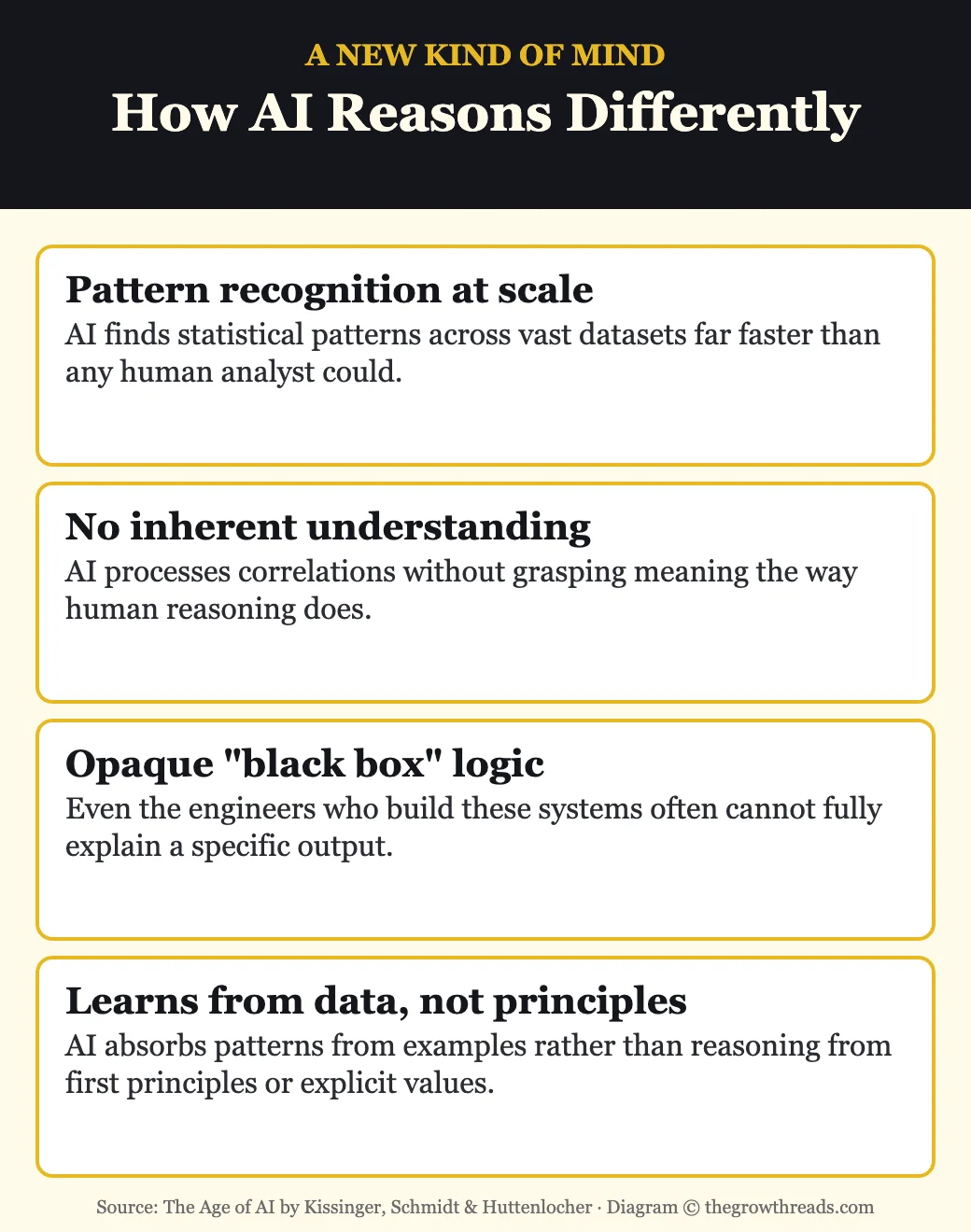
- AI reasons differently than humans: it finds patterns at scale without inherent understanding of meaning.
- Even AI’s creators can’t fully explain specific outputs, making “black box” opacity a structural feature, not a bug to be easily fixed.
- Human identity is affected, as AI reshapes how people access information and form beliefs about the world.
- National security is being transformed by autonomous systems and AI-accelerated military decision-making.
- AI capability is becoming a strategic asset nations compete over, similar to nuclear capability in an earlier era.
- International norms need to be negotiated early, before deployment locks in dangerous default behaviors.
- Human oversight must be built into critical systems, especially in security and infrastructure domains.
- Final judgment on high-stakes, value-laden decisions should stay with humans, not be delegated to optimization alone.
- The authors call for urgency without panic: serious engagement now, not fear-driven paralysis or complacent delay.
What is The Age of AI about?
The Age of AI argues that artificial intelligence represents a philosophical rupture in human reasoning as significant as the printing press or the Enlightenment, reshaping human identity, national security, and international politics, and it calls for urgent, deliberate engagement with these stakes rather than either panic or complacency.
About the authors
The Age of AI brings together an unusually cross-disciplinary trio. Henry Kissinger, former U.S. Secretary of State and National Security Advisor, contributes decades of experience thinking about how transformative shifts reshape international order, from nuclear weapons to globalization. Eric Schmidt, former CEO and Executive Chairman of Google, brings direct insider experience building and scaling the technologies at the center of the book’s argument.
Daniel Huttenlocher is the inaugural dean of MIT’s Schwarzman College of Computing and a computer scientist with deep technical grounding in AI research. Published in 2021, this combination of statecraft, industry, and computer science gives the book a rare vantage point: few author teams could credibly speak to the technology, the geopolitics, and the philosophical stakes of AI all at once.
Key concepts at a glance
| Concept | What it means | Use it when |
|---|---|---|
| Philosophical rupture | A change in how humans access and process knowledge, comparable to the printing press or the Enlightenment | Framing why AI matters beyond its immediate technical capabilities |
| Black box reasoning | AI systems whose specific outputs can’t be fully explained, even by their own creators | Understanding the structural limits of AI transparency |
| AI as strategic asset | AI capability treated by nations as a resource comparable to nuclear or economic power | Analyzing international competition and security policy around AI |
| Human oversight | Deliberately preserved human checkpoints in critical automated systems | Designing security or infrastructure systems that use AI |
| Early norm-setting | Negotiating international rules for AI use before deployment locks in default behaviors | Thinking about AI governance and international agreements |
| Preserved judgment | Reserving high-stakes, value-laden decisions for human authority rather than optimization | Deciding where AI should assist versus decide |
Kissinger’s own intellectual history adds unusual weight to this framing. As a scholar before entering government, his doctoral work examined how European statesmen navigated the aftermath of the Napoleonic Wars, a period when an old order collapsed and a new one had to be negotiated from first principles. That same instinct for recognizing when incremental adjustment is no longer sufficient, when a genuinely new framework is required, animates his approach to AI: he treats it not as a policy problem to be managed with existing tools, but as a rupture requiring new categories of thought entirely.
Part 1: A rupture in human reasoning
The authors open with a historical framing that sets the book apart from more narrowly technical treatments of AI: they compare the current moment to the Enlightenment’s shift from religious authority to human reason as the basis for knowledge. Just as the printing press democratized access to text and destabilized existing hierarchies of authority, AI introduces a new, non-human form of reasoning into how societies generate and validate knowledge, one that doesn’t answer to the same epistemological rules humans have used for centuries.
This isn’t merely a metaphor for the authors; it’s the basis for taking AI’s philosophical implications as seriously as its practical ones. If AI genuinely represents a new way of processing reality, then questions about identity, truth, and authority that took decades or centuries to work through during previous ruptures may need to be worked through again, on a compressed timeline, as AI capabilities scale far faster than the printing press ever did.
Part 2: How AI reasons, and why that’s genuinely new
The authors devote significant attention to explaining, in accessible terms, why AI’s mode of reasoning is qualitatively different from human cognition, not just faster or more data-driven. AI systems find statistical patterns across enormous datasets, patterns that can be genuinely predictive without the system having anything resembling human understanding of what those patterns mean. This distinction matters because it changes what kind of trust and verification AI outputs deserve.
Compounding this, even the engineers who build modern AI systems frequently cannot fully explain why a specific model produced a specific output, a limitation the authors call “black box” reasoning. This isn’t a temporary engineering gap waiting to be solved, they argue, but a structural feature of how these systems work: they learn from examples and correlations rather than reasoning from explicit, inspectable principles, which has serious implications for how much authority we should delegate to them in high-stakes domains.
Part 3: Navigating the transition
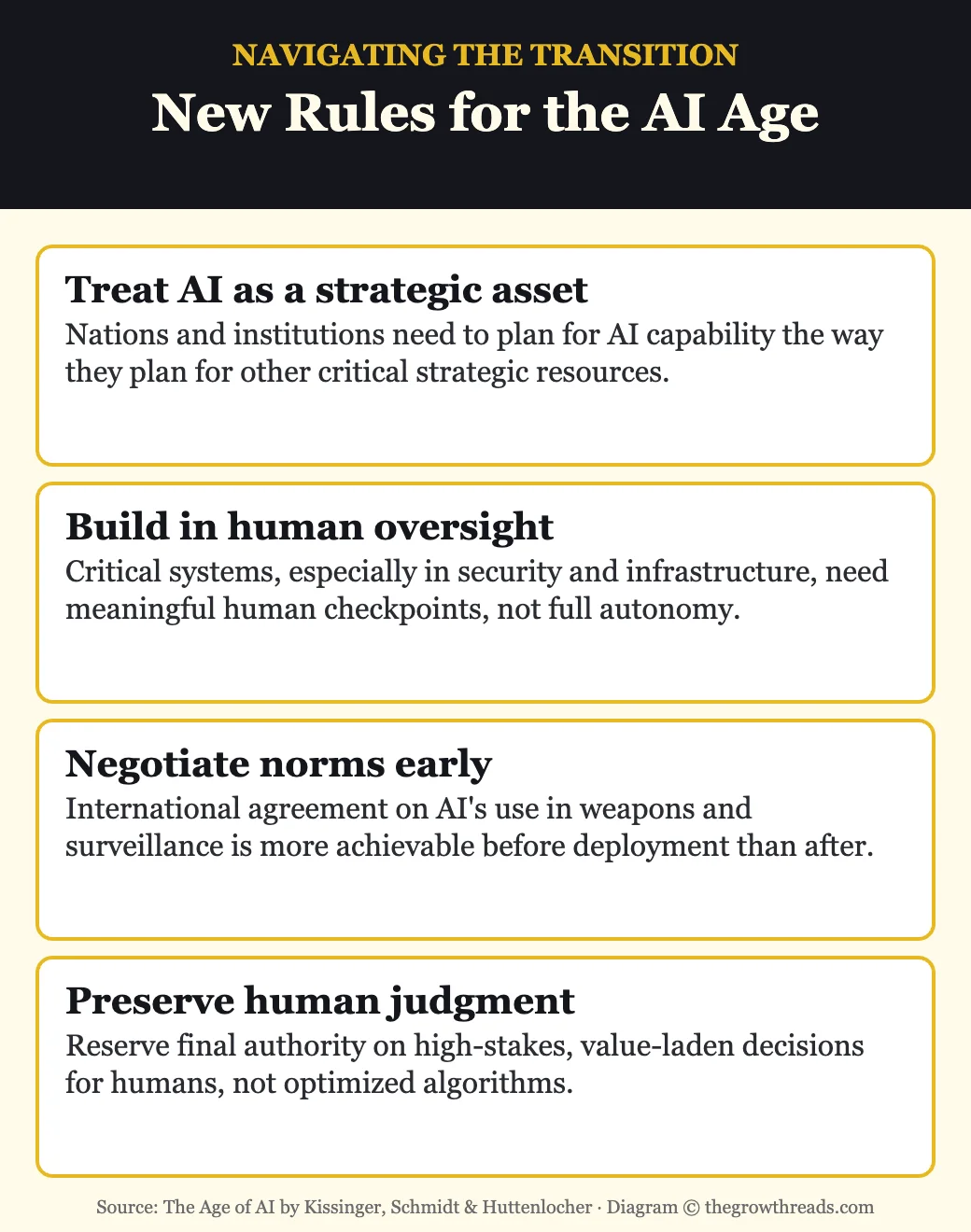
Given the scale of disruption they’ve described, the authors turn to what governments, institutions, and leaders should actually do. Their first recommendation is to treat AI capability as a genuine strategic asset, on par with other resources nations plan around, rather than as a purely commercial or academic pursuit best left to private companies. This has direct implications for how governments fund research, regulate deployment, and think about competitive advantage relative to other nations.
Their second and third recommendations are more immediately actionable: build meaningful human oversight into critical systems, particularly in security and infrastructure, rather than pursuing full autonomy for its own sake, and negotiate international norms for AI’s use, especially in weapons and surveillance, while there’s still room to shape defaults rather than after harmful patterns have already become entrenched. Underlying all three is a consistent principle: preserve human judgment for the decisions that carry the deepest values implications, even as AI takes on more of the analytical heavy lifting.
The authors are careful to note that these recommendations aren’t just for governments and large institutions. Individual organizations, and even individual professionals, make daily choices about how much authority to delegate to AI systems in their own work, choices that collectively shape norms just as surely as international treaties do. A hospital deciding how much diagnostic authority to give an AI system, or a newsroom deciding how much editorial judgment to automate, is making a small-scale version of the same choice the authors describe at the level of nations.
Who is The Age of AI best for — and who should read something else first?
This book is best for readers who want to understand AI’s geopolitical and philosophical stakes at a statesman’s level, rather than a technical or product-focused view. If you want the more personal, behavioral response to AI’s rise, start with Scary Smart instead. If you want a closer look at who actually controls today’s largest AI systems, The Big Nine is a strong complement.
Questions to reflect on
- Where in your own life or organization has AI already changed how you access or verify information?
- What would “black box” reasoning being a structural feature, not a bug, change about how you use AI tools?
- Which high-stakes, value-laden decisions in your work should stay firmly with human judgment?
- How informed do you feel about the international politics of AI development, and where’s the gap?
- What would engaging with AI’s stakes with urgency but without panic look like for you personally?
🔥 Ready to understand AI’s true civilizational stakes?
Grab a copy of The Age of AI and get the statesman-level case for why this technology matters more than you think.
How to apply The Age of AI (7-day plan)
- Day 1: List three ways AI already shapes what information you see or trust day to day.
- Day 2: Research how your country or industry is approaching AI regulation and international coordination.
- Day 3: Identify one high-stakes decision in your work that should stay firmly with human judgment.
- Day 4: Ask a colleague how “black box” reasoning affects their trust in AI tools they use.
- Day 5: Read about one real-world AI security or defense application and consider its oversight structure.
- Day 6: Discuss with someone outside your field how AI is reshaping their sense of identity or authority.
- Day 7: Write a short reflection on what “urgency without panic” looks like for you personally around AI.
Frequently asked questions
What is the central argument of The Age of AI?
The book argues that artificial intelligence represents a philosophical rupture in human reasoning comparable to the printing press or the Enlightenment, reshaping human identity, national security, and international politics simultaneously. The authors call for urgent, deliberate engagement with these stakes, building human oversight into critical systems and negotiating international norms early.
Why did Kissinger, Schmidt, and Huttenlocher write this together?
The three authors bring complementary expertise: Kissinger’s decades of experience in statecraft and international order, Schmidt’s insider knowledge from leading Google, and Huttenlocher’s technical grounding as a computer scientist and dean of MIT’s computing college. This combination lets the book address AI’s technical, geopolitical, and philosophical dimensions with unusual credibility across all three.
Is this book technical, focused on how AI actually works?
Not primarily. While the authors explain AI’s reasoning process in accessible terms, particularly the “black box” problem, the book’s focus is on civilizational and geopolitical implications rather than technical architecture. Readers wanting deep technical detail should look elsewhere; this book is about stakes and consequences.
Does the book argue AI should be restricted or slowed down?
Not exactly. The authors argue for deliberate governance, human oversight in critical systems, and early international norm-setting, rather than either unrestricted development or broad restriction. Their framing treats AI capability as inevitable and strategically important, focusing on how to manage its integration responsibly rather than whether to allow it.
Is this book still relevant, since it was published in 2021?
Yes, arguably more relevant, since the generative AI wave that followed publication has accelerated exactly the identity, security, and political questions the authors raised. The book’s Enlightenment-scale framing has only gained more traction as AI capabilities have advanced faster than most predicted.
How does the “black box” problem affect trust in AI?
The authors argue that even AI’s own creators often cannot fully explain why a specific model produced a specific output. This isn’t a temporary limitation to be engineered away but a structural feature of how these systems learn from patterns rather than explicit principles, which has serious implications for how much authority should be delegated to AI in high-stakes decisions.
What should I read after this book?
Scary Smart for a more personal, behavioral response to the same underlying shift, or The Big Nine for a closer look at who currently controls the companies and countries steering AI’s development.
Related summaries
- Scary Smart by Mo Gawdat
- The Big Nine by Amy Webb
- Weapons of Math Destruction by Cathy O’Neil
- Superintelligence by Nick Bostrom
See all Best Technology & AI Books →
Related Technology Summaries
Chip War Summary & Review: Why Silicon Chips Now Decide Global Power
Empire of AI Summary & Review: What AI’s Rise Actually Costs
Rise of the Robots Summary & Review: Why Automation Now Threatens Cognitive Jobs Too
The AI-First Company Summary & Review (2026)
The New Breed Summary & Review: What Animals Teach Us About Living with Robots