

★★★★☆ 4.3/5 — A compelling case that the humblest of tools — the checklist — can dramatically reduce errors, save lives, and improve performance across every field from surgery to skyscraper construction.
Best for: Professionals in any field who want to reduce mistakes, improve consistency, and ensure critical steps are never skipped under pressure.
Reading time: ~4.5 hours (224 pages)
Difficulty to apply: Low — the entire point is that checklists are simple to build and use. The hard part is the humility to use them.
The Checklist Manifesto in one minute
We fail not because we lack knowledge, but because the knowledge we have has exceeded our ability to deliver it reliably — and a simple checklist is the fix. Atul Gawande, a surgeon and public health researcher, investigates why experts in medicine, aviation, and construction fail despite decades of training. His discovery: the volume and complexity of modern knowledge has outstripped individual memory and attention. The solution is not more training or more technology but the humble checklist — a tool that catches the errors skilled people make when they are busy, distracted, or overconfident. Gawande tested a 19-item surgical safety checklist across eight hospitals worldwide and reduced complications by 36% and deaths by 47%. The book argues that checklists work not by dumbing down expertise but by setting a floor beneath which performance cannot fall.
Key takeaways
- Failure stems from two sources: Ignorance (we lack the knowledge) and ineptitude (we have the knowledge but fail to apply it correctly). Checklists address ineptitude.
- Knowledge has exceeded human capacity: Modern professionals must manage so much complexity that even experts routinely skip critical steps — not from carelessness, but from cognitive overload.
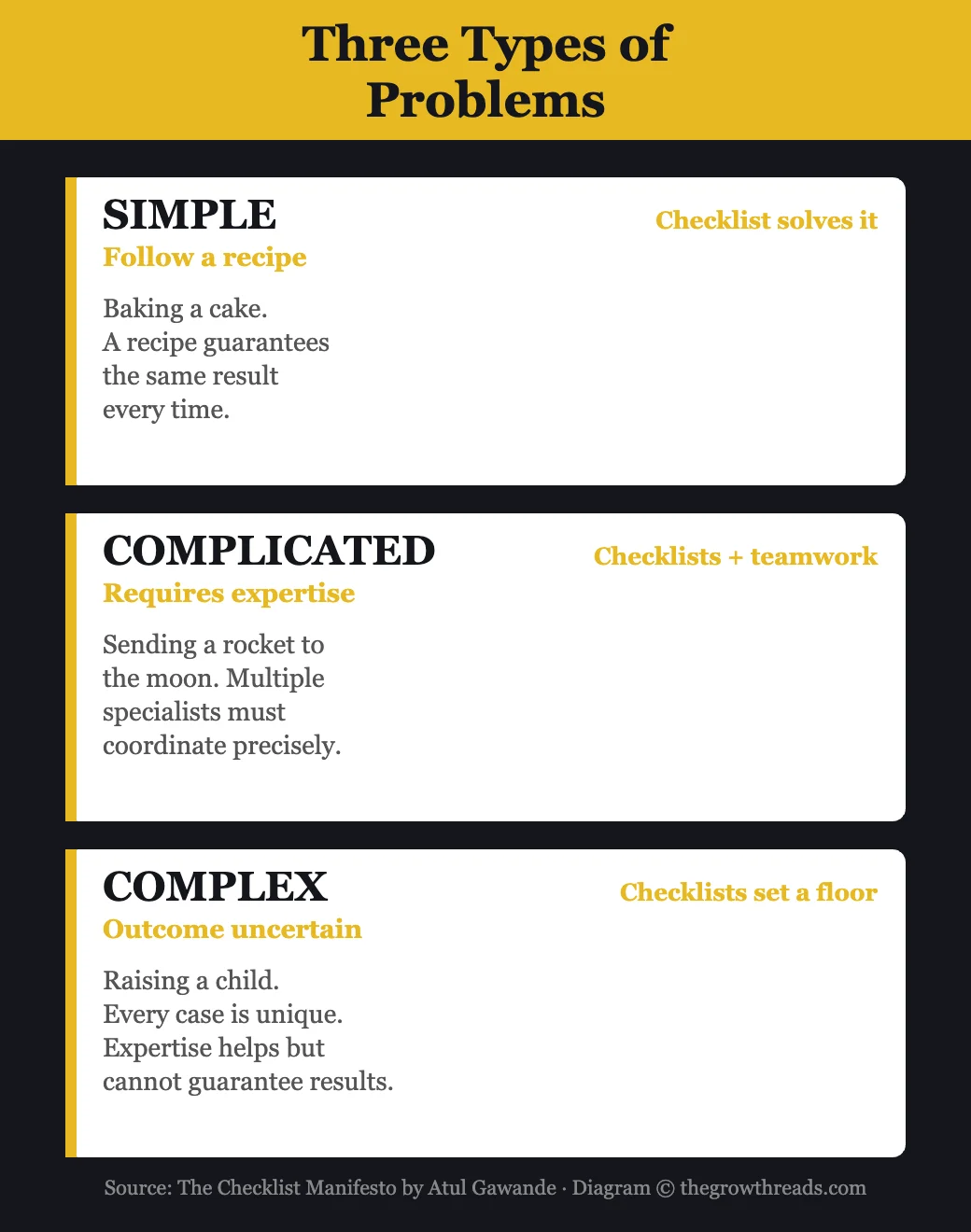
- Problems come in three types: Simple (follow a recipe), complicated (coordinate specialists), and complex (each case is unique). Checklists help with all three, but differently.
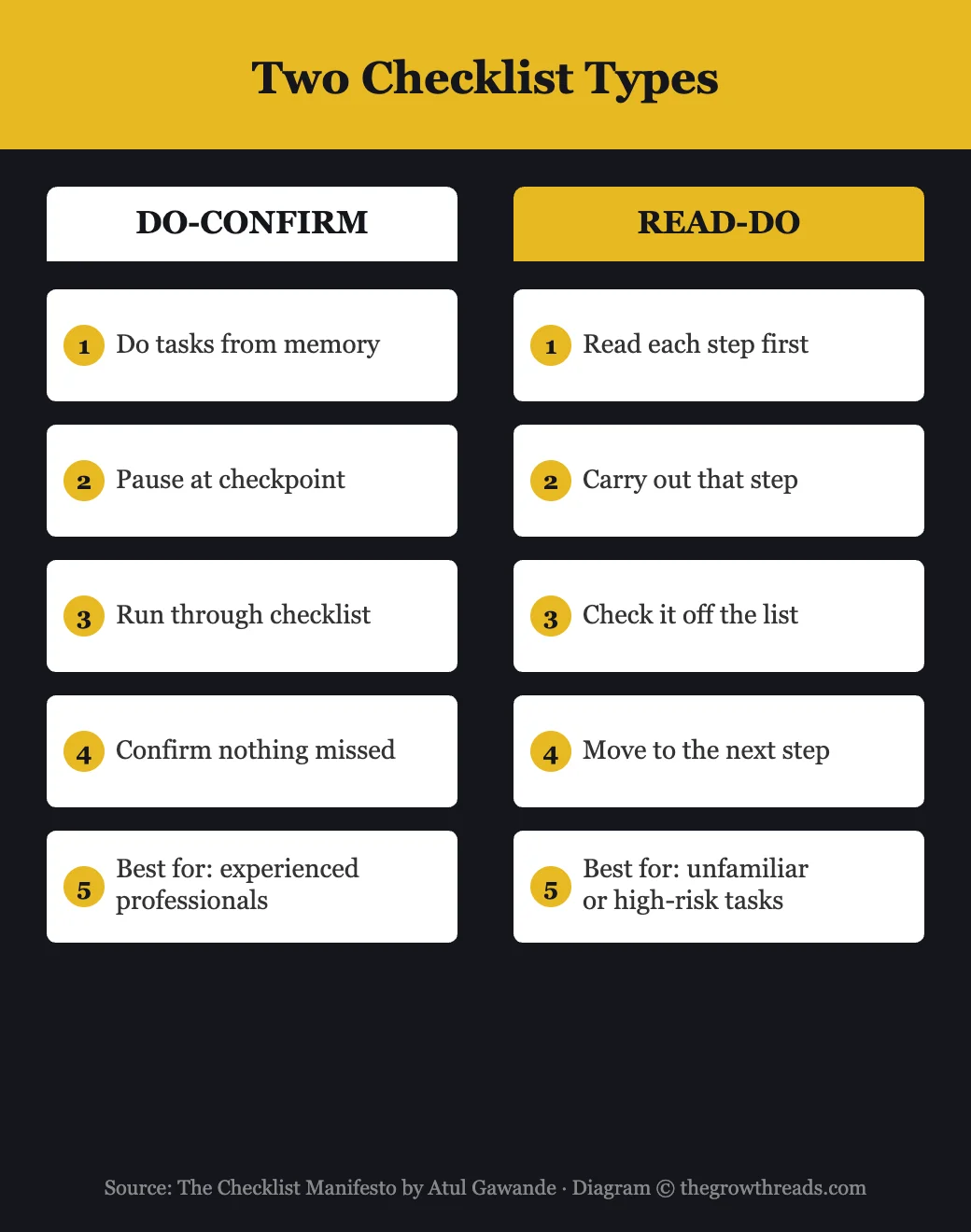
- Two checklist types exist: DO-CONFIRM (do tasks from memory, then pause to verify with the checklist) and READ-DO (read each step, then carry it out). Match the type to the task.
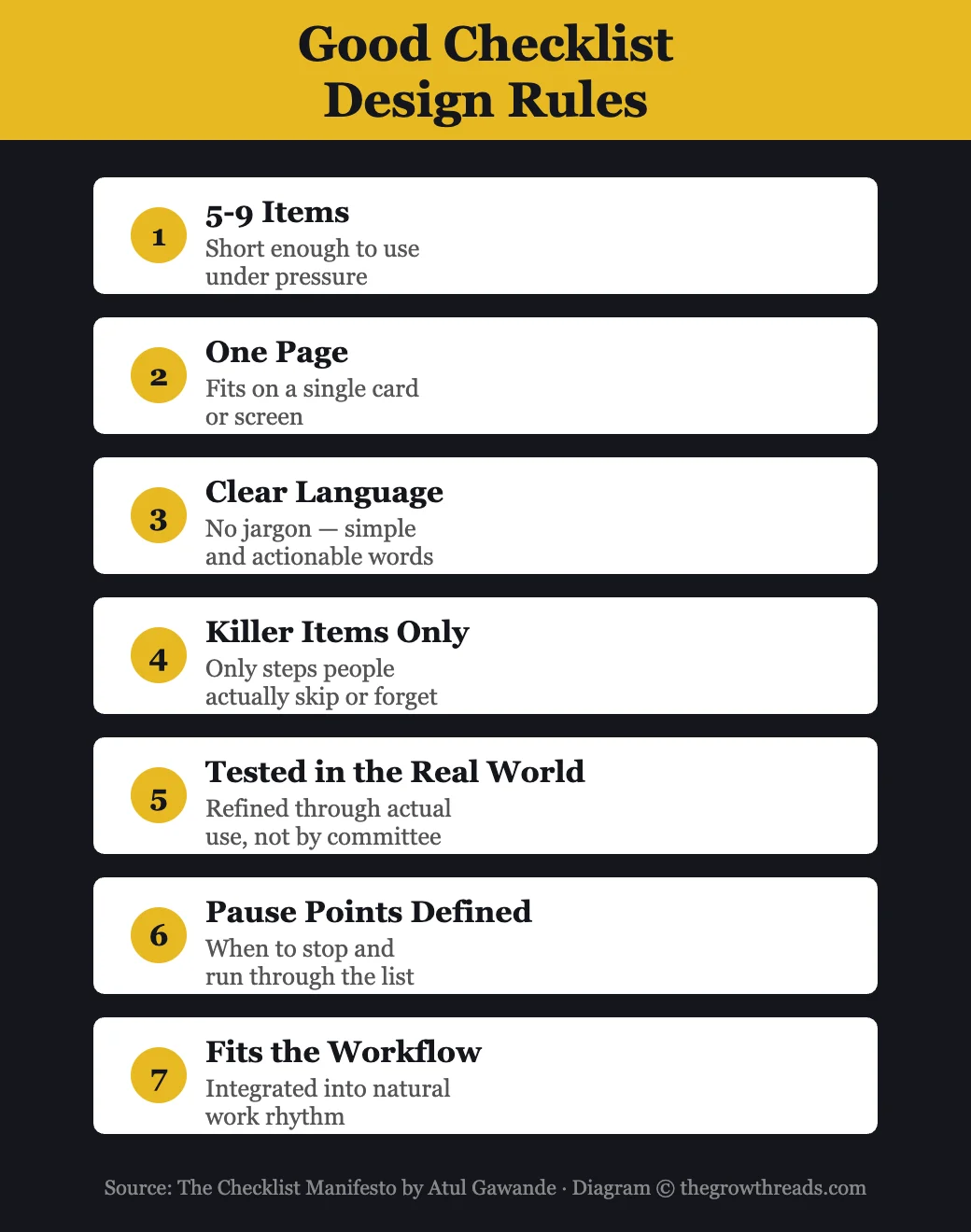
- Good checklists are short: Five to nine items maximum, fitting on a single page. They cover only the steps that are most commonly skipped or forgotten — the “killer items.”
- Checklists force communication: The WHO Surgical Safety Checklist requires team members to introduce themselves before surgery begins. This simple step dramatically improves teamwork and the likelihood that someone will speak up about a concern.
- Aviation proves the model: After the Boeing Model 299 crashed because it was “too complex for one person to fly,” pilots developed the pre-flight checklist. Aviation has used checklists for 80+ years with extraordinary safety results.
- Construction manages extreme complexity: Skyscraper projects use checklists not just for tasks but for communication — requiring specific teams to talk to each other at defined milestones to coordinate unforeseen interactions.
- Checklists require humility: The biggest barrier to adoption is ego. Skilled professionals resist checklists because they feel the tool is beneath them — yet the data consistently shows even experts benefit.
- Results are dramatic: The WHO checklist trial across eight hospitals in eight countries reduced surgical complications by 36% and deaths by 47% — with a tool that takes less than two minutes to use.
What is The Checklist Manifesto about?
The Checklist Manifesto argues that the volume of modern knowledge has exceeded individual human capacity to apply it reliably. Drawing on case studies from surgery, aviation, and construction, Gawande demonstrates that simple checklists dramatically reduce errors and improve outcomes by catching the steps experts skip under pressure, without replacing professional judgment.
About the author
Atul Gawande is a surgeon at Brigham and Women’s Hospital, professor at Harvard Medical School and Harvard T.H. Chan School of Public Health, and staff writer for The New Yorker. He led the World Health Organization’s Safe Surgery Saves Lives initiative, which developed and tested the Surgical Safety Checklist in hospitals worldwide. His books — including Complications, Better, and Being Mortal — have made him one of the most influential voices in modern medicine and public health. He has received a MacArthur Fellowship and has been named one of the world’s most influential thinkers by TIME magazine. Explore all Atul Gawande book summaries →
Key concepts at a glance
| Concept | What it means | Use it when |
|---|---|---|
| Ignorance vs ineptitude | We fail either because we lack knowledge or because we fail to apply it | You want to diagnose whether a failure is a training problem or an execution problem |
| Simple / complicated / complex | Three categories of problems requiring different approaches | You need to choose the right level of structure for a task |
| DO-CONFIRM checklist | Work from memory, then pause to verify nothing was missed | You are experienced and the task is familiar |
| READ-DO checklist | Read each step, then carry it out before moving on | The task is unfamiliar, infrequent, or high-stakes |
| Killer items | The specific steps most commonly skipped or forgotten | You are designing a checklist and need to choose what to include |
| Communication checkpoints | Built-in moments where teams must talk to coordinate | The project involves multiple specialists who might not otherwise communicate |
| Pause point | A natural moment in the workflow to stop and run the checklist | You need to integrate the checklist into an existing process |
Part 1: The problem of ineptitude
Gawande opens with a striking observation: the 21st century’s greatest challenge is not ignorance but ineptitude — the failure to correctly apply knowledge we already possess. Medicine now recognises over 13,000 diseases, has 6,000 drugs available, and performs 4,000 types of surgical procedures. No individual physician can hold all of this in their head. The same is true in aviation, engineering, finance, and law. The sheer volume of what we know has exceeded the capacity of any single human to deliver it reliably.
He illustrates this with medical cases where simple, well-known steps were skipped with catastrophic consequences: a line infection that could have been prevented by following five basic hygiene steps, a surgery where the wrong leg was operated on despite everyone in the room knowing the correct side. These failures are not caused by incompetence or laziness — they are caused by the structural limitation of human memory and attention under complex, pressured conditions.
Gawande then introduces a framework for understanding different types of problems. Simple problems (like following a recipe) can be solved with a fixed set of instructions. Complicated problems (like launching a rocket) require coordination among specialists but are fundamentally solvable through expertise and planning. Complex problems (like raising a child) are irreducible — every case is unique, and outcomes are inherently uncertain. Checklists, he argues, help with all three categories, but in different ways: they provide instructions for simple problems, coordination for complicated ones, and a reliable floor for complex ones.
Part 2: Lessons from aviation and construction
Gawande traces the modern checklist to a pivotal moment in aviation history. In 1935, Boeing’s Model 299 — the most advanced bomber ever built — crashed on its demonstration flight because the pilot forgot to release a single lock on the elevator controls. The aircraft was declared “too much airplane for one man to fly.” Rather than simplifying the plane, test pilots created a simple card listing the essential steps for takeoff, flight, landing, and taxiing. With the checklist, the Model 299 flew 1.8 million miles without an accident and became the legendary B-17 Flying Fortress.
Aviation’s checklist culture has produced an extraordinary safety record: the odds of dying in a commercial flight are now roughly one in eleven million. But Gawande emphasises that aviation checklists work not because they are comprehensive manuals covering every scenario — they work because they focus on the critical steps most likely to be skipped or forgotten under pressure. They are short, practical, and integrated into the natural workflow of flying.
The construction industry offers a different lesson. Building a skyscraper involves hundreds of specialists whose work constantly interacts in unpredictable ways. The industry manages this not just through task checklists but through communication checklists — documents that specify which teams must talk to each other at defined milestones to coordinate unanticipated interactions. This insight was revelatory for Gawande: checklists are not just about ensuring individual steps but about forcing the human connections that catch problems no individual could foresee.
Part 3: The surgical safety checklist and beyond
Armed with insights from aviation and construction, Gawande led the WHO’s development of a 19-item Surgical Safety Checklist designed to be used in operating rooms worldwide. The checklist included three pause points: before anaesthesia (confirm the patient’s identity, site, and consent), before incision (the team introduces themselves by name and role, the surgeon states expected critical steps, and the anaesthesiologist confirms blood availability), and before the patient leaves the operating room (confirm instrument and sponge counts, label specimens, address any equipment problems).
The results were extraordinary. In a trial across eight hospitals in eight countries — from wealthy Toronto to resource-limited Tanzania — the checklist reduced major complications by 36% and deaths by 47%. The improvements occurred across every site, regardless of income level. Even in hospitals that already considered themselves high-performing, the checklist caught errors. The most surprising finding was not about equipment or procedures but about teamwork: the simple step of having everyone introduce themselves before surgery began dramatically increased the likelihood that a nurse or anaesthesiologist would speak up if they noticed a problem.
Gawande closes by arguing that the checklist’s greatest enemy is not ignorance but arrogance. Skilled professionals — surgeons, pilots, lawyers, financial analysts — resist checklists because they feel the tool is beneath them. But the data is unambiguous: even experts with decades of experience benefit from a simple, well-designed checklist. The tool does not replace judgment — it frees judgment to focus on the genuinely uncertain elements by ensuring the routine ones are handled reliably.
Who is The Checklist Manifesto best for — and who should read something else first?
This book is ideal for anyone in a field where errors have significant consequences — medicine, engineering, project management, finance, law — or anyone who wants to build more reliable processes in their work. If you are looking for a broader personal productivity system, start with Getting Things Done by David Allen or The ONE Thing by Gary Keller. If you want to understand why experts make mistakes at a cognitive level, try Thinking, Fast and Slow by Daniel Kahneman.
Questions to reflect on
- In your work, which failures stem from ignorance (lack of knowledge) and which from ineptitude (failure to apply what you know)?
- What are the three to five steps in your most critical processes that are most commonly skipped or forgotten?
- Do you resist using checklists — and if so, is that resistance based on evidence or on ego?
- Where in your workflow would a natural pause point allow you to verify critical steps without disrupting the flow?
- How might a communication checklist — requiring specific people to talk at specific milestones — prevent problems in your team?
🔥 Ready to eliminate the errors that cost you most?
The Checklist Manifesto proves the humblest tool can save lives and transform performance.
How to apply The Checklist Manifesto (7-day plan)
- Day 1 — Identify your failure points: Review the last month. List three times something went wrong because a known step was skipped or forgotten. These are your checklist candidates.
- Day 2 — Draft your first checklist: Pick the most critical process from Day 1. Write down the five to nine steps most commonly missed. Keep each item to one line. Make it fit on a single card.
- Day 3 — Choose DO-CONFIRM or READ-DO: Decide whether you should work from memory then verify (DO-CONFIRM) or follow the checklist step by step (READ-DO). Match the format to your experience level and the stakes.
- Day 4 — Define your pause point: Identify the natural moment in your workflow where you will stop and run through the checklist. It should feel like a checkpoint, not an interruption.
- Day 5 — Test under real conditions: Use your checklist in an actual work situation. Note what works, what feels awkward, and which items you want to add or remove.
- Day 6 — Revise: Based on Day 5, trim any item that was unnecessary and add any step you caught yourself skipping. Remember: fewer items, higher compliance.
- Day 7 — Add a communication checkpoint: Look at your team processes and add one moment where specific people must confirm with each other before proceeding. Test whether this catches coordination problems.
Frequently asked questions
Do checklists replace professional judgment?
No — and this is one of Gawande’s central points. Checklists handle the routine, predictable elements of a task so that professional judgment can focus on the genuinely uncertain and complex elements. A surgical checklist does not tell a surgeon how to operate; it ensures that basic safety steps (correct patient, correct site, antibiotics administered) are not skipped while the surgeon’s attention is on the procedure itself. The checklist sets a floor, not a ceiling.
Why do experts resist checklists?
Ego is the primary barrier. Professionals who have spent years developing expertise feel that a simple list implies they do not know their job. Gawande compares this to a pilot resisting a pre-flight checklist after 20 years of flying — the checklist is not questioning the pilot’s skill but acknowledging that human memory is fallible under pressure. The resistance usually evaporates once professionals see the data: even experienced surgeons in the WHO trial found that the checklist caught errors they would have otherwise missed.
How long should a checklist be?
Gawande recommends five to nine items, fitting on a single page or card. The checklist should include only “killer items” — the specific steps most commonly skipped or forgotten. Longer checklists are less likely to be used consistently, and items that are rarely skipped waste attention. The goal is not comprehensiveness but reliability: every item on the list must earn its place by catching real errors that actually occur under real working conditions.
Can checklists work outside medicine and aviation?
Gawande provides examples from construction, finance, and disaster response. Investment firms have adopted checklists to avoid the cognitive biases that lead to poor decisions under market pressure. Project managers use them to ensure critical handoffs between teams. The principle is universal: any domain where skilled people must reliably execute known steps under pressure will benefit from a well-designed checklist. The format adapts; the principle does not change.
What is the difference between a checklist and a to-do list?
A to-do list captures tasks you need to complete. A checklist captures the critical steps within a specific process that must not be skipped. To-do lists are open-ended and grow over time. Checklists are fixed, short, and tied to a specific moment or process. A pilot does not add items to the pre-flight checklist — it is designed, tested, and standardised. The checklist is a quality tool; the to-do list is a planning tool.
How did the WHO Surgical Safety Checklist reduce deaths by 47%?
The checklist addressed the most common causes of preventable surgical deaths: wrong-site surgery, anaesthesia errors, unrecognised allergies, failure to administer prophylactic antibiotics, uncontrolled bleeding, and communication failures between team members. By requiring verification of these elements at three pause points (before anaesthesia, before incision, before leaving the OR), the checklist caught errors that would otherwise have gone unnoticed. The team introduction step alone improved communication and made nurses more likely to voice concerns.
How do I build a good checklist for my field?
Start by identifying the three to five failures that actually occur in your work — not theoretical risks but real errors that have happened. Draft a checklist targeting those specific failure modes. Keep it to one page with five to nine items. Choose DO-CONFIRM or READ-DO format based on the task. Define a natural pause point in the workflow where the checklist will be used. Test it under real conditions, revise based on feedback, and resist the urge to add more items. A checklist that is too long will not be used consistently.
Related summaries
- Getting Things Done by David Allen — A comprehensive productivity system that uses checklists as one component of a larger framework.
- Atomic Habits by James Clear — How to build reliable systems from small, consistent behaviours.
- Thinking, Fast and Slow by Daniel Kahneman — The cognitive science behind why experts make predictable errors.
- The Culture Code by Daniel Coyle — How psychological safety enables teams to catch errors before they cause harm.
📚 Explore more in our Best Productivity Books guide.