

⭐⭐⭐⭐⭐
4.7 / 5 — A modern classic that reframes money as a behavioral puzzle, not a math equation.
Best for: Anyone who earns money, spends money, or worries about money — which is everyone.
Reading time: ~4 hours (256 pages)
Difficulty to apply: Low — the lessons are mindset shifts, not complex strategies. Start applying them today.
The Psychology of Money in one minute
Your financial outcomes have far less to do with intelligence and far more to do with behavior. Morgan Housel uses 19 short stories to show that managing money well isn’t about what you know — it’s about how you behave. People with modest incomes build fortunes through patience and compounding, while brilliant financial professionals go bankrupt through overconfidence. The book argues that getting wealthy requires optimism and risk-taking, but staying wealthy demands humility and paranoia. The most powerful financial variable isn’t your return rate — it’s time. And the ultimate purpose of money isn’t luxury; it’s freedom.
Key takeaways
- No one is crazy: Everyone makes financial decisions based on their unique life experiences. What looks irrational from the outside makes perfect sense to the person who lived through specific economic conditions.
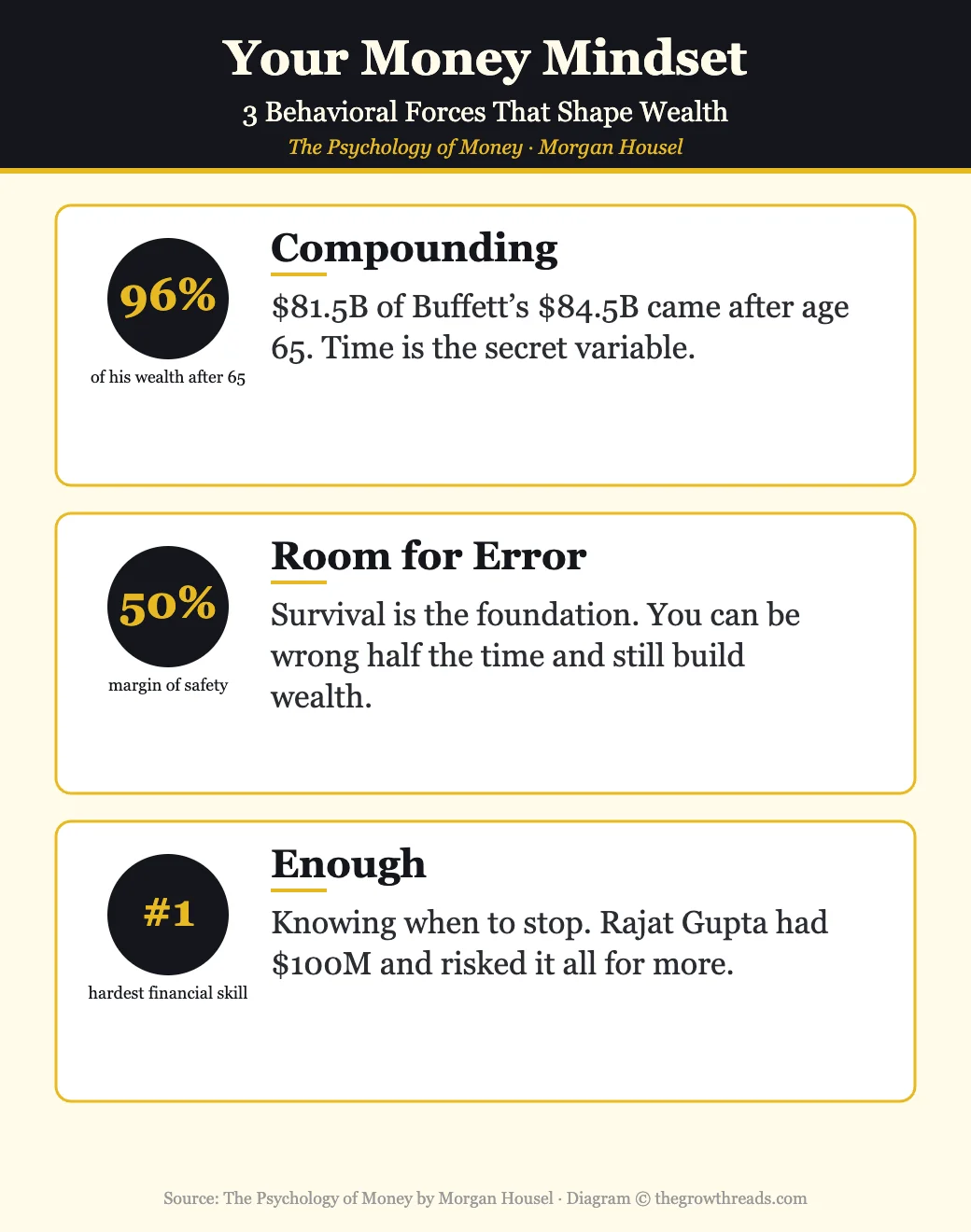
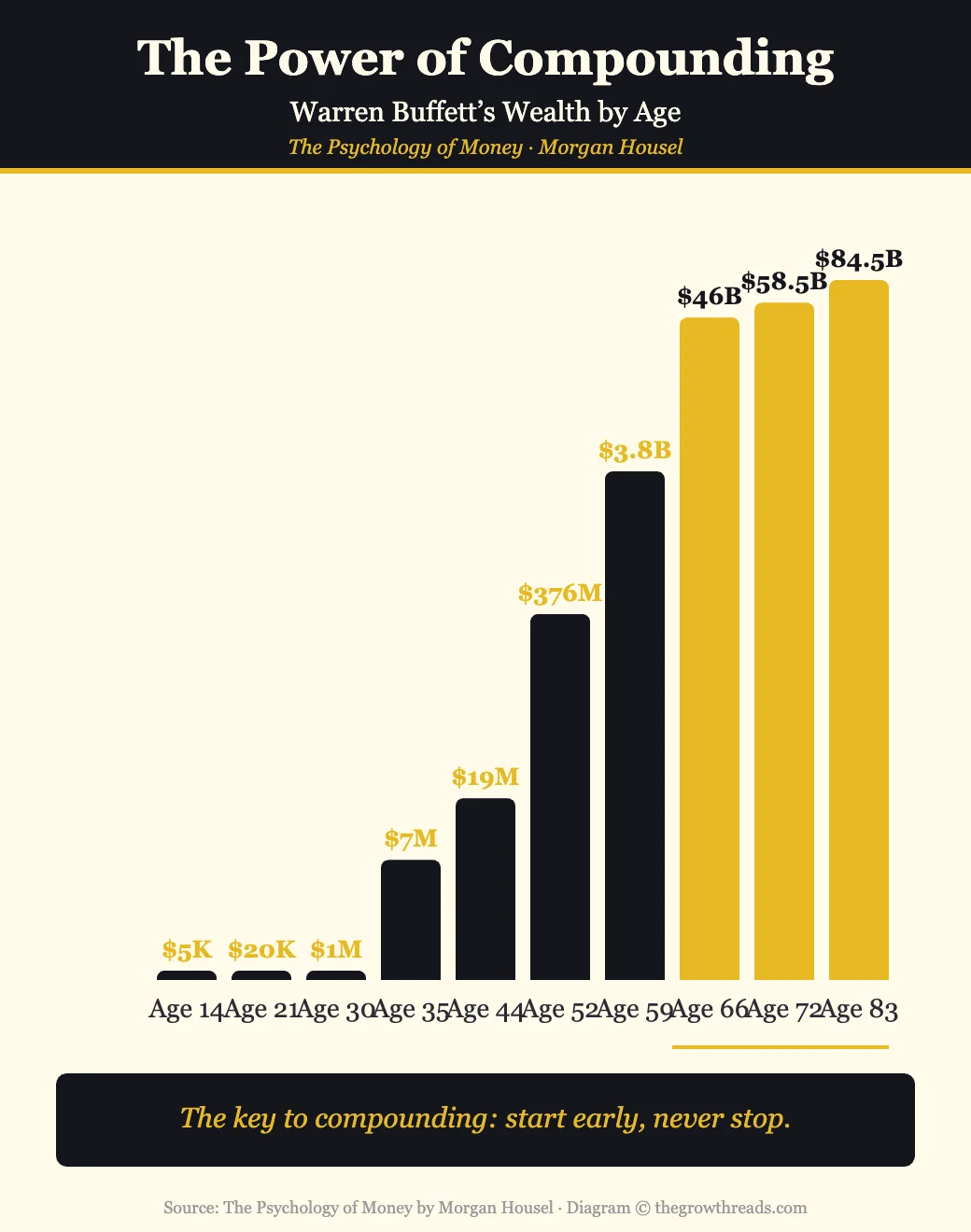
- Compounding is the real magic: Warren Buffett’s skill is investing, but his secret is time. He started at age 10 and never stopped. 96% of his wealth came after his 65th birthday.
- Getting wealthy vs. staying wealthy: These are completely different skills. Getting rich requires risk-taking and optimism. Staying rich requires frugality, humility, and a healthy dose of paranoia.
- Tails drive everything: A tiny number of events drive the vast majority of outcomes. Venture capitalists, stock markets, and careers all follow this power-law pattern.
- Freedom is the highest dividend: The ability to do what you want, when you want, with whom you want, for as long as you want is the ultimate form of wealth.
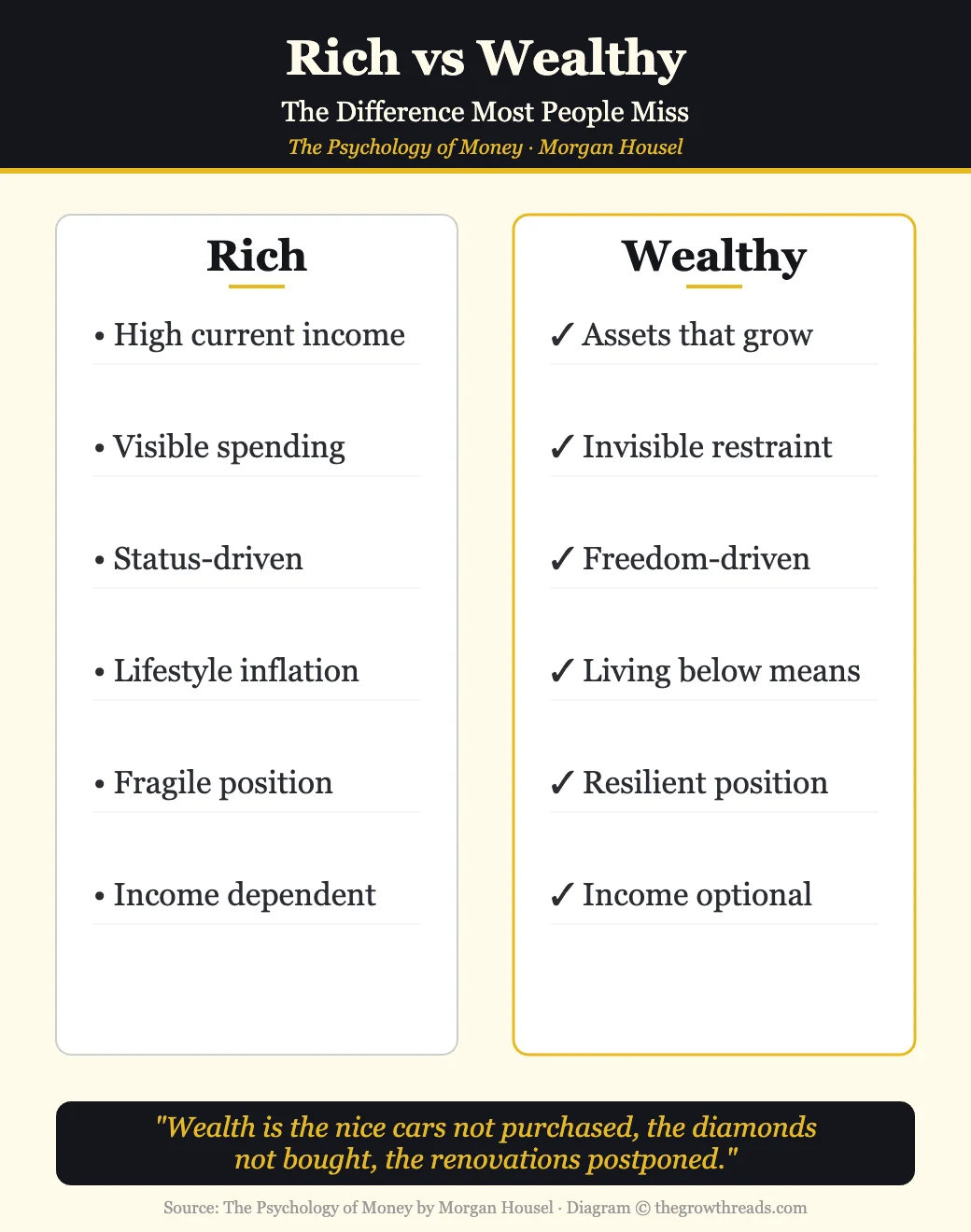
- Wealth is what you don’t see: Spending money on luxury items signals income, not wealth. Real wealth is the money you choose not to spend — it’s invisible.
- Save without a reason: You don’t need a specific goal to save. Saving is a hedge against life’s inevitable surprises and a way to gain control over your time.
- Room for error is everything: The most important part of any financial plan is planning for the plan not going according to plan.
- Reasonable beats rational: Financial decisions that make you sleep well at night are better than mathematically optimal ones that cause anxiety.
- Your personal history biases you: People born during inflation fear it forever. People who experienced stock booms trust markets more. Your birth year shapes your relationship with money.
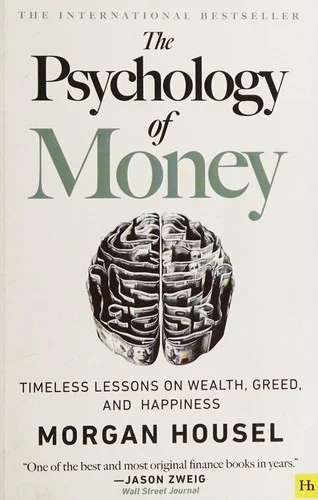
What is The Psychology of Money about?
The Psychology of Money explores how human behavior, personal history, and emotions shape financial decisions more than technical knowledge or intelligence. Through 19 interconnected stories, Morgan Housel reveals why ordinary people with no financial education can build wealth while finance PhDs go bankrupt — and what that tells us about making smarter choices with money.
About the author
Morgan Housel is a partner at The Collaborative Fund and a former columnist at The Motley Fool and The Wall Street Journal. He has won the Best in Business Award from the Society of American Business Editors and Writers twice and the New York Times Sidney Award. Originally from the Pacific Northwest, Housel studied economics at the University of Southern California. His writing blends financial history, behavioral psychology, and storytelling in a way that has earned him millions of readers worldwide. The Psychology of Money has sold over 10 million copies and been translated into more than 50 languages. Explore all Morgan Housel book summaries →
Key concepts at a glance
| Concept | What it means | Use it when |
|---|---|---|
| No One’s Crazy | Everyone’s money decisions reflect their unique experiences | You judge someone else’s financial choices |
| Compounding | Small, consistent growth over long periods creates extraordinary results | You feel impatient with slow progress |
| Tails, You Win | A few big wins matter more than many small decisions | Most of your investments aren’t working |
| Getting vs. Staying Wealthy | Accumulation and preservation require opposite mindsets | You’ve built some wealth and feel invincible |
| Wealth vs. Rich | Wealth is what you don’t spend; being rich is current income | You’re tempted to upgrade your lifestyle |
| Room for Error | Always plan for the plan not working | Building any financial plan or investment strategy |
| Enough | Knowing when to stop reaching for more | Ambition starts pushing you toward unnecessary risk |
| Man in the Car Paradox | People admire the car, not the driver | You’re buying something to impress others |
Part 1: Everyone is playing a different game
Housel opens with a radical idea: no one is crazy with money. A lottery ticket buyer in poverty and a hedge fund manager both make rational choices given their experience. Someone who grew up during the Great Depression treats money completely differently from someone who came of age during the 1990s tech boom. Economists measured this precisely — people who experienced high inflation in their formative years allocated less to bonds for the rest of their lives. Your personal history isn’t a footnote to your financial behavior; it is your financial behavior.
This extends to luck and risk, which Housel frames as siblings. Bill Gates attended one of the only high schools in the world with a computer terminal in 1968 — an event with roughly one-in-a-million odds. His equally talented classmate Kent Evans died in a mountaineering accident before graduation. Same talent, radically different outcomes based on forces completely outside their control. The lesson isn’t that skill doesn’t matter. It’s that we systematically overweight skill and underweight luck when explaining success, and do the reverse when explaining failure.
The “tails drive everything” concept extends this further. At a museum fundraiser, the bulk of donations came from a handful of ultra-wealthy attendees. In venture capital, half of all returns come from fewer than 1% of deals. Even within a single company, most products fail while one or two hits drive all the profits. This means being wrong most of the time is perfectly compatible with being very successful — as long as the few things that work really work.
Part 2: The art of staying wealthy
Getting money and keeping money are fundamentally different skills requiring fundamentally different mindsets. Getting money requires optimism, risk-taking, and putting yourself out there. Keeping money requires the opposite — humility, frugality, and an acceptance that at least some of what you earned was due to luck. Housel calls this combination “survival mentality,” and he argues it’s the single most important financial skill.
He illustrates this through the story of Jesse Livermore, perhaps the greatest stock market trader of the early 20th century. On October 29, 1929 — Black Tuesday — Livermore made the equivalent of over $3 billion in today’s money by shorting the market. He was, for a moment, one of the richest people in the world. But he kept making increasingly aggressive bets, and by 1933 he had lost everything. He died broke.
The compounding lesson is even more striking. Warren Buffett’s net worth at the time of writing was around $84.5 billion. Of that, $81.5 billion came after his 65th birthday. Buffett is an excellent investor, but his real edge is that he has been investing consistently since age 10 — giving compounding over 75 years to work. If he had started at 30 with the same returns, his net worth would be roughly $11.9 million. Not billion — million. The gap between $11.9 million and $84.5 billion is not explained by skill. It is explained entirely by time.
Part 3: The psychology of enough
One of the book’s most powerful chapters asks a deceptively simple question: when is it enough? Housel tells the story of Rajat Gupta, former CEO of McKinsey, who had a net worth of over $100 million. By any objective measure, Gupta had won the financial game completely. But he wanted to be a billionaire. That desire led him to insider trading, conviction, and prison. He risked everything he had for something he didn’t need.
The “Man in the Car Paradox” crystallizes this further. When you see someone driving a Lamborghini, you don’t actually think about the driver. You imagine yourself in the car. The driver bought the car to signal status, but nobody grants them that status — they use the car as a prop for their own fantasy instead. This means most luxury purchases fail at the very thing they’re designed to do.
Housel draws a sharp distinction between being rich and being wealthy. Being rich is having a high current income. Being wealthy is having assets that haven’t been converted into visible stuff. Wealth is the expensive car not purchased, the diamond not bought, the first-class upgrade declined. This makes wealth inherently invisible, which is why it’s so hard to learn from wealthy people — you literally cannot see their wealth because it exists as unspent money.
Part 4: Making smarter decisions
The final section turns from diagnosis to prescription. Housel argues that “reasonable” beats “rational” every time. A perfectly rational investor would hold 100% equities for long-term growth, but a reasonable investor might hold some bonds just to sleep better at night. The slight mathematical disadvantage is more than offset by the ability to actually stick with the plan during downturns. Any strategy you abandon in a panic is worse than a suboptimal strategy you maintain.
Room for error — what engineers call a margin of safety — is the connective tissue of good financial planning. Housel suggests assuming your future returns will be one-third lower than historical averages. This isn’t pessimism; it’s insurance. If you’re wrong and returns are normal, you end up wealthier than planned. If you’re right, you still reach your goals. The only dangerous position is one that requires everything to go perfectly.
He also addresses the role of stories in financial decision-making. Humans are narrative creatures, and the stories we tell ourselves about the economy, about risk, and about our own financial identity shape our decisions more than spreadsheets ever could. The dot-com bubble wasn’t caused by ignorance — it was fueled by a compelling story about the internet changing everything (which it did, just not at the speed or in the way investors expected). Every financial bubble begins with a reasonable premise that gets stretched past its breaking point by the power of narrative.
The book closes with Housel’s own financial philosophy: he and his wife drive modest cars, live in a modest house relative to their means, and maintain a high savings rate — not because they earn little, but because independence is more valuable to them than stuff. Their goal isn’t to maximize wealth. It’s to maximize freedom.
Who is The Psychology of Money best for — and who should read something else first?
This book is ideal for anyone who wants to understand why they make the financial decisions they do. It’s especially powerful for young adults just starting to earn and save, for high earners who feel they should be wealthier than they are, and for anyone who has ever felt anxious about money despite having “enough” on paper. The writing is accessible and jargon-free — you don’t need a finance background to absorb every lesson.
If you’re looking for specific investment tactics (which stocks to buy, how to read balance sheets, portfolio allocation formulas), this isn’t the right starting point. Try our The Intelligent Investor summary or The Four Pillars of Investing summary instead. Similarly, if you need a step-by-step budgeting system, our I Will Teach You to Be Rich summary is more practical for that purpose.
Questions to reflect on
- What financial experiences from your childhood or early adulthood are still shaping your money decisions today?
- If you lost your job tomorrow, how many months could you maintain your current lifestyle? Does that number make you feel secure or anxious?
- When was the last time you made a financial decision to impress someone else — and did it actually work?
- What is your personal definition of “enough”? Have you ever articulated it clearly, or does the goalpost keep moving?
- Are you currently optimizing for maximum returns or maximum peace of mind — and are you comfortable with that trade-off?
🔥 Ready to transform your relationship with money?
Learn the behavioral principles that separate those who build lasting wealth from those who don’t.
How to apply The Psychology of Money (7-day plan)
- Day 1 — Write your money story: Spend 15 minutes listing the financial events that shaped you — your parents’ money habits, your first paycheck, any financial shocks. Notice which ones still influence your decisions.
- Day 2 — Define your “enough”: Write down the specific lifestyle that would make you feel genuinely satisfied. Not aspirational, not minimal — the honest middle ground. Put a number on it.
- Day 3 — Calculate your survival number: How many months could you live on your current savings if all income stopped? Set a target of 6–12 months and identify what needs to change to get there.
- Day 4 — Audit your “Man in the Car” spending: Review your last month of expenses. Circle anything you bought primarily to signal status to others. No judgment — just awareness.
- Day 5 — Add room for error: Look at your financial plan (investments, budget, career path) and identify where you’re assuming everything goes perfectly. Add a 30% buffer to your expense projections.
- Day 6 — Automate and simplify: Set up automatic transfers to savings and investment accounts. Remove the need for willpower. Make your plan so simple it requires no maintenance.
- Day 7 — Write your personal financial philosophy: In one page, describe how you want to think about, earn, save, spend, and invest money. Make it “reasonable” for you, not theoretically “rational.”
Frequently asked questions
Is The Psychology of Money worth reading if I already know about investing?
Absolutely. This book isn’t about investing mechanics — it’s about the behavioral patterns that cause even knowledgeable investors to underperform. Housel’s insight is that financial success depends more on temperament than technique. Experienced investors often find this book more valuable than beginners do, because they recognize the mistakes Housel describes from their own experience. It fills a gap that technical books leave wide open.
What is the main message of The Psychology of Money?
The central thesis is that doing well with money has little to do with how smart you are and a lot to do with how you behave. Your relationship with risk, patience, and greed shapes your financial outcomes far more than your knowledge of interest rates or stock valuations. Housel argues that understanding your own psychology is the most valuable financial education you can get, because behavior is what determines whether knowledge gets applied or ignored.
How long does it take to read The Psychology of Money?
At an average reading pace, the book takes about 4 hours to finish. It’s 256 pages divided into 20 short chapters, each readable in 10–15 minutes. The writing style is conversational and story-driven, which makes it faster to read than most finance books. Many readers finish it in a single weekend. The audiobook runs approximately 5 hours and 48 minutes, narrated by Chris Hill.
Is The Psychology of Money good for beginners?
It’s one of the best possible starting points for anyone new to personal finance. The book uses zero jargon and requires no prior financial knowledge. Housel teaches through stories rather than formulas, making complex ideas like compounding, risk management, and behavioral bias accessible to complete beginners. That said, it won’t teach you how to open a brokerage account or pick specific investments — pair it with a practical guide for those steps.
What does Morgan Housel mean by “wealth is what you don’t see”?
Housel argues that true wealth is invisible because it consists of money that hasn’t been spent. When you see someone driving an expensive car, you’re seeing income being spent, not wealth being accumulated. Real wealth is the ability to buy things you choose not to buy. This makes it impossible to learn about wealth by observing the lifestyles of others — because the wealthiest people often look indistinguishable from the middle class.
How does The Psychology of Money compare to Rich Dad Poor Dad?
Both books challenge conventional financial thinking, but they approach money from very different angles. Rich Dad Poor Dad focuses on building income through assets, real estate, and entrepreneurship — it’s prescriptive and action-oriented. The Psychology of Money is diagnostic — it explains why we make the financial decisions we do and how to align our behavior with our goals. Housel relies on data and historical examples; Kiyosaki uses personal anecdotes. They complement each other well.
What are the best chapters in The Psychology of Money?
Readers most frequently highlight Chapter 3 (“Never Enough”), Chapter 4 (“Confounding Compounding”), Chapter 9 (“Wealth Is What You Don’t See”), and Chapter 18 (“When You’ll Believe Anything”) as standout chapters. Chapter 3’s story of Rajat Gupta is one of the most memorable in modern finance writing. Chapter 4’s Buffett analysis reframes compounding in a way that makes the concept visceral rather than abstract. But the book is designed to be read cover to cover, with each chapter building on the previous ones.
Related summaries
- The Intelligent Investor Summary — Benjamin Graham’s timeless guide to value investing and margin of safety.
- Think and Grow Rich Summary — Napoleon Hill’s 13 principles for building a wealth-oriented mindset.
- The Millionaire Next Door Summary — Data-driven look at how ordinary Americans quietly build wealth.
- I Will Teach You to Be Rich Summary — Ramit Sethi’s practical system for automating your money.
📚 Explore More Money Books
This summary is part of our Best Money Books collection — 43 expert-reviewed guides to help you build, protect, and grow your wealth. Browse the full list →