

★★★★☆ 4.3 / 5
One-liner: The original wealth-mindset blueprint — turn burning desire into a concrete plan through faith, auto-suggestion, and the Master Mind.
Best for: Ambitious beginners who want a foundational framework for goal-setting and wealth psychology.
Reading time: ~6 hours (238 pages)
Difficulty to apply: Moderate — the principles are simple but demand daily repetition and emotional commitment.
Think and Grow Rich in one minute
Wealth begins as a thought — and Napoleon Hill spent twenty years proving it. After studying over 500 of America’s most successful people, Hill distilled their strategies into 13 principles that anyone can follow. The core argument is deceptively simple: fix a precise financial goal, charge it with emotion until it becomes an obsession, feed that obsession to your subconscious through daily repetition, create an organized plan, surround yourself with a Master Mind alliance, and persist until reality bends. The book is not about get-rich-quick schemes — it is about reprogramming how you think so that opportunity, planning, and action converge. Nearly ninety years after publication, the principles remain the bedrock of modern goal-setting, visualization, and personal-finance psychology.
Key takeaways
- Desire is the starting point of all achievement: Not a wish, but a burning, all-consuming obsession backed by a definite plan and a refusal to accept any outcome other than success.
- Faith is created by repetition: You build belief not by hoping harder but by repeatedly affirming your goal until your subconscious accepts it as fact.
- Auto-suggestion is the bridge to the subconscious: Reading your written goal statement aloud twice daily — with emotion — programs your deeper mind to spot opportunities and drive action.
- Specialized knowledge beats general knowledge: What matters is not how much you know, but how effectively you organize and apply knowledge toward a definite purpose.
- Imagination has two forms: Synthetic imagination rearranges old ideas into new combinations; creative imagination receives “hunches” and inspirations from infinite intelligence.
- Every plan needs a Master Mind group: No one achieves lasting success alone — you need a small alliance of people who share your purpose and complement your weaknesses.
- Decision separates leaders from followers: Successful people decide quickly and change their minds slowly; unsuccessful people do the opposite.
- Persistence is the insurance policy of success: Most people quit at the first setback — Hill found that persistence, more than talent or luck, predicted who made it.
- The six ghosts of fear sabotage everything: Fear of poverty, criticism, ill health, loss of love, old age, and death — left unchecked, they override every positive intention.
- Transmutation channels emotional energy into creative power: The same intensity that drives romantic desire can be redirected into business ambition and creative output.
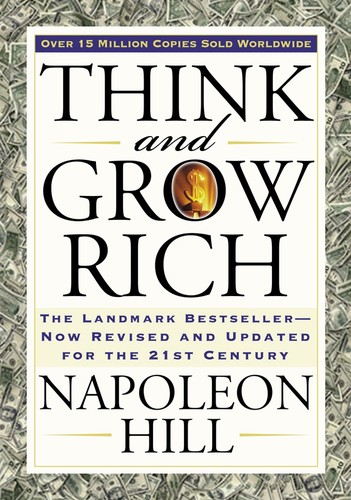
What is Think and Grow Rich about?
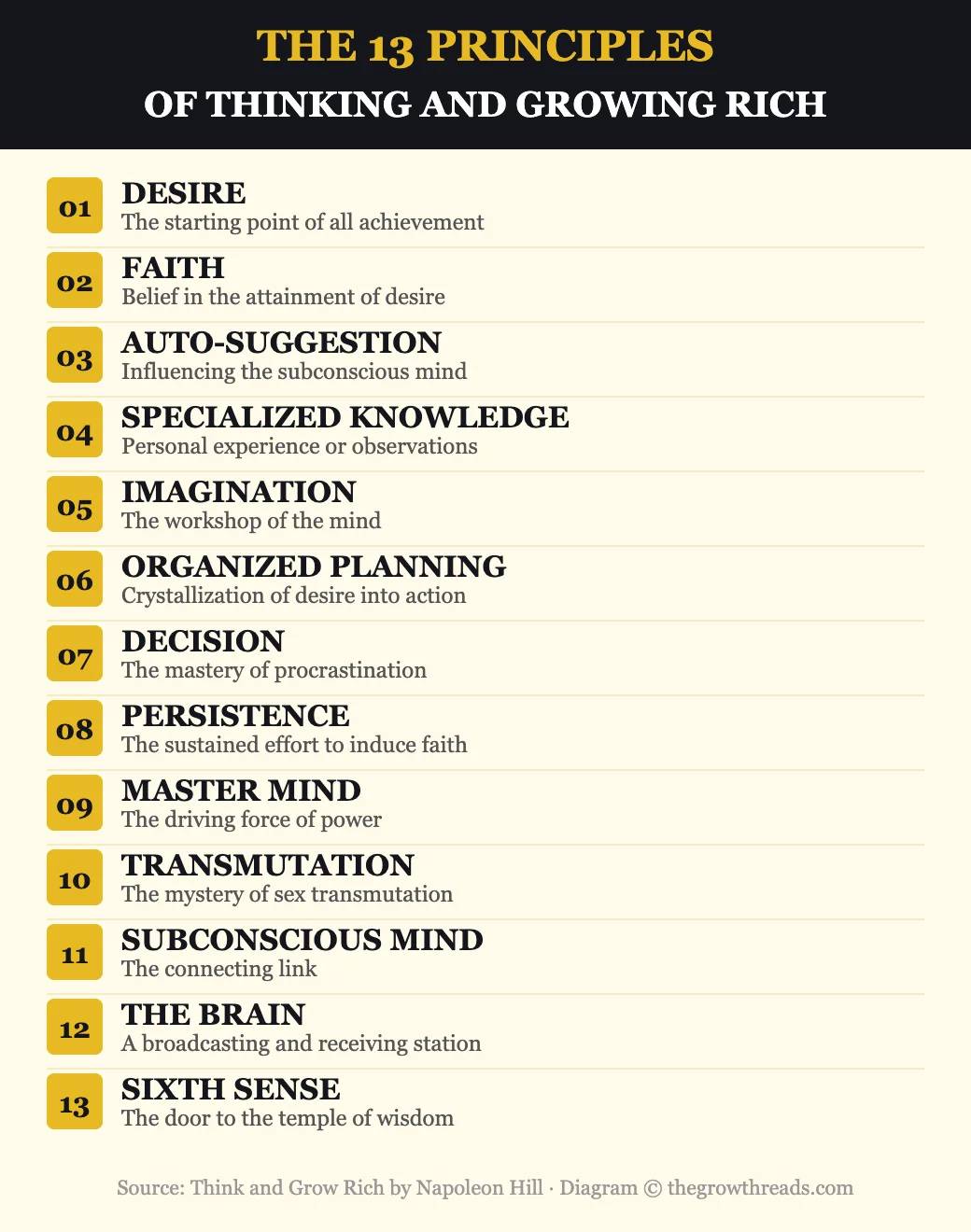
Think and Grow Rich is a personal-finance and self-development classic based on Napoleon Hill’s twenty-year study of over 500 successful Americans, including Andrew Carnegie, Henry Ford, and Thomas Edison. The book presents 13 principles — from desire and faith to organized planning and the Master Mind — that together form a step-by-step philosophy for turning thoughts into wealth.
About the author
Napoleon Hill was born in 1883 in a one-room cabin in Wise County, Virginia. At age thirteen he began writing for small-town newspapers, eventually catching the attention of steel magnate Andrew Carnegie, who commissioned Hill to interview the era’s most accomplished industrialists and distill their success secrets. That project consumed twenty years and culminated in Think and Grow Rich (1937), which has since sold over 100 million copies worldwide. Hill went on to advise Franklin D. Roosevelt and lecture extensively before his death in 1970. Despite controversy over certain biographical claims, his influence on the personal-development and wealth-building genres remains unmatched.
Key concepts at a glance
| Concept | What it means | Use it when |
|---|---|---|
| Burning Desire | An obsessive, emotionally charged goal — not a wish | Setting any major financial or life target |
| Auto-Suggestion | Repeating your goal statement aloud to program the subconscious | Morning and evening daily rituals |
| Master Mind Alliance | A small group of allies with shared purpose and complementary skills | Launching a business or ambitious project |
| Organized Planning | Translating desire into a concrete, written action plan | Moving from dreaming to executing |
| Persistence | Sustained effort despite repeated failure or setback | Facing rejection, pivots, or slow progress |
| Decision | Reaching conclusions quickly and changing them slowly | Overcoming analysis paralysis |
| Creative Imagination | The faculty that receives hunches and novel ideas | Brainstorming, problem-solving, innovation |
| Transmutation | Redirecting emotional or sexual energy into creative pursuits | Channeling restlessness into productive output |
| Six Ghosts of Fear | The six basic fears that silently undermine achievement | Self-diagnosing what’s really holding you back |
Part 1: The foundation — Desire, Faith, and Auto-Suggestion
Hill opens with a story that sets the tone for everything that follows. Edwin C. Barnes arrived at Thomas Edison’s laboratory with no money, no connections, and no appointment — but with a burning desire to become Edison’s business partner, not merely his employee. Barnes worked for Edison for years before the opportunity finally materialized, and when it did, he seized it because his mind was primed by a single, obsessive goal. Hill uses this anecdote to introduce his first principle: desire is not a wish but a white-hot obsession backed by a specific plan.
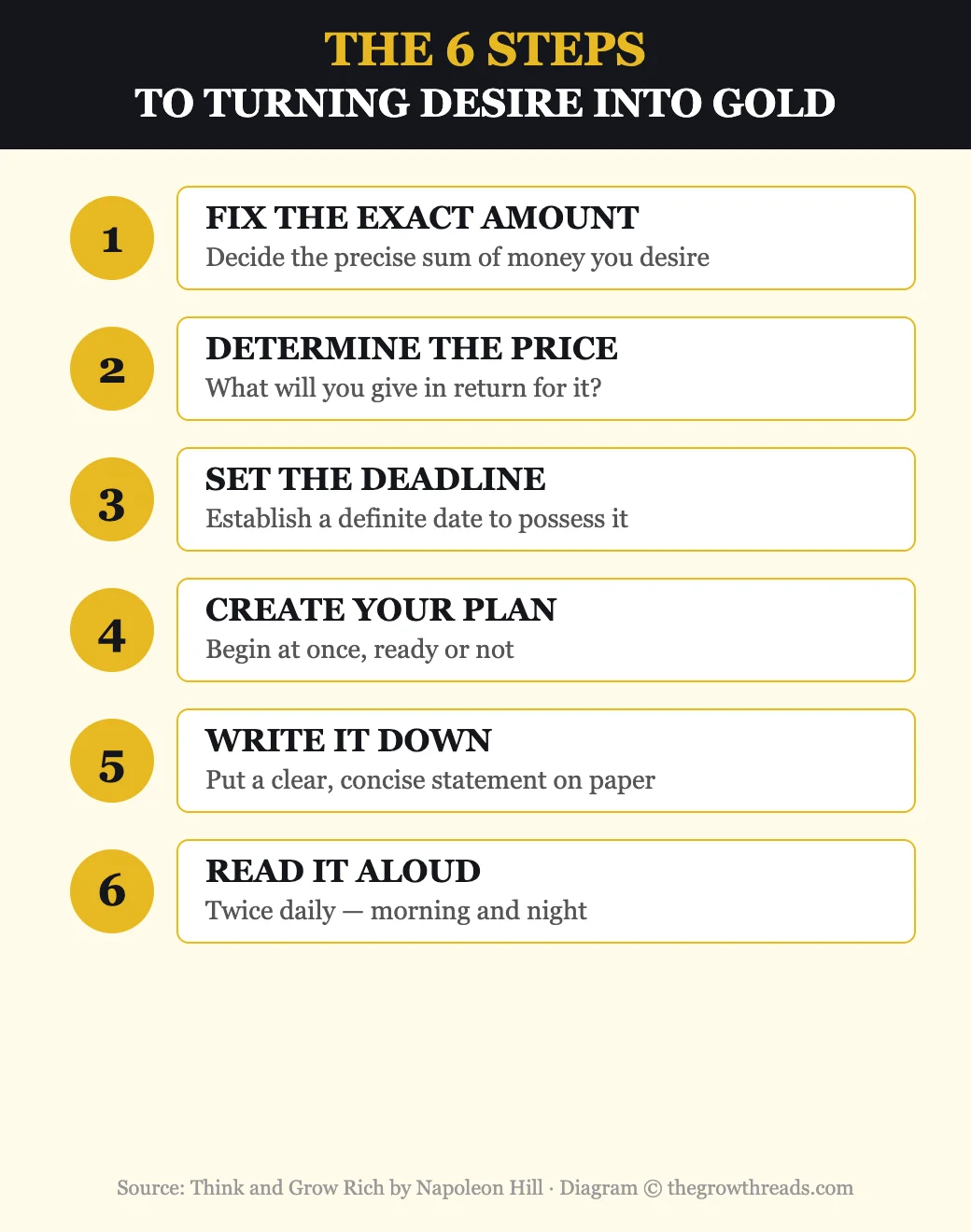
The practical application comes in six precise steps: fix the exact amount of money you want, determine what you will give in return, set a definite deadline, create a concrete plan, write the entire statement on paper, and read it aloud twice a day while visualizing yourself already in possession of the money. Hill is emphatic — vague wanting produces nothing. The goal must be specific enough to measure and emotionally charged enough to sustain you through obstacles.
Faith, the second principle, is not religious belief but a state of mind that can be manufactured through repeated instructions to the subconscious. Hill argues that any thought held in the mind with emotional intensity eventually becomes a physical reality. Auto-suggestion — the third principle — is the mechanism: by deliberately feeding your subconscious a clear, emotionalized picture of your goal, you create a feedback loop where belief strengthens action and action strengthens belief.
Part 2: Knowledge, Imagination, and Organized Planning
Hill draws a sharp distinction between general knowledge and specialized knowledge. Having a broad education is not the same as being able to organize and direct knowledge toward a definite end. He points to Henry Ford — a man with limited formal schooling who nonetheless built an empire by surrounding himself with people who had the specialized knowledge he lacked. The principle is not “learn everything” but “know how to access what you need when you need it.”
Imagination, Hill’s fifth principle, comes in two varieties. Synthetic imagination takes existing ideas, concepts, or plans and rearranges them into new combinations — this is what most business innovation actually looks like. Creative imagination, by contrast, is the faculty through which entirely new ideas arrive as hunches, inspirations, or sudden flashes of insight. Hill believed this faculty could be strengthened through use and that it functioned best when the conscious mind was operating at high speed through intense focus on a problem.
Organized planning turns imagination into action. Hill lays out detailed instructions for building a plan: identify exactly what you have to offer, decide the form of compensation you expect, and present your plan through an attractive written brief. He notes that most people fail not because they lack intelligence but because they give up after the first plan fails. Temporary defeat is not permanent failure — it simply means the plan needs revision.
Part 3: Decision, Persistence, and the Master Mind
Hill analyzed over 25,000 people who had experienced failure and found that lack of decision was near the top of the list of causes. He observed that successful people reached decisions quickly (because they knew what they wanted) and changed those decisions slowly (because they had conviction). Unsuccessful people did the reverse — they hesitated endlessly, and when they finally acted, they abandoned course at the first sign of resistance. The practical lesson: once you have enough information to act, decide. You can adjust later.
Persistence is the sustained application of desire. Hill compared it to an insurance policy on success — most people pay the premiums of effort for a while but cancel the policy just before it would have paid off. He identified four steps to developing persistence: a definite purpose backed by a burning desire, a specific plan expressed in continuous action, a mind closed to negative influences, and a friendly alliance with at least one person who encourages you to follow through.
The Master Mind principle may be Hill’s most enduring contribution. He defined it as “coordination of knowledge and effort, in a spirit of harmony, between two or more people, for the attainment of a definite purpose.” Carnegie attributed his entire fortune to the power of his Master Mind group. The principle works because a group mind generates ideas, energy, and accountability that no individual can match alone. Hill was clear that the alliance must be harmonious — one dissonant member can neutralize the entire group’s power.
Part 4: The subconscious, the brain, and the six ghosts of fear
The final section of the book ventures into territory that felt mystical in 1937 but reads differently in the age of neuroscience. Hill argues that the subconscious mind is a connecting link between the finite mind of man and infinite intelligence. He believed emotions were the gateway — only thoughts mixed with strong feeling penetrate the subconscious deeply enough to influence behavior. The seven major positive emotions (desire, faith, love, sex, enthusiasm, romance, hope) and seven major negative emotions (fear, jealousy, hatred, revenge, greed, superstition, anger) compete for control. Whichever set you feed most consistently wins.
The chapter on the brain introduces the idea that every human brain is both a broadcasting and receiving station for thought vibrations. While the specific mechanism Hill describes has not been scientifically validated, the practical advice is sound: spend time with people who think at a high level, and your own thinking elevates. Isolate yourself in negativity, and your thinking degrades. The principle anticipates what psychologists now call emotional contagion.
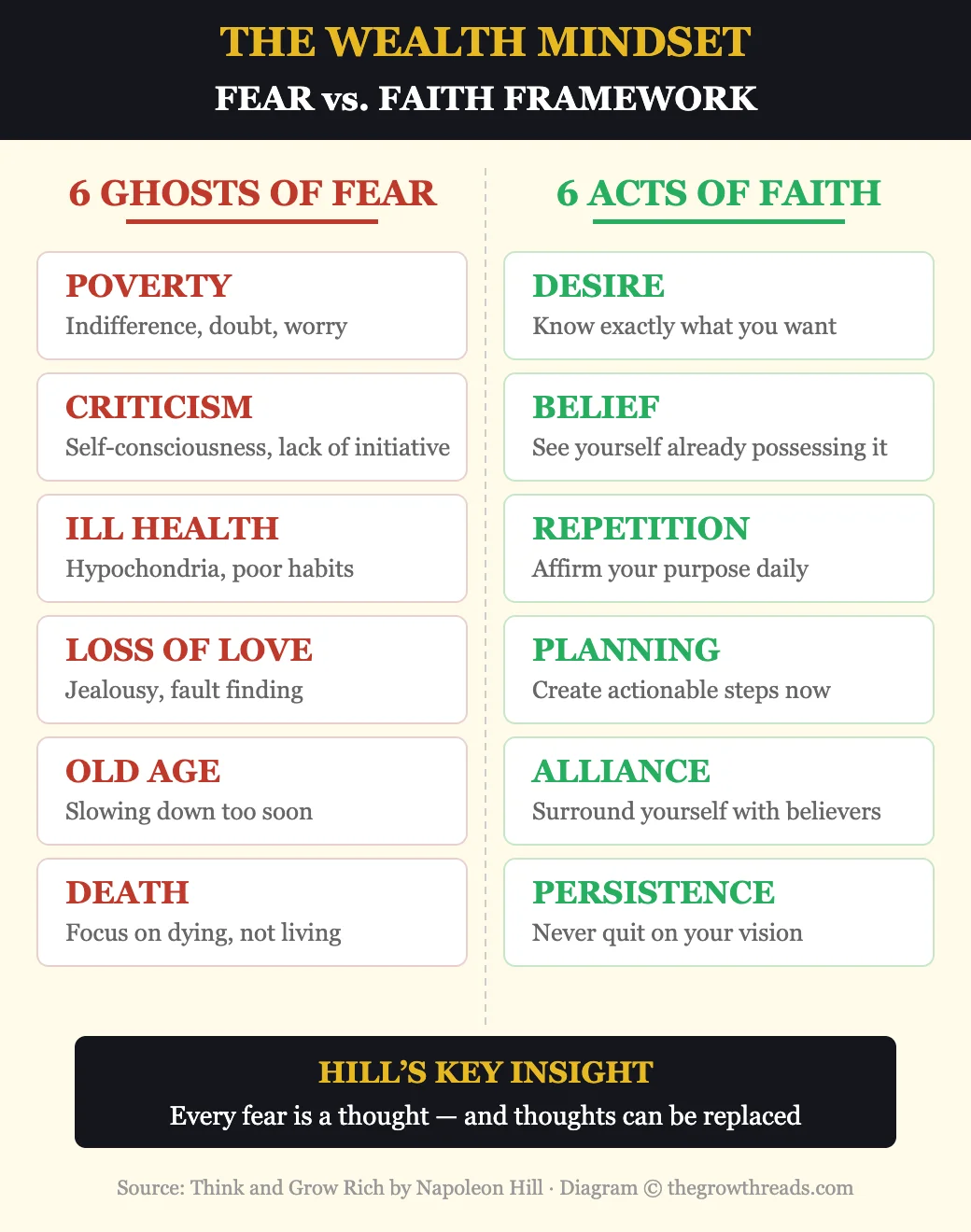
Hill closes with the six ghosts of fear — poverty, criticism, ill health, loss of love, old age, and death — and argues that these fears, operating below conscious awareness, silently sabotage every positive intention. The antidote is not willpower but awareness: once you name the fear, you can replace the thought with its positive opposite. He provides a self-analysis questionnaire to help readers identify which fears are currently active and what symptoms they produce.
Who is Think and Grow Rich best for — and who should read something else first?
This book is ideal for anyone at the very beginning of their wealth-building or personal-development journey — especially if you have never formally set financial goals or thought systematically about the psychology of success. It is also excellent for entrepreneurs and salespeople who need to strengthen their mindset before tackling tactical execution.
If you already have a solid goal-setting practice and want modern, science-backed strategies, you may find the book’s language dated. In that case, start with Atomic Habits for the habit-building layer, or The Psychology of Money for a more contemporary take on wealth psychology. If you want the investing mechanics rather than the mindset, The Simple Path to Wealth is a better starting point.
Questions to reflect on
- What is the exact amount of money I want to earn or accumulate — and by when?
- What am I willing to give in return for that money, and have I written it down?
- Which of the six fears (poverty, criticism, ill health, loss of love, old age, death) is most active in my life right now, and how is it showing up in my decisions?
- Do I currently have a Master Mind group — even two or three people who share my purpose and hold me accountable?
- When was the last time I quit on a plan that might have worked if I had persisted one step further?
🔥 Ready to reprogram how you think about wealth?
Get Napoleon Hill’s timeless 13-principle blueprint and start building your Master Mind today.
How to apply Think and Grow Rich (7-day plan)
- Day 1 — Write your definite chief aim: Decide the exact sum of money you want, the date you want it by, what you will give in return, and your plan to begin. Write it on a card you can carry.
- Day 2 — Start auto-suggestion: Read your statement aloud every morning when you wake up and every night before sleep. Visualize the money as already in your possession — feel the emotion.
- Day 3 — Audit your fears: Go through Hill’s six fears and honestly identify which ones are operating in your life. Write down three specific symptoms each fear produces in your behavior.
- Day 4 — Identify your Master Mind candidates: List 3–5 people whose skills, knowledge, or energy would complement yours. Reach out to at least one and propose meeting regularly.
- Day 5 — Map your specialized knowledge gaps: What do you need to know to execute your plan that you don’t currently know? Identify one course, mentor, or resource to close the biggest gap.
- Day 6 — Make a pending decision: Pick one decision you have been delaying — apply Hill’s principle and decide today. Write down what you decided and why.
- Day 7 — Design your persistence protocol: Create a simple daily checklist: read your aim (2 min), visualize (3 min), take one action toward your plan (30 min). Commit to 30 consecutive days.
Frequently asked questions
Is Think and Grow Rich only about money?
Despite the title, Hill’s 13 principles apply to any form of achievement — career advancement, creative projects, health goals, or relationship building. He chose wealth as the primary example because it is measurable and universally understood, but he explicitly states that the same formula works for “riches” of every kind. Many readers use the book as a general goal-setting framework rather than a strictly financial one.
How long does it take to read Think and Grow Rich?
The revised TarcherPerigee edition runs about 238 pages, which most readers can finish in five to seven hours of focused reading. However, Hill recommended re-reading the book multiple times and treating each principle as a chapter to study and apply over weeks. A practical approach is one chapter per day with journaling, which takes roughly two and a half weeks to complete.
What is a Master Mind group and how do I start one?
A Master Mind group is a small alliance of two or more people who meet regularly to support each other’s goals with knowledge, accountability, and encouragement. To start one, identify three to five people with complementary skills and compatible temperaments, agree on a regular meeting cadence (weekly or biweekly works best), set ground rules for confidentiality and constructive feedback, and rotate the focus so each member gets dedicated problem-solving time.
Does the auto-suggestion technique actually work?
Modern psychology supports the core mechanism under different names. Visualization and affirmation practices have been shown to activate the reticular activating system — the brain’s filter for relevant information — making you more likely to notice opportunities aligned with your goals. The emotional component Hill emphasizes is consistent with research showing that emotionally charged memories and intentions are more strongly encoded. The key is pairing the mental rehearsal with concrete action.
Is Think and Grow Rich still relevant in 2026?
The core principles — definite purpose, emotional conviction, persistence, and strategic alliances — are as relevant today as in 1937. What has changed is the language: Hill’s references to “infinite intelligence” and “ether” feel dated, but the underlying ideas map cleanly onto modern concepts like neuroplasticity, implementation intentions, and network effects. The book is best read as a philosophical foundation and supplemented with modern tactical guides.
What are the six ghosts of fear?
Hill identified six basic fears that he believed sabotage all positive effort: the fear of poverty (the most destructive, because it paralyzes initiative), the fear of criticism (which kills ambition and self-expression), the fear of ill health (which breeds hypochondria and worry), the fear of loss of love (which produces jealousy and fault-finding), the fear of old age (which slows people down prematurely), and the fear of death (which prevents full engagement with life). His antidote is awareness — naming the fear weakens its power.
What should I read after Think and Grow Rich?
For the modern habit-building layer, read Atomic Habits. For updated wealth psychology backed by data, try The Psychology of Money. For the practical investing playbook, see The Simple Path to Wealth. And for mastering the people side of success, How to Win Friends and Influence People is the natural companion.
Related summaries
- The Psychology of Money — Morgan Housel’s modern take on how emotions and behavior drive financial outcomes.
- Rich Dad Poor Dad — Robert Kiyosaki’s framework for building wealth through assets and financial literacy.
- The Millionaire Next Door — What actual millionaires look like (spoiler: not what you expect).
- Secrets of the Millionaire Mind — T. Harv Eker on the mental blueprints that separate rich from poor thinkers.
📚 See all Money book summaries →
How we analyze books: We read every book cover to cover (no AI-generated summaries of summaries), cross-reference key claims with primary sources and later research, and test the practical advice against real-world application. Our 5-point rating weighs evidence quality, practical utility, writing clarity, originality, and lasting impact. Read our full methodology.