

★★★★☆ 4.3 / 5
One-liner: A leadership fable that identifies the five interconnected dysfunctions that undermine every team — and shows exactly how to fix them, starting with trust.
Best for: Leaders, managers, and team members who sense their team is underperforming but can’t pinpoint why, and anyone building or restructuring a team from scratch.
Reading time: ~4 hours (229 pages)
Difficulty to apply: Moderate — the model is simple and intuitive, but building genuine trust and embracing productive conflict requires sustained vulnerability from the leader first.
The Five Dysfunctions of a Team in one minute
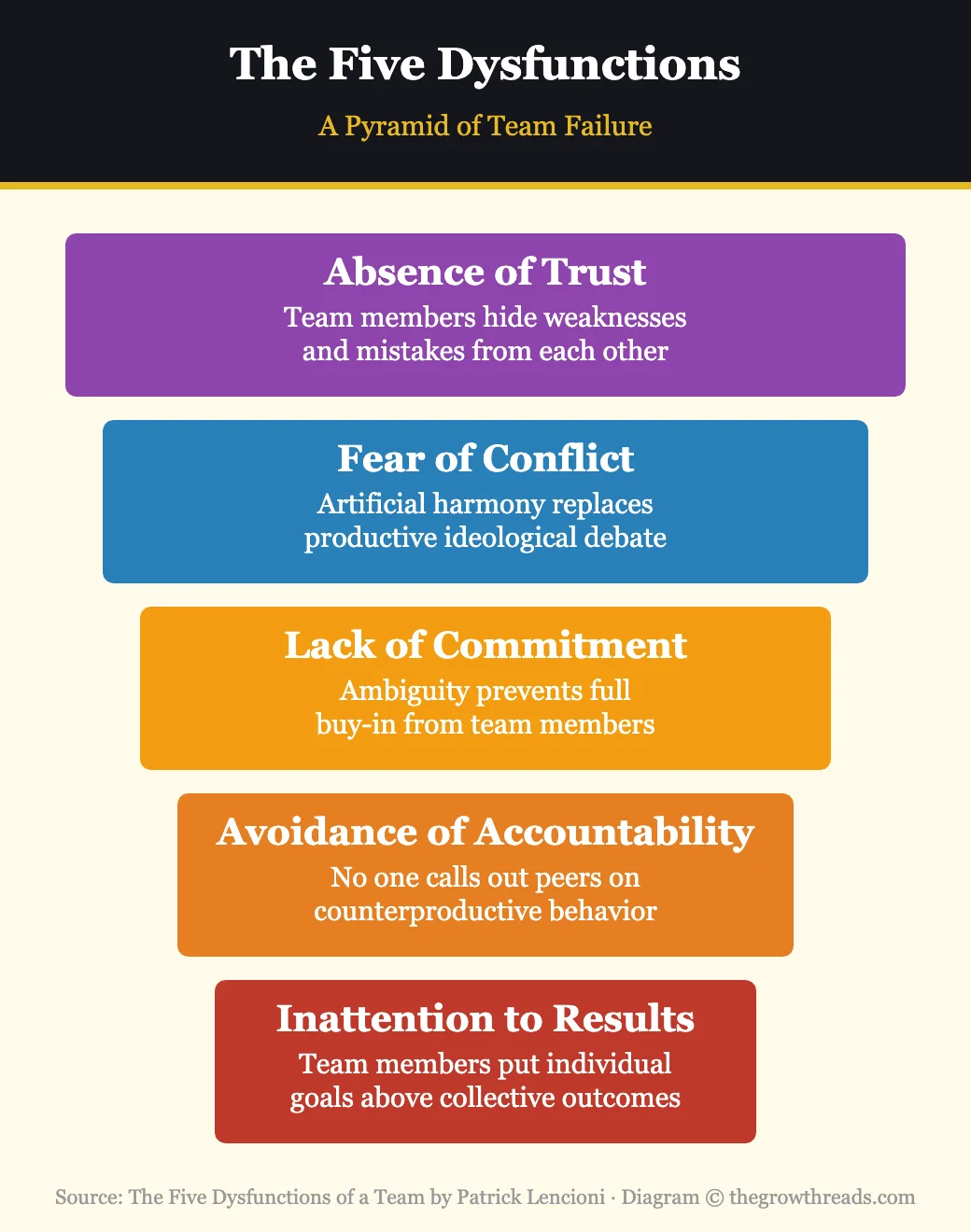
Most teams fail not because of strategy, talent, or resources, but because of five interconnected behavioral dysfunctions that erode trust, suppress honest debate, and prioritize individual ego over collective results. Patrick Lencioni, a management consultant and bestselling author, presents these dysfunctions as a pyramid: at the base is absence of trust (team members hide vulnerabilities from each other), which leads to fear of conflict (artificial harmony replaces productive debate), which causes lack of commitment (without real debate, there’s no genuine buy-in), which enables avoidance of accountability (peers don’t challenge each other), which ultimately produces inattention to results (individual goals trump team outcomes). The genius of the model is that it shows these aren’t five separate problems — they’re one cascading failure that starts with trust.
Key takeaways
- Trust is the foundation of everything: Without vulnerability-based trust — the willingness to admit mistakes, weaknesses, and fears — no team can function at a high level.
- Productive conflict is essential, not optional: Teams that avoid ideological debate settle for artificial harmony, which leads to inferior decisions and suppressed resentment.
- Commitment requires clarity and buy-in: Teams must make clear decisions and ensure every member is genuinely committed, even if they initially disagreed — consensus is not required, but being heard is.
- Accountability must be peer-to-peer: The most effective accountability comes from teammates holding each other to high standards, not just from the leader imposing expectations top-down.
- Results must be collective: When team members prioritize their own department, career, or ego over the team’s shared objectives, the team fails regardless of individual talent.
- The leader must go first: Vulnerability, conflict engagement, decisiveness, accountability, and results focus all start with the leader modeling the behavior before expecting it from others.
- These dysfunctions are interconnected: You cannot fix accountability without first fixing commitment, and you cannot fix commitment without first fixing conflict, and you cannot fix conflict without first fixing trust.
- Great teams fight well: The difference between functional and dysfunctional teams is not the absence of conflict but the type — task conflict (debating ideas) builds better outcomes while relationship conflict (personal attacks) destroys them.
What is The Five Dysfunctions of a Team about?
The Five Dysfunctions of a Team is a leadership book by Patrick Lencioni that uses a fictional fable about a struggling tech company to illustrate the five behavioral patterns that prevent teams from performing at their best. Lencioni identifies these dysfunctions as absence of trust, fear of conflict, lack of commitment, avoidance of accountability, and inattention to results, showing how they cascade from the foundation upward and providing practical tools for overcoming each one.
About the author
Patrick Lencioni is the founder and president of The Table Group, a management consulting firm specializing in organizational health and team development. Before founding the firm, he worked at Bain & Company, Oracle, and Sybase. Lencioni is known for writing business books in the form of leadership fables — narrative stories that embed management principles in fictional but realistic scenarios. This approach has made his books unusually accessible and memorable. The Five Dysfunctions of a Team, published in 2002, has sold over 4 million copies and remains the most widely read book on team dynamics in the world. His other books include The Ideal Team Player, Death by Meeting, and The Advantage. He is a sought-after speaker who has worked with thousands of senior leadership teams across Fortune 500 companies, professional sports organizations, and nonprofits. Explore all Patrick Lencioni book summaries →
Key concepts at a glance
| Concept | What it means | Use it when |
|---|---|---|
| Absence of trust | Team members are unwilling to be vulnerable — they hide mistakes, weaknesses, and concerns | People are guarded in meetings and never ask for help |
| Fear of conflict | The team avoids passionate ideological debate in favor of artificial harmony | Meetings are polite but unproductive, and real opinions surface only in hallway conversations |
| Lack of commitment | Without genuine debate, team members don’t truly buy into decisions | People nod in meetings but don’t follow through, or relitigate decisions after they’re made |
| Avoidance of accountability | Team members don’t call out peers on behaviors that hurt the team | Low performers are tolerated and high standards erode over time |
| Inattention to results | Individual ego, department politics, or career advancement trump collective team outcomes | People celebrate personal wins even when the team is losing |
| Vulnerability-based trust | Trust built on willingness to be open about failures, not just predictability or reliability | You want to distinguish surface-level trust from the deep trust that enables great teamwork |
Part 1: Dysfunction one — absence of trust
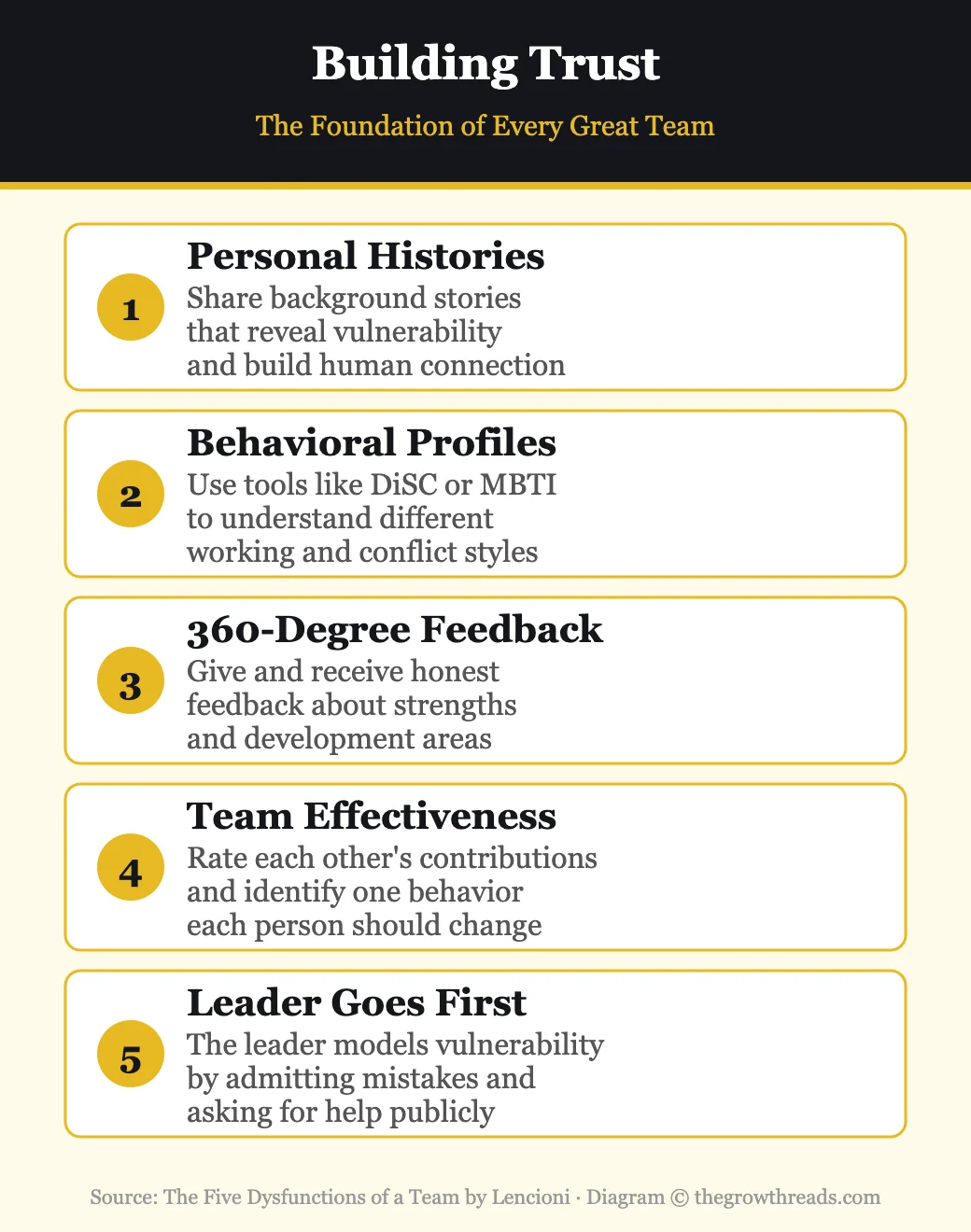
Lencioni’s fable follows Kathryn Petersen, a newly hired CEO of DecisionTech, a struggling Silicon Valley startup with a talented but dysfunctional executive team. Her first move is not to address strategy, product, or market — it is to address trust. Lencioni defines trust in teams not as predictability (“I trust you’ll deliver on time”) but as vulnerability (“I trust you enough to admit I was wrong, ask for help, and show you my weaknesses”).
The absence of vulnerability-based trust manifests in specific behaviors: team members conceal mistakes, never ask for help, jump to conclusions about others’ intentions, hold grudges, and dread meetings. Kathryn’s first intervention is a personal histories exercise — she asks each executive to share something about their background that the others don’t know. The exercise is simple but surprisingly powerful because it humanizes colleagues who have been treating each other as competitors or obstacles.
Lencioni then prescribes behavioral profiling tools (like DiSC or Myers-Briggs) to help team members understand each other’s working styles, and 360-degree feedback to create structured vulnerability. The critical insight is that the leader must go first — Kathryn models vulnerability by sharing her own failures and uncertainties before asking anyone else to do the same.
Part 2: Dysfunctions two and three — fear of conflict and lack of commitment
With trust as the foundation, Lencioni moves to the second dysfunction: fear of conflict. In teams without trust, disagreement feels dangerous because challenging someone’s idea might be interpreted as a personal attack. The result is artificial harmony — meetings where everyone nods politely, real opinions are shared only in private side conversations, and decisions are made by the loudest or most senior voice rather than by genuine debate.
Lencioni argues that productive conflict — passionate, unfiltered debate about ideas, strategies, and approaches — is essential for making good decisions. The key distinction is between ideological conflict (debating ideas) and personal conflict (attacking people). Healthy teams fight about ideas with intensity and passion but maintain respect for each other as people. Kathryn’s role is to “mine for conflict” — to actively draw out disagreements that team members are suppressing, and to give permission for passionate debate by rewarding it rather than punishing it.
The third dysfunction follows directly: without real debate, there can be no genuine commitment. When team members don’t voice their objections and have them addressed, they leave meetings with lingering doubts and reservations. They don’t sabotage openly — they simply fail to execute with full energy and conviction. Lencioni’s solution is what he calls “disagree and commit”: ensure that every voice is heard in the debate, make a clear decision with a deadline, and then expect full commitment from everyone — even those who initially disagreed. The requirement is not consensus but clarity: “I may not agree with this decision, but I was heard, and I will commit to executing it fully.”
Part 3: Dysfunctions four and five — avoidance of accountability and inattention to results
The fourth dysfunction is the natural consequence of weak commitment: when team members haven’t truly bought in, they hesitate to hold each other accountable. Why would you challenge a colleague’s behavior if you’re not sure the team’s direction is right? The result is that standards erode — mediocre performance is tolerated, deadlines slip without consequence, and the leader becomes the sole source of accountability (which is both insufficient and exhausting).
Lencioni’s prescription is peer-to-peer accountability. The most powerful accountability doesn’t come from the boss — it comes from colleagues who respect each other enough to have difficult conversations about performance. He recommends publishing team goals and standards publicly, conducting regular progress reviews where peers evaluate each other’s contributions, and creating a culture where calling out underperformance is seen as an act of care (because you believe in the person’s potential) rather than an act of aggression.
The fifth and final dysfunction sits at the top of the pyramid: inattention to results. When team members aren’t held accountable, they default to pursuing individual goals — their department’s metrics, their personal career advancement, their professional ego — rather than the team’s collective outcomes. Lencioni argues that the ultimate test of a great team is whether members are willing to sacrifice individual recognition for team success. His solution is simple: define clear, measurable team results, make them visible to everyone, and reward only team-level achievement — never individual performance at the expense of the group.
Part 4: The functional team — what it looks like when it works
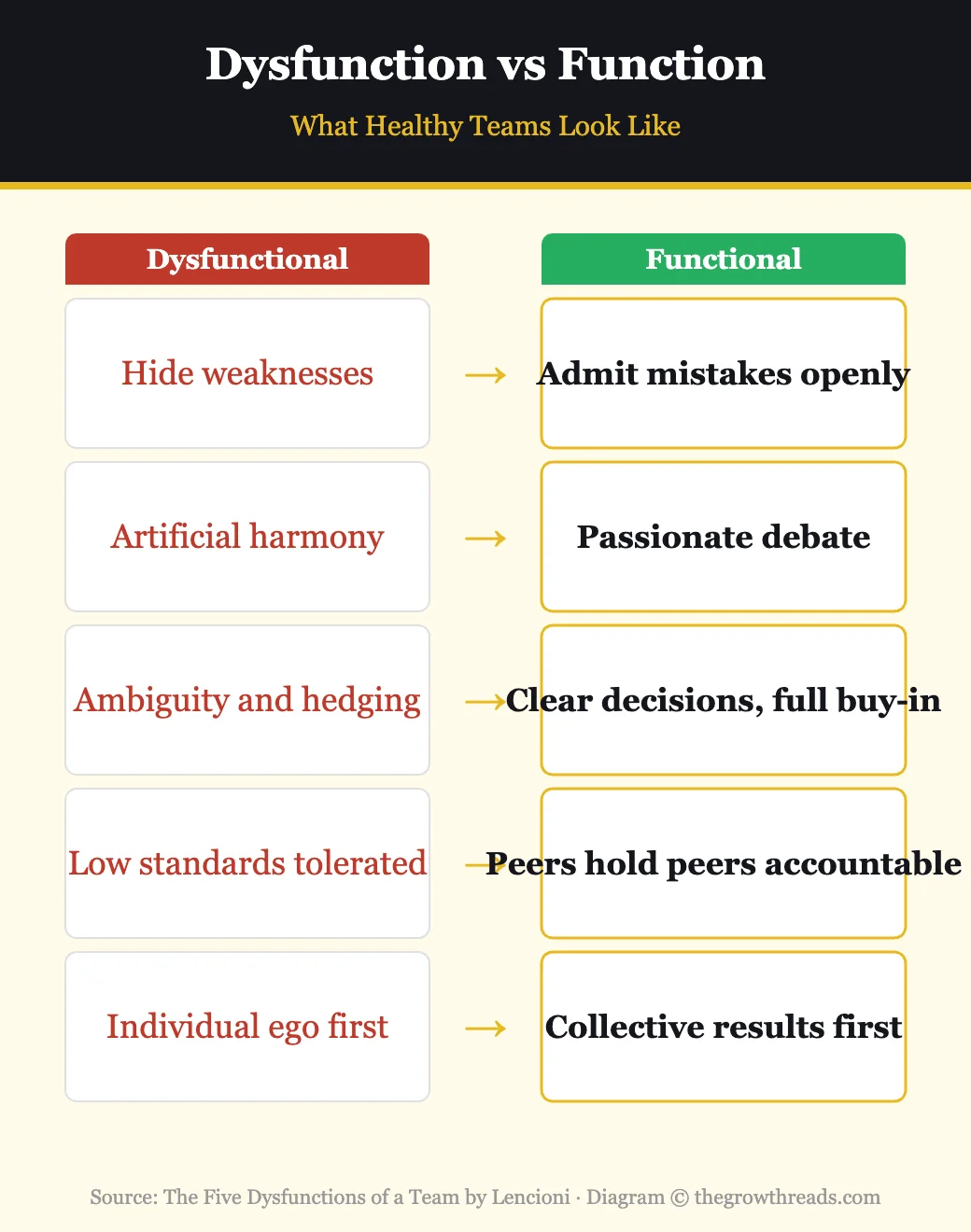
Lencioni closes by contrasting the five dysfunctions with the five characteristics of a functional team. Members of great teams trust each other enough to be vulnerable, engage in passionate and unfiltered conflict about ideas, commit to clear decisions even when they disagree, hold each other accountable to high standards, and focus on collective results above individual ego.
The practical tools Lencioni recommends include: personal histories exercises and behavioral profiling for building trust; real-time permission to engage in debate and mining for buried disagreements for overcoming fear of conflict; clear decisions with deadlines and cascading communication for building commitment; published goals and regular peer reviews for establishing accountability; and public, visible team scorecards for focusing attention on results.
Who is The Five Dysfunctions of a Team best for — and who should read something else first?
This book is essential for anyone leading a team — from first-time managers to CEOs — especially if the team is underperforming despite having talented people. The fable format makes it one of the fastest and most engaging leadership reads available, and the model is intuitive enough to share with an entire team in a single meeting. It is also valuable for team members (not just leaders) who want to diagnose what’s wrong with their group dynamics.
If your challenge is building culture at the organizational level rather than the team level, start with our Culture Code summary by Daniel Coyle. If you need frameworks for having difficult accountability conversations, our Radical Candor summary by Kim Scott provides the communication tools. And if you’re leading through large-scale transformation rather than team-level dynamics, our Team of Teams summary by McChrystal addresses organizational agility.
Questions to reflect on
- When was the last time you admitted a mistake or asked for help in front of your team? If you can’t remember, what does that say about the trust level?
- Do your team meetings produce real debate, or do people wait until afterward to share their actual opinions in private conversations?
- After your last team decision, did every member leave the room genuinely committed to the outcome — or did some walk away with private reservations they never voiced?
- When a teammate underperforms or behaves in a way that hurts the team, do peers address it directly — or does everyone wait for the boss to handle it?
- If you asked each team member what the team’s top priority is, would they all give the same answer?
🔥 Ready to fix your team?
Start with trust. Everything else follows.
How to apply The Five Dysfunctions of a Team (7-day plan)
- Day 1 — Diagnose your team: Rate your team 1–5 on each dysfunction: trust, conflict, commitment, accountability, and results. Be honest. Identify which dysfunction is most severe — that’s where you start.
- Day 2 — Model vulnerability: In your next team interaction, share one thing you’re struggling with or one mistake you recently made. Don’t ask others to reciprocate yet — just go first and observe the response.
- Day 3 — Run a personal histories exercise: In your next team meeting, ask each person to share three things: where they grew up, how many siblings they have, and one interesting challenge from their childhood. Keep it light but personal.
- Day 4 — Mine for conflict: In your next decision-making meeting, before reaching a conclusion, explicitly ask: “What are we not saying? Who disagrees with the direction we’re heading and why?” Give space for genuine pushback.
- Day 5 — Commit and cascade: At the end of your next meeting, write down the specific decisions made and who owns each action. Send the list to the full team within 24 hours. Ask each member to confirm their commitment.
- Day 6 — Establish peer accountability: Publish the team’s top three goals where everyone can see them. In your next check-in, ask each member to rate their own progress and invite one piece of feedback from a peer.
- Day 7 — Focus on team results: Create a simple team scoreboard with 3–5 measurable outcomes that matter. Review it with the team and ask: “Are we winning as a team? What needs to change this week to improve our score?”
Frequently asked questions
What are the five dysfunctions of a team?
The five dysfunctions, arranged as a pyramid from the base up, are: (1) absence of trust — team members hide vulnerabilities; (2) fear of conflict — artificial harmony replaces honest debate; (3) lack of commitment — without debate, there’s no genuine buy-in; (4) avoidance of accountability — peers don’t hold each other to standards; and (5) inattention to results — individual goals trump team outcomes. Each dysfunction feeds the one above it.
Why is trust the foundation?
Because without vulnerability-based trust, every other team behavior breaks down. If people don’t trust each other enough to be honest, they won’t engage in real debate (fear of conflict). Without debate, they won’t commit genuinely to decisions. Without commitment, they won’t hold each other accountable. And without accountability, they’ll prioritize personal goals over team results. Trust is the first domino — fix it and the others become possible.
Is the book a fable or a business book?
Both. The first two-thirds is a narrative fable about a fictional CEO named Kathryn who transforms a dysfunctional executive team. The final third is a practical section that summarizes the model, provides diagnostic tools, and offers specific exercises for addressing each dysfunction. The fable format makes the concepts memorable and engaging, while the practical section gives leaders actionable frameworks to implement immediately.
Does the leader have to fix all five dysfunctions personally?
No — but the leader must model the behavior first for each one. Trust starts when the leader shows vulnerability. Conflict becomes safe when the leader encourages and rewards honest debate. Commitment happens when the leader makes clear decisions and communicates them. Accountability becomes peer-driven when the leader sets the expectation and gives permission. And results focus sticks when the leader celebrates team wins over individual achievements. The leader initiates; the team sustains.
How long does it take to fix a dysfunctional team?
Lencioni suggests that meaningful progress on trust can begin within a single offsite (one to two days of focused exercises), but building deep trust takes months of consistent behavior. Improving conflict, commitment, and accountability can happen within a quarter if the team commits to regular practice. Full transformation typically takes six to twelve months of sustained effort, with the leader maintaining focus and the team holding each other accountable to the new behaviors.
Can this model apply to remote teams?
Yes, with adaptations. Remote teams are actually more vulnerable to these dysfunctions because the absence of in-person interaction makes trust harder to build, conflict easier to avoid, and accountability harder to maintain. Lencioni recommends that remote teams invest more heavily in initial trust-building (ideally through at least one in-person gathering), use video rather than audio for meetings, and create more explicit structures for surfacing disagreement and tracking commitments.
Is The Five Dysfunctions still relevant in 2026?
Absolutely. The book’s focus on fundamental human dynamics — trust, conflict, commitment, accountability, and results — transcends any particular era of management theory. If anything, the rise of remote and hybrid work has made these dysfunctions more prevalent and harder to detect. The model remains the most widely used framework for team diagnostics in the world, used by Fortune 500 companies, military organizations, sports teams, and nonprofits alike.
Related summaries
- The Culture Code by Daniel Coyle — the science behind why safety signals, vulnerability, and shared purpose create high-performing groups.
- Radical Candor by Kim Scott — the communication framework for caring personally while challenging directly.
- Team of Teams by Stanley McChrystal — how to scale trust and accountability across large, complex organizations.
- The Effective Executive by Peter Drucker — the individual discipline that makes team accountability sustainable.