

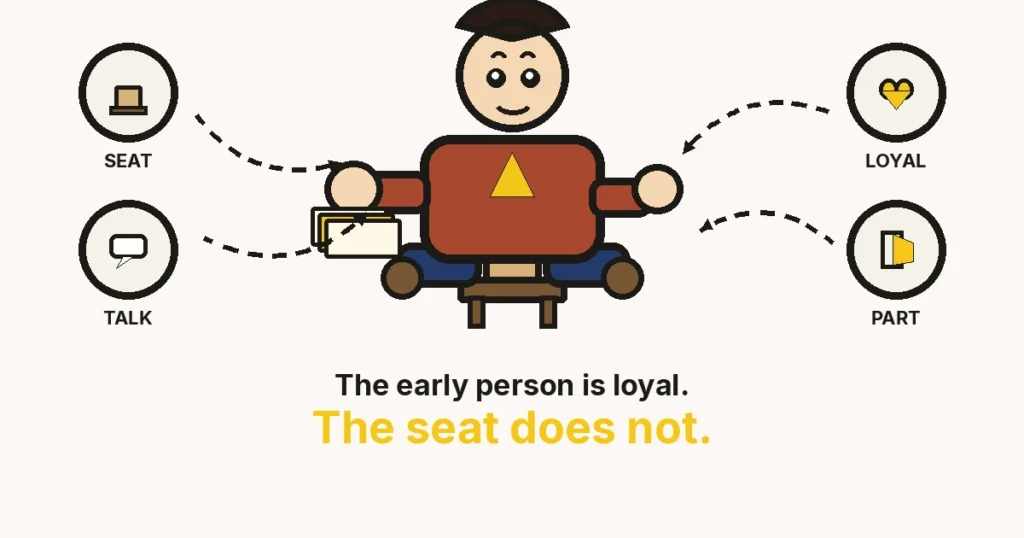
The seat no longer fits when loyalty keeps an early person in a role the work has outgrown. Elad Gil’s chapter on old-timer syndrome says to name the mismatch, say it this week, and refuse a quieter corner. Write the seat, the mismatch, and the sentence before you move them.
Key takeaways
- The seat no longer fits when loyalty keeps an early person in a role the work has outgrown.
- Elad Gil, in the 17 July 2018 note that High Growth Handbook was on sale from Stripe Press, says startup advice has to be filtered through the company in front of you.
- Gil’s old-timer chapter, read on 18 November 2026, says to identify the mismatch, put the owed feeling aside long enough to see it, and discuss it with the person.
- Gil writes that a search for a place where an early employee will do little harm is, in his judgement, a reason to part ways with grace.
- The four-line seat check is this page’s application for a solo founder or a new manager. The print book was not opened, so no page number is given, and no ISBN was checked.
What a seat that no longer fits is
The seat no longer fits when the work has changed and the early person is still in the old shape of the job, held there by loyalty. You are a solo founder. The first person still has the title from the month you were two people. The file they touch comes back unfinished, or blocked, because they still expect a say in every decision. You feel the debt. They stayed when the money was thin. So you add a side project with their name on it and route the real work around them. You are a new manager who inherited that person. The founder still has lunch with them, and you rewrite the stuck file at night.
The seat is the work. A title can stay flattering while the work moves. Gil writes about early employees at companies that are scaling. Some become more valuable as the company grows. Some stay in a seat the work has outgrown because of what they gave at the start. This page is that second case, for a founder or a new manager who can point to one person and one seat. The debt is real. It is not a job description.
This page starts after the person has been here. The first hire, when you do not know what to give them, is the week you choose the first scope. A first week with no shape is the five days after they arrive. Two people on the same task is an owner line. Here there is one person, and the work in the seat has changed.
What the chapter says
Gil’s chapter says some early employees scale with the company, and some should change roles, quit, or be managed out, and the founder should not park the second group in a quieter corner. The book is High Growth Handbook, by Elad Gil. The copy read on 18 November 2026 is the chapter “Old-timer syndrome & early employees” on the official HTML edition at growth.eladgil.com. The chapter page does not state a publication year or an ISBN. The print book was not opened, so this page gives no page number.
His note of 17 July 2018, read the same day, says the book was then on sale and that Stripe Press was the publisher. He describes it as his experience with companies after product-market fit, scaling from a handful of engineers, and maybe a business person or a designer, to multi-hundred or multi-thousand person organizations. The Stripe Press page opened the same day uses the subtitle Scaling Startups from 10 to 10,000 People. A two-person studio sits at the edge of that range. The filter in the same note is the one this page keeps: pass the advice through the company in front of you. He calls the lack of good generic startup advice the only good generic line.
The chapter opens on the early people who last. Some of the most valuable long-term employees, he writes, join early, with the founders’ trust, the culture, and the mission. The ones who scale carry that mindset into a team, know how the company actually runs, and can challenge a rule or explain it. Many lack deep functional experience. The CEO’s trust lets them hire and learn from people who have it. His sentence for the humble ones is specific: early employees who are humble enough to realize they can learn from fresh blood can grow with the company and use it as a personal platform for their own learning and impact. A common sign, he writes, is that they accept a smaller role and less influence for a while, and expect the scope to grow again as they learn.
Some early employees, he writes, overstay. The causes he names are getting too rich and losing hunger, failing to scale skill and mindset, or clinging to the daily lunch with the CEO and a say in every decision. The moves he names are a different role, a resignation, or being managed out. The temptation is the one this page is for: more chances, or a move to a spot that is less important, where they are not very productive. He says that usually means the fit is already poor. Often the person would be happier gone, and stays from loyalty.
He gives three steps. Identify the problem and whether it is solvable. The five shapes are a list, not a score. Then put the owed feeling aside long enough to see the problem. A founder feels the debt, hears issues, and defers them. He says that harms everyone, including the early employee, and that you should understand the situation and act. Then address it head on. Discuss it. Sometimes the frank conversation turns it around. A fundamental mismatch between the role and the skills should move them to a place of good fit. That move may be a demotion, and they may leave. Say why, and ask whether they will thrive. He adds that an early employee is often a large equity holder. Then the test. If you are looking for a place they will do little harm, rather than a place they will excel, he writes that 99% of the time the right answer is to part ways, with grace. They may be relieved.
| What you can point to | His name for it | What you do this week |
|---|---|---|
| They fight a change the work now needs: a new kind of client, a written process, or the end of an offer you have outgrown | Does not evolve with the company | Name the change. Ask whether they can make it inside this seat. |
| They are the first person in a function, and they want the senior title while the skills for that title are missing | Cannot scale into the role they want | Write the work the seat must do. Leave the future vice-president title off this week’s page. |
| At a larger team they have lost the daily say they had, and they block work or take it around the person who owns it | Feeling left out | The sentence names the block. Loyalty does not bring back the everyday lunch. |
| An old title still moves people, while the seat no longer owns the decision | Inappropriate exertion of power | Name the seat that decides. The old title is a fact about the past. |
| Secondary sales and a cash position large enough to distract, in his words tens of millions | Getting too rich | Leave this row in the chapter unless that is your fact. A studio does not borrow it. |
The seat check
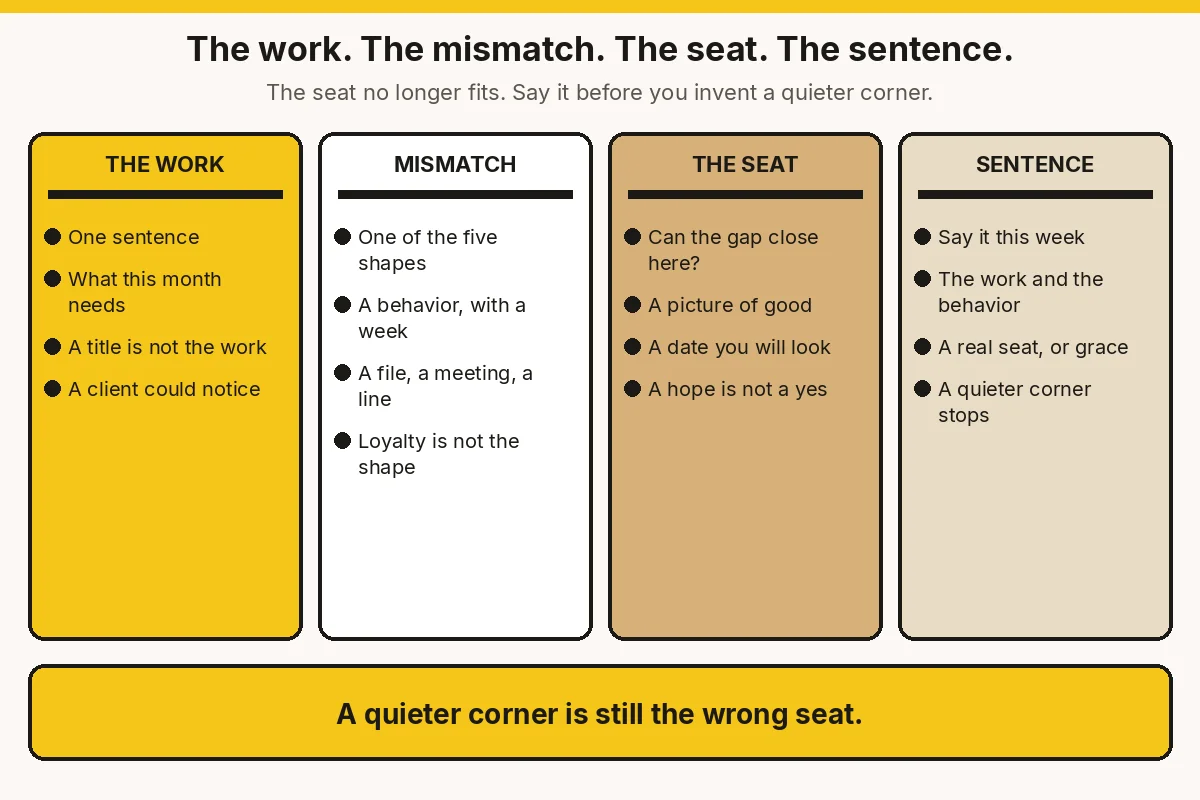
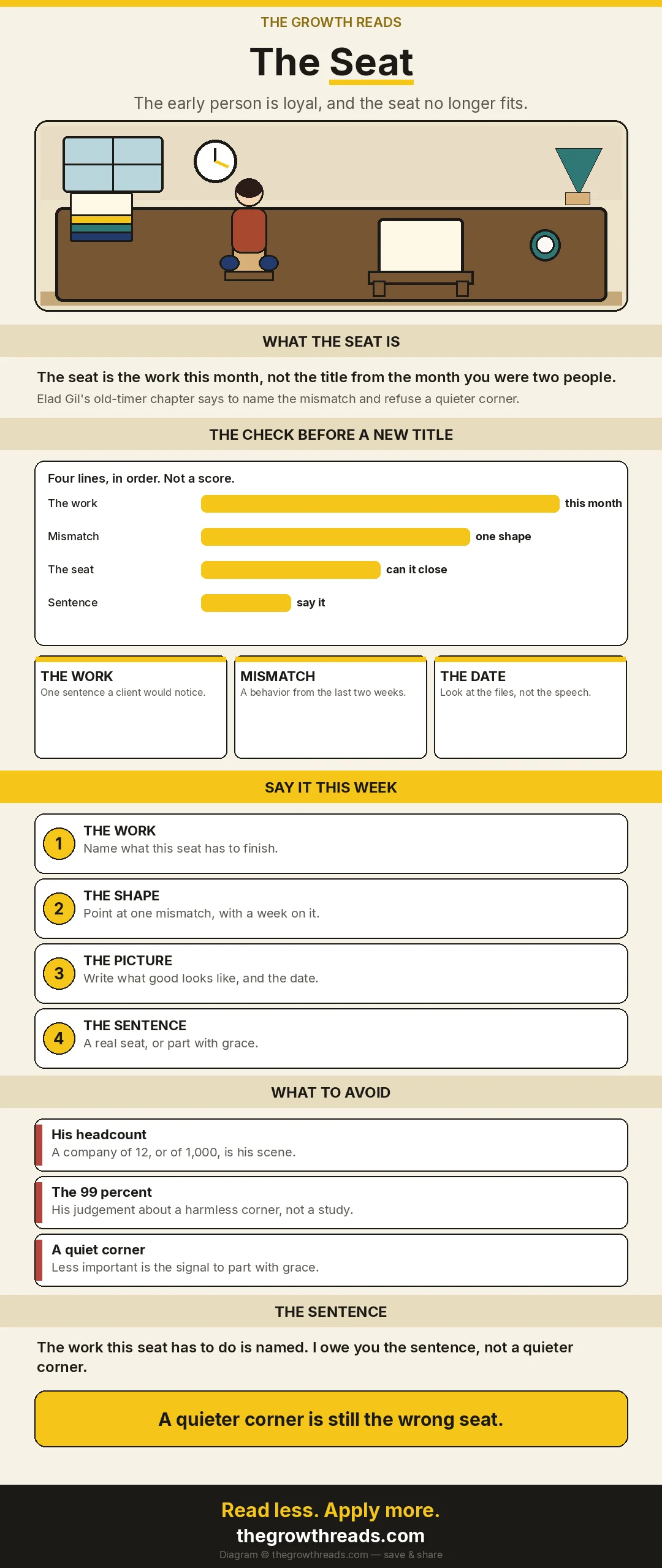
Write four lines before you invent a new title for them. The lines are this page’s application. They are not a form in the chapter. The chapter gives the order: name the mismatch, see it without the debt in the way, say it, and refuse a corner whose purpose is that they do little harm. The check is how a founder or a new manager keeps that order on a Tuesday.
1. The work. One sentence. What this seat has to finish in the next month. A title is not this line. “Head of delivery” is a title. “The three open client files leave here finished, without me rewriting them” is the work.
2. The mismatch. One of the five shapes, tied to something that happened in the last two weeks. If you cannot point at a file, a meeting, or a sentence they sent, you do not have this week’s version of the problem.
3. The seat. Can the gap close inside this seat? If yes, write what good looks like and the date you will look. If the role and the skills do not match, say so in the next line. A hope is not a yes.
4. The sentence. The words below, said to the person this week. If the sentence in your mouth is “we’ll find you something quieter,” you are already on the corner test, and the fourth line should say that.
Read the four lines aloud. The work line should be something a client would notice if it slipped. The mismatch line should be a behavior from the last two weeks. His company of 12, the title carried from 10 people to 1,000, and the cash-out in the tens of millions stay in the chapter. They are his scenes. One person and three files still get the sentence.
The sentence you say
Say the sentence to the person before you redraw the org chart. The brackets are the lines you already wrote. A 1:1 that is only a status recital will not carry this. Put it on the agenda as the decision, or make a separate half hour. Answering before they finish is a different failure. Let them describe the last two weeks before you read the sentence. Then read it.
The work this seat has to do now is [the work]. What I see, from the last two weeks, is [the behavior]. I owe you the sentence, not a quieter corner. If we can close it in this seat, good looks like [the picture] by [the date]. If the seat and the skills do not match, we name a seat where you can excel, or we part on purpose and with grace.
Three replies follow. Only one of them keeps the person in the same seat.
- They take the picture and the date. The seat stays theirs. You look on the date, at the work line, not at how loyal the month felt. The chapter says a frank conversation sometimes turns the issues around. The date is how you know whether this was that time.
- The skills and the seat do not match. You name the other seat in the same conversation, including that it may be smaller. He says a move to a real fit may be a demotion and the person may leave, and that you should say so and ask whether they will thrive there. Leaving is an allowed answer. So is a smaller seat they can actually do.
- You hear yourself designing a corner. Stop the design. The next section is that case. Do not soften the sentence into “special projects” on the way out of the room.
Keep the sentence on the work and the seat. Feedback that turns into a personality comment is a different page, and it is how this conversation goes wrong. “You are not a strategic person” is a verdict. “The three files came back unfinished, and this seat has to finish them” is the mismatch. Gil’s list is behaviors and role fit. It is not a character type.
When the conversation turns it around
The seat can stay theirs when they can learn the work and they accept that their say may shrink for a while. That is his picture of an early person who scales. They learn from someone who knows the function, and they accept a smaller voice in the short term. On a team of three, that someone may be a specialist you both respect, or a written example you both treat as the standard. His headcount is not a ticket you have to punch first.
Write the picture of good in the same nouns as the work line. “Be more senior” is a wish. “The client file goes out with the open questions listed and a date on each, and I do not rewrite it” is a picture. On the date, look at the files. If they match, stop designing an exit.
A new manager still brings one behavior and the work line. His second step is written to the founder who feels the debt and defers. If that founder is the one deferring, the sentence you owe them has the same shape: the work, the behavior, the date. A nod that brings the work back as a different job is what happens when the picture was never restated. Ask them to say the picture back before the half hour ends.
When you are hunting for a quieter corner
A corner whose purpose is that they do little harm is his signal to part ways, with grace. If the seat you are designing has “less important” as its reason, you are in the case he marks with 99%. That figure is his judgement, not a study and not a quota. Use the feeling. Skip the percentage. They may be relieved, because loyalty was what kept them.
Grace, in the words he gives, is a clean release so they are free to do something new. On this page that is a date, a short account of the work that changed, and a reference that matches what they did. Skip the fictional title. He says an early employee at his scale is often a large equity holder. If your person has no equity, skip that sentence. Do not invent a stake.
The kind version of the corner is a research project, a title with no files, or a channel nobody needs. He says the deferral makes a bad environment, including for them. Work that waits on you gets worse when the real files return to your desk. A week that still depends on your hours is the capacity cut after this one. Parting, or a real smaller seat, is what gives the hours back.
When you do not have this person
If nobody early is in a seat the work has outgrown, this page waits. A solo founder with no other person has no seat to check. A plan for the vice president you might hire when you are bigger is a future system. A problem you do not have yet is that plan. Park it. The chapter’s warning about a first marketer who should not be the long-term vice president, and a first engineer who should not be the CTO, is about a role someone already wants or already holds. It is not an instruction to design the executive team on an empty Tuesday.
A person in their first week is on the week-one pages, not this one. You do not have two weeks of behavior to point at, and loyalty has not had time to become the reason you stay silent. Run the first-week scope. Come back if, later, the work changes and the old shape of the job is still where they sit.
His 2018 footnote is the altitude check. He joined Google at around 1,500 people and left at 15,000. He sold MixerLabs to Twitter when Twitter was about 90 people and left Twitter at around 1,500. Those are his posts. They sit behind scenes such as a company of 12 at lunch and a CTO title still in use at 1,000 people with no reports. Your client files are a different room. Use the order. Leave his headcount in the note.
Common mistakes
The mistakes borrow his scenes, or skip the sentence.
- Treating 99% as a finding. The figure is his judgement for the moment you are hunting a harmless corner. It is not a rate you can expect, and it is not a reason to skip the conversation that might turn the work around.
- Importing the 1,000-person title. A CTO title with no reports, at a company of 1,000, is his example. A founder and one contractor do not need that story to name three unfinished files.
- Borrowing “getting too rich.” Secondary sales and tens of millions are his fifth shape. Unless that is your fact, the row stays in the chapter.
- Making it a personality. The sentence names a behavior and a seat. A label about the kind of person they are belongs on the feedback page, where it does the damage.
- Using a nod as the picture of good. If they leave the room without restating the work and the date, the files come back as a different job. The backbrief is the close of the half hour.
- Designing the future executive team. The first-marketer and first-engineer lines are about a role already in play. A chart for a company you do not have is the future-problem page.
- Calling loyalty the job. The chapter praises early people who scale, and it tells the founder to release the ones who are staying out of obligation. Gratitude can be said out loud. It does not fill in the work line.
What the source does and does not say
The chapter gives the split between early people who scale and early people who should move, the five shapes, the three steps, and the harmless-corner test. The four-line seat check is this page’s. The HTML chapter was read in full on 18 November 2026. The 17 July 2018 note and the Stripe Press title line were read the same day. The other chapters were not used. The print edition was not opened.
| Source | What was read | What this page uses | What this page leaves in the source |
|---|---|---|---|
| Elad Gil, High Growth Handbook. Chapter “Old-timer syndrome & early employees,” official HTML edition. His note “High Growth Handbook! LIVE!”, 17 July 2018. Stripe Press title line, opened the same day. | The chapter in full. The 2018 note in full, including the scale of the companies he worked with, the Stripe Press sentence, the context filter, and the footnote about Google and Twitter. The publisher title and subtitle on the Stripe Press page. | Early people can be the most valuable, when they learn and accept a smaller say for a while. The temptation to park someone in a less important seat. The five shapes. The three steps. A frank talk can turn it around. A real mismatch moves them to a seat where they excel, which may be smaller, and they may leave. A harmless corner means part with grace. Filter the advice through the company you actually have. | Any ISBN. Any print page. The 99% as a measured rate. Equity advice where there is no equity. His scenes of scale, kept as his scenes. The four-line check and the sentence, which are this page’s application. |
He is writing to a founder scaling into the hundreds and beyond. The 2018 note says to filter the advice through your own situation. The seat check is our application for a founder with an early person, or a new manager who inherited one. People who can learn, and who can accept a smaller say for a while, stay in the seat.
Frequently asked questions
What does it mean that the seat no longer fits?
The seat no longer fits when an early person is still in a role the work has outgrown, and loyalty is why you have not said so. Elad Gil’s chapter on old-timer syndrome, read in full on the official HTML edition of High Growth Handbook on 18 November 2026, splits early employees who scale from early employees who should change roles, quit, or be managed out. This page is the second group, for a solo founder or a new manager with one person. The seat check names the work, the mismatch, whether the seat can still hold it, and the sentence you say this week.
What does High Growth Handbook say about an early person who does not scale?
Gil says some early employees overstay, from money, from a skill set that did not grow, or from clinging to the time they had a say in every decision. Identify whether the problem is solvable, put the owed feeling aside long enough to see it, and discuss it with the person. A frank conversation sometimes turns it around. A mismatch between the role and the skills should move them to a place they will excel. His 17 July 2018 note says the book is from Stripe Press, and that you should filter the advice through your own company.
What mismatches does the chapter name?
The chapter names five shapes. The person fights changes the company needs. They cannot scale into the role they want. A first marketer may not be the long-term vice president. A first engineer may not be the CTO. They feel left out as the daily say disappears, and they block work or escalate around the owner. An old title still pushes the company. His example is a CTO title carried from 10 people to 1,000, with no reports. Or they get rich enough, in his words tens of millions, to lose hunger. Leave that last shape in the chapter unless it is your fact.
What sentence do you say this week?
Say the work the seat has to do, the behavior from the last two weeks, and that you owe them the sentence rather than a quieter corner. If the gap can close in the seat, say what good looks like and the date you will look. If the seat and the skills do not match, name a seat where they can excel, or part on purpose and with grace. Let them describe the fortnight before you read it. Ask them to restate the work and the date. The sentence is this page’s application. It is not printed in the chapter.
When does the frank conversation fix it?
Gil says the issues are sometimes addressable and the frank conversation turns things around. The sign he gives for an early person who will scale is humility about learning from people with more functional experience, and acceptance that their role and influence may shrink for a while and grow again as they learn. On a small team that learning may be a written standard or a specialist you both respect. Write the picture of good in files and dates. On the date, look at the files. If they match, keep the seat and stop designing an exit. A speech about loyalty is not the picture of good.
What is the quieter-corner test?
Gil says leaders try to find a place an early employee will do little harm, instead of a place they will excel. If you are thinking that way, he writes that 99% of the time the right answer is to part ways, with grace, and that the person may be relieved. The 99% is his judgement in the chapter, not a study. The usable test is the feeling. A seat whose reason is “less important” has already answered the question. Parting with grace, here, is a date, a plain account of the work, and a reference that matches what they did.
Does this apply to a two-person company?
His 17 July 2018 note says the book comes from companies scaling from a handful of people to hundreds or thousands. The Stripe Press subtitle is scaling from 10 to 10,000. He writes that advice has to pass through your own situation, and that there is no good generic startup advice. A founder with one early person can still use the order: name the work, name the behavior, say it, and refuse a harmless corner. His scenes include a company of 12, a title at 1,000 people, and tens of millions. If you have no early person yet, this page waits.
Did this page use a print page or an ISBN?
No. The text read on 18 November 2026 is the official HTML chapter “Old-timer syndrome & early employees,” in full. That page states no publication year and no ISBN. The print book was not opened, so no page number is given. The edition note is his post of 17 July 2018, which says the book was on sale and that Stripe Press was the publisher. The four-line seat check and the sentence are our application. They are not a measured claim about how often a small team parts ways.
Sources
- Elad Gil. High Growth Handbook. Chapter “Old-timer syndrome & early employees.” Official HTML edition, read in full on 18 November 2026 from growth.eladgil.com/book/recruiting/old-timer-syndrome-early-employees/. The chapter page states no publication year and no ISBN. The print book was not opened. No page number was taken. The four-line seat check is not in the chapter.
- Elad Gil. “High Growth Handbook! LIVE!” 17 July 2018. Read 18 November 2026 from blog.eladgil.com/p/high-growth-handbook-live_38. He says the book was then on sale, that Stripe Press is the publisher, that the book draws on companies scaling from a handful of people to multi-hundred or multi-thousand person organizations, and that startup advice has to be filtered through your own situation. The footnote states his Google and Twitter headcounts. The Stripe Press title line, opened the same day at press.stripe.com/high-growth-handbook, gives the subtitle Scaling Startups from 10 to 10,000 People.
Related reading on The Growth Reads
- The first hire, when you do not yet know what to give them — the scope, before loyalty has a history
- You are the bottleneck — the files that still wait on your decision
- Feedback that turns into a personality comment — keep the sentence on the behavior
- A problem you do not have yet — the executive chart for a team that is not here
- The Effective Manager summary — a 1:1 that ends in one decision
- The One Minute Manager Meets the Monkey summary — one owner, when two people think the task is theirs
- The Art of Action summary — the backbrief, so the picture of good survives the room
- The Great CEO Within summary — a wider operating picture when this one seat is not the issue
- Productivity — the cluster this article sits in
- How we review — what a checked chapter is, and what an unread page is not
How this was checked
Who it is for. A solo founder or a new manager whose early person is still in a seat the work has outgrown, and whose loyalty is the reason the sentence has not been said.
What was read. Elad Gil, High Growth Handbook, the chapter “Old-timer syndrome & early employees” on the official HTML edition, in full, on 18 November 2026. His note “High Growth Handbook! LIVE!”, dated 17 July 2018, in full, the same day. The Stripe Press title line for the book, the same day.
What was not read. The other chapters. The print edition. No ISBN, because the chapter page does not print one and no print copy was checked. No page number, because the HTML chapter does not provide one.
Limit. The four-line seat check, the sentence, and the three replies are our application. Gil’s 99% is his judgement about the harmless corner, not a study. His scenes of scale stay his scenes. Early people who can learn, and who can accept a smaller say for a while, stay in the seat.
How we work: every article on The Growth Reads is built from books we have read and from primary accounts we can check, and it is date-stamped when those sources change. Read our methodology.