


The first hire’s week one has no shape when Monday is a tour and Friday is a surprise. Write the five days before they start: two days beside the work, one outcome they finish, and a Friday review. Bradt, Check, and Pedraza name day one and the first week before the job begins.
Key takeaways
- The first hire’s week one has no shape when the first morning is a tour of the tools and the last afternoon is whatever is left on your list.
- George Bradt’s Forbes article of 10 January 2020 tells a new leader to draft a plan before day one that lays out setup, relationships, learning, and the work through day one and the first 100 days.
- A PrimeGenesis note of 15 June 2011, which says its sample is straight out of the third edition of The New Leader’s 100-Day Action Plan, names a day one and a first week before the start.
- That sample first week belongs to a fictional marketing head: review the base plans, meet each marketing person, and sit with the agencies. It is a department week.
- The five-day checklist on this page, shadow then one outcome then a Friday review, is this article’s application. It is not a sentence from the Wiley edition.
What a week with no shape actually is
The first hire’s week one has no shape when they arrive to a tour and leave on Friday still asking what they were supposed to finish. You are a solo founder, so this person is the first one who will do the work beside you. You are a new manager, so this person is new to the work, even if the team is not. Monday you show the logins, the folder, and the way you like things named. Then you say they should jump in. By Wednesday they are waiting for you, because jump in has no finish line. Friday you ask how the week felt. They are polite. The pile you meant to hand over is still yours.
George Bradt’s article “The Stages of Onboarding Into a New Job,” published on Forbes on 10 January 2020, puts the plan before the first morning. In the stretch between acceptance and the start, he tells the new leader to draft a 100-day plan: map the stakeholders, think through the message, and lay out a timeline for getting set up, jump-starting relationships, learning, and working through day one and the first 100 days. After the start, the same article says to manage the entry and the message according to that plan, and to invest in early wins to build the team’s confidence. A first hire who has no plan is the opposite of that timeline. The learning is a tour. The early win is unnamed. Friday is a feeling, not a review.
The book behind that article is The New Leader’s 100-Day Action Plan, third edition, by George B. Bradt, Jayme A. Check, and Jorge E. Pedraza, Wiley, October 2011, as the O’Reilly record lists it. This article opened that record’s contents and the publisher overview. It did not open a numbered page. The contents include a chapter called “Embrace and Leverage the Fuzzy Front End before Day One,” a chapter called “Take Control of Day One,” a chapter called “Overinvest in Early Wins to Build Team Confidence by Day 60,” and an appendix of sample 100-day plans. The overview says the third edition explains why the new job does not start on day one, and starts on the day the offer is accepted, and how to use the time before day one. That is the support for writing the week before they arrive. The five days below are the small-company version of that instruction. They are not a quotation.
What the 100-day plan actually names
The only day-by-day week this article can point to is a fictional marketing head’s week, and the author says it is taken straight from the third edition. On 15 June 2011 George Bradt published “The New Leader’s Journal: 100-Day Action Plan” on PrimeGenesis. The narrator is a character he says he invented, starting as head of marketing. The note says the plan is straight out of The New Leader’s 100-Day Action Plan, and that the journal is a fictional exercise illustrating the prescriptions in the third edition, then expected on 10 October 2011. The O’Reilly record dates that edition to October 2011. This article reports both dates and does not invent a single publication day.
The sample names the days. Day one, in that note, is orange juice with the full team, a new-manager assimilation, and in-store visits. The first week is a review of the base plans, one-to-ones with all the marketing people, and agency orientations. Later blocks in the same note are a burning imperative by day 30, milestones by day 45, early-win plans by day 60, and team roles by day 70. Those later blocks are the book’s longer clock, as the note presents them. They are not a reason to leave week one blank.
A solo founder does not have a marketing department, an agency, or a store to walk. A new manager hiring one person into a small team does not have “all the marketing people.” Copying the sample line for line would invent a department you do not have. The fact you can use is narrower, and it is in the note: day one is a list of events, and the first week is a list of work, and both lists exist before the start date. The 2020 Forbes article says the same thing in plainer language. Learning and working through day one belong on a timeline you draft before they walk in.
| The week | A tour | A written shape |
|---|---|---|
| Monday | Logins, a folder, and “jump in.” | They watch one live piece of work while you do it. |
| Wednesday | They wait, because help has no finish. | They start the one outcome you named before they arrived. |
| Friday | “How was the week?” | Fifteen minutes. Did it finish. What they left alone. What they need. |
| Who holds it | Both of you, vaguely, so it stays on you. | You do the work they watch. They own the one outcome. |
The 2020 article also says that nearly half of new leaders fail in their first 18 months, and that the failures often come from mistakes at the beginning. The page does not name a study, a sample, or a year for that half. This article does not use the number as a finding. A shaped week is a practical decision. It is not evidence that your hire will stay.
The five days
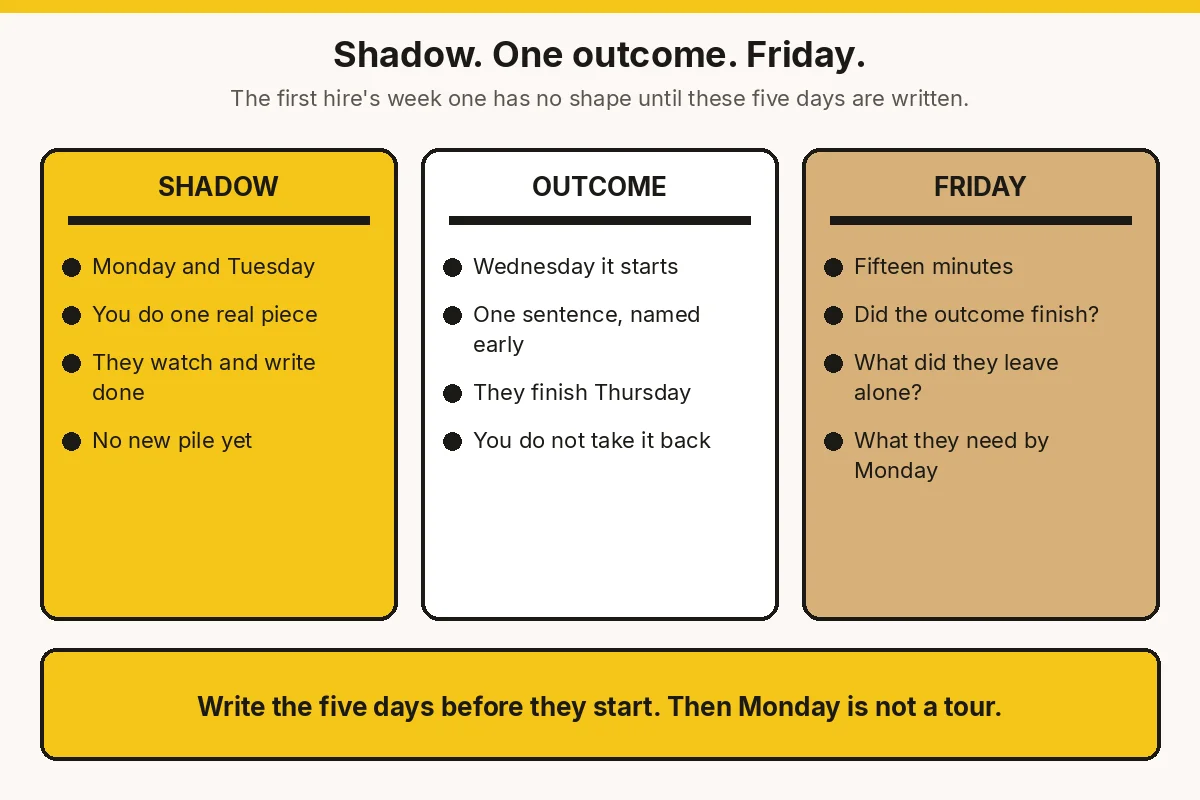
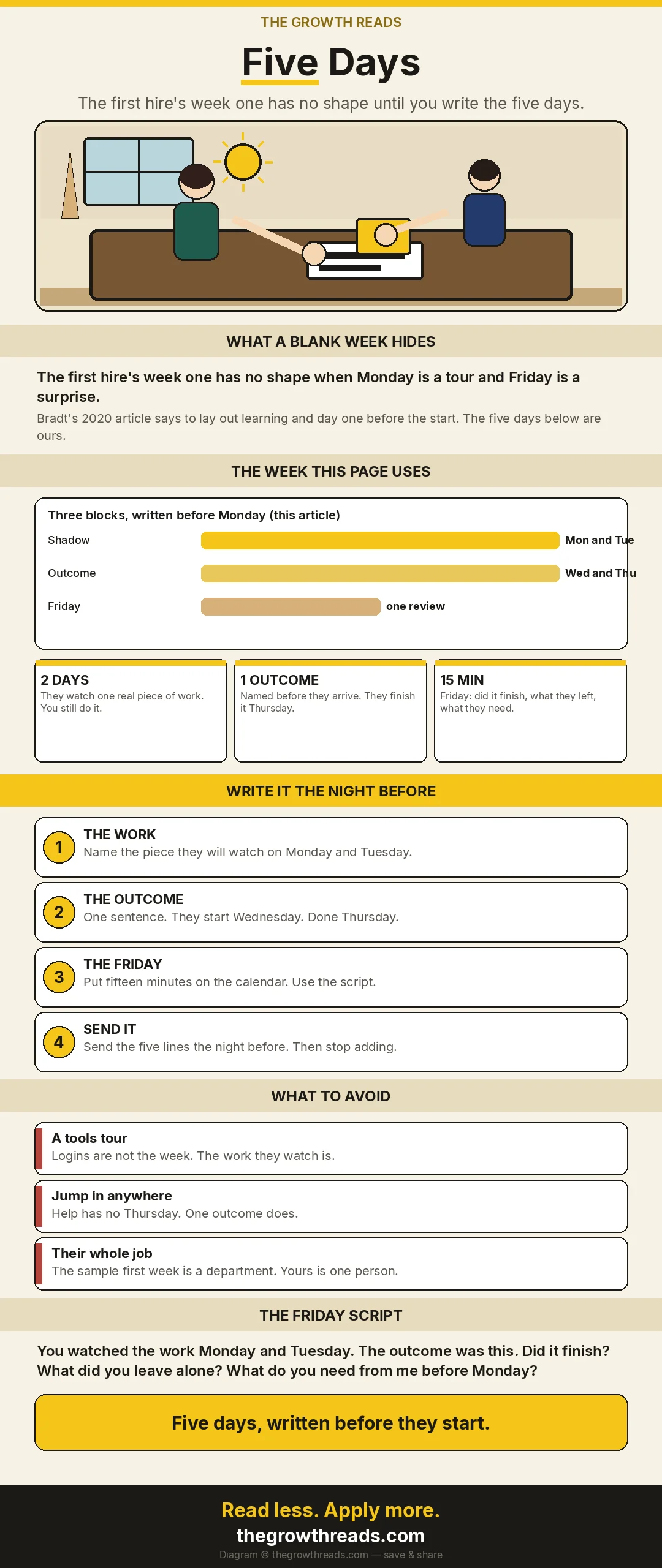
Write five days the night before they start, and send them. Monday and Tuesday are shadow. You do one real piece of the work, the piece a customer or the team will actually see, and they sit where they can watch the decisions. They write what “done” looked like, in their words, before lunch on Tuesday. You do not hand them a second project to prove they are useful. Wednesday the first outcome starts. It is one sentence you wrote before they arrived, small enough to finish on Thursday, and it is a piece of the work they just watched. Thursday they finish it. If you take it back at lunch, the week collapses into the tour again. Friday is the review, on the calendar, for fifteen minutes.
Shadow is the learning Bradt tells a new leader to put on the timeline. The outcome is the early win his 2020 article says to invest in, shrunk to a size one new person can finish in two days. The book’s contents put “overinvest in early wins” at day 60 for a leader taking charge of a team. A first hire is not that leader. Waiting until day 60 to let them finish anything leaves you as the bottleneck for two months. One finished piece in week one is this article’s scale. It is not a claim that the chapter says “finish by Thursday.”
- Monday. You do the work. They watch. They write the steps and what done looked like. No new assignment.
- Tuesday. Same work, or the next slice of it. They say the steps back. You correct the sentence, not their personality.
- Wednesday. They start the one outcome. You stay available for one question at a time you named, and you stay out of the task.
- Thursday. They finish it. You do not redo it in the evening unless it would hurt a customer. If it would, you say so on Friday and you keep the next outcome smaller.
- Friday. The script below. Then one outcome for next week, written in a sentence before you stand up.
Paperwork still happens. A right-to-work check, a contract, payroll, and access to the tools are real, and they are not this article. Do them before Monday or on Monday morning, in a block you have already scheduled, and then start the shadow. A login is not the shape of the week.
The Friday review, in their words and yours
Say five lines, then stop. The 2011 sample does not print this script. The 2020 article does not print it. The lines are the review this week needs so Friday does not turn into a status recital. You can read them. They can answer. You do not add a second pile in the same fifteen minutes.
You: You watched [the piece of work] on Monday and Tuesday.
You: The outcome was [one sentence]. Did it finish?
Them: Yes, or no, and what is left.
You: What did you leave alone?
You: What do you need from me before Monday?
Then you write next week’s one outcome on the same note, and you send it. If they say the outcome did not finish, the next sentence is a smaller outcome, or the same one with a Thursday that is real. It is not a speech about hunger or fit. If the thing they need from you is a decision only you can make, that decision is the answer to the last line. It is not a reason to take the work back.
Put the fifteen minutes on the calendar when you send the five days, so Friday is not the leftover slot after the client call. If you are a solo founder, this is the meeting with the one person who does the work with you. If you are a new manager, this is with the person who is new to the work. A team that already knows the job does not need this script. They need the owner line, below, when two of them think Monday belongs to both.
When you already named three outcomes
Three outcomes are the scope. These five days are the calendar the first outcome sits on. If you already wrote what they will finish, what you will not assign, and a check-in, that page is the first hire’s week-one scope. Keep it. Put the first of those three outcomes on Wednesday of this week. Leave the other two for later weeks. Shadow is not a fourth outcome and it is not “help.” It is you doing one real piece while they watch, so the outcome on Wednesday is a piece they have seen finished once.
Do not reopen the scope conversation on Friday. The Friday script asks whether the one outcome finished. It does not renegotiate the price, who stays, or the promise you already signed. Those stayed on your list when you wrote the scope. If the work they watched is the wrong work, change next week’s sentence. Do not fill Friday with a new job description.
When two people own Monday
Name who does the work and who watches, or Monday belongs to both of you and therefore to you. Shadow fails in a specific way. You sit down to do the piece, they sit down to do it too, and by noon you are both editing the same file. That is the problem on two people thinking they own the same task. For these two days, you own the work they are watching. They own the notes, and from Wednesday they own the one outcome. A helper who also “just finishes it” has taken the week off its shape.
Say it on Sunday night, in the same note as the five days. “Monday and Tuesday I do [the piece]. You watch and write what done looks like. Wednesday you start [the outcome]. I will not take it back on Thursday.” If a teammate also thinks they own that outcome, one name goes on it before Wednesday. The watcher from Monday is not a second owner.
When they already know the work
Use this five-day list for a person who is new to the work. Use the book’s first-week list when the people already do the job. A new manager who inherits a team does not ask a three-year specialist to shadow a task they have finished a hundred times. The 2011 sample is closer to that situation: review the plans that already exist, and sit one-to-one with the people who already do the work. The 2020 article’s after-the-start list points the same way. Get agreement on the one burning imperative. Use milestones. Invest in an early win. Put people in roles. Keep communicating. Those are the moves for a team that is already here.
A contractor who will sit beside you for the month can use the five days if the work is new to them. A contractor hired for one deliverable they already know how to do gets that deliverable as the outcome, a single example to watch if they ask for one, and the Friday script. They do not get a culture week. If you are still the person every task waits on, the prior cut is what you still decide and what you hand off. This week hands off one outcome, not the company.
Common mistakes
- A tools tour that fills Monday. Access matters, and it is a block, not the week. The shape is the work they watch and the outcome they finish.
- “Jump in wherever you can.” Help has no Thursday. One sentence does.
- Giving them the whole job because you are tired. The 2011 sample first week is a department head’s week. Yours is one person and one outcome.
- Taking the outcome back on Thursday night. If a customer would be hurt, say so on Friday and shrink the next one. Quietly redoing it teaches them to wait.
- A Friday that becomes a status recital. Five lines, then stop. A longer meeting that only reports the week is the meeting you already know how to replace with a decision.
- Treating the fictional week as your script. Orange juice with a full team and an agency orientation are in the 2011 note. They are not your Monday.
- Quoting “nearly half fail” as research. Bradt writes that sentence on the 2020 page. The page names no study and no sample. Leave the number out of the note you send.
What the sources do and do not say
The sources say to plan day one and the first week before the start, and they show one sample week for a marketing head. They do not show this five-day shadow.
| Source | What it is | What we took | What it does not show |
|---|---|---|---|
| Bradt, Forbes, 10 January 2020. “The Stages of Onboarding Into a New Job.” Read in full. | The author’s article. Four ideas across five stages of onboarding. Not a study. | Draft a 100-day plan before day one: stakeholders, message, and a timeline for setup, relationships, learning, and working through day one. After the start: manage the entry per the plan, one burning imperative, milestones, early wins, roles, communication. | A five-day shadow. A Friday script. A sample for the sentence “nearly half of new leaders fail in their first 18 months.” A page number from the book. |
| Bradt, PrimeGenesis, 15 June 2011. “The New Leader’s Journal.” Read in full. | A fictional exercise. The note says the plan is straight out of the third edition. | Day one: orange juice with the full team, new-manager assimilation, in-store visits. First week: review base plans, one-to-ones with the marketing people, agency orientations. Later: imperative by day 30, milestones by day 45, early wins by day 60, roles by day 70. | A solo founder. One first hire. Permission to skip naming the week. A claim that the narrator is a real executive. The note says the narrator is fictional. |
| O’Reilly record of Bradt, Check, and Pedraza, third edition, Wiley, October 2011. Contents and overview read. URL ends in 9781118097540. No numbered page opened. | A catalogue record of the book, including the chapter list and the publisher overview. | Authors and edition. Chapters on the time before day one, on taking control of day one, and on early wins by day 60. An appendix of sample 100-day plans. The overview’s line that the job starts when the offer is accepted. | Any sentence from inside a chapter. A confirmation of 352 pages. A first-week checklist for a founder’s first hire. |
Limit: a contents list can tell you a chapter exists and still hide what the chapter requires. Where this article describes day one and the first week in concrete events, those events are the 2011 note’s, and the note says they illustrate the third edition. Where this article tells you to shadow for two days and review on Friday, that calendar is ours. Early wins in the contents are aimed at day 60 for a leader. One outcome in week one is a scale choice for a first hire, not a finding that the book measured.
Frequently asked questions
What do you do when the first hire’s week one has no shape?
The first hire’s week one has no shape when Monday is a tour and Friday is a surprise. Write five days before they start. Monday and Tuesday they watch one real piece of work while you do it, and they write what done looked like. Wednesday and Thursday they finish one outcome you named in advance. Friday is fifteen minutes: what they watched, whether the outcome finished, what they left alone, and what they need before Monday. Bradt’s Forbes article of 10 January 2020 says to lay out learning and day one before the start. These five days are this page’s calendar.
How is a shaped week different from three outcomes?
Three outcomes are the scope of the job. The five days are the calendar the first of those outcomes sits on. If you already wrote what they will finish, what you will not assign, and a check-in, keep that page and put outcome one on Wednesday. Leave the other two for later weeks. Shadow is you doing one real piece while they watch, so Wednesday is work they have seen finished once. Friday asks whether that one outcome finished. It does not reopen the price, who stays, or the promise you already signed. Those stayed with you when you wrote the scope.
What goes on each of the five days?
Monday you do one live piece of work and they watch, then write what done looked like. Tuesday they say those steps back and you correct the sentence. Wednesday they start one outcome you named before they arrived, small enough to finish on Thursday. Thursday they finish it, and you do not take it back at lunch. Friday is fifteen minutes on the script, and then one sentence for next week before you stand up. Logins and the contract sit in a block you already scheduled. They are not a substitute for the work they watch.
What do you say in the Friday review?
Use five lines and then stop typing. You watched this piece of work on Monday and Tuesday. The outcome was this one sentence. Did it finish? What did you leave alone? What do you need from me before Monday? If it did not finish, the next sentence is a smaller outcome, or the same one with a Thursday that is real. It is not a speech about hunger or character. If they need a decision only you can make, answer that line. Do not take the work back in the same meeting. The 2011 sample and the 2020 article do not print this script. The lines are ours.
What does the 100-day plan actually show about week one?
The day-by-day text in front of this article is George Bradt’s PrimeGenesis note of 15 June 2011. He says the plan is straight out of the third edition, and that the narrator is fictional. Day one is orange juice with the full team, a new-manager assimilation, and in-store visits. The first week is a review of the base plans, one-to-ones with the marketing people, and agency orientations. That is a department. A founder with one hire does not copy those events. The usable fact is that day one and the first week are named before the start. No numbered page was opened.
What if you are a new manager and the person already knows the job?
Do not ask a specialist who already does the work to shadow it for two days. The 2011 sample is closer to that week: review the plans that already exist, and sit one-to-one with the people who do the work. Bradt’s 2020 article, after the start, points at one burning imperative, milestones, an early win, roles, and ongoing communication. Use the five-day list when the person is new to the work. Use the owner line when two people think Monday belongs to both of them.
What if the first person beside you is a contractor?
Use the five days when the work is new to them and they will be here for a Friday. You do the piece they watch. They finish one outcome by Thursday. A contractor hired for one deliverable they already know gets that deliverable as the outcome, one example if they ask to see it, and the same Friday script. Payroll, the contract, and access still happen in their own block. Access is not the shape of the work. If every task still waits on you, hand off this one outcome and leave the rest for another week.
Should you tell them that half of new leaders fail?
No. George Bradt’s Forbes article of 10 January 2020 says that nearly half of new leaders fail in their first 18 months, and that the failures often start at the beginning. The page does not name a study, a sample, or a source year for that figure. This article does not treat it as a finding, and it does not belong in the note you send on Sunday. Send the five days, the one outcome, and the Friday time. A shaped week is a decision you can keep. It is not proof that the person will stay, and it is not a verdict you deliver on Friday afternoon.
Sources
- Bradt, G. (10 January 2020). “The Stages of Onboarding Into a New Job.” Forbes. Read in full. Used for the five stages, the four ideas, the instruction to draft a 100-day plan before day one (stakeholders, message, setup, relationships, learning, and working through day one), and the after-the-start list: entry and message, one burning imperative, milestones, early wins, roles, and communication. The page’s “nearly half of new leaders fail” sentence is quoted only to say the page gives no sample. It is not used as a finding. Forbes, 10 January 2020.
- Bradt, G. (15 June 2011). “The New Leader’s Journal: 100-Day Action Plan.” PrimeGenesis. Read in full. The note says the plan is straight out of the third edition of The New Leader’s 100-Day Action Plan, then expected on 10 October 2011, and that the narrator is a fictional character. Used for day one (orange juice with the full team, new-manager assimilation, in-store visits), the first week (base plans, one-to-ones with marketing people, agency orientations), and the later blocks at days 30, 45, 60, and 70. PrimeGenesis, 15 June 2011.
- O’Reilly. Record of Bradt, G. B., Check, J. A., and Pedraza, J. E. The New Leader’s 100-Day Action Plan, 3rd edition. Wiley, October 2011. The record’s URL ends in 9781118097540. Contents and publisher overview read on 14 November 2026. No numbered page of the book was opened. Used for the authors, the edition, the chapter titles on the time before day one, day one, and early wins by day 60, the appendix of sample plans, and the overview’s line that the job starts when the offer is accepted. O’Reilly record.
Related reading on The Growth Reads
The decision next to this one
- The first hire’s week-one scope — three outcomes and what you will not assign, before this calendar
- Two people think they own the same task — one name on Monday’s work, and one name on the outcome
- You are the bottleneck — what you still decide, and the one thing you hand off
- The 1:1 is a status recital — Friday is five lines, not a tour of the week
- The meeting should have been a note — send the five days the night before
Where this sits
How this article was researched
The onboarding book is George B. Bradt, Jayme A. Check, and Jorge E. Pedraza, The New Leader’s 100-Day Action Plan, third edition, Wiley, October 2011, as the O’Reilly record lists it. That record’s contents and overview were read. No numbered page was opened, so this article does not invent one. The day-by-day week is the 15 June 2011 PrimeGenesis note, which Bradt says is straight out of that edition and which he labels as fiction. The planning instruction is his Forbes article of 10 January 2020, read in full. The five-day checklist and the Friday script are our application for a solo founder or a new manager whose first person is new to the work.
Limit: a sample week for a marketing head is not a study of first hires, and a contents list is not the chapter. Early wins in the contents are placed at day 60. One outcome in week one is a scale we chose so the founder is not still the bottleneck in month two. The “nearly half fail” sentence on the Forbes page has no sample attached, and it is not used as evidence. Contracts, payroll, and the right to work are outside this note. If the relationship is already unsafe, do not handle it with a Friday script.
How we work: every article on The Growth Reads is built from sources we can check, and it is date-stamped when those sources change. Read our methodology.