

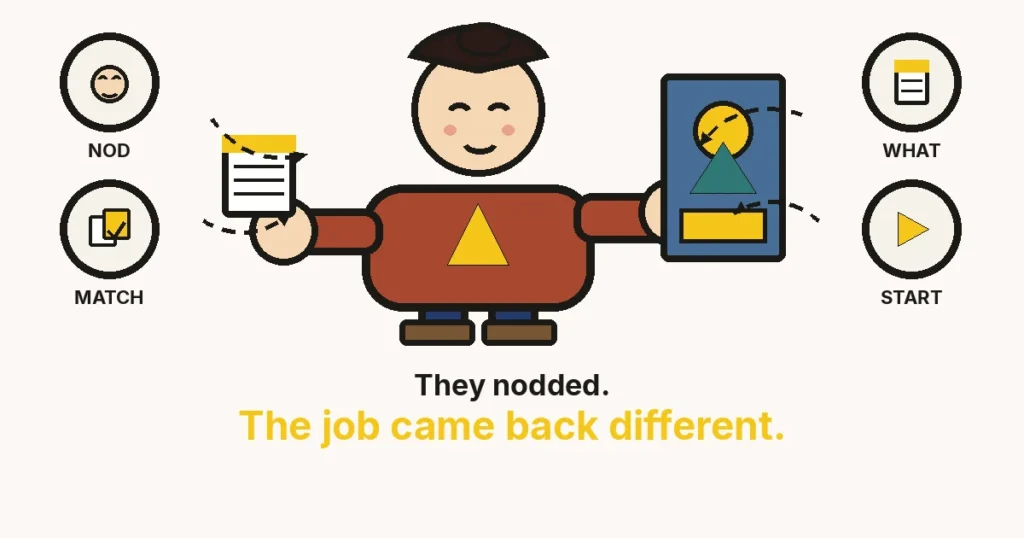
They nodded, and the work came back as a different job, because agreement is not a restatement. Stephen Bungay’s January-February 2011 Harvard Business Review article has the person come back and say how they will tackle the task. Send the what, the why, the main effort, and the boundaries, and wait for that reply before the file opens.
Key takeaways
- They nodded, and the work came back as a different job, when a nod was treated as a restatement of the task.
- Stephen Bungay, in the January-February 2011 Harvard Business Review, names the unanswered question as “What do you want me to do?” and starts the briefing with what a person is expected to do and why.
- Bungay’s 2011 article has the leader ask each person who owns a task to come back and say how the task will be tackled, so the direction is checked before the file becomes the job.
- Bungay writes in that 2011 article that measures are the dashboard and the outcome is the destination, and that a boundary limits the other objectives a team might chase.
- The four-line note — what and why, the main effort, the boundaries, and the day the first piece comes back — is the script for a solo founder or a new manager. No numbered page of The Art of Action was opened.
What the nod actually is
They nodded, and the work came back as a different job, when “sure” was allowed to stand in for the task. You are a solo founder. On the call you said, “Update the proposal so the new price is on the first page and the old scope stays.” The contractor nodded. Three days later the deck is a redesign, the price is in an appendix, and the scope has grown a page you did not sell. You are a new manager. In the hallway you said, “Fix the handoff so the client gets the file we already promised.” The person nodded. The document that comes back is a process for handoffs in general. The promised file is still sitting where it was.
The nod felt like the assignment. It was only the sign that they had heard a sentence. Hearing a sentence and being able to say the job back are different events. The first happens in the room. The second has to be written, in their words, before the file opens. If you skip the second, you will spend the review meeting discovering which job they did.
That is a different problem from a price that was already named and then the work moved. The piece on work that changed after the price is the note for a result that is no longer the result you priced. A nod that produced a different file is the case where the result never got restated, so two people left the room with two jobs and one polite word. It is also different from two people who think they own the same task. Ownership is who may decide. A backbrief is whether the job in their mouth is the job in yours. You can have one owner and still get the wrong file.
What the briefing asks for
Stephen Bungay’s January-February 2011 Harvard Business Review article says the question under a pile of goals is “What do you want me to do?” The piece is “How to Make the Most of Your Company’s Strategy,” reprint R1101L. The byline calls him a director of the Ashridge Strategic Management Centre and the author of The Art of Action: How Leaders Close the Gaps Between Plans, Actions and Results (Nicholas Brealey Publishing, 2011), and it says the article is based on that book. The public article page confirms the issue date and the reprint number. The full text used here is the reprint. No numbered page of the book was opened, and no ISBN was checked.
He calls the method strategy briefing. The article lists five steps: state your intent, meaning what you are expected to do and why; revise that intent in the context of the situation; determine which measures best indicate whether you are achieving the goal; define the tasks implied by the intent; and define the boundaries, or constraints, that limit the team. He illustrates the steps with a fictional manager named Joe, “stitched together” from his own experience as a consultant and a teacher. Joe’s company figures belong to that fiction. They are not a benchmark, and they are not reused below.
In the fiction, Joe has already presented the company goals when a technician asks what they are really trying to achieve. The first answers fail in two familiar ways. “Build a world-class development facility” is an aspiration anyone could have. “Build a new development facility” is only a description of the activity. The statement that survives names a what and a why: accelerate delivery of the critical products, in order to let sales halt a loss of share by year-end. Getting there took several tries. Bungay’s sidebar says a clearly defined intent unifies effort, and that before the statement people were generating a lot of activity. After it, they could see which activity supported the intent and stop the rest.
He also has Joe write the situation before the intent will stick, including what the level above him is trying to do and why, and the level above that. A solo founder does not have a corporate strategy document or two layers of bosses. The part that still transfers is the order. Write the situation in a few lines before you write the what and the why. “The client already bought the shop page at the price in the proposal. The form on that page drops entries. Friday is the date we named.” That is context. “Rebuild the brand” is not. The article’s own warning on measures belongs here too. Joe says the outcome is what the group is trying to optimize, and the measures are the dashboard. “We should not confuse the readings on it with what we really want to do, which is to arrive on time at our destination.” A count of pages redesigned can look like progress while the form still drops entries.
Then he has the group name the tasks the intent implies, and ask which one they would cut last. In the fiction that task is marked “Main effort.” If headcount were cut, people would move onto that task so it would not slip. The last step is boundaries. The sidebar says employees need boundaries in order to adapt when the situation changes, and that this sounds paradoxical. “In my experience, if they’re not given boundaries, people create more rigid ones for themselves.” He distinguishes a boundary from a worry. A worry is something that might go wrong. A boundary “puts limits on possible alternative objectives.” Joe could optimize time. Cost and quality became the limits, not a second and third thing to maximize at the same time. Joe’s own role, in a line the article pulls out, was to manage the team’s boundaries.
| What is in front of you | What it is | What you ask them to write |
|---|---|---|
| A nod, a “sure,” or a thumbs-up | They heard a sentence | The four lines, before the file opens |
| A longer explanation from you | More of your words | Still their restatement, not another paragraph of yours |
| A full list of tasks | Activity with no main effort | The one piece they would cut last |
| A list of worries | What might go wrong | The limit on the other objectives, in Bungay’s sense of a boundary |
The backbrief you send
At the end of the fiction, Joe does not accept the nod. He asks each person leading a task to come back and say how they are going to tackle it. The article’s name for the loop is a back-briefing. Three things happen. The person doing it checks their understanding of the direction. The leader sees what that direction actually implies and may revise it. If the notes come back together, the leader can look for gaps, overlaps, and coherence. Bungay also describes the cascade in one structural line: the task you assign becomes their what, and your what becomes their why. They are not repeating your paragraph. They are saying what they will do in order to serve the result you named.
The article gives Joe until the end of the next week for that conversation, inside a large product group at an off-site. A solo founder and a new manager do not need a week or an off-site. They need the note before the clock on the work starts. The four lines below are our application. They are not a template printed in the 2011 article.
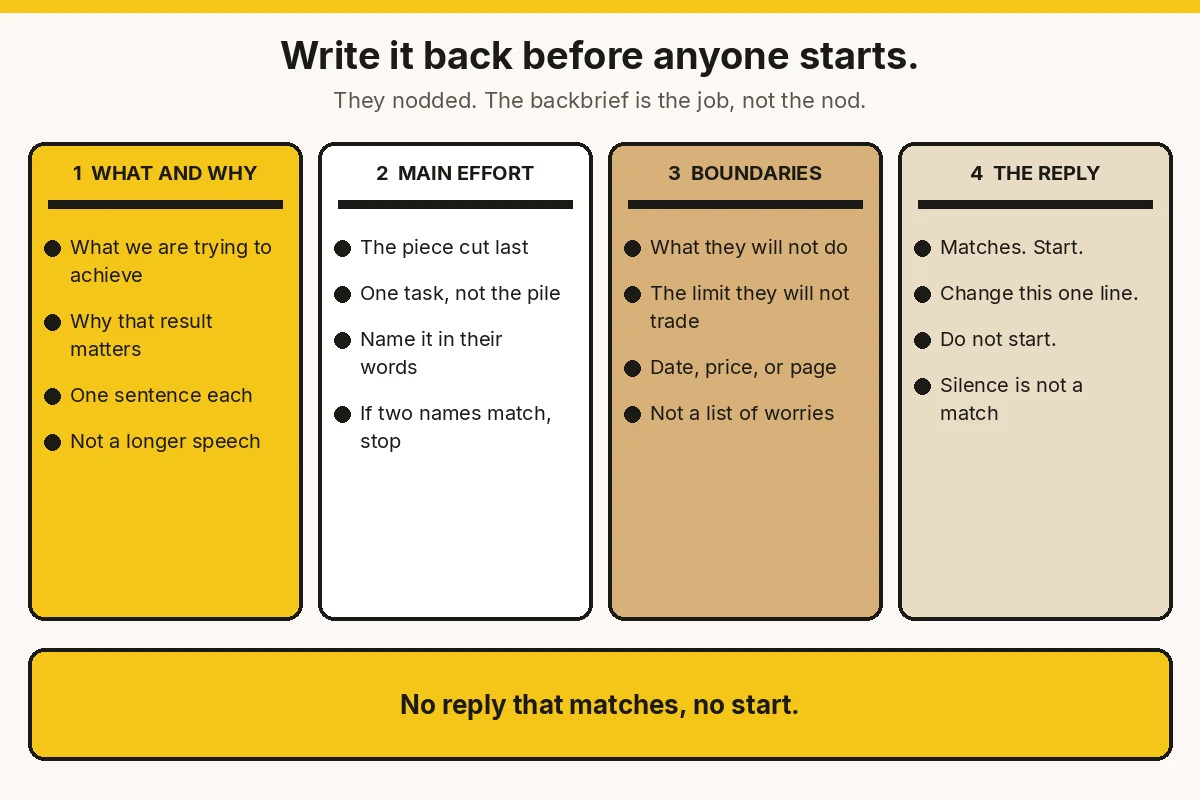
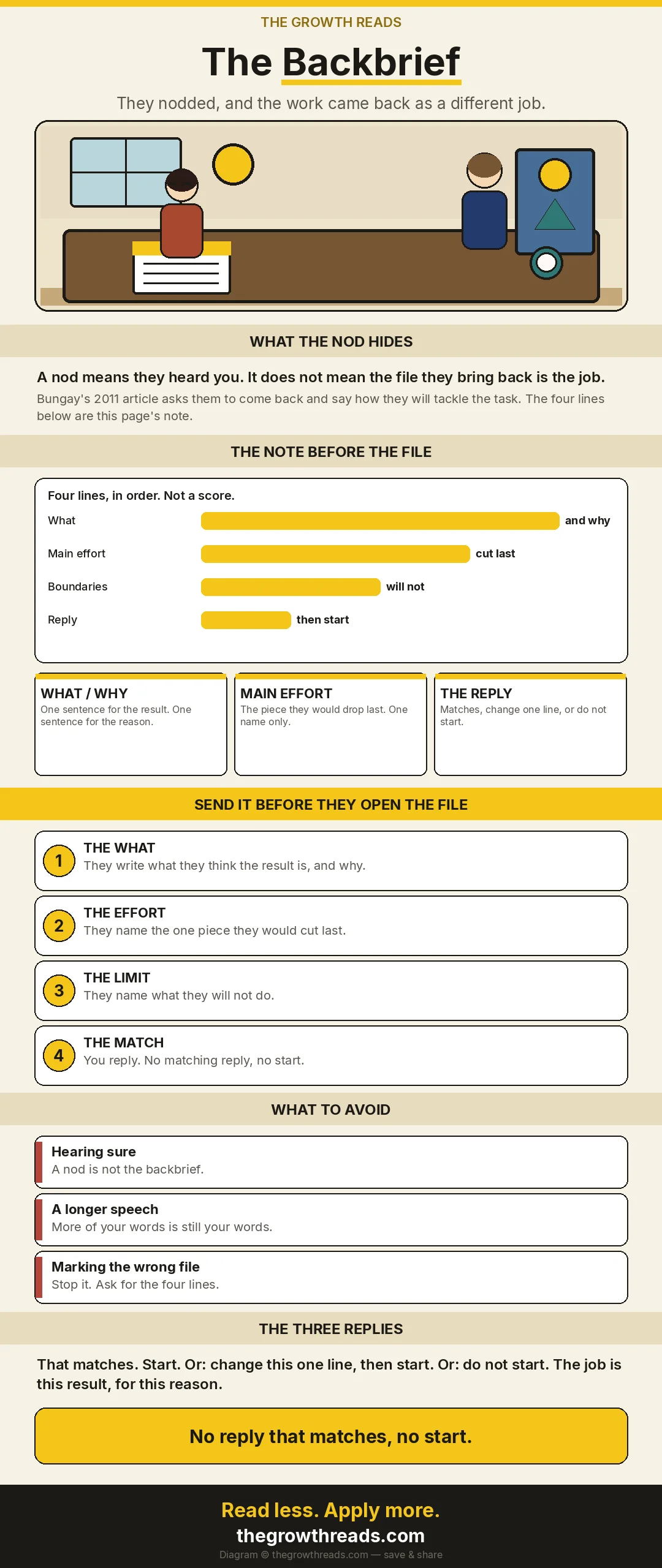
Send this before the file opens.
What I think we are trying to achieve: ____.
Why: ____.
Main effort, the piece I would cut last: ____.
I will not: ____.
I will bring the first piece back on: ____.
Read the reply against the job you meant, not against their confidence. “Update the proposal so the new price is on the first page, so the client can sign the scope we already sold. Main effort: the price on page one. I will not redesign the deck or add a page. First piece back Thursday at 3.” That matches. “Rethink the proposal so it feels like the new brand” does not match, even if the person sounds certain. The certain version is how the wrong file gets a head start.
Keep the main effort to one piece. If they name three, they have not chosen the task they would cut last, which is the question Bungay has Joe ask. Ask for one. Keep the boundary as a limit on another objective, not as a worry. “I will not add a page” is a boundary. “I hope the client likes it” is a worry. “I will not miss Friday” is a second objective unless Friday is the thing you are optimizing and the page count is the limit. Pick one thing to optimize. The others become the fence.
The three replies
You answer with one of three lines, and only the first two allow a start. The 2011 article says a back-brief may cause the leader to revise the original direction. Leave room for that. Sometimes their note shows you that the job you said is not the job you meant. That is a useful revision. It is not the same as accepting a different job because they already built it.
That matches. Start.
Change this line, then start: ____.
Do not start. The job is: ____, in order to ____.
Silence is not the first reply. If they wrote the four lines and you said nothing, they will treat the silence as a match, which puts you back at the nod. “Looks good” is also not a match unless you can point at the what, the why, and the main effort and mean them. Change one line when one line is wrong. Do not rewrite their whole note in your voice and call that a backbrief. The point of the loop is that the understanding is theirs.
“Do not start” is the reply when the what is a different result, when the main effort is the wrong piece, or when the boundary gives away the limit you cannot trade. Say the job again in one what and one why. Ask for a new note. Do not ask them to “use your judgment” on top of a mismatch. Judgment is what the boundaries are for after the match, not a substitute for the match.
When the file is already open
If the wrong file is already open, stop it and ask for the four lines. Do not mark up the wrong job as if it were the right one. Markup on a redesign teaches them that the redesign was the assignment and that your comments are the brief. Close the file. Send the note. When the reply matches, they can reuse a piece of the old file only if that piece serves the main effort. A new cover does not survive a job that was “price on page one.”
If the wrong file has already gone to the client, the backbrief does not unsay it. You write the client yourself. Then you still run the four lines for the repair, so the repair does not become a second surprise. Bungay’s article does not give you that client sentence. It is ours. One version: “The file you received is not the job we agreed. The job is the price on the first page of the scope you already have. You will have that page on Thursday. Please ignore the redesign.”
Do not use the episode as a reason to take the work back forever. The piece on being the bottleneck is the cut for work that waits on you, and the sentence there is “I intend to,” after which you allow it or stop it. That sentence moves a decision. The backbrief checks that the job about to be done is the job you meant. A person can intend, quite clearly, to do the wrong job. You want the intent sentence only after the four lines match. Using “I intend to” on a mismatched what just ships the mismatch with more confidence.
When two notes name the same main effort
If two people name the same piece as the main effort, you do not have a wording problem. You have an overlap. Bungay’s third use of a joint back-brief is to see gaps, overlaps, and coherence. Two notes that both say “I would cut the price page last” mean both people think that page is theirs. Pick one name. The other note changes its main effort, or it becomes support with a boundary: “I will not touch the price page.” The owner line itself is the other article, two people, one task. Do not invent a second owner to be fair.
A gap is the opposite and just as visible. Nobody’s main effort is the form that drops entries, because everyone wrote a broader job. Name the gap as someone’s main effort before anyone starts. Coherence is the check that the whys still point at the same result. One person accelerating the price page “so we can upsell” and another protecting it “so the signed scope stays” are not on the same job. Revise the direction, which the 2011 article says a back-brief is allowed to do, and send both notes back.
When you are the only pair of hands
If there is no other person, write the four lines to yourself before you open the file. A solo founder can nod at their own client and then build the job they wish the client had bought. The note is the same. What is the result. Why. The piece you would cut last. What you will not do. The day the first piece exists. If you cannot fill the main effort, you are not ready to start, and another hour in the file will not produce the missing line.
A contractor is not “no other person.” Send them the note and wait for their words. Do not paste your four lines into their document and ask them to begin. Their reply is the check. If they cannot restate the what and the why, do not start the clock. Shrink the job to a piece they can say back, or keep it. The article on a first hire’s week with no shape is the longer plan for someone new. A backbrief is the gate on one job, including a job you give a person in week one.
Bungay is writing about a department inside a large company, with measures, bonuses, and two levels above the manager. He is not writing about a two-person studio, and the article does not claim the five steps were tested on one. The transfer is the order of the questions, not Joe’s off-site and not his targets. He also tells the reader not to set a target the group cannot achieve: “If we give ourselves a target we can’t achieve, we’re setting ourselves up for failure.” If Thursday is impossible, say so in the reply and change the day. Do not leave an impossible day in the note and call the note aligned.
Common mistakes
- Treating “sure” as the brief. The nod is the moment the four lines are still unwritten. Ask for them before you open your next task.
- Sending a longer explanation. Another paragraph from you is still your words. Bungay’s back-brief is their account of how they will tackle the task.
- Writing every step so they cannot adapt. His 2011 sidebar says boundaries exist so people can adapt, and that a boundary limits the other objectives. A script of forty clicks is not a boundary.
- Letting the dashboard become the job. He has Joe separate the outcome from the measures. A pile of new pages is a reading. The destination was the price on page one.
- Marking up the wrong file. Comments on the wrong job promote it. Stop the file. Ask for the note. The client repair, if the file already went, is yours to send.
- Using the handoff sentence on a mismatched job. “I intend to” moves a decision that is already the right decision. It does not correct a what that never matched.
- Borrowing Joe’s targets. The manager in the article is fictional. His revenue, cost, and product counts are the story’s scenery. Your boundary is the limit on your job, written in your note.
What the source does and does not say
The 2011 article gives you the briefing and the back-brief. It does not give you the email, the three replies, or a result for a two-person team. We read the reprint of R1101L in full on 16 November 2026. The public Harvard Business Review page for the same piece confirms the January-February 2011 issue and the reprint number, and its summary includes the question “What do you want me to do?” The summary on that page is not the full article. The book named in the byline was not opened.
| Source | What was read | What this page uses | What this page does not use |
|---|---|---|---|
| Stephen Bungay, Harvard Business Review, January-February 2011, reprint R1101L | The full reprint. The public page was checked for the issue date, the reprint number, and the opening question. | The five steps. What and why. Main effort as the task you would cut last. Boundaries as limits on other objectives. The request to come back and say how you will tackle the task. The three uses of a back-brief: understanding, a possible revision, and gaps, overlaps, and coherence. The line that your task becomes their what, and your what becomes their why. | Joe’s figures. The claim that the practice has a long military record, which he states and which we did not check. Any promise that a briefing is the best use of a manager’s time. |
| Stephen Bungay, The Art of Action, Nicholas Brealey Publishing, 2011 | The title, the publisher, and the year, as the HBR byline states them. No page. | The identification of the book the article says it is based on. | No scene, no template, and no page number. An ISBN was not checked, so none is given. |
He closes by tracing strategy briefing to military practice and by calling it a serious investment of time. That close is his argument. It is not a study of founders, and it is not evidence that a four-line note raises a completion rate. We did not look up the armies. The Monday use of the article is the unanswered question and the loop that answers it: they say how they will tackle the task, and you do not treat a nod as that sentence.
Frequently asked questions
What does it mean that they nodded and the work came back different?
They nodded, and the work came back as a different job, when the person agreed in the room and the file solves a different task. A nod or a “sure” means they heard a sentence. It does not mean they can restate the result, the reason, the piece they would cut last, or the limit they will not cross. Stephen Bungay’s January-February 2011 Harvard Business Review article treats that restatement as a back-brief. The four-line note here is the version a solo founder or a new manager sends before the file opens.
What is a backbrief, in Bungay’s 2011 article?
A back-brief, in the January-February 2011 article, is the loop after a briefing. The person who received the direction comes back and says how they will tackle the task. Bungay says three things happen. They check their understanding. The leader sees what the direction implies and may revise it. Together, the notes show gaps, overlaps, and coherence. The task you assigned becomes their what, and your what becomes their why. His example gives a large team until the end of the next week. The same-day note here is our shorter application, not a form in the article.
How is a backbrief different from “I intend to”?
“I intend to” is the handoff in the piece on being the bottleneck. The person names the decision they are about to make, and you allow it or stop it. That sentence moves a decision off your desk. A backbrief is earlier. It checks that the job about to be done is the job you meant. Someone can intend, clearly, to redesign a deck when you asked for a price on page one. Use the four lines first. Use “I intend to” only after the what, the why, and the main effort match. The 2011 article does not use that handoff wording.
What do you send before they start?
Ask them to write four lines in their words. What they think you are trying to achieve. Why. The main effort, the one piece they would cut last. What they will not do. And the day the first piece comes back. Stephen Bungay’s 2011 steps are the source of the what, the why, the main effort, and the boundary. The email itself is not in the article. Read the reply for a match, not for confidence. If the main effort names three pieces, they have not answered the cut-last question. Ask again for one piece before you say start.
What are the three replies?
The three replies are this page’s rule, not a script in the 2011 article. “That matches. Start.” “Change this line, then start,” with the one line named. “Do not start. The job is this result, in order to serve this reason.” Only the first two allow the file to open. Silence is not a match. “Looks good” is not a match unless the what, the why, and the main effort are the ones you mean. Use “do not start” when the result, the main effort, or the boundary is wrong. Then ask for a new note.
What if the wrong file is already open?
Stop the file and ask for the four lines. Do not leave comments on the wrong job, because the comments teach them that the wrong job was the assignment. When the reply matches, they may keep a piece of the old file only if that piece is the main effort. If the wrong file already went to the client, write to the client yourself and say what to ignore. The 2011 article does not contain that sentence. Run the four lines again for the repair. Do not take the work back forever because one file missed.
What if you are the only person, or two notes match?
If nobody else will do the job, write the four lines to yourself before you open the file. If you cannot name the piece you would cut last, you are not ready to start. A contractor still counts as another person: wait for their words, and do not start the clock if they cannot restate the what and the why. If two people name the same main effort, Bungay’s overlap check applies. Pick one name. The other person either changes their main effort or accepts a boundary that keeps them off that piece. That owner choice is the separate problem of two people on one task, not a second backbrief.
Did this page use a numbered page of The Art of Action?
No. The book is Stephen Bungay, The Art of Action, Nicholas Brealey Publishing, 2011. The title, the publisher, and the year are the byline of his January-February 2011 Harvard Business Review article, which says the article is based on the book. No numbered page was opened. No ISBN was checked. Joe, the manager in the article, is fictional, and his targets are not advice. The five briefing steps and the back-brief are from reprint R1101L, read in full. The four-line note is our application for a smaller team than the department in that article.
Sources
- Bungay, S. (January-February 2011). How to make the most of your company’s strategy. Harvard Business Review. Reprint R1101L. Read in full from the reprint on 16 November 2026. The public page confirms the issue and the reprint number, and the summary includes the question “What do you want me to do?”: hbr.org/2011/01/how-to-make-the-most-of-your-companys-strategy. The byline identifies the author and states that the article is based on The Art of Action (Nicholas Brealey Publishing, 2011). Joe is the article’s fictional example. His figures are not used. The military history in the close was not checked.
Related reading on The Growth Reads
- You are the bottleneck — the handoff that moves a decision, after the job matches
- Two people own the same task — when two backbriefs name one main effort
- The work changed after the price — a different problem: the agreed result moved
- The first hire’s week one has no shape — the week, not the gate on one job
- Productivity — the cluster this article sits in
- How we review — what a checked source is, and what an unread page is not
How this was checked
Who it is for. A solo founder or a new manager who left a conversation with a nod and later received a file that solves a different job.
What was read. Stephen Bungay’s Harvard Business Review article from January-February 2011, reprint R1101L, in full, on 16 November 2026. The public article page was opened the same day and confirms the issue, the reprint number, and the opening question in its summary. The byline is the source for the book title, the publisher, and the year.
What was not read. No numbered page of The Art of Action. No ISBN database. No military history. Joe’s figures stay inside the fiction.
Limit. The four-line note and the three replies are our application for a smaller team than the department in the article. They are not a measured lift in how often the right file comes back.
How we work: every article on The Growth Reads is built from books we have read and from primary accounts we can check, and it is date-stamped when those sources change. Read our methodology.