

★★★★★ 4.5/5 — The most research-backed relationship book ever written, distilling 40 years of lab data into seven actionable principles for lasting love.
Best for: Married and committed couples who want a practical, science-based framework for building a thriving relationship.
Reading time: ~6 hrs (guide: 20 min)
Difficulty to apply: Low to moderate — the principles are simple but require daily practice.
The Seven Principles for Making Marriage Work in one minute
After studying over 3,000 couples in his “Love Lab” at the University of Washington, John Gottman can predict with 91% accuracy whether a marriage will succeed or fail — often within the first five minutes of observing a conflict conversation. His research revealed that happy marriages are not conflict-free; they are marriages where partners maintain a deep friendship, navigate disagreements with respect, and repair ruptures quickly. The book distills four decades of research into seven principles that any couple can practice, along with a clear warning system — the “Four Horsemen” of relationship apocalypse — that signals when a marriage is in danger. It is the rare relationship book that earns its advice through rigorous science rather than anecdote.
Key takeaways
- Happy marriages are built on deep friendship: The foundation is not passion or conflict resolution but genuine knowledge of and fondness for each other’s inner world.
- The Four Horsemen predict divorce: Criticism, contempt, defensiveness, and stonewalling — when these become habitual, the marriage is in serious danger. Contempt is the single strongest predictor.
- The magic ratio is 5:1: Stable marriages maintain at least five positive interactions for every one negative interaction during conflict. Below that ratio, relationships deteriorate.
- Most marital problems are perpetual: Roughly 69% of conflicts in any marriage are never fully resolved — they are managed. Gridlock happens when dreams clash, not opinions.
- Turning toward beats turning away: Small daily moments of connection (responding to a comment, acknowledging a sigh, showing interest) matter more than grand romantic gestures.
- Repair attempts are the secret weapon: Successful couples are not better at avoiding fights — they are better at de-escalating during fights through humor, affection, or apology.
- Accepting influence from your partner is essential: Gottman’s research shows that marriages where one partner refuses to share power have an 81% chance of failing.
- Shared meaning creates lasting bonds: The strongest marriages are those where partners create a shared culture — rituals, goals, roles, and symbols that belong uniquely to them.
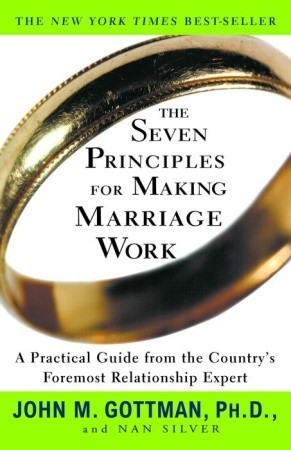
What is The Seven Principles for Making Marriage Work about?
The Seven Principles for Making Marriage Work is a research-based relationship guide that presents seven principles derived from 40 years of studying couples in laboratory settings, showing what behaviors predict lasting marriages and providing practical exercises for building friendship, managing conflict, and creating shared meaning.
About the author
Dr. John Gottman is a psychologist, professor emeritus at the University of Washington, and co-founder of the Gottman Institute with his wife, Dr. Julie Schwartz Gottman. He is widely regarded as the world’s foremost researcher on marriage and relationships, having studied over 3,000 couples across four decades in his famous “Love Lab” — a research apartment equipped with cameras and physiological monitoring equipment where couples lived while researchers observed their interactions. His ability to predict divorce with over 90% accuracy made international headlines and established him as the leading scientific authority on what makes love last. He has authored over 200 academic papers and 40 books, and the Gottman Method is now practiced by therapists worldwide. Explore all John Gottman book summaries →
Key concepts at a glance
| Concept | What it means | Use it when |
|---|---|---|
| Love Maps | Detailed knowledge of your partner’s inner world | You want to deepen your friendship |
| The Four Horsemen | Criticism, contempt, defensiveness, stonewalling | You notice destructive patterns in fights |
| The 5:1 Ratio | Five positive interactions per one negative in conflict | You want to gauge relationship health |
| Bids for Connection | Small moments of reaching out for engagement | You want to build daily closeness |
| Repair Attempts | Efforts to de-escalate conflict mid-fight | Arguments spiral out of control |
| Perpetual Problems | 69% of conflicts are never fully resolved — only managed | You keep fighting about the same things |
| Shared Meaning | Rituals, goals, and symbols unique to the relationship | You want a deeper sense of partnership |
Part 1: The foundation — love maps, fondness, and turning toward
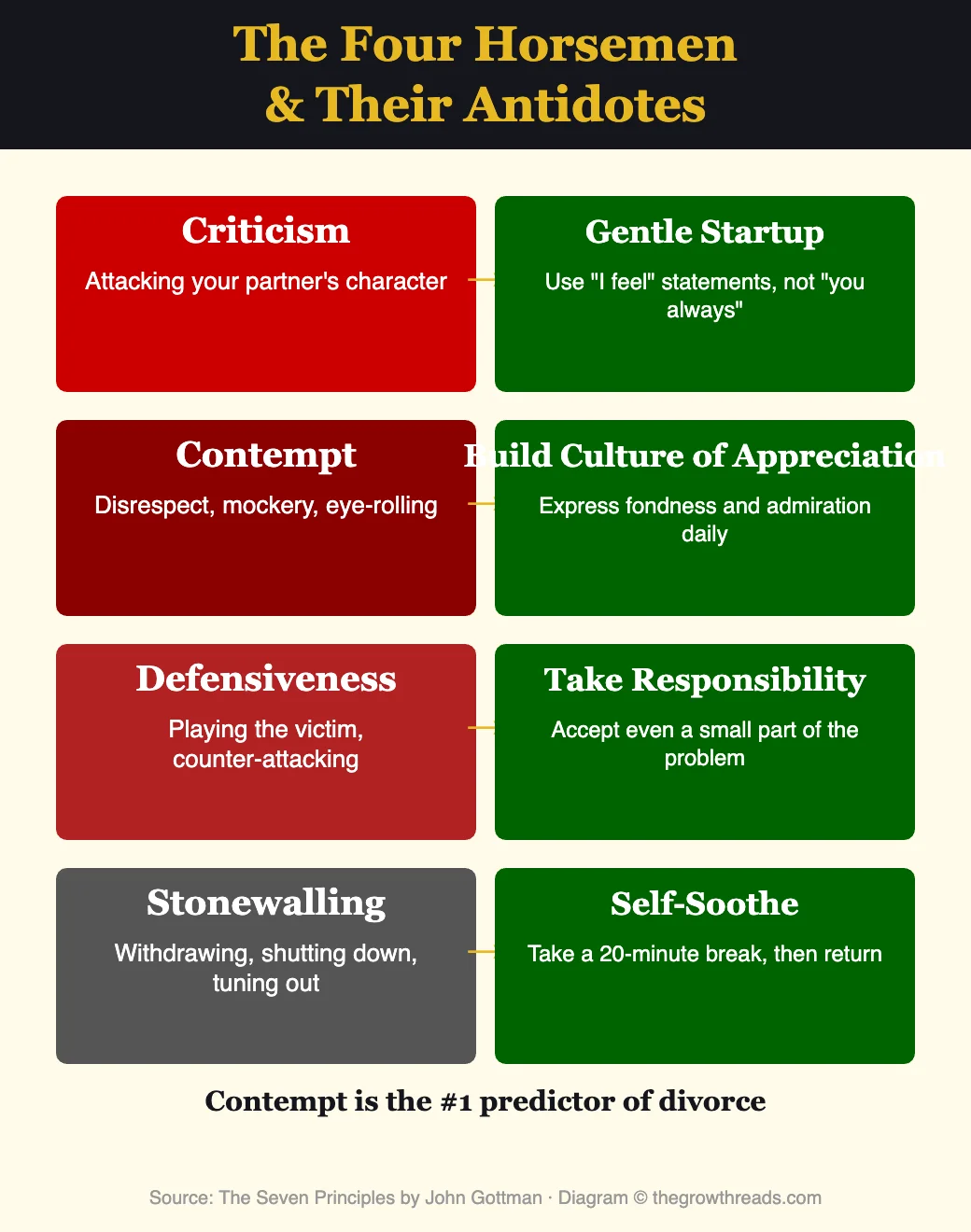
Gottman begins with the foundation of every healthy marriage: friendship. A “love map” is his term for the mental space where you store everything you know about your partner — their worries, dreams, favorite things, stressors, friends, history, and preferences. Couples with detailed love maps are better equipped to navigate stress because they understand each other’s inner world. Those without love maps are essentially strangers sharing a home — they may coexist peacefully in calm times but crumble under pressure.
The second principle — nurturing fondness and admiration — is Gottman’s antidote to contempt. In his research, couples who maintained a habit of expressing what they appreciated about each other, even during difficult periods, were dramatically more likely to stay together. The exercise is simple: every day, find one specific thing your partner did that you genuinely appreciate and tell them. Not generic praise (“you’re great”) but specific observation (“I noticed you made coffee before I woke up — that made my morning”).
The third principle — turning toward instead of away — is perhaps the most practically important. Throughout a typical day, partners make dozens of small “bids” for each other’s attention: a comment about something they read, a sigh after a phone call, a gesture toward the window. In Gottman’s research, couples who stayed together responded to these bids 86% of the time. Couples who divorced responded only 33% of the time. The individual moments seem trivial; their accumulation is anything but.
Part 2: The Four Horsemen and managing conflict
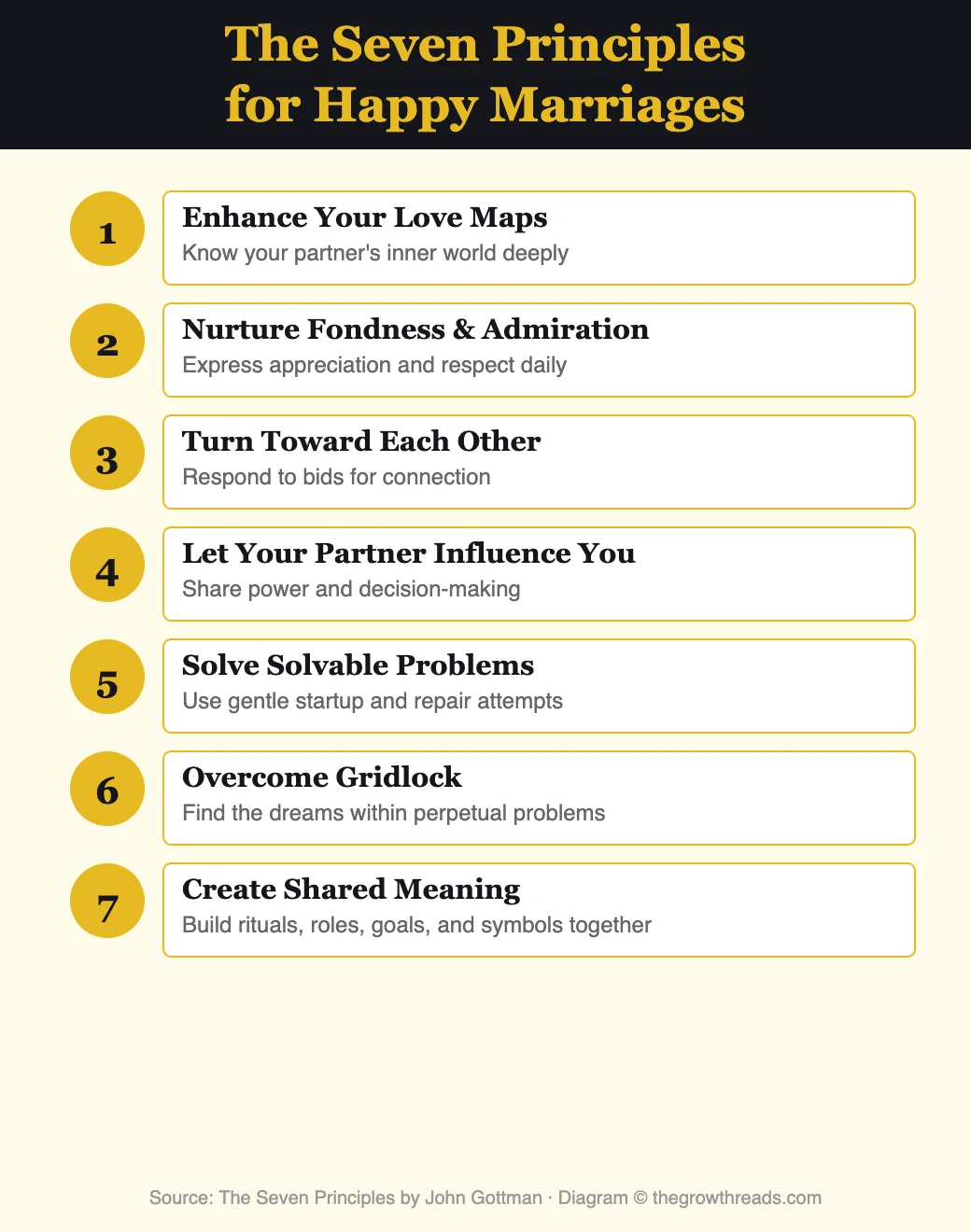
The Four Horsemen of the Apocalypse — criticism, contempt, defensiveness, and stonewalling — are the interaction patterns that most reliably predict relationship failure. Criticism differs from complaints: a complaint addresses a specific behavior (“I’m frustrated that you forgot to take out the trash”), while criticism attacks character (“You never think about anyone but yourself”). Contempt — sarcasm, mockery, eye-rolling, name-calling — is the deadliest horseman, fueled by long-simmering negative thoughts about the partner.
Defensiveness is the natural response to feeling attacked, but it escalates rather than resolves conflict because it communicates “the problem is not me, it is you.” Stonewalling occurs when one partner (usually the man, Gottman’s data shows) becomes physiologically overwhelmed — heart rate above 100 BPM, flooding of stress hormones — and withdraws completely. Each horseman has a specific antidote: gentle startup instead of criticism, building a culture of appreciation instead of contempt, taking responsibility instead of defending, and physiological self-soothing instead of stonewalling.
Part 3: Overcoming gridlock and creating shared meaning
Gottman’s research produced a finding that surprises most couples: roughly 69% of marital conflicts are perpetual problems that will never be fully resolved. These are not bugs in the relationship — they are features of any union between two distinct individuals with different temperaments, backgrounds, and values. The difference between happy and unhappy couples is not whether they have perpetual problems but how they handle them.
Gridlocked perpetual problems develop when partners cannot discuss the issue without hurt and frustration. Gottman’s research reveals that gridlock almost always involves hidden dreams — aspirations, hopes, or values that feel non-negotiable. The partner who wants to spend more money may be seeking adventure; the one who wants to save may be seeking security. The solution is not compromise on the surface issue but understanding and honoring the dream beneath it.
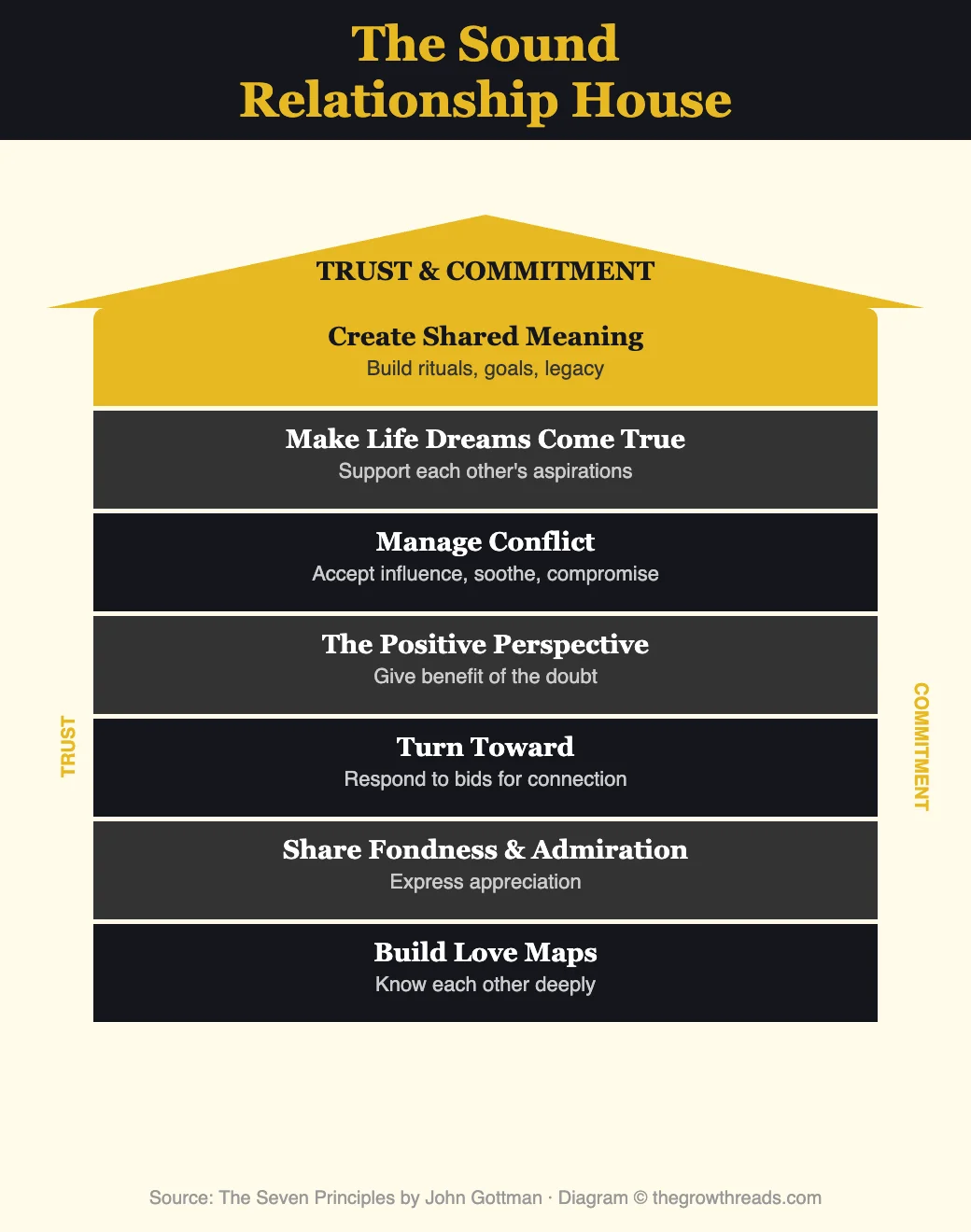
The seventh principle — creating shared meaning — elevates a marriage from functional to profound. Shared meaning comes from building a culture unique to the relationship: family rituals (how you celebrate birthdays, how you say goodbye in the morning), shared goals (what you want to build together in the next five years), agreed-upon roles (who handles what, and why), and symbols (inside jokes, meaningful places, songs that belong to you). Marriages with rich shared meaning systems are more resilient because the partners are not just cohabitating — they are co-creating a life story.
Who is The Seven Principles best for — and who should read something else first?
This book is ideal for any committed couple, whether newly married or decades in, who wants a research-backed framework for relationship health. It is also valuable for couples therapists, premarital counselors, and individuals who want to understand what successful relationships look like before choosing a partner.
If your relationship is in acute crisis with serious attachment wounds, start with Hold Me Tight which addresses the emotional depth needed for repair. If you are single and want to understand your own attachment patterns first, Attached is the better starting point.
Questions to reflect on
- How detailed is your love map of your partner? Could you name their three biggest current worries, their childhood best friend, and their ideal retirement?
- Which of the Four Horsemen appears most often in your conflicts, and what is its specific antidote?
- When your partner made a bid for connection today, did you turn toward, turn away, or turn against?
- What perpetual problem in your relationship might have an unspoken dream beneath it?
- What rituals, inside jokes, or shared goals make your relationship uniquely yours — and when was the last time you invested in one?
🔥 Ready to build a marriage that lasts?
Learn the seven research-backed principles that predict relationship success.
How to apply The Seven Principles (7-day plan)
- Day 1: Update your love map. Ask your partner three questions you do not know the answer to: What is stressing you most right now? What is one thing you are looking forward to? What is a dream you have not talked about recently?
- Day 2: Express fondness and admiration. Tell your partner one specific thing they did recently that you genuinely appreciated. Be precise — not “you’re great” but “I noticed you handled that stressful call with incredible patience.”
- Day 3: Track bids for connection. Count how many times your partner reaches out today (a comment, a touch, a question) and notice how you respond. Aim to turn toward at least 80% of the time.
- Day 4: Identify your Four Horsemen. Recall your last three arguments. Which horseman showed up most? Practice its antidote: gentle startup for criticism, appreciation for contempt, responsibility for defensiveness, or a calm break for stonewalling.
- Day 5: Practice a repair attempt. During your next disagreement, try one of Gottman’s repair phrases: “I see your point,” “Can we take a break and come back to this?,” or “I’m sorry — that came out wrong.”
- Day 6: Explore a gridlocked problem. Choose a recurring disagreement and ask each other: “What dream or value does your position represent?” Listen without trying to solve.
- Day 7: Create or renew one shared ritual. Agree on a weekly practice: Sunday morning coffee without phones, a monthly date night, or a nightly two-minute gratitude exchange.
Frequently asked questions
How can Gottman predict divorce with 91% accuracy?
Gottman and his team observed thousands of couples in controlled laboratory settings, measuring their interactions during conflict conversations alongside physiological data (heart rate, skin conductance, blood pressure). Over years of follow-up, they identified specific behavioral patterns — particularly the ratio of positive to negative interactions and the presence of the Four Horsemen — that reliably predicted which couples would divorce and which would stay together. The 91% accuracy rate was achieved using specific coding of facial expressions, tone of voice, and verbal content during a 15-minute conflict discussion.
What is the 5:1 ratio?
The 5:1 ratio (also called the “magic ratio”) is the finding that stable, happy couples maintain at least five positive interactions for every one negative interaction during conflict discussions. Positive interactions include humor, affection, interest, empathy, and agreement. Negative interactions include criticism, contempt, defensiveness, and stonewalling. Couples who fall below this ratio — even to 3:1 or 4:1 — are at significantly higher risk of relationship deterioration. Importantly, the ratio applies to conflict discussions specifically, not to all interactions.
Are the Four Horsemen always fatal to a marriage?
Not necessarily. All couples occasionally slip into criticism, defensiveness, or even contempt. The danger arises when these patterns become habitual — the default mode of interaction rather than occasional lapses. Gottman is clear that the presence of horsemen is not a death sentence if couples learn to recognize them quickly and deploy the specific antidotes. Contempt is the most dangerous because it communicates fundamental disrespect, but even contempt can be addressed if both partners commit to building a culture of appreciation and fondness.
What are repair attempts?
Repair attempts are any statement or action during a conflict that prevents negativity from escalating out of control. They can be verbal (“I’m sorry, let me try that again”), physical (reaching for a partner’s hand mid-argument), or humorous (an inside joke that breaks the tension). Gottman found that the success or failure of repair attempts is the single most important predictor of whether a marriage will thrive. Crucially, it is not the elegance of the repair that matters — it is whether the receiving partner accepts it. In distressed marriages, even clear repair attempts are often rejected.
What does it mean that 69% of problems are perpetual?
Gottman’s longitudinal research found that couples who were studied over a period of years were still fighting about the same core issues — differences in neatness, spending habits, parenting approaches, social needs. These perpetual problems stem from fundamental personality differences and values that do not change. Happy couples learn to discuss these issues with humor, affection, and acceptance rather than trying to resolve them permanently. The problems become background music rather than a source of ongoing resentment. Gridlock occurs when partners stop being able to discuss the issue without pain.
Is this book only for married couples?
Despite the title, the principles apply to any committed romantic relationship — whether married, cohabiting, engaged, or in a long-term partnership. Gottman’s research included both married and unmarried couples, and the patterns he identified are universal to committed romantic bonds regardless of legal status. The book has also been adapted for same-sex couples (Gottman conducted specific research on same-sex relationships and found the same core principles apply). Some readers also find the principles useful for close family relationships and deep friendships.
How does this compare to Hold Me Tight?
The two books are complementary rather than competing. Gottman operates primarily at the behavioral level — what couples do during interactions and how to change specific behaviors. Sue Johnson operates at the emotional level — why couples react the way they do and how to access the deeper attachment needs beneath the surface behavior. Gottman gives you the diagnostic tools (Four Horsemen, 5:1 ratio) and practical exercises (love maps, repair attempts). Johnson gives you the emotional depth and vulnerability required for transformative bonding moments. Reading both provides the complete picture.
Related summaries
- Hold Me Tight Summary & Review — Sue Johnson on attachment bonds and emotional repair.
- The 5 Love Languages Summary & Review — Gary Chapman on expressing love in the way your partner receives it.
- Nonviolent Communication Summary & Review — Marshall Rosenberg on empathic, needs-based communication.
- Best Relationship Books — Our complete guide to the top books on love, communication, and connection.
How we analyze books: Every summary on The Growth Reads is built from a close reading of the full text, cross-referenced with the author’s published interviews, peer-reviewed research where applicable, and reader feedback from multiple platforms. We focus on extracting actionable frameworks rather than abstract theory. Read our full methodology.