

★★★★☆ 4.4/5 — Stop listening to the voice that rehearses the problem. Talk, then move.
Best for: people who already know the next task and are still stuck in a fluent inner brief that sounds like thinking.
Reading time: ~4.5 hours (224 pages) · this guide ~12 min
Difficulty to apply: Easy to start, medium to keep — the lines are simple; using one in the next ten minutes is the work.
Unfu*k Yourself in one minute
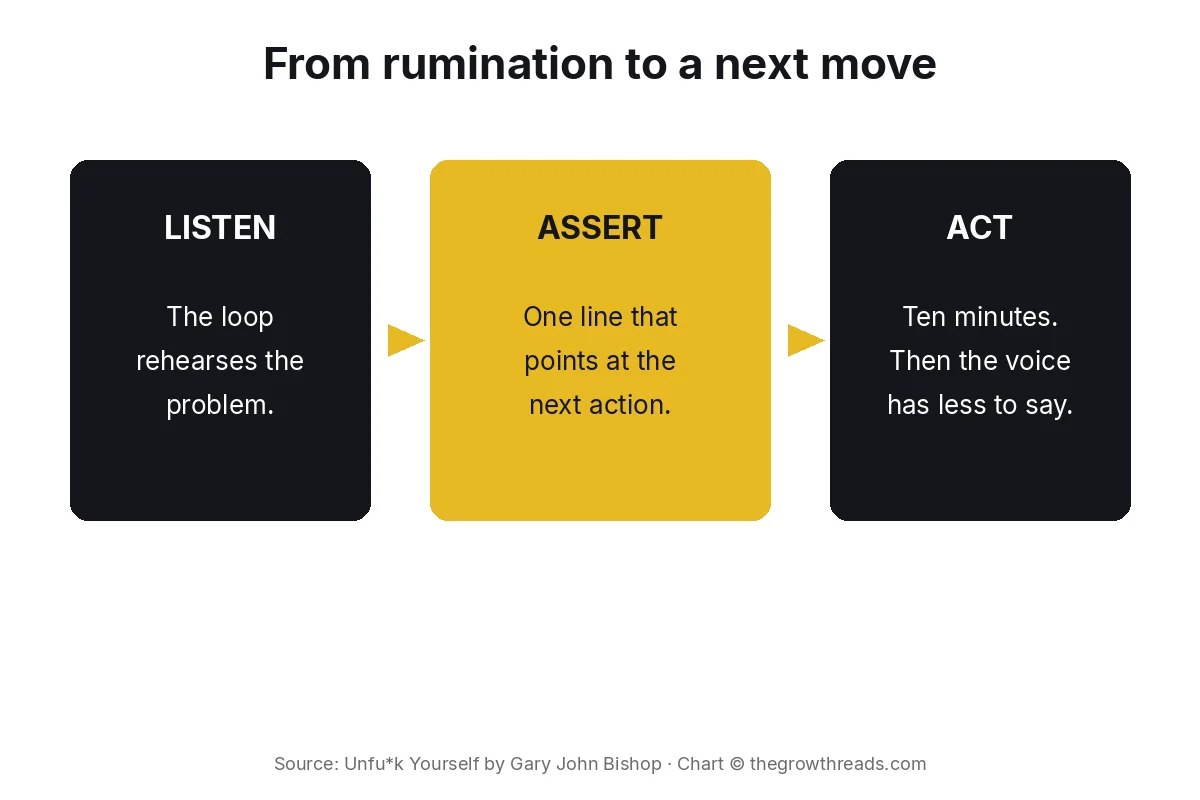
The voice in your head is not a briefing. It is a loop, and it will chair the meeting until you talk over it and then do something small. Gary John Bishop’s Unfu*k Yourself (HarperOne, 2017) is a short, impatient book about assertive self-talk. Listening catalogues evidence that you cannot start; talking is a chosen line that points at the next action. He gives you seven of those lines and refuses to treat insight as the finish. Mood may lag. The scoreboard is what your hands did after the sentence. Pick the assertion that matches this morning’s stall, say it once, and start a ten-minute task before the narration reconvenes.
Key takeaways
- Listening is not thinking: the inner brief rehearses proof. It rarely produces a next step.
- Talking is a choice: an assertion is a line you issue, not a feeling you wait to catch.
- Personal will is already running: your week reveals what you are actually committed to, not what you wish you wanted.
- Willingness beats readiness: I am willing is permission to begin while you still dislike the work.
- You are wired to win at your current game: even a losing pattern is a skill. Change the game, not the pep talk.
- Uncertainty is the terrain: waiting for a guarantee is how the loop buys another afternoon.
- You are not the narrator: thoughts happen; the scoreboard is behavior.
- Relentless is boring: one more rep after friction, not a cinematic second wind.
- Expect nothing, accept everything: drop the bargain with reality, then take the next honest action anyway.
What is Unfu*k Yourself about?
Unfu*k Yourself argues that most stuck weeks are not a talent problem or a calendar problem. They are a self-talk problem: you keep listening to a fluent inner narrator instead of issuing a line that points at action. Bishop’s seven assertions are the interrupt, and the next ten minutes are the proof.
About the author
Gary John Bishop grew up in Glasgow and spent years as a senior programme director at Landmark Worldwide before writing in a voice that is unmistakably his: short sentences, little patience, and a philosopher’s toolkit (Stoicism, a little Nietzsche, a lot of “do it anyway”) in kitchen-table English. Unfu*k Yourself began self-published and was issued by HarperOne on 1 August 2017; it became a New York Times bestseller and spawned sequels plus a workbook. He is a coach, not a lab. He will not give you a new habit stack. He will tell you why the stack never starts when the narrator is still in charge of the morning. Explore all Gary John Bishop book summaries →
Key concepts at a glance
| Concept | What it means | Use it when |
|---|---|---|
| Listening to yourself | Treating the inner brief as news and letting it delay the work. | You have been “thinking it through” for days and nothing shipped. |
| Talking to yourself | Issuing a chosen assertion that points at a next action. | You can name the task and still have not opened the file. |
| Personal will | The commitment your calendar already voted for, under the wishes. | Your stated goal and last week’s hours do not match. |
| I am willing | Consent to begin without waiting to like it. | Readiness is the new procrastination. |
| Wired to win | You are already excellent at the game you keep playing, even if it loses. | You keep “winning” at delay, people-pleasing, or research. |
| I got this | Act from competence you already have, not from a future identity. | You are waiting to feel qualified. |
| Embrace uncertainty | Start without a guarantee the outcome will be clean. | You are shopping for certainty as a precondition. |
| Not your thoughts | The narrator is weather. Behavior is the scoreboard. | A thought feels like a verdict. |
Part 1: The conversation you are losing
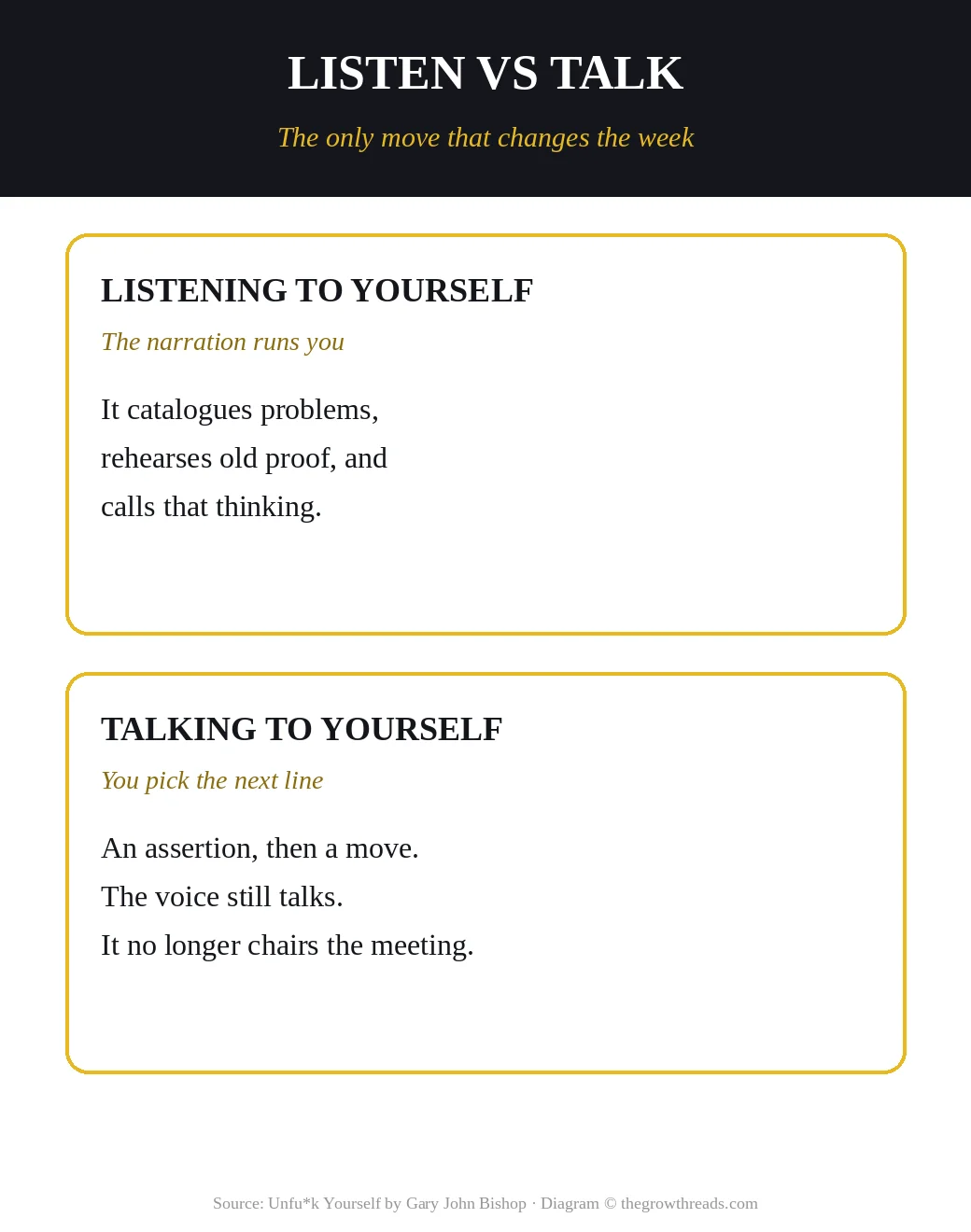
Bishop opens where most productivity books politely skip: the private, fluent voice that explains why today is not the day. We treat it as a trusted aide. His first rude claim is that this is not information. It is a conversation you are losing. Listening is the passive stance — you sit in the audience while the narrator catalogues problems and calls the replay “processing.” Talking is the opposite. You pick a line and mean it as an instruction, then stand up.
Under that split sits personal will. Will, here, is the undercurrent you are already living: the pattern your hours keep voting for when nobody is watching. You can wish for a writing life and still have a will committed to remaining unexposed. Look at the last two weeks. That is the will. The assertions are how you stop pretending the wish was the plan.
I am willing is the first assertion because willingness is cheaper than confidence and more honest than readiness. You do not have to want the workout. You have to be willing to start the first set. Insight that stays seated is still listening. A willing body in motion is already a different conversation, even if the narrator is still complaining in the hallway.
TGR Note: If the stall is a missing cue rather than a loud narrator, start with Atomic Habits or Mini Habits. Bishop is for the morning you already know the cue and still sit down to argue with it. The War of Art names that argument Resistance. Use Pressfield for the name; use Bishop for the next sentence.
Part 2: Wired to win, and I got this
I am wired to win sounds like a gym slogan until Bishop turns it around. You are not failing at life in general. You are winning at the game you have actually been playing. If you always research for three more days, you are a world-class winner at not being judged yet. The nervous system is not broken. It is loyal to an old scoreboard. Changing the pep talk without changing the game just produces a more eloquent delay.
That is why I got this sits next to it. Competence panic is often a costume for staying in the old game. Bishop’s line is not a claim that you are already elite. It is a claim that you already have enough to take the next honest step: open the doc, make the call, send the draft ugly. Waiting to inhabit a future identity is how listening dresses up as growth. Use the skills in this room, not the biography you planned to deserve first.
He is not asking you to gaslight a real skill gap. If you cannot do the thing, get a drill — that is Colvin’s beat, not this book. If you can do the thing and you are still producing a legal brief against starting, you have a narrator with a gavel. Name the game you keep winning in one sentence, then pick a smaller game for today. Ten minutes of the new game is a better argument than a new personality.
TGR Note: For a warmer identity rebuild, You Are a Badass is the cousin. For a physical interrupt at the edge of the task, The 5 Second Rule is the countdown. Bishop is the script rewrite in between: less sparkle than Sincero, less timer than Robbins, more “say the line and pick up the tool.”
Part 3: Uncertainty, and you are not your thoughts
I embrace the uncertainty is Bishop’s answer to shopping for guarantees. We want the project approved in advance by reality. The narrator is happy to wait with you. Uncertainty feels like a storm; Bishop treats it as weather you walk in. Starting is how you gather the only data that counts. Sitting still in search of a forecast is how an afternoon disappears with a clean conscience.
The fifth assertion is the cleanest split: I am not my thoughts; I am what I do. Thoughts will keep arriving. Fusing with them — “I thought it, therefore I must obey” — is how listening turns into a life. Bishop’s move is not to win the debate. It is to stop holding the hearing. Notice it, decline the gavel, and look at the scoreboard. Did you send it? Did you show up for ten minutes? That is the identity he will honor. The rest is weather.
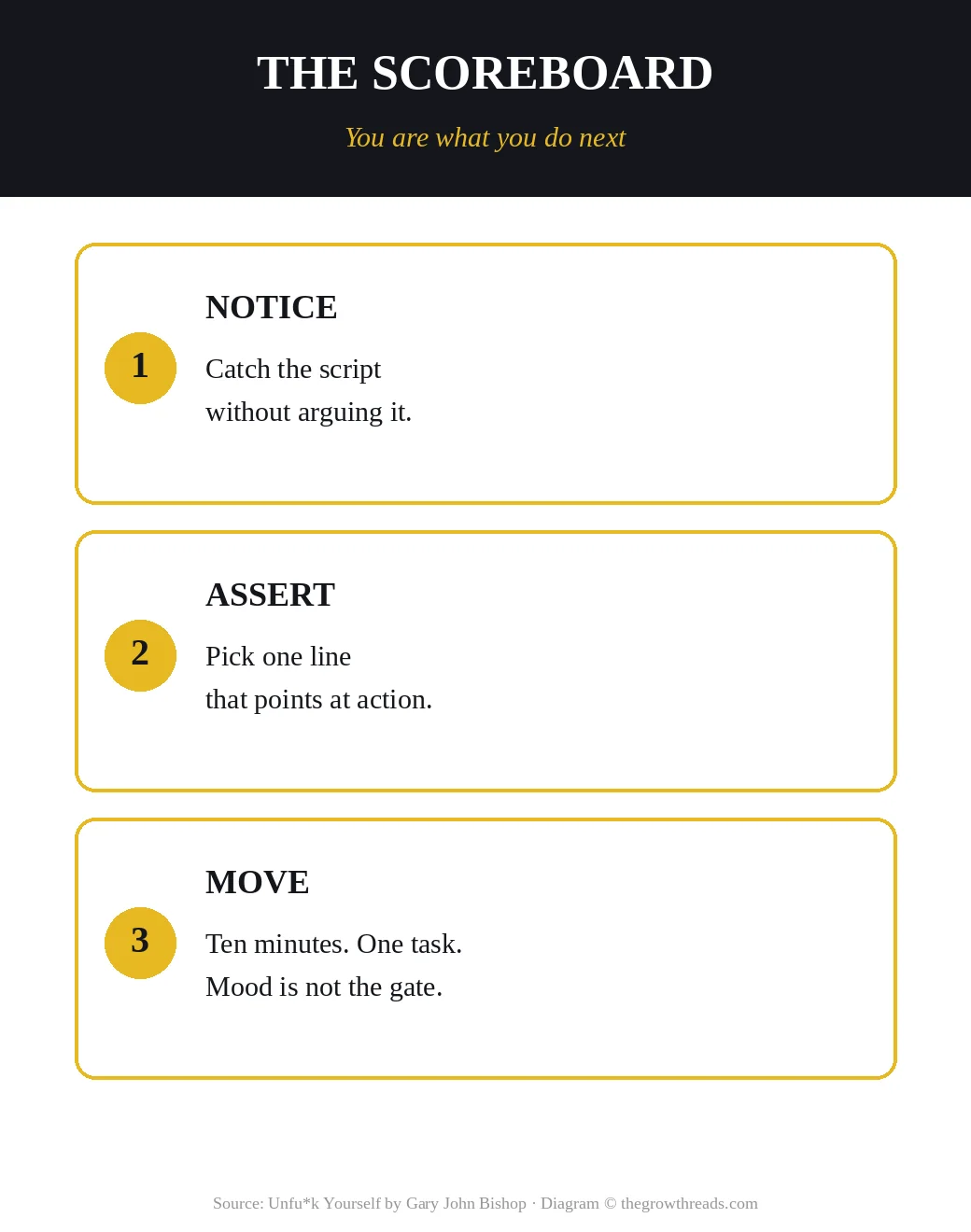
This is why the book sits in a productivity silo, not only on a mindset shelf. A calendar full of “thinking time” can be a shrine to the narrator. A calendar with one protected first action — ugly, timed, finished — is already talking. You need a closed loop: assertion, action, evidence. Waiting to feel like the kind of person who does the work is the loop buying another day in a nicer vocabulary.
TGR Note: If the stall is raw force rather than a script, Can’t Hurt Me and Relentless are the volume knobs. If it is a Tony Robbins-scale identity install, Awaken the Giant Within and Unlimited Power go wider. Bishop is the pocket version: seven lines, then the next ten minutes. The High 5 Habit is the gentler morning interrupt if his tone is too sharp for day one.
Part 4: Relentless, then drop the bargain
I am relentless is easy to mishear as grind culture. Bishop’s version is smaller. Relentless is what you do after the first burst of willingness fades and the narrator returns with a better brief. You need the next boring rep: the second session this week, the follow-up email. Relentless is a relationship with friction, not a personality transplant. People who look relentless from the cheap seats usually declined a very reasonable-sounding exit at 11:40 a.m.
The last assertion — I expect nothing and accept everything — sounds like giving up until you use it. Expectation, in Bishop’s frame, is a secret contract: I will try if the world cooperates. When it does not, the narrator files a grievance and you get the afternoon off. Accepting everything is not passivity. It is refusing to let the grievance become the project. You stop arguing with the fact pattern long enough to take the next honest action inside it.
Put the seven lines on a card if you want. The card is not the work. The work is a morning where you notice which stall showed up, issue one matching sentence, and start a task small enough to finish before the meeting reconvenes. Do that for a week and you will know whether this book is a novelty swear or a switch. Bishop will not build your system. He will get you out of the chair so a system can finally run.
Who is Unfu*k Yourself best for — and who should read something else first?
Read this if you already know the next task, you can explain your stall in complete sentences, and you are tired of treating that explanation as a plan. It is especially sharp if you have a stack of habit books and a week that still looks like the old will. The tone is blunt on purpose. If that wakes you up rather than shuts you down, you are the reader.
Read something else first if you cannot get into the chair at all — go to Atomic Habits or Mini Habits. If the stall is a five-second freeze at the edge, start with The 5 Second Rule. If you need a warmer identity story, start with You Are a Badass. If the problem is designed practice rather than a narrator, Talent Is Overrated is the better next hour. Bishop will not replace a coach, a calendar, or a cue. He will interrupt the speech that keeps all three theoretical.
Questions to reflect on
- What game did last week’s hours actually win — delay, research, niceness, chaos — regardless of what you wished?
- Which of the seven assertions names this morning’s stall in one line?
- What ten-minute action would count as talking, not as more listening?
- Where are you shopping for certainty as a precondition for a move you could make ugly today?
- If thoughts are weather and behavior is the scoreboard, what would today’s scoreboard have to show by 6 p.m.?
🔥 Ready to get out of your head?
Pick one assertion. Take one ten-minute action before the narrator reconvenes.
How to apply Unfu*k Yourself (7-day plan)
- Day 1 — Write the stall in one sentence. Match it to one assertion. Do not collect all seven.
- Day 2 — Before email, say the line out loud and start a ten-minute task it points at. Stop at ten.
- Day 3 — Name the old game you keep winning (delay, research, niceness). Write the smaller game for today.
- Day 4 — When a thought arrives as a verdict, label it weather. Take the next physical action anyway.
- Day 5 — Do the second session of the same task. Relentless is the repeat, not a new personality.
- Day 6 — Drop one bargain (“I’ll start if X happens”). Start inside the actual room.
- Day 7 — Review the scoreboard: what shipped? Keep the one assertion that earned a result. Block four ten-minute starts next week.
Frequently asked questions
What is Unfu*k Yourself about in one paragraph?
Unfu*k Yourself is Gary John Bishop’s blunt case that your inner narration is not information — it is a program, and you can interrupt it. He offers seven personal assertions, from I am willing to I expect nothing and accept everything, that reorient you from rehearsing the problem to taking the next action. The book is short, Scottish, and impatient with insight that never leaves the chair. Read it as a switch for the next ten minutes, not as a personality diagnosis or a new identity to collect.
What are the seven assertions in Unfu*k Yourself?
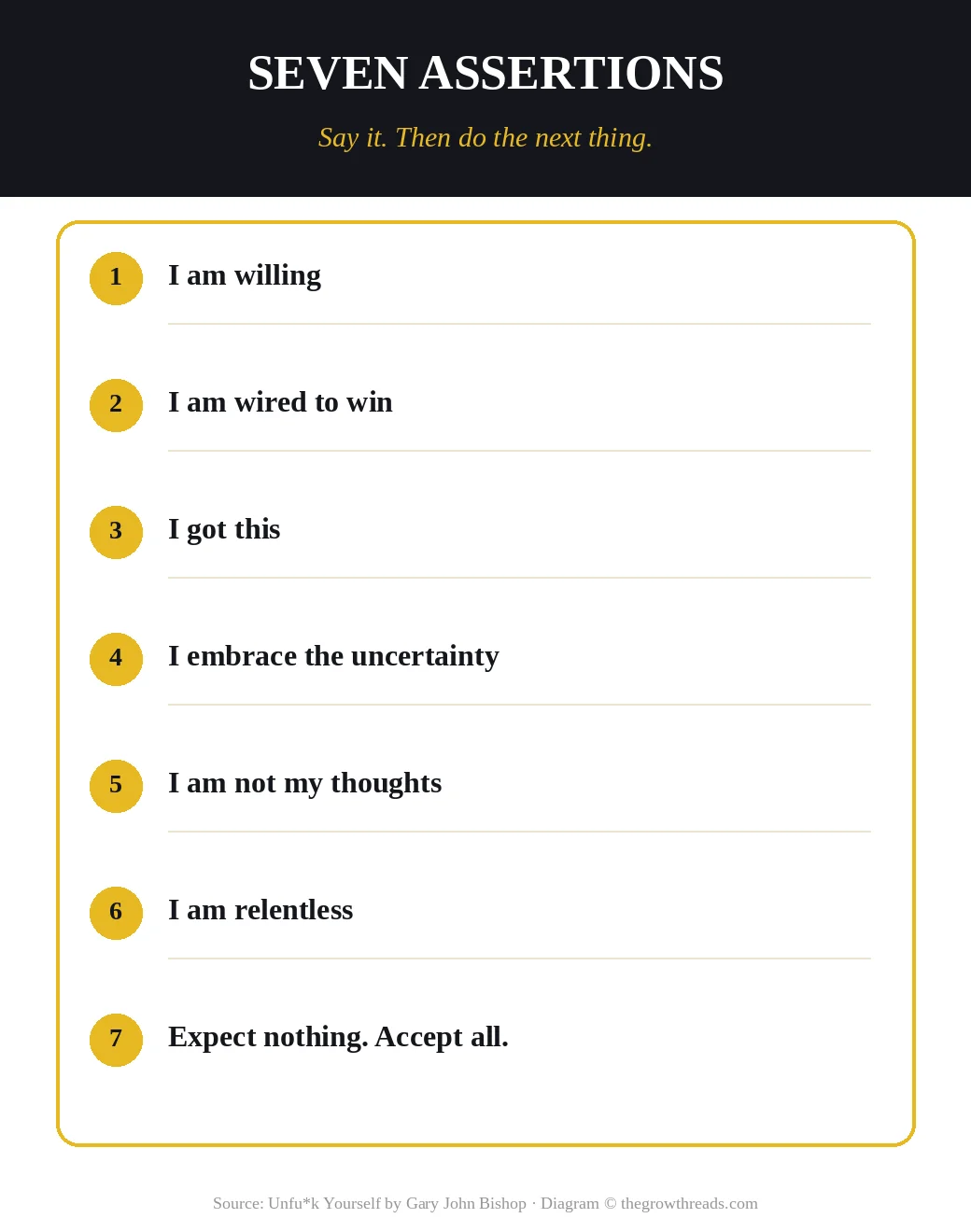
Bishop’s seven lines are: I am willing; I am wired to win; I got this; I embrace the uncertainty; I am not my thoughts, I am what I do; I am relentless; and I expect nothing and accept everything. Each one names a stall — refusal, the underdog story, competence panic, waiting for certainty, fusing with the voice, quitting at friction, or bargaining with reality — and points at a next move. You do not need to chant all seven. Pick the one that matches this morning’s script, say it once, and start the smallest action the sentence implies.
Is Unfu*k Yourself just positive thinking?
No. Positive thinking tries to swap a nicer story into the same chair. Bishop wants you out of the chair. The assertions are not mood wallpaper; they are instructions that only count if a behavior follows in the next few minutes. I am willing is a permission slip to begin while you still dislike the work. I am not my thoughts is a split between the narrator and the person who can still send the email. If the sentence does not change what your hands do, you are still listening. That is the whole test, and it is harsher than a vision board.
How is this different from Atomic Habits or The War of Art?
Atomic Habits is the architecture of showing up: cue, craving, response, reward. The War of Art names Resistance as the force that keeps the door closed. Unfu*k Yourself is the voice in the doorway. Use Clear when the problem is a missing cue. Use Pressfield when you need a name for the stall. Use Bishop when you already know the next task and you are still auditioning reasons. They nest. A tiny habit still dies if the narration chairs the meeting. Resistance still wins if you wait to feel ready. The assertion is the interrupt, then the habit can run.
Who is Gary John Bishop and should I trust the book?
Bishop is a Scottish-born personal development trainer who spent years as a senior programme director at Landmark Worldwide before writing in his own voice. HarperOne published Unfu*k Yourself in 2017 after an earlier self-published run; it became a New York Times bestseller. He is a coach, not a lab. Treat the book as applied self-talk, not as a randomized trial. The useful claim does not need a lab coat: rumination is cheap, and a ten-minute action changes the evidence the voice has to work with. If you want the science of habits next, stack Atomic Habits or Mini Habits after you have moved once.
How long does Unfu*k Yourself take to apply?
The hardcover is 224 pages, roughly four and a half hours of reading. Application is shorter on purpose. Day one is one assertion and one ten-minute task, not a personality rebuild. Most people who bounce off the book try to feel different first. Bishop’s sequence is the reverse: act, then let the feeling catch up. A week is enough to learn which of the seven lines you actually need. Ninety days is enough to notice whether your scoreboard — sent, shipped, walked, called — has changed. If nothing on the scoreboard moved, you were still listening, however loudly you underlined the chapter.
Should I read The 5 Second Rule or You Are a Badass instead?
Read The 5 Second Rule if your stall is a five-second freeze at the edge of the task — Mel Robbins is the physical interrupt. Read You Are a Badass if you need a warmer permission slip. Read Unfu*k Yourself if the problem is a long inner brief that sounds like thinking. Robbins moves the body. Sincero rebuilds the self-image. Bishop attacks the script that keeps both books theoretical. If you already own a pep-talk title and still have not started Tuesday’s hard thing, start here, then return to the habit book with one completed move.
Related summaries
- The War of Art — names Resistance; Bishop hands you the next sentence.
- Atomic Habits — the cue-and-reward architecture once you are out of the chair.
- The 5 Second Rule — the body interrupt at the edge of the task.
- You Are a Badass — a warmer permission slip if Bishop’s tone is too sharp.
- Best productivity books — the full Productivity pillar.
How we analyze books: every book on The Growth Reads is read cover to cover, summarized in thousands of words of original analysis, and rated against our five-criteria rubric (lasting impact, evidence quality, practical application, writing & originality, external consensus). Read our full methodology.