

★★★★☆ 4.3/5 — the original Robbins toolkit: run your state, then loop the formula until the result shows.
Best for: Capable people who already know the next move and still do not take it
Reading time: ~10 hours (448 pages) · this guide ~16 min
Difficulty to apply: Medium — the drills are simple; running them on a flat Tuesday is the work
Unlimited Power in one minute
You do not have a strategy problem. You have a state problem. Unlimited Power (1986) is Tony Robbins’ first big book: a field manual for running your brain the way excellent people already do. Information is cheap. The person who uses it while slumped, vague, and looping an unhelpful movie will lose to the person who stands up, specifies the outcome, and changes tactics when reality talks back. Robbins’ name for that loop is the Ultimate Success Formula. This summary is the application layer: state, modeling, four tools you can use this week, and a 7-day plan.
Key takeaways
- State first: Physiology plus the pictures, sounds, and feelings you run. Change those before you add another tactic.
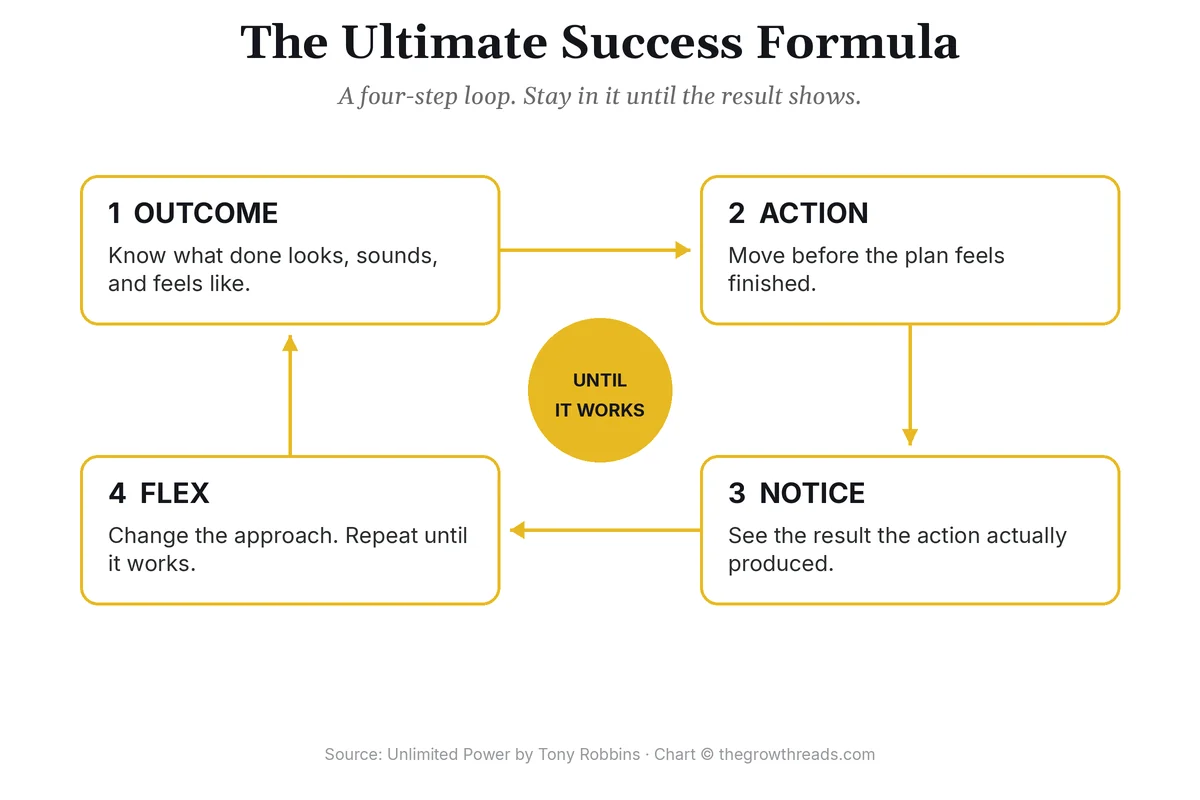
- The formula is a loop: Know the outcome, take action, notice the result, change the approach. Repeat until it works.
- Model excellence, do not collect it: Find someone who produces the result. Copy the difference that makes the difference.
- Beliefs are filters, not decorations: They decide what you notice and what you attempt.
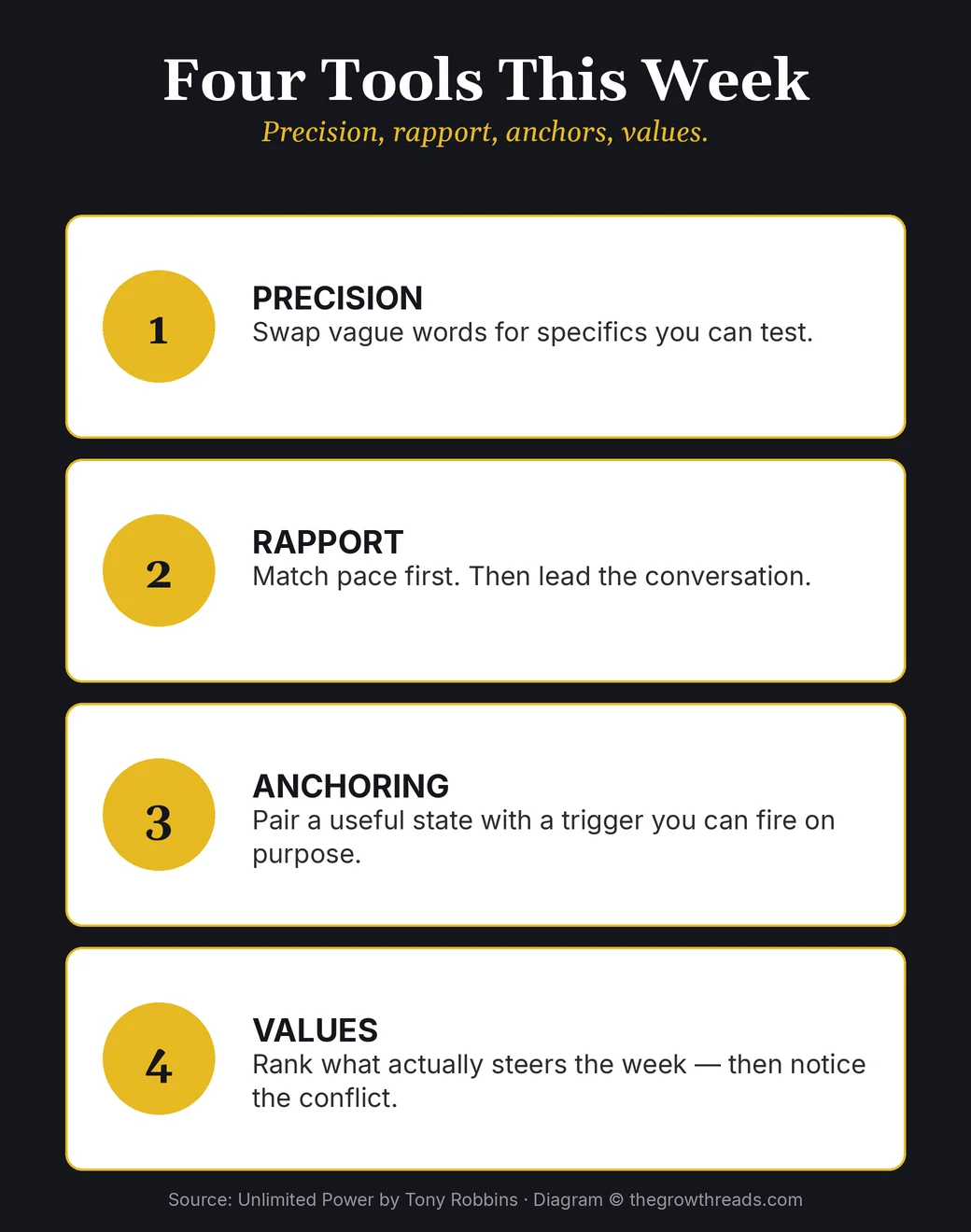
- Language is a tool: Vague nouns hide the next move. Precision makes the week testable.
- Rapport before lead: Match pace, then ask. People do not follow a mismatch.
- Anchors are on purpose: Pair a useful state with a trigger you can fire when the mood leaves.
- Values steer when willpower sleeps: Rank them. Conflicts in the ranking explain stalled weeks.
- Energy is a production system: Sleep, food, and movement are not extras. They are the instrument.
- The 10-day challenge is a streak: Refuse unresourceful language. If you slip, restart the ten days.

What is Unlimited Power about?
Unlimited Power is Tony Robbins’ 1986 playbook for personal achievement through NLP. You get results by running your state — physiology plus internal pictures, sounds, and feelings — then looping a four-step formula: know a sensory outcome, act, notice what happened, and change until it works. Modeling excellence beats collecting more information.
About the author
Tony Robbins (born Anthony Robbins, 1960) grew up in California and turned a janitor’s schedule into a career modeling how high performers actually produce results. In the early 1980s he studied NLP, ran seminars that made “state” a public demonstration, and published Unlimited Power in 1986 as the field manual. The later, more famous Awaken the Giant Within (1991) is the decisions book; the money titles came decades after. He writes here as a modeler, not a biographer: find the person who already has the result, isolate the beliefs and syntax that make it repeatable, and practise them until they are yours. The voice is urgent on purpose. The useful part is the drills. Explore all Tony Robbins book summaries →
Key concepts at a glance
| Concept | What it means | Use it when |
|---|---|---|
| State | Physiology plus internal pictures, sounds, feelings | You know the move and still will not start |
| Ultimate Success Formula | Outcome → action → notice → change, as a loop | You keep repeating a tactic that already failed |
| Modeling | Copy the difference that produces the result | You collect advice and still cannot repeat excellence |
| Submodalities | How you code a movie — size, distance, volume | An unhelpful image feels more real than the plan |
| Precision | Replace vague language with testable specifics | The meeting ends and nobody could film “better” |
| Rapport | Match pace, then lead | You are right and still losing the room |
| Anchoring | Pair a useful state with a trigger you can fire | You wait to feel ready before you begin |
| Values hierarchy | A ranked list of what actually steers the week | You say one thing matters and live another |
Part 1: Modeling excellence and the Ultimate Success Formula
Robbins’ opening argument is blunt: people who produce unusual results are not collecting more facts than you. They are running a different sequence. Modeling is the job of finding that sequence — the beliefs, the body, the order of questions — rather than admiring the outcome from the cheap seats.
The Ultimate Success Formula is the spine. Know your outcome in sensory terms. If you cannot say what you will see, hear, and feel when it is done, you do not have an outcome. You have a mood. Take action anyway; waiting for a perfect plan is how weeks vanish. Then look. Sensory acuity means noticing the result you actually got, not the one you narrated in the hallway. If it is not the outcome, change the approach. Flexibility is the power. Staying loyal to a tactic that already failed is not discipline. It is a stalled loop.
He is not asking you to become a different personality. He is asking you to treat excellence as something you can reverse-engineer. The tennis player, the closer, the calm parent — each has a syntax. Find it. Practise it. Measure it by the result, not by how inspired the journal entry sounded.
TGR Note: If you want the later Robbins — decisions, identity, a longer values chapter — go to Awaken the Giant Within. Unlimited Power is the earlier toolkit. Do not read both in the same week expecting two different personalities. Use this one for the loop; use Giant when the stall is “who I am,” not “how I start Tuesday.”
Part 2: State — physiology, pictures, and beliefs
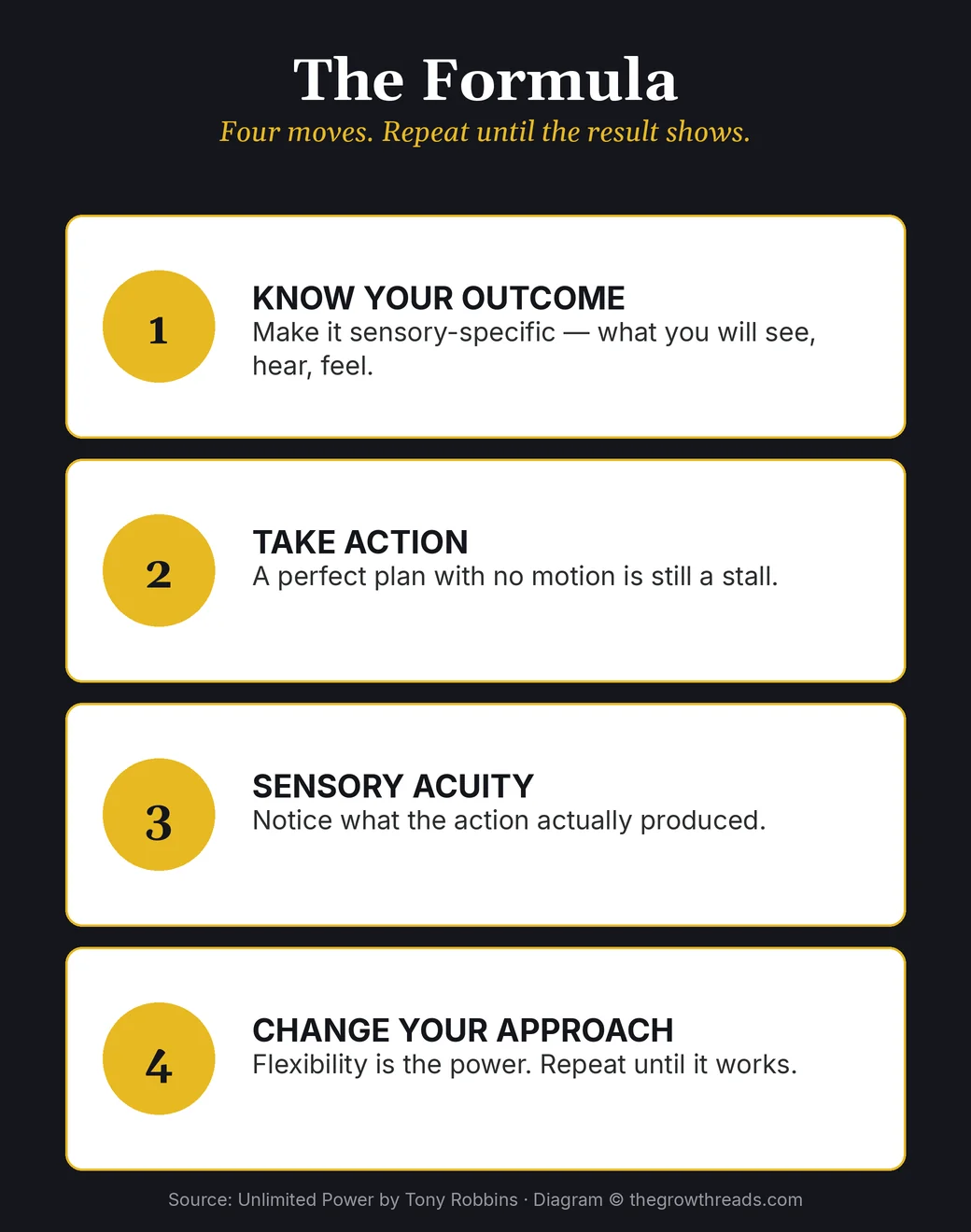
State is the switch. Robbins splits it into two levers you can actually grab. Physiology is first because it is fast: breath, posture, movement. Sitting like the problem already won is not rest. It is a vote. Change the body and the available thoughts change with it. That is why a two-minute reset beats another paragraph of self-talk from the same slump.
The second lever is internal representations — the movies you run. You do not experience the world raw. You experience a coded version: how close the picture is, how loud the voice is, whether the feeling sits in the chest or the gut. Those codes are submodalities. Dim an unhelpful image (smaller, farther, quieter). Brighten a useful one. You are not lying to yourself. You are editing the interface you already use.
Beliefs sit under both levers. They are filters: they decide what counts as possible and what you bother to notice. “I always choke in the last ten minutes” is not a personality. It is a program that looks for evidence. Robbins’ move is to treat beliefs as something you can test against a model who does not choke — then practise their syntax until yours updates. “The quality of your life is the quality of your communication,” he writes, and he means the communication inside your head as much as the conversation in the room.
TGR Note: For the self-image layer under state, Psycho-Cybernetics is the quieter sister. For the inner voice that misses, The Inner Game of Tennis is the useful pair. Robbins gives you the volume knob. Those two explain why the movie feels like you.
Part 3: Precision, rapport, and anchors
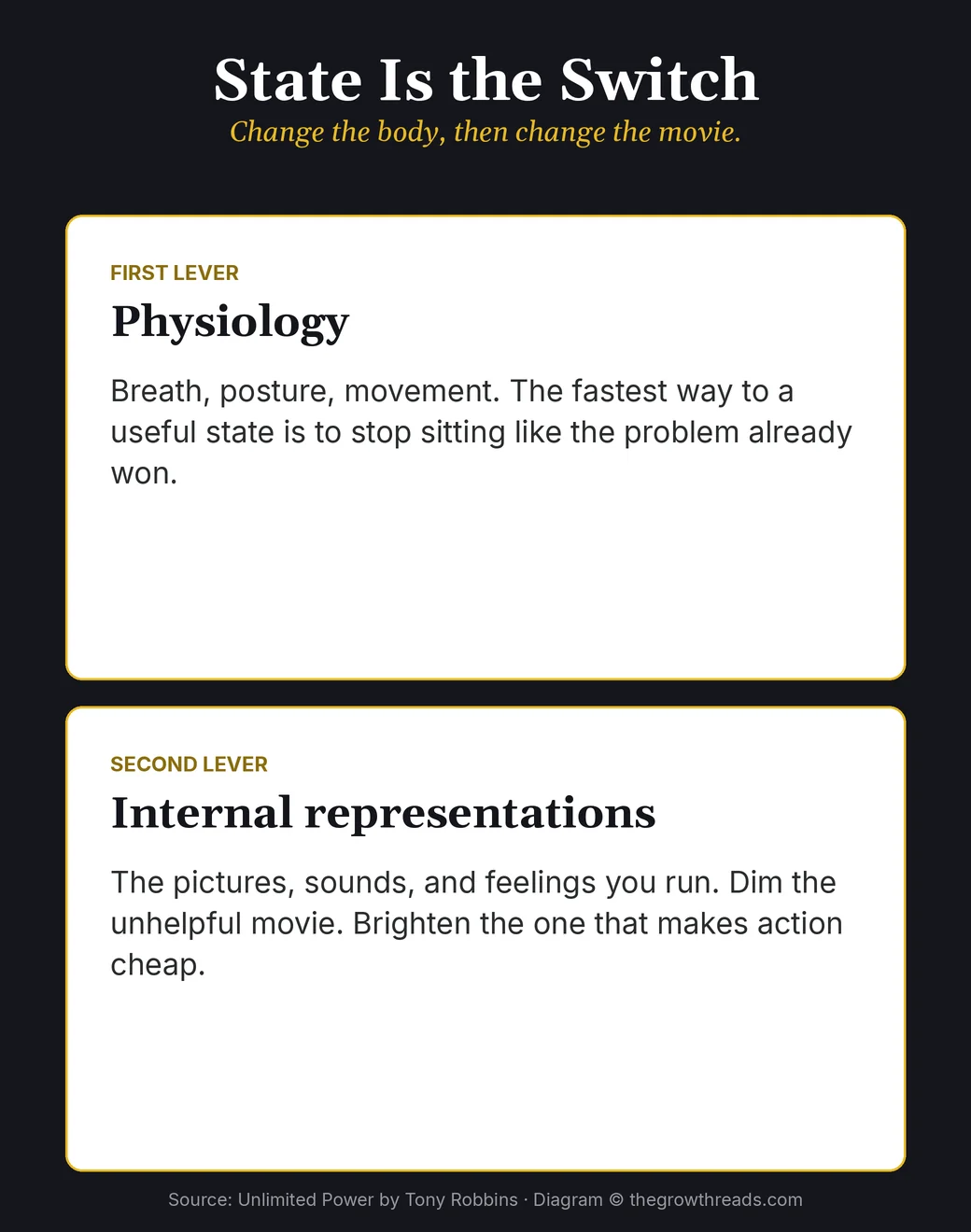
Once state is available, the book turns outward. Language is either a fog machine or a tool. The Precision Model (Robbins’ working version of the NLP meta-model) is a set of questions that refuse to let vague nouns do the work: who, specifically? compared to what? what would you see if it were done? “We need to communicate better” is not a next action. “By Friday I will send one paragraph naming the decision and the owner” is.
Rapport is the other half of communication. People do not follow a mismatch. Match pace — speed, volume, posture — long enough that the other person is no longer bracing, then lead. This is not mimicry as a trick. It is the precondition for an ask. Skip it and your excellent argument arrives as noise.
Anchoring is how you stop waiting to feel ready. Pair a useful state with a trigger you can fire on purpose: a gesture, a word, a song cue. The seminar version looks theatrical. The Tuesday version is small: one trigger that recalls the physiology of a time you already did the hard thing. Fire it before the task, not after the stall.
Metaprograms — how people sort for possibility versus necessity, self versus others, big picture versus detail — are the advanced chapter. You do not need the full map this week. You need one: notice whether you (or the person you are briefing) move away from pain or toward a picture. Brief them in their direction. Then get back to the formula.
TGR Note: If the action step keeps dying because it is too big, pair this chapter with Mini Habits or Atomic Habits. Robbins will tell you to move. Those books make the move embarrassingly small so the loop can actually repeat.
Part 4: Values, a compelling future, and the 10-day challenge
Values are the compass when willpower is tired. Robbins wants them ranked, not framed. A person who ranks “freedom” above “certainty” and then takes a job that only pays in certainty will look “unmotivated” while the ranking does the real work. Write the list. Number it. Watch the week. Where the calendar disagrees with the ranking, you have the actual problem.
A compelling future is the sensory outcome stretched across a season: enough detail that the nervous system can aim. It is not a vision board as décor. It is the first step of the formula written at 90 days instead of 90 minutes. If you cannot describe a Thursday in that future, it will not pull you through a Tuesday.
The 10-day mental challenge is the installation drill. For ten consecutive days, refuse to dwell in unresourceful language and unresourceful movies. If you catch yourself, the ten days restart. It is a streak by design. Robbins also names seven characteristics he kept seeing in the people he modeled: passion, belief, strategy, clarity of values, energy, bonding power, and mastery of communication. You do not need to tattoo all seven. Pick the one that is empty this month — often energy or precision — and run the formula on it.
“It’s not the events of our lives that shape us, but our beliefs as to what those events mean,” he writes. The 10-day challenge is how you stop rehearsing the old meaning long enough for a new syntax to stick.
TGR Note: For a later, more list-like personal OS, The Success Principles and High Performance Habits are cleaner 2020s companions. Robbins gives you state. Those books give you a weekly scoreboard so the compelling future does not stay a speech.
Who is Unlimited Power best for — and who should read something else first?
Best for people whose calendar is not the real constraint — state is. Best if you already know the next email, workout, or call and still do not start. Best if you communicate for a living and want questions that make “better” filmable. Best as the original Robbins toolkit before the Giant book.
Read something else first if you need a tiny-habit installer: Mini Habits or Atomic Habits. If the stall is capture and next actions, Getting Things Done is the system. If you want later Robbins on decisions and identity, start with Awaken the Giant Within. If you want belief without the NLP vocabulary, The Magic of Thinking Big is the shorter door.
Questions to reflect on
- What outcome this week is still a mood — and what would a camera actually see if it were done?
- When you stall, which lever is off: physiology, or the movie you are running?
- Whose result are you trying to copy without modeling their beliefs and syntax?
- Where does your values ranking disagree with last week’s calendar?
- What unresourceful sentence would restart the 10-day challenge if you said it out loud?
🔥 Ready to run the formula this week?
Get Robbins’ state toolkit, then use the 7-day plan below instead of collecting another tactic.
How to apply Unlimited Power (7-day plan)
- Day 1 — Write a sensory outcome. Write one outcome in what you will see, hear, and feel when it is done. If a stranger could not film it, it is still a wish.
- Day 2 — Change physiology first. Two minutes: stand, breathe, move. Do not start the hard task from the posture of defeat.
- Day 3 — Edit the movie. Dim one unhelpful picture; brighten one useful one. Notice the state change before you add tactics.
- Day 4 — Take the action anyway. One move toward the outcome. Motion is the second step of the formula, not the tenth.
- Day 5 — Ask precision questions. Replace two vague sentences with specifics you can test. “Better” is not an outcome.
- Day 6 — Practise rapport, then lead. In one real conversation, match pace first. Then make one clear ask.
- Day 7 — Start the 10-day challenge. For ten days, refuse to dwell in unresourceful language. If you catch yourself, the ten days restart. Set one anchor you can fire on purpose.
Frequently asked questions
What is Unlimited Power about in one paragraph?
Unlimited Power is Tony Robbins’ 1986 introduction to personal achievement through NLP. Results, he argues, come less from more information and more from the state you are in when you act — the combination of physiology and the pictures, sounds, and feelings you run internally. The operating loop is the Ultimate Success Formula: know a sensory-specific outcome, take action, notice what you actually produced, and change the approach until it works. Around that loop sit practical tools: precision in language, rapport, anchoring, and a ranked list of values. The book is a drill manual, not a biography of excellence.
What is the Ultimate Success Formula in Unlimited Power?
Four steps, used as a loop rather than a slogan. First, know your outcome in sensory terms — what you will see, hear, and feel when it is done. Second, take action; a perfect plan with no motion is still a stall. Third, develop sensory acuity: look at the result the action produced, not the result you hoped for. Fourth, change your approach and repeat. The power is in step four. People who keep the same move and wait for a different week are not using the formula. Stay in the loop until the outcome shows.
Is Unlimited Power the same as Awaken the Giant Within?
No. Unlimited Power (1986) is the NLP foundation: state, modeling, the four-step formula, precision, rapport, and anchors. Awaken the Giant Within (1991) is the later, more popular book about decisions — what you focus on, what you decide it means, and what you do — plus a longer treatment of values, rules, and identity. If you want the original toolkit for running your brain, start here. If you want the later “change that lasts” argument, read the Giant summary next. They rhyme; they are not duplicates.
How do you change state quickly, according to Robbins?
Change the body first, then the movie. Physiology is the fast lever: breath, posture, movement. Sitting like the problem already won is not a neutral stance — it is a state. Then inspect internal representations: the pictures, sounds, and feelings you are running. Dim an unhelpful image (smaller, farther, quieter) and brighten a useful one. Pair a useful state with a trigger you can fire on purpose — an anchor — so you are not waiting for inspiration. The point is not to feel amazing all day. It is to have a state that makes the next action cheap.
Who should read Unlimited Power — and who should skip it for now?
Read it if your week dies because of state, not because you lack another app: you know the next move and still do not take it. It is useful if you communicate for a living and want cleaner questions and faster rapport. Read something else first if you need a tiny-habit installer (Mini Habits, Atomic Habits), a capture system (Getting Things Done), or the later Robbins on decisions (Awaken the Giant Within). The NLP vocabulary is from 1986. The drills still work if you treat them as drills.
Is Unlimited Power still useful in 2026?
The jacket copy is dated. The problem is not. People still stall in a state that makes action expensive, still talk in vague nouns, still copy tactics without modeling beliefs. A 2026 reader can ignore the firewalk folklore and keep the loop: outcome, action, notice, flex. Pair it with a modern habit layer so the action step is small enough to repeat. Some original NLP claims have been debated; the practical advice — sit up, specify the outcome, change the approach — is uncontroversial.
How long does it take to apply Unlimited Power?
You can run the four-step formula on one outcome in a single week — that is the 7-day plan below. Anchors and rapport take a few real conversations, not a weekend seminar. The 10-day mental challenge is a streak: if you slip, the ten days restart. Modeling one person well takes longer than copying their morning routine. Treat the book as a season of drills. If you only do Days 1, 2, and 4 — a sensory outcome, a physiology reset, and one visible action — you are already practising it.
Related summaries
- Awaken the Giant Within Summary & Review
- Psycho-Cybernetics Summary & Review
- Mini Habits Summary & Review
- The Success Principles Summary & Review
- Best Productivity Books
How we analyze books: every book on The Growth Reads is read cover to cover, summarized in thousands of words of original analysis, and rated against our five-criteria rubric (lasting impact, evidence quality, practical application, writing & originality, external consensus). Read our full methodology.