

★★★★☆ 4.5/5 — Offer a new path, not a slightly better version of the old one.
Best for: coaches, consultants, and founders who already have a skill and need a message people will pay for.
Reading time: ~6 hrs, guide: 16 min · Difficulty to apply: Medium. You need a real skill and one small room, even five people.
Expert Secrets in one minute
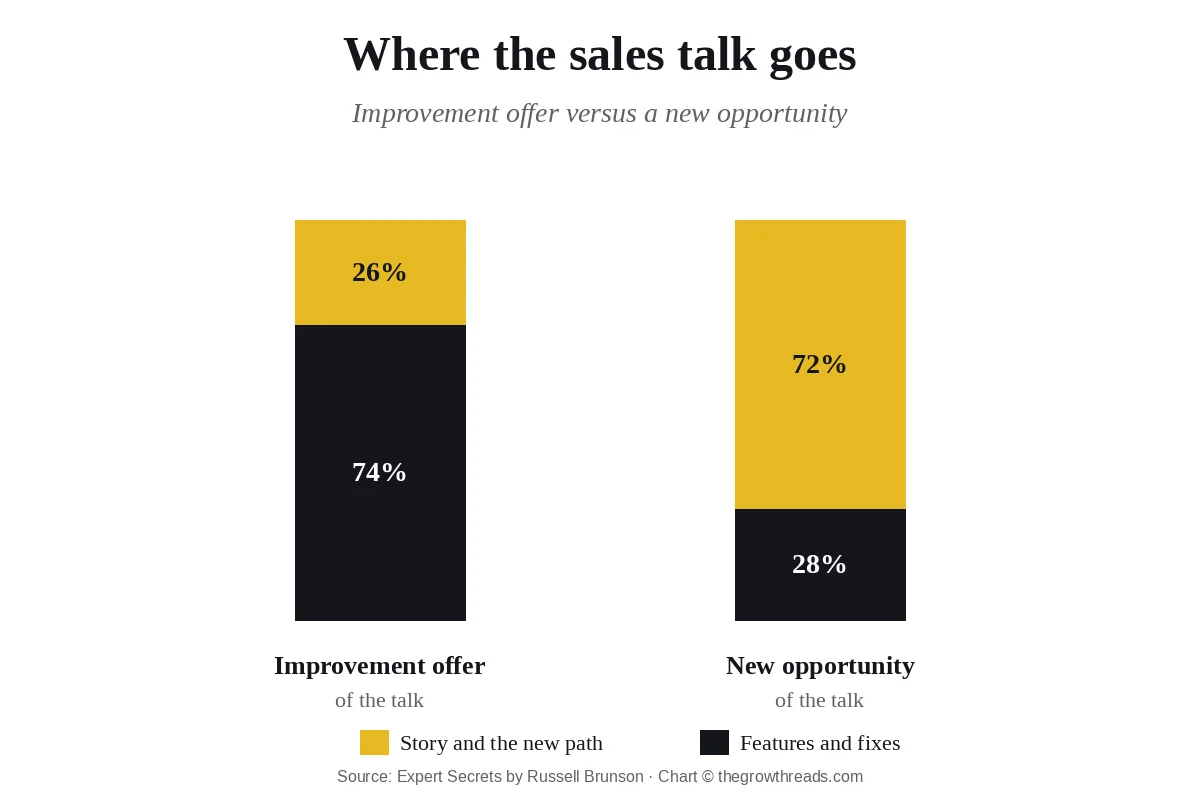
People do not leave a familiar failure for a slightly improved version of it. They leave when a leader offers a different vehicle for the same desire. That is the spine of Expert Secrets. Russell Brunson argues that a skilled person with a vague pitch will stay busy and underpaid, because the pitch asks the buyer to try harder at the path that is already exhausting them.
The fix is a movement with three parts: a specific leader, a future-based cause, and a new opportunity. Under those sits one belief, the Big Domino. Carry it with an Epiphany Bridge, a true scene of the old path breaking. Tell the script live, break three false beliefs, stack the offer, and only later automate it.
Key takeaways
- Status quo is the competitor: they are choosing you versus a method they already understand.
- Improvement offers stall: “do the old thing better” stays inside a story that failed. Change the vehicle.
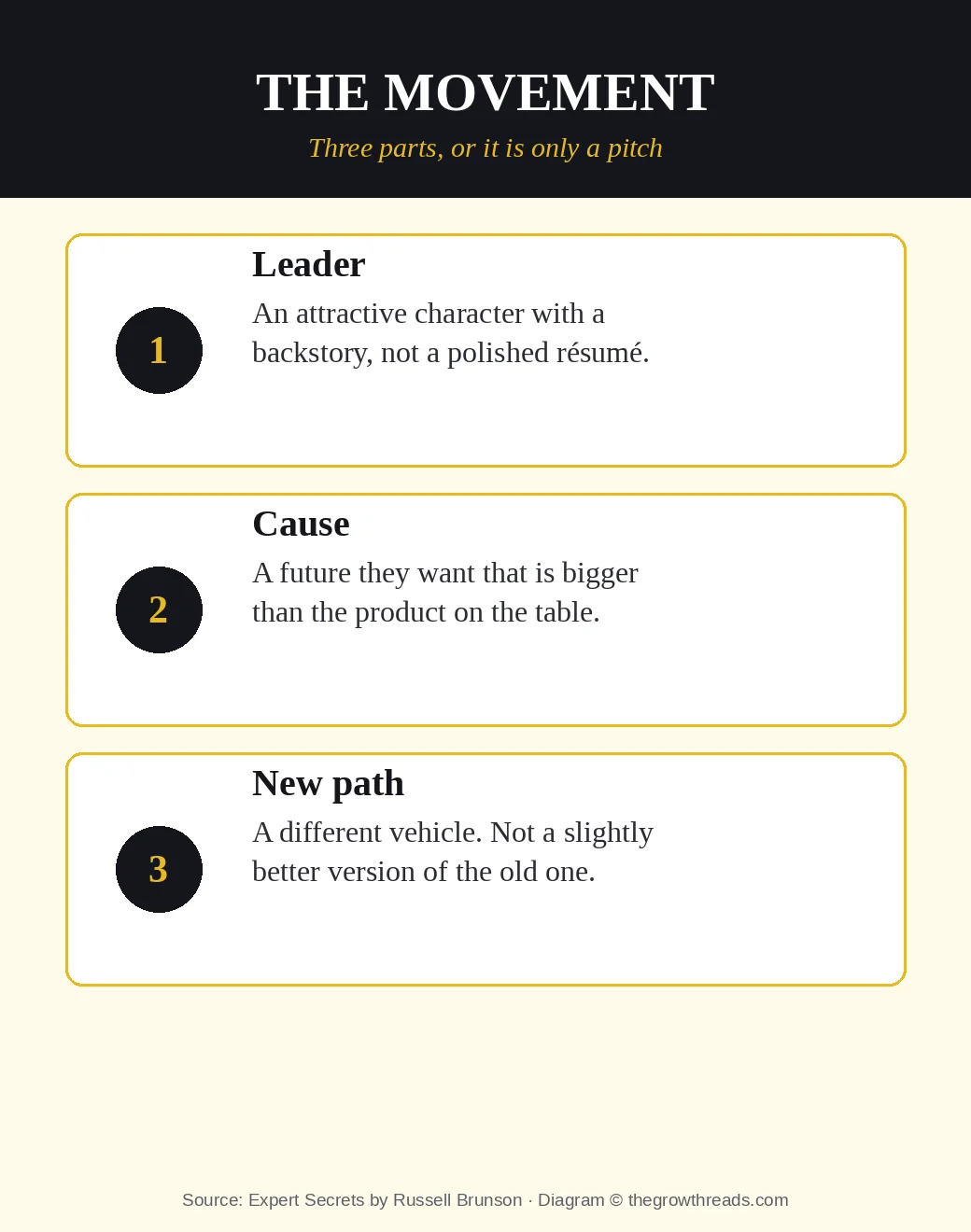
- A movement has three parts: a leader, a future-based cause, and a new opportunity.
- The Big Domino is one sentence: the new path is the key, and your vehicle is how they walk it.
- Stories create the belief: an Epiphany Bridge has a wall, a realization, and a plan.
- Three false beliefs, three stories: the vehicle, the self, or the outside obstacle.
- The stack makes the ask concrete: list what they get, then show the price.
- Say it live first: five people count. An untested recording only scales the confusion.
What is Expert Secrets about?
Expert Secrets is Brunson’s playbook for turning a skill into a paid movement. Buyers rarely leave a failing path for a slightly better version of it. They move for a new opportunity, a future they can name, and one story that makes a single belief feel true.
About the author
Russell Brunson is a marketer and cofounder of ClickFunnels. He came to direct response because a polished website is not the same thing as a sale, and he has traced his taste for repetition to competitive wrestling before he ever built software. The Secrets trilogy is his public curriculum. DotCom Secrets lays down the ladder. Expert Secrets, the 2017 Morgan James edition with a foreword by Robert Kiyosaki, is the belief that makes someone step onto it. Traffic Secrets, the third book, is about being found. Explore all Russell Brunson book summaries →
He writes like a practitioner in a room, not a historian of advertising. Read him for the sequence, then go deliver the result you just described. A loud movement with nothing underneath it is the failure mode.
Key concepts at a glance
| Concept | What it means | Use it when |
|---|---|---|
| New opportunity | A different vehicle for the same desire, not a tune-up of the old one. | Your pitch still sounds like the plan they already tried. |
| Attractive character | A specific leader with a backstory, a point of view, and real flaws. | Your about page reads like a résumé and nobody leans in. |
| Future-based cause | The world the buyer wants, bigger than your invoice. | People cannot repeat why you exist without saying your price. |
| Big Domino | The one belief that makes the smaller objections less urgent. | You are debating price, time, and trust as if they were separate wars. |
| Epiphany Bridge | A scene where the old path broke and the new one became obvious. | You have claims and case studies, and still no moment anyone feels. |
| False belief trio | The vehicle, the self, or the outside world is why they will say no. | The call dies at “I need to think about it” and you do not know which doubt won. |
| The stack | Every piece of the offer listed, valued, then priced. | The buyer cannot picture what they are actually saying yes to. |
Build the movement before you build the slides
Skilled people stall by pitching a better version of what the market already knows. Each sentence asks the buyer to stay inside a story that already disappointed them.
The competitor is the status quo. A new opportunity keeps the desire and changes the vehicle. “Work harder on the same funnel” is an improvement. “One niche, one promise, one weekly story” is a new opportunity, because a stranger can picture a different week.
A movement here is not a crowd. It has three parts. The leader is an attractive character: a backstory, a visible flaw, and a side of the argument. The cause is future-based, in words the buyer would use at dinner. The new opportunity is the vehicle that reaches that future without dragging the old failure behind it.
An accountant’s improvement pitch is “more accurate books.” The owner has already paid for books that arrived too late. The new opportunity is “a Friday number, one page, that tells you whether you can hire.” The cause is owners who decide with the week still in front of them. The leader is the person who once missed payroll by a weekend and built that page so the miss would not repeat. If the cause is only “buy my program,” you have a cash register. If the vehicle sentence still says “better” or “more,” you are selling the old road.
TGR Note: Put a floor under the story. DotCom Secrets builds the ladder. $100M Offers asks whether the vehicle is worth buying. Narrate the path only after both are real.
One belief, told as a scene
Once the new opportunity has a name, Brunson wants one belief, not a dozen arguments. He calls it the Big Domino. If they believe this new opportunity is the key to the result they want, and that they get it through your vehicle, the smaller objections shrink. Price is often a vehicle doubt in a nicer suit. “I don’t have time” is often an internal doubt. “My partner will never go for it” is an external doubt. You still answer them. You stop opening a new war for each one. If the domino needs a paragraph, you have a brochure.
An accountant’s version fits in one breath: if a one-page Friday number will change hiring more than a thicker report, and you will install that page in thirty days, the software argument can wait. Belief does not arrive through adjectives. It arrives through the Epiphany Bridge: the old belief, the wall, the moment the new path became obvious, and the plan that followed. The room has to feel the break. Logic is what people use later to defend a decision they already felt. Lead with logic and you get a nod. Nods do not buy.
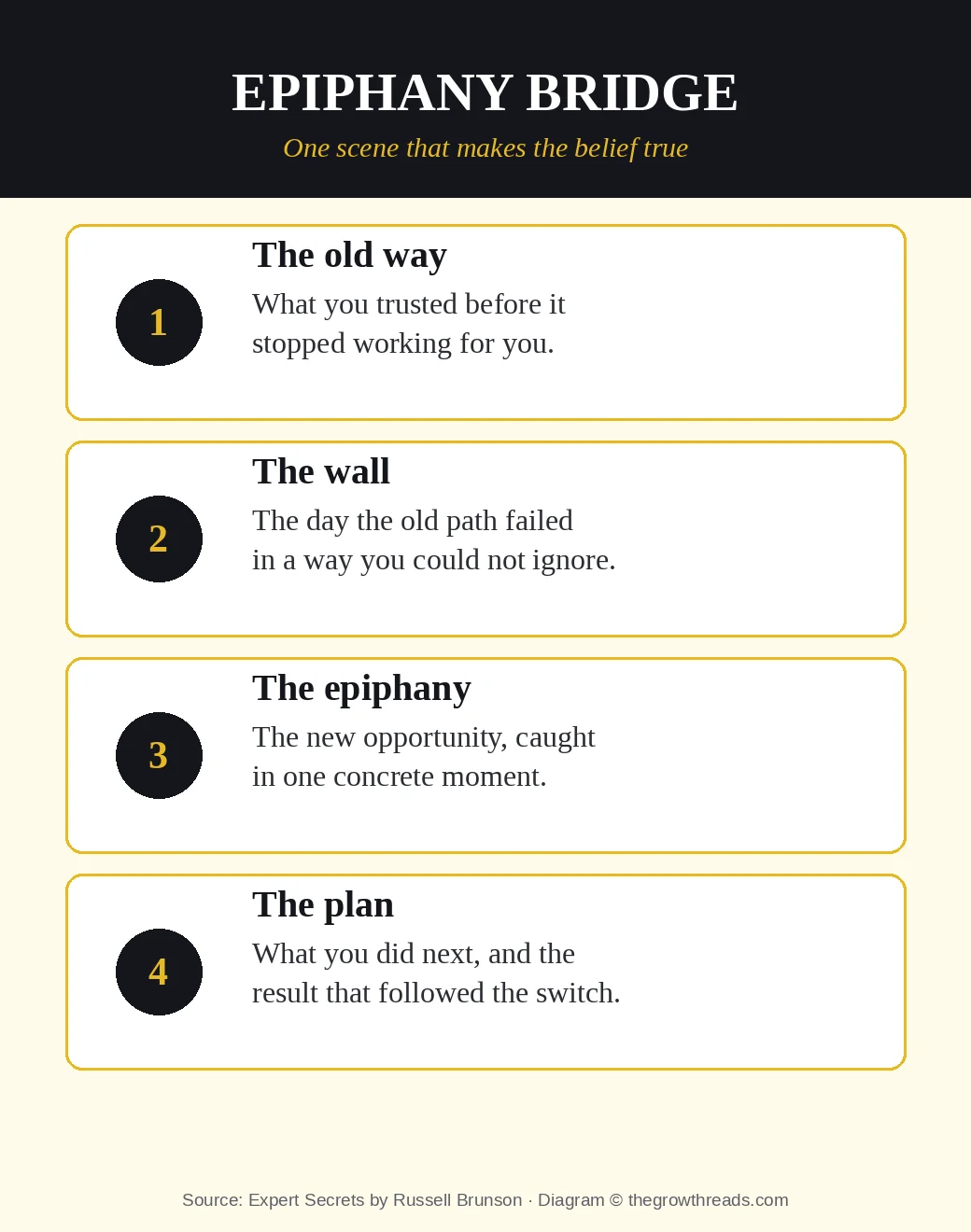
The scene has to be narrow enough to film. “I struggled and then I succeeded” is not a bridge. A fifteen-page proposal that lost to a one-page competitor, because the winner named the buyer’s fear in line one, is a bridge. A story that ends in genius teaches admiration. A story that ends in a step teaches movement.
Split the journey. The achievement is the external result. The transformation is who they become on the way. A number alone is a receipt. A feeling alone is a poster. The bridge needs both.
TGR Note: They Ask, You Answer publishes the same bridges before the call. If the inbox keeps the five questions the room never hears, write them down first, then use the live script for people who still want a conversation.
Break three false beliefs, then show the stack
The middle of the book turns that one belief into a script. Brunson sorts resistance into three false beliefs and wants a separate story for each. Mix them and the buyer feels lectured. Separate them and the buyer feels recognized.
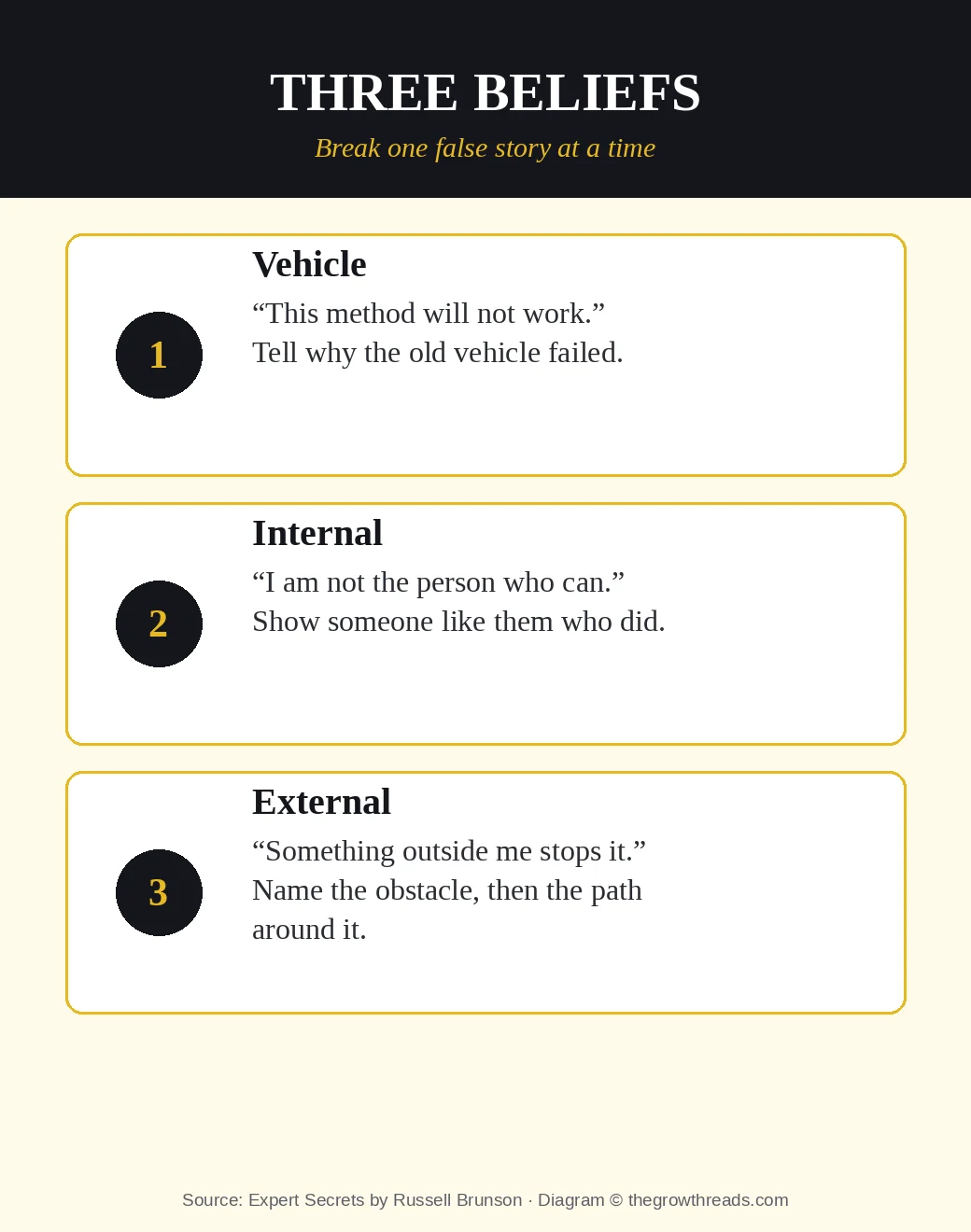
The vehicle belief says the method is the problem. You do not beat it with enthusiasm. You show why the old vehicle was built to fail. Three clever campaigns that never named a single offer were not underfunded. They were unfocused. The new vehicle is focus, not a louder ad. The internal belief says “I am not the kind of person who can,” and it hides inside competent people: the owner who can make the product and cannot say the price. The story that breaks it looks like the listener, same constraints, not like a fifteen-year highlight reel. The external belief says a partner, a season, or a tiny list will block it. A list of ninety people is not a reason to wait for a thousand. It is a reason to tell the script to those ninety this month.
Only then does the offer appear. The stack lists what the buyer actually receives: a Friday template, four working sessions, a rewrite of the offer sentence, a review of the first five conversations. Put a fair value next to each piece, then the price. Inflated values turn this into theater. Honest ones answer the only question a careful buyer has: what, exactly, am I buying? Say the script live, to a small room, before you record it. A webinar you have never survived in person just scales the sentences that do not land.
TGR Note: Building a StoryBrand keeps the buyer as the hero and you as the guide. Your bridge proves you have stood where they stand. Their name stays on the result.
Tell it this week, in a room you already have
The last demand in the book is repetition, not scale. Deliver the same script until you can feel the room change at one sentence. You do not need a launch. You need five people who already know your name and a hold on the calendar.
The technician does the work. The expert narrates the new opportunity so the right people recognize themselves. Deliver without a story and every client starts from zero. Narrate without delivery and the first result exposes you. Name the path, tell a true scene, state the price, and be able to survive a no.
Score the room, not the spike. Did they repeat the new opportunity? Did you learn which false belief was still standing? Did the stack make yes and no equally clear?
TGR Note: If “mass movement” starts to mean everyone, read This Is Marketing. A cause that includes every buyer softens the vehicle until it is an improvement offer again. Pick the people the new path is for.
Who is Expert Secrets best for — and who should read something else first?
This book is for someone who can already do the work and sounds foggy when they invite someone into it. Coaches, consultants, founders, and specialists with a real result and a résumé where a point of view should be. You will get the most from it if you can name ten people who might care, even if you do not have a list of ten thousand.
Read something else first when the missing piece is not the story.
- If the offer itself is thin, start with $100M Offers and build a vehicle worth narrating.
- If the first yes has no second step, start with DotCom Secrets and put a ladder under the story.
- If the same practical questions keep arriving unanswered, start with They Ask, You Answer and publish the bridges.
- If the buyer disappears from your stories, start with Building a StoryBrand and give them the hero’s seat back.
The wider shelf lives on the best productivity books page.
Questions to reflect on
- What old path are my buyers still loyal to, even when it keeps failing them?
- Can a stranger repeat my new opportunity in one sentence without using my product name?
- Which false belief shows up last, right before they say they need to think about it?
- Which scene from my own switch am I still telling as a résumé bullet instead of as a wall, an epiphany, and a plan?
- If I had to make the offer live on Thursday to five people, which line of the stack is still vague?
🔥 Ready to offer a new path?
Read the playbook, then tell the new opportunity once this week to a room you already have.
How to apply Expert Secrets (7-day plan)
- Day 1 — Name the vehicle. One sentence. If it says “better” or “more,” rewrite until the old plan disappears.
- Day 2 — Name the cause. The future, in their words, with your product name deleted. If a stranger cannot repeat it, cut words.
- Day 3 — Write the Big Domino. One breath: the new opportunity is the key, and your vehicle is how they get it. Circle the stumble.
- Day 4 — Draft the bridge. Old belief, wall, epiphany, plan. Under 200 words. Cut any line that only tries to impress.
- Day 5 — Three false beliefs. Vehicle, internal, external, in the buyer’s words. One short story each.
- Day 6 — Stack it on one page. Real pieces, a fair value, the total, the price. Delete any line you would hate to explain.
- Day 7 — Say it live. Five people, or one real prospect. Write down the sentence they did not believe. That is next week’s only edit.
Frequently asked questions
What is Expert Secrets about?
Expert Secrets is Russell Brunson’s playbook for turning a skill you already have into a message people will pay to follow. He argues that most experts pitch an improvement, a slightly better version of a path the buyer is already tired of, and then wonder why nobody moves. The book offers a different sequence: be a specific leader, name a future-based cause, and present a new opportunity. One belief, carried by a true story, does more work than a list of features. A simple script and a clear offer stack sit on top of that idea.
Is Expert Secrets worth reading after DotCom Secrets?
Yes, if DotCom Secrets gave you a ladder and you still sound vague when you describe why someone should step onto it. DotCom Secrets is about the path: who you help, where they are, what bait starts the relationship, and what result the ladder leads to. Expert Secrets is about the belief that makes a person willing to climb. Read DotCom first if you have no next step after the first yes. Read Expert Secrets when the next step exists and the story is still a résumé. One builds the vehicle. The other makes a stranger believe it.
What is a new opportunity versus an improvement offer?
An improvement offer asks someone to do the old thing better. A new opportunity offers a different vehicle for the same desire. Brunson’s point is that people rarely leave a familiar failure for a slightly improved version of it. Leaving feels like admitting the last two years were wasted. A new path lets them keep the goal and drop the method. A better morning routine is an improvement. A two-meeting week that protects four deep-work mornings is a new opportunity, because the vehicle changed. If a stranger can still picture the old plan, you have not switched yet.
What is the Big Domino in Expert Secrets?
The Big Domino is the one belief that makes the smaller objections less important. Brunson frames it this way: if someone believes the new opportunity is the key to what they want, and that your vehicle is how they get it, then price, timing, and the urge to think about it lose their grip. You still answer practical questions. You stop treating every question as a separate debate. Write it as one sentence before you build slides. If you cannot say it in a single breath, the script will wander. Most stalled offers are missing this sentence, not a feature.
What is an Epiphany Bridge?
An Epiphany Bridge is the story of the moment the old path broke and the new opportunity became obvious. Brunson wants a scene, not a highlight reel: what you used to believe, the wall you hit, the epiphany, and the plan you followed next. Emotion makes the belief feel true. Logic is what the buyer borrows later, when they explain the decision to a partner. A miracle with no steps entertains. A scene plus a plan invites. You need one bridge for the method, one for self-doubt, and one for the outside obstacle.
Do I need a large audience or a webinar to use this?
No. The script can live in a webinar, and Brunson teaches it that way, but the first delivery should be live and small. Five people on a call count. A Thursday workshop counts. One sales conversation where you try the Big Domino sentence counts. Automation comes after you can feel which story breaks which belief. A recorded webinar of a script you have never said out loud just scales the confusion. Borrow a room if you have no list: a client, a peer group, or one prospect who already raised a hand.
Who should read a different book before Expert Secrets?
Read a different book first if the raw material is missing. If you cannot name an offer someone would pay for, start with $100M Offers and build the vehicle before you narrate it. If the offer is real and there is no next step after the first yes, start with DotCom Secrets. If buyers arrive full of practical questions you have never published, start with They Ask, You Answer. If every story stars you, and the buyer cannot see their own life in it, read Building a StoryBrand and give them the hero’s seat before you polish the attractive character.
Related summaries
- DotCom Secrets summary — the ladder under this story: who, where, bait, and result.
- $100M Offers summary — make the vehicle worth describing before you scale the script.
- They Ask, You Answer summary — publish the belief-breaking answers before the call.
- Building a StoryBrand summary — keep the buyer as the hero while you lead.
- Best productivity books — the wider shelf, if you are still choosing the next read.