

★★★★½ 4.5/5 — a short parable that installs persistence as a daily script, not a mood.
Best for: Anyone who already knows what to do and still negotiates the start — salespeople, rebuilders, and readers who highlight advice they never reread
Reading time: ~3 hours (128 pages) · this guide ~12 min
Difficulty to apply: Easy to finish in a sitting — harder to keep one scroll for thirty days
The Greatest Salesman in the World in one minute
You do not have a motivation problem. You have a reread problem. Og Mandino’s claim, wrapped in a desert parable, is that character is a script you repeat until your mouth runs it without a meeting with your mood. Hafid, a camel boy, wants to be a great merchant. He receives ten short scrolls and a rule that is the whole book: read one, three times a day, for thirty days, then open the next. The famous lines are vows, not slogans. Read it to install one scroll this month, not to collect another philosophy of grit.
Key takeaways
- The book is a practice, not a pitch deck: Ten scrolls. One at a time. Three reads a day. Thirty days.
- Begin a new life means replace the old tape: Do not stack a goal on the sentence that already runs you. Swap the sentence.
- Love is the first sales tool: Greet the day — and the person in front of you — before you extract anything.
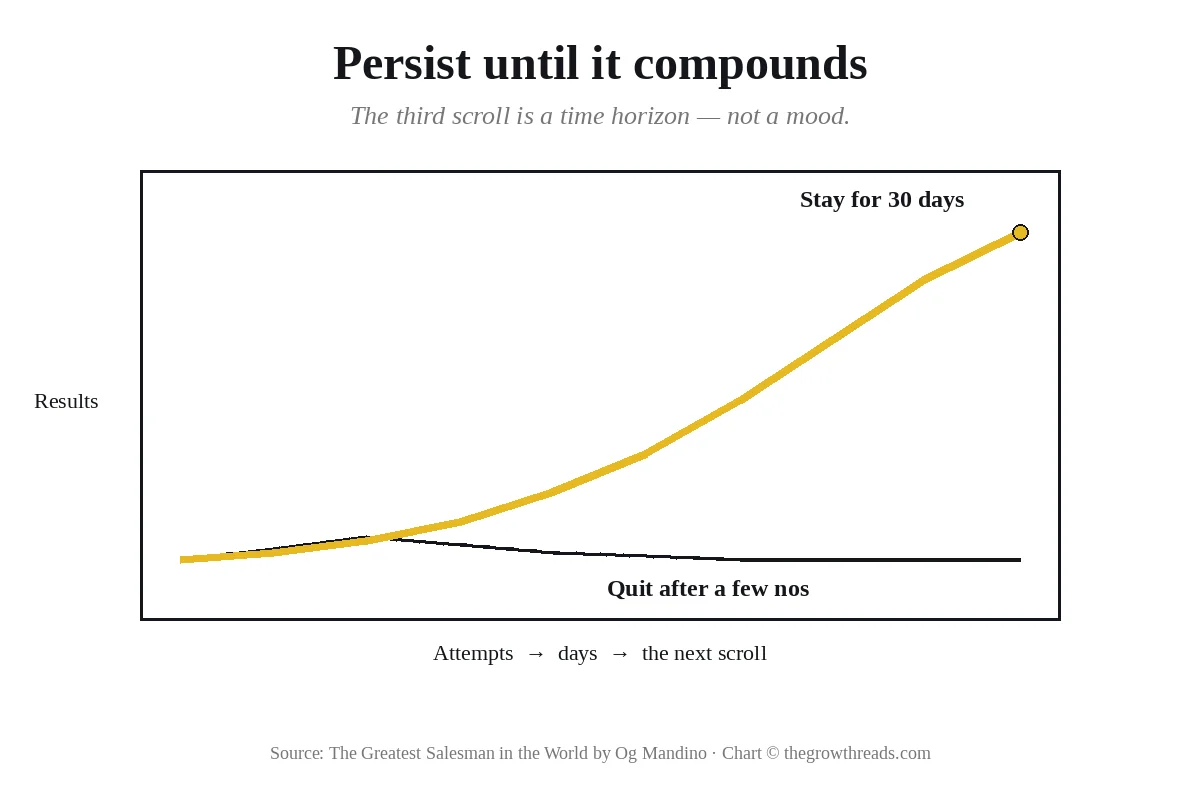
- Persist is a time horizon: “Until I succeed” is staying past the nos that usually send you home.
- You are not a copy: Comparison postpones the only life you can actually practice.
- Master emotion; do not abolish it: Feel the spike. Do not let it drive the next hour.
- Multiply value, then ask: Leave people better than you found them. The close is a side effect.
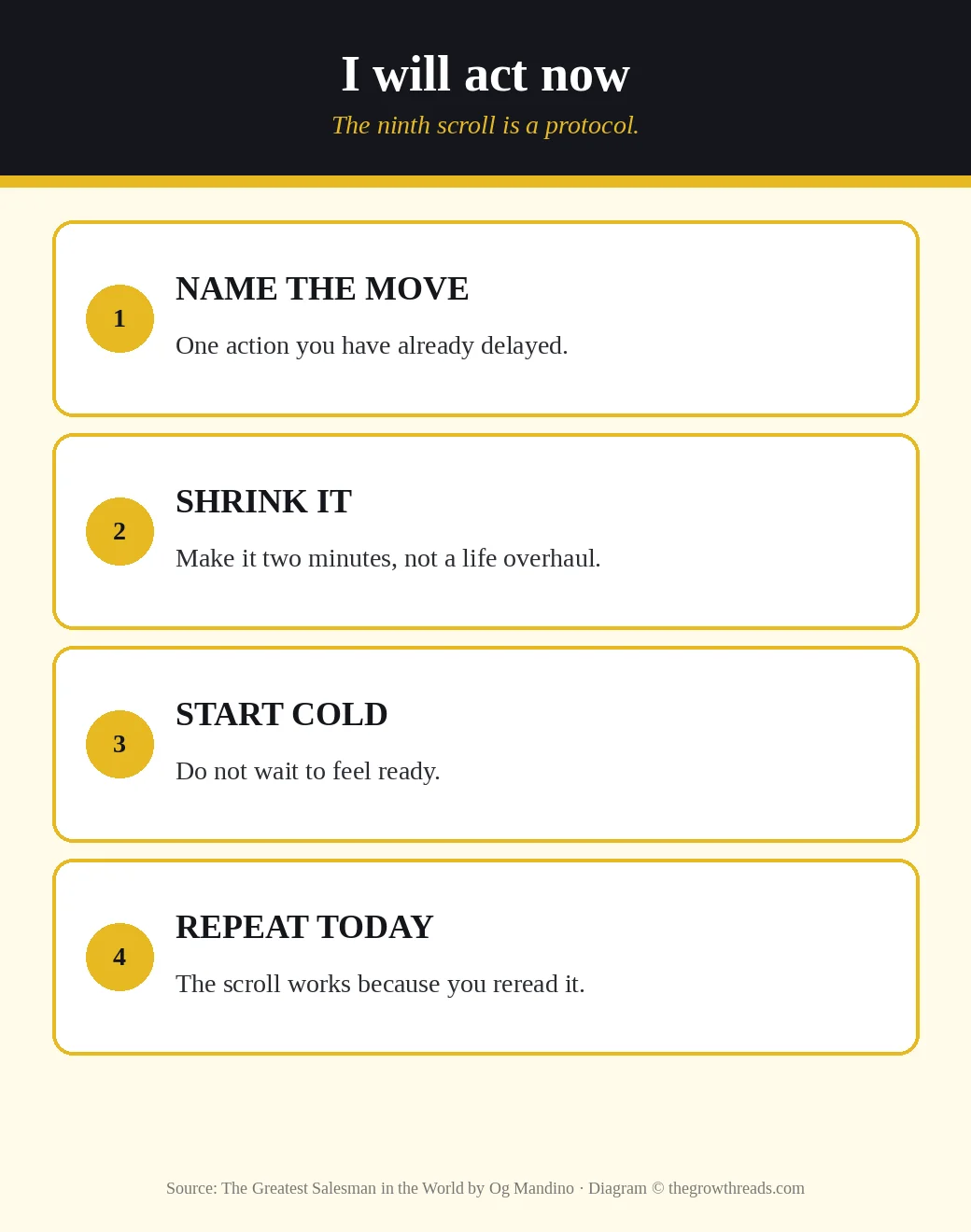
- Act now is the engine: The ninth scroll is a protocol for the thing you have already delayed.
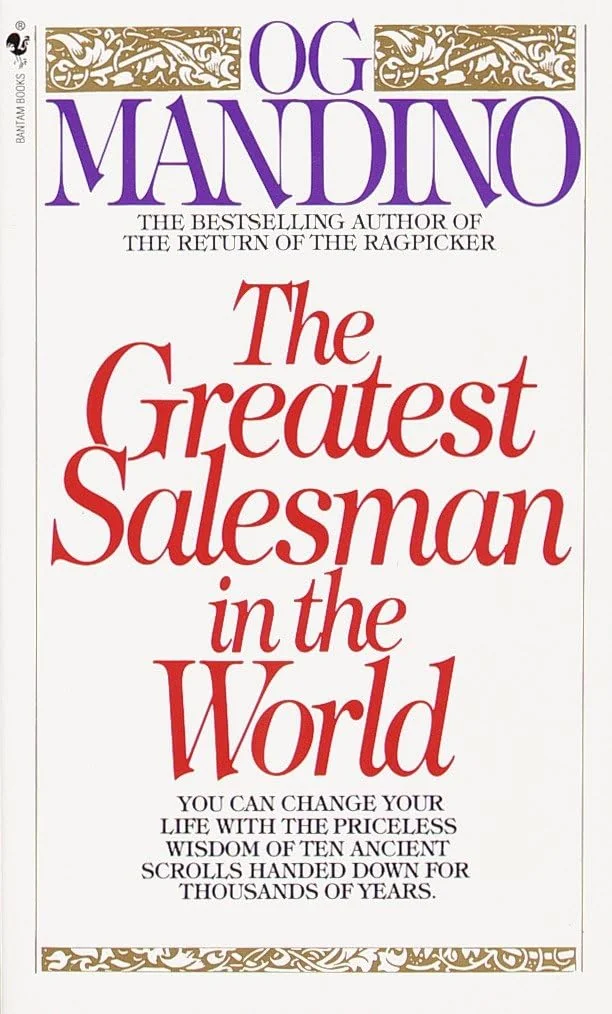
What is The Greatest Salesman in the World about?
The Greatest Salesman in the World is Og Mandino’s 1968 parable of Hafid, a camel boy who becomes a great merchant by living ten short scrolls. Each scroll is a daily script — persist, act now, begin again — read three times a day for thirty days before you open the next.
About the author
Augustine “Og” Mandino II (1923–1996) grew up in Massachusetts, flew as a World War II bombardier, then came home and fell apart — drinking, drifting, close to ending it in a Cleveland hotel. A library stack of self-help books became the first new script. He sold insurance, later edited Success Unlimited, and published The Greatest Salesman in the World in 1968. The book has sold tens of millions of copies in more than twenty languages. He is not a lab scientist. He is a recovered person handing you the reread that pulled him back. The ten scrolls are the method: short, first-person, meant to be done, not admired. Explore all Og Mandino book summaries →
Key concepts at a glance
| Concept | What it means | Use it when |
|---|---|---|
| The ten scrolls | Short first-person vows, lived in order | You keep collecting advice and never install one line |
| 30-day reread | Three reads a day, one scroll, then the next | You “got it” on page one and still have not started |
| Begin a new life | Replace the old mental tape, don’t stack a goal on it | January you is still running last year’s sentence |
| Persist until | Stay past the nos that usually send you home | You quit when the mood breaks, not when the work is done |
| Live this day | Today is the only unit the book will accept | Your plan lives in a someday file |
| Master of emotions | Feel the spike; do not hand it the steering wheel | One slight writes the rest of the afternoon |
| Multiply value | Leave people better than you found them | You are scoring the close instead of the help |
| Act now | Motion first, mood later — on one delayed move | You know the next action and keep negotiating it |
| Ask for guidance | Ask, then take the next honest step | You use “waiting for a sign” as a stall |
Part 1: The parable is a delivery system for a 30-day loop
The book opens at the end. Hafid is old and rich. A struggling seller named Erasmus wants a secret. The secret is a chest of ten scrolls and a rule Hafid survived more than invented: you do not get the next page until the current one has been lived. Success is not a speech you hear once. It is a page you reread until your day starts matching it.
Young Hafid tends camels and wants the traders’ life. Pathros will not hand him a route. He hands him a test: sell the most precious robe in the stock. Hafid fails the close and succeeds at what Pathros was actually grading. He gives the robe to a poor couple with a newborn in a cave — the book’s Nativity turn — because the night asks for warmth more than a price. Only then does the chest appear, with the law that makes this a productivity book: each scroll is read three times a day for thirty days. No skipping because you are clever. You are not studying sales. You are rehearsing a self.
TGR Note: If the identity swap is the part you want — new life, new tape — pair it with our Atomic Habits summary. Clear wants a cue and a reward. Mandino wants a sentence in your mouth for thirty days. Pick one live stall this week and give it a single line you will actually reread.
Part 2: Begin again, love, persist, and stop copying
Scroll I is a funeral for the old commentary. “Today I begin a new life” is permission to retire the sentence already driving the week — I’m behind, I’ll start Monday. Mandino’s crash sits under the page: he had to stop being the man in the hotel room before he could be the man with a route. Write the old sentence. Cross it out. Read the new one before you reopen the wound.
Scroll II is the one title-readers skip. Love, here, is not a feeling you wait for. It is how you greet the day and the human in front of you before you extract a yes. Pathros’s robe test was the same lesson: if you cannot greet, you will only hunt.
Scroll III is the line people quote and abandon on day four. “I will persist until I succeed.” The power is in until. Mandino sets a horizon that outlasts a mood and a week of silence. Hafid is not lucky at the first stall. The stall is not allowed to finish the story. In modern work that is the follow-up, the next draft, the second conversation after the first one went nowhere.
Scroll IV — I am nature’s greatest miracle — kills comparison. You cannot run someone else’s route with your own feet. Uniqueness here is not a brand exercise. It is a ban on postponing your practice until you look like the person on the stage.
TGR Note: Thirty days will feel theatrical if you cannot start a two-minute version. Our Mini Habits summary is the shrink-ray. If you are already in a start-stop loop, Finish cuts the goal in half so persistence has a finish line. Use Mandino for the vow. Use those two when the vow is still too big to pick up.
Part 3: Today, emotion, laughter, and multiplied value
Scroll V spends the only currency the book accepts: today. Mandino is not asking for drama. He is attacking the someday file — where ambitious people store the work that would actually change the week. Old Hafid is restless because “later” ate the days. What would you still do if this were the last workday you got? Do a slice of that before noon.
Scroll VI puts you in charge of the weather inside. Master of my emotions does not mean numb. It means the slight, the delay, the spike of fear does not get to drive the next hour. Mandino learned this the expensive way. The cheaper version is still costly: one message writes the afternoon. Name the feeling in a clause. Keep the next action the scroll already named.
Scroll VII — I will laugh at the world — restores proportion. The work can be serious. You cannot be. Laughter is also a sales skill: people move toward the person who is not crushing the room with need.
Scroll VIII is the closest the book comes to a commercial strategy. Multiply your value a hundredfold — not your hours, your usefulness. The hundredfold is poetry. The mechanism is compounding competence plus generosity. The unit of progress is value delivered, not time performed.
TGR Note: If the stall is the room, not the vow, read Good Habits, Bad Habits. Wendy Wood’s point is that context beats grit. Mandino already built the context (morning / midday / night). Park the card on the kettle and the pillow so the 30-day loop has somewhere to live.
Part 4: Act now, ask, then pass the chest
Scroll IX is the engine. “I will act now.” Every prior scroll can become calligraphy without this one. Mandino repeats the command until it is boring, which is the point. Action is a timestamp, not a personality type. The camel boy does not wait to feel like a merchant. He takes the next stall. The modern translation is the email rewritten four times, the call you keep moving. Shrink it. Start cold. Let the mood catch up on the walk back.
Scroll X — I will pray for guidance — is easy to misread as a stall. In Mandino’s hands it is the opposite of waiting for a vibe. You ask, then you take the next honest step you already have light for. Guidance that never turns into motion is just a prettier form of delay. The book is not a theology class. It is a reminder that you do not have to see the whole route to walk the next street.
The frame closes the way a good practice should: Hafid does not keep the chest as a trophy. He passes it. Erasmus gets the scrolls when he is ready to live them, not quote them. If someone else can run the 30-day reread without your speech attached, you actually learned it.
Beside a modern selling book the difference is loud. To Sell Is Human gives attunement and an off-ramp. The Go-Giver gives a value-first posture. Mandino gives you a mouthful you can still say when both feel too clever for a bad Tuesday. Use him for the start. Use them for the craft once you are moving.
Who is The Greatest Salesman in the World best for — and who should read something else first?
Best for people whose week is full of known next actions and empty of starts. Also for anyone rebuilding after a crash — Mandino wrote from that room — and for sellers who flinch at tricks. The book gives you a vow and a calendar, not a costume.
Read something else first if you need a modern map. For cues and identity, start with Atomic Habits. For moving others without becoming a closer, To Sell Is Human. For value-first posture, The Go-Giver. If thirty days is a joke right now, Mini Habits. Come back to Mandino when you are ready to reread on purpose.
Questions to reflect on
- What sentence already runs your mornings — and which scroll would you actually swap it for?
- Where in the last five workdays did you quit at a no that was probably temporary?
- What is the one delayed action that would make “I will act now” concrete before noon?
- If you greeted the next person as a gift instead of a net, what would change in the first two minutes?
- Who gets the chest if this loop works — and what would they need written down besides your enthusiasm?
🔥 Ready to stop negotiating the start?
Get The Greatest Salesman in the World, then run one scroll three times a day this week — not all ten as a poster.
How to apply The Greatest Salesman in the World (7-day plan)
- Day 1 — Pick one scroll, not ten. Write scroll nine on a card: I will act now. Under it, name one delayed move in six words.
- Day 2 — Morning read before inbox. Read the card out loud. Then do two minutes of the named move. Stop. That is the whole drill.
- Day 3 — Midday reread when the mood dips. Same card, same move if it is unfinished. Do not upgrade the goal.
- Day 4 — Count the nos. Tally rejections or stalls without a story about your character. Persistence starts with a count, not a mood.
- Day 5 — Greet first. In one live conversation, lead with the other person’s constraint or need before you ask for anything. That is scroll two in the wild.
- Day 6 — Night read, then sleep. Read the card once more. Put it on the pillow. No third task. Protect the loop.
- Day 7 — Decide the next 30. Keep scroll nine for a month, or graduate to scroll three (persist) if the start is now cheap. Write the 30-day end date on the card.
Frequently asked questions
What is The Greatest Salesman in the World about in one paragraph?
The Greatest Salesman in the World is Og Mandino’s 1968 parable of Hafid, a camel boy who becomes a master merchant by living ten short scrolls. Each scroll is a daily script — begin again, greet the day with love, persist, remember you are unique, live today, master emotion, laugh, multiply your value, act now, and ask for guidance. You read one scroll three times a day for thirty days before opening the next. The book is not a close-technique manual. It is a character-installation loop dressed as a story, written by a man who used scripts to rebuild a life.
What are the ten scrolls in The Greatest Salesman in the World?
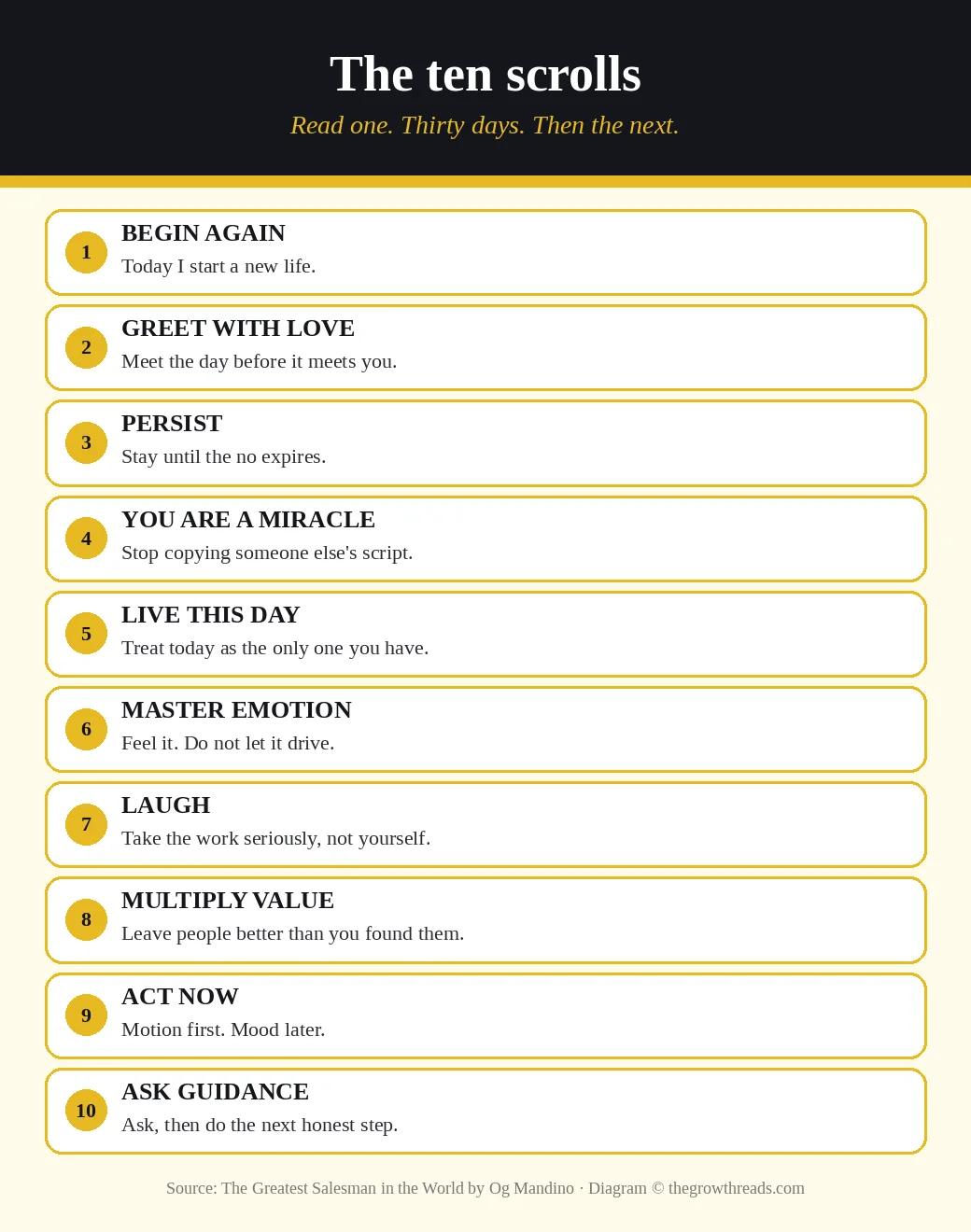
The ten scrolls are short first-person vows. One: today I begin a new life. Two: I will greet this day with love in my heart. Three: I will persist until I succeed. Four: I am nature’s greatest miracle. Five: I will live this day as if it is my last. Six: today I will be master of my emotions. Seven: I will laugh at the world. Eight: today I will multiply my value a hundredfold. Nine: I will act now. Ten: I will pray for guidance. Treat them as a sequence, not a poster. Mandino’s rule is one scroll at a time, reread until it is muscle.
How does the 30-day reading practice actually work?
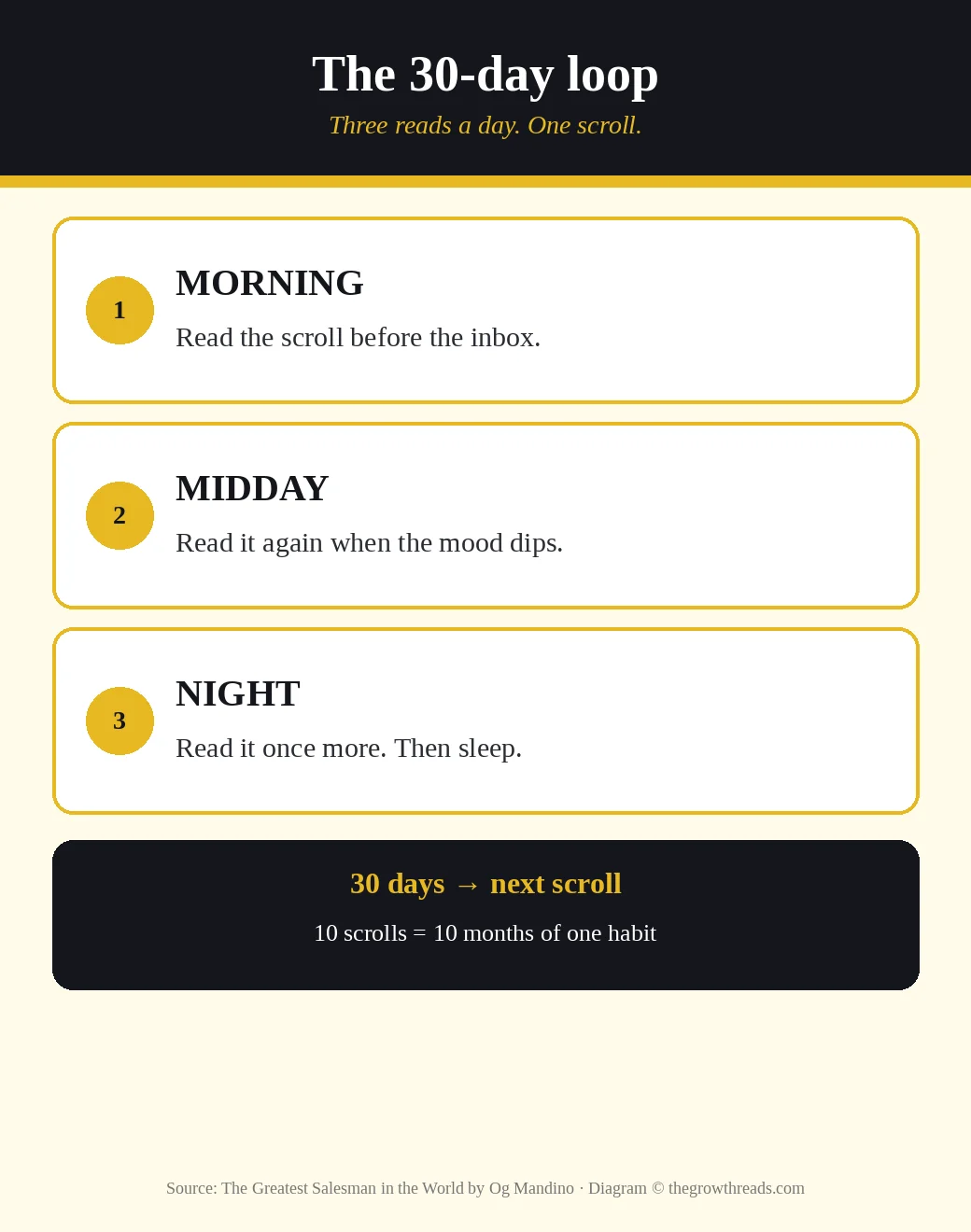
Pick one scroll. Read it in the morning before the inbox, again at midday when the mood dips, and once more at night. Do that for thirty days. Do not skip ahead because you “get it.” The point is not comprehension. It is installation. After thirty days, seal that scroll and open the next. Ten scrolls at that pace is about ten months of one habit. If thirty days feels huge, run scroll nine — I will act now — for seven days first, then stretch the loop. The practice is the book. The story is how Mandino gets you to stay.
Is The Greatest Salesman in the World a sales book or a self-help book?
Both, and the sales part is smaller than the title suggests. Hafid learns to sell by becoming the kind of person people trust: persistent, useful, emotionally steady, quick to act. There is no funnel, no objection flowchart, no closing script. If you need modern persuasion craft — attunement, pitches, an off-ramp — read To Sell Is Human after this. If you need a daily character loop you can reread on a bad Tuesday, start here. The “salesman” in the title is a stand-in for anyone whose work requires other people to say yes.
Is The Greatest Salesman in the World still worth reading in 2026?
Yes, if you treat it as a practice book rather than a research book. The language is 1968. The Nativity frame is of its time. There are no studies. What still earns the hour is the 30-day reread: a spaced, first-person script that does not depend on motivation. Pair it with a modern habit book if you want cues and environment design. Skip it only if parable-and-vow is a format you will not follow. For everyone else, one scroll installed beats another highlighted chapter on grit. The useful test is whether you can still say the line without the page.
How is The Greatest Salesman in the World different from The Go-Giver?
The Go-Giver is a modern fable about giving value first — five laws for becoming the person others want to work with. Mandino is older, shorter, and more monastic: ten vows, a 30-day reread, and a command to act now. Burg and Mann teach a market posture. Mandino teaches a daily mouth-and-muscle loop. Read The Go-Giver when the stall is selfishness or scorekeeping. Read Mandino when you already know what to do and you keep negotiating the start. They stack. They are not substitutes. Start with the one that names this week’s actual friction.
What is the fastest way to apply The Greatest Salesman in the World this week?
Do not start all ten scrolls. Open scroll nine. Write one delayed action at the top of a card: the email, the call, the page, the apology. Shrink it until it fits in two minutes. Read “I will act now” three times — morning, midday, night — and do that one move before the third read. Log the nos without a story about your character. On day seven, keep the same scroll or graduate to scroll three (persist) for a longer horizon. The book works when a line gets into your mouth before a mood gets a vote.
Related summaries
- The Go-Giver — value first, then the yes
- To Sell Is Human — modern craft for moving others
- Atomic Habits — cues and identity under the vow
- Mini Habits — shrink the scroll until it is too small to skip
- Best productivity books — the silo list
How we analyze books: every book on The Growth Reads is read cover to cover, summarized in thousands of words of original analysis, and rated against our five-criteria rubric (lasting impact, evidence quality, practical application, writing & originality, external consensus). Read our full methodology.