

★★★★½ 4.6/5 — the house manual for a talk they can rebuild.
Best for: Operators, founders, and specialists who present ideas and still dump a slide novel
Reading time: ~5 hours (288 pages) · this guide ~12 min
Difficulty to apply: Medium — the throughline is simple; rehearsal is the work
TED Talks in one minute
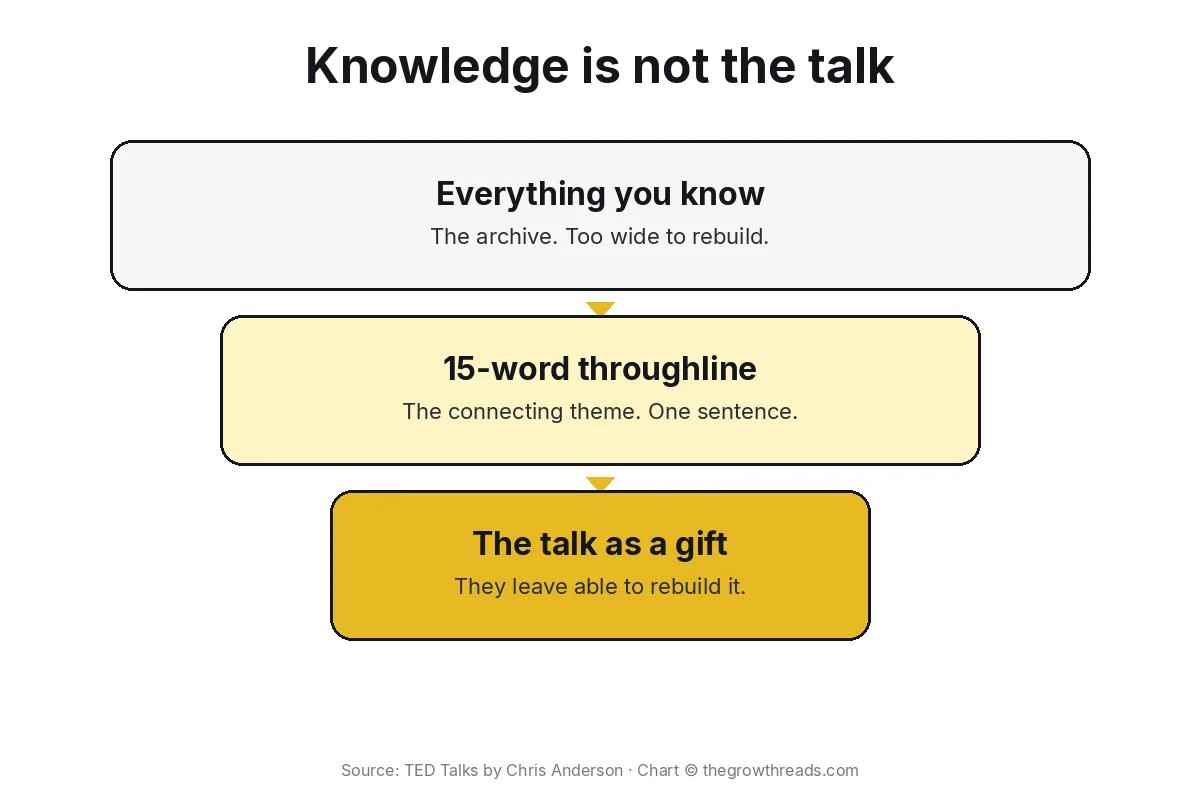
If they cannot rebuild your idea in their own words, you did not give a talk. You gave them your notes. Chris Anderson’s TED Talks summary in one line is that: a talk is a gift. You take something that matters deeply, cut it to a throughline of fifteen words or fewer, and reconstruct it inside other people’s heads. Presentation literacy is a skill you can build. The TED stage is optional. Tuesday’s all-hands is not. This book is how the next pitch, demo, or lecture stops being a tour of everything you know.
Key takeaways
- A talk is a gift: they must be able to rebuild the idea when you sit down.
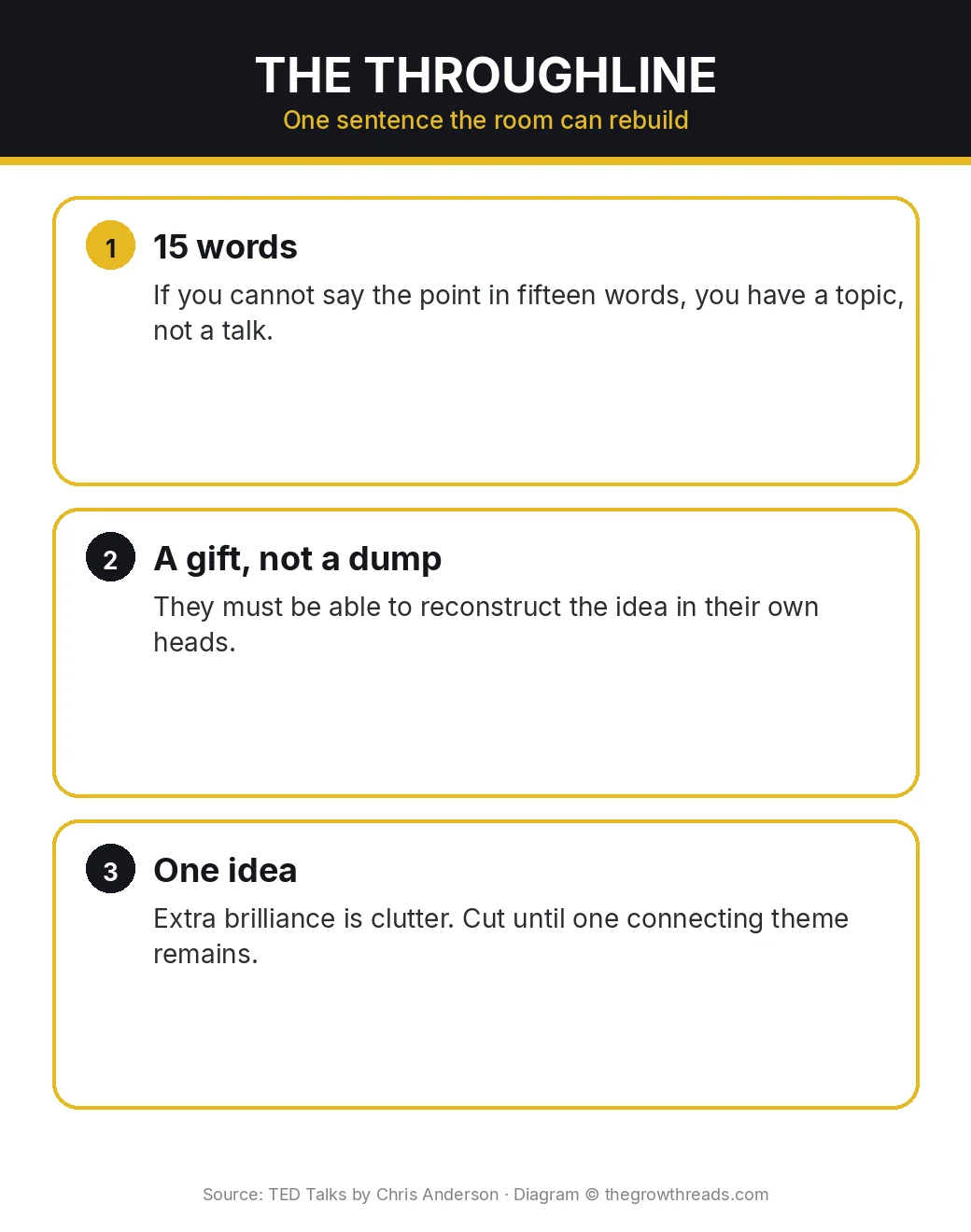
- The throughline: one connecting theme, spoken in fifteen words or fewer.
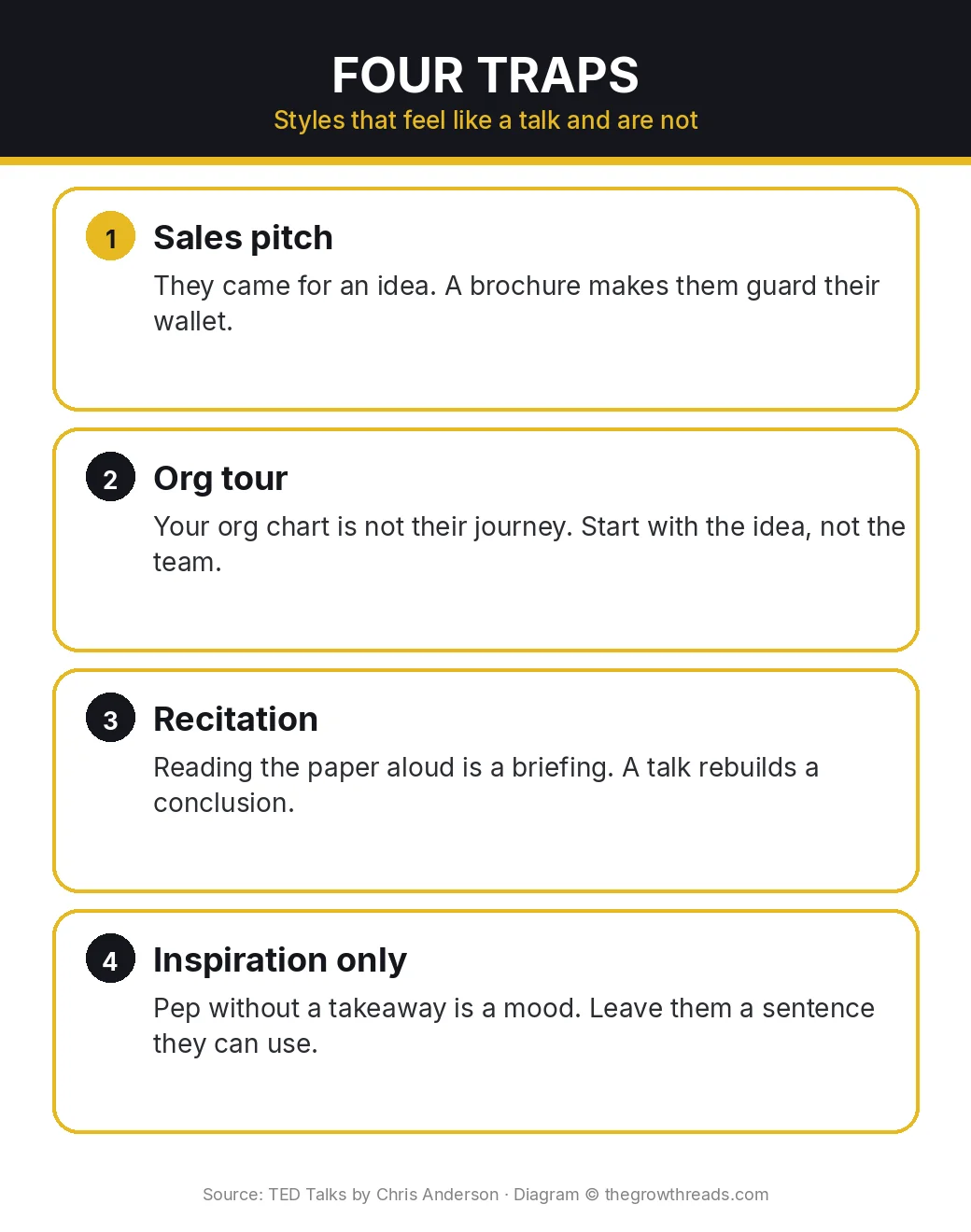
- Four traps: sales pitch, org tour, recitation, inspiration with no takeaway.
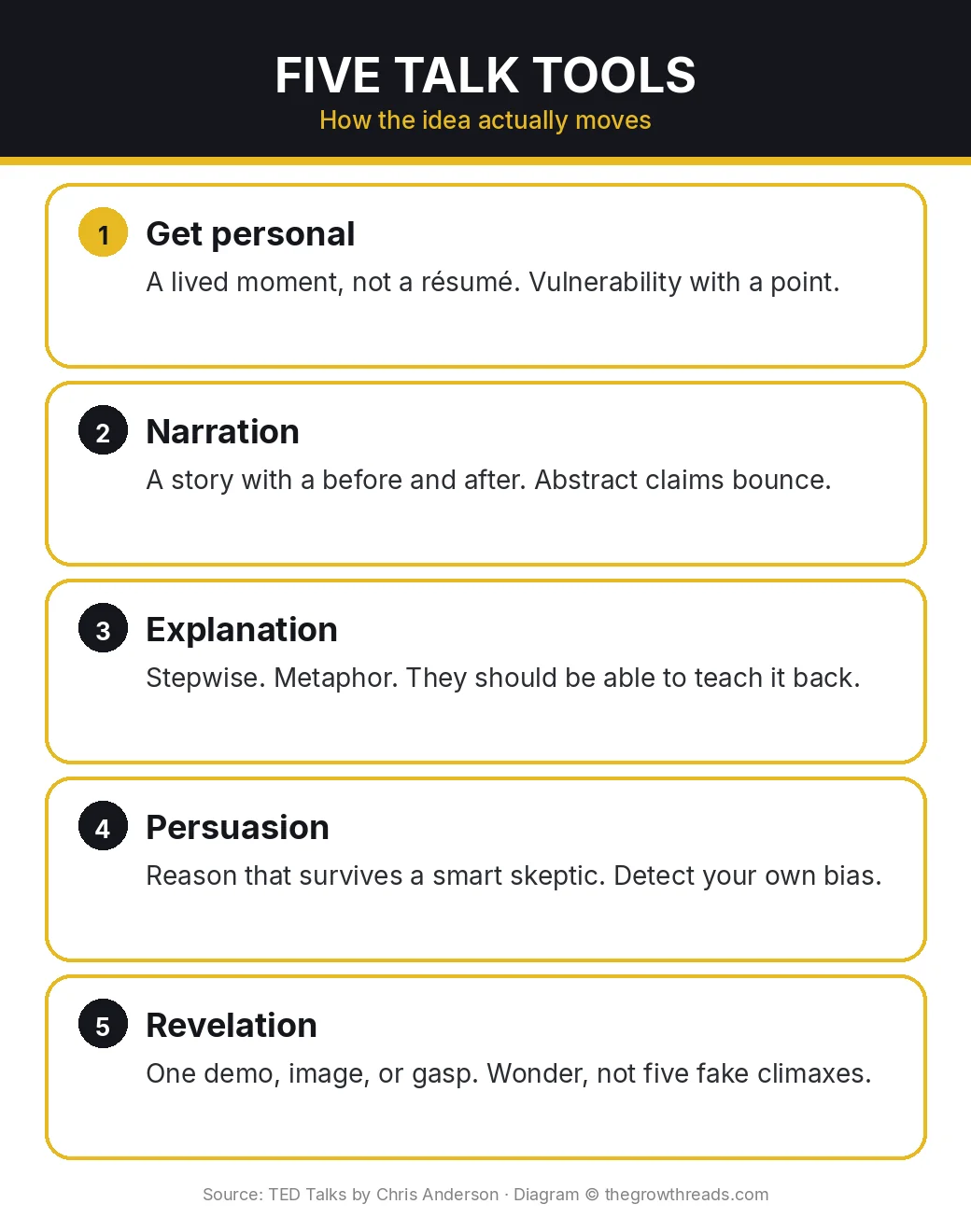
- Get personal: a lived moment with a point, not a résumé.
- Narration and explanation: a story they can see; a metaphor they can teach back.
- Persuasion and revelation: reason that survives a skeptic; one gasp, not five.
- Slides are support: if they can read the paragraph, they will not hear you.
- Rehearse out loud: memorize the open and close; know the middle.
- Nerves are energy: the room wants you to succeed; breathe and begin.
- Sit down: extra brilliance is how the one idea dies of crowding.
What is TED Talks about?
TED Talks is Chris Anderson’s 2016 official guide to public speaking: how to cut an idea to a throughline, avoid four fake-talk styles, and use story, explanation, and rehearsal so a room can rebuild what you gave them — on a TED stage or in a Tuesday meeting.
About the author
Chris Anderson is the British-American curator of TED, the nonprofit that turned short idea-talks into a global format. He took the conference over in 2001 after building Future Publishing and the games site IGN, and spent the next decade coaching speakers whose talks we still quote — Ken Robinson, Amy Cuddy, Bill Gates among them. This is not the Wired editor who wrote The Long Tail; that is a different Chris Anderson. The TED curator’s claim is unromantic: presentation literacy is not a birthday personality. It is a skill. TED Talks (2016) is the briefing he would hand you before you walk on. You may love the topic in private. On stage, or on a Zoom tile, you are a craftsman with a throughline and a gift the hallway should still be able to rebuild. Explore all Chris Anderson book summaries →
Key concepts at a glance
| Concept | What it means | Use it when |
|---|---|---|
| Throughline | One connecting theme in ≤15 words | Your “talk” is still a topic or a table of contents |
| Idea as a gift | They reconstruct it in their own heads | You are dumping the archive you happen to own |
| Sales-pitch trap | A brochure dressed as a talk | They start guarding their wallet in minute two |
| Org-tour trap | Your chart is not their journey | You open on teams, not the idea |
| Recitation trap | The paper, read aloud | A briefing would have done the same job |
| Inspiration-only trap | Mood without a takeaway | They feel lifted and cannot use a sentence |
| Five tools | Personal, narration, explanation, persuasion, revelation | The middle of the talk is a plateau of claims |
| Slides as support | Images and cues, not a script on the wall | Every slide is a paragraph |
Part 1: Foundation — the idea as a gift
Anderson’s first move is to retire mystique. A great talk is not lightning. It is presentation literacy: you take something that matters and you rebuild it inside someone else. “Your number-one mission as a speaker is to take something that matters deeply to you and to rebuild it inside the minds of your listeners.” That is the whole book in one job. Knowledge you cannot give away is a private hobby. A talk is the transfer.
The tool is the throughline. Not a theme deck. Not “a few thoughts on innovation.” A sentence of fifteen words or fewer that names the connecting idea. If you cannot say it on a card, you have a topic. Topics do not travel. Throughlines do. Every story, demo, and slide either serves that sentence or it is clutter — including the brilliant aside you love. The room has one working-memory slot. You are either filling it on purpose or filling it by accident with your fourth point.
He is equally blunt about what a talk is not. A sales pitch makes them guard their wallet. An org tour makes them wait for the idea. A recitation of a paper is a briefing with a spotlight. Inspiration without an idea is a mood. All four feel like speaking. None of them leave a sentence the hallway can rebuild. Name the trap on your current deck before you add a story. Most “I need better slides” problems are a missing throughline.
TGR Note: If the sentence itself will not stick on the page, our Made to Stick summary is the companion — simple, unexpected, concrete — before you stand up. Anderson assumes you have an idea worth gifting. Heath and Heath help you design that idea so it survives the hallway. Do not collect both as a way to delay writing the fifteen words. For the nine delivery habits once the throughline exists, use Talk Like TED.
Part 2: Connection — five tools that rebuild the idea
Once the throughline exists, Anderson’s middle is a toolbox, not a personality transplant. Get personal: a moment you lived, with enough sensory junk that they can see it, then the point. Vulnerability without a point is oversharing. A résumé in story-clothes is still a résumé. The room does not need your CV. It needs one scene that makes the throughline inevitable.
Narration is how that scene becomes shareable — a before and after, a person in a situation, not a claim with a name taped on. Explanation is how a hard idea becomes teachable: stepwise, with a metaphor they could hand to a colleague. If they cannot teach it back, you explained a vibe. Persuasion is reason that survives a smart skeptic, including the bias in your own pet example. Revelation is the gasp: one demo, one image, one number that should not be that size. Five gasps is none. Plan the wonder the way you plan the close.
You will not use all five tools in every ten-minute standup. You will use the one the throughline actually needs. A product review often needs explanation plus one revelation. A hiring pitch often needs a personal moment plus persuasion. A postmortem needs narration without the org-tour trap. Steal the tool. Do not steal a TED cadence that is not yours.
TGR Note: If the job is moving people after the meeting — a forward, a customer call, a Slack paste — our Contagious summary is how an idea travels once it has left your mouth. Anderson gets it into their heads. Berger gets it into other mouths. For selling without turning the talk into trap one, To Sell Is Human is the service frame. None of them replace the throughline. If you cannot name it, do not add a virality story.
Part 3: Preparation — slides, script, and the clock
Anderson’s visual chapter is a mercy to anyone who has sat through a paragraph on a wall. Slides are not the talk. If they can read it, they will not hear you. High-resolution images, sparse words, no bullet novels. A slide that only you understand is a speaker note you accidentally projected. Build the talk on paper. The deck is the last artifact, not the first. That is the same order The Presentation Secrets of Steve Jobs keeps: headline, then picture, then maybe a number.
Scripting is a spectrum, not a religion. Some TED speakers memorize every word. Some work from a structured outline so tight the talk cannot wander into trap four. Anderson’s practical middle: memorize the open and the close — the two places the room decides whether to stay — and know the middle well enough that a skipped slide is not a crash. Recited talks leak. Untethered talks ramble. Out-loud rehearsal is how you find the sentences that still need the page.
The clock is TED’s house bet about attention. Eighteen minutes is long enough to be serious and short enough to hold one idea. You may own twelve minutes on a Zoom tile. The throughline does not care. Cut until the talk serves the fifteen words, then sit down while they still want more. Extra slides feel like insurance. They are how the gift dies of crowding.
TGR Note: If the sentences on the page are still a mess, our On Writing Well summary is the cut before you stand up. Zinsser on the page is Anderson at the lectern: fewer words, more picture. For a body that does not leak in the first ten seconds, The Charisma Myth is presence, power, and warmth. Use them after you have a throughline. A warmer opening still fails if it is the fourteenth point.
Part 4: On stage — nerves, then sit down
Nerves are not a character flaw. They are energy with nowhere to go. Anderson’s coaching here is ordinary and kind: the audience wants you to succeed; breathe; begin. Wardrobe is “do not let the outfit become the talk.” Notes, confidence monitors, or nothing — pick the setup you rehearsed, not the one that looks more TED. Voice is life in the words you already chose, not a borrowed baritone.
The last chapters are why this skill is not optional. Talks connect knowledge across rooms. They connect people. You will not get a red circle at the product review. You will get eighteen minutes of attention if you earn it. The philosopher’s secret is the same as the curator’s: give the talk only you can give, then stop. Internal talks count. A postmortem, a hiring pitch, a Friday demo — those rooms are where most of us actually speak. TED is the lab. Your calendar is the product.
Steal the cut this week on a meeting you cannot postpone. Write the fifteen words. Name the trap. Add one tool. Rehearse the open. Sit down. Ask one person what they would rebuild. If they rebuild a side story, you buried the gift. Change the talk, not your personality.
Who is TED Talks best for — and who should read something else first?
Best for people whose week already includes a room that has to leave with an idea: founders, PMs, researchers, teachers, anyone who currently narrates a deck. If you keep finishing talks exhausted and unquoted, this is the briefing. It transfers to Zoom, a board update, and a ten-minute demo. You do not need a red carpet. You need a throughline and a gift.
Read something else first if the idea itself is mush — start with Made to Stick. If you freeze before you speak, The Charisma Myth is the body. If you already have the sentence and need nine delivery habits, Talk Like TED is the clinic. If the slides are a novel, The Presentation Secrets of Steve Jobs is the visual cut. A negotiation manual is the wrong shelf. Anderson is how one idea becomes a gift inside those systems.
Questions to reflect on
- What is the fifteen-word throughline of the next talk already on my calendar?
- Which of the four traps is my current deck actually running?
- Where is the lived moment that makes the throughline inevitable — and which slides are hiding it?
- If they had to teach the hard part back, what metaphor would I leave them?
- What would I cut if I had to sit down while they still wanted more?
🔥 Ready to give the talk only you can give?
Get TED Talks, then use the 7-day plan to cut one real meeting to a throughline, a gift, and a clock.
How to apply TED Talks (7-day plan)
- Day 1 — Write the throughline. For a talk you already have this week, write one sentence of fifteen words or fewer. If you need two sentences, you have two talks.
- Day 2 — Name the trap. Circle pitch, org tour, recitation, or inspiration-only on the current deck. Cut the opening that runs that trap.
- Day 3 — One lived moment. A scene you were in, past tense, then the point. Put it in the first third.
- Day 4 — One teach-back. Add the metaphor or stepwise explanation they could hand to a colleague. If they cannot teach it, you do not have it yet.
- Day 5 — Kill slide text. Turn paragraphs into pictures or cues. The talk lives in your mouth, not on the wall.
- Day 6 — Open and close out loud. Memorize the first and last sixty seconds. Time a full pass. Cut until the throughline is the only leftover.
- Day 7 — Give the talk and sit down. Ask one person what they would rebuild. Change the talk, not your personality.
Frequently asked questions
What is TED Talks by Chris Anderson about?
TED Talks is Chris Anderson’s 2016 field manual for talks a room can rebuild — the book people mean when they search for a TED Talks summary. Anderson, the curator of TED, argues presentation literacy is a skill: you take an idea that matters, cut it to a throughline of fifteen words or fewer, and give it as a gift so listeners can reconstruct it themselves. He names four traps (pitch, org tour, recitation, inspiration without an idea), five tools (personal, narration, explanation, persuasion, revelation), and the unglamorous work of slides, rehearsal, and nerves. You need one sentence they can still say in the hallway.
What is a throughline in TED Talks?
A throughline is the connecting theme of the talk, spoken in fifteen words or fewer. It is not a topic (“innovation,” “our Q3”) and not a table of contents. It is the one idea you want them to rebuild when you sit down. Anderson’s test is rude and useful: if you need a paragraph, you do not have a throughline yet. Write it on a card. Every story, slide, and demo either serves that sentence or it is clutter, even if it is brilliant. The throughline is how a 288-page house manual collapses into one job for Tuesday’s all-hands.
Is TED Talks the same book as Talk Like TED?
No. Talk Like TED is Carmine Gallo’s 2014 study of nine habits famous TED speakers share — passion, story, eighteen minutes. TED Talks is Chris Anderson’s official house guide from inside TED: the throughline, the four traps, the five tools, and how a curator actually coaches a speaker. Gallo reverse-engineers the corpus from the outside. Anderson writes the briefing he would hand you before you walk on. Read Gallo if you want a checklist of delivery habits. Read Anderson if you still do not know which idea is the talk. They stack. They are not duplicates.
How long should a TED-style talk be?
TED’s house format is about eighteen minutes — long enough to be serious, short enough that working memory can still hold one idea. Anderson is not selling a stopwatch fetish for every standup. He is selling the cut: one throughline, then sit down. If your slot is ten minutes, you still need the fifteen-word sentence and you still refuse the fourth point. If you truly need forty-five minutes, you probably have three talks. Give one. Park the rest for questions. The clock is a kindness to the room, not a TED costume you put on for a keynote.
Should I memorize my TED-style talk?
Memorize the open, the close, and the throughline. Know the middle well enough that a skipped slide does not kill you. Anderson is not asking you to become an actor who cannot survive a cough in the front row. Recited talks leak — the room can hear the page. Untethered talks ramble into the fourth trap. The middle path is a tightly structured talk you have said out loud until it sounds like a conversation. Record a pass. Time it. Ask one person what they would repeat. Then change the talk, not your personality.
Who should read TED Talks — and who should start elsewhere?
Read TED Talks if your week already includes a room that has to leave with an idea: founders, PMs, researchers, teachers, anyone currently narrating a deck. Skip it as a first book if the idea itself is mush — start with Made to Stick — or if you freeze before you speak — The Charisma Myth is the body. If you already have a throughline and need nine delivery habits, Talk Like TED is the clinic. If the slides are a novel, Presentation Secrets of Steve Jobs is the cut. Anderson is the gift-wrapping of one idea, not a media-training OS.
What is the one idea to steal from TED Talks this week?
Steal the fifteen-word throughline, not a new identity as a keynote speaker. Take one talk already on the calendar. Write the sentence they should be able to rebuild. Cut every slide that does not serve it. Add one lived moment near the front and one explanation they could teach back. Practice the open and close out loud. Then sit down while they still want more. Anderson’s whole argument is that presentation literacy is a skill, and a talk is a gift. The room does not need your archive. It needs one idea it can carry into the hallway.
Related summaries
- Talk Like TED by Carmine Gallo
- The Presentation Secrets of Steve Jobs by Carmine Gallo
- Made to Stick by Chip Heath & Dan Heath
- The Charisma Myth by Olivia Fox Cabane
- Best productivity books
How we analyze books: every book on The Growth Reads is read cover to cover, summarized in thousands of words of original analysis, and rated against our five-criteria rubric (lasting impact, evidence quality, practical application, writing & originality, external consensus). Read our full methodology.