

★★★★½ 4.6/5 — the rewrite clinic for anyone whose sentences still sound like a committee.
Best for: Operators, researchers, and specialists who write at work and need the page to travel without them
Reading time: ~8 hours (336 pages) · this guide ~12 min
Difficulty to apply: Medium — the work is cutting words, not installing a new personality
On Writing Well in one minute
If the sentence can be read two ways, you are not finished thinking. William Zinsser’s On Writing Well summary in one line is that: clutter is a thinking problem wearing extra words. First published in 1976 and revised for decades, the book is a usage clinic for people who write at work. Strip every sentence to the words that do work. Write for one reader across a table. Hold one pronoun, one tense, and one mood. Put a person in the lead. End before you start speechifying. Then rewrite — out loud — until the line can only mean one thing. Later chapters apply that pressure to interviews, places, memoir, science, and the memo you send on Tuesday. Style is what is left of you after the fog is gone. It is not a hat you put on in paragraph two.
Key takeaways
- Simplicity first: strip the sentence to parts that earn their keep.
- Clutter is unfinished thought: fat language hides that you are not sure yet.
- Style comes after: voice is residue, not a costume you add to a muddy draft.
- One reader: write for a person across the table, not a committee in the sky.
- Unity: one pronoun, one tense, one mood. Switching is how readers get lost.
- The lead is a contract: a person, a fact, a problem — then keep the promise.
- Read it aloud: the ear catches the stumble the eye forgives on screen.
- Work writing is still writing: the memo has to travel without a translator.
- The draft is a lump: rewriting is the job, not a personality trait.
- Write as well as you can: the standard is the sentence, not the mood you wrote it in.
What is On Writing Well about?
On Writing Well is William Zinsser’s 1976 guide (revised through a 30th-anniversary edition) to nonfiction that can be understood on the first pass: cut clutter, hold unity, write a lead that keeps a promise, and rewrite until each sentence can only mean one thing.
About the author
William Zinsser (1922–2015) learned sentences the public way: as a feature writer at the New York Herald Tribune, then as a magazine essayist and Yale teacher of nonfiction. The New Haven course is the skeleton of On Writing Well. The book sold on the order of 1.5 million copies because it spoke to people who write at work — not only to people who call themselves writers. He also published memoirs and books on jazz, baseball, and American places. The through-line is a human voice and a clean line. He kept revising the guide as usage shifted. The demand did not: if the reader has to decode you, you have not finished the thought. Explore all William Zinsser book summaries →
Key concepts at a glance
| Concept | What it means | Use it when |
|---|---|---|
| The transaction | Writing is a personal transaction: you, a subject, a reader | The page sounds like a department, not a person |
| Simplicity | Strip every sentence to components that do work | You are adding words to sound serious |
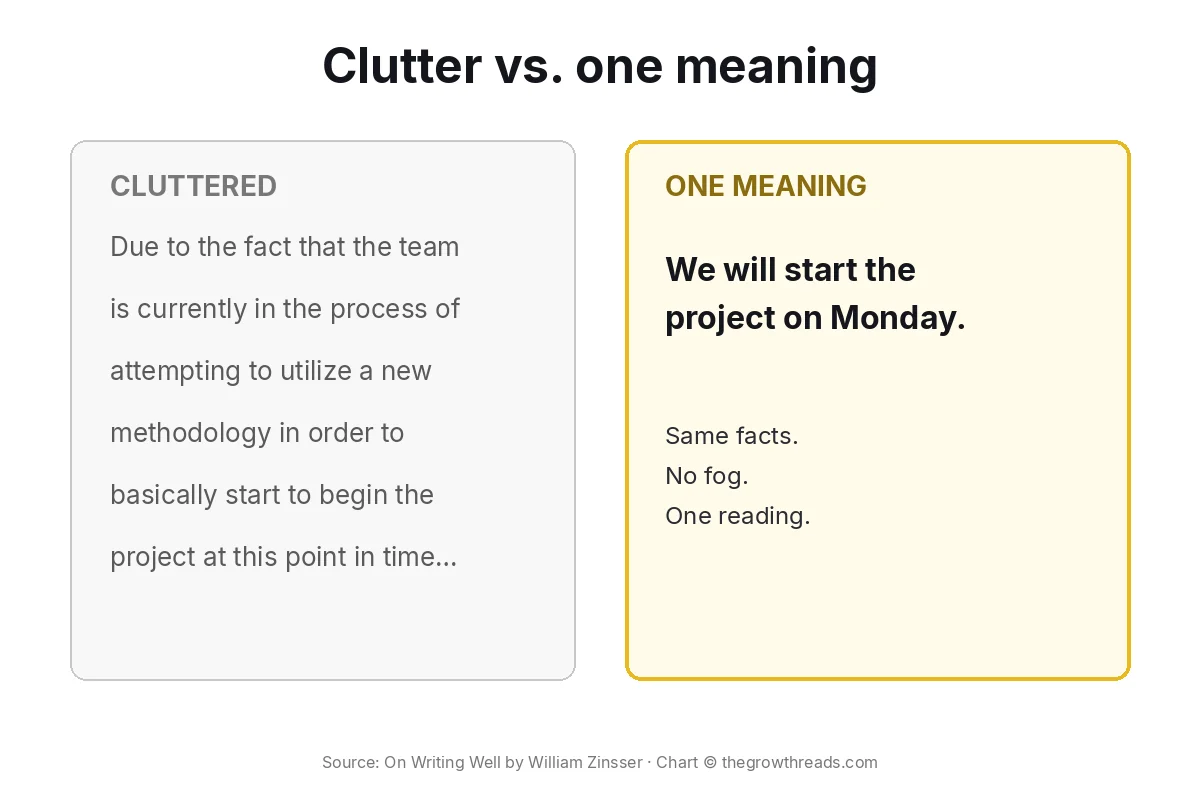
| Clutter | Unfinished thought wearing extra phrases | Due to the fact that, in order to, at this point in time |
| Style | What remains of you after the fog is gone | You are decorating a muddy draft instead of cutting it |
| The audience | One reader across the table | You are performing for a hypothetical stadium |
| Unity | One pronoun, one tense, one mood | The piece changes speaker or clock mid-way |
| The lead | A contract: person, fact, or problem the rest must keep | Paragraph one is throat-clearing |
| Rewrite | The lump is not the product; reading aloud is a tool | You ship the first version because you are tired |
Part 1: Principles — simplicity is a thinking job
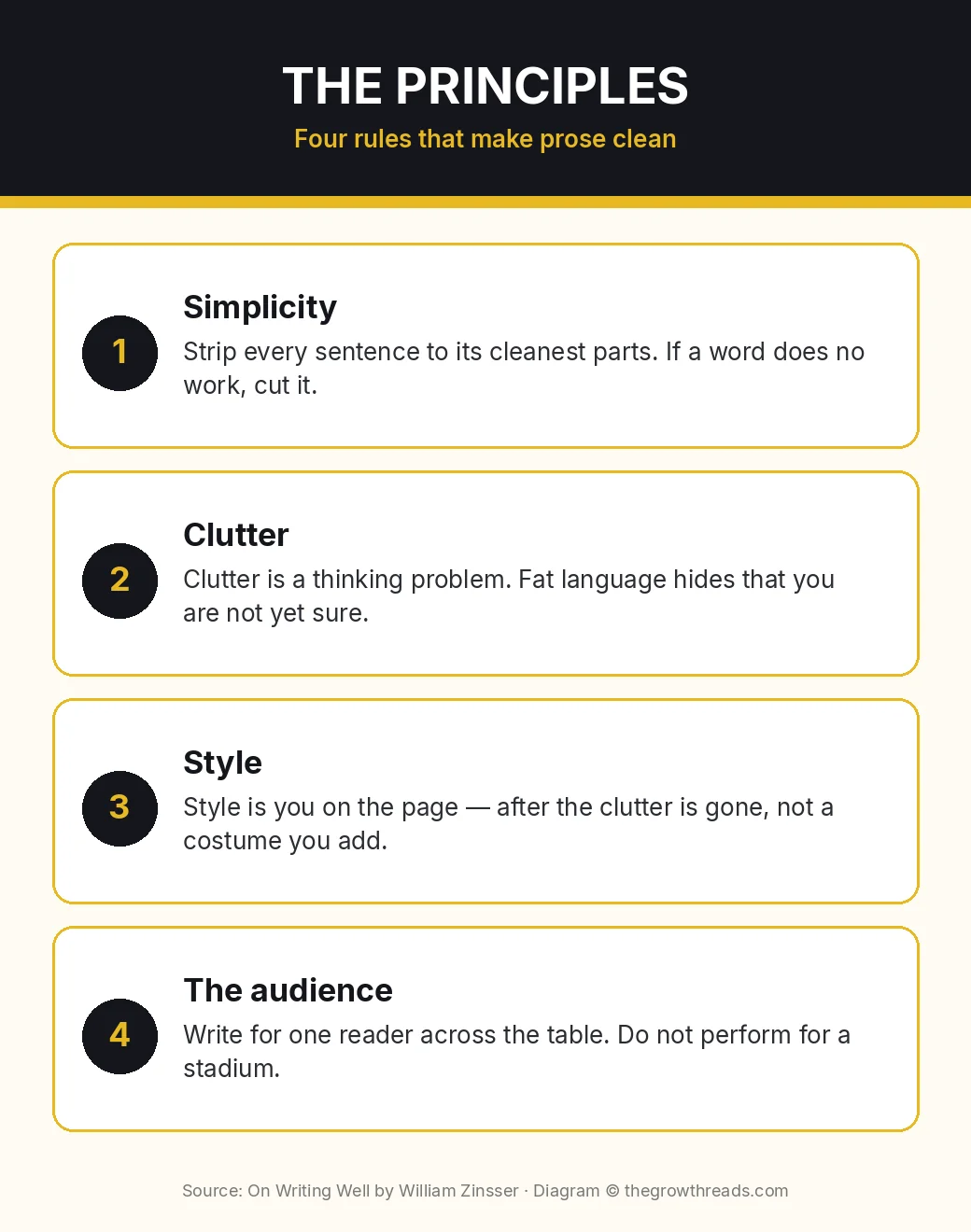
Zinsser does not open with grammar drills. He opens with a transaction. Nonfiction is a person trying to make a second person care about a third thing. If you hide, it fails. Corporate we and agentless verbs feel like fog because nobody is in the room. The first skill is the willingness to be on the page as someone who has actually looked at the subject.
Simplicity is the mechanic. Zinsser’s diagnosis is short enough to steal: clutter is the disease of American writing. Not slang. Clutter — the extra phrase, the doubled verb, the adverb that only stalls, utilize when you mean use. Each extra word is a place the reader can get off the train. Cutting is not aesthetic minimalism. It is finishing the thought far enough that the sentence can only be read one way.
Style, in this book, is what is left after you stop performing. People try to sound like a magazine or a professor, and the page fills with borrowed music. Zinsser wants the opposite sequence: get the meaning clean, then the voice you already have will show. The audience is one person across the table. Words and usage get a craftsman’s chapter, but they serve the same law. If a word does no work, it is not decorating. It is hiding.
TGR Note: If the freeze is not clutter but sitting down, start with our Bird by Bird summary. Lamott’s short assignment is how a terrible first version gets born; Zinsser is what you do to it on Tuesday. For a fiction desk’s hours and toolbox, use On Writing by Stephen King. Do not read all three as a way to delay cutting fifty words from a paragraph you already sent.
Part 2: Methods — unity, the lead, and the ending
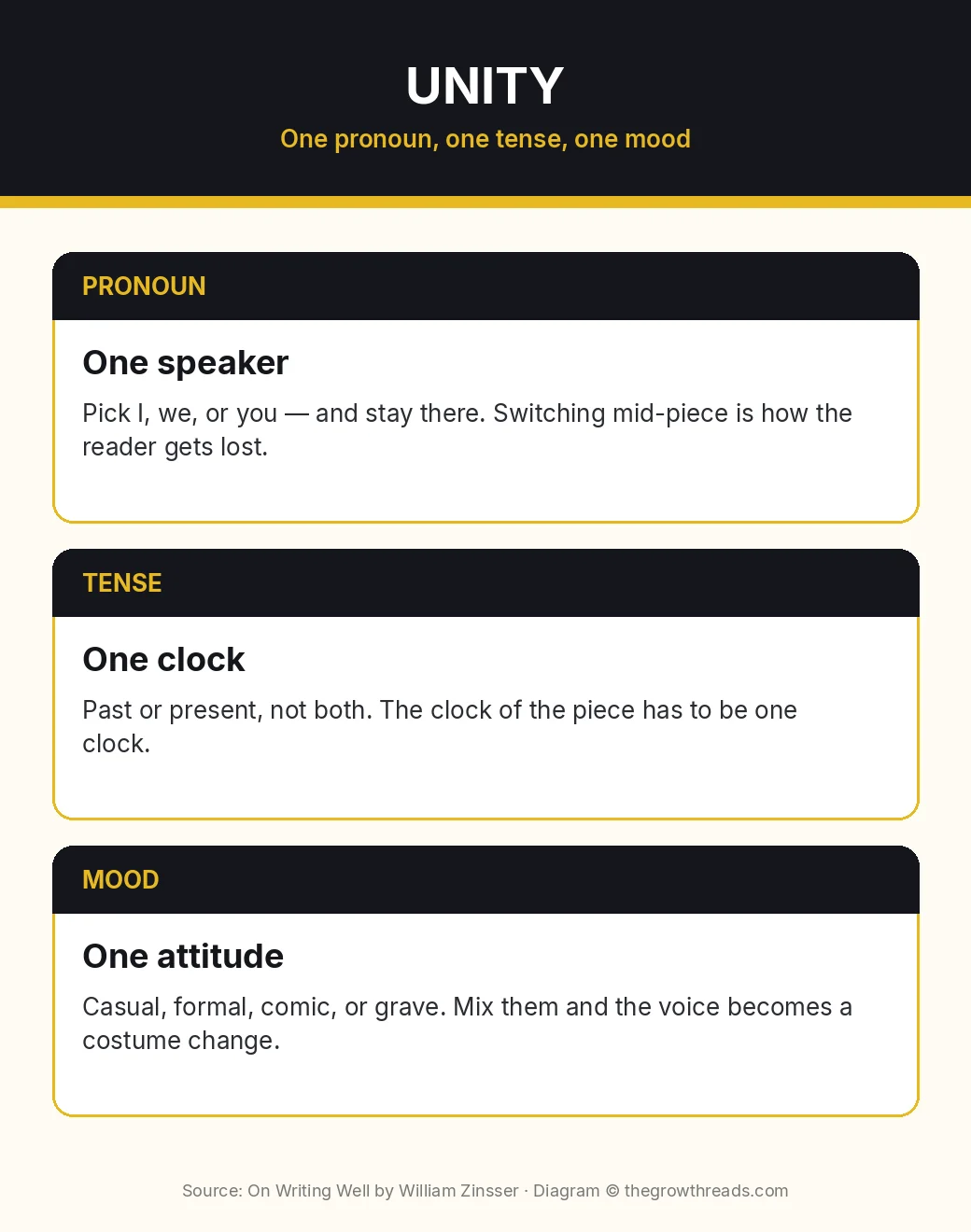
Principles fail without a spine. Zinsser calls the spine unity. Pick a pronoun and stay there: I, we, or you. Pick a tense. Pick a mood — casual, formal, comic, grave — and do not change costumes because a later paragraph felt more important. Readers will forgive a plain voice. They will not forgive a piece that becomes a different person on page three. Unity is also unity of subject. If you promised a hiring memo, do not wander into your philosophy of work unless that philosophy is the memo.
The lead is a contract. Zinsser wants a person, a concrete fact, or a problem in the opening — something that makes the next sentence necessary. Throat-clearing (“In today’s fast-paced world”) is how you tell the reader you are not ready. The ending is the other half of the contract: stop when the thought is complete. Do not moralize. Do not announce that you have now reached the conclusion. A last concrete image, a last clean sentence, and leave. Most weak endings are fear of silence.
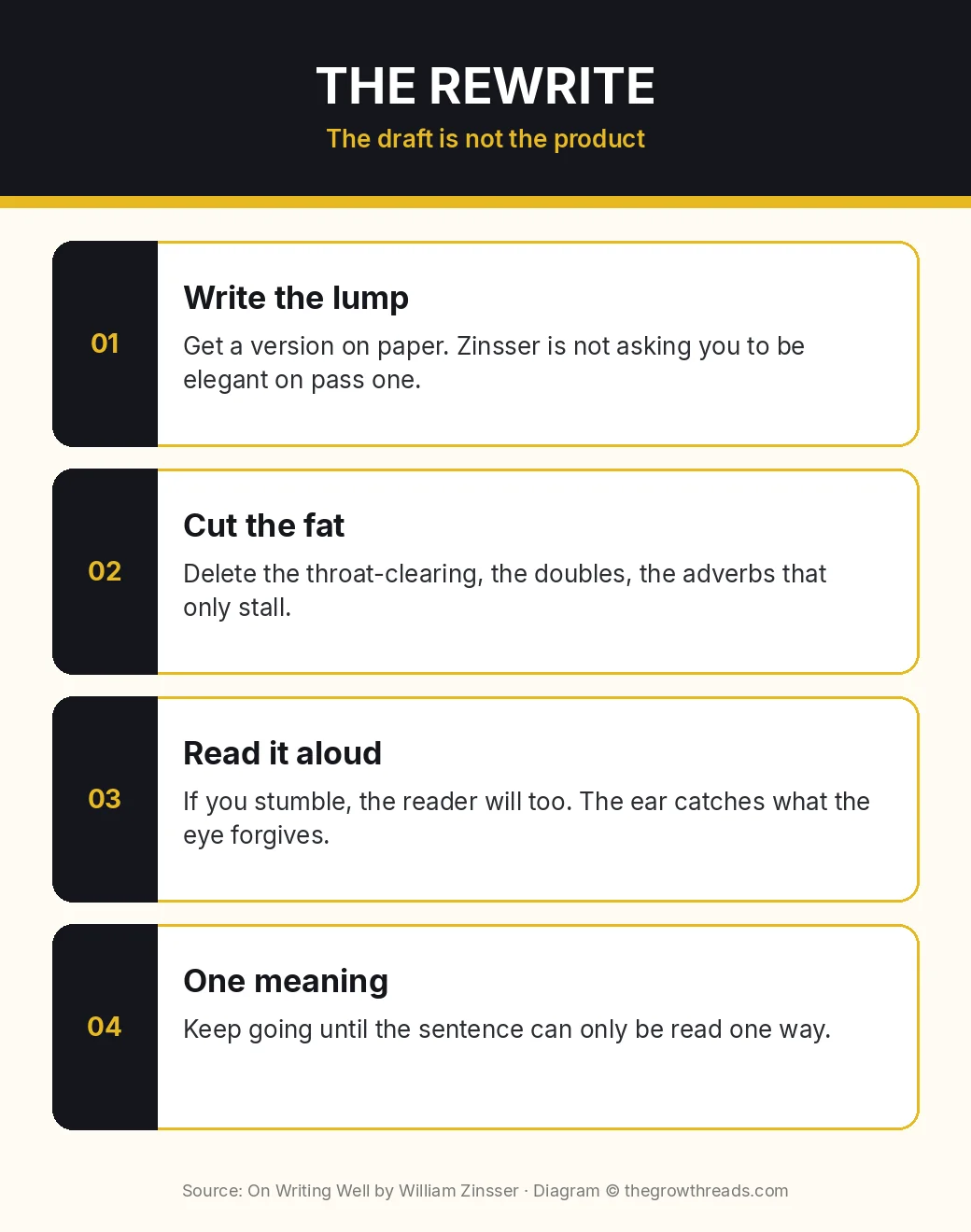
Bits and pieces is the workshop drawer: punctuation that serves the ear, paragraph length as a kindness, a short sentence after a long one. The method underneath is rewriting. The first version is a lump of ore. Professionals are not people who bleed perfect copy. They will sit with the lump until it is a sentence. Reading aloud is the cheapest diagnostic in the book. If you stumble, the reader stumbles. Fix the step, not your identity.
TGR Note: If the missing layer is capturing material before you write, our How to Take Smart Notes summary is the inbound pipe. Zinsser assumes you already have something to say. For reading that actually yields a point of view, use How to Read a Book. Notes without a rewrite still dump fog on the page; Adler without Zinsser still leaves the memo unsent.
Part 3: Forms — people, places, work, and science
The middle of the book is a set of rooms where the same law is tested. Writing about people is mostly listening: do the homework, let silence work, quote the human sentence, and put the person in a physical place so they are not a stack of opinions. Writing about places fails when it is a brochure. A place piece needs a noticing eye — the odd detail that could only have been seen by someone who stood there.
Writing about yourself is the memoir problem: the I has to earn the page by seeing. Family history is a form, not a dump of dates. Humor is a pressure test of the same simplicity; a joke with clutter is a briefing. Science writing is where clutter does the most damage, because the reader cannot fall back on lived experience. If you cannot say the mechanism in a sentence a smart non-specialist could repeat, you do not yet understand it well enough to publish it. Unclear writing is delayed work for everyone downstream.
Business writing gets its own chapter because the office is where most people actually write. Zinsser’s claim is not that a memo should sound like a New Yorker essay. It is that a memo is still a transaction with a reader who is busy. Jargon is often fear. Passive voice is often a missing owner. If the email cannot be forwarded without a translation, it has failed. In 2026 the same chapter is the best filter for unedited machine drafts: they arrive already padded. You still owe the cut.
TGR Note: If the block is not clutter but Resistance — the sudden urge to reorganize the desk — our War of Art summary names the enemy. Zinsser assumes you will sit. Pressfield assumes you will flee. For a daily creative practice that is closer to a gym than a usage clinic, The Creative Habit is the companion. Put the rewrite after an existing block of work, not after a mood.
Part 4: Attitudes — voice, fear, and writing as well as you can
The last movement of On Writing Well is about the inner weather that produces clutter in the first place. The sound of your voice is not a brand exercise. It is what happens when you stop imitating the last impressive paragraph you read. Enjoyment matters because hatred of the subject leaks. Fear matters because fear pads: we add clauses to look covered. Confidence, in Zinsser’s usage, is not swagger. It is the willingness to be simple in public.
The tyranny of the final product is the chapter operators need. People delay the lump because they can already see the polished piece they do not have. Zinsser’s answer is process: write, then cut, then cut again. Outline enough to know the destination, not so much that you never leave the dock. The closing command is simple: write as well as you can today, on this sentence, without the extra words that are only there to protect you.
That standard scales to a Slack message. It scales to a research abstract. It scales to the paragraph in a doc that six people will quote out of context. If they can quote it wrong, you left two meanings in the line. The rewrite is how you remove the second one.
Who is On Writing Well best for — and who should read something else first?
Best for people whose work already produces sentences — operators, founders, researchers, specialists, anyone whose email is a product. If your pages sound like a committee, this is the clinic. The method transfers to a remote job and to a first draft a tool helped you dump. You still need a reader, a cut, and a read-aloud.
Read something else first if you cannot start — use Bird by Bird. If the block is fear of the chair, use The War of Art. If you want a fiction professional’s calendar, use On Writing. If you needed a grammar textbook or a roast of other people’s style, this is the wrong shelf — Zinsser is building a rewrite habit, not a takedown.
Questions to reflect on
- Which paragraph I sent this week would fall apart if someone quoted only one sentence?
- Where am I still performing (utilize, leverage, in order to) instead of finishing the thought?
- What pronoun, tense, and mood did I actually pick in the last thing I wrote — and where did I switch?
- What would change if I wrote the next memo for one named person instead of “the team”?
- Which sentence can I cut by a third today without losing a fact?
🔥 Ready to cut until the sentence can only mean one thing?
Get On Writing Well, then use the 7-day plan to rewrite one paragraph you already sent.
How to apply On Writing Well (7-day plan)
- Day 1 — Cut fifty words. Take one paragraph you already sent. Delete throat-clearing. Do not add a new draft. Subtract.
- Day 2 — Read one page aloud. Yours or Zinsser’s. Mark every stumble. Those marks are the rewrite list, not a vibe.
- Day 3 — Unity check. On one piece, write the pronoun, tense, and mood at the top. Fix every switch.
- Day 4 — Rewrite a lead. Replace the first two sentences of a doc with a person, a fact, or a problem. Delete the weather.
- Day 5 — One email, one meaning. Send a message that can be forwarded without a translation. No utilize. No “just circling back to.”
- Day 6 — Put a person on the page. In a update or a post, include one concrete human detail you actually observed.
- Day 7 — Ship 400 words. A lump, then two rewrite passes out loud. Stop when each sentence can only be read one way. That is the standard, not a new identity.
Frequently asked questions
What is On Writing Well about in one paragraph?
On Writing Well is William Zinsser’s classic guide to nonfiction, first published in 1976 and still the book people mean when they search for an On Writing Well summary. The load-bearing idea is simplicity: clutter is not a costume you wear, it is unfinished thought, and rewriting is how you finish. Unity of pronoun, tense, and mood keeps a piece from wandering. Later chapters put the same pressure on interviews, travel, memoir, science, humor, and the memo you send at work. This TGR guide turns that into principles, methods, forms, attitudes, and a seven-day plan you can run on a paragraph you already wrote.
Who should read On Writing Well?
Read it if you write for work and the page still sounds like a committee: emails, docs, reports, landing pages, research notes. Zinsser is for people who need to be understood, not for people hunting a personality transplant. Skip it as a first book if you cannot yet sit down — Bird by Bird is the permission slip. Skip it if the block is fear of the blank page rather than fat sentences; The War of Art names Resistance. Fiction writers who want a desk ritual more than a usage clinic should start with King’s On Writing. Zinsser is the rewrite coach for nonfiction that has to travel.
How long does it take to read On Writing Well?
The 30th-anniversary Harper Perennial edition is about 336 pages — a comfortable week of forty-minute evenings, or roughly eight hours in a few sittings. It is a teacher in the room, not a dense textbook and not a parable you finish on a commute. Some form chapters (sports, travel) you can skim once you have the principles. This TGR guide is a twelve-minute reconstruction of the method, not a replacement for his examples. If you only have one evening, read the one-minute section, the concepts table, and run Day 1 of the plan on a paragraph you already wrote.
Is On Writing Well still relevant in 2026?
Yes, more than the copyright page suggests. Clutter now arrives as corporate jargon, slide-deck English, and unedited machine drafts. Zinsser’s test still holds: if a word does no work, cut it; if you stumble reading aloud, the reader will too. The interview and business chapters assume paper and memos, but the mechanic is the same on Slack and in a doc. What aged is some cultural furniture, not the demand that a sentence mean one thing. Use this On Writing Well summary as the filter you run on whatever drafted the first lump — including you.
How is this different from On Writing or Bird by Bird?
King’s On Writing is a memoir of a working fiction desk: toolbox, hours, and surviving the day. Bird by Bird is Lamott’s permission to write a terrible first version and take the next short assignment. On Writing Well is the usage-and-rewrite clinic for nonfiction: simplicity, clutter, unity, leads, and the forms you actually file at work. They stack. Use Lamott when you will not start. Use King when you need a professional’s calendar. Use Zinsser when the draft exists and still cannot be quoted. Do not read all three as a way to delay cutting fifty words today.
Does On Writing Well help with business emails and AI drafts?
That is half the point of the business-writing chapter, updated by the moment we are in. Zinsser treats the memo as literature’s poorer cousin that still has to be clear. An email that cannot be forwarded without a translation is a failed piece. Machine drafts are a new source of the same disease: padded verbs, fake formality, two hedges per clause. The fix is not a better prompt alone. Write or paste the lump, then run his tests: one reader, one meaning, read aloud, cut the doubles. If the tool wrote the first pass, you still owe the rewrite. That is the job.
What is the one idea to steal from On Writing Well this week?
Steal the cut, not a new identity as a Writer. Take one paragraph you already sent — an email, a doc, a post. Delete every phrase that is only throat-clearing: due to the fact that, in order to, at this point in time, I think that. Read what remains out loud. If you stumble, cut or split. Keep going until the sentence can only mean one thing. Do not announce a writing-practice era. Zinsser’s whole argument is that clear writing is clear thinking, and the thinking finishes on the rewrite, not on the mood in which you opened the file.
Related summaries
- On Writing by Stephen King
- Bird by Bird by Anne Lamott
- The War of Art by Steven Pressfield
- How to Take Smart Notes by Sönke Ahrens
- Best productivity books
How we analyze books: every book on The Growth Reads is read cover to cover, summarized in thousands of words of original analysis, and rated against our five-criteria rubric (lasting impact, evidence quality, practical application, writing & originality, external consensus). Read our full methodology.