

★★★★½ 4.5/5 — the field manual for turning a slide dump into a room that leans forward.
Best for: Founders, product people, and specialists who still open Keynote before they have a story
Reading time: ~6 hours (272 pages) · this guide ~12 min
Difficulty to apply: Medium — the scenes are simple; rehearsal is the work
The Presentation Secrets of Steve Jobs in one minute
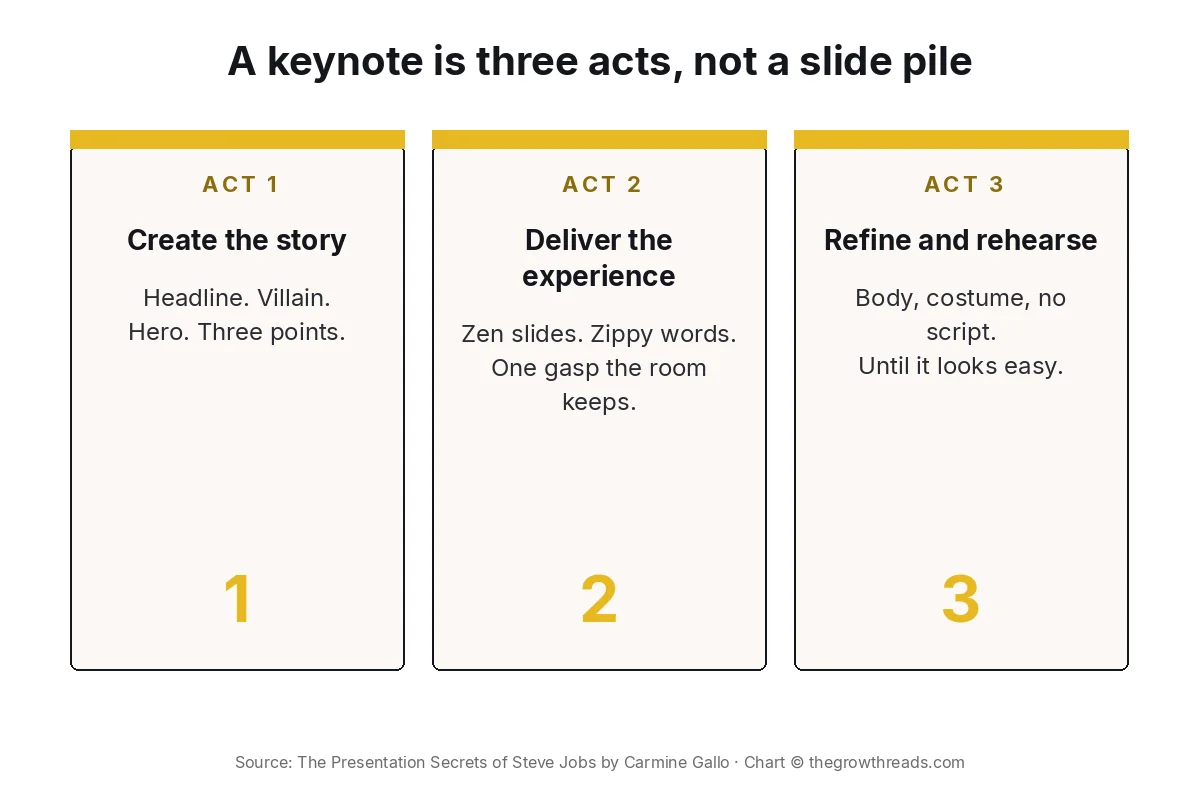
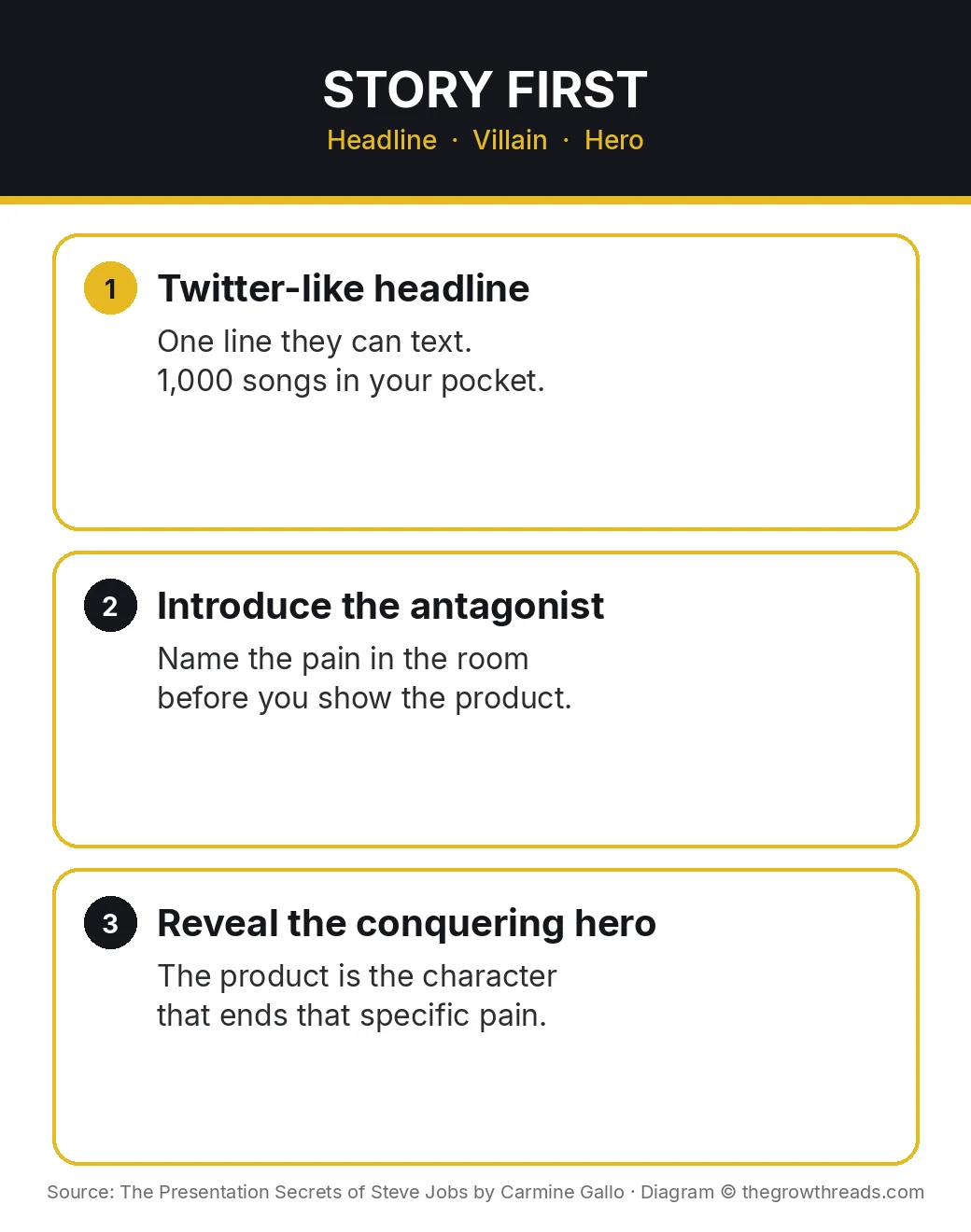
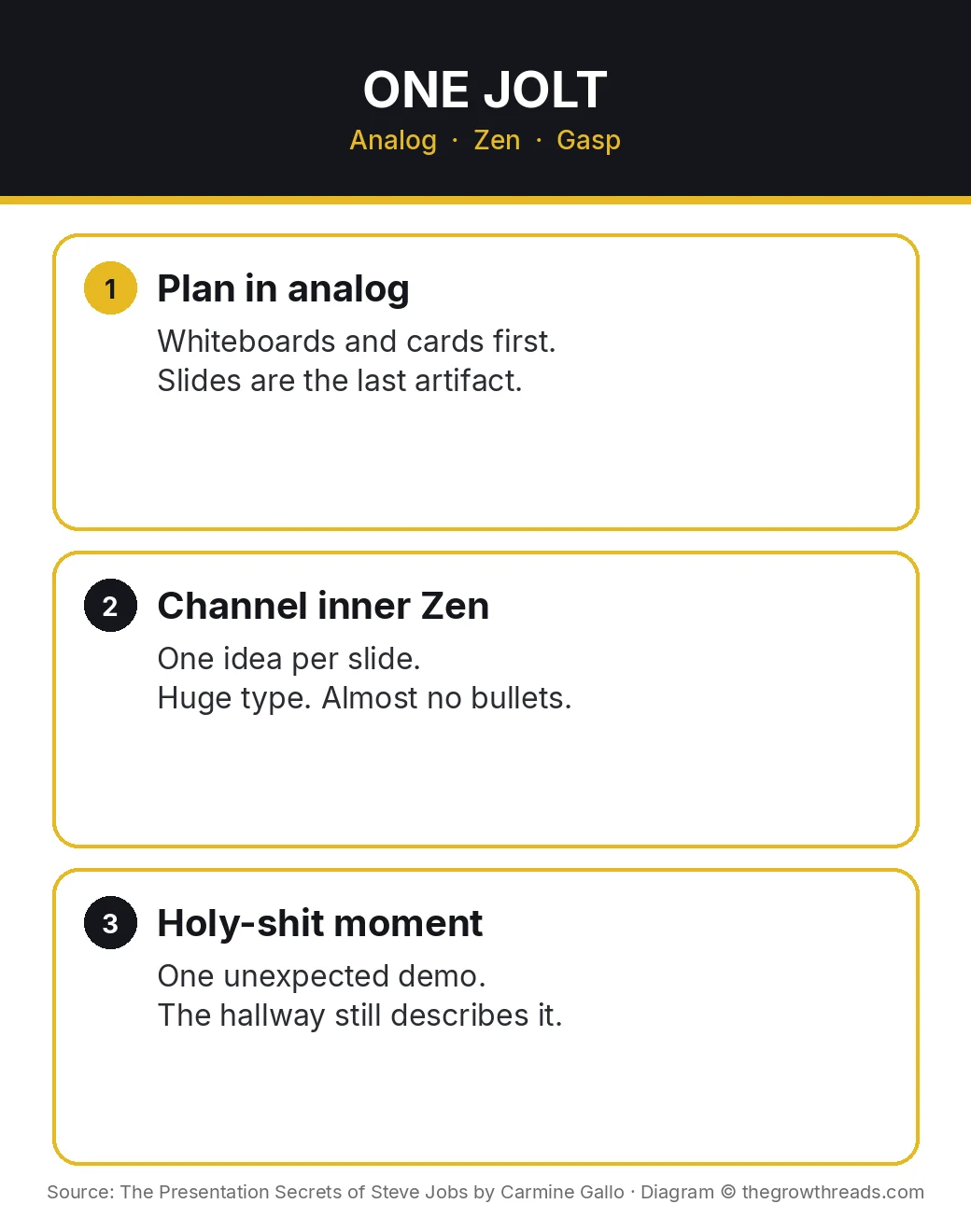
Steve Jobs did not present slides. He staged a three-act play that sold a feeling, then a product. Carmine Gallo’s 2009 classic (McGraw-Hill paperback 2016) reverse-engineers eighteen “scenes” from those keynotes so a normal person can steal the structure without stealing the turtleneck. Act 1 writes the story on paper: a headline a stranger can text, a villain the room already hates, a hero that ends that specific pain, usually in three points. Act 2 turns the story into an experience — sparse slides, numbers that mean something, zippy words, and one demo the hallway still describes. Act 3 is the unglamorous half: days of rehearsal until the script disappears from the voice. If you only take one move from this The Presentation Secrets of Steve Jobs summary, it is this: the deck is the last artifact, not the first.
Key takeaways
- Story before slides: whiteboards and cards first. Keynote is packaging, not thinking.
- Answer the only question: why should I care — in one line they can repeat.
- Purpose is the fuel: sell the dent in the universe, not the processor speed.
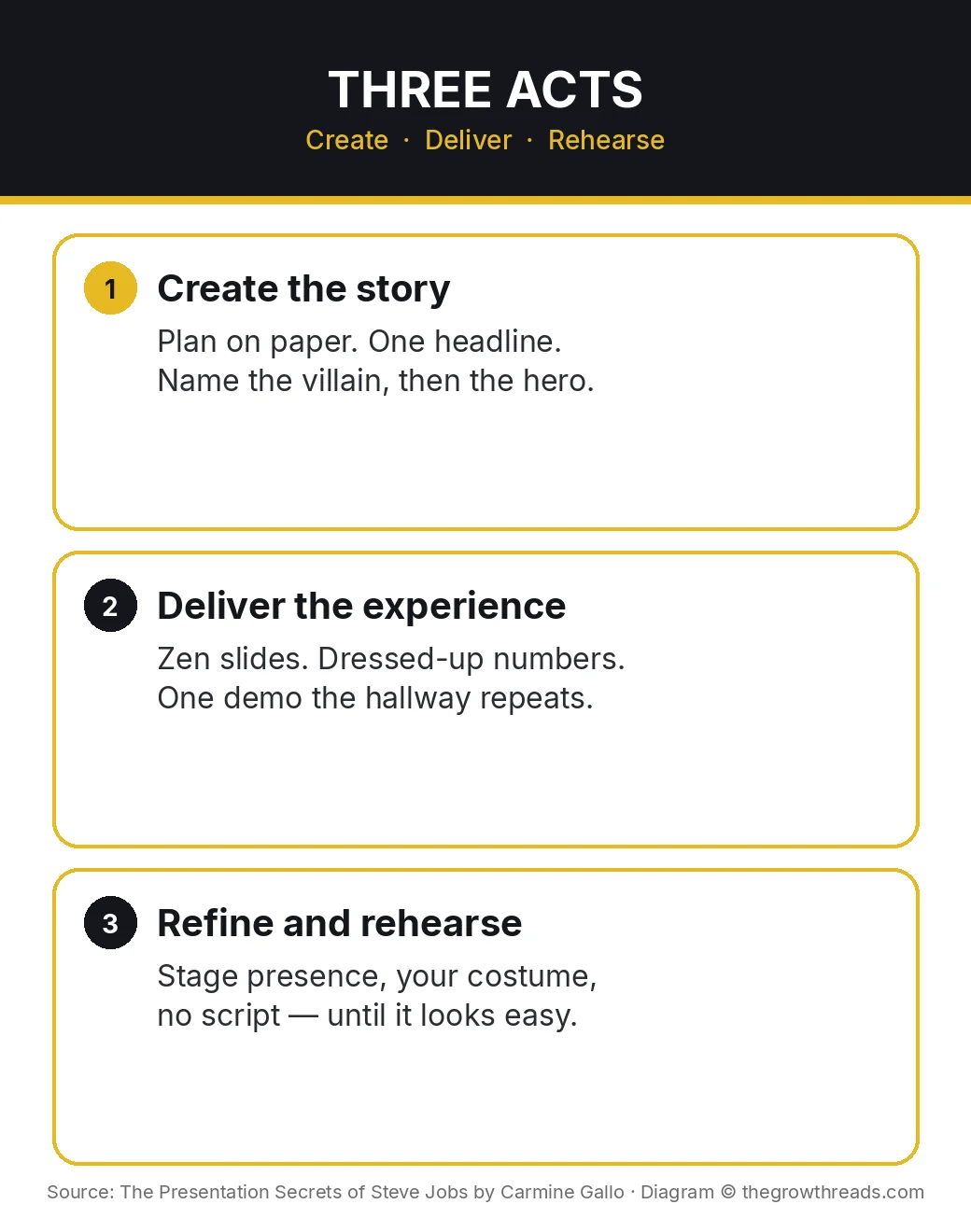
- Twitter-like headlines: “1,000 songs in your pocket” beats a feature list.
- Draw a road map: three points, shown up front, returned to like scenes.
- Name a villain, then a hero: the product is a character that defeats a specific pain.
- Ten-minute jolts: attention drops; insert a story, demo, or video before it dies.
- Zen slides: one idea, huge type, almost no bullets. Numbers get dressed in human units.
- One holy-shit moment: a prop or demo they will still describe at lunch.
- Rehearse until it looks easy: Jobs ran the show for hours. Your costume is yours, not his.
What is The Presentation Secrets of Steve Jobs about?
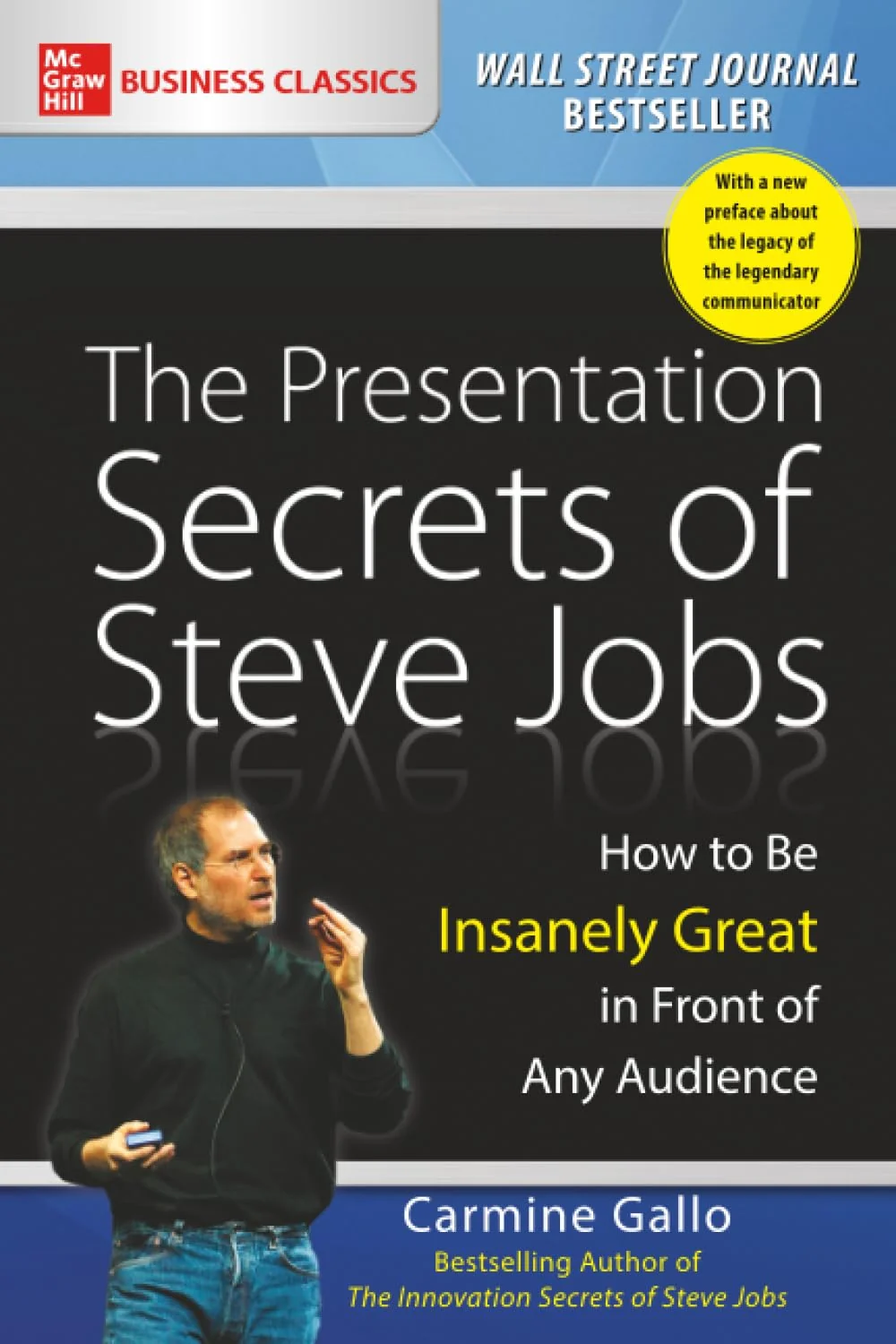
The Presentation Secrets of Steve Jobs is Carmine Gallo’s scene-by-scene breakdown of Apple keynotes as three-act theatre: write a story worth caring about, deliver it as an experience, then rehearse until the effort disappears — so a normal talk can make a room lean forward.
About the author
Carmine Gallo is a former journalist and news anchor who got tired of watching sharp people flatten good work into bullet tours. He coaches executives, writes on communication for Forbes, and runs Gallo Communications Group from Pleasanton, California. This book came first, built from years of watching Jobs turn product launches into events people quoted the next morning. Talk Like TED is the later, wider field manual. Read this one when the job is a launch, a demo, or any room that currently dies by PowerPoint. The through-line in both books is the same: inspiration is a craft. You can rehearse it. Explore all Carmine Gallo book summaries →
Key concepts at a glance
| Concept | What it means | Use it when |
|---|---|---|
| Plan in analog | Whiteboards and cards before any slide software | You open the deck to “figure out what to say” |
| One question | Why should I care — answered in one repeatable line | Your opener is an agenda slide |
| Twitter-like headline | A short, concrete promise the hallway can text | The title is “Q3 Update” or “Product Overview” |
| Antagonist + hero | Name the pain, then reveal the product as the character that ends it | You list features with no enemy in the room |
| Three-point road map | A visible outline you keep returning to | The talk is twelve disconnected topics |
| Ten-minute rule | Insert a jolt before attention falls off a cliff | Minute twelve is still a wall of text |
| Zen slides | One idea, huge type, photos instead of bullets | Each slide is a document they could have read |
| Holy-shit moment | One unexpected demo or prop the room keeps | The middle of the talk is a plateau |
| Make it look effortless | Rehearse for hours so the script leaves the voice | You are reading speaker notes in public |
Part 1: Create the story — analog, villain, hero
Gallo’s first act is a refusal. Most presenters start in the slide tool because the empty canvas looks like work. Jobs started on paper, whiteboards, and index cards. Software invites decoration. Paper forces sequence: the one line, the enemy, the three movements. The show looked casual because the writing was not.
Scene two is the question that matters most. A room does not owe you their Tuesday. Jobs answered it in language a stranger could text. The iPod was not a five-gigabyte drive. It was a thousand songs in your pocket. The MacBook Air was not millimeters. It was a notebook that disappeared into an envelope. If you cannot say that line in one breath, you do not have a talk yet. You have a stack of claims.
Purpose sits under the headline. Gallo calls it a messianic sense of purpose without asking you to become a cult. Jobs sold a dent in the universe — computers for the rest of us — and only then the chips. You do not need a turtleneck to say what would be better in the customer’s Tuesday if this thing existed. That sentence is the fuel. Without it, even a clean demo is a gadget.
Then the plot: a Twitter-like headline; a three-point road map shown early so the room can see the hour; an antagonist already in the building — complexity, the old way, the ugly cable. The conquering hero in a product talk is the product, not you. You are the narrator. If you cannot name the villain in six words, the hero has nothing to punch.
TGR Note: The headline-plus-villain work is the same job Chip and Dan Heath describe as a concrete, unexpected idea in our Made to Stick summary. Gallo gives you a theatrical plot. Heath gives you the stickiness tests. Do not collect both as a way to delay writing the one line. Write the line, then steal a SUCCES check if it still sounds like a spec sheet.
Part 2: Deliver the experience — zen slides and one gasp
Act 2 is where most decks go to die. Gallo’s “channel their inner Zen” is a load limit, not a design cult. One idea per slide. Type large enough from row six. Photographs instead of clip art. Bullets only when they earn the air. A Jobs slide looked empty next to a consulting template because the speaker carried the argument. The slide was a billboard. If it can be emailed as the talk, you have a PDF with a human attached.
Numbers get dressed. Five gigabytes is trivia. A thousand songs is a life. Twenty-eight million songs sold becomes thousands a day, which a tired brain can hold. Gallo’s “amazingly zippy” words are easy to parody — Jobs really did say amazing and gorgeous — but the rule is not hype. Short, sensory, specific. If a smart sixteen-year-old would not know the acronym, it is homework, not a headline.
Then the theatre. Share the stage with a partner, an engineer, a customer, a video. Props do work bullets cannot. The 2008 MacBook Air sliding out of a manila envelope was a proof, not a claim. Gallo’s “holy shit” moment is that jolt — one beat you plan on purpose. Not nine. If you spray surprises, none survive lunch. If you stage one, people still describe the envelope on the walk back.
TGR Note: The later Gallo book is the length and passion manual. Our Talk Like TED summary is the companion when the job is eighteen minutes and one idea, not a product launch. The jaw-drop in that book and the holy-shit moment here are cousins. Use this title for the three-act plot and the analog first draft. Use Talk Like TED when you need the clock. Do not stack them as two weekends of theory.
Part 3: Refine and rehearse — until it looks easy
Act 3 is the chapter slide culture skips. Gallo spends real pages on body: open posture, movement with a reason, eyes on people instead of the confidence monitor. Voice goes up and down on purpose. Pauses are punctuation, not dead air. This is blocking, the way a play has blocking. Mark it on the analog script. Run it in an empty room.
Effortlessness is a lie you earn. Apple launch weeks were hours of run-throughs, not a genius walking in cold. The black sweater was a costume: a repeated uniform so he did not invent an outfit while inventing a show. Do not copy the turtleneck. Copy the decision to choose clothes that disappear so the story can appear. The test is whether anyone remembers the outfit instead of the headline.
Toss the script means toss the sense that you are reading. Jobs used notes. He did not sound like notes. That gap is rehearsal. Have fun is not a vibe slide. Rooms borrow your nervous system. If you look like you want to leave, they want to leave. Fun, here, is permission to enjoy the demo you actually believe in.
TGR Note: If the missing layer is the state of your body in the first ten seconds, our The Charisma Myth summary is the companion — presence, power, and warmth before a single slide. Gallo assumes you will open your mouth. Cabane is how the room decides you are here. Do not use either book as a reason to delay the analog outline.
Part 4: Intermissions and encore — ten minutes, then one more thing
Gallo plants two intermissions for a reason. The ten-minute rule is physiology. Attention falls unless you insert a jolt: a story, a video, a demo, a new voice. Jobs’s acts were built with those pulses. A forty-minute feature tour with no pulse is why laptops open in row four. You do not need Apple’s budget. You need a planned change of texture three or four times.
The Phil Schiller intermission is the permission slip. The method is teachable. People near Jobs could run a version of the show without becoming him. You are not trying to be a dead genius on a black stage. You are trying to give your actual product a plot.
The encore — “one more thing” — is a structural gift, not a mug slogan. After the room thinks it is over, add one more gift that is actually a gift. Do not fake it. If you have no encore, sit down. The encore is optional. The three acts are not.
Who is The Presentation Secrets of Steve Jobs best for — and who should read something else first?
This book is for people who already have something to ship: a product, a research result, a strategy, a fundraising story. If your job this month is a room with slides, start here. Founders and product managers get the most from the analog plot and the holy-shit demo. Specialists who present once a quarter get the Zen-slide diet and the ten-minute jolt. If you do not present, and the real job is writing a document people will read alone, start with our On Writing Well summary instead. If the job is a short inspirational talk rather than a launch, Talk Like TED is the tighter clock. If the idea itself will not stick even in a hallway sentence, Made to Stick is the prior book. Do not use Gallo as a personality transplant. Use him as a plot and a rehearsal calendar.
Questions to reflect on
- What is the one question your next room actually walked in with — and can you answer it in one textable line?
- Who is the villain in that room, in six words, without naming a competitor you cannot prove?
- If you deleted every slide, what demo, prop, or number would still make the hallway talk?
- Where does attention die in your current talk, and what jolt did you schedule at minute ten?
- What would “your costume” be this Thursday — not Jobs’s — so the outfit disappears and the headline stays?
🔥 Ready to stop dying by PowerPoint?
Get The Presentation Secrets of Steve Jobs, then use the 7-day plan to write one headline, one villain, and one gasp.
How to apply The Presentation Secrets of Steve Jobs (7-day plan)
- Day 1 — Steal the question. Write “Why should they care?” at the top of a paper page. Answer in one sentence a stranger could text. If it names a feature, rewrite until it names a human result.
- Day 2 — Name the plot. Villain in six words. Hero as the product, not you. Three-point road map. No software. Cards or a whiteboard only.
- Day 3 — Headline and numbers. Draft three Twitter-like headlines and pick one. Dress every stat in a human unit (songs, minutes, people, dollars a week).
- Day 4 — Zen the slides. One idea per slide. Kill bullets that are sentences. One photograph where you currently have a chart nobody can read from row six.
- Day 5 — Build the jolt. Choose one holy-shit moment: a prop, a live demo, or a video. Rehearse the reveal until your hands know it without looking.
- Day 6 — Full run in an empty room. Time the ten-minute marks. Insert a texture change if a stretch is flat. Record your phone video. Watch it once without self-hatred — only for script-in-the-voice.
- Day 7 — Costume and encore test. Wear what you will actually wear. Decide if you have a real “one more thing” or if you should sit down. Give the talk to one colleague. Ask them to text you the headline. If they cannot, the analog page is not done.
Frequently asked questions
What is The Presentation Secrets of Steve Jobs about in one paragraph?
The Presentation Secrets of Steve Jobs is Carmine Gallo’s 2009 field manual — the book people mean when they search for a The Presentation Secrets of Steve Jobs summary — for talks that feel like events instead of slide tours. He breaks Apple keynotes into eighteen scenes across three acts: create a story (headline, purpose, villain, hero, road map), deliver an experience (Zen slides, dressed-up numbers, zippy words, props, one gasp), and refine until the effort disappears. The through-line is theatre, not software. This TGR guide turns those scenes into a plot you can write on paper this week and a seven-day rehearsal plan for a real room.
Is The Presentation Secrets of Steve Jobs still worth reading in 2026?
Yes, if you still present to humans. The gadgets in the examples are old. The failure mode is not. Rooms still die by bullet tours, unread charts, and openers that sound like a table of contents. Gallo’s analog-first plot, three-point road map, ten-minute jolt, and single holy-shit moment transfer to Zoom all-hands, fundraising, and a Thursday demo. What aged is the clothing myth. Do not copy the turtleneck. Copy the rehearsal calendar and the one-line headline. If you already run Talk Like TED’s eighteen-minute rule well, this book is still useful as the launch-plot companion rather than a second personality book.
What is a “holy shit” moment in the book?
Gallo’s phrase is the planned jolt — one unexpected demo, prop, or proof the hallway will still describe. The famous example is the MacBook Air sliding out of a manila envelope: a claim about thinness you could see, not a millimeter on a slide. You only need one. The job is emotional memory, not a magic show. Pick the moment, rehearse the hands, and protect it from a dozen smaller surprises. If you cannot name yours, you have a sequence of claims. Claims leak. A single staged proof travels.
How is this different from Talk Like TED?
Same author, different job. The Presentation Secrets of Steve Jobs is a three-act launch play reverse-engineered from Apple keynotes: analog plot, villain and hero, Zen slides, props, encore. Talk Like TED is a nine-habit field manual for talks that stick in about eighteen minutes — passion, story, novelty, pictures, staying in your lane. Read this when you have a product or decision to stage. Read Talk Like TED when you have one idea and a short clock. You can use both. Start with the one that matches this month’s room, not both as homework.
Do I need to copy Steve Jobs’s style or clothes?
No. Gallo is explicit that the turtleneck, jeans, and sneakers were Jobs’s costume, not a uniform for you. Copy the principle: choose clothes that disappear so the story can appear. In a bank that means a quiet jacket. In a design shop it might mean the opposite. Copying the black sweater in a room that does not expect it makes you the topic. The method is analog story, one headline, one villain, sparse slides, one jolt, and hours of rehearsal. Personality stays yours. Structure is borrowed.
How long does it take to apply this without an Apple budget?
A week of small sits will beat a heroic weekend. Day 1–2 are paper: question, villain, three points. Day 3–4 are headline, dressed numbers, and a brutal slide diet. Day 5 is one demo or prop. Day 6–7 are full runs, including clothes you will actually wear. You do not need a black stage or a video team. You need a phone camera, an empty room, and one colleague who will text you the headline after. If they cannot text it, the analog page is unfinished. That is the whole test.
Where should I start if I only have two hours?
Skip the biographical color and run scenes 1, 2, 4, 6, 7, and 13 as a worksheet. Write the care question, the textable headline, the six-word villain, the three-point map, and one holy-shit moment. Then delete half your slides. Two hours will not give you Jobs’s polish. It will give you a plot, which is the part most Thursday decks never had. Rehearsal can wait until the next morning. The analog page cannot. If those two hours produce a line a stranger can text, the book already paid for the sitting.
Related summaries
- Talk Like TED by Carmine Gallo
- Made to Stick by Chip Heath & Dan Heath
- The Charisma Myth by Olivia Fox Cabane
- Contagious by Jonah Berger
- Best productivity books
How we analyze books: every book on The Growth Reads is read cover to cover, summarized in thousands of words of original analysis, and rated against our five-criteria rubric (lasting impact, evidence quality, practical application, writing & originality, external consensus). Read our full methodology.