

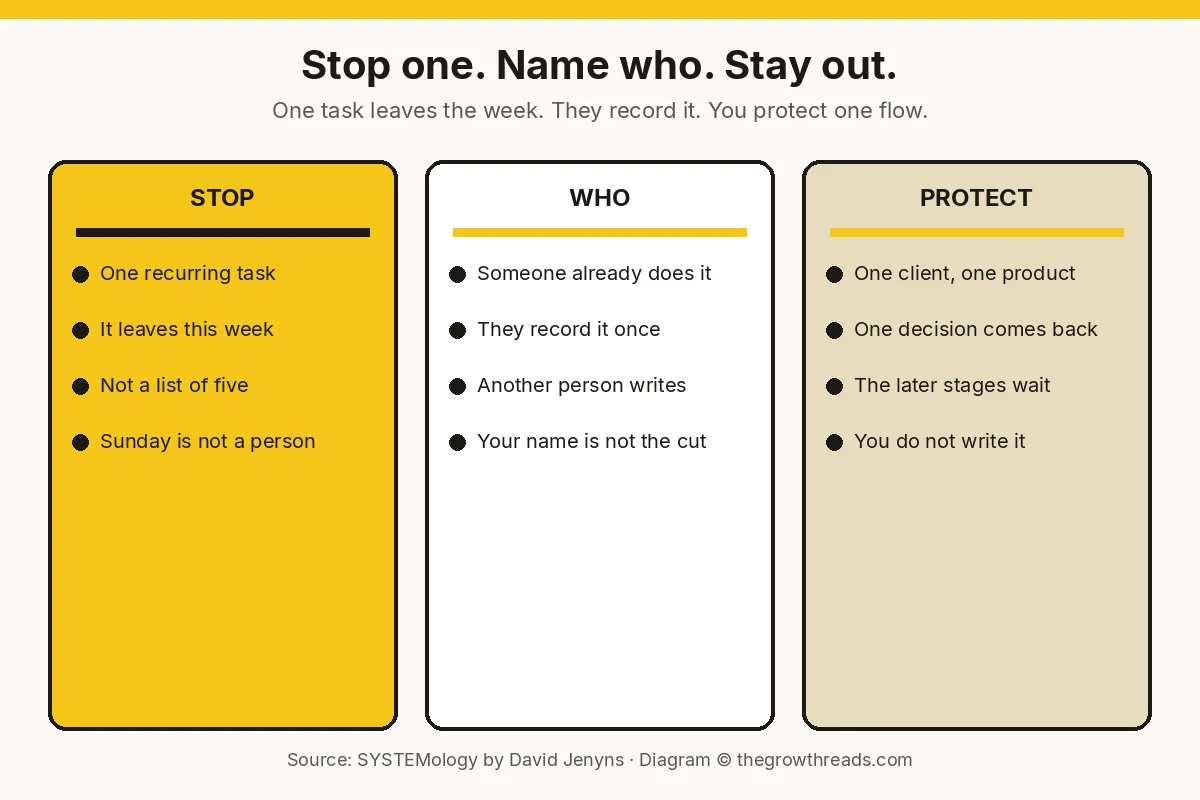
★★★★☆ 4/5 — Use it when the week is full and the company still stops if you step out. Stop one task, name who already does it, and stay out of the write-up.
Best for: a solo founder with at least one other person, or a new manager whose team already does the work.
Reading time: the seven stages are a short sitting beside his framework page. The November 2020 paperback is 212 pages.
Difficulty to apply: moderate. The cut is one task. Staying out of the document is the work.
SYSTEMology in one minute
Stop one recurring task, let the person who already does it record the doing, and stay out of the write-up. David Jenyns’s 2020 book is seven stages for an owner-dependent business. On his framework page he says the book walks through them, and that you do not start with hundreds of systems. Start with one critical client flow. The person doing the work records it. Someone else writes the steps. His line for the extract is that the owner stays out of it entirely. If nobody else works with you yet, the task still comes off the week.
Key takeaways
- Hundreds of systems is the stall: his framework page says you need a critical client flow, which he puts at 10 to 15 systems, and everything else can wait.
- The exercise page is tighter: systemology.com says 7 to 12 steps, one client, one product, about twenty minutes. The counts do not match. Use the overlap.
- The owner is the wrong writer: the paperback’s description, and his page, say owners are typically the worst people to document systems.
- The knowledgeable worker records it: the person who already does the task well captures it by screen, video, or audio. No writing at that stage.
- A Systems Champion writes it: someone detail-oriented inside the business turns the recording into steps. Not you, if you are the owner.
- A rough note beats a perfect one: he calls a usable draft a minimum viable system, and says it is better than a polished system that never gets written.
- Later stages are not Monday: organise, integrate, scale, and optimise start after one flow is running.
- Solo is a different cut: the Critical Client Flow page says the map can be drawn alone, and that the method is most useful with a few team members. Build a small team before you pretend the extract has a name.
What is SYSTEMology about?
SYSTEMology is David Jenyns’s 2020 book for a business that still stops when the owner steps out. He describes seven stages that start with one critical client flow. The person who already does the task records it, someone else writes the steps, and the owner stays out.
About the author
David Jenyns wrote SYSTEMology. The cover names a foreword by Michael E. Gerber, author of The E-Myth. On his framework page he describes founding Melbourne SEO Services and spending years as the person every decision ran through. He writes that he worked 60-plus hours a week and that the business could not function without him. He writes that in 2016 he hired a CEO, stepped back from daily operations, and the business kept growing. That is his account, on his site, not a study. The same page says the Systems Champion role is the subject of his second book. We found no Wikipedia photo, so this review does not invent one. The buttons use the 18 November 2020 paperback, 212 pages, ISBN 9780648871033. We did not read a numbered page. Explore all David Jenyns book summaries →
Key concepts at a glance
| Concept | What it means | Use it when |
|---|---|---|
| Critical client flow | How one client receives one product. His page says 10 to 15. The exercise page says 7 to 12. | You are about to document the whole company. |
| Knowledgeable worker | The person who already does the task. They record it and own that system. | Your name is still on work someone else can carry. |
| Systems Champion | A detail-oriented person inside the business who writes the steps from the recording. | You were about to write it tonight. |
| Extract | Screen, video, or audio first. Someone else writes. The owner stays out. | The handoff is still only “you’ve got this.” |
| Minimum viable system | A rough usable document, better on his page than a perfect one that is never written. | You are polishing a manual nobody follows. |
| One client, one product | The exercise page says to map one target client and one product, and only current work. | The freed hours are about to become a second offer. |
| Solo limit | You can sketch the flow alone. The page says to build a small team before the extract matters. | The only name on the task is yours. |
One flow, not a wall of systems
The morning problem is a full week that still depends on your hours. Jenyns’s answer, on the framework page he says the book walks through, is not a longer week and not a binder. The first myth he names is that you need hundreds of systems. You do not. You need the critical client flow, the systems that touch the client journey, and he puts that at 10 to 15. Everything else can wait. Stage 1 maps that flow from the first contact through delivery and a repeat. His plumber example starts at answering the phone and ends at the invoice and a review. He says every business has one.
The Critical Client Flow page on systemology.com is a shorter exercise and a different count: 7 to 12 steps, about twenty minutes, one target client, one primary product. The steps are what you do now, in two or three words. If you have more than 12, combine steps one person already handles. We checked both pages on 13 November 2026. They do not agree on the number, and we did not read a page of the book that settles it. The overlap is what you can use this week: one client, one product, and not a wall of systems.
The person doing the work records it
The second myth on his framework page is that the owner should do the documenting. He says the owner is usually the worst person for it, because they are too close, too busy, and too likely to overcomplicate the steps. The person who should capture the system is the person already doing it well. He calls them the knowledgeable worker. The paperback’s description, on Amazon, Booktopia, and Google Books, lists the same promise: why business owners are typically the worst people to document systems. That is the blurb, not a page we read.
Stage 2 names that worker as the owner of the system, and names a Systems Champion, someone detail-oriented inside the business who drives the project. Stage 3 is the extract. The worker records the task by screen, video, or audio. No writing yet. The champion turns the recording into steps. The line on his page, which we are not assigning to a page number, is: “The owner stays out of it entirely.”
You stay out of the write-up
The third myth is the evening trap. A minimum viable system, his name for a rough but usable document, beats a perfect system that never gets written. That lets you stop polishing. It does not put the pen back in the owner’s hand. Stage 3 already moved the writing to someone else.
The later stages are real and they are not this week. Organise means one shape and one place to put the steps. Integrate means people actually use them. Scale means the next department, after this flow is running. Optimise means a review later. Opening all four on Monday adds a project to a full week. The cut is narrower. One task leaves. The person who already does it records it once. Someone who is not you writes the steps. If you are faster, that is not a reason to take the pen back. If you would both keep an eye on it, it is not owned.
Protect one client and one product
The hours you free will fill unless you name what they are not for. The Critical Client Flow page keeps the map to one target client, one primary product, and the work you do now. His framework page says everything outside that flow can wait. Protect that one flow, including the one decision that still comes back to you. Do not protect the whole week, and do not spend the freed hours on a second offer.
The same page answers the solo case. You can sketch the flow alone, and the method is most useful with a few team members. Its instruction is to build a small team first. The extract assumes a knowledgeable worker and a Systems Champion, and neither is the owner. If you are alone, do not write the manual tonight and call it a handoff. Take one task off this week. Do not move it to Sunday. The next person you add absorbs it, or it stays off.
The sentence below is this review’s application for a solo founder or a new manager. The pages we read do not print it. Leave the shape. Replace the brackets. Do not add a second task in the same note.
When someone already does the work: Starting [day], I am stopping [the one task]. [Name] owns it. Please record yourself doing it once. [Champion, or the same name] will write the steps. Bring me [the one exception] only. I am keeping [one client and one product], and I am not opening a second system this week.
When you are the only person: I am taking [the one task] off this week. I will not write the manual for it myself. The next person I add absorbs that task, or the task stays off. I am protecting [one client and one product]. Nothing else gets a system until that person exists.
Then stop typing. A second paragraph that keeps you across the rest of the list puts your hours back on it. The only decision you still keep is the one exception you named.
Who is SYSTEMology best for — and who should read something else first?
Read this if a full week still stops when you step out, and someone else already does a task you are still touching. The extract is the part that matches. You do not need the later stages for this week’s cut. A new manager uses the person who is already good at the task.
Read Essentialism first if the problem is a whole client who is a bad fit. Read The Great CEO Within if you need a wider operating picture and this one task is not the bottleneck. Read The Effective Manager if the hour is a 1:1 with no owner. If you are alone, the Critical Client Flow page says to build a small team first. This book will not invent that person.
Questions to reflect on
- Which one recurring task stops when you stop, and could someone who already works with you carry it?
- If you named that person, would you still write the steps tonight because you are faster?
- What is the one client and the one product this flow is allowed to cover?
- What is the single exception they should still bring you, and what are you tempted to add as a second look?
- If the only name is yours, which task comes off the week anyway, without moving it to Sunday?
🔥 Ready to stop one task and stay out of the system?
The November 2020 paperback is the edition in the Amazon button. Use the extract on the one task the week still waits on you to touch.
How to apply SYSTEMology (7-day plan)
- Day 1 — Write one target client and one product you already serve. If you cannot name them, stop. Do not open a documentation project.
- Day 2 — List the tasks in that flow that stop when you stop. Circle one another person could already do.
- Day 3 — Name that person, or write “nobody.” If the name is yours, skip to day 6. Do not write the steps yourself.
- Day 4 — They record the task once. Someone who is not you writes a rough set of steps.
- Day 5 — Send the sentence. The task leaves your week. Name the one exception. Nothing else comes back for a look.
- Day 6 — If you are solo, take the task off the week and leave it off. Do not move it to Sunday. The next person absorbs it, or it stays stopped.
- Day 7 — Do not open a second flow. The later stages stay closed until this task has a name that is not yours.
Frequently asked questions
What do you do when the company still depends on your hours?
The company still depends on your hours when a full week stops if you step out of it. Name one recurring task that waits on you, and name the person who already does that work. They record themselves doing it once. Someone else writes the steps. Jenyns’s framework page calls that person the knowledgeable worker and says the owner stays out of the extract. Protect one client and one product. Do not open a second system this week. If the only name is still yours, you have not made the cut. Take the task off the week, and do not move it to Sunday.
What is a critical client flow?
A critical client flow is how one client receives one product, not a manual of the company. Jenyns’s framework page puts it at 10 to 15 systems on the client journey and says the rest can wait. The Critical Client Flow page puts it at 7 to 12 steps, about twenty minutes, only the work you do now. The pages do not match on the number. We did not read a page of the book that settles it. Use the overlap: one client, one product, not hundreds of documents. If one person already handles two steps, combine them.
Who should write the system down?
Not you, if you are the owner. Jenyns’s framework page says the owner is usually the worst person to document a process, because the owner is too close and too likely to overcomplicate it. The person who already does the work records it. A Systems Champion writes the steps from that recording. His stage 3 says the owner stays out entirely. The paperback’s description lists the same promise. That is the blurb, not a chapter we read. A rough note is what he calls a minimum viable system. Being faster is not a reason to take the pen back tonight.
What if you are a solo founder with no team?
Do not write the manual tonight and call that a handoff. The Critical Client Flow page says the map can be drawn alone, and that the method is most useful with a few team members. Its instruction is to build a small team first. The extract assumes a knowledgeable worker and a Systems Champion, and both are people who are not the owner. Until that person exists, take one recurring task off this week and leave it off. Do not move it to Sunday. The next person you add absorbs that task, or the task stays stopped. Protect one client and one product while you wait for them.
What should you say when you hand the task off?
One task, one name, one exception, and then stop. Say you are stopping the task on a named day, that the named person owns it, and that they will record it once while someone else writes the steps. Name the single exception they should still bring you, and the one client and product you are keeping. The pages we checked do not print this note. The wording is this review’s application. A second paragraph that keeps you across the rest puts your hours back on the list. If you would both keep an eye on it, it is not owned.
Which edition is this review based on?
The buttons use the paperback Amazon, Booktopia, and Google Books record vYANzgEACAAJ list: publisher SYSTEMology, 18 November 2020, 212 pages, ISBN-13 9780648871033, ISBN-10 0648871037. Open Library OL30904120M is a separate listing, ISBN 9780648871002, hardcover, 18 August 2020, also 212 pages. We did not mix those records or read a numbered page. The stages and the line that the owner stays out are his framework page. The 7-to-12 count is the Critical Client Flow page. Where those pages disagree, we say so.
Is this the same as documenting the whole company?
No. This cut is one task, one name, and one flow you still protect. Jenyns’s framework page says you do not need hundreds of systems, and that everything outside the critical flow can wait. Organise, integrate, scale, and optimise are real stages on that page. They are not Monday’s job. A new manager uses the person who already does the task. A solo owner, on the Critical Client Flow page, builds a small team before the extract has someone else’s name on it. Documenting every department this week puts your hours onto a new project. The original task never leaves, so the company still depends on you.
Related summaries
- The E-Myth Revisited summary — when you are still the technician because the file is open
- Clockwork summary — when the business should run a week you did not design hour by hour
- Work the System summary — a different systems stance for the same owner-shaped week
- Built to Sell summary — when the offer is still a custom pile
- Best productivity books