

★★★★☆ 4.4/5 — your chaos is a machine you have not documented yet.
Best for: Founders and operators who are the bottleneck in every recurring fire
Reading time: ~8 hours (4th edition, 2021) · this guide ~12 min
Difficulty to apply: Medium — the first procedure is easy; keeping the package current is the job
Work the System in one minute
If the same fire returns every Tuesday, you do not have a people problem. You have an undocumented system. Sam Carpenter ran a 24/7 telephone answering service on 80-hour weeks until his health gave out. The turn was mechanical: treat the company as a collection of systems, write three documents that describe the machine, and improve the procedures whenever something fails. The Strategic Objective says where the machine is going. General Operating Principles decide without a meeting. Working Procedures are the numbered steps a competent stranger could follow tomorrow. This TGR summary turns that package into a concepts table, three diagrams, and a seven-day start you can run before you buy another tool.
Key takeaways
- Systems mindset: your life and business are collections of repeating processes, not unique emergencies.
- See it first: you cannot improve a loop you still experience as “just how Mondays are.”
- Three documents: Strategic Objective, General Operating Principles, Working Procedures — in that order.
- Document the real steps: write what actually happens, not a prettier flowchart of imaginary steps.
- Errors are system errors: when something fails, fix the procedure the same day, not the person.
- One procedure at a time: the hour you win funds the next document. Do not boil the ocean.
- 95/5: most of the week should maintain working systems; firefighting is a documentation gap.
- The owner designs: your job is to work on the machine, not to remain the machine.
- Maintenance is the product: documents nobody uses are wallpaper. Update them when reality changes.
- Freedom is a byproduct: hours collapse after the package exists — not after another heroic week.
What is Work the System about?
Work the System is Sam Carpenter’s method for turning a chaotic business into a documented machine: see your repeating processes, write a Strategic Objective plus operating principles plus working procedures, then improve those procedures whenever they fail so the company can run without you in every loop.
About the author
Sam Carpenter is an Oregon entrepreneur who built Centratel, a telephone answering service that had to stay up all night, then nearly worked himself to death keeping it alive. After years of 80-hour weeks, a health crash forced him to stop treating every fire as a unique emergency. He wrote down what the company already did, put a one-page destination at the top, and started fixing the procedures that kept breaking. Hours collapsed; the business grew. Work the System (2008; fourth edition 2021, with consultant Josh Fonger) is the field manual from that turn. He still operates from Bend and teaches owners who have become the bottleneck in their own machine. Explore all Josh Fonger book summaries →
Key concepts at a glance
| Concept | What it means | Use it when |
|---|---|---|
| Systems mindset | Repeating work is a machine, not a mood | You keep calling the same fire a one-off |
| Strategic Objective | 1–2 pages: what you are, who you serve, where you are going | Every procedure has no destination |
| Operating principles | Short rules that decide without a meeting | Quality depends on who is in the room |
| Working Procedures | Numbered steps a stranger could follow | Training means shadowing you for a month |
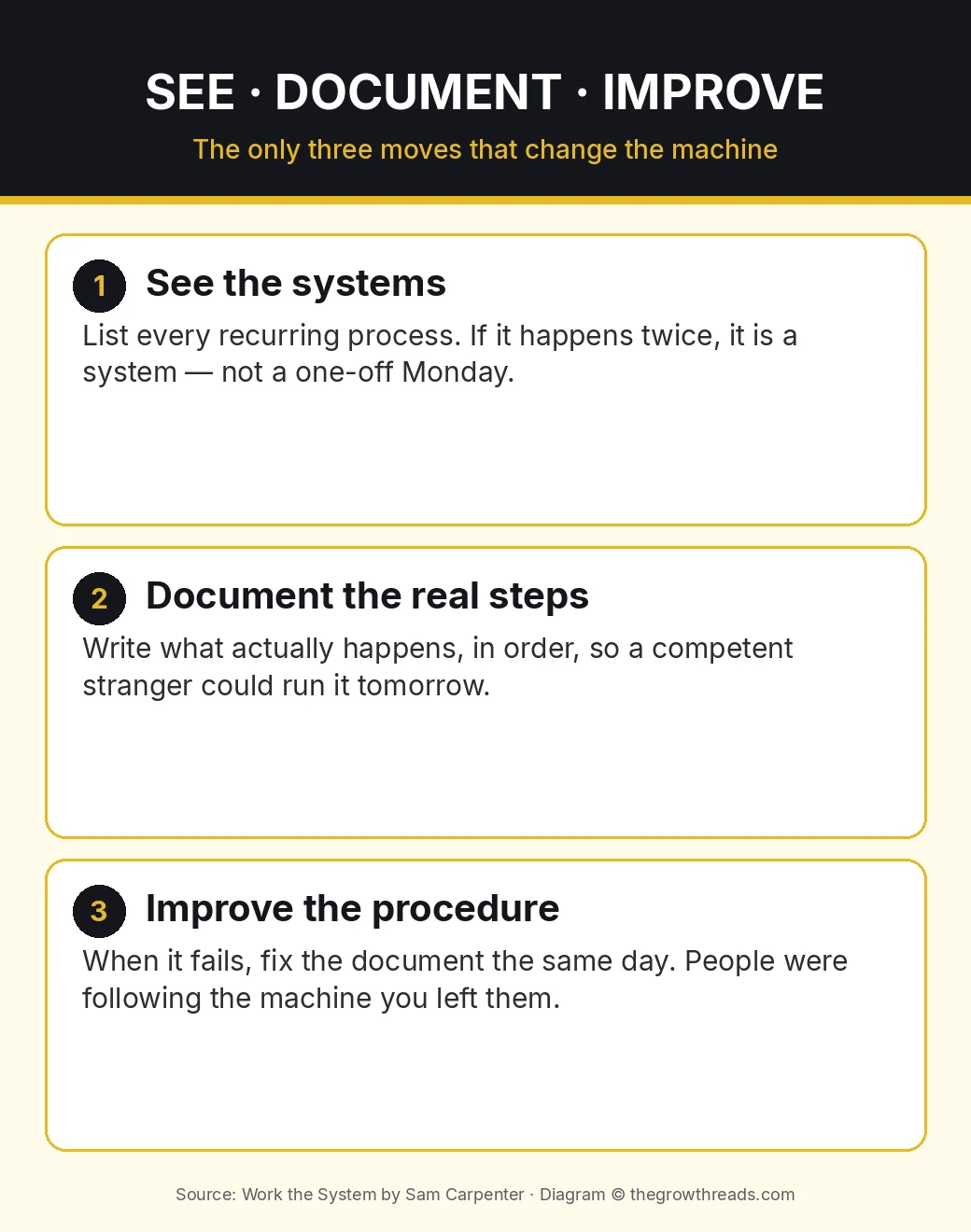
| See → document → improve | The only three moves that change the machine | You buy tools instead of writing the real steps |
| Errors are system errors | Fix the procedure the same day, not the person | The same mistake has a name attached to it |
| 95/5 | Most of the week maintains working systems | Your calendar is 90% exceptions |
| Primary system | The business as a whole, made of subsystems | You improve a step that fights the destination |
Part 1: Chaos is a machine you have not named
Carpenter’s story is the argument. Centratel had to answer phones around the clock. The founder became the overflow valve: every exception, every night, every “just this once.” That is not a personality flaw. It is what an undocumented primary system does to the person who still cares. He was working inside the machine so hard he could not see it was a machine.
The systems mindset is the first move, and it is smaller than it sounds. Walk your week and list every process that already happened twice — how a lead is answered, how a job is closed, how an invoice goes out, how a night shift is covered. If it recurs, it is a system. While you experience it as weather, you will keep bringing heroics. Once you name it, you can point at a step. That list is the raw material for everything else in the book. Do not decorate it. Do not skip the ugly loops. The fire you are proud of putting out is usually sitting on that list with no owner and no steps.
TGR Note: The older version of this argument is The E-Myth Revisited: stop being the technician, design a business a stranger could run. Clockwork is the same wound with a timesheet and a vacation date. Carpenter is the documentation layer those books assume. If your fire is always the same fire, Upstream is the prevention twin — move before the event, not during it.
Part 2: The three documents that run the machine
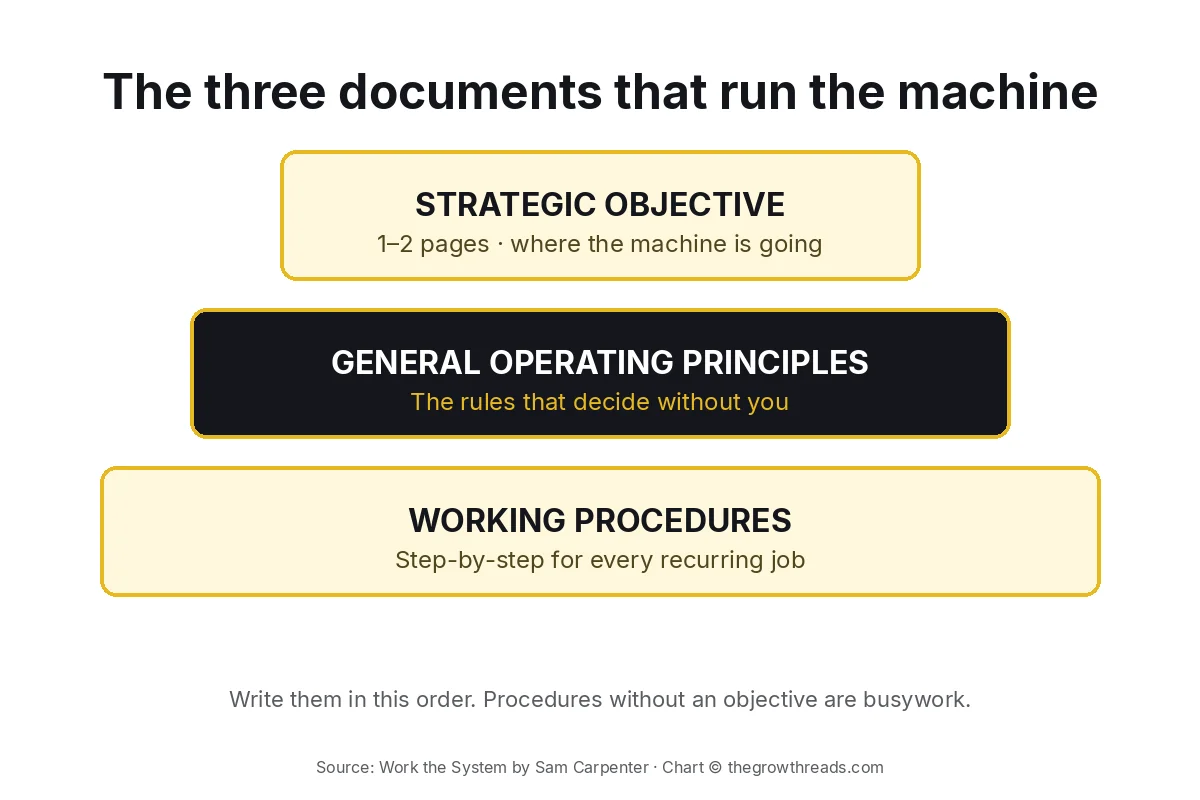
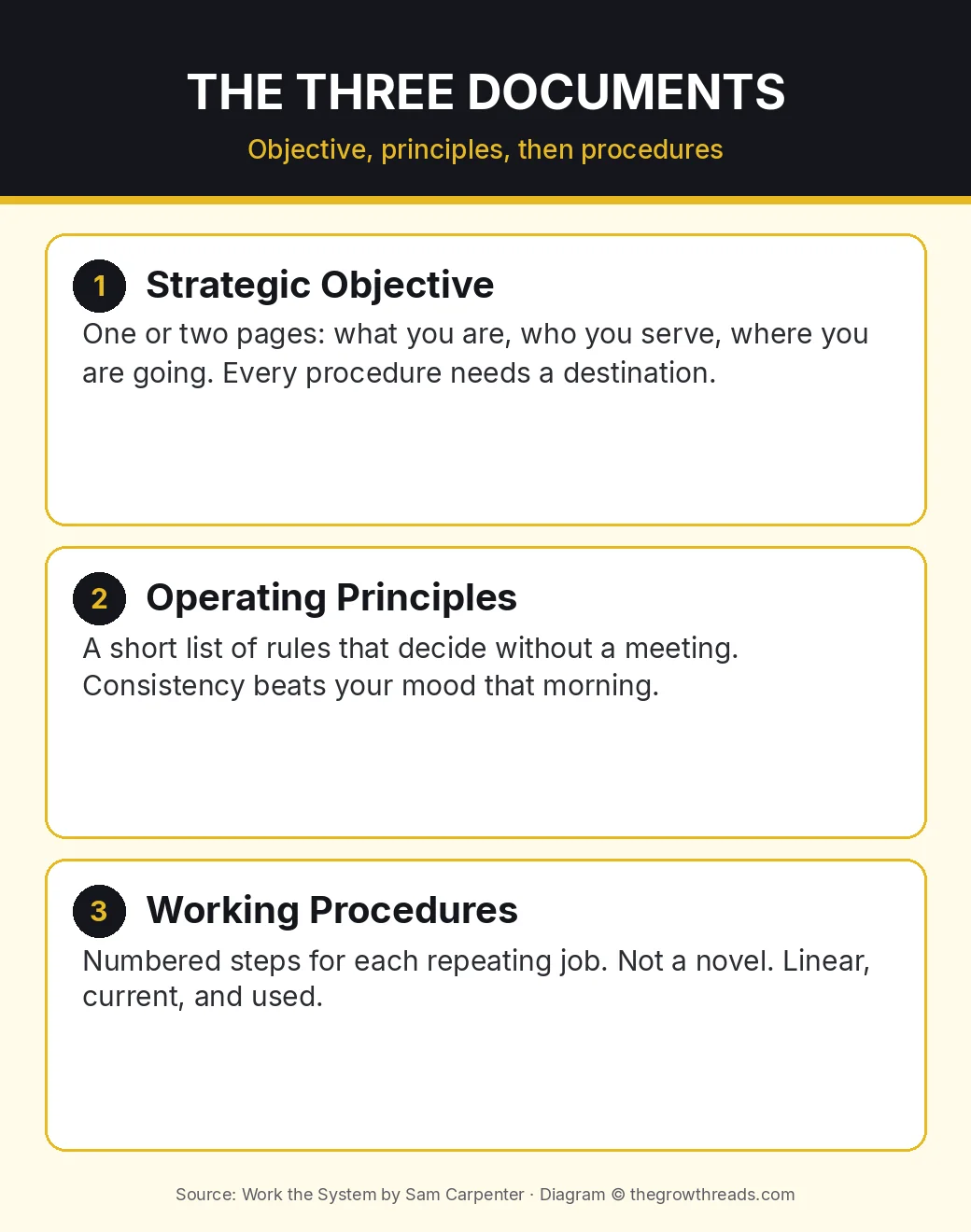
Carpenter does not want a wiki. He wants three living files, written in order. The Strategic Objective is one or two pages: what this machine is, who it serves, and where it is going. Without that, every procedure is busywork with nice formatting. General Operating Principles are the rules that decide when you are not in the room — quality, speed, what you will not do for a loud customer. Working Procedures are linear, numbered, current. A competent stranger should be able to execute one tomorrow. If they cannot, it is not a procedure yet. It is a diary of how you do it on a good day.
Write the Objective first even if it feels too simple. Then ten principles, not forty. Then the one procedure that failed last week, not the entire company. The pyramid in the chart above is the point: a fat stack of SOPs with no destination is how teams get busy and still miss the promise. Keep the files short on purpose. Short is how they get used.
TGR Note: If your real gap is capture — open loops living in your head — start with Getting Things Done. Carpenter assumes you can see the work long enough to write it. The Checklist Manifesto is the cousin on the execution side: a short list that makes the known steps happen under pressure. Use it inside a Working Procedure, not instead of one.
Part 3: Document first, then improve
The sequence is easy to reverse and that is how the method dies. Teams love a brainstorm about the “future process” and never write the current one. Carpenter’s order is blunt: document what actually happens, however ugly, then change the step that fails. You cannot improve a ghost. The first draft of a Working Procedure should sound like a walk-through, not a policy. Number the steps. Name the tools. Say who owns the outcome.
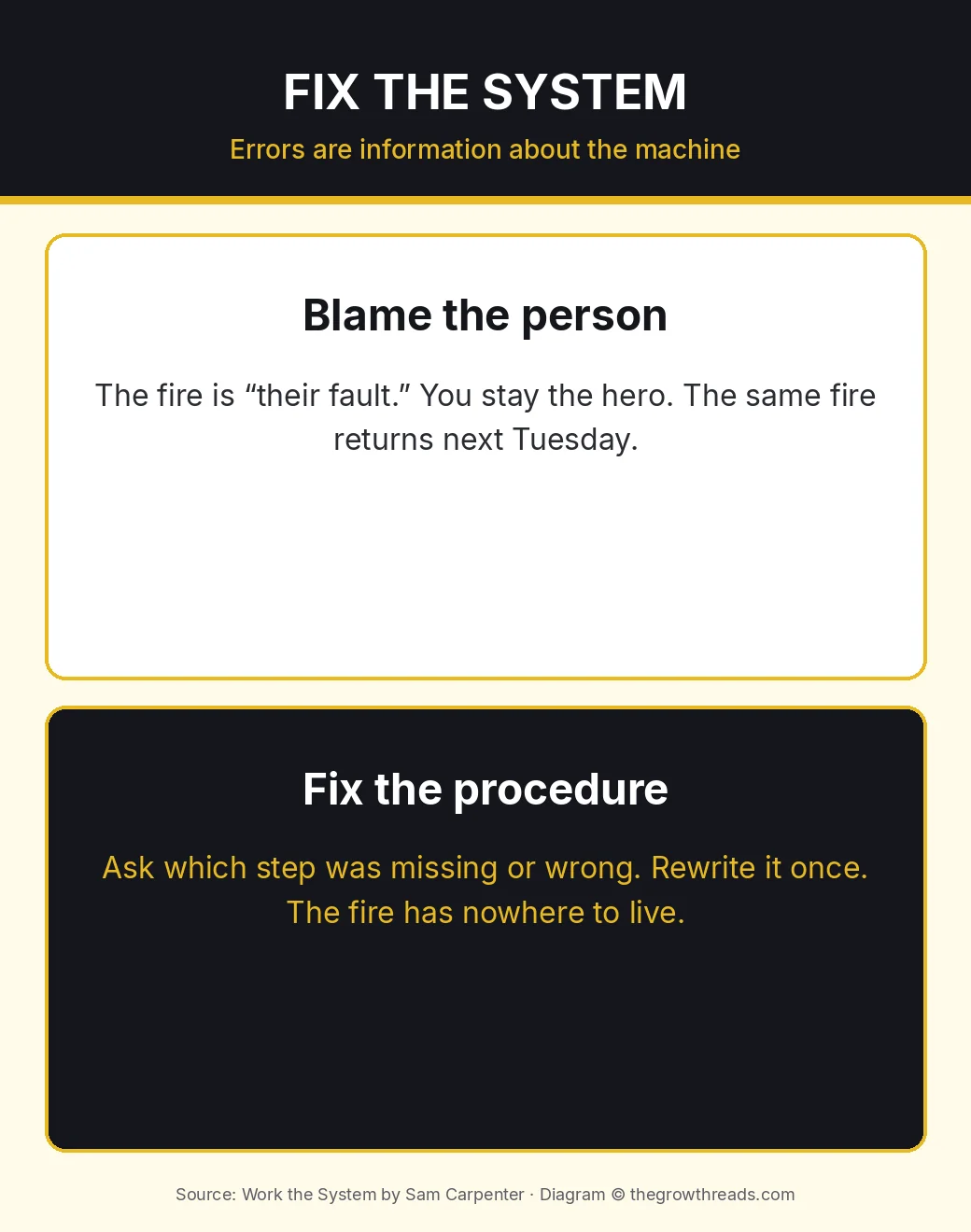
When the next error lands, do not hold a character meeting. Ask which step was missing or wrong. Rewrite the procedure the same day. That is the mechanical kindness of the book. People were usually following the machine you left them. Blame keeps you in the hero seat and guarantees the fire returns. A one-line patch to step 4 does not feel like leadership. It is how Centratel stopped needing Carpenter in every exception. Improve is a daily verb, not a quarterly offsite.
TGR Note: If you cannot hand the procedure to anyone, you do not have a documentation gap yet — you have a transfer gap. Who Not How is the staffing twin: name the outcome, find the who. The 4-Hour Workweek treats absence as a design constraint. Write the steps first, then pick the who. Otherwise you hire a shadow of yourself.
Part 4: Maintain the package, buy back the week
Carpenter’s 95/5 split is the adult version of work-life rhetoric. Most of a healthy week should be maintaining systems that already work. The creative 5 percent — new offers, real exceptions, design — only exists if the 95 is not on fire. If your calendar is 90 percent exceptions, you do not need more grit. You need the next Working Procedure and a 30-minute weekly review that asks “what broke, which file do we change?”
Maintenance is the product. A binder nobody opens is worse than no binder, because it lets you pretend the machine exists. Put the files where the work happens. Date the last edit. Kill steps that reality already killed. The extra hours do not arrive as a prize at the end of a heroic quarter. They arrive one documented loop at a time, then you reinvest them in the next loop. That is how an 80-hour founder gets a company that keeps its promise on a Thursday he is not in the building.
TGR Note: If cash is the fire, do not start here. Profit First (same neighborhood as Clockwork’s author) makes profit a habit before you document a machine that cannot pay you. If focus is the fire, The One Thing picks the promise. Then come back and write the procedure that serves it.
Who is Work the System best for — and who should read something else first?
Best for founders, ops leads, and solo operators whose week is the same fires with different names. If you cannot take two days off without Slack finding you, this is the documentation job those weeks have been postponing. It is especially sharp if you already believe in systems and still have no files a stranger could run.
Read something else first if the wound is personal habit, not a repeating company loop — start with Atomic Habits. If you cannot see the work because it lives in your head, Getting Things Done first. If you need a business that keeps a promise while you are gone, and you want the timesheet version, Clockwork is the sibling; come back here to write the actual steps.
Questions to reflect on
- Which fire returned last week, and which undocumented system produced it?
- If you vanished for ten days, which three loops would break first — and do they have a Working Procedure?
- What would a one-page Strategic Objective say you are not doing this year?
- When the last error landed, did you fix a person or a step?
- What is the one procedure you will document this week, and where will it live so someone else can find it?
🔥 Ready to stop fighting the same fire?
Get Work the System, then use the 7-day plan to name your systems, draft the Objective, and write one Working Procedure.
How to apply Work the System (7-day plan)
- Day 1 — List the machine. Write twenty recurring processes from the last month. Circle the three that ate the most hours.
- Day 2 — Draft the Objective. One page: what you are, who you serve, where you are going, what you will not do. Keep it ugly.
- Day 3 — Ten principles. Rules that should decide without you. If a principle would not change a real decision this week, cut it.
- Day 4 — One Working Procedure. Document the process that failed last week, as it actually happens, in numbered steps.
- Day 5 — Stranger test. Hand the procedure to someone else, or follow it yourself as if you were new. Patch every stall.
- Day 6 — Error = edit. Whatever breaks today, change the document the same day. Do not hold a character meeting.
- Day 7 — Reinvest. Pick next week’s one procedure. Put a 30-minute systems review on the calendar. That meeting is the maintenance.
Frequently asked questions
What is Work the System about in one paragraph?
Work the System is Sam Carpenter’s field manual for owners who have become the bottleneck in their own company. After years of 80-hour weeks inside his telephone answering service, he treated the chaos as a collection of undocumented systems instead of a string of unique emergencies. You write three documents — a Strategic Objective, General Operating Principles, and Working Procedures — then you improve the procedures whenever something fails. The point is not a prettier binder. It is a machine a competent stranger could run, so your hours drop while the business still keeps its promise.
What are the three documents in Work the System?
Carpenter asks for a short package, not a wiki. The Strategic Objective is one or two pages: what the business is, who it serves, and where it is going. General Operating Principles are the rules that decide without a meeting — quality, speed, what you will not do. Working Procedures are numbered steps for each repeating job, written so a competent stranger could follow them tomorrow. Write them in that order. Procedures with no objective become busywork. Principles with no procedures stay posters on the wall. The package is how the machine keeps a promise when you are not in the room.
How is Work the System different from the E-Myth, Clockwork, and GTD?
The E-Myth Revisited tells the technician to stop being the business and to design a franchise prototype. Clockwork adds a timesheet, a Queen Bee Role, and a vacation test. Getting Things Done captures open loops so your head is not the inbox. Work the System is the documentation layer those books assume: three living files that turn recurring work into a machine you can improve. Use E-Myth or Clockwork to see that you own a job. Use Carpenter to write the next procedure this week. Use GTD if the wound is personal capture, not a company that still needs you on every exception.
Is Work the System only useful if I already have employees?
No. A solo operator still has systems: how a lead is answered, how an invoice goes out, how a job is closed. If those loops live only in your head, you cannot take a week off and you cannot hire without shadowing yourself for a month. Write the procedure first, even if you are the only person who will follow it this quarter. The document is what lets you improve the loop instead of reliving it. When you do hire, you hand over a process, not a personality. That is the whole point of working on the machine instead of remaining the machine.
What does Carpenter mean by a systems mindset?
A systems mindset treats your week as a collection of repeating processes, not a string of unique emergencies. Invoicing, onboarding, the 5 p.m. scramble — if it happened twice, it is a system. While you experience it as “just how Mondays are,” you cannot adjust it. Once you name it, you can see the steps, write them, and change the one step that keeps failing. Carpenter’s own crash at Centratel came from living inside undocumented systems until his health gave out. The mindset is mechanical on purpose: your business is a machine. Document it. Then improve it.
Do I need the fourth edition of Work the System?
The method has been stable since 2008: see the systems, write the three documents, improve the procedures when they fail. The 2021 fourth edition (Greenleaf, with Josh Fonger) keeps that core and adds an epilogue plus case studies from owners who installed the package. If you already own an earlier copy, you do not need a new edition to start. If you are buying once, the fourth edition is the clean hardcover to get — ISBN 9781626347694, the copy this review used. Apply the 7-day plan either way. The documents matter more than the cover date.
How long does it take to apply Work the System?
You can name twenty systems and draft a one-page Strategic Objective in a week. That is the 7-day plan in this review. A working package — principles plus the ten procedures that actually eat your calendar — is a quarter, not a weekend. Carpenter’s own turn at Centratel took months of writing what the company already did, then fixing the errors the documents exposed. Do not try to document everything in seven days. Document the process that failed last week. Reinvest the hour you win into the next one. Maintenance is the product; the binder is not.
Related summaries
- Clockwork by Mike Michalowicz
- The E-Myth Revisited by Michael E. Gerber
- The 4-Hour Workweek by Timothy Ferriss
- Getting Things Done by David Allen
- Best productivity books
How we analyze books: every book on The Growth Reads is read cover to cover, summarized in thousands of words of original analysis, and rated against our five-criteria rubric (lasting impact, evidence quality, practical application, writing & originality, external consensus). Read our full methodology.