

★★★★½ 4.5/5 — Productize the work so a buyer is purchasing a firm, not a person who cannot leave.
Best for: Agency, consultancy, and practice owners who are still the rainmaker, the doer, and the manager.
Reading time: ~3 hrs (guide: 12 min)
Difficulty to apply: Low on the logic; honest on saying no to the generalist menu.
Built to Sell in one minute
If the firm needs you, you do not own a business. You own a job. Built to Sell (2011) is John Warrillow’s short fable for service owners who are exhausted and still unsellable: the calendar is full, quality lives in their head, and a broker would not pay for a person who cannot leave. The move is one teachable unique offering — named, documented, sold without your charm — then a month off as the only honest test. If you take one move from this Built to Sell summary, write the offering in one sentence a stranger could repeat, and cut everything that does not fit it.
Key takeaways
- A job is not an asset: Busy is not sellable when the owner is still the engine.
- Specialize on purpose: A menu of favours is how agencies stay unsellable.
- Name the product: A teachable unique offering has a sentence, a price, and steps.
- Document delivery: If only you can do it, you have not productized it.
- Stop being the rainmaker: A salesperson with a script replaces founder charm.
- Cash before work: Get paid first so the cycle does not need your panic.
- The month off is the exam: What breaks while you are gone is the real org chart.
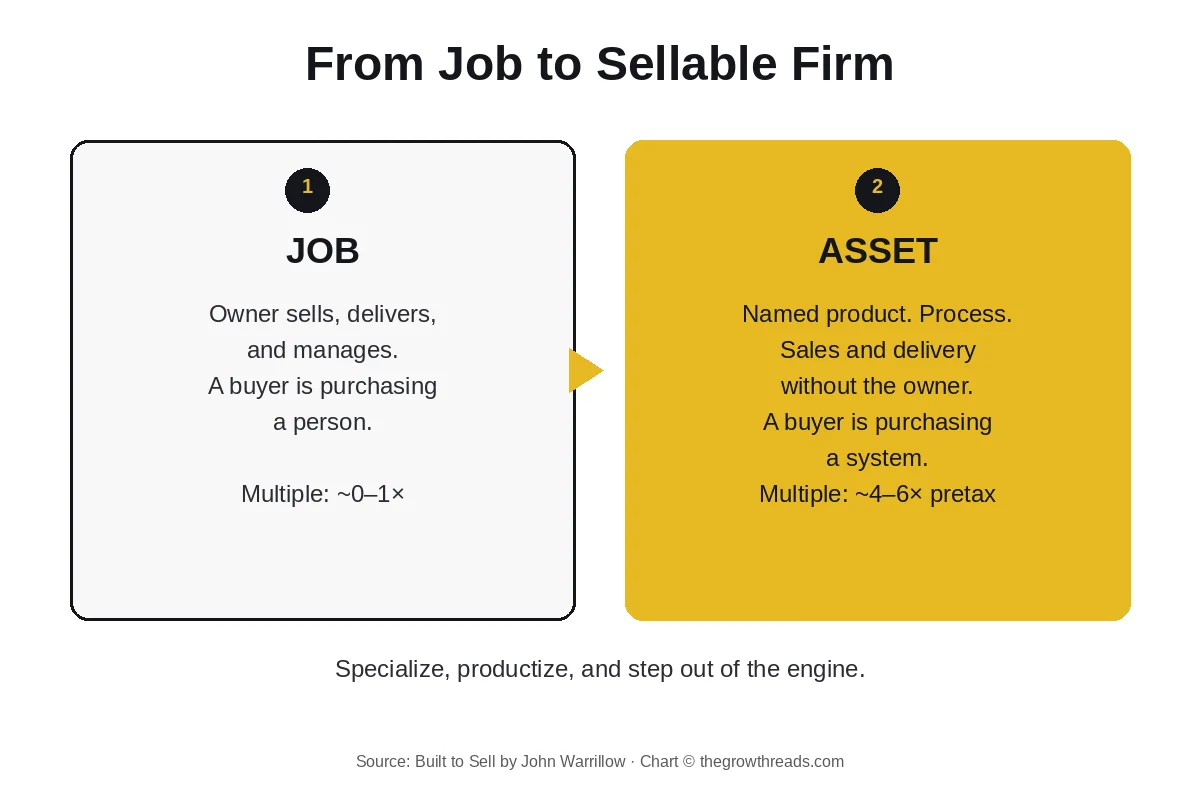
- Buyers pay for systems: Owner-optional firms earn a multiple; owner-shaped jobs do not.
- Narrow is a premium: Saying no this quarter is how the asset shows up later.
- Selling is optional: The same design gives you evenings even if you never list the firm.
What is Built to Sell about?
Built to Sell is John Warrillow’s 2011 fable for service-firm owners who are the product: specialize into one teachable offering, document a process other people can deliver, stop being the rainmaker, and take a month off — so a buyer is purchasing a system, not a person.
About the author
John Warrillow is a Canadian entrepreneur and writer who learned that a service company can be busy and still unsellable. After building and selling a market-research business, he interviewed founders about what actually made a buyer write a cheque. That reporting became Built to Sell (Portfolio, 2011), a short fable with a foreword by Bo Burlingham, then a practice: the Value Builder System, a sellability score used by advisors, and Built to Sell Radio. Later books push the same spine — recurring revenue, then the sale itself. He is a former owner who watched generalist shops work themselves into a corner, and he wrote a fable so you can productize this quarter instead of hoping a broker will pay for your heroics. Explore all John Warrillow book summaries →
Key concepts at a glance
| Concept | What it means | Use it when |
|---|---|---|
| Owner-dependence | You sell, deliver, and manage; the firm is a person | A week off would stall the work |
| Teachable unique offering | One named product a junior can follow | Your website is a menu of favours |
| Specialize | Say no to work that needs a hero | You are “full service” and exhausted |
| Documented process | Steps, not tribal knowledge | Quality lives in your head |
| Not the rainmaker | A salesperson plus a script | Every deal still needs your name |
| Cash first | Paid before delivery; positive cycle | You finance the client’s project |
| Month-off test | Leave and see what breaks | You think “I’m finally optional” |
| Valuation multiple | Buyers pay for a system, not a salary | You want a cheque, or the option |
Part 1 — A busy firm that still will not sell
Warrillow’s fable opens where a lot of owners live. Alex Stapleton runs a generalist marketing agency. The phone rings. The work gets done. Then he tries to sell, and a broker’s math is blunt: without Alex, there is almost nothing to buy. Clients hired him. Staff wait on him. A buyer is not purchasing a firm. They are being asked to purchase a person who wants to leave. That is a job with a logo.
Owners hear “unsellable” as a verdict on effort. Warrillow means a design diagnosis. Three hats sit on one head: rainmaker, doer, manager. Together they make a bottleneck that looks like leadership. The more Alex says yes — logos, sites, copy, anyone with a cheque — the more the firm needs him. Revenue goes up. Optionality goes down. Indispensable is exactly what a buyer will refuse to pay for.
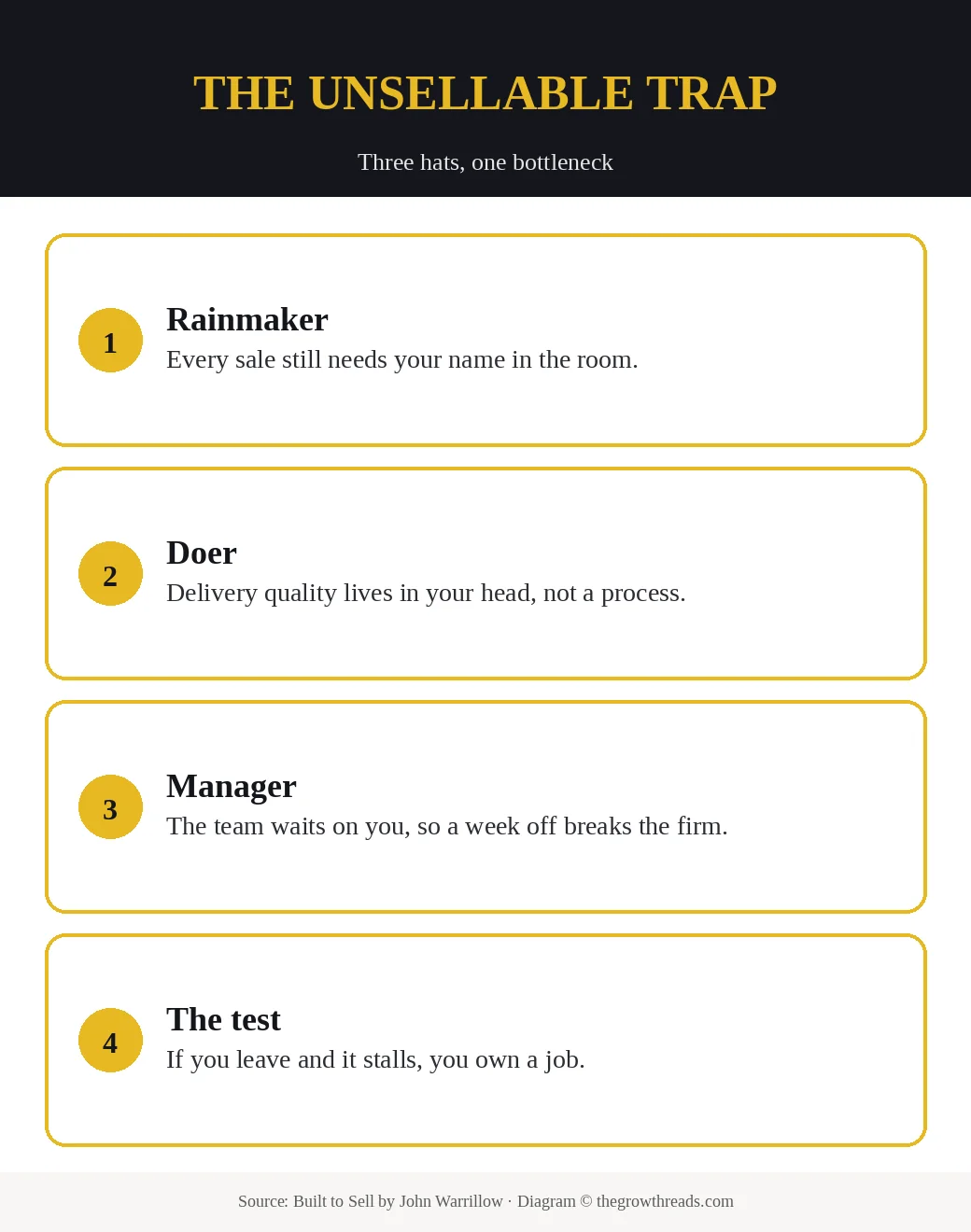
The practical read is not “find a broker.” It is “write what would break if you left on Monday.” Sales conversations. Delivery steps that live in your notes app. Approvals only you will sign. That list is the org chart. Warrillow wants you to see it while you still have energy to redesign it. Indispensable feels like safety. In this book it is the reason the multiple stays near zero.
TGR Note: The E-Myth Revisited is the diagnosis that you are the technician. Clockwork is the later design test: a Queen Bee Role and a vacation that the firm survives. Warrillow is the productizing fable between them. Use Gerber when you need the name of the trap. Use Michalowicz when you need the calendar. Use this book when the stall is a generalist menu and an owner-shaped bottleneck. Do not collect all three as a way to delay the one-sentence offering.
Part 2 — One teachable product, not a menu
The mentor’s first cut is specialization. A stranger should repeat what you sell in one sentence. If it needs a brochure, you have a menu, not a product. Alex’s agency did whatever a client asked. That trained the market to buy Alex. Warrillow’s move is a teachable unique offering: a named package, a niche, steps a junior person can follow, and a price that does not invent the job every Tuesday.
Owners hear “specialize” as “get smaller.” The fable argues the opposite on a two-year clock. A named product trains faster, sells at a premium, and is what a salesperson can describe without you. Custom work that only you can do will always need you — which is why it will not sell. The uniqueness is the checklist plus the refusal. You become one thing a buyer could understand in a meeting without you.
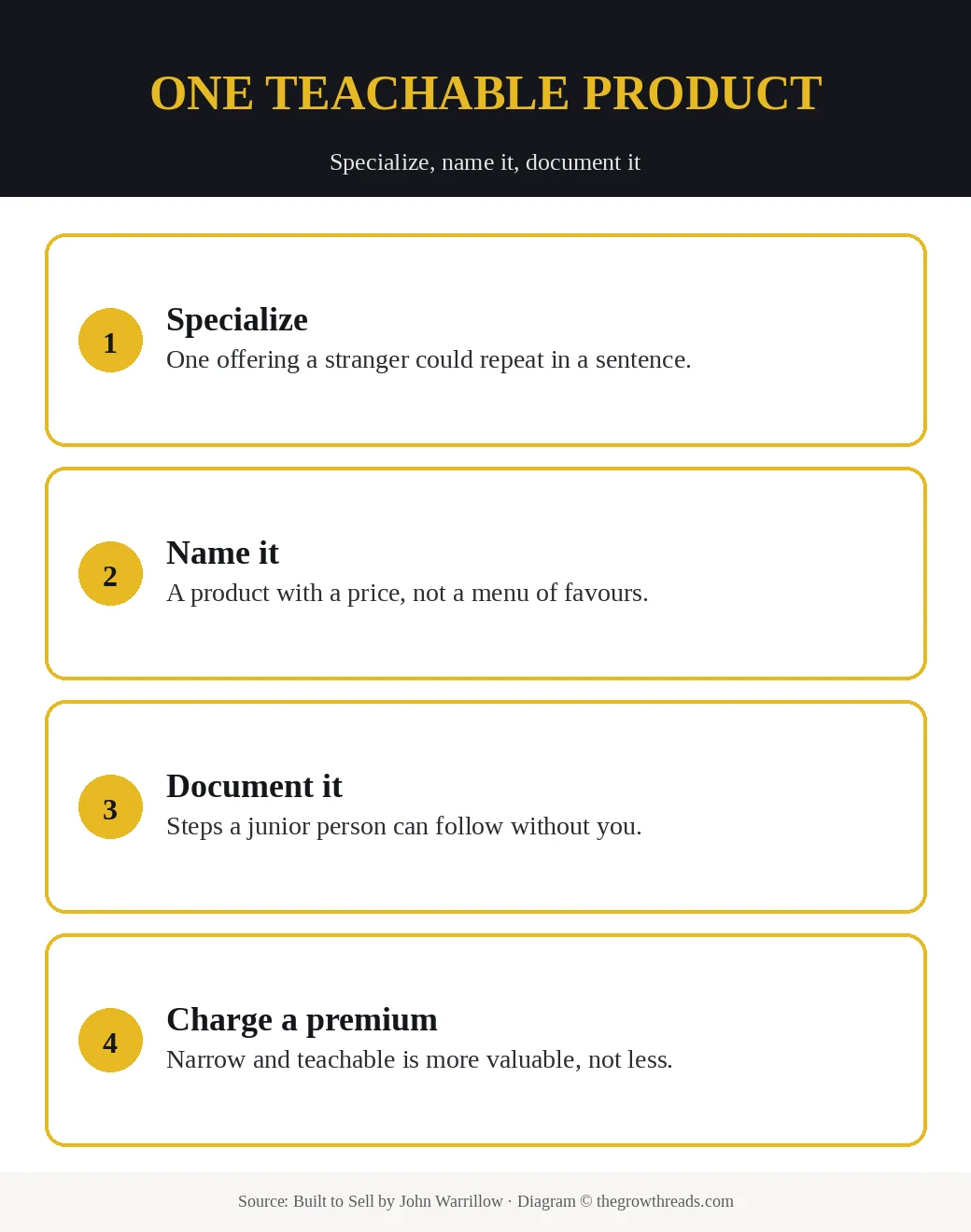
Write the offering before you decorate it. One sentence. Who it is for. What they get. What you will not do. Then eight steps a person you already employ could run without texting you. If you cannot write the steps, you do not have a process. You have a talent. Talent is admirable. It is also how service firms stay jobs. Charge for the package, not the hour. Hours keep you in the engine. A package is how the engine gets a name.
TGR Note: The cut is cousin to The One Thing and Essentialism: designed exclusion, not a prettier to-do list. The $100 Startup is useful when you still need a paying offer; this book is for after the offer exists and you are still the delivery. Do not use all four as a reading pile that delays the sentence. Write the offering. Cut the menu. Then read whoever helps you keep the no.
Part 3 — Sales, process, and cash without the owner
A product that still needs your charm to close is not a product yet. If every deal requires the founder’s story, a buyer is purchasing that story. Appoint a salesperson. Give them a script: package, steps, price, fit. Sit out of one conversation and see whether the offering survives without your personality. That sitting is the point.
Delivery has the same test. Documented steps are how a junior person becomes the doer — a sequence you could hand someone on Tuesday and audit on Friday. Then cash. Custom shops often finance the client: work first, invoice later. A productized firm gets paid before delivery so the cycle does not need your adrenaline. Positive cash flow here is how the business stops using you as a credit line.
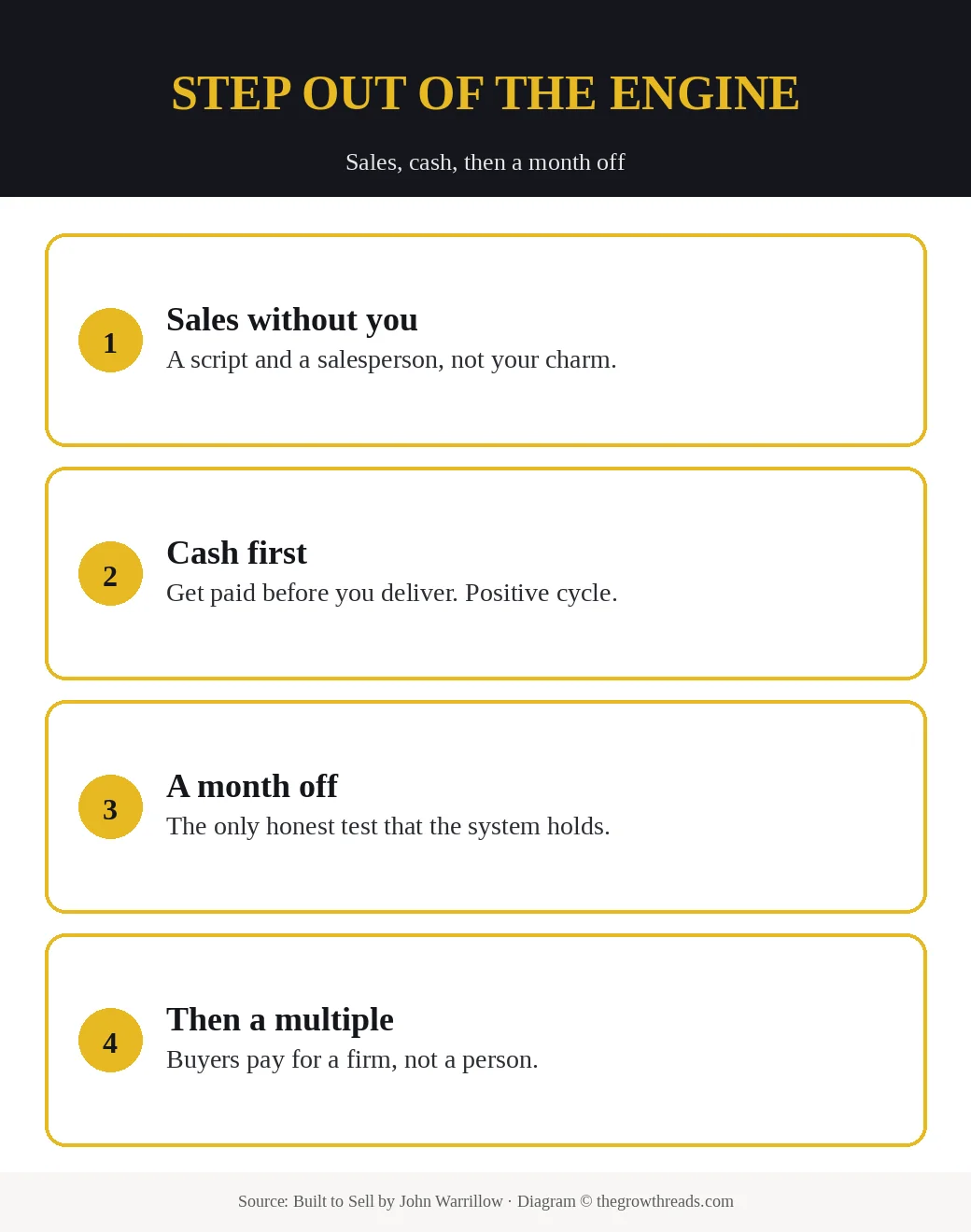
None of this is a software fantasy. The change is who the work depends on: a script, a checklist, a deposit. If those three feel too simple, that is because owners prefer a more sophisticated reason to stay in every meeting. Take one hat off this week. Sales without you is the usual first. That quiet is the beginning of a firm.
TGR Note: Buy Back Your Time is how you buy hours back from the calendar. The 4-Hour Workweek is how you stop being the default operator of every task. Warrillow wants the firm itself to be optional — then a buyer can pay a multiple for that optionality. Use Martell when the stall is delegation math. Use Ferriss when the stall is identity-as-operator. Use this book when the stall is that clients still buy you. Do not automate a menu you have not specialized.
Part 4 — Take a month off, then take a multiple
The exam is not a slide deck. It is time away. If sales, delivery, and cash keep moving while you are gone, you have a business. If they stall, you have a list of remaining owner-shaped steps. A long weekend is a start. A month is the claim. What breaks is next quarter’s curriculum, not a reason to put the three hats back on.
Then the multiple. Service firms that are still a person sell for little, or for a salary dressed up as a deal. Firms that run as a system — named product, process, sales, cash, a manager who is not you — can sell for a multiple of pretax profit because the buyer is purchasing future work that does not need the seller in the room. Exact multiples vary; the direction does not. Owner-optional is worth more. The fable ends with a sale because that is the clean exam. The everyday use is that you could sell. Evenings come from the same design.
Make it physical. One card this week: the sentence, the eight steps, the sales conversation you will not attend, the two days you will actually leave. Work the System would call those steps the documentation of the machine. Warrillow would call them the reason a stranger might one day pay. If you want a cheque later, or a Thursday that does not need you now, the offering still has to fit on a card.
TGR Note: Clockwork is the sibling vacation test with a role map; use it when you already have a product and need the firm to survive four weeks. Work the System is the documentation habit for whatever you already sell. Warrillow is the specialize-then-leave fable. Do not reread all three as a way to skip the month. Name the offering. Take two days off. Write what broke. That is the book, used.
Who is Built to Sell best for — and who should read something else first?
Best for owners of service firms — agencies, consultancies, practices, studios — who are still the rainmaker, the doer, and the manager. Especially if the calendar is full, quality lives in their head, and a week off would stall delivery. Independent specialists who want a product instead of hours will recognise Alex immediately.
Read something else first if you cannot yet sell one repeating service — The $100 Startup or The E-Myth Revisited, then come back. If the enemy is that you have a product and still cannot leave the building, start with Clockwork. If the enemy is buying back hours rather than designing an asset, start with Buy Back Your Time. Come to Warrillow when the bottleneck is that clients still buy you, and you want the option of a firm that does not.
Questions to reflect on
- What do you sell, in one sentence a stranger could repeat without you in the room?
- Which three services on your menu still require your name, your taste, or your night?
- What eight steps would a junior person follow to deliver the offering without texting you?
- Which sales conversation will you sit out this week, and what script will they use?
- If you left for two days starting Monday, what would actually break — named, not guessed?
🔥 Ready to stop being the product?
Write the one-sentence offering, cut the menu, and take two days off as a test.
How to apply Built to Sell (7-day plan)
- Day 1 — One sentence. Write what you sell so a stranger could repeat it. If it needs a brochure, cut words until it does not.
- Day 2 — Cut the menu. List every service you still say yes to. Circle the one that fits the sentence. The rest wait or get a no.
- Day 3 — Eight steps. Draft the delivery process a junior person could follow. If a step is “use my taste,” rewrite it as a check they can see.
- Day 4 — Price the package. One price for the offering, not an hourly guess. Deposit before work starts.
- Day 5 — Sales without you. Script one conversation. Have someone else take it, or record yourself and sit out the next live one.
- Day 6 — Remove one hat. Pick rainmaker, doer, or manager. Take yourself out of one real job in that hat. Write what broke.
- Day 7 — Two days off, on a calendar. Block them. Do not hover. On return, list what stalled. That list is next week’s productizing, not a reason to put all three hats back on.
Frequently asked questions
What is Built to Sell about?
Built to Sell is John Warrillow’s 2011 fable for service-firm owners who are still the product. Through Alex Stapleton’s exhausted marketing agency, it shows why a busy shop can be unsellable: the owner sells, delivers, and manages every job. The fix is a teachable unique offering — one named product, a documented process, sales that do not need the founder’s charm, and a month off as the only honest test. A buyer then purchases a system and pays a multiple of pretax profit, not a salary for a person who cannot leave.
What is a teachable unique offering in Built to Sell?
A teachable unique offering is one product a stranger could repeat in a sentence, with steps a junior person can follow without the founder in the room. Warrillow’s fable starts with a generalist menu — logos, sites, copy, anyone who will pay — and replaces it with a named, priced process. Narrow is the point. Custom work that only you can do is a job. A product other people can deliver is a firm. Charge a premium for the package. The uniqueness is not a slogan. It is the checklist, the niche, and the fact that delivery does not collapse when you take a week off.
Is Built to Sell only for people who want to sell their company?
No. Selling is the exam, not the only use. The month-off test is useful even if you keep the firm: if it breaks when you leave, you own a job with extra anxiety. Productizing — one offering, a process, a salesperson, cash before delivery — is how you get evenings back and how a later buyer would pay. Skip it as a first book if you do not yet have a repeating service; get that work first, then take yourself out of the engine. The option to sell only exists after the engine runs.
How is Built to Sell different from The E-Myth or Clockwork?
The E-Myth names the trap: you are the technician instead of designing a firm. Clockwork gives you a Queen Bee Role and a four-week vacation as the design test. Built to Sell is the productizing fable in between: specialize until the offering has a name, document it so someone else can deliver, stop being the rainmaker, then take a month off. Use Gerber for the diagnosis. Use Michalowicz for the calendar. Use Warrillow when the stall is a generalist menu and an owner-shaped bottleneck. Do not collect all three as a way to delay the one-sentence offering.
Who should read Built to Sell?
Owners of service firms — agencies, consultancies, practices, studios — who are still the rainmaker, the doer, and the manager. Especially if the calendar is full, the quality lives in your head, and a week off would stall delivery. Independent specialists who want a product instead of hours will recognise the fable. Skip it as a first book if you cannot yet sell one repeating service; get a customers-and-offers book first. If the stall is personal focus rather than a firm that needs you, a habit or attention book will help more. Come here when the bottleneck is that you are the product.
How long is Built to Sell and how should I read it?
The Portfolio hardcover is about 153 pages, plus a short foreword. Most readers finish it in three hours. Do not study it like a textbook. Read the fable once, then run the drills on your live firm the same week: write the one-sentence offering, cut the menu, draft an eight-step process a junior could follow, and script one sales conversation you do not have to attend. The book is short so the productizing can be long. If you highlight every chapter and never name the offering, you have bought a poster. If you take two days off and the work still moves, you have used the book.
Does specializing shrink the business?
It feels like shrinking because you say no to familiar revenue. Warrillow’s claim is the opposite on a two-year clock: a named product with a process sells at a premium, trains faster, and is what a buyer will pay a multiple for. A generalist menu looks bigger this month and is worthless the month you try to leave. The fable’s agency stops being everything to everyone and becomes one teachable offering. Revenue that required the owner’s heroics is replaced by a package a salesperson can describe. If saying no this quarter is the fear, write the offering anyway. The shrink is the menu. The growth is the asset.
Related summaries
- Clockwork — the vacation test and the Queen Bee Role once you have a product
- The E-Myth Revisited — the technician trap that makes you the engine
- Work the System — documenting the machine you already run
- Buy Back Your Time — buying hours back before the firm is optional
- More on the best productivity books pillar
How we analyze books: we read for application, not for a takedown — then we add a plan you can run this week. Read our full methodology.