

★★★★½ 4.5/5 — Peak states are not weather. Design the door, then recover.
Best for: Operators who wait for inspiration, then binge the week — founders, makers, coaches, and teams that only catch fire at the offsite.
Reading time: ~6 hrs (guide: 12 min)
Difficulty to apply: Easy to name a trigger; honest on recovery and on staying legal.
Stealing Fire in one minute
Most people treat flow as lightning and then wonder why the week is dark. Steven Kotler and Jamie Wheal’s Stealing Fire (Dey Street, 2017) is the field report that peak states — ecstasis, stepping beyond the self — are being engineered on purpose by SEALs, labs, athletes, and teams. Stop waiting for the mood. Build a trigger, protect a block, recover on purpose, and share the attention. If you take one move from this Stealing Fire summary, pick a start cue for tomorrow’s hardest problem and defend the hour after it.
Key takeaways
- Steal, don’t wait: Prometheus is the metaphor. Peak states can be designed, not begged from the weather.
- Ecstasis is the product: Stepping beyond the self is the state knowledge work already chases and rarely names.
- STER is the signature: Selflessness, timelessness, effortlessness, richness — you will feel those four when it is working.
- Four forces open doors: Psychology, neurobiology, pharmacology, and technology. TGR application stays on the first, second, and fourth.
- Altered states can become altered traits: Only if you recover and write what changed. A high with no landing is a binge.
- Shared attention multiplies: Group flow is not a trust fall. It is a designed hour with one problem.
- The other side of awe is awful: Cults, burnout, and hijacked weekends are the same mechanism without a floor.
- Recovery is the second half: More fire without sleep is arson. The cycle includes the walk home.
- Inspiration is a protocol: A start cue plus a hard problem beats a motivational speech.
- Stay legal on Tuesday: The book maps many doors. Your week uses breath, challenge, novelty, and people.
What is Stealing Fire about?
Stealing Fire is Kotler and Wheal’s tour of how elite teams now engineer non-ordinary states — flow, group flow, ecstasis — instead of waiting for inspiration, and how those states can become better work if you recover, stay honest about the dark side, and keep the week legal.
About the author
Steven Kotler is an American journalist who reports on peak performance and the science of flow. He wrote The Rise of Superman from action-sports fieldwork, later The Art of Impossible for knowledge work, and co-founded the Flow Research Collective. Jamie Wheal co-founded the Flow Genome Project with him. Stealing Fire is their joint field report: a map of labs, platoons, and studios that treat altered states as a production input. They watched people wait for lightning, then watched other rooms steal the fire on a calendar. Explore all Jamie Wheal book summaries →
Key concepts at a glance
| Concept | What it means | Use it when |
|---|---|---|
| Ecstasis | Stepping beyond the self | The inner critic is running the hour |
| Steal vs wait | Design the state; do not beg it | You only work when you “feel like it” |
| STER | Selfless, timeless, effortless, rich | You need a test that the block worked |
| Four forces | Psychology, biology, chemistry, tech | You only pull one lever and stall |
| Group flow | Shared attention on one problem | The offsite was magic and Monday died |
| Altered traits | A state that changes the next day | The high never reaches the calendar |
| Dark side | Awe without a floor becomes harm | The team is high and no one can leave |
| Recovery | The second half of the cycle | You stack peaks and call it grit |
Part 1 — Stop waiting for lightning
Kotler and Wheal open with a Promethean theft: fire was never meant to stay on the mountain. The modern version is a SEAL team using arousal control, a lab treating attention as scarce fuel, a festival that looks like play and runs like research. Knowledge work still treats the best hour as weather. We wait to feel ready, then we binge, then we call the crash “a busy season.”
Ecstasis — stepping outside the ordinary self — is the product those rooms are after. In a good block the narrator goes quiet, time folds, the work pulls, and the signal gets louder than the noise. That is a state, not a personality. The Rise of Superman found flow on the mountain. This book asks what happens when a platoon or a product team steals the same fire on a Tuesday.
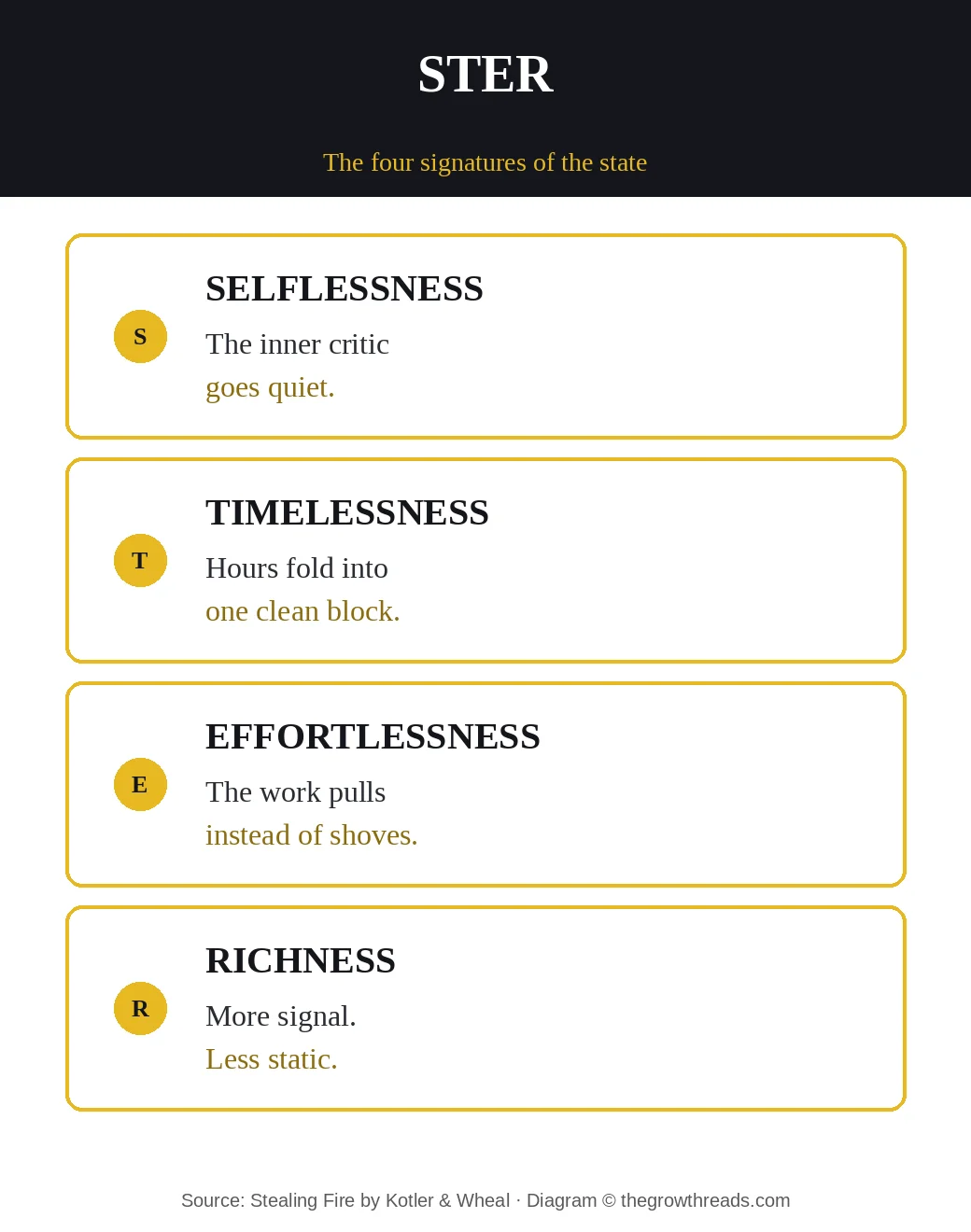
STER is the signature you can check without a lab. Selflessness: the inner critic goes quiet. Timelessness: an hour feels like twenty minutes. Effortlessness: you are not shoving the work uphill. Richness: more information fits, and it is the useful kind. If none of those showed up, you had a busy hour, not a stolen one. Write the test on the card: which of the four appeared? If the answer is none, change the trigger, not the slogan.
TGR Note: The Rise of Superman is Kotler’s earlier proof that flow compresses practice hours. The Art of Impossible is the later personal protocol for knowledge work. Use this book when the missing piece is the door into the state — especially a shared door. Do not collect all three as a way to delay the start cue.
Part 2 — Four doors, one legal week
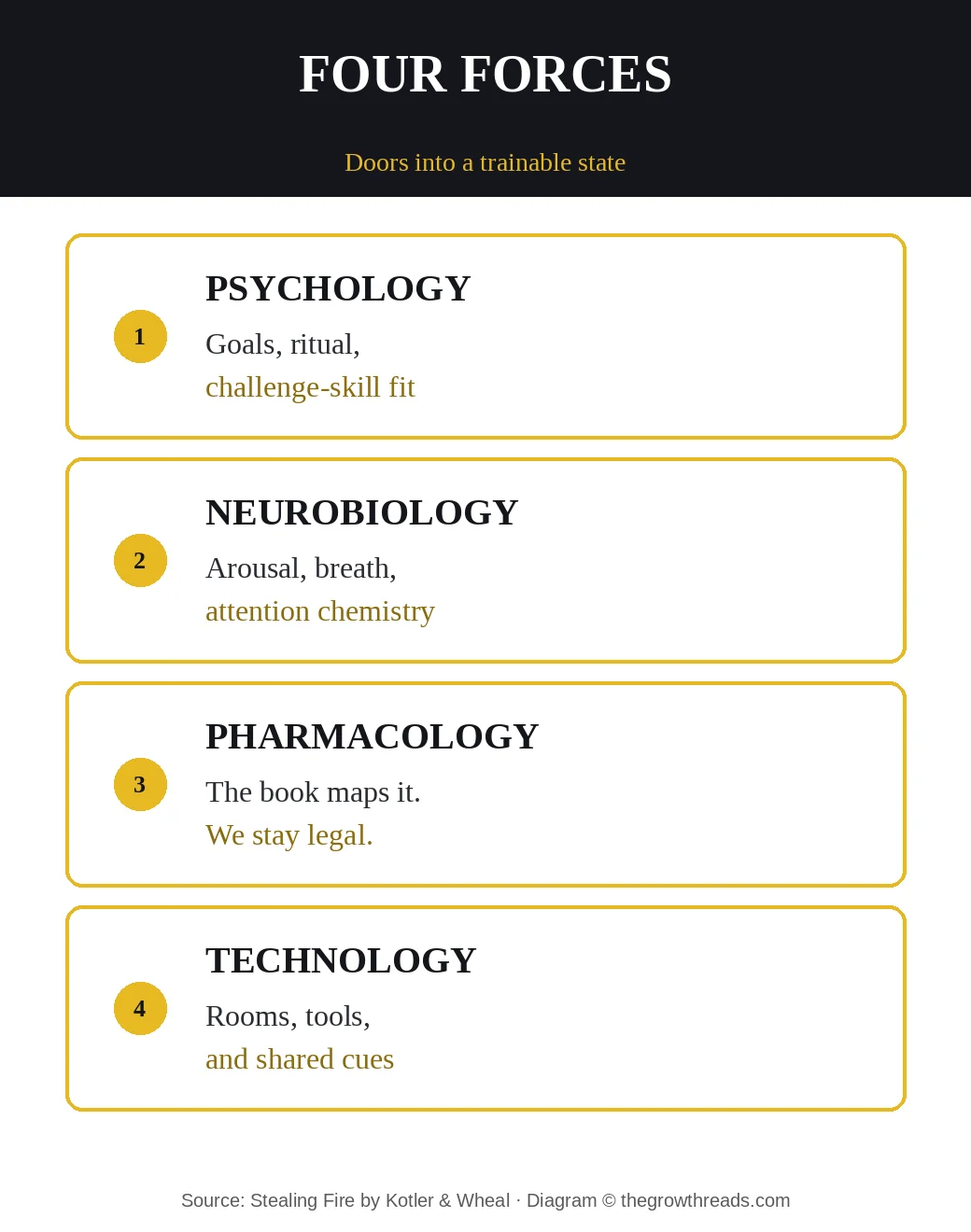
The middle of the book maps four forces that made non-ordinary states cheaper: psychology, neurobiology, pharmacology, and technology. Psychology is the desk door: clear goals, feedback, a challenge that slightly exceeds skill, a start ritual. Neurobiology is the body door: breath, arousal, sleep. Technology is the room: closed tab, shared board, a timer that is not a punishment. Pharmacology is the door the book surveys and the one TGR will not turn into a Tuesday plan. Stay on the first, second, and fourth doors at work.
The practical stack for a knowledge worker is boring on purpose. Name the problem in one sentence. Match it to a skill you almost have. Start with the same cue every day — a walk, a box of breath, a closed door. Put the phone in another room. Work until STER shows up or the timer ends. Then stand up. That is stealing fire at the scale of a calendar, not a headline. Teams add one more lever: shared attention. One problem, one board, no status theatre. Group flow is not a retreat. It is an hour you designed so the critic in every head goes quiet together.
Wheal’s contribution is culture: the room either protects the state or auctions it to the loudest meeting. If “collaboration” is twelve tabs and a chat that never sleeps, technology is pointed at the wrong target. Point it at one cue. The four forces are four doors, not a shopping list. Pick the legal ones you control this week.
TGR Note: Deep Work is the attention bunker: shut the door, do the hard thing. Do Hard Things is toughness that notices, then chooses. Use Newport when the enemy is interruption. Use Magness when the enemy is a story about grit. Use Kotler and Wheal when the bunker is built and the state still never arrives — you have a room, and you still wait for lightning inside it.
Part 3 — The other side of awe
The book’s necessary chapter is the dark side. The same mechanism that produces communitas can produce a cult. Kotler and Wheal are blunt: the other side of awe is awful. Awe without a floor becomes harm — burnout dressed as devotion, leaders who confuse a shared state with permission. If nobody can leave the circle, you built a furnace and locked the door.
Recovery is how a state becomes a trait. Sleep, walk, write what changed. A peak with no landing is a binge. Knowledge workers skip the landing because the inbox looks like loyalty. Your version is small and non-negotiable: water, a walk, a sentence. Which STER showed up. What you will change about the trigger. Then stop.
Shared attention has the same floor. A designed hour is not an identity. When the hour ends, people get to be ordinary again. That is how you keep the gold quadrant from rotting into “mood.” The offsite that cannot survive a Monday was never engineered. It was weather you rented. Steal fire again next week by keeping the cue, not by chasing a bigger high.
TGR Note: Inner Excellence trains present, other-centered attention under pressure — a cousin to selflessness in STER. The Champion’s Mind is the inner coach versus the inner critic. Use Murphy or Afremow when the stall is the voice. Use this book when the stall is the missing door: you can talk to yourself kindly and still never enter the state because the week has no trigger and no recovery.
Part 4 — A Tuesday you can steal
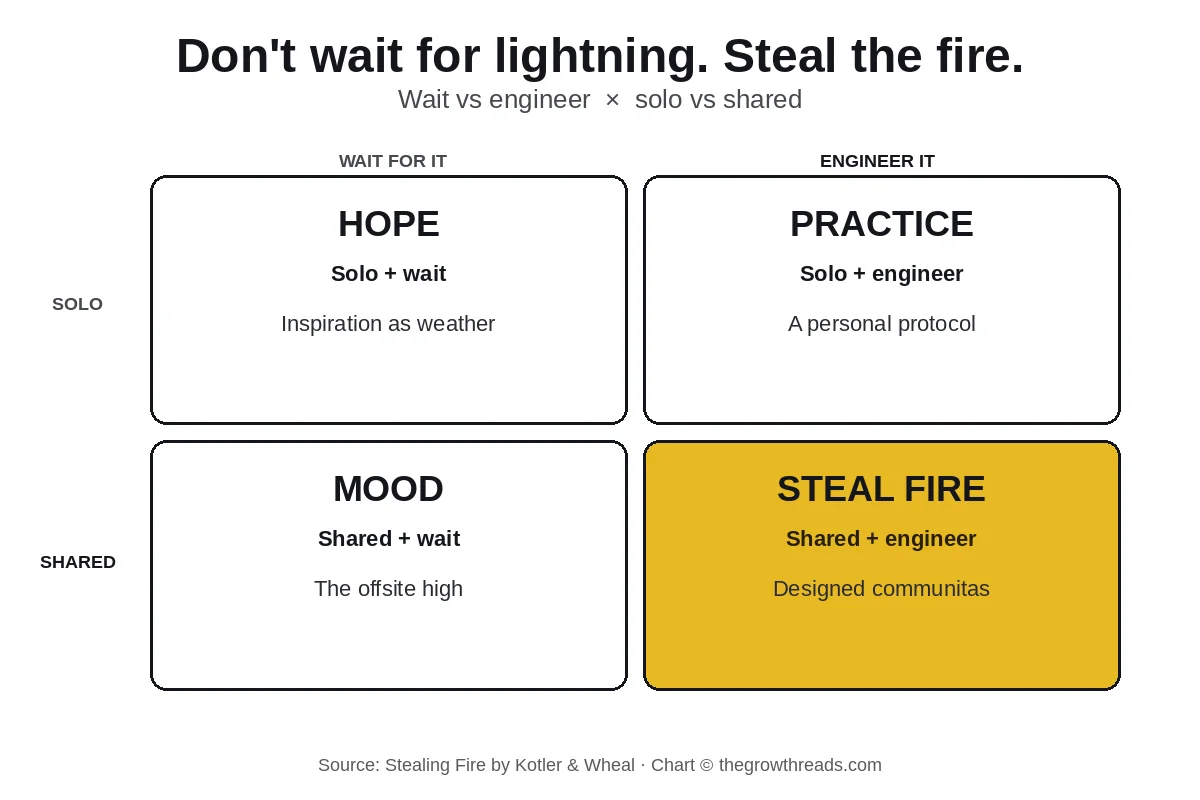
The last move is to put the map back on a calendar. You do not need their whole landscape. You need a 2×2 you can aim. Waiting plus solo is hope — talent as weather. Waiting plus shared is mood — the offsite high. Engineering plus solo is practice — a personal protocol. Engineering plus shared is the gold: designed communitas, one problem, one hour, a floor at the end. Most knowledge workers live in hope and visit mood twice a year. The book’s ask is to move right, then down, without setting the building on fire.
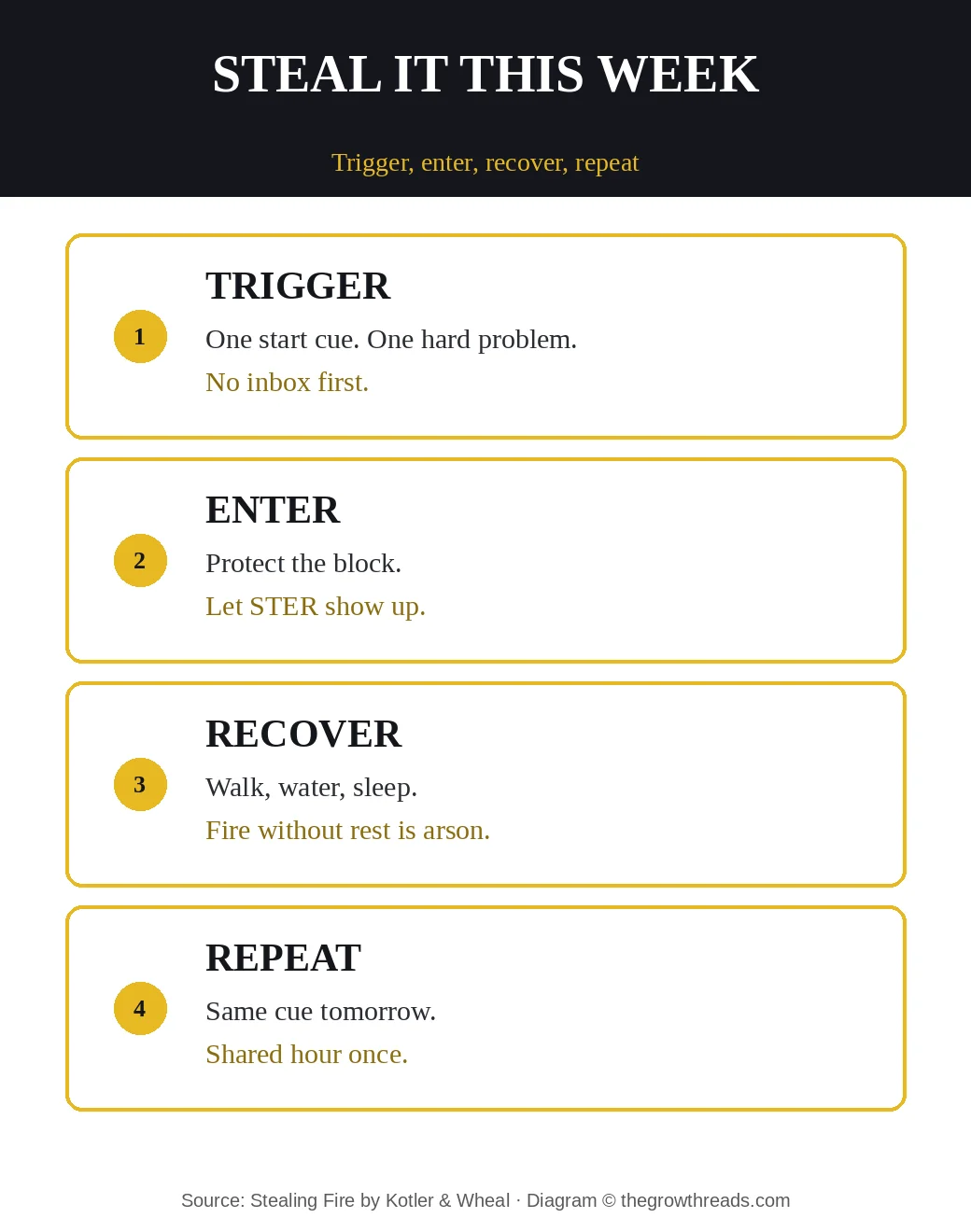
Make it physical. One card: the problem, the start cue, the STER check, the recovery. Tomorrow, the same cue. Once this week, a shared hour with one board and no chat. Atomic Habits can keep the ritual alive after the cue. Kotler and Wheal would put the state first.
Stay inside the legal week. Breath, challenge, novelty, a closed door, a person beside you, a walk after. If you land one stolen hour and one recovery by Friday, you have used the book. If you highlight every lab and never pick a cue, you have bought a poster of a flame.
TGR Note: Win the Day is the thinner Tuesday: frog, kite, rope. Today Matters is the wider life checklist. Use Batterson or Maxwell when the day has no picture. Use Stealing Fire when the picture exists and the hour still never catches — you know what the work is, and you are still waiting to feel like doing it.
Who is Stealing Fire best for — and who should read something else first?
Best for people whose work includes a hard problem and a week of waiting: founders, makers, researchers, coaches, product teams, and operators who only catch fire at the offsite. Especially if you already know Deep Work and still treat the best hour as weather.
Read something else first if you cannot yet start a twenty-minute sitting — Tiny Habits or Deep Work, then come back. If you want the sports-flow origin story, start with The Rise of Superman. If you want a personal training plan without the cultural tour, start with The Art of Impossible. Come to this book when the bottleneck is the door into the state, not the size of the vision board.
Questions to reflect on
- Where are you still waiting for lightning instead of naming a start cue?
- Which STER signature showed up in your last good hour — and which never does?
- Is your collaboration a designed hour or a rented mood?
- What recovery did you skip after the last peak, and what did that cost Tuesday?
- What is the one legal trigger you will actually run tomorrow before the inbox?
🔥 Ready to steal the fire this week?
Pick one start cue, protect one hard hour, recover on purpose, and share the attention once.
How to apply Stealing Fire (7-day plan)
- Day 1 — Name the stall. Write yesterday’s worst hour in one line. Circle wait or engineer, solo or shared. That cell is this week’s drill.
- Day 2 — One trigger. Pick a start cue you will not negotiate: a walk, a closed door, ten slow breaths. Put it before the inbox.
- Day 3 — One hard problem. Write the problem in a sentence a tired colleague could repeat. Work it for twenty-five minutes after the cue.
- Day 4 — STER check. After the block, tick which of the four showed up. If none, change the problem or the cue, not your character.
- Day 5 — Recover. Walk, water, or an earlier lights-out. Write one sentence: what changed. Then stop. No second peak.
- Day 6 — Shared hour. One board, one problem, no chat. Forty-five minutes. End on purpose so the circle can open.
- Day 7 — Land it. Which cell did you live in. Which trigger survived. Repeat the cue Monday. Do not add a fifth force.
Frequently asked questions
What is Stealing Fire about?
Stealing Fire is Steven Kotler and Jamie Wheal’s 2017 field report on how elite teams now engineer non-ordinary states — flow, group flow, what the Greeks called ecstasis — instead of waiting for inspiration. They tour Navy SEALs, Silicon Valley labs, athletes, and festivals, then argue that those states can become better work if you recover and stay honest about the dark side. The usable residue for a knowledge worker is a designed trigger, a protected block, a recovery, and, when you can, a shared hour. It is a map of doors, not a memoir and not a chemistry course.
What does STER mean in Stealing Fire?
STER is the four-part signature Kotler and Wheal use to tell a stolen hour from a busy one: selflessness, timelessness, effortlessness, and richness. Selflessness is the inner critic going quiet. Timelessness is an hour that folds. Effortlessness is work that pulls instead of shoves. Richness is more signal and less static. You do not need a lab to use it. After a block, tick which of the four showed up. If none did, change the trigger or the problem. If two or three did, you stole something. Repeat the cue that produced them instead of hunting a bigger high.
Is Stealing Fire worth reading if I already read The Rise of Superman?
Yes if you want the cultural and organizational sequel, not another action-sports origin story. The Rise of Superman showed that flow compresses practice hours in the mountains. The Art of Impossible later gave knowledge workers a personal training plan. Stealing Fire sits between them as a map of how teams steal the same fire on purpose — and how that map goes dark when there is no floor. If Superman already changed how you train, this one changes how you open the door, especially with other people. Skip it as a first Kotler if you still cannot protect a twenty-minute sitting.
How is Stealing Fire different from Deep Work or The Art of Impossible?
Cal Newport’s Deep Work is the bunker: shut the door, do the cognitively hard thing. The Art of Impossible is Kotler’s later solo protocol for knowledge work — motivation, learning, creativity, flow as skills. Stealing Fire is the door and the room around those skills: why organizations chase non-ordinary states, how group flow is designed, and why awe without recovery becomes harm. Use Newport when the enemy is interruption. Use The Art of Impossible when you want a personal stack. Use this book when the bunker is built and the state still never arrives, especially on a team.
Who should read Stealing Fire?
Founders, makers, researchers, coaches, product teams, and operators whose weeks are full and whose best hours still depend on weather: the person who waits to feel ready, then binges, then calls the crash loyalty. It is especially useful if you already know Deep Work or Rise of Superman and still treat inspiration as lightning. Skip it as a first book if you cannot yet sit down for twenty focused minutes — go to a start-small habit book, then return. Come here when the bottleneck is the door into the state, not the size of the vision.
How long is Stealing Fire and how should I read it?
The Dey Street hardcover runs about 293 pages; most readers finish it in five to seven hours. Do not study it like a textbook and do not treat the pharmacology chapters as a shopping list. Read for the 2×2: wait versus engineer, solo versus shared. Then run one legal trigger the same day — a start cue, a hard problem, a STER check, a walk. One door, one problem, same afternoon. If you highlight every lab and never pick a cue, you have bought a poster. If you land a stolen hour and a recovery by Friday, you have used the book.
Does Stealing Fire tell you to use drugs to get into flow?
No, and this summary will not either. The book surveys a wide map of doors, including pharmacology, because that is part of the landscape they reported. The TGR application is the legal week: psychology, breath and sleep, rooms and tools, shared attention, and recovery. You can understand the map without walking every path. If a chapter is not a practice you can run at a desk, keep the insight and spend the hour. Peak states that require you to break the law or skip sleep are not a Tuesday plan. Steal fire with a cue, a problem, and a floor.
Related summaries
- The Rise of Superman — Kotler’s earlier proof that flow compresses practice hours
- The Art of Impossible — the later personal protocol for knowledge work
- Deep Work — the attention bunker around the state
- Inner Excellence — present attention under pressure
- More on the best productivity books pillar
How we analyze books: we read for application, not for a takedown — then we add a plan you can run this week. Read our full methodology.