

★★★★½ 4.6/5 — Make the product the obvious choice for the buyer who already cares, instead of a weaker copy of a giant.
Best for: Founders and product marketers whose product is good and whose buyers still compare it with the wrong thing.
Reading time: ~4 hrs, guide: 16 min
Difficulty to apply: Medium. The canvas is short. Telling the truth about alternatives, and ignoring a market you wish you had, is the work.
Obviously Awesome in one minute
A product gets easier to buy when the context makes one strength the point. Obviously Awesome, by April Dunford, is a field guide for that context. She defines positioning as deliberately defining how you are the best at something a defined market cares a lot about. The pass runs through happy customers, real alternatives, unique value, who cares, and a market frame that puts that strength in the center. When the frame is right, a buyer can explain the win without your deck.
Key takeaways
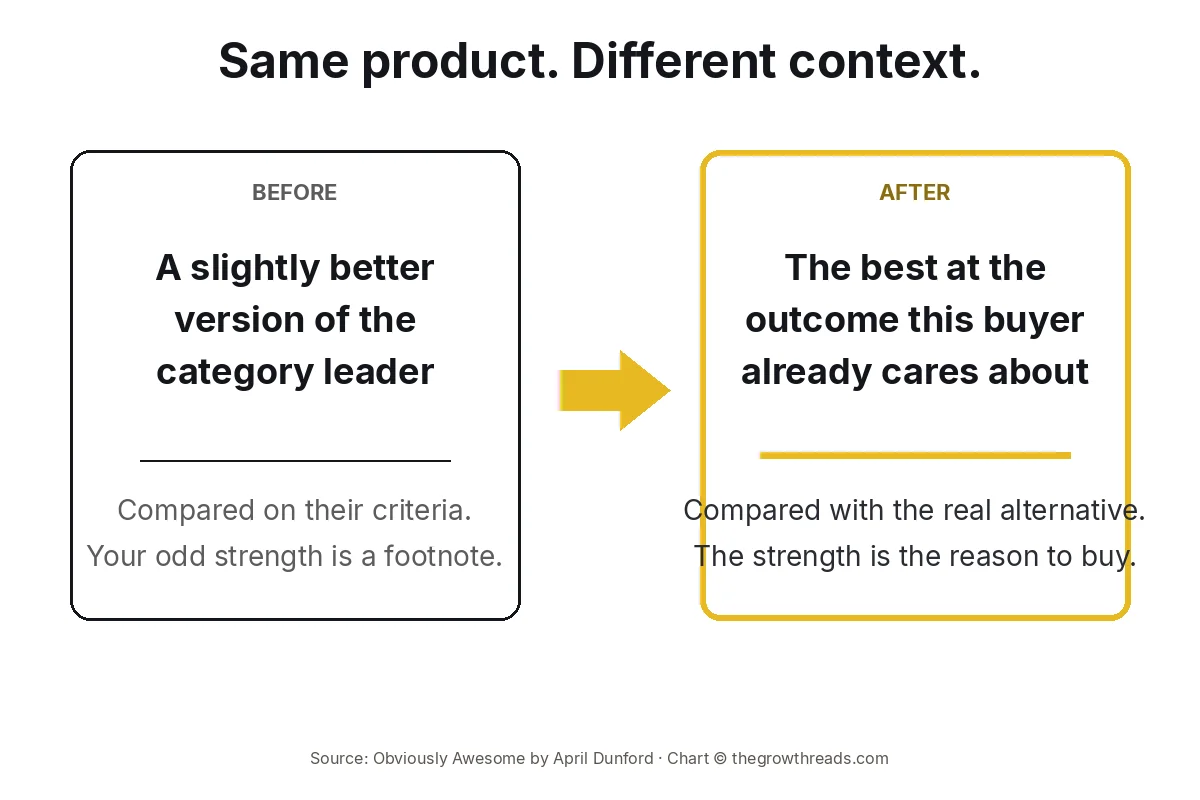
- Positioning is context: the product can stay the same while the comparison changes, and the comparison is what makes a strength obvious.
- Start with customers who already love you: their words beat a brainstorm about a market you wish you served.
- Name the real alternative: include the spreadsheet, the suite, the freelancer, and doing nothing, not only the logo on a competitor slide.
- Unique means they cannot get it without you: cross out any capability the real alternative already has.
- Value is the outcome in their language: a buyer purchases the change, not the technical property that creates it.
- Who cares a lot is a pattern: describe the buyers who purchased quickly, and be willing to name who sits outside the pond.
- The market frame sets the criteria: pick a category where your strength is the point of the purchase.
- Three styles, one test: head to head, big fish small pond, or a new game. Keep the style that makes the value obvious.
- Capture one page and repeat it: the homepage, the first sales slide, and the opening of the demo should say the same thing.
What is Obviously Awesome about?
Obviously Awesome is April Dunford’s field guide to product positioning. She shows a team how to name the thing it is best at, the buyer who cares a lot, and the market frame that makes that value the obvious reason to buy. The product can stay. The comparison has to change.
About the author
April Dunford spent her career in business-to-business technology marketing, moving from technical work into marketing leadership and then into independent consulting. The pattern she kept meeting was stubborn. A team would have a product the right users liked, a site full of capabilities, and a pipeline of polite stalls, because the offer sat in a comparison it could not win. She wrote Obviously Awesome, published by Ambient Press on 14 May 2019, as the workshop she wished those teams had run first. The title came from the other side of that work. Once the context fit, a customer could call the same product obviously awesome. She teaches a canvas a founder, a seller, and a marketer can fill together and then repeat on the page, in the demo, and on the roadmap. Explore all April Dunford book summaries →
Key concepts at a glance
| Concept | What it means | Use it when |
|---|---|---|
| Competitive alternatives | What the buyer would do if you vanished, including doing nothing. | The deck lists rivals the buyer never actually considers. |
| Unique attributes | Capabilities the real alternative does not have. | The homepage claims features a leader can also claim. |
| Value themes | The outcome those attributes create, in the buyer’s words. | Prospects nod at features and still ask why it matters. |
| Best-fit customers | Characteristics of people who care a lot about that value. | You are chasing logos that buy slowly and argue about price. |
| Market category | The frame that makes your value the point of the purchase. | Buyers compare you with a giant you cannot beat on their criteria. |
| Relevant trends | A shift the buyer already believes, used only if it favors you. | Someone wants a headline on the page that does not change the purchase. |
| Positioning canvas | One page the company can repeat: alternatives, value, who, and frame. | Sales, product, and the website describe three different products. |
The product did not change. The context did.
Dunford starts from a scene most product teams know. People who try the product often like it. The site lists capabilities. The demo walks through screens. Then a prospect says they already have a tool for that, and the deal goes quiet. The product did not get worse. The buyer placed it in a comparison it cannot win.
A tagline will not repair that comparison. A longer feature list often makes it worse, because it invites a scorecard written by the category leader. Her definition is a set of choices: what you are best at, who cares a lot, and which frame makes that strength the reason to buy.
The symptoms are ordinary. Calls restart the education. Discounts appear because the buyer is shopping “good enough.” The homepage changes every quarter. Product adds a feature for the last lost deal, and the story gets wider. Those are positioning problems before they are effort problems.
Ask one question. If you disappeared tomorrow, what would your happiest customers actually do? The answer is rarely the logo on the competitor slide. It may be a spreadsheet, a suite, a freelancer, or postponing the work. That is the real alternative. Until you name it, “better” has nothing honest to beat.
TGR Note. Ries and Trout, in Positioning, taught teams to own an open place in the mind. Dunford asks for the fieldwork under that word. If you cannot yet say which hole your happiest buyers already handed you, do the customer list before you coin a phrase.
Five components, not a slogan
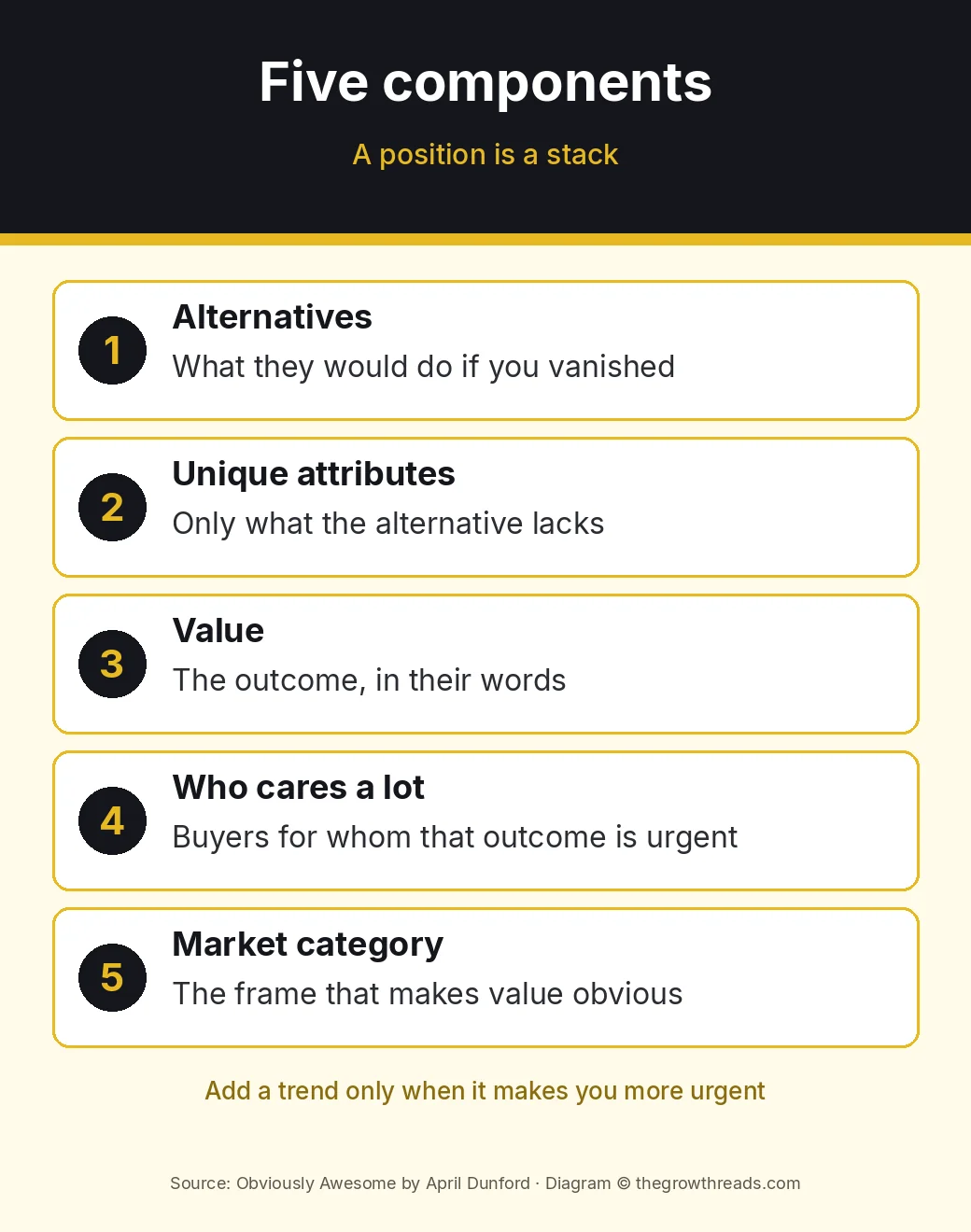
Dunford stacks five layers. Skip one and the sentence floats.
Competitive alternatives come first, including the status quo. A famous rival who is not in the deal is a distraction. The alternative sets the bar. If the buyer is choosing a spreadsheet, you do not need to beat a suite they will not leave this year.
Unique attributes come next. A capability the alternative also has is table stakes. Cross out anything a buyer could get without you. The list that remains should be short enough to prove in a demo.
Value is the translation. Attributes are what the product does. Value is the change the buyer gets: time back, risk down, a workflow the team will finish. Say it in the customer’s language. If you need the feature name to say it, you are still describing the factory.
Who cares a lot is a pattern, not a fictional persona. Look at buyers who purchased quickly and stayed. Note the situation they share. Buyers who need a discount to care are telling you the value is optional for them.
The market category is the frame that makes the value the point of the comparison. Copying the leader’s category imports the leader’s criteria. Inventing a word nobody uses imports a teaching bill. A trend belongs on top only when the buyer already believes it and it makes your strength more urgent.
TGR Note. The beachhead in Crossing the Chasm is the same instinct as “who cares a lot.” Use Dunford to fill the canvas. Use Moore when the next problem is moving from the buyers who already love you to pragmatists who need the category to feel safe.
Pick the pond where your strength is the point
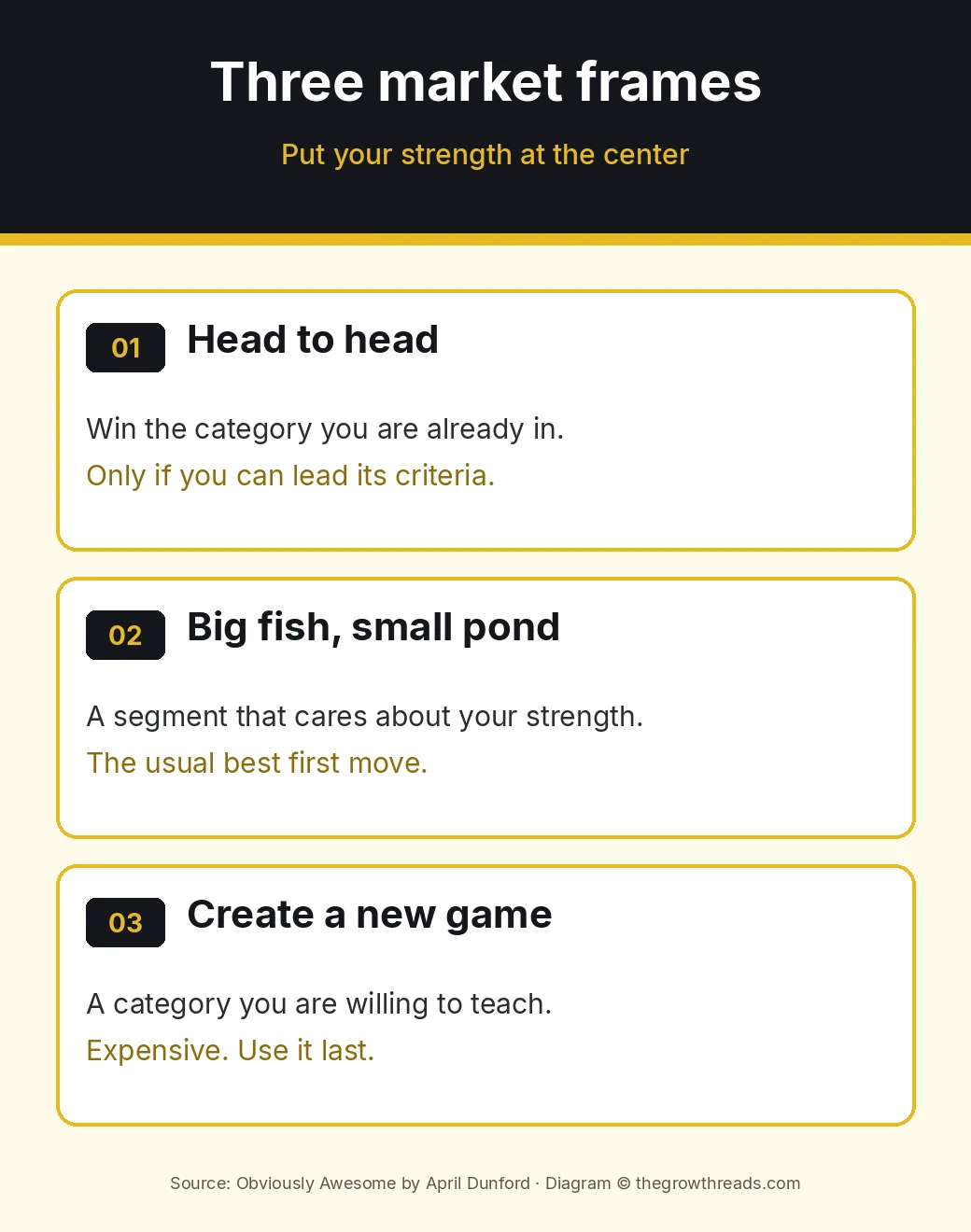
Three styles follow. They are choices about the frame.
Head to head means you win the category the buyer already knows, on criteria that category already uses. Choose it only when you lead those criteria. Beside a suite with distribution and a “good enough” reputation, calling yourself the better version invites the comparison you lose.
Big fish, small pond means you narrow the market until your strength is what that segment cares about most. The pond can be an industry, a size, a job, or a moment in the year. The test is whether a buyer inside it would switch because of your odd attribute. A narrow pond often looks timid in a board meeting and clear in the pipeline.
Create a new game means you teach a category the buyer did not have a name for. Dunford does not ban it. She prices it. You hold the point of view while the market’s language catches up. Use it when every existing frame hides the value and you can afford the teaching. Do not use it to avoid a competitor’s name.
Write the criteria a best-fit buyer already uses. If your strengths lead that list, head to head can work. If they matter to a subset, pick the pond. If every list buries you, consider a new frame. If you need a paragraph to justify the frame, it is a costume.
TGR Note. Playing to Win asks where to play and how to win for the whole company. Dunford asks the same pair for one product. Settle the cascade before you tighten a homepage that has no pond under it.
Ten steps, then one sentence everywhere
The ten steps are easy to list and uncomfortable to do, because several ask you to give something up.
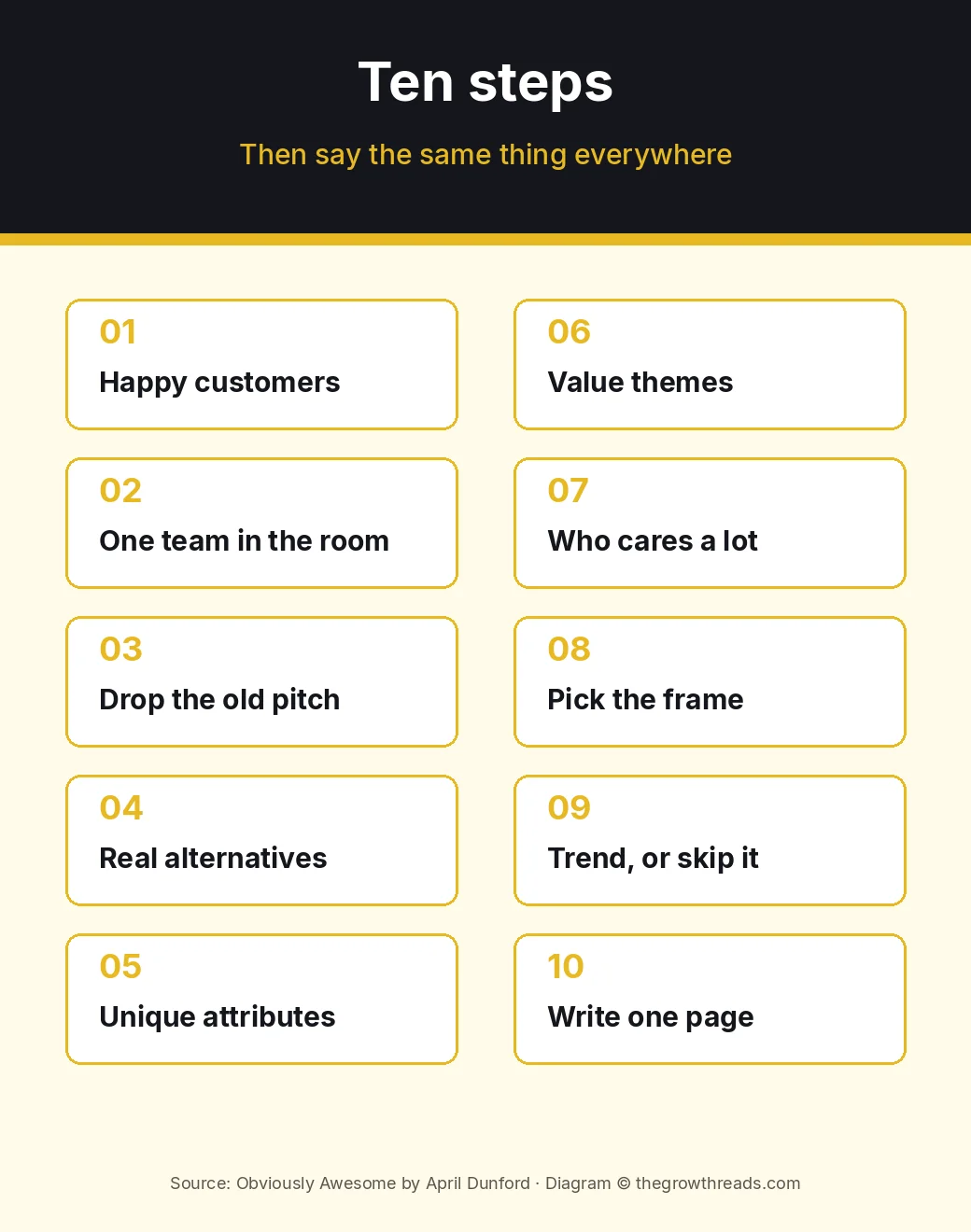
Start with customers who already love the product: who bought without a war, who stayed, and who would miss it. Put a builder, a seller, and the person who will publish the page in one room. Set the old pitch down so it cannot veto the evidence. List real alternatives. Keep only unique attributes. Map them to a few value themes. Name who cares, and name who is outside the pond.
Pick the frame that puts the strength at the center. Add a trend only if it makes that buyer more urgent. Capture alternatives, value, buyer, category, and the trend if you kept one, on a single page. A clever sentence with no page under it will drift by Friday.
Then put the page into the market. The homepage hero, the first sales slide, and the opening minute of the demo should match. The roadmap should show what serves the best-fit buyer and what was baggage. When those surfaces disagree, you have notes, not a position. A new seller should be able to explain it. You will still lose deals outside the pond. That loss means the pond is real.
TGR Note. Once the canvas is one page, repeat it in public. This Is Marketing argues for a specific promise to people who already want it. Building a StoryBrand helps when the homepage still stars the company. Neither replaces the customer list.
Who is Obviously Awesome best for — and who should read something else first?
Read this book if people like the product once they understand it, and you are tired of explaining it from scratch. It fits founders, product marketers, and early sales leads who can talk to real customers this month. It is especially useful before a rebrand, a new category name, or a feature sprint aimed at the last lost deal.
Read something else first if you do not yet know what to build. The Mom Test will teach you how to hear a customer without feeding them your idea. If the company still has no theory of where it plays, start with Playing to Win or Good Strategy Bad Strategy, then come back and position the product inside that choice. If you need the classic vocabulary of owning a word, read Positioning beside this one, not instead of the customer list.
Questions to reflect on
- If your product vanished, what would your last ten happy customers actually use tomorrow?
- Which lines on your homepage could the real alternative also claim?
- What outcome do those customers name without using your feature names?
- Who bought quickly, and who are you still chasing out of habit?
- Which market frame makes your strength the point, and which frame flatters a market you wish you had?
🔥 Ready to make the value obvious?
Name the real alternative, the buyer who cares, and the frame that makes your strength the point.
How to apply Obviously Awesome (7-day plan)
- Day 1 — List ten happy customers. Write who bought quickly, who stayed, and the words they used for the result. Leave the logos you wish you had off the page.
- Day 2 — Name the real alternative. For each of those customers, write what they would do if you vanished. Include spreadsheets, suites, freelancers, and doing nothing.
- Day 3 — Cross out shared features. Keep only attributes the alternative does not have. If the list is still long, you have not been strict.
- Day 4 — Translate attributes into value. For each remaining attribute, write the outcome in a customer’s sentence. Ban your internal feature names for this pass.
- Day 5 — Circle who cares a lot. Note the situation those buyers share. Write one sentence about who is outside the pond, and do not apologize for it.
- Day 6 — Test three frames. Write a head-to-head line, a small-pond line, and a new-game line. Keep the one that makes yesterday’s value obvious in a single breath.
- Day 7 — Put the same sentence in three places. Homepage hero, first sales slide, and the opening minute of the demo. If they disagree, you are not done.
Frequently asked questions
What is Obviously Awesome about?
Obviously Awesome is April Dunford’s field manual for product positioning, published by Ambient Press in 2019. She argues that a product becomes easy to buy when you deliberately define how you are the best at something a specific market cares about. The work starts with customers who already love you, names the real alternatives, isolates what is truly unique, and translates that into value. You then choose who cares a lot and pick a market frame that makes the value obvious. The output is one page sales, product, and the website can repeat without inventing a new story on each call.
What does Dunford mean by “obviously awesome”?
The phrase is a test, not a slogan to print on a mug. Dunford watched teams keep the product and change the context, then heard a customer call the offer obviously awesome. Before the shift, every demo needed a long explanation. After it, the right buyer could finish the sentence. She uses the phrase to separate a clear position from a clever line. If a prospect still asks how you differ from the big tool they already have, the context is wrong. If a best-fit buyer can repeat why you win without the slide deck, the position is doing the job.
What are the five components of positioning?
Dunford builds a position from five pieces, plus an optional trend. Competitive alternatives are what the buyer would actually do if you did not exist, including spreadsheets, a general suite, a freelancer, or doing nothing. Unique attributes are capabilities those alternatives lack. Value is the outcome the attributes create, in the buyer’s language. Target-market characteristics describe who cares a lot about that outcome. The market category is the frame that makes the value the point of the purchase. A relevant trend can sit on top only when the buyer already believes it and it points at your strengths.
What counts as a competitive alternative if you have no direct competitor?
No direct competitor usually means the pitch has not asked the buyer what they do today. Dunford treats the status quo as a rival. A team may list a famous product on a slide while the buyer is choosing between you, a spreadsheet, and postponing the problem. Those real alternatives set the bar. If the spreadsheet is good enough, your unique attributes have to beat good enough on a value that buyer feels this quarter. They do not have to beat a feature the category leader advertises and the buyer never uses. Naming the status quo also stops a homepage from copying a giant who is not in the deal.
Should a startup create a new market category?
Sometimes, and usually not first. Dunford describes three styles. Head to head means you win the existing category on criteria buyers already use, which favors the leader. Big fish, small pond means you pick a segment where your odd strength is the reason to switch. Creating a new game means you teach a category the buyer did not have a name for. She treats that path as expensive: you educate the market and wait while search language catches up. Most teams get a faster yes by narrowing the pond until the value is obvious, then widening only after that story repeats itself in real sales calls.
How is Obviously Awesome different from Positioning by Ries and Trout?
Ries and Trout taught a generation to own a word in the mind and to find an open hole rather than shouting that they were better. Dunford does not throw that lesson out. She gives a product team the fieldwork that comes before the word. You earn the claim by studying happy customers, the alternatives they actually use, and the value they already feel. Positioning is the classic argument about attention. Obviously Awesome is the workshop that produces a one-pager you can hand to sales, product, and the website. Read Ries and Trout for the principle. Use Dunford when the homepage and the demo still describe two different products.
How long does a positioning exercise take, and who should be in the room?
A serious first pass fits in a few working sessions, not a six-month rebrand. Dunford wants a small team that has spoken to customers: a founder or product lead, someone from sales who hears the objections, and the marketer who will publish the page. The point of meeting together is to drop the old pitch in the same room, so the canvas is not a marketing document the rest of the company ignores. Customers who already love you are the research. If nobody in the room has heard a recent buyer explain the choice, get that conversation before you pick a category name.
Related summaries
- Positioning — own an open place in the mind before you decorate it.
- Crossing the Chasm — pick a beachhead, then build the whole product that buyer needs.
- Playing to Win — where to play and how to win, one level above the homepage.
- This Is Marketing — say something specific to the people who already want it.
More titles in this silo live on the best productivity books pillar.
How we analyze books: we read for the moves you can use, check the author’s public record, and turn the argument into a one-week plan. Read our full methodology.