

★★★★☆ 4.5/5 — you cannot be seen until you learn to see.
Best for: founders and makers who keep buying attention and converting shrugs
Reading time: ~6 hours (Portfolio hardcover, 2018, 267 pp) · this guide ~12 min
Difficulty to apply: Medium — the sentence is simple; picking a tiny market is the hard part
This Is Marketing in one minute
You cannot be seen until you learn to see. Seth Godin’s 2018 book is a filter for that sentence. Most teams treat marketing as a volume problem: more ads, more posts, a wider net. Godin treats it as an empathy problem. Someone already wants a change. Your job is to see their status, their fear, and the story they tell about people like them — then make a thing that lets them enroll. Advertising can rent a glance. It cannot rent trust.
The working tools are small on purpose. Pick the smallest viable market. Write the culture sentence: people like us do things like this. Decide whether you are selling status, affiliation, or both. Create enough tension that staying the same feels more expensive than trying you. Then ask for enrollment, not applause. If you cannot name ten humans who would miss the work, you have a seeing problem, not a media problem.
Key takeaways
- Marketing is not advertising. Ads buy attention. Marketing earns the chance to be chosen.
- See first. You cannot be noticed by people you have not bothered to understand.
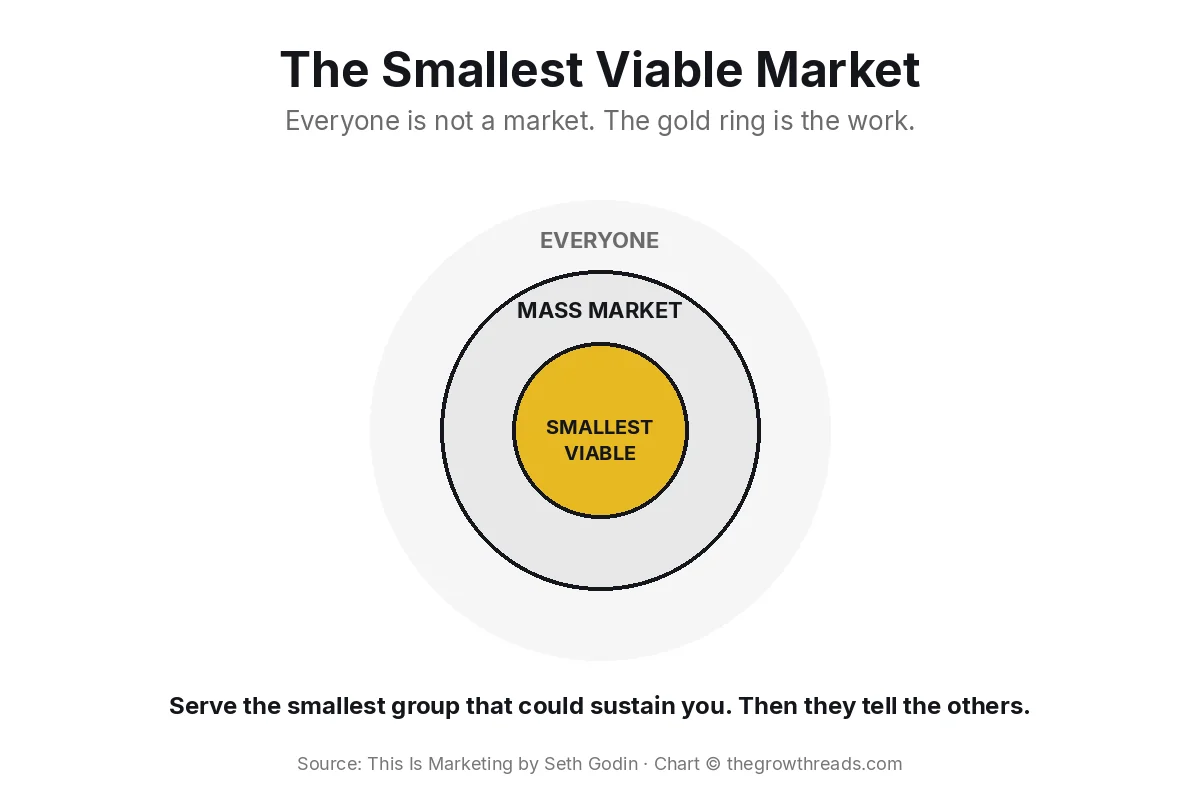
- Smallest viable market. The tiniest group that could sustain you is the point, not a stepping stone.
- People like us do things like this. They enroll in a culture, not a feature list.
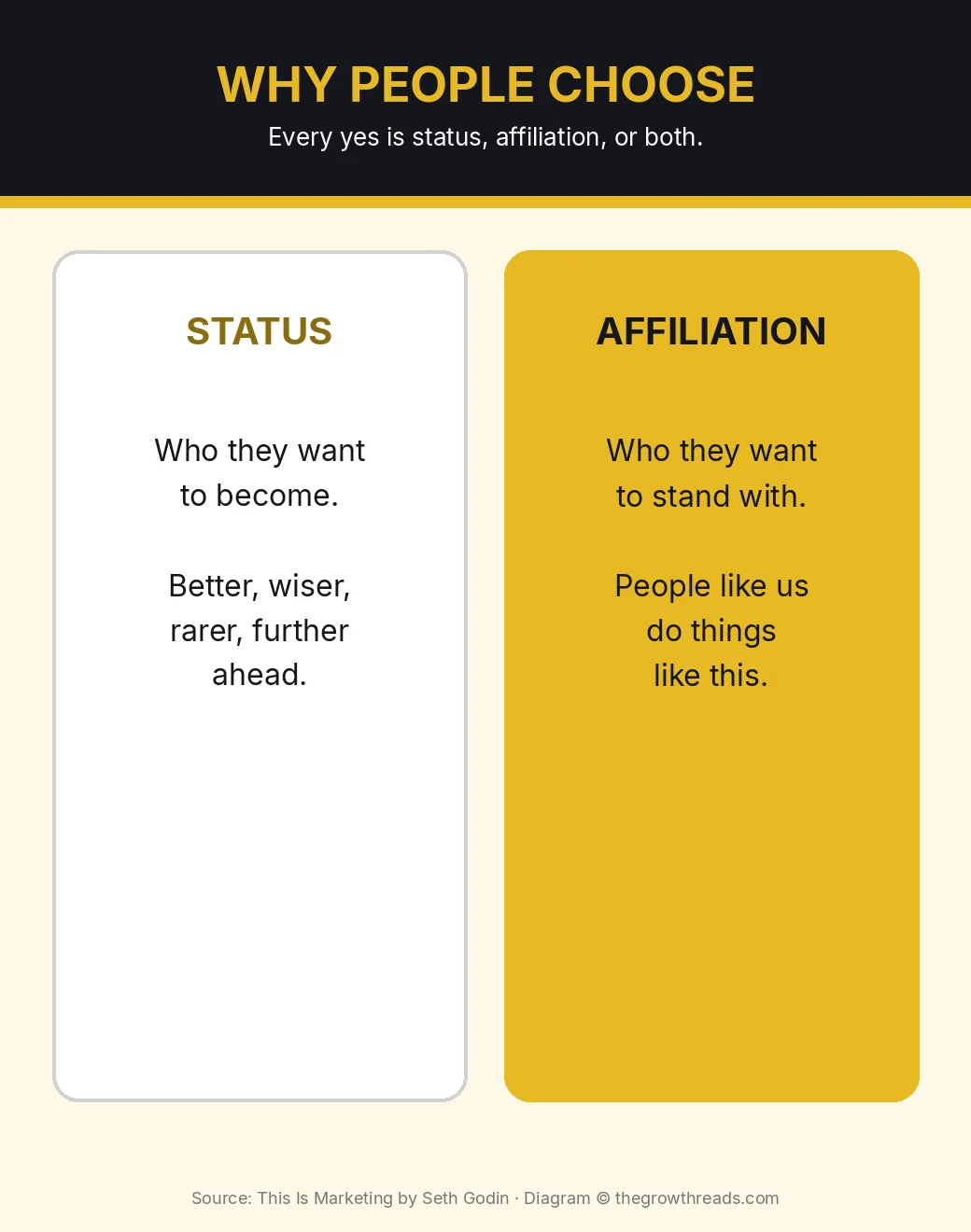
- Status and affiliation run the yes. Who they want to become, and who they want beside them.
- Tension makes a story travel. Comfort is forgettable. A better future with a cost to wait is not.
- Permission beats interruption. A subscribed yes compounds. A stolen glance resets to zero.
- Be generous on purpose. Help them get the change they seek. That is the strategy.
- Everyone is a hiding place. A market of all humans is a market of no one you can serve on Tuesday.
What is This Is Marketing about?
This Is Marketing is Seth Godin’s 2018 case that marketing is not advertising. It is the generous work of seeing a specific group, making the change they seek, and earning the right to be noticed. Pick the smallest viable market and tell a story they already want to live.
About the author
Seth Godin has spent two decades turning marketing into a daily public practice. He writes a blog every day, ran Yoyodyne — an early internet marketing firm later sold to Yahoo — and founded the altMBA and Akimbo workshops so people could learn by shipping, not by sitting. Purple Cow argued that very good is invisible. The Dip argued that quitting the wrong thing is a skill. Linchpin argued that factory work is over. This Is Marketing, from 2018, is the synthesis: marketing is not ads. It is the work of seeing a specific group of people, making change for them, and earning enrollment. You listen because he has been repeating that honest sentence for twenty years, and the work keeps proving him right. Wikipedia: Seth Godin. Explore all Seth Godin book summaries →
Key concepts at a glance
| Concept | What it means | Use it when |
|---|---|---|
| See, then be seen | Empathy first, attention second | The ads are on and the replies are shrugs |
| Smallest viable market | The tiniest group that could sustain the work | The brief still says “everyone 25–54” |
| People like us… | A culture sentence they can say without a brochure | The copy lists features and nobody leans in |
| Status | Who they want to become | You are selling a tool and they want an identity |
| Affiliation | Who they want to stand with | The product is fine and still feels lonely to buy |
| Tension | The gap between the status quo and a better story | The offer is kind, clear, and easy to ignore |
| Permission | An earned yes you can use again | You keep interrupting people who never asked |
| Enrollment | They choose the journey, you do not drag them | The funnel is full and the trust is empty |
Part 1: Marketing is not advertising — it is seeing
Godin opens by taking the word back from the people who buy media. Marketing, in this book, is the work of making change happen. Advertising is one expensive tactic inside that work. Teams collapse the two because tactics feel like a dashboard: spend, impressions, a spike, a story for Friday’s meeting. Seeing a human does not graph as neatly. It also does not expire when the campaign ends.
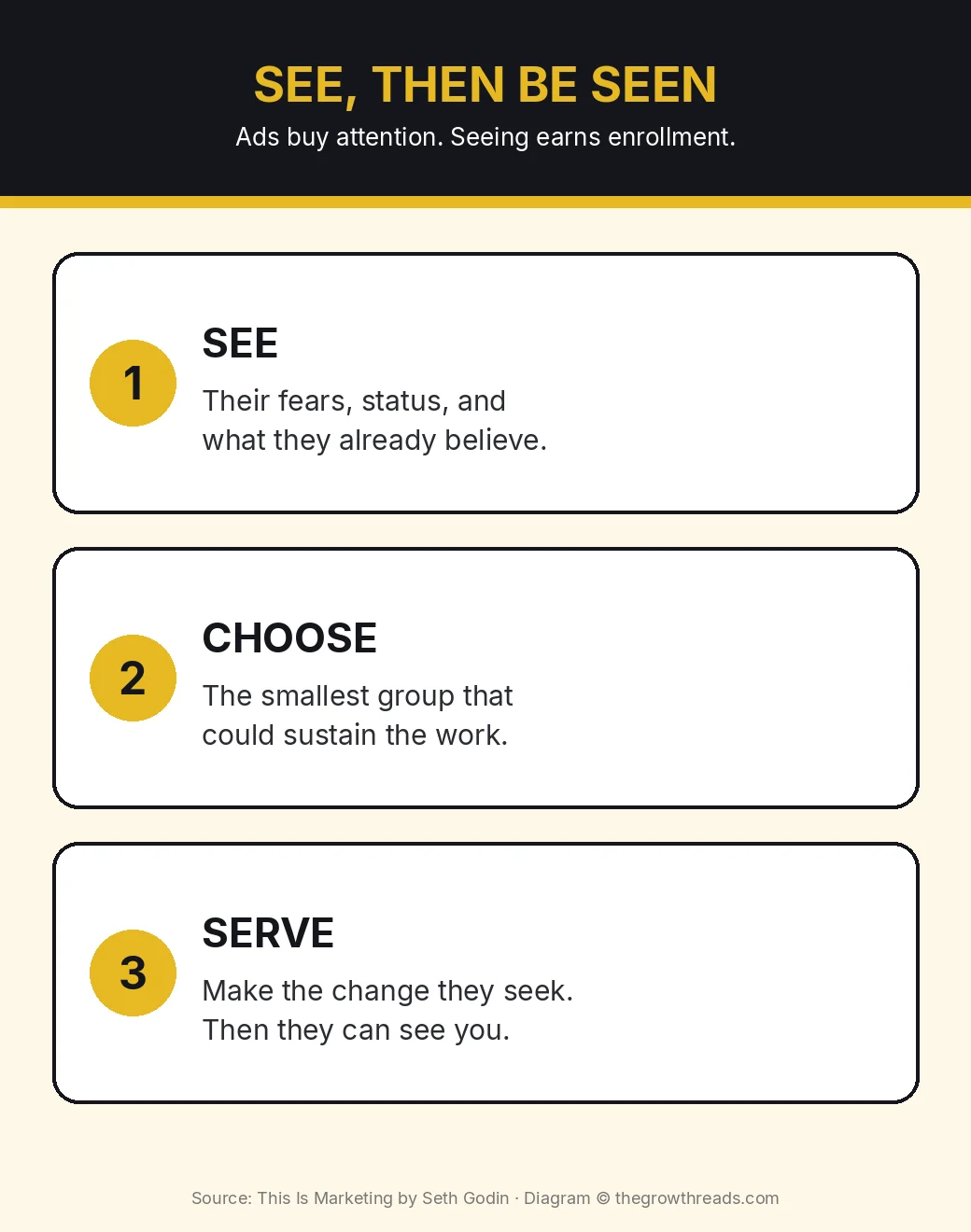
The subtitle is the whole method: you cannot be seen until you learn to see. That is a sequence. First you understand what the other person is afraid of, what status they are protecting, and what better future they already want. Then you make something that meets that want. Then, maybe, they look up. Shouting first is how you become noise. The teams with the biggest ad budgets often have the least specific picture of a customer.
He is not anti-promotion. He is anti-hiding inside promotion. A generous marketer helps a person get where they already want to go. A selfish marketer extracts a click from whoever wandered past. Both can use the same channels. Only one builds a next time. If your plan is “get in front of more people,” this part of the book is a stop sign. Get in front of the right people, having already done the seeing.
TGR Note: Miller’s Building a StoryBrand will order the sentence once you know who the hero is. Godin is the prior question: which humans, and what change. If the thing is beige, skip the copy and read Purple Cow.
Part 2: The smallest viable market and people like us
The smallest viable market is Godin’s most useful cut. It is not a compromise you make until you can afford Super Bowl ads. It is the strategy. Find the tiniest group of people who, if they became true fans, could keep the work alive. Then serve them so well that they tell the next ring. Mass is a lagging indicator of a small group that was actually seen.
Teams resist this because small feels like failure in a culture that worships scale. Godin’s answer is practical, not humble. You cannot see a million people. You can see fifty. You can learn their language, their status games, their “people like us” sentence, and the thing they will forward without being asked. A brief that says “women 25–54” is a request to be average. Average is invisible.
The culture sentence is how you test whether the market is real. People like us do things like this. If you cannot finish that sentence without a demographic adjective, you do not have a market yet. You have a spreadsheet. Us is a scene and a shared no. This is the action they are proud to be seen doing. Godin wants you specific enough that the wrong people self-select out — a gift to them and to your week.
TGR Note: This is Essentialism for customers. Essentialism and The One Thing cut your own pile. Godin cuts the pile of humans you are trying to please. Skip that cut and you will spend the week serving a crowd that was never going to enroll.
Part 3: Status, affiliation, and the stories that spread
Once the market is small enough to see, Godin asks what the yes is actually made of. People buy status and affiliation. Status is who they want to become: further ahead, more competent, rarer, safer. Affiliation is who they want to stand with: a scene, a standard, a table where they will not have to explain themselves. Features are how those two drives get delivered. Features are not the drive.
This is why a cheaper competitor with a clearer identity wins, and why a better spec sheet loses to a story. If your page only argues utility, you are hoping the customer will do the identity work for you. Most of them will not. They will buy the thing that lets them say the culture sentence out loud. Godin wants you to pick a drive on purpose. A status offer without affiliation can feel lonely. An affiliation offer without a status gain can feel like a club with no progress.
Stories travel when they give the teller a role. A remark is not a slogan you paid to insert. It is a sentence someone will say because it makes them look like the person they are trying to be. Purple Cow is the product worth remarking on. This book is the social physics: the remark moves through status and affiliation, not through frequency.
TGR Note: Heath and Heath’s Made to Stick is why some messages survive. Berger’s Contagious is why some get shared. Godin is why a human bothers to hold the message: it tells the truth about who they are. Use all three after the market is small enough to name.
Part 4: Tension, permission, and the work of being generous
Comfortable offers disappear. Godin wants tension: a gap between the status quo and a better story that the customer can see themselves in. Tension is not a fake countdown clock. It is an honest picture of what staying the same costs, plus a path that feels walkable. If there is no tension, there is no plot, and a plotless offer is a shrug. The smallest viable market already feels the gap. Your job is to name it without humiliating them.
Permission is how the relationship compounds. Interruption resets to zero every time. An earned yes — a subscribe, a trial, a reply — is an asset you can use again without stealing another glance. Godin is less interested in the email list as a trophy and more interested in enrollment: they choose the journey. You are a guide, not a kidnapper. That should sound like Miller’s StoryBrand on purpose. The difference is that Godin will not let you write the guide speech until you have picked the humans.
The close of the book is a stance, not a channel plan. Be generous. Make the change they seek. Measure enrollment, not applause. The 7-day plan below is TGR’s. Godin will not give you a streak tracker. He will give you a standard: if you cannot name the market, the drive, and the tension, you are buying noise and calling it a strategy.
TGR Note: If the work is not shipping, Godin’s Poke the Box and The Practice are the prior books. This Is Marketing cannot enroll a product that does not exist. Tribes is the leadership cousin: connect people who already want to be connected, after you can finish the culture sentence.
Who is This Is Marketing best for — and who should read something else first?
Best for founders, consultants, creators, and small teams who already have an offer and still market to everyone. If your ads are on and the people who actually love the work are a mystery, this is the book.
Read something else first if you do not have a product yet — Rework or Anything You Want will get you to an offer. If you are not shipping, Poke the Box and The Practice beat a positioning workshop. If the thing is beige, Purple Cow is the product problem. If the offer is good and the sentence is fog, Building a StoryBrand will order the page. If the story is clear and still does not move, Contagious is the next layer.
Questions to reflect on
- If a stranger read only your last post, who is “people like us” — can you name ten of them?
- Are you shouting at everyone because the small market feels too small to admit?
- Which drive does your offer actually serve, status or affiliation, and which did you hope they would infer?
- Where is the tension, or is the offer only comfort with a price tag?
- What would you make this week if you only had to please the humans who would miss the work?
🔥 Ready to stop shouting at everyone?
Get This Is Marketing, then use the 7-day plan to serve the smallest viable market.
How to apply This Is Marketing (7-day plan)
- Day 1 — Name the smallest viable market. One sentence. Ten humans you could actually email. If you cannot list the ten, the market is still a vibe.
- Day 2 — Write their worldview. What they believe, fear, and already want. No product language. If you only have demographics, you are not done.
- Day 3 — Pick the drive. Status, affiliation, or both. One paragraph for each. Circle the one your current page never says.
- Day 4 — Name the tension. Status quo versus better story. One honest cost of waiting. No fake urgency.
- Day 5 — Make one generous asset. A page, a PDF, a short video, a workshop slot — something only that group would forward.
- Day 6 — Ask for enrollment. A reply, a call, a trial. Not a like. Permission you can use again.
- Day 7 — Send it to the ten, not the list. If they cannot repeat what you do and who it is for, cut the market. Do not buy a wider blast.
Frequently asked questions
What is This Is Marketing about in one paragraph?
This Is Marketing is Seth Godin’s 2018 case that marketing is not advertising, hype, or a race to be everywhere. It is the generous work of seeing a specific group of people, making the change they already seek, and earning the right to be noticed. You pick the smallest viable market, tell a story they want to live, and create enough tension that they choose to enroll. Ads can buy a glance. They cannot buy trust. Seeing is a skill you can practice this week on a real offer, a real sentence, and a handful of people.
What is the smallest viable market in This Is Marketing?
The smallest viable market is the tiniest group of people who, if they became true fans, could sustain the work. It is not a demographic blob and it is not everyone with a pulse and a credit card. Godin wants a group small enough that you can name their fears, status, and the sentence they already tell themselves. Mass marketing feels safer because it hides you in a crowd. A tiny market feels risky because they can say no to your face. That is the feature. If ten people in that group would miss the work, you have a place to begin. Everyone else can arrive later.
What does “people like us do things like this” mean?
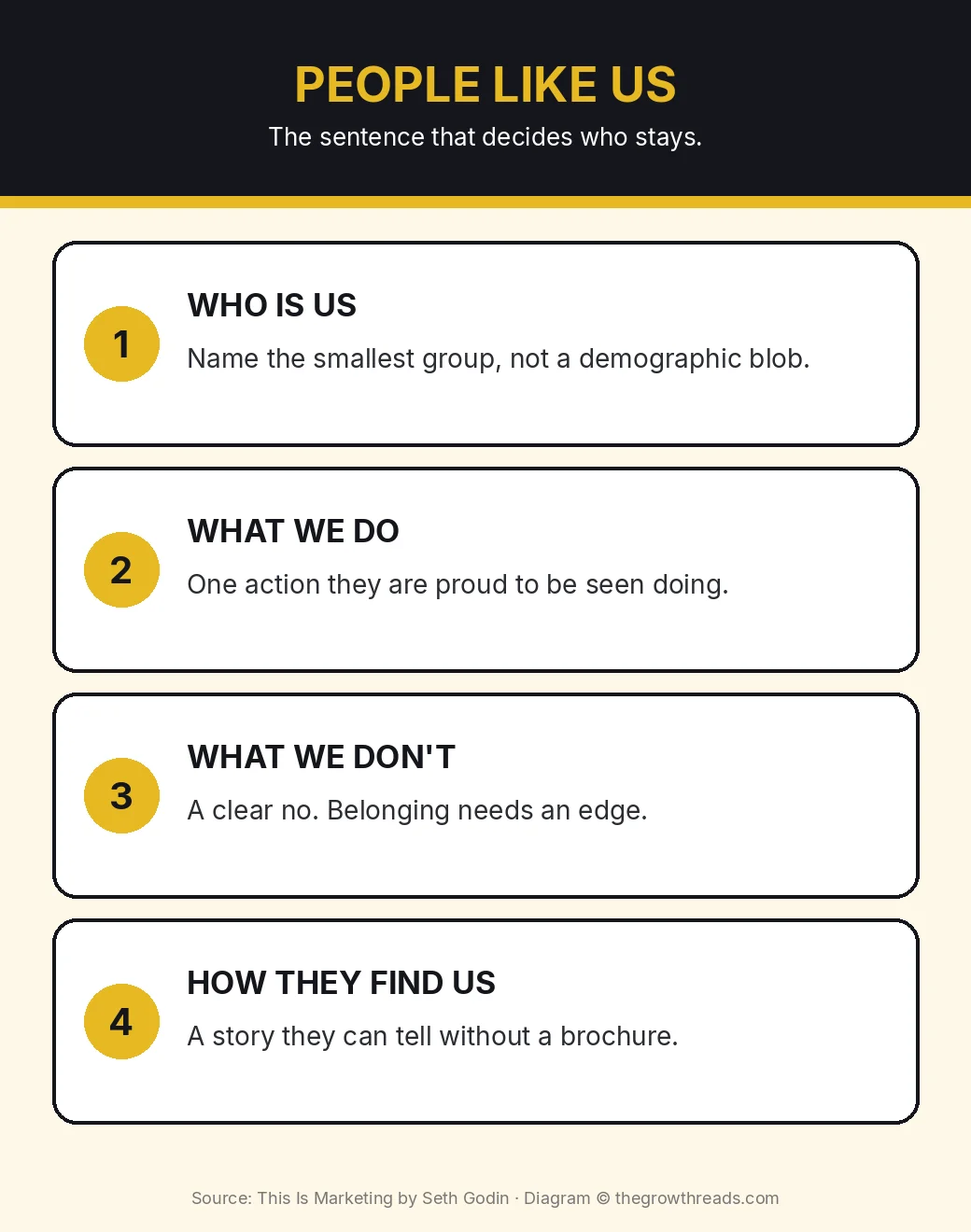
It is Godin’s culture sentence. People do not buy a feature list. They enroll in a story about who they are and who they stand with. Status is who they want to become. Affiliation is who they want beside them. When your offer lets someone say, people like us do things like this, they are not being persuaded so much as recognized. The work is to make that sentence specific: who is us, what we do, what we refuse, and how a newcomer finds the door. Vague niceness produces no us. A clear edge does. Write the sentence for ten people you could actually email, not for a persona slide.
Is This Is Marketing only for marketers and agencies?
No. Godin is writing for anyone who needs someone else to say yes: founders, freelancers, teachers, nonprofit leads, product managers, and operators who keep buying attention and converting shrugs. If your week includes a page, a pitch, a launch, or a request for trust, this is a productivity book dressed as marketing. It is not a media-buying manual and it will not give you ad copy formulas. It will give you a filter for what to make and who it is for. If you do not yet have an offer, read Rework or Anything You Want first. If you have an offer and still shout at everyone, start here.
How is This Is Marketing different from Purple Cow or Building a StoryBrand?
Purple Cow is the product problem: if the thing is beige, no story will save it. Building a StoryBrand is the homepage problem: put the customer in the hero’s seat and make the sentence finishable. This Is Marketing sits under both. It asks who the work is for, what change you are trying to make, and whether you have earned enrollment or only bought a glance. You can have a remarkable product and a clear story and still spray it at a crowd that was never going to care. Godin wants the crowd cut first. Then Miller can order the sentence. Then the cow can be purple for someone specific.
Who is Seth Godin, and why listen to him on marketing?
Seth Godin writes a daily blog, ran Yoyodyne, an early internet marketing firm later sold to Yahoo, and founded the altMBA and Akimbo workshops so people could learn by shipping. Purple Cow, Permission Marketing, The Dip, Linchpin, and The Practice all orbit the same claim: remarkable, generous work is a practice, not a personality type. This Is Marketing is the 2018 synthesis of that claim for people who need a yes. You listen because he has been repeating the same honest sentence for twenty years while channels, platforms, and ad prices changed under him. The tactics age. Seeing a specific human does not.
How should I apply This Is Marketing this week?
Do not buy another burst of ads aimed at everyone. Write one sentence: people like us do things like this. Name ten humans who could sustain the work if they loved it. Write their status drive and their affiliation drive in plain language. Make one generous asset that only that group would forward. Ask for enrollment — a reply, a call, a trial — not a like from a stranger. Send it to those ten, not a list of thousands. If they cannot repeat what you do and who it is for, cut the market, not the budget. The 7-day plan below is that method for one week.
Related summaries
- Purple Cow — the product has to be worth remarking on before you ask to be seen.
- Building a StoryBrand — put that specific customer in the hero’s seat on the page.
- Made to Stick — why the culture sentence survives in memory.
- The Practice — the shipping habit so the smallest market actually gets something.
More in this silo: best productivity books.
How we analyze books: every book on The Growth Reads is read cover to cover, summarized in thousands of words of original analysis, and rated against our five-criteria rubric (lasting impact, evidence quality, practical application, writing & originality, external consensus). Read our full methodology.