

★★★★½ 4.5/5 — Fix six weeks. Shape the work. Kill the leftover list.
Best for: Founders, product managers, designers, and small build teams who keep adding sprints and never ship a shaped bet.
Reading time: ~4 hrs (guide: 14 min)
Difficulty to apply: Easy to put one idea on a six-week appetite this week; hard to let the circuit breaker stand when the hill is still high.
Shape Up in one minute
Stop asking how long the work will take. Ask how much time it is worth — then shape it to fit. Ryan Singer’s Shape Up (Basecamp, 2019) is how a small product company actually ships: senior people shape a project before it is scheduled, a betting table funds six uninterrupted weeks, and the team cuts scope until something real is deployed. No backlog of leftover maybes. A cool-down, then you bet again. If you take one move from this Shape Up summary, give one raw idea an appetite and refuse to build until the pitch is bounded.
Key takeaways
- Appetite, not estimate: Time is a budget you set. It is not a guess you defend later.
- Shape before you schedule: Rough, solved, and bounded work is what you bet on — not a slogan and a ticket pile.
- Breadboard, then fat-marker: Places, affordances, connections. Thick lines so you cannot hide in pixels.
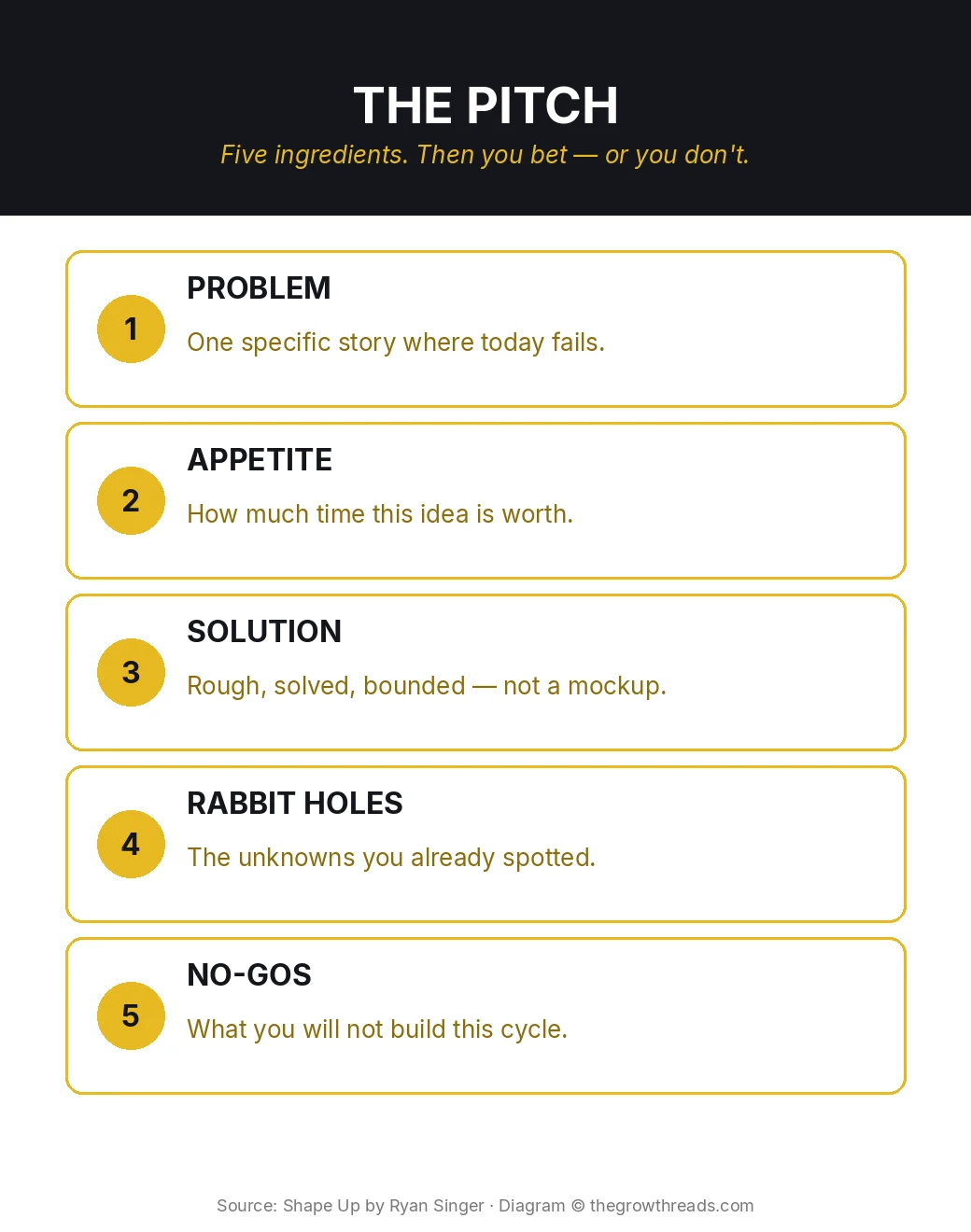
- The pitch has five parts: Problem, appetite, solution, rabbit holes, no-gos. Then you bet, or you don’t.
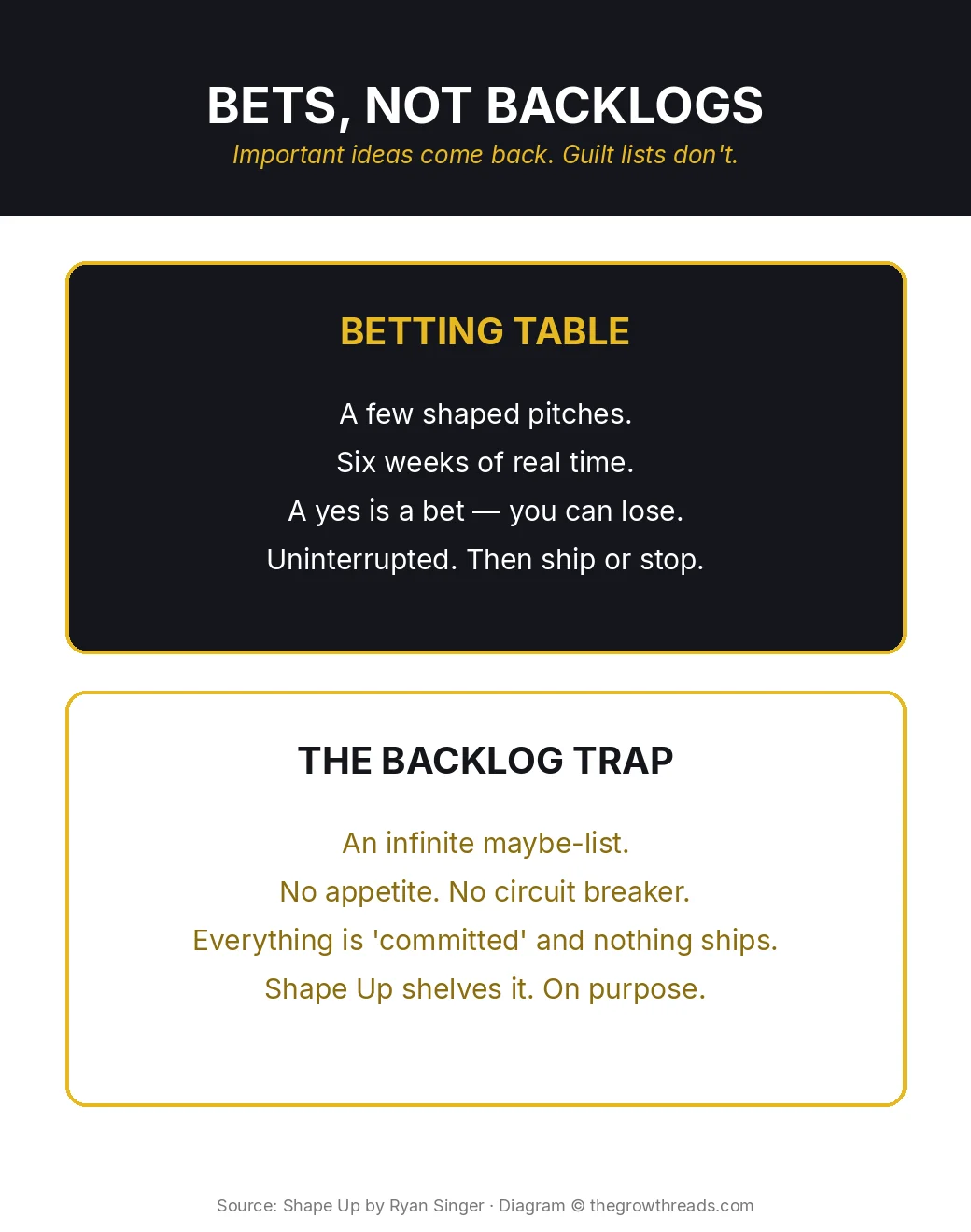
- Bets, not backlogs: A few shaped pitches compete. Important ideas come back. Guilt lists don’t.
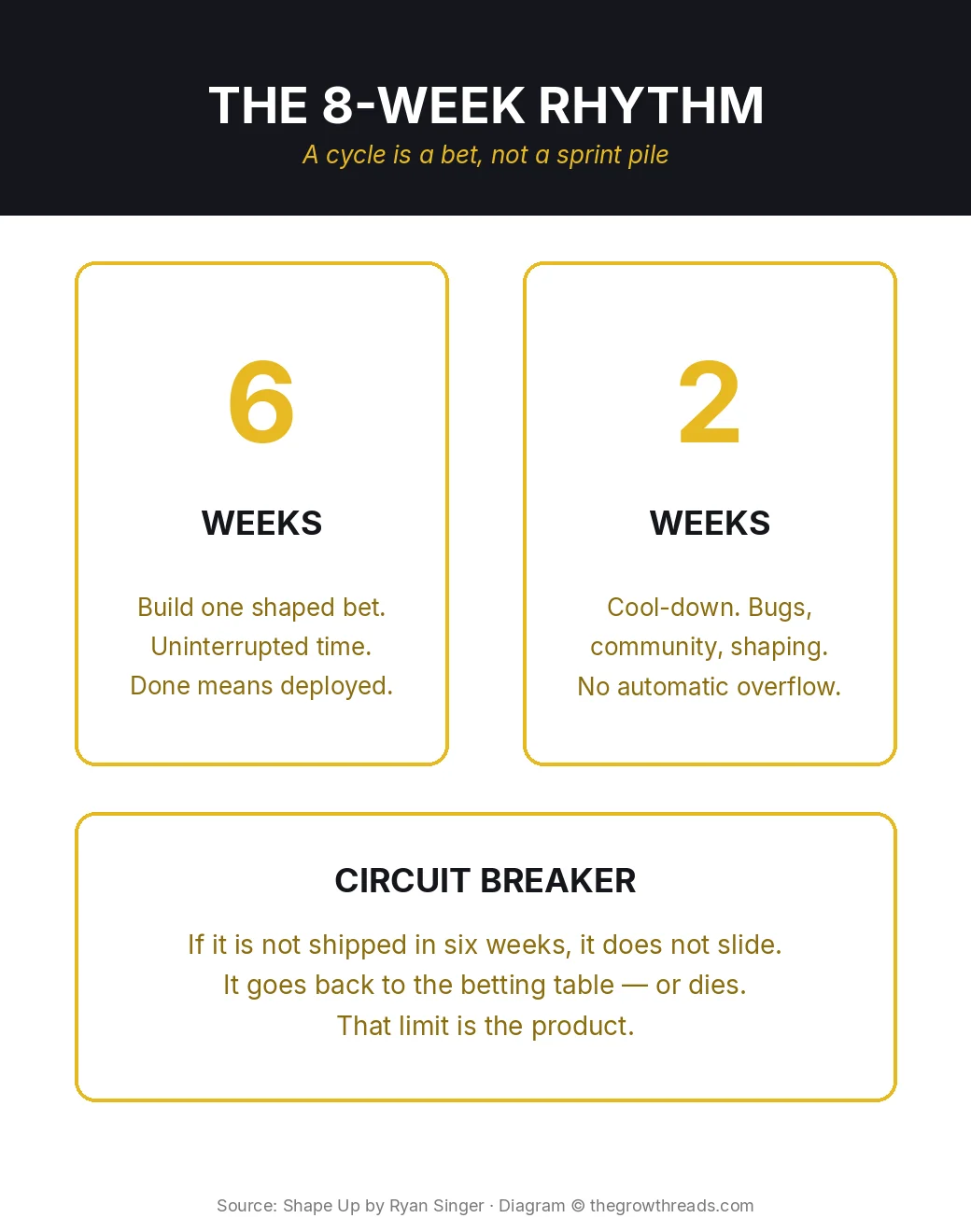
- Six weeks plus two: Build in the cycle. Cool-down is for bugs, community, and the next shapes — not overflow.
- Circuit breaker: Unshipped work does not slide into the next cycle. It returns to the table or dies.
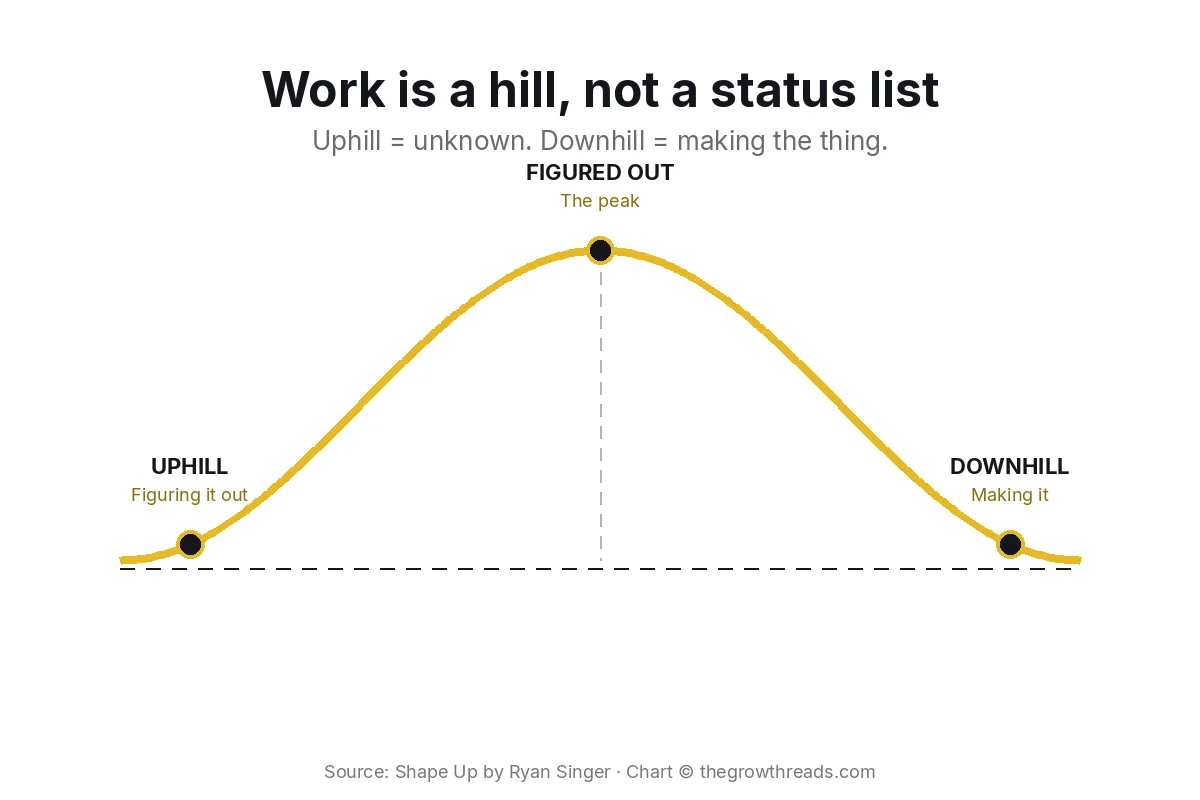
- Hill, not a status list: Uphill is unknown. Downhill is making it. Nobody has to fake “on track.”
- Done means deployed: A vertical slice that users can touch beats a perfect horizontal layer.
- Hammer the scope: Cutting to the appetite is the craft. It is not a quality drop.
What is Shape Up about?
Shape Up is Ryan Singer’s field manual for how Basecamp ships: senior people shape a project to a fixed time appetite, a small betting table funds six uninterrupted weeks, and the team cuts scope — not quality — until something real is deployed. No backlog. No automatic overflow.
About the author
Ryan Singer spent more than fifteen years at Basecamp (formerly 37signals), working the whole stack — interface design, back-end programming, and product strategy. He designed features used by millions of customers and helped invent the way that small team actually decides, builds, and ships. Shape Up (2019) is that method written down: first as a web book anyone can still read, then as a print edition Basecamp produced itself rather than through a traditional house. The credential is the shipped cycle, not a stage persona. He taught appetites, pitches, hills, and circuit breakers to teams drowning in standups and never-ending sprints. Explore all Ryan Singer book summaries →
Key concepts at a glance
| Concept | What it means | Use it when |
|---|---|---|
| Appetite | A time budget for the idea — small batch or six weeks | You are estimating instead of choosing |
| Shaping | Make the work rough, solved, and bounded before you bet | Teams get a slogan and a ticket pile |
| Breadboarding | Places, affordances, connections — not a mockup | Pixel debates start before the problem is narrow |
| Pitch | Problem, appetite, solution, rabbit holes, no-gos | You “align” in a meeting with no write-up |
| Betting table | A few shaped pitches; a yes is a six-week bet | Everything is already “committed” |
| Circuit breaker | Unshipped work does not automatically continue | Every project slides into the next sprint |
| Hill chart | Uphill = unknown; downhill = executing what you now see | Status is a color and a percent |
| Scope hammering | Cut to the appetite without lowering the bar | The hill is still high in week five |
| Cool-down | Two weeks after the cycle for bugs, community, next shapes | You stack the next build on a tired team |
Part 1 — Shape the work before anyone builds
Singer’s first fight is with how teams start. A founder has a feeling. Someone draws a wireframe. Someone else files twenty tickets. Building begins while the problem is still a grab-bag. Shape Up pulls that work off the build track. Shaping is a senior job — product, design, and technical risk in one sketch — not a committee.
Shaped work is rough (fat lines, not a fake-complete spec), solved (not a mystery branded as empowerment), and bounded (the appetite is declared; “wouldn’t it be nice” is out). Wireframes are too concrete; the team inherits accidents. Pure words hide holes. The middle language is breadboarding: places, affordances, connections — then a fat marker so nobody sneaks in a settings panel.
Appetite makes the rest possible. Ask “how much is this idea worth?”, not “how long will it take?” A small batch is a week or two. A big batch is six. Time is fixed; scope moves. Singer’s calendar tell: once customers only needed a month of dots, a full calendar clone was not quality. It was appetite they refused to spend. Hunt rabbit holes — login, permissions, the one flow that explodes — then write the pitch: failure story, appetite, solution, holes, no-gos. That document is what the table reads. Not a vibe.
TGR Note: Shaping is not the same job as discovery. Continuous Discovery Habits is Torres on talking to a customer every week so you can even name the failure story. Inspired is Cagan on the product trio and the four risks. Use those to learn. Use Shape Up when you already have a story and you keep turning it into an unshaped ticket pile. Do not skip the interviews and call a breadboard “research.”
Part 2 — Bet six weeks, kill the backlog
The backlog, in Singer’s telling, is a guilt machine. It stores every maybe so nobody has to say no. Important ideas come back; they do not need a museum. Shape Up keeps a short list of shaped pitches and a betting table — the people who own the bet, not planning theater. A yes is six weeks of uninterrupted time for a small team (often one designer and one or two programmers). A no leaves the idea off the calendar. It can be reshaped. It is not a spreadsheet promise.
The cycle makes the bet visible: six weeks of building, then two weeks of cool-down for bugs, community, and the next pitches. Cool-down is not overflow. If the bet does not deploy, the circuit breaker trips and the work returns to the table. The other system trains people to slip, hero-mode, and start tired. Bugs wait for cool-down unless they block the ship. New requests get shaped or they wait. A new product may need an R&D bet whose output is learning. “Just one more sprint” is how the hill never peaks.
TGR Note: The same company wrote the culture books. Rework is Fried and DHH on meetings, estimates, and “we’re always in crunch.” It Doesn’t Have to Be Crazy at Work is the calendar version. Shape Up is the project version: a betting table instead of a backlog, a circuit breaker instead of a heroic last week. Stack them. Do not install six-week cycles on a team that still treats every Slack ping as a commitment.
Part 3 — Build the slice, hammer the scope
Shapers hand over the pitch, the appetite, and the responsibility — not a drip of tasks. Kick-off is a conversation. Then the team gets one piece done: a vertical slice you can touch, even if v1 is a hard-coded password instead of full accounts. Horizontal layers (all screens, then all logic) look like progress and hide the iceberg until week five.
Scopes are structures in the product — drafts, sending, permissions — not “front-end / back-end.” A layer cake does not stand alone. An iceberg is a small label over a huge unknown; split it or cut it. Chowder is leftover dump. Nice-to-haves get a tilde and drop first. Each scope sits on the hill: climbing (still figuring it out) or descending (making it). Status without a standup color.
Week five is the costume test. If the hill is still a wall, you hammer scope to the pitch’s baseline and ship. Extending is a rare new bet, not a slide. QA is for the edges of a thing that already works. Done means deployed. A branch that “would work” is still uphill.
TGR Note: A six-week bet is not a Sprint. Knapp’s week is for making an idea testable when you do not yet know if it deserves an appetite. Singer’s cycle is for shipping a shaped bet you already chose. If adding people feels like the fix, The Mythical Man-Month is still the warning: extra bodies on a late hill make it later. Hammer scope first.
Part 4 — Cool-down, and how to start this month
After the cycle, let the storm pass. Feedback is not automatically next cycle’s work — it gets shaped again or it is a backlog with better lighting. Cool-down is bugs, customer time that is not a fake six-week project, and pitches written while nobody pretends to ship at the same time.
You do not need Basecamp’s whole calendar. Option A: one six-week experiment with a real circuit breaker. Option B: start shaping even if sprints stay — stop handing over unshaped work. Option C: install cycles first if shipping is the fire. Small teams can wing ceremony; bigger teams need separate shaping and building tracks. The test is whether customers can touch something in the appetite you named — and whether you let the leftover die. The web book is free; print existed because Basecamp sold it themselves. If your system cannot say no, the method will feel rude. That is the point.
Who is Shape Up best for — and who should read something else first?
Best for product teams of a few builders who already have customers, who can pull senior people onto a shaping track, and who are honest that “the backlog is the plan” has stopped working. Founders who still sit in the work will get more from it than a PMO looking for a new template. If you can name one idea worth six weeks and protect the team from drive-by scope, this is your book.
Read something else first if you cannot yet tell a specific story of today’s failure. For the weekly habit of finding those stories, start with Continuous Discovery Habits or The Mom Test. A five-day prototype to test whether an idea deserves an appetite is Sprint. If the real problem is meetings and fake urgency, Rework and It Doesn’t Have to Be Crazy at Work change the calendar first. Coaching feature teams toward outcomes is Empowered; the discovery companion is Inspired.
Questions to reflect on
- What is one idea you keep re-estimating instead of giving an appetite?
- Where did last quarter’s “committed” list actually ship — and what quietly slid?
- Who shapes work today? If the answer is “the whole Slack channel,” who could do it instead?
- Draw last week’s project as a hill. Which scopes are still uphill, and which did you only color green?
- What would you cut if the circuit breaker tripped on Friday?
🔥 Ready to ship one shaped bet?
Pick an appetite, write the five-ingredient pitch, and let the circuit breaker stand.
How to apply Shape Up (7-day plan)
- Day 1 — Name the appetite. Pick one live idea. Write “small batch (two weeks)” or “big batch (six weeks)” at the top of a page. Do not estimate.
- Day 2 — One failure story. Write the specific status quo that does not work. One customer, one moment. Not a market slide.
- Day 3 — Breadboard. List places, affordances, connections. If you reach for Figma, put the tablet down and use boxes.
- Day 4 — Rabbit holes and no-gos. Circle the one technical unknown that could eat the appetite. Cut it, spike it, or declare it out of bounds.
- Day 5 — Write the pitch. Five headings only: problem, appetite, solution, rabbit holes, no-gos. Send it to one other person who can say no.
- Day 6 — Fake betting table. Thirty minutes. Bet, shelf, or reshape. If you bet, name the two people and the Friday six weeks out.
- Day 7 — One slice, one hill. If you are building, deploy the smallest vertical piece. Draw one scope as a hill. Mark whether you are still climbing.
Frequently asked questions
What is Shape Up about?
Shape Up is Ryan Singer’s 2019 field manual for how Basecamp ships software. Senior people shape a project to a fixed time appetite — usually six weeks — before anyone is scheduled. A small betting table funds that cycle with uninterrupted time. The team cuts scope, tracks work on a hill chart, and deploys something real. There is no backlog of leftover maybes and no automatic overflow if the work is late. Cool-down follows the cycle. If you take one move from this Shape Up summary, stop estimating. Set an appetite and refuse to build until the pitch is bounded.
What is an “appetite” in Shape Up?
An appetite is a time budget, not a forecast. You decide how much the idea is worth — a small batch of a week or two, or a big batch of six — and you shape the solution to fit. Estimates ask “how long will this take?” after the scope has already ballooned. Appetite asks “is this worth six weeks of a senior team?” first. That flip is what makes scope variable on purpose. If the hill is still high in week five, you cut work to the appetite; you do not move the Friday. Use it when you keep defending a number you made when you knew the least.
What is a “hill chart”?
A hill chart is Singer’s picture of real status. The left slope is uphill: you are still figuring the work out, and the unknown is the point. The peak is “figured out.” The right slope is downhill: you are making the thing you now understand. Each scope on the project sits somewhere on that hill. It replaces a green percent that hides fear. Nobody has to say “I don’t know” into a standup color. If every scope is still climbing in week four, you do not need a pep talk. You need to split an iceberg, cut a nice-to-have, or trip the circuit breaker.
Does Shape Up replace Agile or Scrum?
Shape Up is not a rebrand of Scrum. Singer is explicit that Basecamp is not trying to be waterfall, agile, or scrum. There are no story points, no two-week sprint theater, and no backlog grooming as the plan. There is a shaping track, a betting table, a six-week cycle, and a two-week cool-down. You can steal pieces without renaming your jobs. Many teams keep standups and still gain from appetites and a circuit breaker. If your “agile” has become an infinite maybe-list and a demo that never ships, Shape Up is the alternative method, not a new ceremony pack for the same list.
How long is a Shape Up cycle?
The building cycle is six weeks of uninterrupted time on one shaped bet. After that comes a two-week cool-down for bugs, community, and shaping the next pitches — eight weeks of rhythm, not eight weeks of build. Small batches inside the same philosophy can be one or two weeks when the idea is not worth a full cycle. The six-week number is an appetite Basecamp found long enough to finish something real and short enough that risk stays visible. If you stretch it because you are “almost done,” you have already turned the cycle back into a sliding project. The Friday is the product.
Who should shape the work?
Shaping is a senior job. Singer wants people who can see the customer problem, the interface, and the technical holes in the same sketch — often a seasoned designer with a programmer in the room, not a crowd-sourced Slack thread. Builders are not excluded from insight; they are protected from unshaped work. Two tracks run in parallel: someone is shaping the next bet while a small team builds the current one. If the same three people try to shape, build, and answer every ping, you will get neither a pitch nor a ship. Start by pulling one senior person off the ticket pile for a week of shaping.
Is Shape Up only for Basecamp-sized teams?
No. The book’s appendix is honest that basic truths (fixed time, variable scope, shaped work, a real stop date) travel further than Basecamp’s exact calendar. A tiny team can wing more of the ceremony and still set an appetite. A larger company needs the tracks — shaping versus building — or the same meeting will try to do both. You do not need Basecamp the product. You need one six-week experiment with a circuit breaker, or even just a rule that unshaped work does not get scheduled. If your org cannot say no, the glossary will not save you. Practice one bet first.
Related summaries
- Rework — fewer meetings, more shipping, same company DNA
- Inspired — the product trio and the four risks before you shape a bet
- Continuous Discovery Habits — weekly customer conversations that feed the pitch
- Sprint — a five-day prototype when the idea is not yet worth six weeks
- More on the best productivity books pillar
How we analyze books: we read for application, not for a takedown — then we add a plan you can run this week. Read our full methodology.