

★★★★☆ 4.6/5 — discover the product before you build it.
Best for: PMs, founders, and tech leads stuck in feature-factory mode
Reading time: ~6.5 hours (Wiley hardcover, 2017, 368 pp) · this guide ~14 min
Difficulty to apply: Medium-hard — you cannot run it alone if the org still assigns solutions on a date
Inspired in one minute
Discover the product before you build it. Marty Cagan’s Inspired is the field guide behind that sentence. Most technology teams are staffed to ship output: a stakeholder names a feature, it lands on a roadmap, a product manager writes a spec, and engineering builds to a date. Success is “we shipped.” The companies customers actually love staff product teams instead. They give a small group a problem and an outcome, and judge them on results.
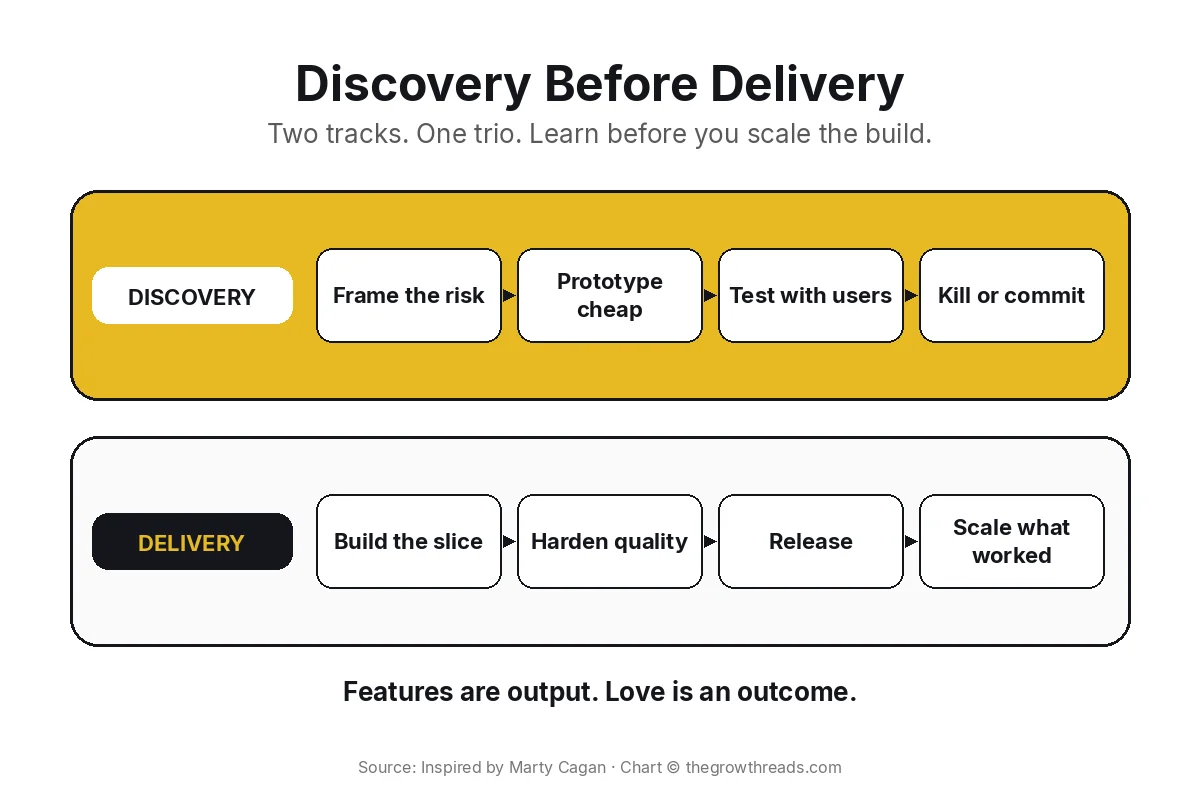
Cagan’s working unit is the product trio — a product manager, a product designer, and an engineer on the same bet. Their first job is discovery: turn four risks (value, usability, feasibility, viability) into evidence with prototypes and customer time. Delivery is the second track, run by the same people. If you only remember one move, stop putting solutions on the calendar until someone has tested the risk that still scares you.
Key takeaways
- Outcome over output. Closing tickets is not the win. Customer or business change is.
- Product teams, not feature teams. Give people a problem, not a pre-decided solution.
- The product trio. PM, designer, and engineer share one bet the whole time.
- Four risks. Value, usability, feasibility, viability — all of them need evidence, not hope.
- Discovery is a job. It runs beside delivery, not as a phase you finish before sprint one.
- Prototypes beat PRDs. Learn with something a human can react to this week.
- Engineers belong in discovery. Coding is only half their value.
- Vision and strategy beat a feature roadmap. Sequence bets. Stop listing solutions on dates.
- Missionaries, not mercenaries. Reward people who will kill a bad idea.
What is Inspired about?
Inspired is Marty Cagan’s manual for staffing and running technology product teams that discover what customers will love before they scale the build. It covers the product trio, the four risks, dual-track discovery and delivery, and the culture that lets a team kill a feature and keep the outcome.
About the author
Marty Cagan is the founder of Silicon Valley Product Group, where he coaches product leaders on how the best teams discover and deliver technology products. He spent the earlier part of his career as a product executive — including vice president of product at eBay during its scale years, plus senior product roles at Hewlett-Packard and Netscape Communications. Inspired (second edition, 2017) is the field guide those companies keep handing new PMs; Empowered (2020) and Transformed (2024) extend the same argument to coaching and company change. He writes regularly at svpg.com. The through-line is blunt: most teams are staffed to ship output. The work that matters is discovering something valuable, usable, feasible, and viable before you scale the build. Explore all Marty Cagan book summaries →
Key concepts at a glance
| Concept | What it means | Use it when |
|---|---|---|
| Feature factory | Success = shipped output on a date | The roadmap is a list of solutions |
| Product team | A small group owns a problem and an outcome | You keep assigning tickets, not problems |
| Product trio | PM + designer + engineer on the same bet | One of the three joins after the spec is done |
| Four risks | Value, usability, feasibility, viability | You are about to “just build it” |
| Discovery | Turn those risks into evidence | Delivery is fast and the product is shrugged at |
| Prototype | Something a human can try this week | The PRD is long and nobody has seen a user |
| High-integrity commitment | A date you promise after discovery, not before | Sales needs a date and the idea is still a guess |
| Missionaries | People who will kill a bad idea for the outcome | The team is optimizing for utilization |
Part 1: Lessons from top tech companies
Most product organizations are feature factories. A stakeholder has an idea. It lands on a roadmap. A product manager writes a spec. Designers make it pretty. Engineers build it. Success is shipped-on-the-date. Cagan’s opening argument, drawn from HP, Netscape, eBay, and the companies SVPG coaches, is that the best product companies staff product teams instead: a small group given a problem and an outcome, accountable for results rather than a pre-chosen solution.
The difference is not agile theater. Plenty of feature factories run Scrum, standups, and a tidy board with great discipline. They are still optimizing output. Cagan wants missionaries: people who wake up caring whether the customer actually got the value. Mercenaries ship the ticket. Missionaries will kill their own idea when the evidence says so.
He is blunt about why roadmaps of features fail. A feature on a date pretends we already know what to build. We almost never do. Value, usability, feasibility, and viability are all risks. A roadmap that lists solutions skips the only work that reduces them: discovery. When sales or the CEO needs a date, Cagan allows a high-integrity commitment — after enough discovery to know the promise is real, not because a slide needed a Q3 column.
The pattern he holds up is consistent: strong product managers, designers in the room from day one, engineers who participate in discovery, and leaders who coach rather than dictate the backlog. If your org charts a PM as a project manager who writes tickets for a silent build team, Inspired is a map of a different job.
TGR Note: If the pain is “we debate for months, then build,” pair this chapter with Jake Knapp’s Sprint — a five-day prototype is discovery with a calendar. If the pain is “we keep adding,” Rework is the permission to ship less while you restaff the team.
Part 2: The right people — the product trio
Cagan’s product manager is not a backlog administrator. The job is to discover a product that is valuable, usable, feasible, and viable — which means time with customers, fluency with data, a working knowledge of the business model, and enough industry context to smell a bad bet. Process without that product sense is a nicer feature factory.
The other two seats matter as much. A product designer in this model is not the person who receives a spec and chooses colors. They own the experience: the usability risk, the prototype the customer can actually try, the flow that makes the value obvious. And engineers are not a build resource you protect from distraction. Cagan’s line is the one teams quote: “If you only use your engineers to code, you’re only getting about half their value.” The other half is the feasibility imagination that happens when they sit in discovery — they will invent a cheaper path than the spec assumed, or they will kill a fantasy before it burns a quarter.
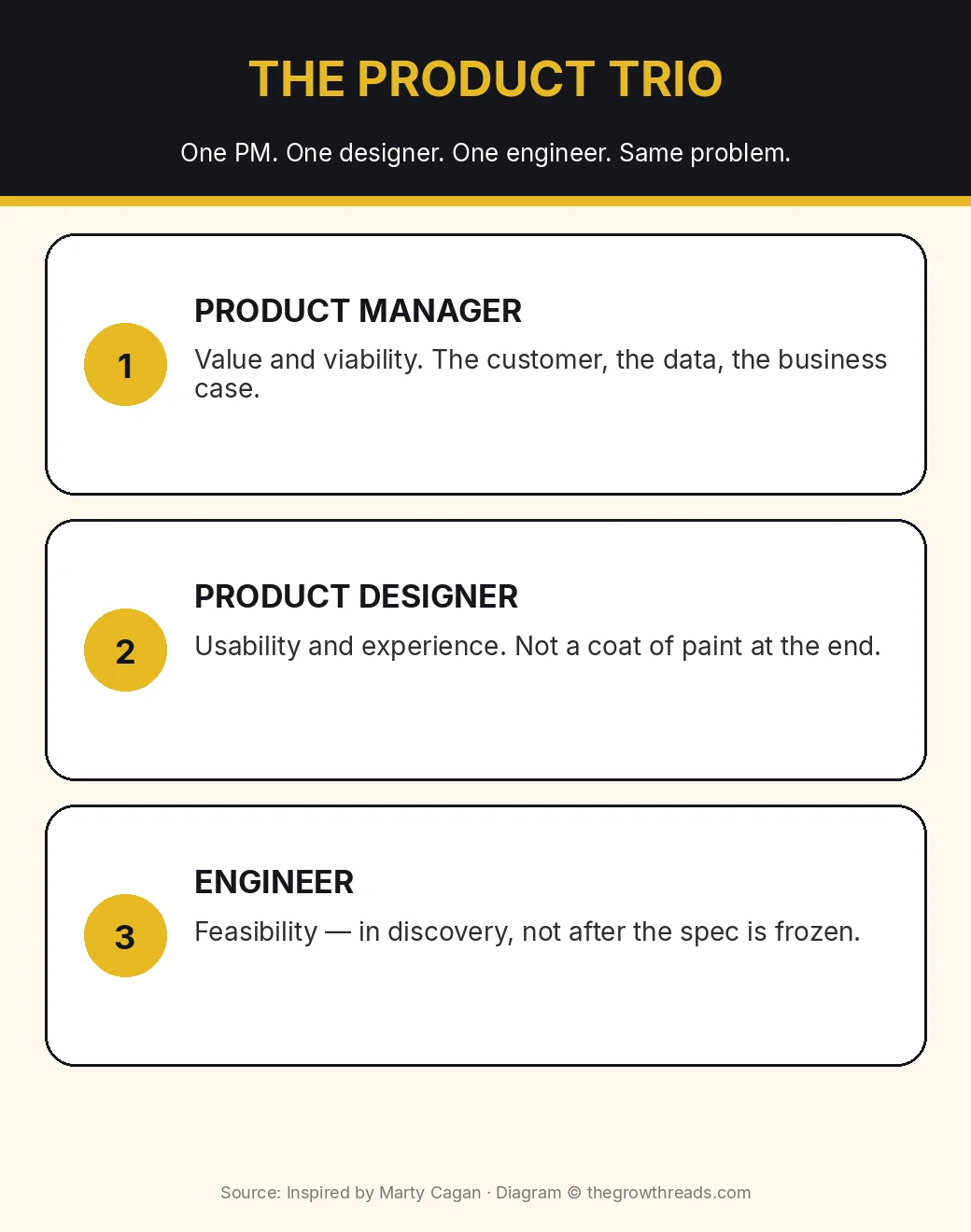
Those three people are the product trio. They share one problem. They do not throw artifacts over walls. Product leaders exist to staff these teams, set vision and strategy, and coach — not to be the source of the next twenty features.
If you cannot name the designer and the engineer on your most important bet, you do not have a product team. You have a queue.
TGR Note: Customer time only helps if people tell you the truth. Rob Fitzpatrick’s The Mom Test is the conversation craft Cagan assumes: ask about their life, not your idea. Lean Startup’s build-measure-learn loop (The Lean Startup, Leadership silo) is the cousin for business-model search.
Part 3: The right process — discovery before delivery
Discovery is the job that happens before you scale delivery. Dual-track does not mean a research department hands insights to a build train. The same trio runs both tracks. Discovery is how you turn the four risks into evidence. Delivery is how you build, harden, and release the thing that survived.
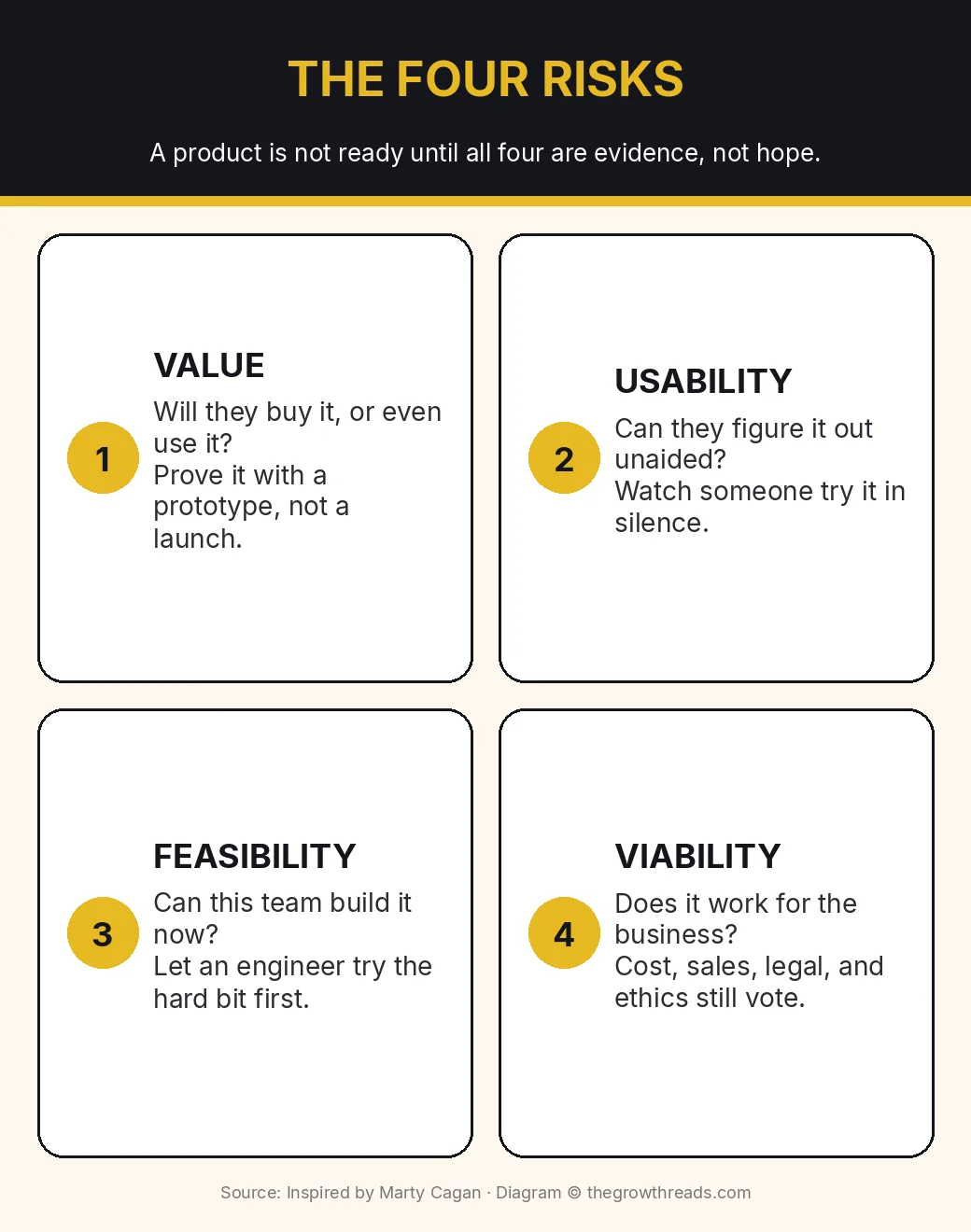
Cagan’s toolkit is deliberately un-glamorous. Interview customers about their lives and work, not about your idea. Prototype something they can react to this week — a user prototype for value and usability, a feasibility prototype for the scary technology, a live-data prototype when fake screens stop teaching you. Test qualitatively until you know why. Use quantitative tests when you need to know how much. Write an opportunity assessment instead of a PRD: what problem, who suffers, how we will measure, why now.
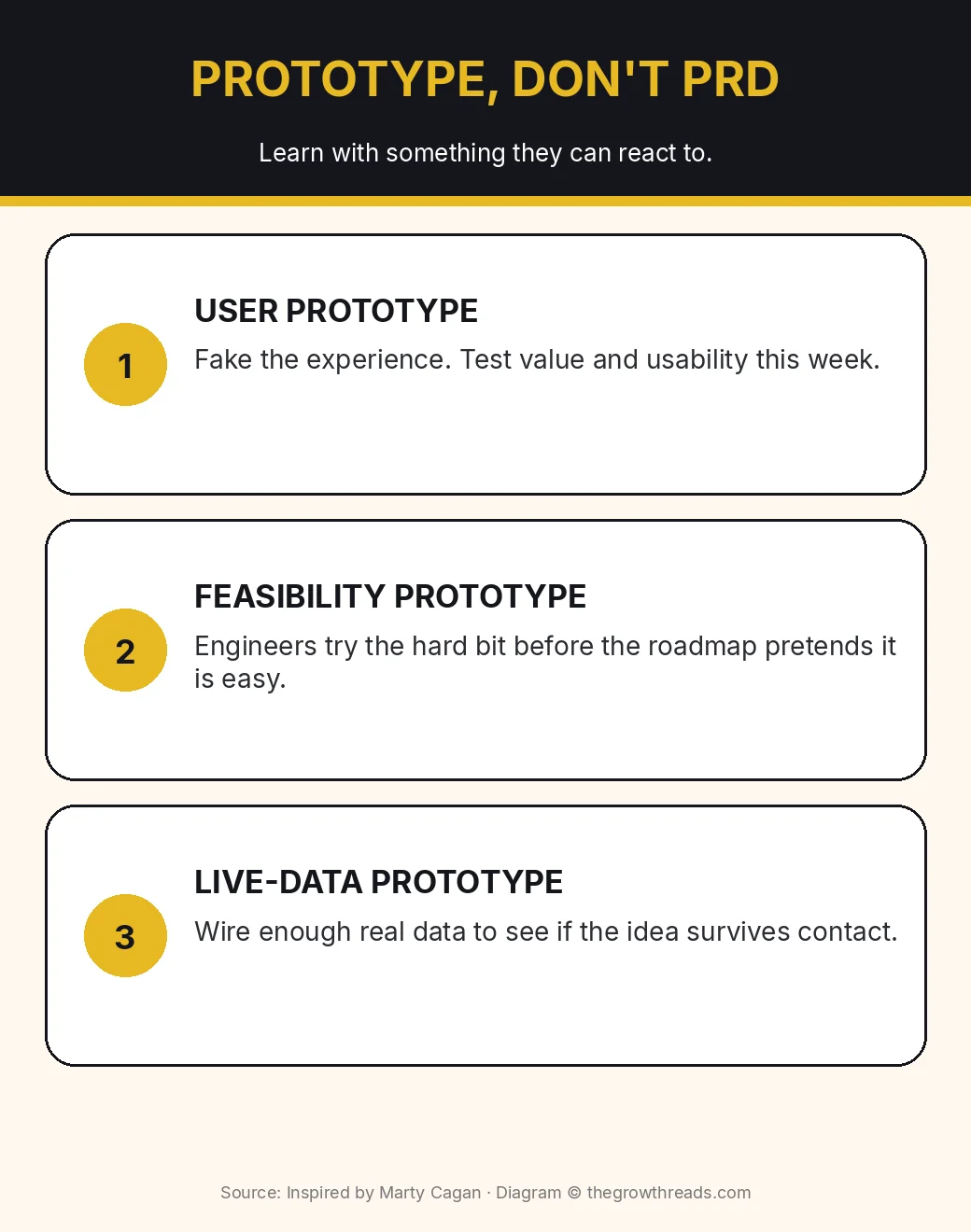
The point of a prototype is to learn, not to impress. A forty-page spec feels like progress and teaches you nothing about value. A clunky prototype in front of three users will embarrass you and save the quarter. When the evidence is in, you either kill the idea, iterate, or make a high-integrity commitment and deliver. That is the whole process. Agile delivery without this front end just helps you build the wrong thing faster.
OKRs show up as a way to keep the team on outcomes: an objective about customer or business change, not a list of features. Product vision (years) and product strategy (the sequencing of bets that could get you there) replace the roadmap-as-solution-list. You still need a way to say no. Discovery is how you earn the no.
TGR Note: If delivery itself is on fire — every release is a heroics story — read The Phoenix Project next, then come back. Discovery cannot save a team that cannot ship a slice. Thinking in Systems helps when the feature factory is a structure, not a mood.
Part 4: The right culture
Culture is what happens when a stakeholder walks in with a solution. In a mercenary culture, the team estimates it and puts it on the sprint. In a missionary culture, the team asks which of the four risks is still a guess, and whether this request is even the customer problem. Cagan wants leaders who protect that question instead of answering it with rank.
He writes about evangelism because a discovered product still has to be sold inside the building — to sales, to execs, to the engineers who were not in the interview. The PM who cannot tell the story will lose to the loudest roadmap. He writes about ethics because “can we?” is not “should we?”: a product that works and harms is a failed product.
Transformation is slow on purpose. You do not announce “we are now empowered” and change nothing about staffing or rewards. You pick a team, give them a problem instead of a feature list, put a designer and an engineer in the customer work, and judge them on outcomes. Then you copy what worked. Inspired is a standard you can use this week, not a reorg-in-a-box.
Who is Inspired best for — and who should read something else first?
Best for: product managers who were promoted from project management and never got the discovery job described; founders who have a build machine and a shrug from users; designers and engineers who want a real seat before the spec freezes; product leaders who keep asking for “more output” and cannot name an outcome.
Read something else first if: your actual blocker is lying customer interviews — start with The Mom Test. If you need a one-week prototype ritual with a decider in the room, start with Sprint. If the team is drowning in scope and needs permission to cut, start with Rework. If the product exists and nobody can say who it is for, This Is Marketing and Building a StoryBrand are the sentence work after discovery, not instead of it. Inspired assumes you work on technology-powered products and can put three people on one problem.
Questions to reflect on
- Of the last five things you shipped, which had a named outcome versus a named output?
- Who is on the trio for your most important bet — and who is actually deciding?
- Which of the four risks is still a guess dressed up as a plan?
- When did an engineer last sit with a customer, not with a ticket?
- What would you kill this week if you were a missionary, not a mercenary?
🔥 Ready to stop shipping features nobody asked for?
Get Inspired, then use the 7-day plan to put discovery in front of delivery.
How to apply Inspired (7-day plan)
- Day 1 — Name the factory. List the last five shipped items. Mark each as output (a feature, a date) or outcome (a change in customer or business behavior). If you cannot mark three as outcomes, you have the book’s diagnosis.
- Day 2 — Pick one bet and write the four risks. Value, usability, feasibility, viability. One sentence each. Star the risk that is still a guess. That is tomorrow’s work.
- Day 3 — Three customer conversations. Use Mom Test rules: their life, not your pitch. Write what you heard that would change the bet.
- Day 4 — A prototype, not a spec. Paper, clickable fake, or a feasibility spike — whichever matches the starred risk. Time-box to a few hours.
- Day 5 — Put an engineer in the room. Review the prototype and the risk together. Ask what they would try before anyone estimates a build.
- Day 6 — Write one outcome objective. A two-week goal that does not contain a feature name. Share it with the trio only.
- Day 7 — Kill or keep. Take one roadmap item that is still a solution-on-a-date. Kill it, convert it to a problem, or make a high-integrity commitment after the evidence. Tell the stakeholder which, and why.
Frequently asked questions
What is Inspired about in one paragraph?
Inspired is Marty Cagan’s field guide to how the best technology product companies actually work. Most teams are staffed to ship output — features on a date. The teams customers love are staffed to discover a product that is valuable, usable, feasible, and viable, then deliver it. Cagan shows you the people (a product manager, designer, and engineer sharing one problem), the process (prototypes and customer evidence instead of a spec-driven roadmap), and the culture (missionaries who will kill a bad idea). The 2017 second edition is the Inspired summary people search for: a working manual, not a memoir of one startup.
Is Inspired still relevant in 2026?
Yes. The stack changed. The failure mode did not. Teams still confuse a board of tickets with product discovery. Faster coding — including model-assisted delivery — makes shipping the wrong thing cheaper, so Cagan’s insistence on evidence before you scale is more useful, not less. The second edition already assumed continuous delivery, dual-track work, and outcome objectives. You will not find a chapter on today’s tooling. You will find the questions that still decide whether a feature is a product: will they use it, can they use it, can we run it, and should we. Read it as a staffing and evidence book.
Inspired vs The Lean Startup — which should I read first?
Read Inspired if you already have a team and a build machine, and the machine keeps shipping things nobody asked for. Cagan is specific about roles, discovery techniques, and how product leaders should coach. Read The Lean Startup if you are still searching for a business model and need the loop of build-measure-learn in its pure form. They rhyme — both hate pretending you know — and they are not substitutes. Lean Startup lives on TGR under Leadership. If your pain is customer conversations that flatter your idea, start with The Mom Test in this silo, then come back to Cagan’s trio.
What is the product trio in Inspired?
The product trio is the smallest unit Cagan trusts: a product manager, a product designer, and an engineer sharing one customer problem. The PM owns value and viability. The designer owns usability and the experience the customer can actually try. The engineer owns feasibility and sits in discovery, not behind a frozen spec. They do not hand documents over a wall. They talk to customers, prototype, and decide together what is worth delivering. If one of the three is missing, you do not have a product team — you have a pipeline. Staffing that trio is the first concrete move, even inside a feature factory.
How is Inspired different from a Scrum or Agile handbook?
Scrum will help you deliver in slices. Inspired is about whether the slice deserves to exist. You can be a high-performing Scrum team and still be a feature factory: the backlog arrived from a stakeholder, the PM administered it, and the sprint succeeded because the tickets closed. Cagan uses delivery — often agile — as the second track. The first track is discovery: prototypes, customer evidence, and the four risks, run by the same trio. If your agile practice has no discovery time, no designer in the customer work, and a roadmap of solutions, Inspired is the missing book. It changes what is allowed onto the board.
Who should read Inspired — and who should start with another book?
Product managers, founders, designers, and engineering leads who suspect they are shipping output will get the most from it. It is especially sharp if you were promoted into PM from project management and nobody explained the discovery job. Start somewhere else if you need interview craft first (The Mom Test), a five-day prototype ritual (Sprint), or permission to build less (Rework). If you do not work on technology-powered products, the examples will feel foreign even when the outcome-versus-output lesson is universal. Pair later Cagan books only after this one is in the team’s vocabulary.
How long does it take to apply Inspired at work?
You can run the 7-day plan on one bet this week: name the outcome, write the four risks, talk to three users, put an engineer in the room, and kill or keep one roadmap item. Changing a company takes longer because it is a staffing and incentive problem, not a workshop. Cagan is honest that empowered is a poster until a team is actually given a problem, a trio, and judgment on results. Use Inspired as a weekly standard on one product, not as an all-hands reorg. If after two weeks you cannot point to a prototype or a killed idea, you did not apply it.
Related summaries
- Sprint — five days to prototype and test the risk Cagan wants evidence for.
- The Mom Test — how to talk to customers without hearing a polite lie.
- Rework — build less while you restaff around outcomes.
- The Phoenix Project — when delivery itself is the constraint.
More in this silo: best productivity books.
How we analyze books: every book on The Growth Reads is read cover to cover, summarized in thousands of words of original analysis, and rated against our five-criteria rubric (lasting impact, evidence quality, practical application, writing & originality, external consensus). Read our full methodology.