

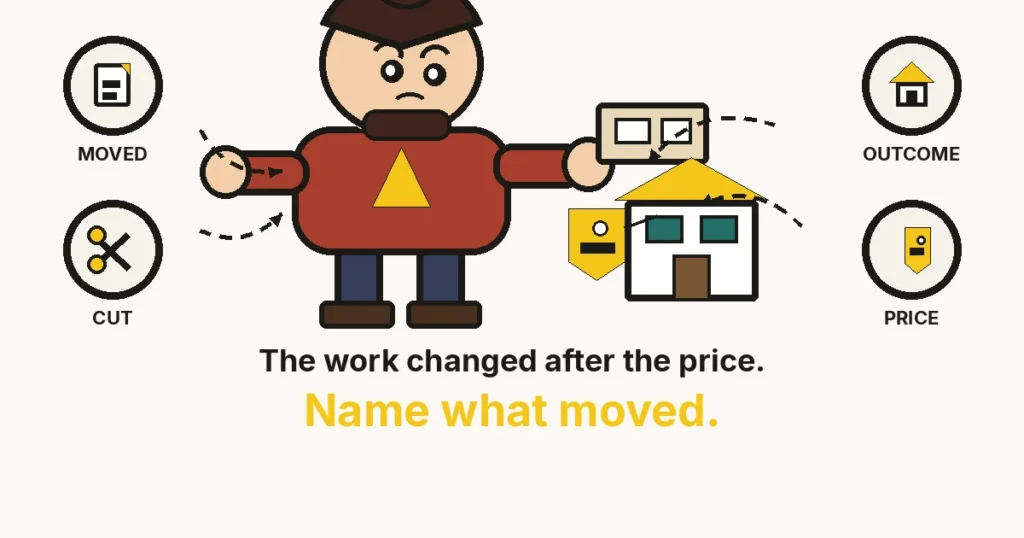
The work changed after the price when the thing in front of you is no longer the result you named. The file is already open. Write what moved. If it still reaches that result, do it inside the price. If it does not, cut it. If the result itself moved, name a new price or finish the original.
Key takeaways
- The work changed after the price when a new thing shows up after the number was named, and the original result stays the job until you sort that thing.
- Jonathan Stark, on 19 June 2021, writes that a value-priced project has no change order, because the price is the client’s desired business outcome, and that the scope of the work will change on any project that lasts.
- In that 2021 piece he writes that the desired business outcome virtually never changes, and that a tactical change halfway through which reaches that outcome faster is work you do inside the price.
- Stark, on 17 October 2020, writes that a request which is unlikely to help the desired outcome is one you leave out, because the distraction puts the project at risk, and that if the outcome held and the work still cost more than you expected, the original price was too low.
- Mike McDerment and Donald Cowper, in the 2013 book Breaking the Time Barrier, have the mentor refuse to haggle: a client who wants to pay less has to choose less delivered. This week’s note names what moved, then sends one of the three replies.
What it means when the work changed after the price
The work changed after the price when a new thing is on the table and the number was already said. You are a solo founder. The proposal went out, the client said yes, and you are in the file. Then they want another page, another room, another report, or a different result from the one in the note. You are a new manager. Someone on your team is already building, and the client, or your own boss, has just widened the job. The price is not still a guess. The price has a name. The work in front of you does not match that name yet, because nobody has said what moved.
This is a different moment from the ask that arrives before you start. That earlier cut sorts what the price already covers from what would be a new result, and it happens while the file is still closed. Here the file is open. People are in it. A new invoice, a quiet yes, or a longer week are the three ways the moment usually ends, and only one of them is a decision. The decision is a sort. Write the result the price bought. Write the new thing. Then send one reply.
Why the work moves after the number is named
The work moves because a project that lasts will not keep the same list of things, and the price was never supposed to be that list. Jonathan Stark, on 19 June 2021, answers the question he says he hears when people start value pricing: do you value-price the change orders too? His answer is that in a value-pricing model there is no such thing as a change order. You are not pricing the deliverables. You are pricing the client’s desired business outcome. He writes that for any project of a non-trivial duration, one thing you can be sure of is that the scope of the work will change. He says that is fine, because the price already allowed for it. The client’s desired business outcome, he writes, will virtually never change during the project.
That split is the whole sort. A deliverable is a thing: a page, a feature, a report, a room. An outcome is a change in the client’s business: fewer failed handoffs, a launch that a buyer can use, a shop that sells. Stark’s 17 October 2020 note makes the same cut with two lists. Blueprints, style guides, and features are things. Lower cost, a clearer reputation, more applicants, and higher satisfaction are changes. Once the change is named, you keep the work pointed at it. A new thing that helps you get there is how you finish. A new thing that does not help is how the week disappears.
Mike McDerment and Donald Cowper, in the 2013 fable Breaking the Time Barrier, put the same idea in a café conversation. The mentor, Karen, says the value of the work is the impact on the client’s business. Clients do not hire her to design a website for its own sake. They hire her to help the business. She asks where the client is now, which she calls point A, and where the client wants to go, which she calls point B. The value is closing that gap. She will not haggle the price. If a client wants to pay less, they have to choose to have less delivered. When the designer in the story asks what happens if a fixed month runs long, she says she does what it takes, that it has happened, and that those months are offset because the fee was not an hour count. She still knows her costs. The fable is a story. It is not a count of how often months run long.
Three replies: inside the price, cut it, or a new price
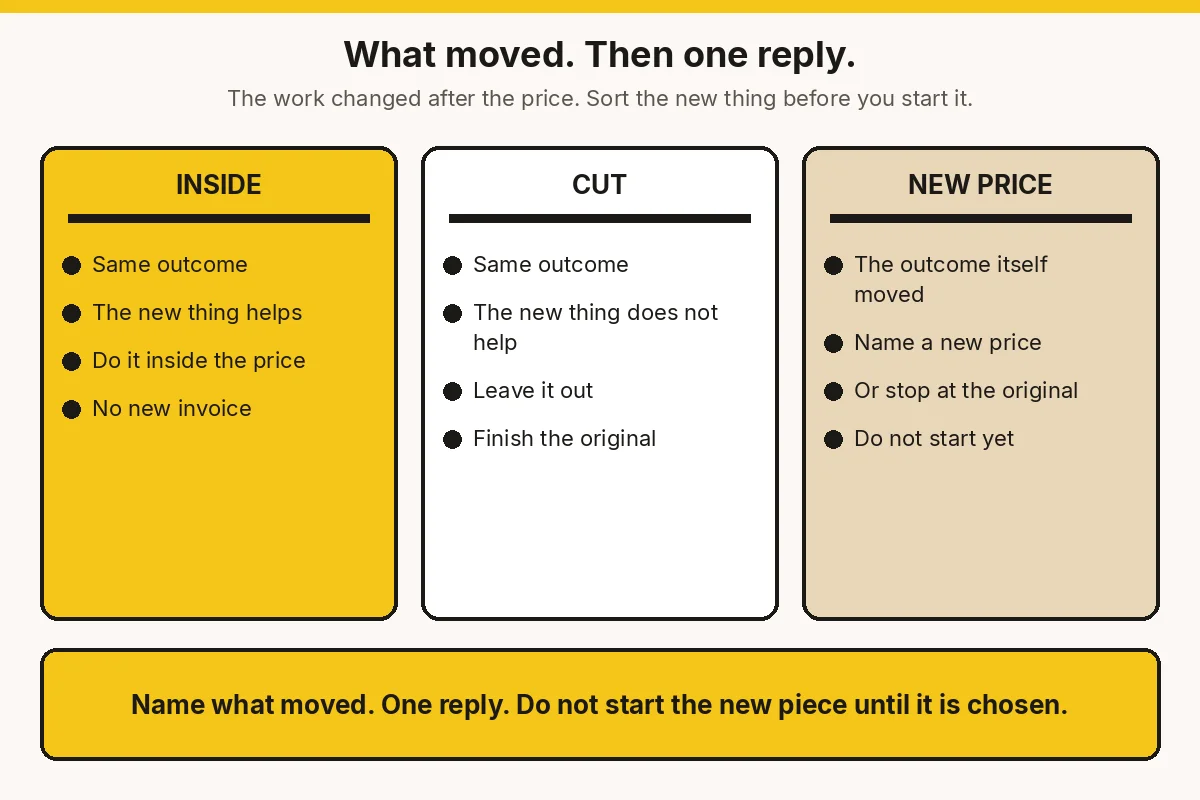
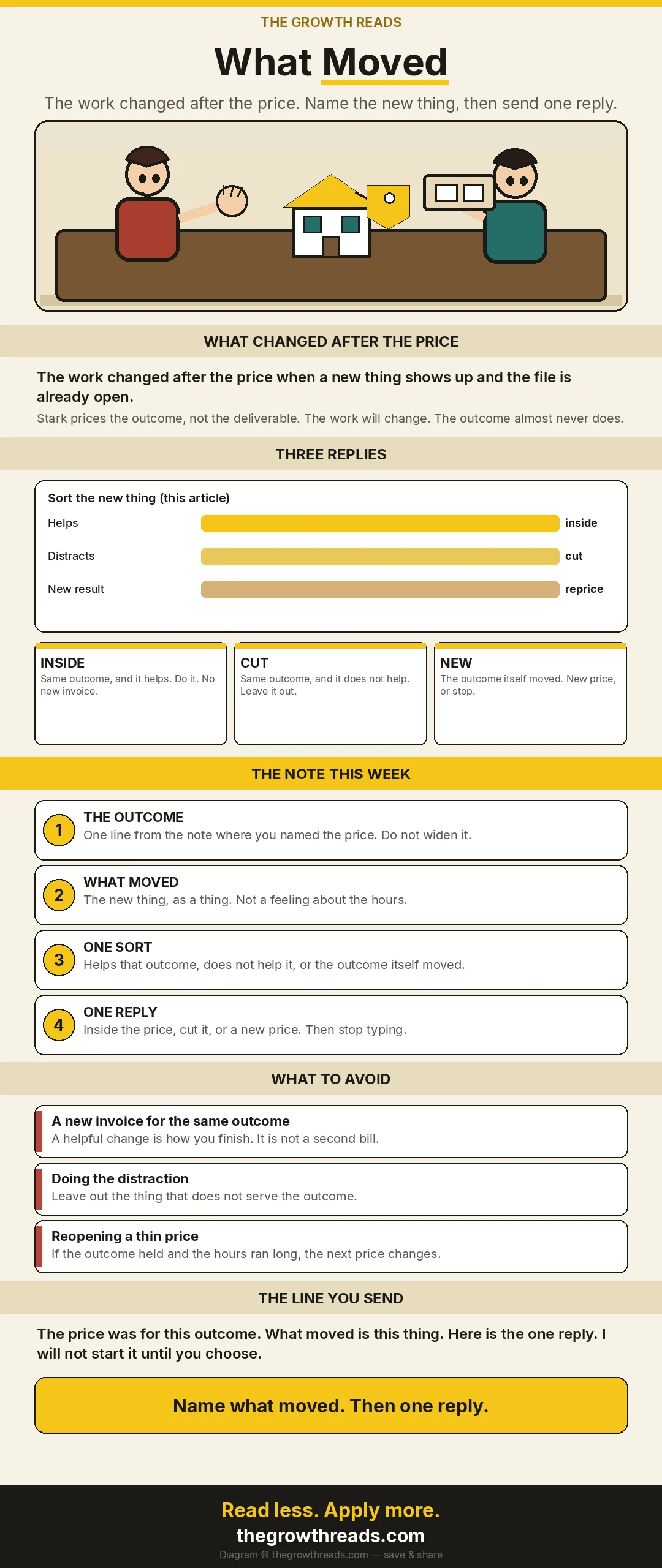
There are three replies, and you send one. Stark’s October 2020 note is the test for the first two. If the client’s request is unlikely to contribute to the desired outcome, you should not do it. He says the reason is not that phrase “it’s out of scope.” The reason is that spending time and money on a distraction puts the success of the project at risk, and leaving it out is in the client’s interest. If the request will likely contribute, you do it, because you can declare the result sooner, and finishing sooner is how that price stays intact. His June 2021 line for the helpful case is blunt: halfway through, a tactical change that gets to the desired outcome more quickly is one you will want to do, inside the price you already named, because it gets you to the finish line faster.
The third reply is the rare one, and both sources say so by what they spend their words on. Stark writes that the desired outcome will virtually never change. The book spends its scene on pricing the impact before the work, and on refusing to lower a number unless less is delivered. A new price belongs only where point B itself is a different result: they no longer want the shop to sell the thing you priced, they want a different business problem solved. A new page on the same shop is not that. A new page is either the first reply or the second.
| Where you are | What moved | The reply | What you do next |
|---|---|---|---|
| The file is open and they want another thing | A thing that still produces the result you priced | Inside the price. No new invoice. | Do the thing. Say that it stays inside the number. Keep the date you already gave, or name the new date in the same note. |
| The file is open and the new thing is a side path | A thing that does not help the result | Cut it. Finish the original. | Leave the thing out. Do not start it while you think. The original result is still the job. |
| They now want a different result | Point B itself. The outcome moved. | A new price, or stop at the original. | Name the new result and the new number, or say you will finish the original and stop. Wait for the choice. |
| The outcome held and the hours ran long | Nothing. The result is the one you priced. The work was heavier. | No new invoice for this job. | Finish it. Stark’s October note says the original price was too low. That fact belongs on the next price, not on a bill for this one. |
The sentence you send
The note names the outcome, names what moved, and gives one reply. The sentences below are this article’s application. They are not a line from Stark and they are not a line from the fable. Fill the brackets from the note where you named the price. Then stop.
If it still reaches the outcome: The price we named was for [the outcome]. What moved is [the thing]. It still gets us there, so I will do it inside the price. I will not send a new invoice.
If it does not help: The price we named was for [the outcome]. What moved is [the thing]. It does not help that outcome, so I will leave it out and finish the original.
If the outcome itself moved: The price we named was for [the original outcome]. What moved is the outcome. It is now [the new outcome]. I can do that for [the new price], or I can finish the original and stop. Which do you want? I will not start the new piece until you say.
One note. One reply. Do not add an apology, a discount on the original number, or a menu of maybes. McDerment and Cowper’s mentor will not haggle: less money means less delivered, and the client chooses. Stark’s reason for leaving a distraction out is the project’s success, so the note can say that in plain words. You do not need a clause number to say it.
How to send the note this week
Do this before you touch the new piece. The list is the application. It is short on purpose.
- Find the note where the price was named. Copy the result from it, in one line. If that note was only a number, write the result you are actually finishing, and say in the reply that the original note did not name it. Do not widen the result so the new thing fits inside it.
- Write what moved, as a thing. A page, a report, a room, a second audience. “They keep adding” is not yet a thing. If you cannot point at it, you are not ready to sort it.
- Mark one of the three. It still produces that result. It does not. Or the result itself is different. If you want to mark two, you have two things, and each one gets its own mark.
- Send the matching sentence. For the first mark, do the work and say it stays inside the price. For the second, leave it out and finish the original. For the third, wait. Do not open the new file while you wait.
- If they do not reply, the original result is still the job. A silence is not a yes to a new outcome, and it is not a reason to invoice a helpful change.
When someone else would just start
You send the note. They can describe what moved. A new manager’s report, or a solo founder’s first contractor, will often say yes in the thread because starting feels helpful. Helpful on a thing that does not serve the outcome is how the price stops meaning anything. Helpful on a thing that does serve it is the first reply, and it still needs the sentence, so nobody sends a fresh invoice for it next week. Give them the one-line outcome and the table before they are on the thread alone. They draft. You send. If they already said yes, you send the sort the same day. A yes that matched the first reply can stand, once you have said it stays inside the price. A yes that started a different outcome does not stand. You name the new price or you stop at the original.
Common mistakes
- A new invoice for a thing that still hits the outcome. Stark’s June 2021 answer is that this is not a change order. You do it because you finish sooner. A second bill for it is the resentment you were trying to avoid.
- Calling a new outcome “small” so you can skip the note. Small is not a sort. The sort is whether point B moved. If it moved, the third sentence is the note. If it did not, small is either inside the price or a cut.
- Reopening this price because the hours ran long. The October 2020 note says that if you kept the client on the outcome and the work still cost more than you expected, the price was too low in the first place. He also says the client might not have agreed to a higher number, and that this is a different problem. Finish this job. Change the next price.
- Haggling the original number down. The book is plain. If they want to pay less, they choose less delivered. A lower number on the same result is a different conversation, and it is not this reply.
- Starting the new piece while you draft. The third reply includes the line that you will not start until they choose. The second reply leaves the thing out. Only the first reply is permission to work, and it is permission because the thing serves the result you already sold.
- Letting a report’s yes become the price. They can name the thing in the client’s words. They do not spend the number. You send the sentence.
What the sources do and do not say
The sources give you the sort. They do not give you the email, and they do not give you a rate. We read the 2013 FreshBooks PDF of Breaking the Time Barrier in full, and we read Stark’s two daily notes in full. We did not read Hourly Billing Is Nuts for this article, so these lines are not credited to that book.
| Source | What it is | What we took | What it does not show |
|---|---|---|---|
| Jonathan Stark, “But what about changes?”, 19 June 2021, jonathanstark.com. | A public note by the author. Read in full. Not a study. | No change order when you price the desired business outcome rather than the deliverables. The scope of the work will change. The outcome virtually never changes. A tactical change halfway through that reaches the outcome faster is work you do inside the price, because you finish sooner. | The three sentences in the script box. A dollar figure. A rule for a job you priced by the hour and now regret. |
| Jonathan Stark, “How do I avoid scope creep on a value priced project?”, 17 October 2020, jonathanstark.com. Question from Jonathan Quaade, shared on that page with permission. | A public reply. Read in full. Not a study. | Things and business changes are different lists. Leave out a request that will not help the outcome, because the distraction puts the project at risk. Do the request that will help, because you finish sooner. If the outcome held and you still feel you are losing money, the original price was too low. Whether the client would have paid twice as much is a different problem. | A percentage to add. Permission to reopen this invoice. A script. |
| Mike McDerment and Donald Cowper, Breaking the Time Barrier, FreshBooks, Toronto, 2013. Official PDF, read in full. | A business fable about pricing the impact instead of the hour. Not a study. | Value is the impact, described as the gap from point A to point B. The mentor will not haggle: less money means the client chooses less delivered. When a fixed month runs long, she does the work inside the fee, and she still tracks costs. The designer’s own income story in the preface is his account of one year. We did not turn it into a rule. | A mid-project email. A fee you should copy. Proof that every long month is offset. The three sentences. |
Limit: Stark is writing to someone who already priced the outcome, and the book is a fable about learning to do that before the work starts. If your number was an hour count, you still sort this ask. A thing that serves the result you are actually finishing stays inside the number you named. A different result gets a new price or a cut. You do not pretend either source contains a surcharge. You also do not use “the outcome virtually never changes” as a reason to call a new result a small tweak. If point B moved, say so.
Frequently asked questions
What do you do when the work changes after you named the price?
Write the result that price bought, in one line, and the new thing beside it. If the thing still produces that result, do it inside the price and say so. Jonathan Stark, on 19 June 2021, treats that helpful change as part of finishing, not as a change order, because the price was the desired outcome. If the thing does not help, leave it out and finish the original. If the result itself is now different, name a new price or stop at the original, and wait. The file being open does not skip the sort.
How do you tell a helpful change from a new outcome?
A helpful change still produces the result you priced. A tighter page, a fix, or a step that gets you there sooner is that case, and Stark’s October 2020 note says you do it so you finish sooner. A new outcome is a different point B from the note where you named the price. Another page can be either, so write both lines before you answer. Ask what would be true when the extra is done, and mark that sentence. If the pricing note never named a result, reconstruct it and do not widen it after the ask arrives.
What sentence do you send when the work has already started?
Name the outcome the price bought, name what moved, and give one reply. If it still reaches that outcome, say you will do it inside the price and will not send a new invoice. If it does not help, say you will leave it out and finish the original. If the outcome itself moved, offer a new price or the original finish, and do not start until they choose. Those sentences are this article’s application. They are not a quotation. Send one. Do not discount the original number in the same note.
Should you invoice the change?
Not when the new thing still reaches the outcome you priced. Stark wrote on 19 June 2021 that there is no change order in that model, because you priced the desired outcome, and a tactical change that gets you there faster stays inside the price. You do name a new price when the outcome itself moved, and you wait before you start. You do not invoice a distraction you should have cut. In the 2013 fable, less money means the client chooses less delivered. The original number does not get haggled down.
What if the work took longer and you feel underpaid?
Finish the result you priced. Stark’s 17 October 2020 reply says that if you stayed on the desired outcome and the work still cost more than you expected, the original price was too low. He adds that the client might not have agreed to twice the number, and that this is a different problem. Use the heavy week when you set the next price. Do not collect the difference on this invoice. In the 2013 fable, a long month is still done inside the fee. That scene is a story, not proof that every long month is offset.
What if the client says the new piece was obviously included?
Go back to the note where the price was named. If that result is what the new piece produces, do it inside the price, with no new invoice. If the result is different, use the third sentence and let them choose a new price or the original finish. If the note was only a number, say so, name the result you are finishing, and sort the piece against that line. Stark’s line that the outcome virtually never changes is a reason to look hard at point B. It is not a reason to treat every new thing as already bought.
What if you are a new manager and your report already said yes?
Send the sort the same day. They can describe what moved. They do not spend the price. If their yes started a thing that still reaches the outcome, let it continue and say it stays inside the price. If it started a distraction, stop that piece and finish the original. If it started a different outcome, send the third sentence and wait. A first hire is the person most likely to say yes in order to be helpful. Give them the one-line outcome before they are on the thread alone.
When do you name a new price?
Name a new price only when the outcome itself moved. Stark wrote on 19 June 2021 that the desired outcome virtually never changes during the work, which is why a new invoice for a helpful tweak is the common mistake. Offer the new price or the original finish, and do not start until they choose. Also change the next job’s price when this one ran long and the outcome held. That second case, from his October 2020 note, is not a bill you send now. The 2013 fable agrees that less money means less delivered. It does not give the number.
Sources
- Stark, J. (2021, June 19). But what about changes? jonathanstark.com. https://jonathanstark.com/daily/20210619-0144-but-what-about-changes. Read in full for this article. The script is not a quotation.
- Stark, J. (2020, October 17). Reader question: “How do I avoid scope creep on a value priced project?” jonathanstark.com. https://jonathanstark.com/daily/20201017-1400-reader-question-how-do-i-avoid-scope-creep-on-a-value-priced-project. Question from Jonathan Quaade, as published there with his permission. Read in full.
- McDerment, M., and Cowper, D. (2013). Breaking the Time Barrier: How to Unlock Your True Earning Potential. FreshBooks, Toronto. Official PDF read in full: https://fbstaticprod-uploads.freshbooks.com/public-website-assets/other/Breaking-the-Time-Barrier.pdf. No page numbers used. The dollar figures inside the fable are the story’s examples, not a fee schedule.
Related reading on The Growth Reads
The decision next to this one
- More than the price — the ask that arrives before the file is open, sorted as in or a change
- The price feels guessy — the number you name before this problem starts
- You are the bottleneck — the reply still goes out from you
Where this sits
How this article was researched
The sort is from two public notes by Jonathan Stark, read in full on 15 November 2026, and from the 2013 FreshBooks PDF of Breaking the Time Barrier by Mike McDerment and Donald Cowper, also read in full. Stark supplies the mid-project test: price the outcome, do the change that reaches it, leave out the distraction, and do not reopen a thin price on this invoice. The book supplies the refusal to haggle and the point-A to point-B description of value. The three sentences are our application for a solo founder or a new manager. We did not add a rate, a percentage, or a study.
Limit: the book is a fable about pricing before the work, and Stark’s notes assume the outcome was priced on purpose. If your number was an hour count, you still honour it for the result you are finishing. You do not pretend either source contains the email.
How we work: every article on The Growth Reads is built from books we have read and from primary accounts we can check, and it is date-stamped when those sources change. Read our methodology.