

⭐⭐⭐⭐ 4.3 / 5
One-liner: A complete, jargon-free system for giving every dollar a purpose — so you stop wondering where your money went.
Best for: Anyone living paycheck to paycheck, new budgeters, and people who have tried budgets before and quit.
Reading time: ~5 hours (256 pages)
Difficulty to apply: Low — the system is designed around real human behavior, not spreadsheet perfection.
You Need a Budget in one minute
Most budgets fail because they treat you like a robot. Jesse Mecham built YNAB around a different idea: your budget should change as fast as your life does. The method runs on four rules — give every dollar a job, prepare for large expenses by breaking them into monthly chunks, adjust freely when reality shifts, and gradually increase the age of your money until you are spending dollars that are at least thirty days old. Together, the rules replace the paycheck-to-paycheck treadmill with a system that absorbs surprises instead of breaking under them. Mecham is not offering a get-rich-quick playbook; he is offering a daily practice that turns financial chaos into financial calm.
Key takeaways
- Give every dollar a job: When income arrives, assign each dollar to a specific category before it can be spent mindlessly. Unassigned money disappears.
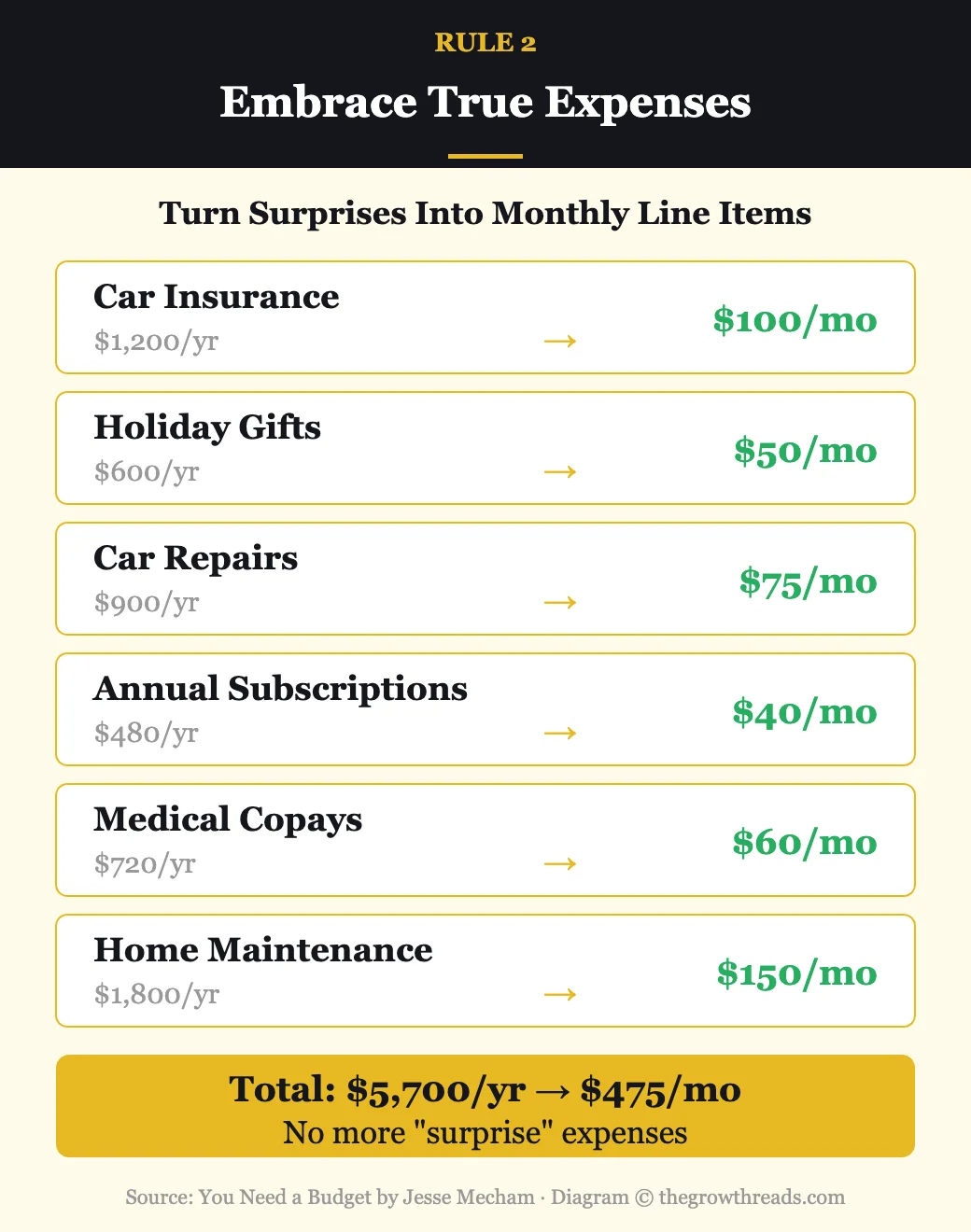
- Embrace your true expenses: Annual and irregular bills — insurance, car repairs, holidays — are not surprises. Divide them by twelve and fund a monthly bucket.
- Roll with the punches: Overspending in one category is not failure; it is a signal to move money from a lower-priority category and keep going.
- Age your money: The ultimate metric is the gap between earning and spending. When your dollars sit for thirty or more days, the paycheck cycle is broken.
- Budgets are living documents: A budget you never change is a budget you abandon. Frequent, guilt-free adjustments are the engine of the system.
- Prioritize clarity over complexity: You do not need dozens of accounts or apps. One clear spending plan outperforms elaborate but ignored spreadsheets.
- Debt is a priority problem: Mecham treats debt as a line item inside the same four-rule framework, not as a separate emergency requiring shame or panic.
- Financial stress is a behavior problem: The gap between income and spending is less important than the gap between intention and action.
- Start from where you are: The method works regardless of income level because it focuses on directing whatever money exists right now.
- Money is a tool for your priorities: The real point of budgeting is not restriction — it is making sure your spending reflects what actually matters to you.
What is You Need a Budget about?
You Need a Budget is a personal finance guide built around four rules that teach you to assign every dollar a purpose, prepare for irregular expenses, adjust your plan without guilt, and increase the age of your money until you are no longer living paycheck to paycheck. The method replaces rigid spreadsheets with a flexible, behavior-first system.
About the author
Jesse Mecham started budgeting out of necessity. As a newly married college student with no steady income, he and his wife Julie needed every dollar accounted for just to make rent. That kitchen-table budget eventually became YNAB (You Need A Budget), first a spreadsheet he shared online, then a software company that now serves millions of users worldwide. Mecham has no background in Wall Street or financial planning — his authority comes from two decades of teaching real people to manage real money. He hosts the YNAB podcast and has been featured in The New York Times, Forbes, and NPR. His approach is practical, conversational, and unapologetically focused on behavior over theory. Explore all Jesse Mecham book summaries →
Key concepts at a glance
| Concept | What it means | Use it when |
|---|---|---|
| Give Every Dollar a Job | Zero-based budgeting — allocate all available cash to categories | Income arrives or you receive any windfall |
| Embrace True Expenses | Convert annual or irregular costs into monthly line items | Setting up your budget or adding a new large expense |
| Roll with the Punches | Move money between categories when plans change | You overspend in groceries, gifts, or any category |
| Age Your Money | Increase the days between earning and spending | You want to break the paycheck-to-paycheck cycle |
| Rule One Mindset | Ask “what does this money need to do before more arrives?” | Making any spending or saving decision |
| WAM (Whack-A-Mole) | Frequent, guilt-free budget reshuffling | Life throws a curveball at your original plan |
| Buffer Building | Gradually saving until you budget with last month’s income | You want to eliminate paycheck timing stress |
| Debt as a Category | Treat debt payoff as a budget line, not a separate system | You carry credit card, student loan, or car debt |
Part 1 — The method: four rules that change everything
Mecham opens with a confession: traditional budgets are punishment disguised as planning. They work backward from what you spent last month and try to cap future behavior. His system works forward — it starts with the money you have right now and asks a single question: what does this money need to do before more arrives?
Rule One, Give Every Dollar a Job, is zero-based budgeting stripped of the jargon. When your paycheck lands, every dollar gets assigned to a category — rent, groceries, electric bill, date night, savings. Unassigned dollars are the enemy; they evaporate into vending machines and impulse buys. The key insight is that you only budget money you actually possess, not money you expect to earn later. This forces you to make priority decisions with real numbers rather than optimistic forecasts.
Rule Two, Embrace Your True Expenses, tackles the expenses that wreck most budgets: car insurance every six months, holiday gifts in December, the veterinary bill nobody plans for. Mecham argues these are not emergencies — they are perfectly predictable costs people refuse to predict. The fix is simple arithmetic: divide the annual cost by twelve and set that amount aside monthly. When December arrives, the gift money is already sitting in its category.
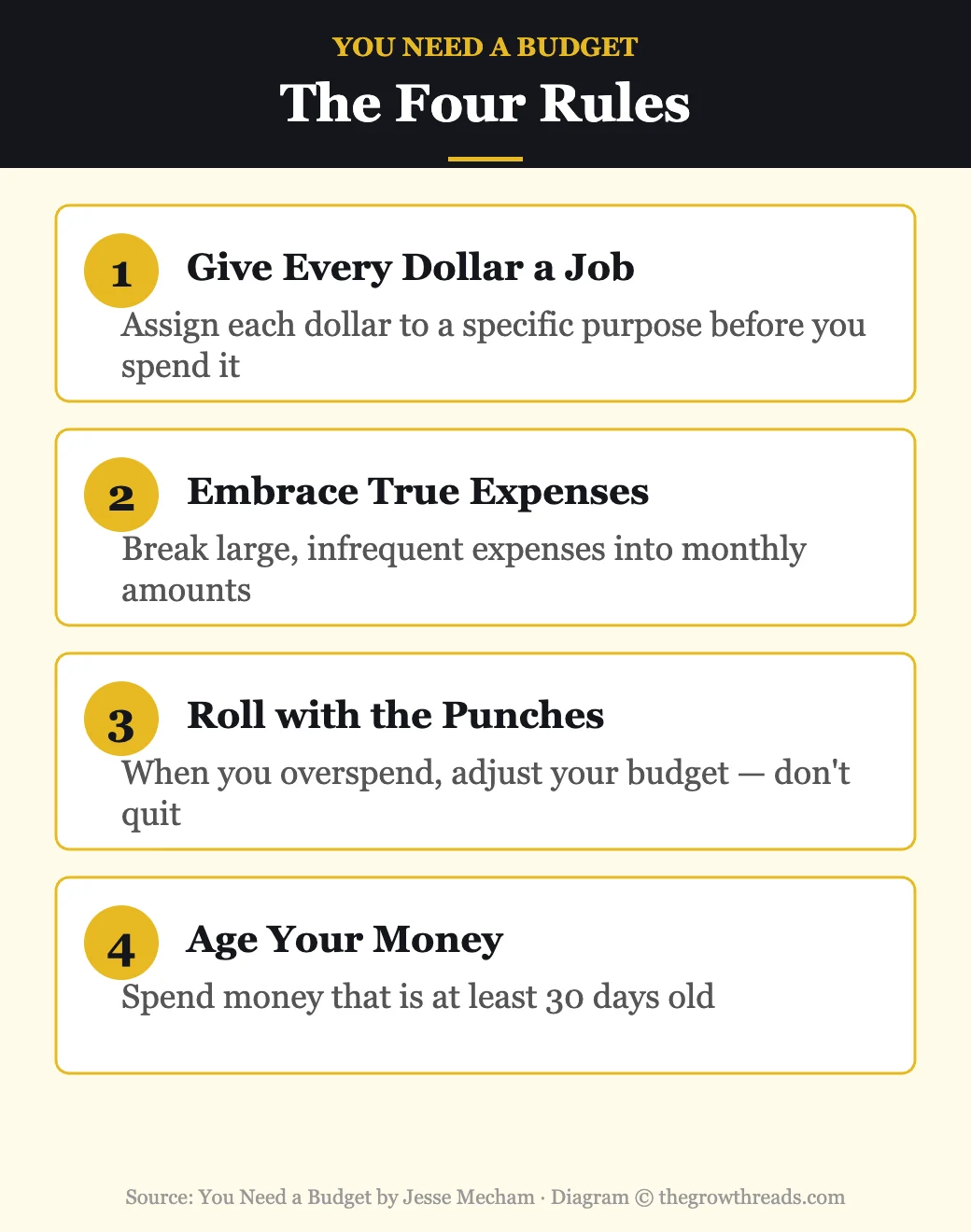
Rule Three, Roll with the Punches, is what separates YNAB from diets that end with a single cheat meal. When you overspend on groceries, you do not spiral into guilt — you simply move money from another category. Maybe the clothing budget absorbs it, maybe dining out gives up twenty dollars. The budget bends instead of breaking. Mecham compares rigid budgets to rigid diets: one slip and the whole thing collapses. YNAB is designed to survive daily reality.
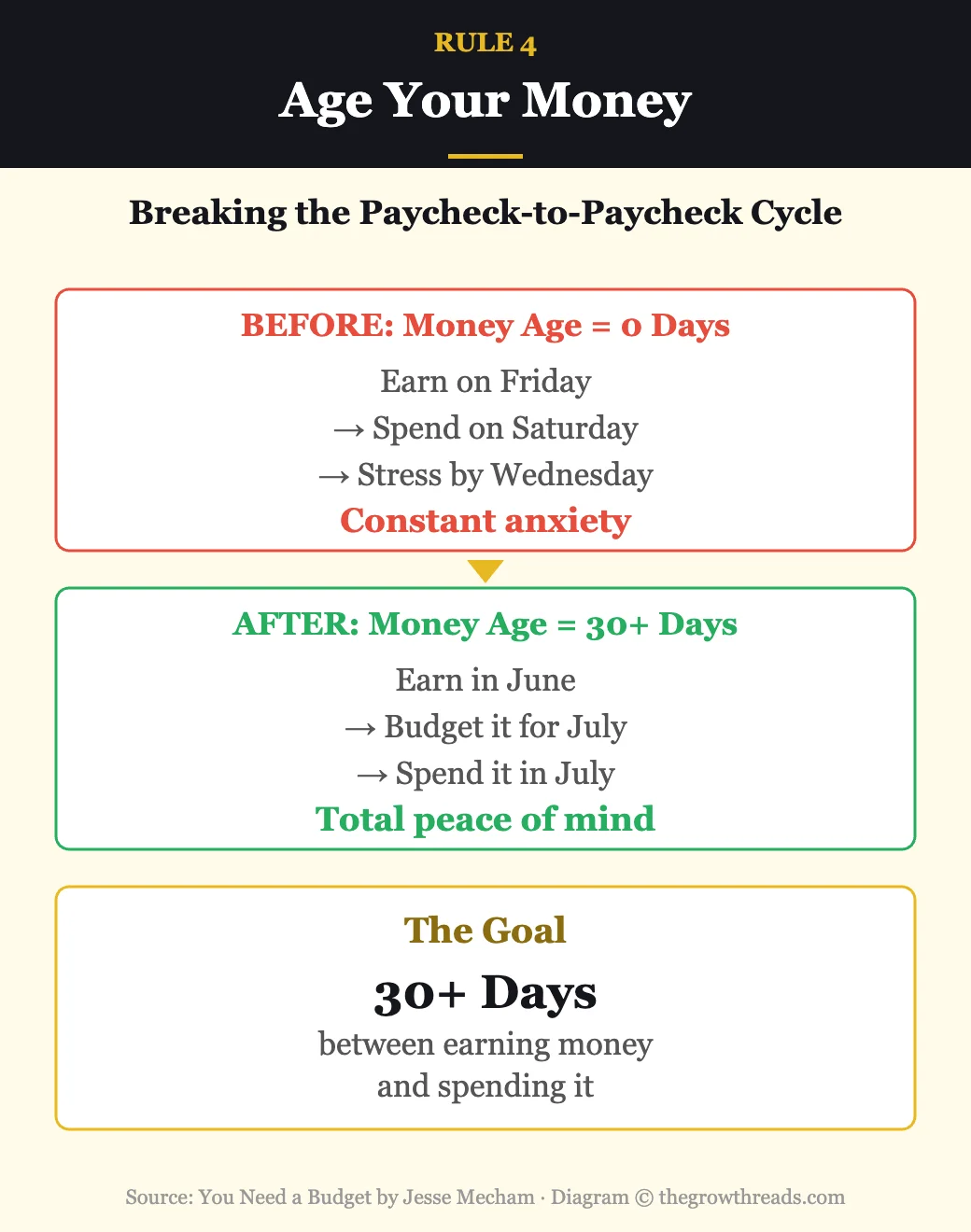
Rule Four, Age Your Money, introduces the system’s ultimate scoreboard. Instead of tracking net worth or savings rate, YNAB tracks how many days pass between when you earn a dollar and when you spend it. A money age of zero means you are spending today’s paycheck today — classic paycheck-to-paycheck living. An age of thirty or more means you are spending last month’s income to cover this month’s bills. The paycheck cycle is broken, and financial stress drops dramatically.
Part 2 — Living on last month’s income
The middle section of the book turns theory into practice. Mecham walks through how to build a buffer — the pool of money that lets you budget with last month’s income instead of this week’s paycheck. He does not prescribe a fixed timeline. Some readers build a full month’s buffer in ninety days; others take a year. The speed matters less than the direction.
The buffer-building process is deceptively simple. Each time you budget, look for any category with leftover money at the end of the month. Instead of spending it or leaving it unassigned, move it into a “buffer” or “next month” category. Over time, that category grows until it covers an entire month of expenses. Once it does, you flip: at the start of each month, you budget using money earned in the previous month. Income timing becomes irrelevant because the money is already waiting.
Mecham dedicates significant attention to the emotional side of this transition. He describes the “scarcity mindset” that makes people hoard cash in savings accounts while carrying credit card debt at 22% interest. He talks about couples who fight over money not because they disagree on priorities but because they have never articulated their priorities clearly enough to budget for them. The four rules, he argues, are less a financial tool than a communication framework. When both partners can see where every dollar is assigned, the arguments about spending disappear — replaced by collaborative priority-setting.
Part 3 — Dealing with debt, goals, and real life
Mecham resists treating debt as a hair-on-fire emergency that requires its own separate system. Instead, debt gets a category inside the same budget as groceries and rent. You decide how much of each paycheck goes toward debt repayment, and that amount competes for priority alongside everything else. The psychological benefit is significant: debt stops being an overwhelming, shapeless monster and becomes a manageable line item with a clear payoff trajectory.
He addresses the avalanche-versus-snowball debate briefly — pay highest interest first for math, smallest balance first for motivation — but his real contribution is reframing the question. Under the YNAB system, the method matters less than the consistency. Because every dollar is already assigned, there is no “extra” money lying around to tempt you. Debt payments happen automatically as part of the budget, not as heroic acts of willpower.
The book’s strongest practical chapters cover goal-setting and life transitions. Mecham walks readers through budgeting for a career change, a new baby, a cross-country move, and irregular freelance income. In each case, the four rules apply without modification — the framework is flexible enough to handle wildly different financial realities. He uses real stories from YNAB users (anonymized but detailed) to illustrate how people at every income level — from $24,000 to $200,000 — have used the system to eliminate financial stress.
Part 4 — The mindset shift: from scarcity to clarity
The final section is where Mecham gets philosophical. He argues that most people’s relationship with money is governed by either guilt or ignorance — they feel bad about spending or they avoid looking at the numbers entirely. The YNAB method replaces both with intentionality. When you consciously choose to spend forty dollars on a nice dinner, there is no guilt because the money was allocated for exactly that purpose. When you choose not to buy something, there is no deprivation because you can see what that money is doing instead.
Mecham introduces the concept of “financial first aid” for people who are deep in crisis. He outlines a triage process: list the absolute minimum you need to survive this month (rent, food, utilities, minimum debt payments), budget only for those, and then add categories one at a time as income allows. It is a compassionate approach that acknowledges reality — sometimes you cannot fund everything, and that is not failure; it is math. The four rules still apply; they just operate on a smaller set of categories until the situation stabilizes.
He closes with a vision of what financial clarity looks like on the other side. It is not luxury or early retirement (though those may follow). It is the absence of money-related anxiety — knowing that every bill is covered, every irregular expense is funded, and your spending reflects your actual values. For Mecham, that peace of mind is the real product YNAB delivers.
Who is You Need a Budget best for — and who should read something else first?
This book is ideal for people who have never had a budget that stuck, anyone currently living paycheck to paycheck, and couples who want a shared framework for money conversations. It is particularly effective for people with irregular income — freelancers, commission earners, gig workers — because the system budgets only money you already have, not money you expect.
If you are already past the budgeting phase and want guidance on investing, start with The Simple Path to Wealth or The Little Book of Common Sense Investing. If your challenge is less about budgeting mechanics and more about your emotional relationship with money, The Psychology of Money may be a better starting point.
Questions to reflect on
- If you had to assign every dollar in your checking account to a category right now, which categories would you fund first — and what does that reveal about your real priorities?
- What recurring “surprise” expense has caught you off guard in the last year, and what would it look like as a monthly line item?
- How old is your money right now — are you spending this week’s paycheck or last month’s income?
- When was the last time you overspent on something and felt guilty about it — and what would it have felt like to simply adjust your budget instead?
- What is one financial goal you have been postponing because it does not feel urgent, and how much would you need to set aside monthly to fund it?
🔥 Ready to give every dollar a purpose?
Start the system that has helped millions break the paycheck-to-paycheck cycle.
How to apply You Need a Budget (7-day plan)
- Day 1 — List your categories: Write down every expense you can think of — fixed bills, variable spending, savings goals, debt payments. Group them into 10–15 categories.
- Day 2 — Budget only what you have: Look at your current bank balance. Assign every dollar to a category, starting with the most urgent (rent, food, utilities). Stop when the money runs out.
- Day 3 — Identify your true expenses: List every annual, semi-annual, or quarterly bill (insurance, subscriptions, car registration). Divide each by twelve and add those monthly amounts as categories.
- Day 4 — Spend and record: Go about your day normally, but check each purchase against its category. If the category is empty, move money from a less important one — do not stop budgeting.
- Day 5 — Roll with reality: Review your budget so far. Where did you overspend? Move money between categories without guilt. The goal is an accurate plan, not a perfect one.
- Day 6 — Calculate your money age: Find the oldest transaction in your checking account that you have not yet spent. The gap between that deposit date and today is your money’s age. Write it down as your baseline.
- Day 7 — Set your buffer target: Calculate one month of essential expenses. That number is your buffer goal. Identify one category where you can trim $50–100 this month and redirect it toward the buffer.
Frequently asked questions
Is You Need a Budget only useful if you use the YNAB software?
No. The book teaches a method, not a software product. You can implement all four rules with a spreadsheet, a notebook, or any budgeting app. The YNAB software automates the process and provides features like automatic bank imports and money-age tracking, but the principles work independently of any specific tool. Mecham developed the rules years before the software existed, using nothing more than a basic spreadsheet.
How is YNAB different from traditional budgeting?
Traditional budgets project future income and set spending caps based on past behavior. YNAB only budgets money you currently possess, which eliminates the gap between plan and reality. It also encourages frequent adjustments — moving money between categories is a feature, not a failure. This makes the system resilient to the unpredictability of real life, whereas traditional budgets tend to collapse after the first overspend.
What does “age your money” actually mean?
Money age measures the number of days between when you earn a dollar and when you spend it. If you deposit your paycheck on Friday and spend it by Monday, your money age is three days. The YNAB goal is to increase that age to thirty days or more, meaning you are spending last month’s income to cover this month’s bills. At that point, the timing of your paycheck no longer matters and financial stress drops significantly.
Can YNAB work for irregular or freelance income?
YNAB is especially effective for irregular income because Rule One — budget only the money you have — eliminates the need to forecast. When a freelance payment arrives, you assign those dollars to your highest-priority categories. If another payment comes a week later, you budget that too. You never plan with money that has not yet arrived, which removes the anxiety of unpredictable pay cycles.
How long does it take to build a one-month buffer?
It depends on your income, expenses, and how aggressively you redirect surplus money. Some YNAB users build a full buffer in three to four months by cutting discretionary spending temporarily. Others take six to twelve months with smaller monthly contributions. Mecham emphasizes that the timeline matters less than the consistency — even small monthly buffer contributions compound the habit of intentional spending.
Does YNAB address investing and long-term wealth building?
The book focuses primarily on budgeting, cash flow management, and debt elimination rather than investment strategy. Mecham mentions retirement contributions and savings goals as budget categories, but he does not cover asset allocation, index funds, or portfolio construction. Once you have mastered the YNAB system and built your buffer, books like The Simple Path to Wealth or The Little Book of Common Sense Investing are natural next steps for the investing phase.
Is this book relevant if I already have a high income?
Yes. Mecham shares stories of high earners — households making $150,000 to $200,000 — who still live paycheck to paycheck because spending expands to match income. The YNAB system is income-agnostic; it works by creating intentionality around spending, regardless of whether you earn $30,000 or $300,000. High earners often find the method particularly eye-opening because it reveals how much money disappears into unexamined categories.
Related summaries
- The Psychology of Money — why your behavior with money matters more than your knowledge
- The Latte Factor — how small daily spending choices compound into wealth or poverty
- Profit First — the same allocation-at-receipt principle applied to business finances
- Broke Millennial — a practical money guide for the generation just starting out
Best Money Books — The Full TGR List