

★★★★★ 4.6/5 — A refreshingly forgiving decluttering method for people who’ve failed at every organizing system.
Best for: chronically messy households and anyone who’s bought bins and labels without actually reducing what they own.
Reading time: ~3.5 hrs to read · ~20 min to skim this guide
Difficulty to apply: Easy — small daily sessions, no special tools or big blocks of time required.
Decluttering at the Speed of Life in one minute
You can’t organize your way out of too much stuff — decluttering has to come first, and it works best in small, imperfect, repeatable sessions rather than one heroic weekend purge. Dana K. White writes as a self-described reformed “slob” rather than a professional organizer, and that experiential voice shapes the whole book: instead of promising a perfect system, she offers a set of simple questions and rules of thumb that work even on a bad day, in a messy house, with no time to spare. Her central argument is that most organizing advice fails because it assumes the volume problem is already solved — buy the right bins, add the right labels, and the clutter will behave. White flips that order. The container you already have — the shelf, the closet, the room — should set the limit on what you keep, and everything beyond that limit has to go, no matter how it’s stored. The book walks through how to apply that idea room by room, how to make quick decisions about ambiguous items, and how to handle the sentimental clutter that stops most people cold.
Key takeaways
- Decluttering comes before organizing: bins and labels applied to excess volume just produce neatly organized clutter, not less clutter.
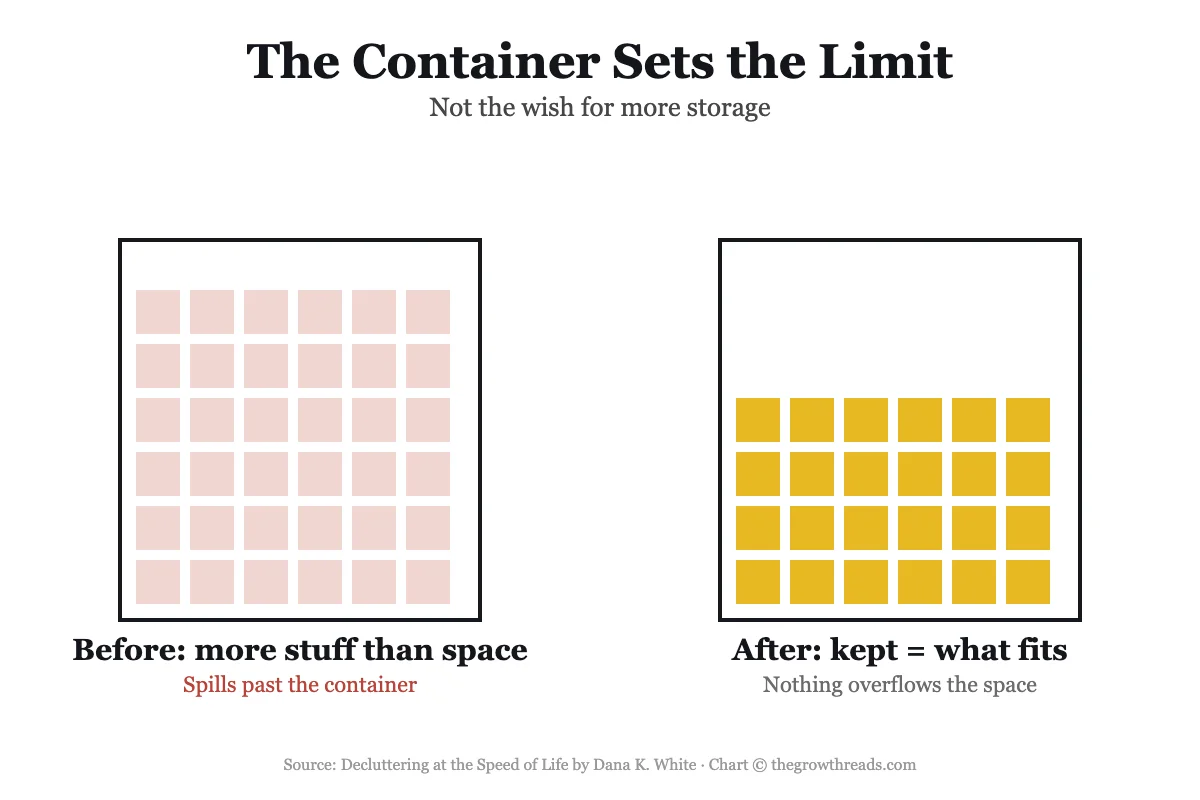
- The Container Concept sets the ceiling: whatever space you have — shelf, drawer, closet, room — is the limit; don’t buy more storage to fit more stuff.
- Ask the Two Questions on anything ambiguous: where would I look for this if I needed it, and would it occur to me that I already own one?
- Start with what’s visible: declutter the rooms you and others see daily before hidden storage — visible progress sustains motivation.
- Watch for “procrasticlutter”: items kept under the illusion you’ll deal with them “someday” — most someday tasks never happen.
- Keep a running donate box: low-friction, ongoing donation beats sorting every item for resale value.
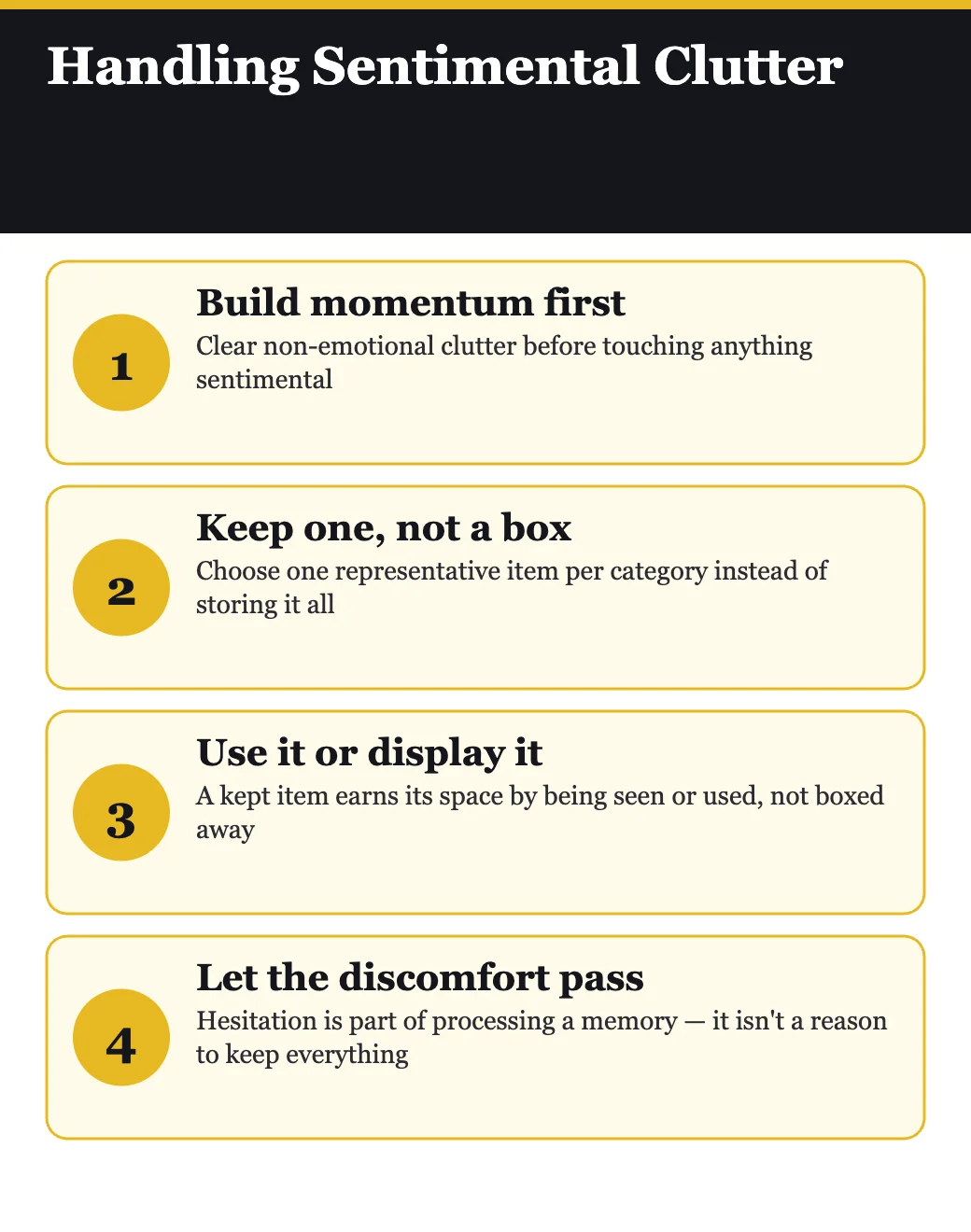
- Build momentum on non-emotional clutter first: tackle the easy, unsentimental stuff before touching anything with memories attached.
- For sentimental items, keep one, not a box: a single representative piece, used or displayed, honors the memory better than a stored container.
- Treat decluttering as an ongoing habit, not a finished project: the goal is a repeatable rhythm, not a permanent, perfect state.
What is Decluttering at the Speed of Life about?
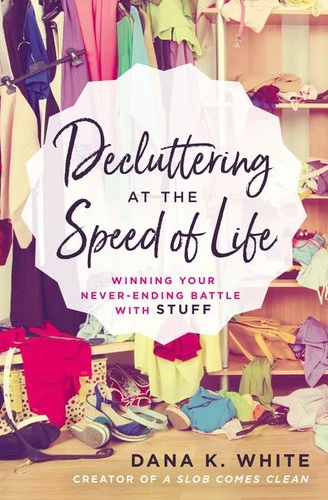
Dana K. White’s Decluttering at the Speed of Life argues that organizing systems fail without first reducing volume, and offers a practical, forgiving method — the Container Concept and two simple decision-making questions — for cutting clutter in small, repeatable sessions rather than one overwhelming purge.
About the author
Dana K. White is not a professional organizer by training — she describes herself as a reformed “slob” who spent years buried in clutter before working out, through trial and error in her own home, the principles that make up this book. She writes the long-running blog “A Slob Comes Clean,” where she’s documented her decluttering process since 2009, and hosts a podcast of the same name. That experiential, non-expert framing is part of her appeal: her advice reads less like a professional organizer’s rulebook and more like tested notes from someone who struggled with the exact same overwhelm her readers feel. That framing also shapes the tone throughout the book — she’s candid about her own past failed attempts, half-finished decluttering projects, and the years it took to arrive at a system simple enough to actually maintain, which makes the advice feel earned rather than theoretical. Decluttering at the Speed of Life, published in 2018 by Thomas Nelson, was her first traditionally published book and remains her most widely read, building directly on the Container Concept and decision-making questions she first developed and tested with her blog readers. Explore all Dana K. White book summaries →
Key concepts at a glance
| Concept | What it means | Use it when |
|---|---|---|
| The Container Concept | The space you have — not a wish for more storage — sets the limit on what you keep | You keep buying bins but the clutter never actually shrinks |
| The Two Questions | Where would I look for this, and would it occur to me I already own one? | You’re stuck deciding whether to keep an ambiguous item |
| Visibility rule | Declutter seen spaces before hidden ones, since visible progress sustains motivation | Deciding which room to start in |
| Procrasticlutter | Items kept under the illusion you’ll deal with them “someday” | You find a stash of “I’ll fix/finish/use this later” items |
| Running donate box | A perpetual, low-friction box for anything you’re releasing, no sorting required | You’ve been putting off donating because sorting feels like a project |
| One-item rule | Keep a single representative item per sentimental category instead of a whole box | Deciding what to do with memory-heavy belongings |
Part 1: Why organizing isn’t the answer
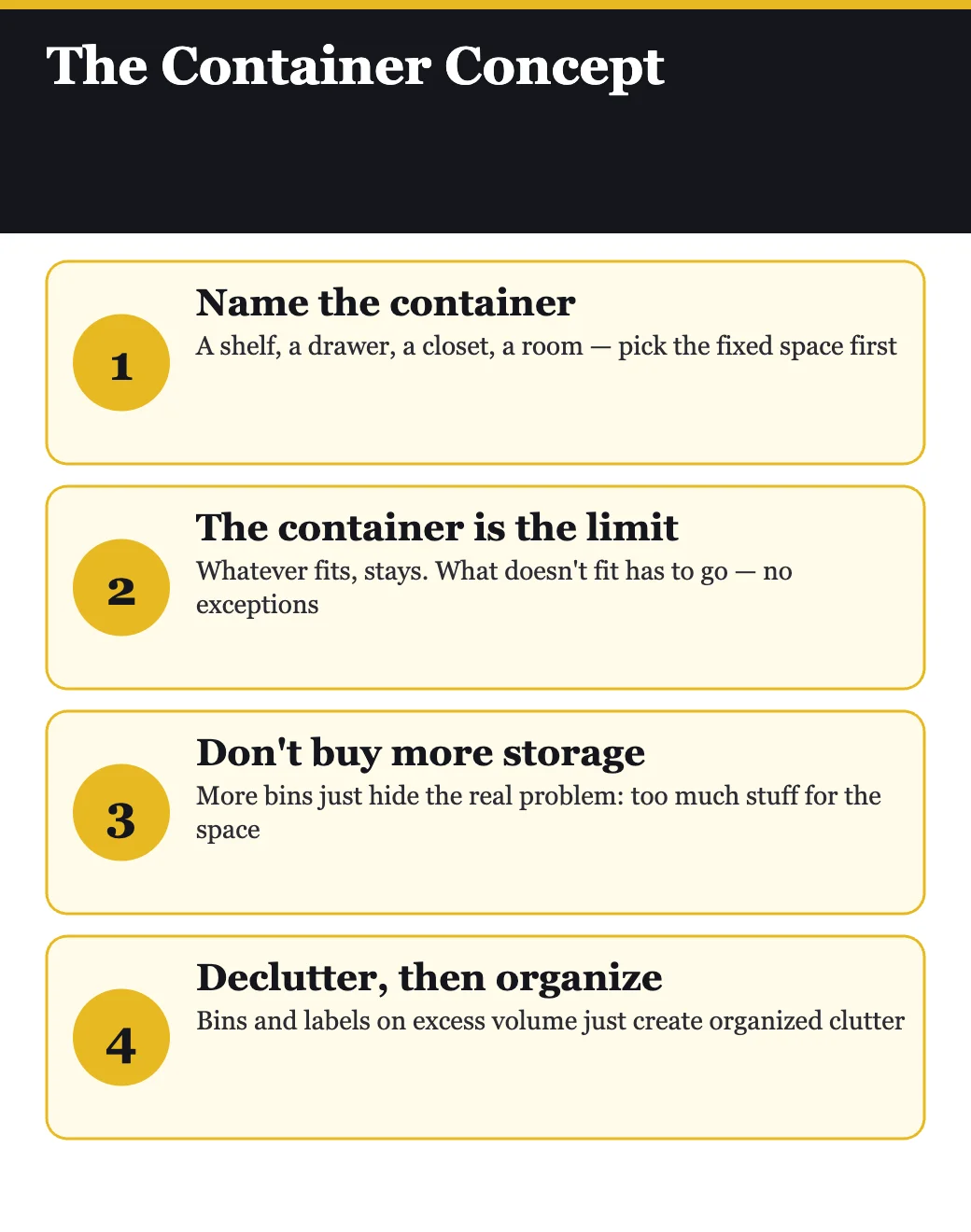
White opens by naming a problem most decluttering advice ignores: organizing without first reducing volume just produces organized clutter. A labeled bin full of things you don’t need is still clutter — it’s simply tidier clutter. Her fix is what she calls the Container Concept: every space you have, whether it’s a kitchen drawer, a bookshelf, a closet, or an entire garage, is a fixed-capacity container, and the container itself — not a wish for more storage — should dictate how much you’re allowed to keep in it. If it doesn’t fit, something has to leave, rather than triggering a trip to buy another bin.
This reframing does real work because it removes an endless, exhausting question — “do I have room for this?” — and replaces it with a fixed, visible boundary. You don’t need to negotiate with yourself about whether you might need more shelves someday; the shelf you have is the shelf you have. This is a small but important shift in framing: most people experience clutter decisions as an argument with an uncertain future (“what if I need this someday, in some hypothetical situation”), and that kind of argument can be won by almost any object, since almost anything is conceivably useful someday. The Container Concept short-circuits that argument by making the relevant question concrete and present-tense — does this fit in the space I actually have, right now — rather than open-ended and hypothetical. White applies this consistently across the book, from kitchen cabinets to closets to entire rooms, treating “buy more storage” as a red flag that usually means the real decluttering step is being avoided.
She’s also candid that this approach doesn’t require big blocks of uninterrupted time, which she identifies as one of the most common reasons people never start. Waiting for a free Saturday to “really tackle” a room means the clutter usually just accumulates until the next imagined free weekend. Instead, she pitches decluttering as something that fits into small pockets of ordinary life — five minutes here, one drawer there — which is part of what the book’s title is getting at: decluttering has to move at the actual speed of a busy life, not the speed of an idealized one.
Part 2: The two questions that cut through indecision
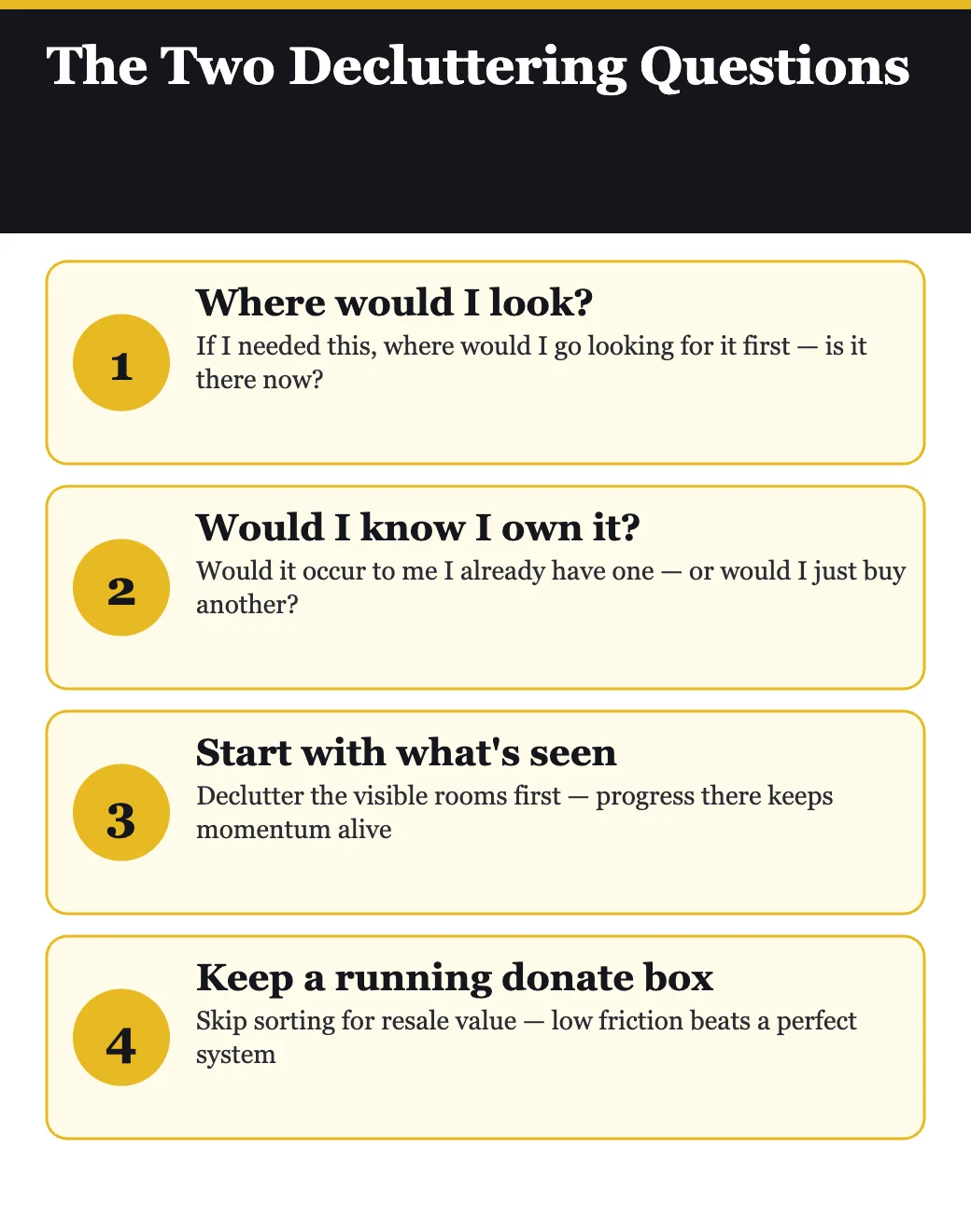
The most practical tool in the book is a pair of questions White developed while working through her own kitchen drawers, meant to be applied to any item you’re genuinely unsure about. The first: “If I needed this, where would I look for it?” If the honest answer is somewhere other than where it currently lives, that’s information — either move it there or notice that you never actually go looking for it, which is itself a signal. The second: “Would it ever occur to me that I already have one?” If you’d forget you own it and simply buy a replacement, White argues it isn’t earning its space, regardless of its condition or original price.
She pairs this decision framework with what she calls the visibility rule: declutter the rooms and surfaces you and other people actually see every day — entryways, living rooms, kitchen counters — before touching hidden storage like garages, attics, or the backs of closets. The logic is motivational as much as practical: visible progress is what keeps a person going, while a decluttered junk drawer nobody sees provides almost no felt reward. White notes this is one of the more counterintuitive parts of her method, since the instinct in most households is to hide the mess by shoving it into closets and drawers first — which means the most-hidden spaces often end up the most cluttered, and the least motivating to finally tackle. Starting with visible spaces builds the momentum needed to eventually tackle the less rewarding hidden ones.
White also names a specific trap she calls “procrasticlutter” — items kept because of a vague plan to deal with them someday: the shirt to be mended, the craft project to be finished, the gadget to be researched and resold. She argues most “someday” items never actually get their someday, and that naming the pattern out loud makes it much easier to let go of the item without the guilt of “wasting” it, since the alternative was never really going to happen anyway.
Part 3: Building momentum without a big weekend project
White is emphatic that decluttering works best as small, frequent sessions rather than a single marathon effort, partly because marathon decluttering days tend to end in exhaustion, half-finished piles, and a room that’s temporarily worse than when you started. Her recommended order reinforces this: start with the easiest, least emotionally loaded categories — expired products, obvious trash, duplicate items — before moving to anything that requires real thought. Early, easy wins build the momentum and confidence needed for harder decisions later in a session or later in the week. This ordering also protects against a common failure mode: starting with the hardest category first, running out of decision-making energy within minutes, and abandoning the session with a bigger mess than before. Sequencing easy decisions first keeps that energy in reserve for the choices that actually need it.
A practical habit she recommends throughout is keeping a running donate box somewhere accessible at all times, rather than treating donation as a separate, occasional project. Items go in as soon as a decision is made, and the box gets dropped off whenever it’s full — no sorting for resale value, no research into which charity pays best for which item. White’s stance is that friction of any kind, including the friction of trying to extract maximum value from a giveaway, is usually what causes decluttering to stall entirely. It’s a stance some reviewers have pushed back on, arguing it doesn’t account for where donated goods actually end up, but as a practical mechanism for keeping momentum in an overwhelmed household, it’s simple enough to actually stick. For readers who want to weigh that criticism, a reasonable middle ground is keeping the donate box’s low-friction spirit while occasionally routing higher-value items — electronics, furniture, specialty gear — to a resale platform or a charity with clearer sourcing practices, without letting that extra step become a bottleneck for the majority of everyday items passing through the box.
White also repeatedly emphasizes that visible progress compounds: a single decluttered shelf makes the next shelf feel more possible, and a fully decluttered entryway changes how a person feels walking into their own home every day, which in turn makes the next decluttering session easier to start. This is less a rigorous psychological claim than a practical observation from her own experience and years of reader feedback on her blog, but it aligns with the general principle that visible momentum sustains follow-through better than invisible progress does.
Part 4: Sentimental clutter and making it a habit
The hardest category in any decluttering process is sentimental items, and White dedicates real attention to it rather than treating it as a footnote. Her core advice is to keep one representative item per category — one child’s drawing instead of a full box, one grandparent’s item instead of an entire shelf of them — and to actually use or display whatever is kept, since an item boxed away in storage isn’t really being honored, it’s just being stored. She frames the discomfort of letting go as a normal part of processing a memory or a life transition, not a signal that the item must be kept to avoid the feeling.
She also advises tackling sentimental categories last, after momentum has already been built on easier, non-emotional clutter. By the time a person reaches the sentimental box, they’ve had practice making quick decisions and trusting their own judgment, which makes the harder emotional decisions more manageable than if sentimental clutter were tackled first, cold. White also suggests giving yourself permission to revisit a sentimental decision later rather than treating every choice as permanent and irreversible — a photograph of an item you’re unsure about, kept for a week before the final decision, can lower the stakes enough to make the letting-go easier without requiring the item to be kept indefinitely just in case.
The book closes by reframing decluttering as an ongoing habit rather than a finished project with a permanent end state. New clutter accumulates continuously in any lived-in home, so the goal isn’t a one-time perfect purge but a repeatable, low-friction rhythm — a donate box that’s always in use, a visibility check that becomes automatic, and decision questions that get faster with practice. White is explicit that she still declutters regularly herself, years after developing the system, which is presented less as a failure of the method and more as an honest description of how households actually work.
Who is Decluttering at the Speed of Life best for — and who should read something else first?
This book is best suited to people who feel overwhelmed by clutter and have tried organizing products — bins, labels, shelving systems — without seeing real improvement, since it directly targets that mismatch. Readers looking for a more structured, category-by-category method with a stronger cultural following may prefer Marie Kondo’s KonMari approach, which shares some philosophical overlap but moves at a different pace and emphasizes joy as the sorting criterion rather than container size. If your bigger challenge is time and task management rather than physical belongings, our Time Smart summary is a better starting point.
Questions to reflect on
- Which room in your home would benefit most from applying the Container Concept this week?
- What’s one item you’re keeping under a vague “I’ll deal with it someday” plan?
- Where would you actually look for an item you’re unsure about — and is that where it currently lives?
- Which sentimental category could you reduce to one representative item without losing the memory?
- What would a five-minute decluttering session look like on your busiest weekday?
🔥 Ready to declutter without waiting for a free weekend?
Grab a copy and start with one visible room this week.
How to apply Decluttering at the Speed of Life (7-day plan)
- Day 1: Pick one visible room (entryway or living room) and apply the Container Concept to a single shelf or surface.
- Day 2: Open one drawer and run every ambiguous item through the Two Questions.
- Day 3: Start a running donate box and add at least five items without sorting for resale value.
- Day 4: Hunt for procrasticlutter — three “someday” items — and decide their fate today.
- Day 5: Choose one sentimental category and apply the one-item rule to it.
- Day 6: Declutter a second visible space using only five minutes.
- Day 7: Review the week, drop off the donate box, and set a recurring weekly slot for the habit going forward.
Frequently asked questions
Is this book about decluttering or organizing?
It’s specifically about decluttering — reducing what you own — which White argues has to happen before organizing makes sense. Her recurring point is that bins, labels, and shelving systems applied to too much stuff just produce neatly organized clutter, not less clutter, so the book deliberately stays focused on reduction rather than storage products.
What exactly is the Container Concept?
The Container Concept treats every space you have — a shelf, a drawer, a closet, a room — as a fixed-capacity container that should set the limit on what you keep in it. Instead of buying more storage to fit more belongings, you let the existing container’s size dictate how much stays, and anything beyond that limit has to be decluttered rather than stored elsewhere.
How do the Two Questions work in practice?
On any item you’re unsure about, ask where you’d actually look for it if you needed it, and whether it would occur to you that you already own one. If the item lives somewhere you’d never think to search, or if you’d simply forget you had it and buy a replacement, that’s a strong signal it isn’t earning its space and can be let go.
Does White recommend a specific order for decluttering rooms?
Yes — she recommends starting with visible, high-traffic spaces like entryways and living rooms before hidden storage like garages or attics, because visible progress sustains motivation far better than a tidied space nobody sees. Within any single space, she also suggests tackling easy, non-emotional clutter before harder, sentimental categories.
How does the book suggest handling sentimental items?
White recommends keeping one representative item per sentimental category rather than an entire box, and actually using or displaying whatever is kept rather than storing it away unseen. She also suggests tackling sentimental clutter last, after momentum from easier decisions makes the harder emotional ones more manageable.
Is the book repetitive?
Some readers and reviewers have noted that the core principles — the Container Concept, the Two Questions, the visibility rule — get restated across many different rooms and scenarios, which can feel repetitive if read cover to cover in one sitting. That repetition is arguably part of the design, since the book is meant to be referenced room by room rather than read once and fully absorbed, but readers who prefer a single, concise statement of the method may find some chapters cover familiar ground.
How does this compare to Marie Kondo’s KonMari Method?
Both methods start from the premise that reducing volume matters more than better storage, but they differ in pace and sorting criteria. KonMari organizes by category (clothes, books, papers, and so on) and asks whether an item “sparks joy,” often completed in a concentrated period. White’s method is slower-paced and room-based, using the Container Concept and Two Questions rather than a joy-based test, and is explicitly designed to work in small sessions rather than a concentrated overhaul — which some readers find more sustainable for a busy, ongoing household.
Related summaries
- Margin — building slack and reserves into a busy life
- Laziness Does Not Exist — a counterweight to nonstop optimization
- Finish What You Start — follow through without relying on motivation
- More time management book summaries