

★★★★★ 4.6/5 — The most structured “reset” diet in print: 30 days of zero exceptions rewires cravings and reveals which foods are quietly working against you.
Best for: Anyone who suspects a food is sabotaging their energy, skin, digestion, or mood — and wants a strict, short-term framework to find out which one.
Reading time: ~28 min guide · ~6 hrs full book
Difficulty to apply: High — a true 30-day elimination protocol with no cheat days
The Whole30 in one minute
Stop negotiating with your cravings: for 30 days, remove the foods most likely to be driving inflammation, cravings, and energy crashes, then reintroduce them one at a time to find out, with evidence instead of guesswork, what your body actually tolerates. The Whole30, created by Melissa Urban and Dallas Hartwig, isn’t a weight-loss plan — they’ll tell you to put the scale away — it’s a 30-day elimination diet that cuts added sugar, alcohol, grains, legumes, dairy, and common food additives to reset your relationship with food. The real payoff isn’t just clearer skin or better sleep during the 30 days; it’s the reintroduction phase afterward, where you methodically test each food group and learn, firsthand, which ones are worth keeping in your life.
Key takeaways
- The 30 days are non-negotiable: break one rule — even once — and you restart the clock at Day 1. The strictness is the point, not a flaw.
- This is an elimination diet, not a diet-diet: the goal isn’t calorie restriction or a number on the scale, it’s identifying which foods cause inflammation, cravings, or digestive issues.
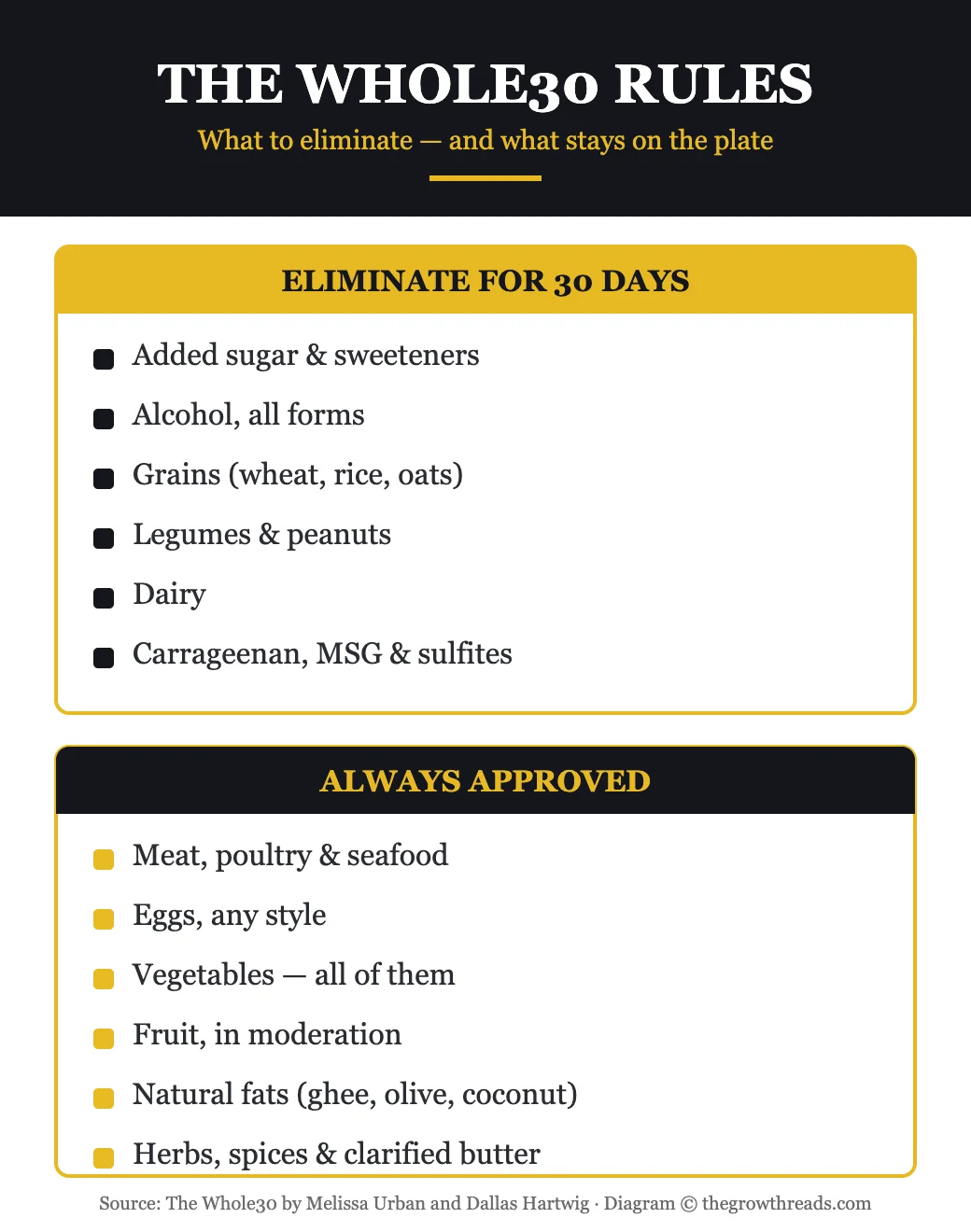
- Six categories are off-limits for 30 days: added sugar and sweeteners (real or artificial), alcohol, grains, legumes, dairy, and additives like carrageenan, MSG, and sulfites.
- SWYPO is banned: recreating pancakes, cookies, or treats out of approved ingredients keeps your brain hooked on the reward of “junk food,” even when the ingredients are technically compliant.
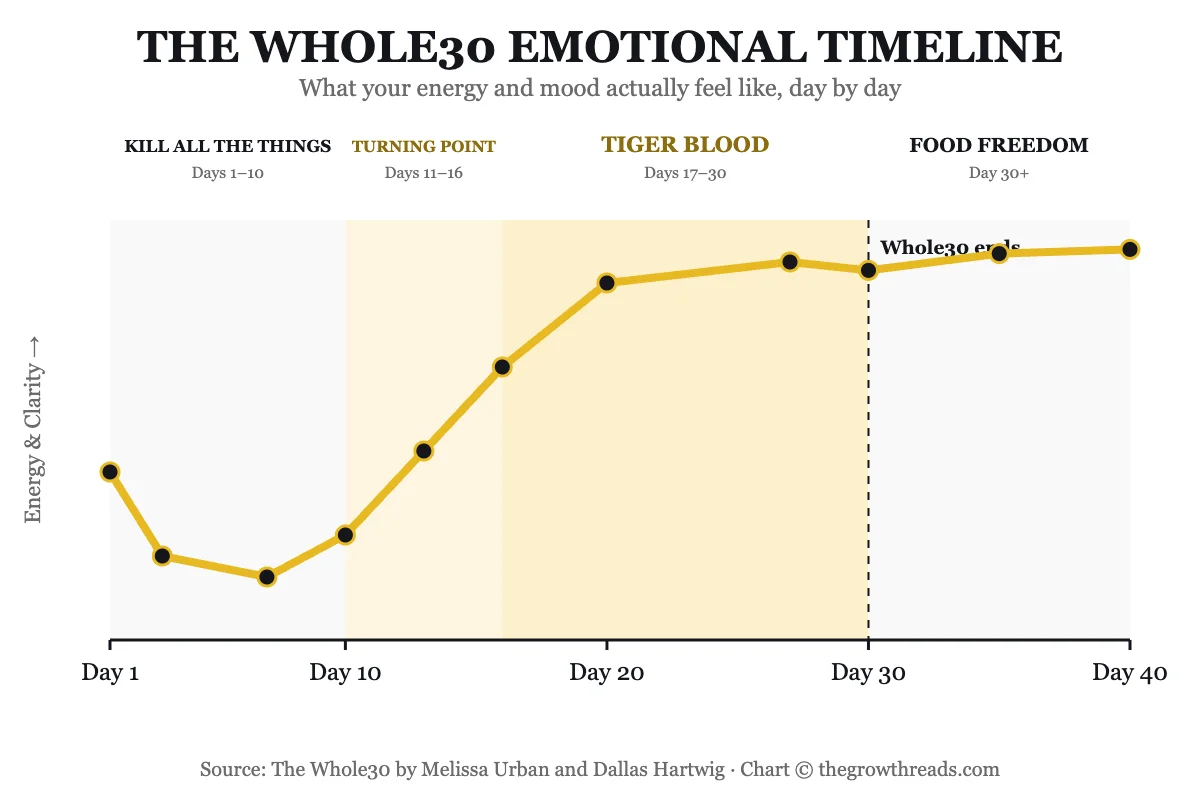
- Expect to feel worse before you feel better: Days 1–10 (“Kill All The Things”) often bring headaches, fatigue, and irritability as your body adjusts.
- “Tiger Blood” is the reward, and it’s real: most people report a surge in energy, mental clarity, and mood around Day 16–21 that makes the hard early days worth it.
- The scale is banned for 30 days: Urban and Hartwig want progress judged by energy, sleep, skin, and mood — not a number that moves for reasons unrelated to health.
- The real work starts on Day 31: the reintroduction protocol — testing one food group at a time, with 48 hours between each — is what turns a 30-day reset into lasting, personalized food rules.
- Read every label, every time: sugar and non-compliant additives hide in unexpected places — deli meat, salad dressing, even bacon.
- It’s psychological as much as physical: the book’s real target is “food noise” — the mental chatter and rationalizing that keeps people cycling through cravings and guilt.
What is The Whole30 about?
The Whole30 is a 30-day elimination diet developed by Melissa Urban and Dallas Hartwig that removes added sugar, alcohol, grains, legumes, dairy, and common additives to reset cravings and identify food sensitivities. After the 30 days, a structured reintroduction phase tests each food group individually, turning a strict short-term reset into personalized, evidence-based eating habits.
About the author
Melissa Urban (formerly Melissa Hartwig) co-created the Whole30 program in April 2009 with her then-husband, Dallas Hartwig, while both were working as certified sports nutritionists. What began as a challenge posted to friends and family grew into a #1 New York Times bestselling franchise: Urban and Hartwig co-authored It Starts With Food (2012) and The Whole30 (2015) before separating later that year. Urban took over the business and has since published several follow-up books, including Food Freedom Forever (2016) and The Whole30 Day by Day. She has spoken openly about her own recovery from addiction, which shaped the program’s uncompromising, zero-exceptions structure — she has said the strictness isn’t arbitrary, it’s designed to short-circuit the rationalizing that keeps people stuck in old patterns. Urban continues to run Whole30 as CEO from Salt Lake City, Utah. Explore all Melissa Urban book summaries →
Key concepts at a glance
| Concept | What it means | Use it when |
|---|---|---|
| The 30-Day Reset | A full elimination of the foods most commonly linked to cravings, inflammation, and digestive issues | You want to isolate the cause of a nagging health issue |
| Non-Negotiable Rules | Zero-exception rules — break one and you restart the 30-day clock | Willpower and rationalizing have derailed past attempts |
| Tiger Blood | The surge in energy and mental clarity many people report around Day 16–21 | You need a concrete reason to push through the hard early days |
| Food Noise | The mental chatter, cravings, and guilt cycle driven by sugar and processed food | You want to understand why “just eat less” hasn’t worked |
| Reintroduction Protocol | Testing one food group at a time after Day 30, with 48-hour gaps between tests | You’re ready to learn your own personal food sensitivities |
| Whole30 Approved | The “always yes” list: meat, seafood, eggs, vegetables, fruit, natural fats, herbs, and spices | You’re grocery shopping or ordering off a menu during the 30 days |
| SWYPO | “Sex Wax Yo Personal Order” — avoiding compliant treats that mimic junk food | You’re tempted to bake “paleo” cookies during the reset |
| Kill All The Things (Days 1–10) | The roughest withdrawal window, marked by headaches, fatigue, and irritability | You feel worst and want to quit — this phase reliably passes |
Part 1: Why “just eat less” doesn’t work
Urban and Hartwig open with a case against moderation, and it’s more psychological than nutritional. Their argument: sugar and heavily processed food don’t just taste good, they hijack the same reward pathways as other habit-forming substances, which is why “just have one cookie” so rarely works as advice. Every time you eat something engineered to be irresistible, you reinforce a loop of craving, consumption, and guilt — and the guilt itself becomes a trigger for more eating. They call the resulting static “food noise”: the constant background chatter of cravings, rules, and self-judgment that makes eating feel like a fight instead of fuel.
The book’s core insight is that you can’t out-willpower a system that’s designed to overwhelm willpower. Moderation asks you to make a hundred small decisions a day, and decision fatigue means you’ll eventually lose some of them. A hard reset removes the decision entirely for 30 days: there’s no “should I” because the answer is already no. That’s uncomfortable, but Urban and Hartwig argue it’s actually easier than the daily negotiation most people are stuck in — you’re not exercising willpower every hour, you’re following one rule you already agreed to.
Part 2: The rules — what’s in, what’s out
The Whole30 rulebook is deliberately short and deliberately strict. Six categories are eliminated for the full 30 days: added sugar and sweeteners (including “natural” ones like honey and maple syrup), alcohol in any form, grains, legumes and peanuts, dairy, and additives like carrageenan, MSG, and sulfites. What’s left is a generous list: any meat, poultry, or seafood; eggs; vegetables; fruit; natural fats like ghee, olive oil, and coconut oil; and herbs and spices.
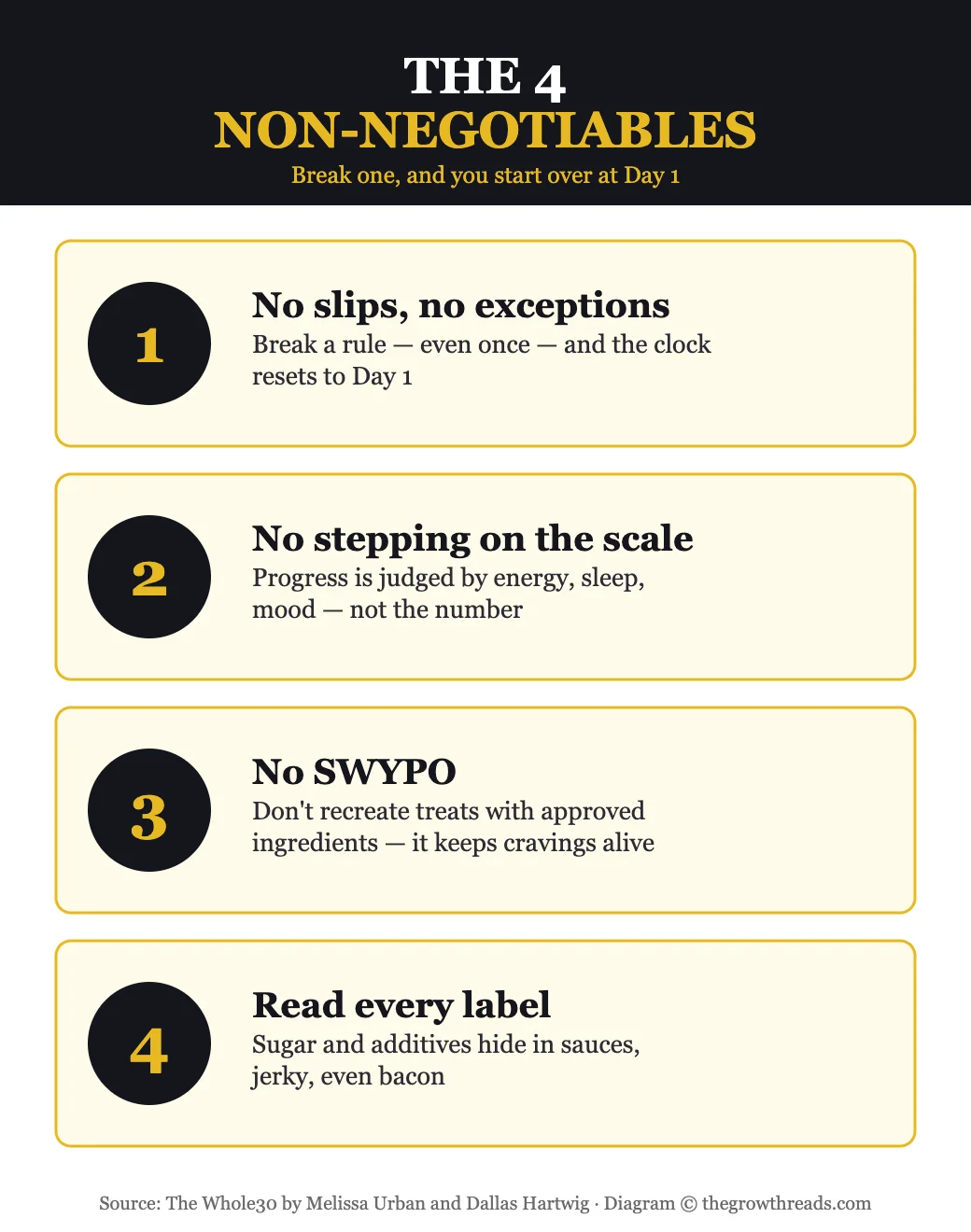
What makes The Whole30 distinct from a typical “clean eating” plan is its four non-negotiable rules, which exist specifically to close the loopholes people use to talk themselves out of a hard reset. No slips, ever — break one rule and the 30-day clock restarts, no exceptions for special occasions. No stepping on the scale, because the program is measuring energy and clarity, not weight. No SWYPO (recreating baked goods or treats with compliant ingredients), because the goal is breaking the reward association with treat-foods, not just swapping the flour. And read every label, every time, because sugar and non-compliant additives hide in places most people never check — bacon, deli meat, canned tomatoes, salad dressing.
Part 3: The timeline — what actually happens, day by day
One of the most practically useful parts of the book is simply telling you, in advance, what to expect — because the emotional arc of an elimination diet is disorienting if you don’t know it’s coming. Days 1 through 10, which Urban and Hartwig nickname “Kill All The Things,” are typically the hardest: headaches, fatigue, irritability, and intense cravings as your body adjusts to running without added sugar and alcohol. Around Day 10 to 16 there’s usually a turning point — the acute withdrawal symptoms fade and energy starts to stabilize. Then, somewhere between Day 16 and 21, most people report what the Whole30 community calls “Tiger Blood”: a surge in energy, mental clarity, and mood that feels disproportionate to a simple change in diet.
The authors are careful to frame this timeline as a typical range, not a guarantee, and they use it deliberately as a motivational tool — if you know the roughest days are behind you by Day 10, it’s easier to push through Day 4. The timeline also does quiet reframing work: by naming and normalizing the hard days, it stops people from concluding “something is wrong with me” and instead lets them think “this is Day 6, this is supposed to be hard.”
Part 4: Food freedom — the reintroduction protocol
The 30 days get the attention, but Urban and Hartwig are explicit that the reintroduction phase is the actual point of the program. Starting Day 31, you reintroduce one food group at a time — eating it deliberately, then returning to Whole30-compliant eating for 48 hours while you watch for reactions: bloating, joint pain, skin breakouts, mood changes, sleep disruption, or renewed cravings. The recommended order moves from least to most commonly reactive: dairy first, then gluten-containing grains, then non-gluten grains, then legumes, and sugar and alcohol last, since both are the easiest to overdo once reintroduced.
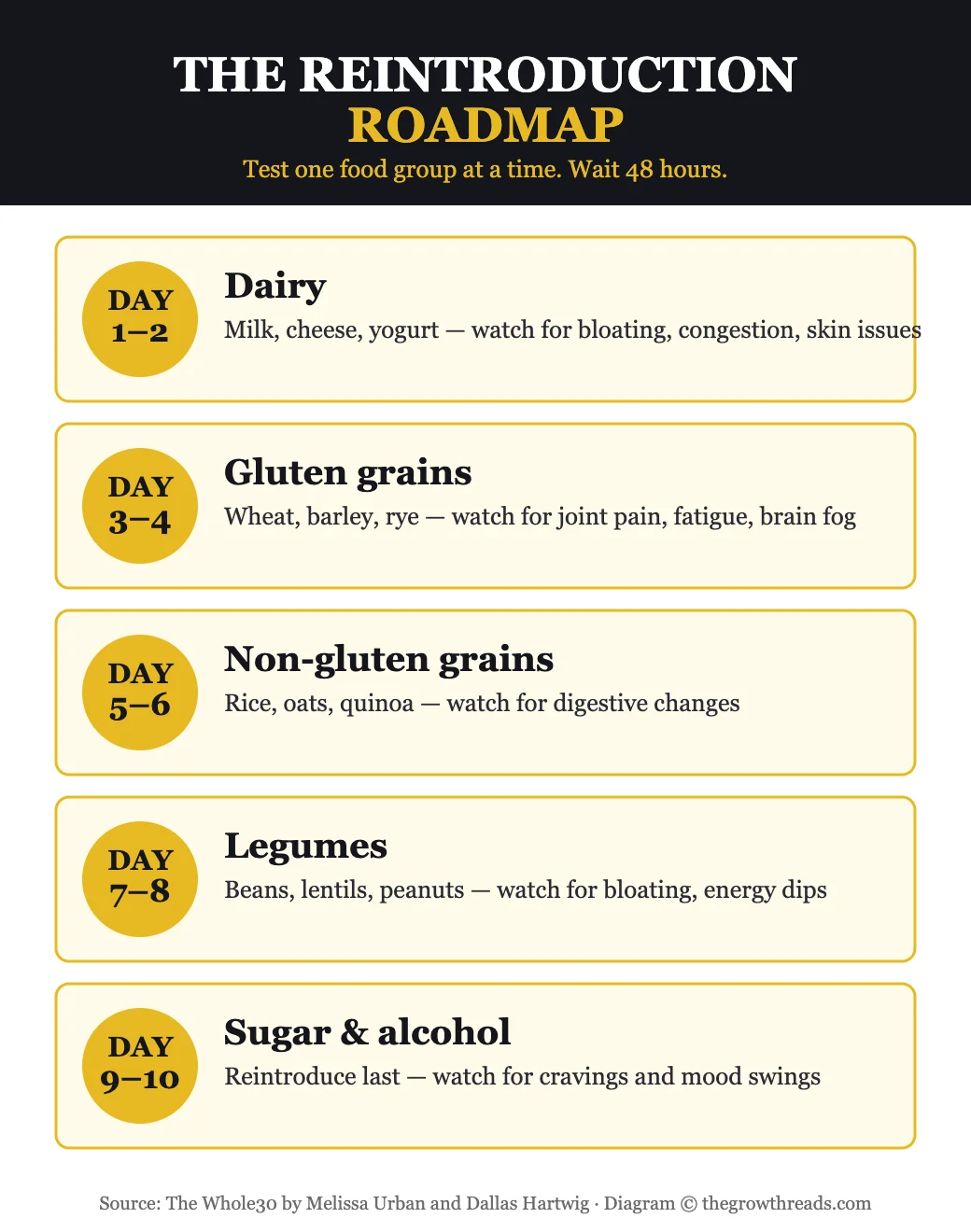
This is where The Whole30 stops being a diet and becomes a diagnostic tool. Most people finish the 10-day reintroduction with a short, personal list — “dairy makes me congested,” “I feel fine on rice but bloated on wheat” — that no generic diet advice could have told them. The book calls the destination “food freedom”: not permanent restriction, but eating everything you choose to eat on purpose, with clear eyes about what it costs you.
Who is The Whole30 best for — and who should read something else first?
The Whole30 is best for people who suspect a specific food is quietly working against their energy, skin, digestion, or mood, and want a strict, short-term framework with clear rules and a defined endpoint. It also suits anyone who has tried “everything in moderation” and found that moderation, for them, just means slow drift back to old habits — the zero-exceptions structure removes the daily negotiation that trips that group up.
If a full 30-day elimination feels too restrictive right now, or if you have a history of disordered eating, start with Intuitive Eating instead, which builds a healthier relationship with food without an elimination phase. If your main concern is blood sugar and energy crashes rather than a full reset, Glucose Revolution offers lighter-touch changes with a similar payoff. And if you’re drawn to the idea of a metabolic reset but want to keep eating the same foods on a schedule instead of eliminating them, The Obesity Code is the fasting-based alternative.
Questions to reflect on
- Which foods do you already suspect might be affecting your energy, skin, or mood — and what’s stopped you from testing that theory?
- Do you tend to negotiate with rules (“just this once”), or do you do better with a hard line and zero exceptions? What does that tell you about how to structure your own habit changes?
- What would you do differently on a hard day if you knew, in advance, that it was a normal and temporary part of the process?
- Where in your life besides food do you rely on “moderation” as a strategy — and is it actually working?
- If you finished a reintroduction phase tomorrow, what’s the one food you’d genuinely be surprised to learn was affecting you?
🔥 Ready to reset your relationship with food?
Grab The Whole30 and get the exact rules, timeline, and reintroduction protocol straight from the source.
How to apply The Whole30 (7-day plan)
- Day 1: Read the full Whole30-approved and off-limits ingredient lists and do a pantry audit — separate what stays from what goes.
- Day 2: Meal-plan your first week using only approved ingredients, then do one full grocery shop from that list.
- Day 3: Batch-cook three or four compliant proteins and a large tray of roasted vegetables so the first week isn’t a daily scramble.
- Day 4: Pick your official Day 1 start date and tell one accountability person your plan and your reasons.
- Day 5: Prep grab-and-go compliant snacks — hard-boiled eggs, nuts, jerky — for the moments cravings hit hardest.
- Day 6: Read the four Non-Negotiable Rules twice and post them somewhere you’ll see every morning.
- Day 7: Start Day 1. Remember the book’s own advice: it’s not hard — don’t you dare tell yourself it’s hard.
Frequently asked questions
What exactly can’t I eat on the Whole30?
For 30 days you eliminate added sugar and sweeteners (natural or artificial), alcohol in any form, grains, legumes and peanuts, dairy, and additives like carrageenan, MSG, and sulfites. Everything else — meat, poultry, seafood, eggs, vegetables, fruit, natural fats, herbs, and spices — is fair game. The strictness is intentional: the program is designed to remove every commonly reactive food group at once so the reintroduction phase can isolate which ones actually matter for you.
How is the Whole30 different from Paleo or keto?
The Whole30 is more restrictive than Paleo in one specific way: it bans natural sweeteners like honey and maple syrup that Paleo typically allows. Unlike keto, it isn’t organized around carbohydrate limits at all — fruit and non-gluten grains would be fine calorically on keto but are treated differently under Whole30’s rules (grains are eliminated, fruit is allowed). The Whole30 is also explicitly time-boxed at 30 days with a built-in reintroduction phase, where Paleo and keto are typically framed as indefinite lifestyles.
Will I lose weight on the Whole30?
Many people do, as a side effect of cutting added sugar, alcohol, and processed food, but weight loss is explicitly not the program’s stated goal — the scale is banned for the full 30 days. Urban and Hartwig frame success in terms of energy, sleep quality, skin, digestion, and mood instead, and they’re candid that some people see no change on the scale at all despite feeling significantly better.
What happens if I break a rule partway through?
Under the book’s Non-Negotiable Rules, any slip — even a small one — means restarting the count at Day 1. This isn’t meant as punishment; it’s meant to remove the mental loophole of “I’ll just make it up” that undermines most moderation-based diets. If a true restart isn’t realistic, the authors suggest being honest that what you did was a modified version of the program rather than quietly moving the goalposts.
Is the Whole30 backed by scientific research?
Independent, peer-reviewed research specifically on the Whole30 protocol is limited, and some nutrition experts and outlets have ranked it among the more restrictive popular diets, noting the combination of eliminated food groups is broader than most evidence-based nutrition guidance would require. At the same time, its emphasis on whole foods, vegetables, and cutting added sugar and alcohol lines up with mainstream nutrition advice. The most defensible way to read the program is as a structured self-experiment — a way to gather personal data through the reintroduction phase — rather than a permanently prescribed way of eating.
How long should I stay on Whole30 before reintroducing foods?
The program is a strict 30 days, not a day less — Urban and Hartwig are firm that the psychological and physical adjustments described in the timeline (through Tiger Blood around Day 16–21) need the full window to stabilize before reintroduction data will be reliable. After Day 30, the reintroduction phase itself takes about 10 additional days if you’re testing one food group every 48 hours.
Can I do the Whole30 as a vegetarian or vegan?
It’s difficult but not impossible. Since legumes, dairy, and grains are all eliminated alongside animal proteins being one of the few concentrated protein sources left, strict vegetarians and especially vegans will find the protein math challenging — eggs remain compliant for vegetarians, but vegans are largely limited to nuts, seeds, and vegetables for protein. The authors acknowledge this tension and suggest vegans consult the program’s website for modified guidance rather than attempting an unmodified version.
Related summaries
How we analyze books: We read the full text, cross-reference the author’s other published work and interviews, and build original diagrams, application plans, and reflection prompts — we don’t summarize chapter by chapter or reproduce the book’s text. Read our full methodology.