

⭐⭐⭐⭐ 4.2/5
One-liner: A research-backed anti-diet framework built on ten principles that help you rebuild trust with your body, reject restriction, and find a sustainable relationship with food.
Best for: Chronic dieters, anyone with a complicated relationship with food, health professionals seeking an evidence-based alternative to diet culture, and parents wanting to raise intuitive eaters.
Reading time: ~7 hours (368 pages)
Difficulty to apply: Moderate to high — the concepts are clear but require unlearning years of diet-culture conditioning.
Intuitive Eating in one minute
Diets do not work — and the proof is overwhelming. Evelyn Tribole and Elyse Resch present a revolutionary framework grounded in decades of clinical experience and hundreds of research studies showing that restrictive dieting leads to weight cycling, metabolic damage, disordered eating, and profound psychological harm. Their alternative — intuitive eating — is built on ten principles that guide you back to the internal hunger and fullness cues you were born with. The approach rejects external food rules in favour of body wisdom, self-compassion, and joyful movement. Since the first edition in 1995, over 200 studies have validated the framework, showing improvements in blood pressure, cholesterol, body image, self-esteem, and overall wellbeing — without the collateral damage of restriction.
Key takeaways
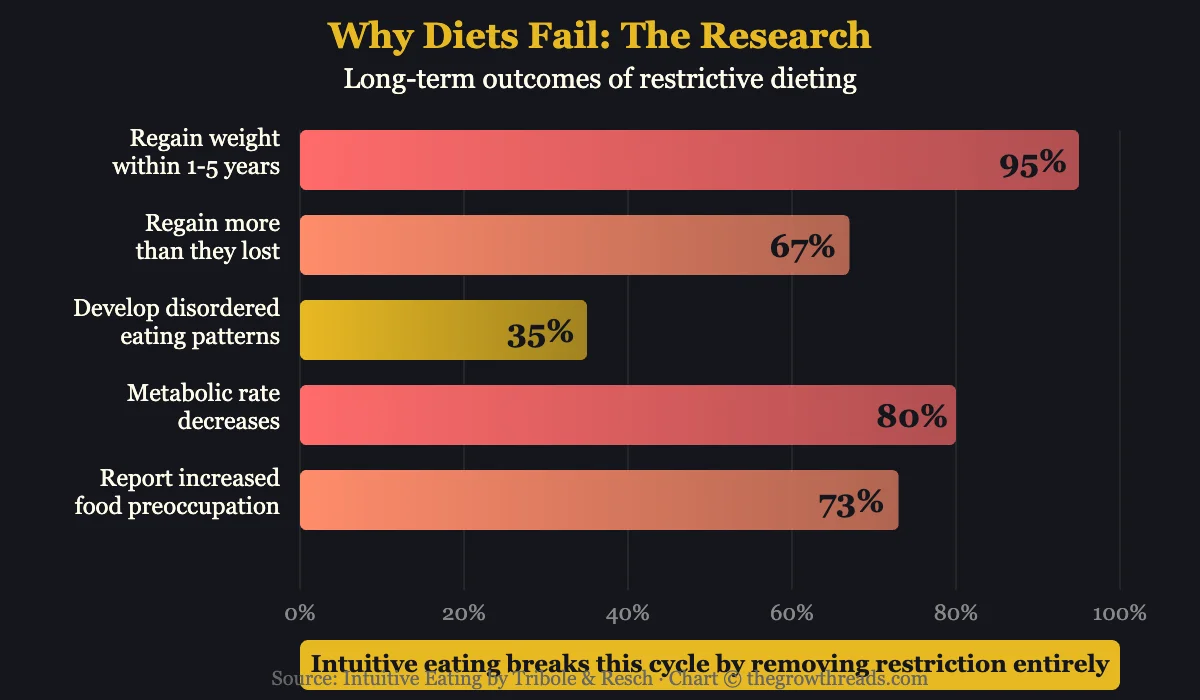
- Diets fail 95% of the time: Research consistently shows that the vast majority of dieters regain all lost weight within one to five years, and up to two-thirds regain more than they originally lost.
- Restriction triggers biological backlash: When you restrict food, your body responds with increased hunger hormones, decreased metabolism, heightened food preoccupation, and intensified cravings — it is biology, not willpower failure.
- You were born an intuitive eater: Babies cry when hungry and stop eating when full. Diet culture overrides these natural cues with external rules about what, when, and how much to eat.
- The food police live in your head: The critical inner voice that labels foods as “good” or “bad” and assigns moral value to eating choices is the internalised voice of diet culture — and it must be challenged directly.
- Satisfaction is the hub of the wheel: When you eat what you truly want in a pleasant environment, you feel satisfied with less. Deprivation drives overeating; permission dissolves it.
- Emotional eating is not the enemy: Using food for comfort occasionally is a normal human behaviour. The problem arises only when food is your sole coping mechanism, which typically happens when restriction has eliminated all other pleasures around eating.
- Respecting your body does not mean loving every part of it: Body respect is treating your body with dignity regardless of its shape — like wearing comfortable clothes and not speaking about yourself with cruelty.
- Exercise should feel good: Joyful movement replaces punitive exercise. The goal is to find physical activity you genuinely enjoy, not to “burn off” what you ate.
- Health is not determined by weight alone: The Health at Every Size research shows that behaviours — eating patterns, movement, stress management, sleep — predict health outcomes far better than the number on the scale.
- Gentle nutrition comes last: Nutrition guidance is principle ten, not principle one. You cannot make truly healthy food choices until you have first rebuilt your relationship with food and your body.
What is Intuitive Eating about?
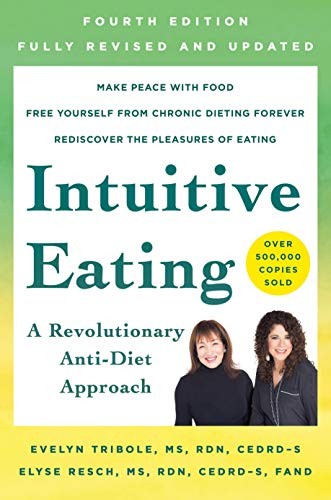
Intuitive Eating is an evidence-based, anti-diet approach to food and body image developed by registered dietitians Evelyn Tribole and Elyse Resch. Built on ten principles, it teaches readers to reject diet culture, reconnect with internal hunger and fullness signals, make peace with all foods, and build a sustainable, shame-free relationship with eating that supports both physical and mental health.
About the author
Evelyn Tribole and Elyse Resch are both registered dietitians with decades of clinical experience. Tribole is an award-winning dietitian who has worked with elite athletes and served as a nutrition expert for Good Morning America. Resch specialises in eating disorders and has maintained a private practice in Beverly Hills for over thirty years. Together, they coined the term “intuitive eating” in 1995 with the first edition of this book, which has since spawned a certified counsellor training programme, a companion workbook, and a body of over 200 peer-reviewed studies validating the approach. The fourth edition, published in 2020, incorporates the latest research on weight science, interoception, and the biological mechanisms that make diets fail. Explore all Elyse Resch book summaries →
Key concepts at a glance
| Concept | What it means | Use it when |
|---|---|---|
| Diet mentality | The belief that a new diet plan will finally deliver lasting results | You catch yourself thinking “this time will be different” about a new restriction |
| Interoceptive awareness | The ability to perceive internal body signals like hunger, fullness, and emotion | You are not sure whether you are physically hungry or eating for another reason |
| The Food Police | Internalised rules about food that create guilt and moral judgement around eating | You feel guilty after eating a “bad” food or virtuous after eating a “good” one |
| Unconditional permission | Allowing yourself to eat any food without guilt or moral judgment | You notice certain foods feel “forbidden” and trigger binge-restrict cycles |
| Habituation | The tendency for the appeal of a food to decrease when it is freely available | You fear that permission to eat anything will lead to eating everything forever |
| Last Supper eating | Overeating a food because you believe you will restrict it starting tomorrow | You eat excessive amounts before a new diet starts |
| Gentle nutrition | Making food choices that honour health and taste without rigidity | You have made peace with food and are ready to incorporate nutrition gently |
| Weight set point | The genetically influenced range your body naturally maintains | Your weight keeps returning to a similar range despite dieting efforts |
Part 1: Why diets fail — the science of restriction
Tribole and Resch open with a devastating review of the evidence against dieting. They cite meta-analyses showing that 95% of dieters regain lost weight within one to five years, with a significant proportion ending up heavier than when they started. This is not a failure of individual willpower — it is a predictable biological response to caloric restriction.
When you diet, your body interprets the caloric deficit as a famine threat. It responds with a cascade of biological adaptations designed to restore the lost weight: metabolism slows, hunger hormones (particularly ghrelin) increase, satiety hormones (particularly leptin) decrease, and the brain’s reward centres become hypersensitive to food cues. The result is a body that is simultaneously burning fewer calories, feeling hungrier, and finding food more rewarding — a perfect storm that makes weight regain virtually inevitable.
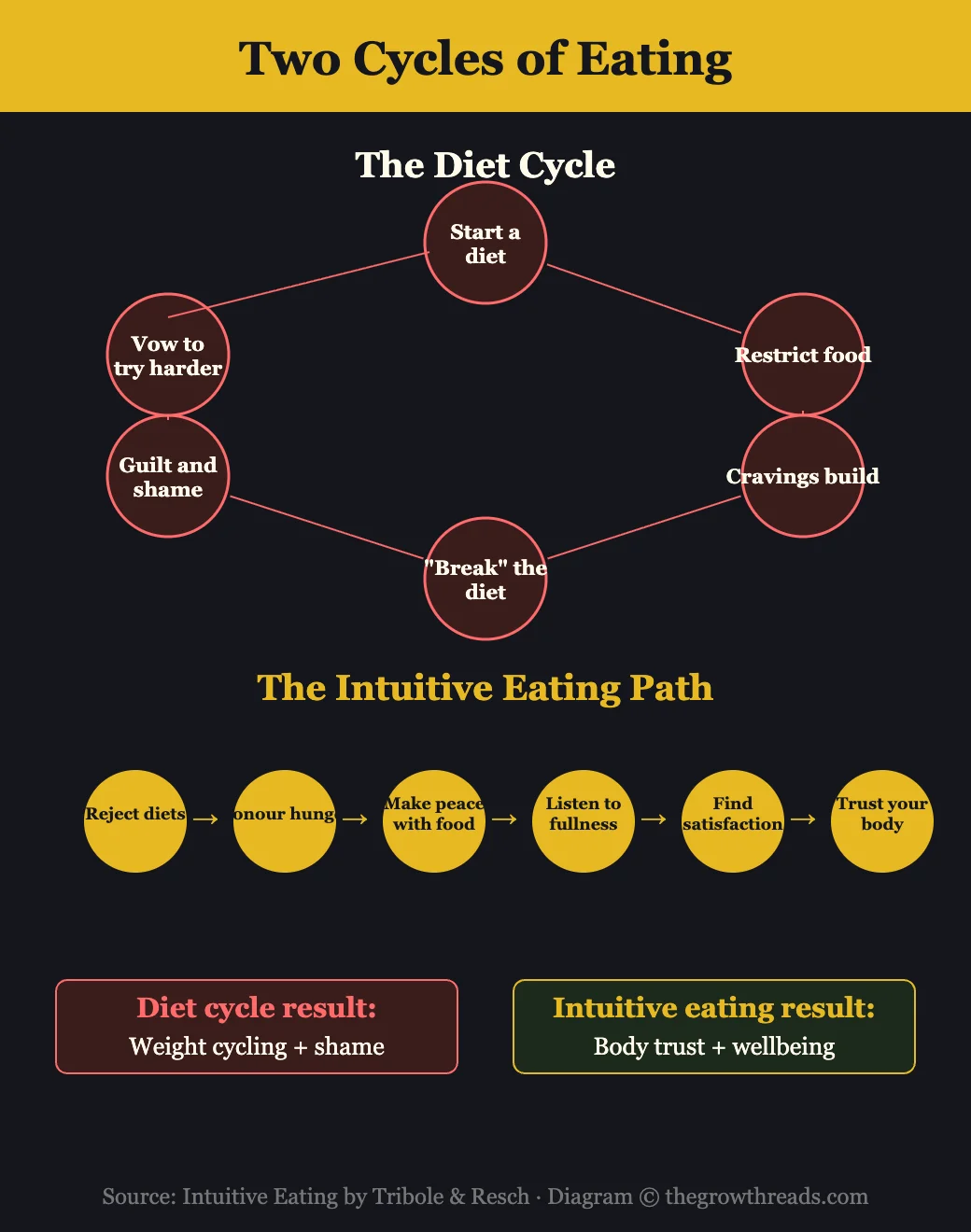
Beyond the biology, restriction creates psychological damage. Dieting increases food preoccupation, reduces the ability to recognise internal hunger and fullness cues, and often triggers binge eating as the body’s compensation for deprivation. The restrict-binge cycle becomes self-reinforcing: each binge generates guilt that motivates a new round of restriction, which produces another binge, and so on.
Part 2: The ten principles — rebuilding trust with your body
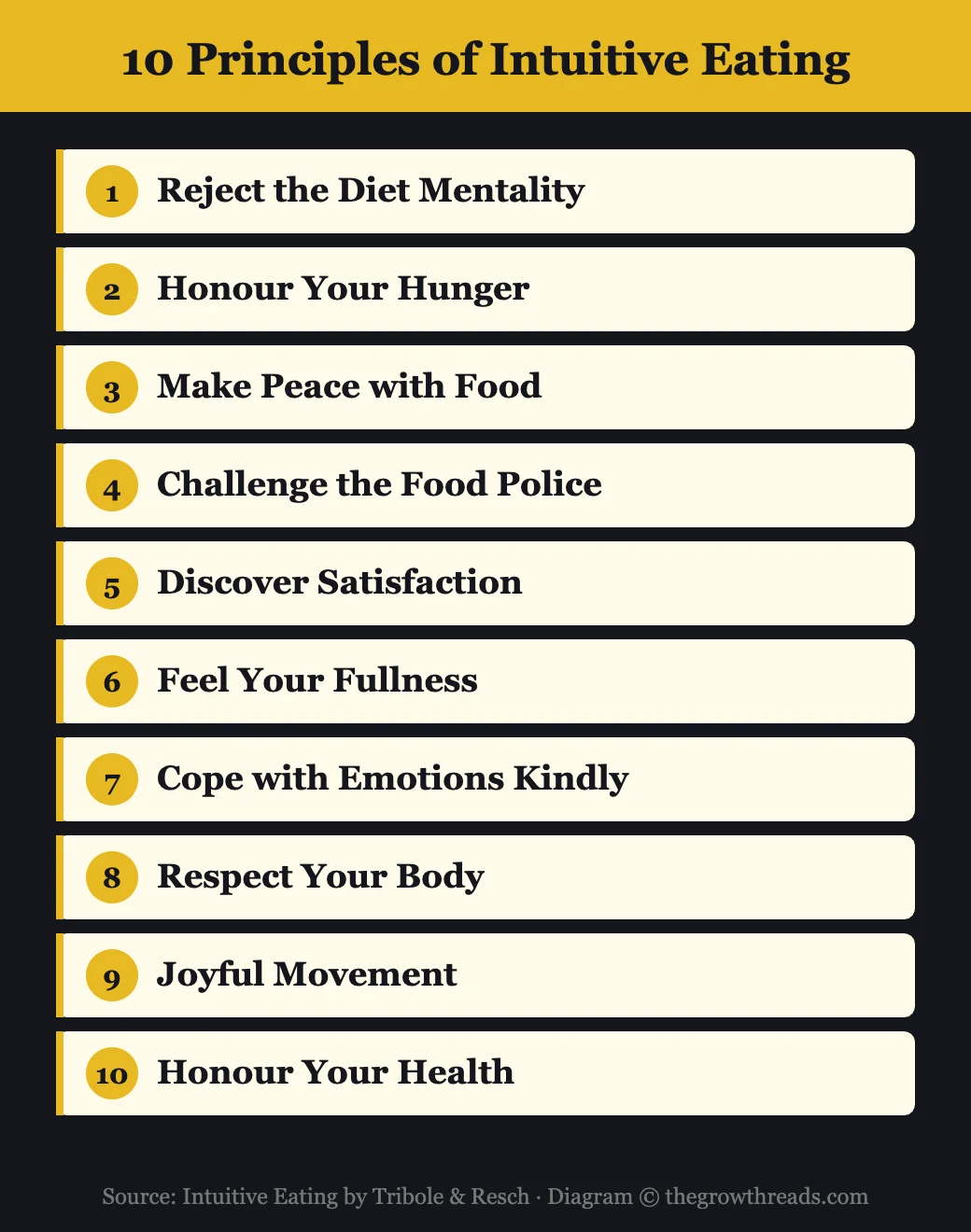
The core of the book presents the ten principles of intuitive eating, which Tribole and Resch describe not as a linear programme but as a set of interlocking practices that gradually dismantle diet mentality and restore body wisdom.
Principle 1: Reject the diet mentality. This is the foundational step. As long as you harbour hope that a new diet will work, you cannot fully commit to intuitive eating. Tribole and Resch ask readers to throw out diet books, unfollow diet-culture social media accounts, and stop pursuing intentional weight loss as a goal.
Principle 2: Honour your hunger. Biological hunger is your body’s signal that it needs fuel. Denying hunger triggers a primal drive to overeat — the same way holding your breath triggers a gasp. The practice is to respond to hunger promptly and adequately, which rebuilds the trust between your mind and body that dieting destroyed.
Principle 3: Make peace with food. Give yourself unconditional permission to eat any food. Research on habituation shows that when a food is freely available with no guilt attached, its emotional charge diminishes. The cookie that feels irresistible when forbidden becomes ordinary when it is always an option.
Principle 4: Challenge the food police. The food police is the inner voice that categorises foods as good or bad and assigns moral value to your eating choices. Tribole and Resch teach readers to identify these thoughts, recognise them as internalised diet culture, and replace them with neutral, permission-giving self-talk.
Principle 5: Discover the satisfaction factor. Satisfaction is the hub of the intuitive eating wheel. When you eat what you truly want, in a pleasant environment, with full attention, you feel satisfied with less. Eating a salad when you really want pasta leaves you physically full but psychologically unsatisfied — which leads to continued eating in search of the satisfaction you denied yourself.
Part 3: The ten principles — emotions, body, and movement
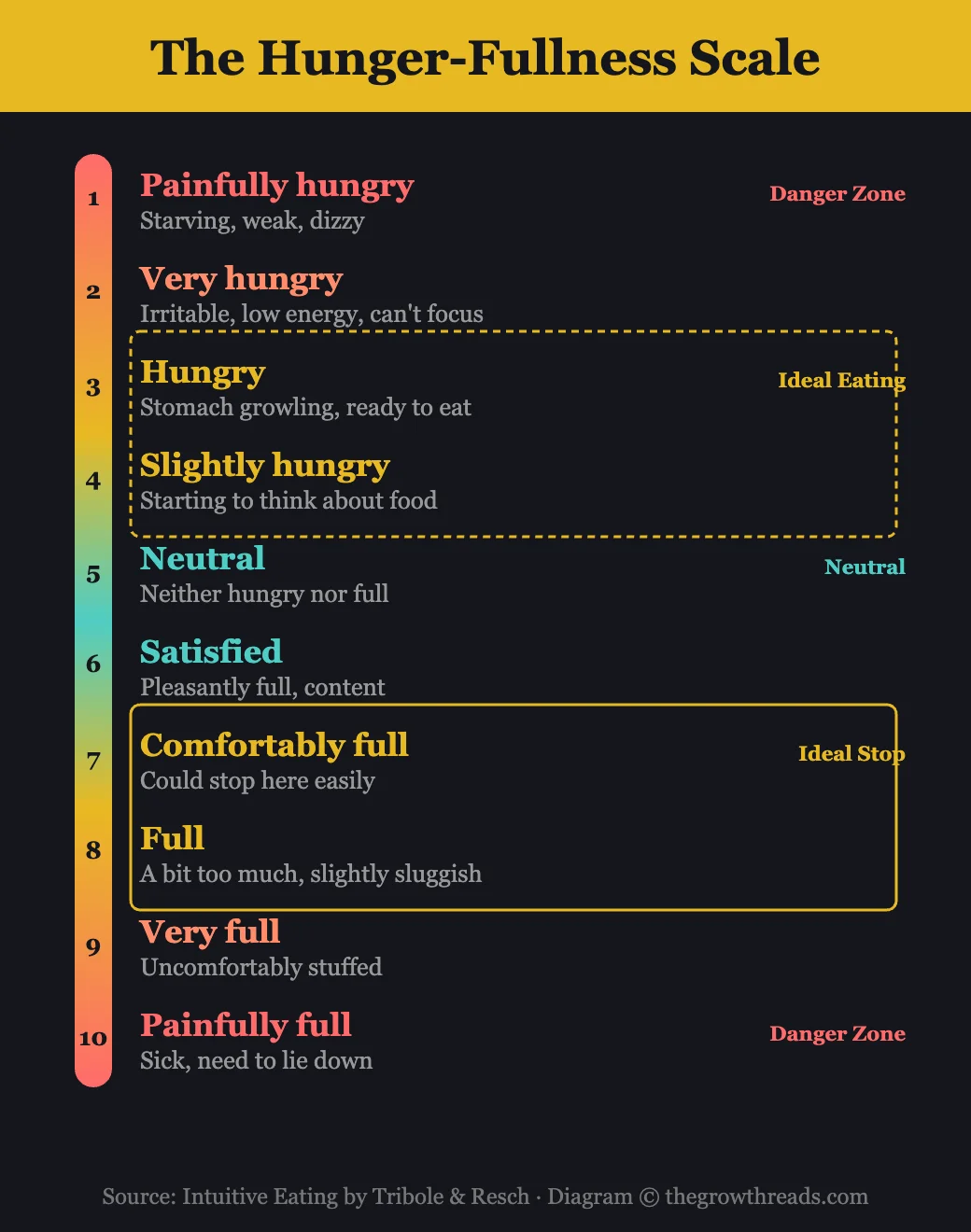
Principle 6: Feel your fullness. Just as honouring hunger means eating when you are hungry, feeling your fullness means learning to stop when you are comfortably satisfied. This requires slowing down, eating without distraction, and checking in with your body mid-meal. The hunger-fullness scale — a 1-to-10 spectrum from painfully hungry to painfully full — is a practical tool for developing this awareness. The sweet spot is starting to eat around a 3-4 and stopping around a 6-7.
Principle 7: Cope with your emotions with kindness. Emotional eating is not inherently pathological. Food is comforting, and using it occasionally for comfort is a normal part of being human. The problem arises when food is your only coping mechanism — which typically happens when restriction has stripped away all pleasure and spontaneity around eating. Tribole and Resch recommend building a diverse toolkit of emotional coping strategies while simultaneously removing the restriction that makes emotional eating more intense.
Principle 8: Respect your body. Body respect is not body love — it is the commitment to treating your body with basic dignity regardless of its shape or size. This means wearing clothes that fit and feel comfortable, speaking about yourself without cruelty, and accepting that bodies come in a wide range of genetically determined shapes and sizes that cannot all be forced into the same mould.
Principle 9: Movement — feel the difference. Joyful movement replaces punitive exercise. Instead of exercising to burn calories or earn food, the practice is to find physical activities that feel genuinely enjoyable and to focus on how movement makes you feel — energised, strong, relaxed — rather than on calories burned or minutes logged.
Principle 10: Honour your health — gentle nutrition. This principle comes last intentionally. You cannot make truly healthy food choices from a place of restriction, guilt, or fear. Once you have made peace with food and rebuilt body trust, you can incorporate nutrition knowledge gently — choosing foods that taste good, feel good in your body, and support your health without perfectionism or rigidity.
Part 4: The research and long-term practice
The fourth edition dedicates significant space to the growing body of research supporting intuitive eating. Over 200 peer-reviewed studies have examined the framework, and the findings are consistent: intuitive eaters have better cholesterol levels, lower blood pressure, reduced rates of disordered eating, higher self-esteem, better body image, and greater overall psychological wellbeing compared to dieters. Notably, these improvements occur regardless of whether weight changes.
Tribole and Resch also address common concerns. Many people fear that giving themselves unconditional permission to eat will lead to eating nothing but junk food forever. Research on habituation shows that the opposite happens: when no food is forbidden, the initial excitement of “allowed” foods fades, and most people naturally gravitate toward a balanced variety because a balanced diet simply feels better in their body. The key insight is that this self-regulation only works when permission is genuine — half-hearted permission with a mental asterisk (“I can eat this, but I really shouldn’t”) does not trigger habituation.
The book closes with guidance on raising intuitive eaters — teaching children to trust their hunger and fullness cues rather than cleaning their plates — and on navigating a diet-culture world as an intuitive eater. The authors acknowledge that intuitive eating exists within a broader social context where weight stigma, food insecurity, and cultural food traditions all play important roles, and they encourage readers to engage with these complexities thoughtfully.
Who is Intuitive Eating best for — and who should read something else first?
Intuitive Eating is essential reading for chronic dieters, anyone recovering from disordered eating, health professionals who counsel patients on nutrition, and parents who want to raise children with a healthy relationship with food. It is particularly powerful for anyone who has tried multiple diets and experienced the restrict-binge cycle firsthand.
If your primary interest is the science of nutrition without the anti-diet framing, In Defense of Food by Michael Pollan offers a complementary perspective. If you are specifically interested in how food affects brain health and cognitive function, Genius Foods by Max Lugavere provides that lens. And if sleep and recovery are your bigger concerns, Why We Sleep by Matthew Walker addresses the foundation that supports all other health behaviours.
Note: This summary discusses approaches to eating and body image. It is not medical advice. If you are experiencing disordered eating, please consult a qualified healthcare professional.
Questions to reflect on
- How many diets have you tried in your life, and what has been the long-term outcome of each one?
- Can you identify the voice of the food police in your own thinking — the rules about what you “should” and “should not” eat?
- When was the last time you ate something purely because it sounded delicious and satisfying, without any guilt or mental calculation?
- On a scale of 1-10, how well can you identify your current level of hunger right now — and when did you last eat based on that signal rather than an external cue?
- What form of physical movement would you choose if burning calories were completely irrelevant?
🔥 Ready to break free from diet culture?
Get Tribole and Resch’s evidence-based framework for rebuilding your relationship with food.
How to apply Intuitive Eating (7-day plan)
- Day 1 — Audit your diet mentality. Write down every food rule you currently follow — no carbs after 6pm, no snacking, no seconds, clean eating only. For each rule, note where it came from (a diet book, social media, a parent). This is your domestication inventory.
- Day 2 — Honour your hunger for one full day. Eat whenever you feel genuinely hungry today, without consulting a clock or a calorie budget. Notice when hunger appears, what it feels like physically, and how it differs from boredom or stress.
- Day 3 — Give unconditional permission. Choose one food you have been restricting or feel guilty about eating. Buy it, eat it without distraction, and notice the experience without judgment. Pay attention to taste, texture, satisfaction, and when you feel like stopping.
- Day 4 — Practice the hunger-fullness check-in. At every meal today, pause halfway through eating and rate your fullness on the 1-10 scale. Notice the difference between comfortably satisfied (6-7) and uncomfortably full (8+). There is no right answer — only observation.
- Day 5 — Challenge one food police thought. When you catch yourself thinking “I shouldn’t eat this” or “I was bad today,” write the thought down, identify which diet rule it comes from, and replace it with a neutral statement: “All foods are morally equal” or “My worth is not determined by what I eat.”
- Day 6 — Move for joy. Skip your usual workout. Instead, choose a form of movement purely because it sounds fun — a walk with a podcast, dancing in your kitchen, swimming, a bike ride. Focus entirely on how it feels, not on calories or duration.
- Day 7 — Reflect and set your intention. Review the week. Which principle felt most natural? Which was hardest? Write down one principle to focus on for the next month. Remember: intuitive eating is a practice, not a destination. Progress means reconnecting with your body, not perfecting a system.
Frequently asked questions
What is intuitive eating?
Intuitive eating is an evidence-based, anti-diet framework developed by dietitians Evelyn Tribole and Elyse Resch. It consists of ten principles that guide you to reject diet culture, reconnect with your body’s natural hunger and fullness cues, make peace with all foods, and build a sustainable relationship with eating. Over 200 peer-reviewed studies support the approach, showing improvements in physical health markers, mental health, body image, and overall wellbeing.
Will I gain weight if I start intuitive eating?
The honest answer is that weight may go up, down, or stay the same — it depends on where your body’s natural set point is relative to your current weight. If you have been chronically restricting, your body may initially seek a higher weight as it recovers. Over time, most people stabilise at their body’s natural set point range. The key insight is that health behaviours (eating variety, joyful movement, adequate sleep, stress management) predict health outcomes far more reliably than weight does.
Won’t I just eat junk food all the time without rules?
This is the most common fear, and research consistently shows the opposite happens. When all foods are truly permitted without guilt, the novelty and emotional charge of previously forbidden foods diminishes through a psychological process called habituation. Most people go through an initial “honeymoon” phase of eating more previously restricted foods, followed by a natural settling into a varied, balanced pattern — because balanced eating genuinely feels better in the body.
Is intuitive eating the same as mindful eating?
Not exactly. Mindful eating is one component of intuitive eating — it involves paying attention to the sensory experience of eating and noticing hunger and fullness cues. Intuitive eating is broader: it also addresses the psychological relationship with food (rejecting diet mentality, challenging the food police), body image, emotional coping, joyful movement, and gentle nutrition. You can practice mindful eating without rejecting diet culture, but intuitive eating requires both internal awareness and a fundamental shift in how you think about food and bodies.
Can intuitive eating help with binge eating?
Yes — research shows that intuitive eating is effective for reducing binge eating episodes. Binge eating is most commonly triggered by restriction (biological or psychological). When you remove the restriction — by giving yourself unconditional permission to eat, honouring hunger promptly, and eliminating food guilt — the primary driver of binge eating is dismantled. However, if you have a clinical eating disorder, working with a therapist or registered dietitian who specialises in eating disorders alongside reading the book is strongly recommended.
How long does it take to become an intuitive eater?
There is no fixed timeline. Most people find that the early principles (rejecting the diet mentality, honouring hunger) take weeks to months to internalise, while deeper principles (challenging the food police, body respect) can take a year or more. The process is not linear — you may feel comfortable with one principle and then encounter a situation that triggers old diet thinking. The authors emphasise that intuitive eating is a lifelong practice, not a destination, and that patience with yourself is essential.
Can I practice intuitive eating if I have a medical condition requiring dietary changes?
Yes, but with nuance. Intuitive eating’s principle 10 (gentle nutrition) explicitly allows for incorporating health needs into your food choices — the difference is that medical nutrition guidance is applied flexibly and without moral judgment, not as rigid rules that trigger restriction. For conditions like diabetes, celiac disease, or food allergies, working with a registered dietitian who understands both the medical requirements and the intuitive eating framework is the best approach. The goal is to honour your health needs while maintaining a peaceful relationship with food.
Related summaries
- In Defense of Food by Michael Pollan — Summary & Review
- The Obesity Code by Jason Fung — Summary & Review
- The Body Keeps the Score by Bessel van der Kolk — Summary & Review
- Glucose Revolution by Jessie Inchauspe — Summary & Review
- Best Health Books — The Complete TGR List