

★★★★☆ 4.3/5
One-liner: Infidelity is not just about sex or betrayal — it is a window into human desire, identity, and what we expect from modern love that no generation before us has ever attempted.
Best for: Anyone navigating the aftermath of infidelity, therapists working with couples, and thoughtful readers who want to understand the deeper forces behind betrayal without simplistic moralizing.
Reading time: ~7 hours (336 pages)
Difficulty to apply: High — the book challenges deeply held assumptions about relationships and requires emotional maturity to process.
The State of Affairs in One Minute
We have never expected more from love — and that is exactly why affairs keep happening. Esther Perel, the world’s most famous couples therapist and host of the podcast Where Should We Begin, challenges conventional thinking about infidelity with this provocative, deeply researched exploration of why people stray. Rather than treating affairs as simple moral failures, Perel examines them as complex human experiences that reveal fundamental truths about desire, identity, and the impossible demands modern society places on romantic partnerships. We ask one person to be everything — best friend, co-parent, intellectual companion, emotional support system, and passionate lover — and then act surprised when the arrangement cracks. The book does not excuse infidelity but it refuses to reduce it to a crime-and-punishment narrative, instead exploring what affairs can teach us about ourselves, our relationships, and the nature of love itself.
Key Takeaways
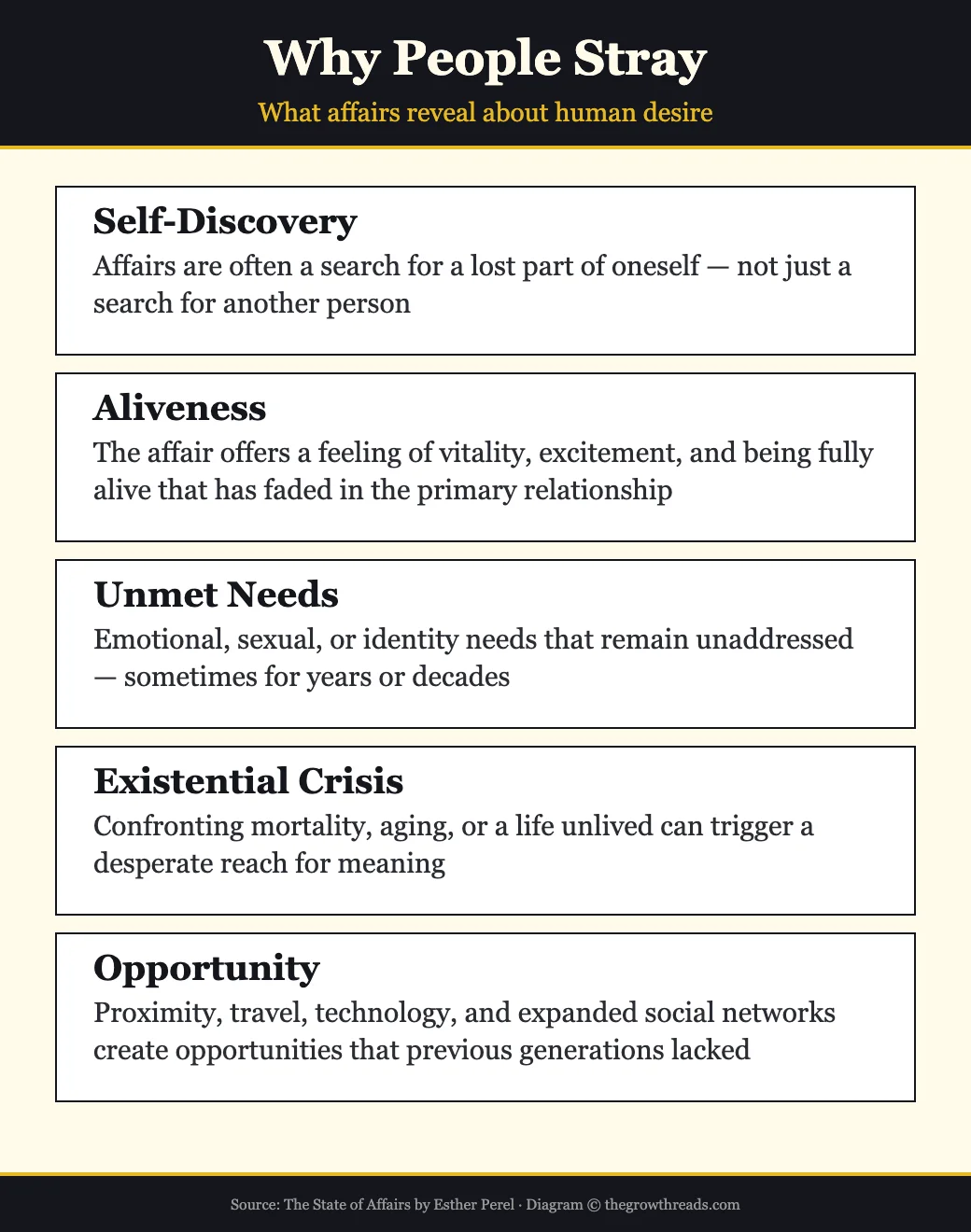
- Affairs are about more than sex: Most infidelity is driven by a desire for aliveness, self-discovery, or escape from a lost sense of identity — not merely physical desire.
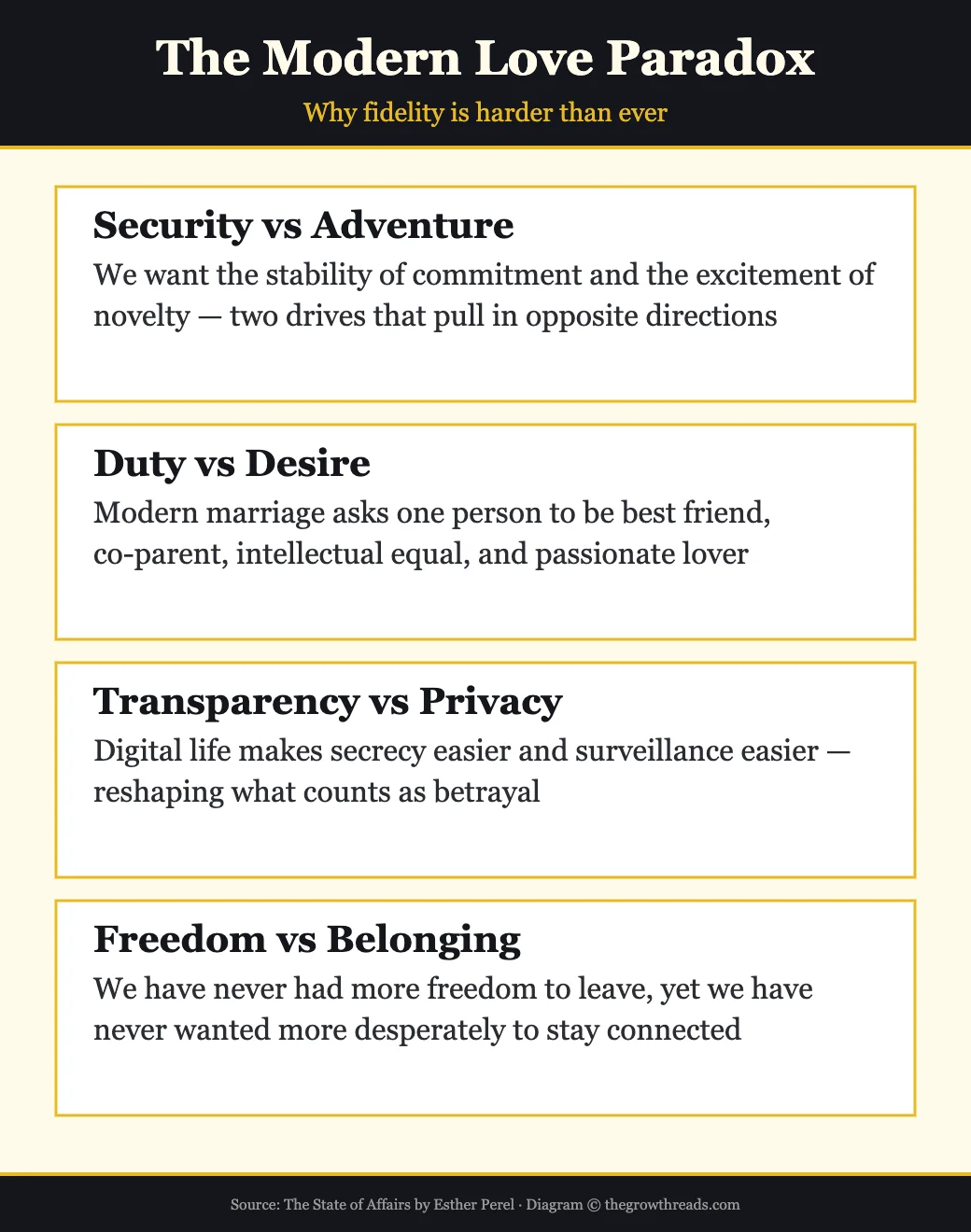
- Modern love carries impossible expectations: We ask one relationship to provide what an entire village once did — security, adventure, belonging, freedom, stability, and passion simultaneously.
- The definition of infidelity is expanding: In the digital age, emotional affairs, sexting, and online connections have blurred the lines of what constitutes betrayal.
- Happy people in good relationships have affairs too: Infidelity is not always a symptom of a bad relationship — sometimes it is a reflection of individual longings that exist independently of the partnership.
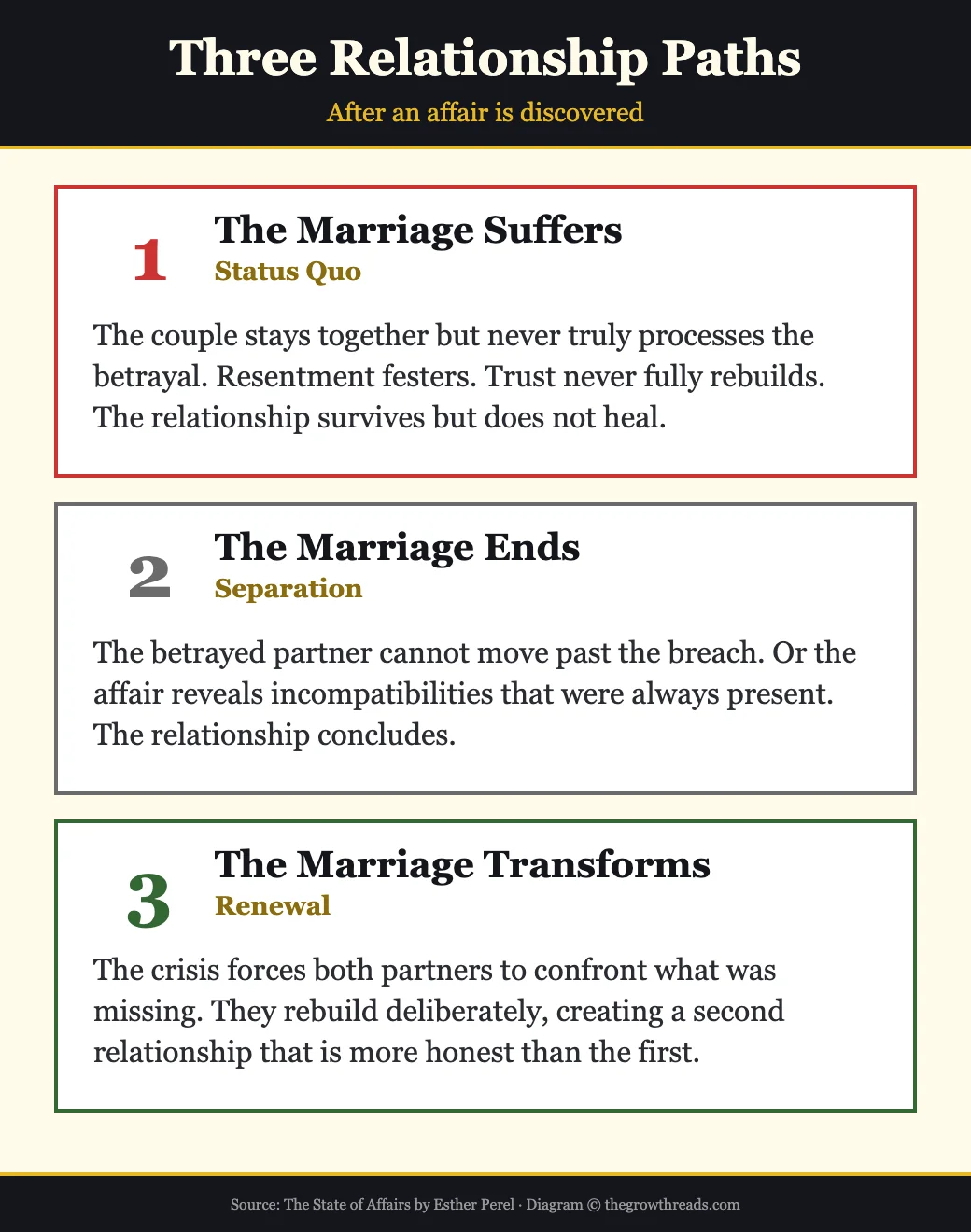
- Three paths follow discovery: The relationship can suffer in silence, end, or — in the most courageous cases — transform into something more honest and intentional than before.
- Jealousy is a complex emotion: It contains fear of loss, humiliation, competition, and a threat to identity all at once — understanding its components helps process it.
- Cultural context shapes everything: How societies define, tolerate, and punish infidelity varies enormously — our current absolutism is historically unusual.
- Curiosity is more healing than certainty: For the betrayed partner, asking “what did the affair mean to you?” produces more healing than demanding every physical detail.
What Is The State of Affairs About?
The State of Affairs explores infidelity as a window into human desire, modern love’s impossible expectations, and the complex forces that drive people to stray. Esther Perel challenges reductive moralizing, examines affairs through psychological, cultural, and existential lenses, and presents three paths couples can take after betrayal.
About the Author
Esther Perel is a Belgian psychotherapist, New York Times bestselling author, and one of the most recognized voices on modern relationships worldwide. Born to Holocaust survivors in Antwerp, she grew up observing the contrast between those who survived merely to exist and those who survived with a fierce commitment to living fully — an observation that shapes her understanding of desire and aliveness. Her TED talks on infidelity and desire have been viewed over thirty million times. She is the author of Mating in Captivity, the host of the acclaimed podcast Where Should We Begin, and a consultant to organizations including the United Nations, Fortune 500 companies, and the U.S. military on relationship dynamics. Explore all Esther Perel book summaries →
Key Concepts at a Glance
| Concept | What It Means | Use It When |
|---|---|---|
| The Modern Love Paradox | We want security and adventure from the same relationship — drives that pull opposite directions | You feel torn between stability and excitement in your relationship |
| Affairs as Self-Discovery | Infidelity is often a search for a lost part of oneself, not just another person | You want to understand the deeper meaning behind an affair |
| Three Paths After Betrayal | Suffering in silence, ending the relationship, or transforming it into something more honest | You are navigating the aftermath of infidelity |
| Expanding Definition | Digital life has blurred the lines of what constitutes betrayal | You are uncertain whether an emotional connection constitutes infidelity |
| Investigative vs Meaning Questions | Asking what the affair meant versus demanding physical details produces more healing | You are the betrayed partner trying to process what happened |
Part 1: The Landscape of Affairs
Perel opens by dismantling the conventional narrative that affairs only happen in bad relationships to bad people. The research tells a more complicated story: many people who stray describe their primary relationships as satisfying. They are not looking for a better partner — they are looking for a different version of themselves. The affair offers a space where they feel alive, desired, and free from the roles and responsibilities that define their daily existence.
This observation does not excuse the behavior but it does demand a more nuanced understanding. Perel traces the historical and cultural context of infidelity, showing that our current absolutist stance — any affair is an unforgivable betrayal — is historically unusual. Most societies throughout history have had more complex, sometimes contradictory, attitudes toward sexual and emotional fidelity. The modern expectation that one person should fulfill every emotional, intellectual, social, and sexual need is unprecedented, and Perel argues it is this expectation, not human weakness, that sets the stage for affairs.
She also addresses how technology has transformed the landscape. Social media, dating apps, and constant digital connectivity have made both temptation and surveillance easier than ever. The line between harmless flirtation and emotional affair has blurred. What constitutes betrayal — a text? A like? A deleted conversation? — is genuinely ambiguous in ways previous generations never confronted.
Part 2: After the Storm
The middle section focuses on what happens after an affair is discovered. Perel identifies three possible outcomes. In the first, the marriage suffers — the couple stays together but never truly processes the betrayal, living in a state of cold war where resentment simmers beneath a surface of normalcy. In the second, the marriage ends — the betrayed partner cannot move past the breach, or the affair reveals fundamental incompatibilities that were always present but never confronted. In the third and rarest outcome, the marriage transforms — the crisis forces both partners to honestly examine what was missing, to take responsibility for their contributions to the relationship’s vulnerabilities, and to deliberately build a second relationship that is more honest, more intentional, and more alive than the first.
Perel devotes significant attention to the experience of the betrayed partner. She validates the devastating pain of discovery while also challenging the victim-perpetrator framework that often dominates. Healing, she argues, requires moving from investigative questions (“where were you? what did you do?”) to meaning questions (“what did this relationship mean to you? what were you looking for? who were you becoming?”). The investigative questions provide facts; the meaning questions provide understanding — and understanding is what actually enables recovery.
She also addresses the experience of the unfaithful partner with unusual compassion. Most cultural narratives reduce them to villains, but Perel’s clinical experience reveals people who are often deeply conflicted, genuinely love their primary partner, and are struggling with forces they do not fully understand. This does not diminish their responsibility, but it does challenge the idea that affairs are simply selfish acts by selfish people.
Part 3: Reimagining Fidelity
The final section challenges readers to rethink fidelity itself. Perel does not advocate for open relationships or excuse betrayal. Instead, she asks couples to have honest conversations about what fidelity means to them specifically — conversations most couples never have because they assume they agree. What counts as crossing a line? Is an emotional connection with someone else a betrayal? What about watching someone else on a screen? What about a conversation you delete? These questions have no universal answers, and Perel argues that the failure to discuss them explicitly leaves couples vulnerable to violations of expectations they never articulated.
She also explores what she calls the “erotic mind” — the part of human consciousness that craves novelty, transgression, and the unknown. This drive does not disappear in committed relationships; it goes underground. Healthy couples, Perel suggests, find ways to honor both the security of commitment and the vitality of desire — not by eliminating the tension between them but by acknowledging it openly and navigating it together.
The book closes with a call for what Perel describes as “informed fidelity” — a commitment chosen with full awareness of the alternatives, the temptations, and the sacrifices, rather than a commitment assumed by default and enforced through shame. This kind of fidelity, Perel argues, is both more difficult and more meaningful than the conventional version because it is actively chosen rather than passively assumed.
Who Is The State of Affairs Best For — and Who Should Read Something Else First?
The State of Affairs is essential for anyone navigating the aftermath of infidelity — whether as the betrayed partner, the unfaithful partner, or the therapist working with the couple. It provides a framework for understanding that transcends blame and enables genuine healing. It is also valuable for couples who want to proactively strengthen their relationship by honestly discussing desire, fidelity, and expectations.
If you are looking for practical tools for rebuilding a relationship after betrayal, Hold Me Tight provides specific therapeutic conversations. If you want to understand the desire-security tension before it becomes a crisis, Perel’s Mating in Captivity addresses that dynamic directly.
Questions to Reflect On
- Have you and your partner explicitly discussed what fidelity means to each of you — or are you assuming you agree?
- What do you turn to your partner for that you used to get from a broader community — friendship, intellectual stimulation, adventure, validation?
- If you have experienced betrayal, are you asking investigative questions or meaning questions — and which would serve your healing better?
- What parts of yourself have you set aside in your relationship — and do you miss them?
- Is your fidelity actively chosen or passively assumed — and what would it mean to choose it consciously?
🔥 Ready to Understand the Deeper Truth About Love?
Explore what infidelity reveals about human desire, modern expectations, and the possibility of relationship transformation.
How to Apply The State of Affairs (7-Day Plan)
- Day 1 — Define fidelity explicitly: Write down what fidelity means to you — not what you assume it means, but what specifically constitutes a violation of your relationship agreement.
- Day 2 — Share your definition: Ask your partner to do the same exercise independently. Compare your definitions. Note where they align and where they differ.
- Day 3 — Discuss the gaps: Have an honest conversation about the differences in your definitions. What surprised you? What needs clarification or negotiation?
- Day 4 — Audit your expectations: List everything you expect from your partner — friendship, passion, co-parenting, intellectual stimulation, adventure. Ask honestly: is this a reasonable load for one person?
- Day 5 — Reconnect with desire: Do something that makes you feel alive — not for your partner, but for yourself. Rekindle a part of your identity that has been dormant.
- Day 6 — Ask a meaning question: In a calm moment, ask your partner: what do you need from our relationship that you are not currently getting? Listen without defending.
- Day 7 — Choose your fidelity: Reflect on your commitment. Is it actively chosen or passively assumed? Write one paragraph about why you choose this relationship — consciously, with full awareness of the alternatives.
Frequently Asked Questions
Does Esther Perel excuse infidelity?
No. Perel is clear that affairs cause tremendous pain and violate trust. What she challenges is the reductive narrative that reduces affairs to simple moral failures by bad people. She argues that understanding the complex motivations behind infidelity — without excusing the behavior — is essential for genuine healing. Her approach is “understanding is not endorsing” — you can examine why something happened without approving that it did.
What are the three paths after an affair?
The marriage can suffer (staying together without genuine healing, living with unresolved resentment), end (the breach is too deep or reveals fundamental incompatibility), or transform (the crisis forces honest examination of what was missing, leading to a more intentional and alive second relationship). Perel observes that the transformative path, while rarest, produces relationships that are often stronger than before because they are built on truth rather than assumption.
Why do happy people have affairs?
Perel’s clinical experience shows that many unfaithful partners describe their primary relationship as satisfying. They are not looking for a better partner — they are looking for a different version of themselves. The affair offers aliveness, adventure, and escape from the identity they have constructed within their relationship. This challenges the common assumption that affairs only happen in unhappy relationships.
What are meaning questions vs investigative questions?
Investigative questions seek facts: where were you, how many times, what exactly did you do? Meaning questions seek understanding: what did this person represent to you, what were you looking for, who were you becoming in that relationship? Perel argues that while investigative questions are natural and necessary early on, the shift to meaning questions is what ultimately enables healing and transformation rather than just surveillance and punishment.
How has technology changed infidelity?
Digital technology has simultaneously made temptation easier (dating apps, social media reconnection, constant connectivity) and surveillance easier (phone tracking, message monitoring, social media investigation). It has also blurred the definition of infidelity — is an emotional text thread an affair? What about a relationship conducted entirely online? Perel argues that couples need to explicitly discuss what constitutes betrayal in the digital age rather than assuming shared definitions.
How does this compare to Mating in Captivity?
Mating in Captivity explores the tension between domestic security and erotic desire within committed relationships — why desire fades and how to rekindle it. The State of Affairs examines what happens when that tension becomes unbearable and one partner reaches outside the relationship. Mating in Captivity is the preventive book; The State of Affairs is the diagnostic and recovery book. Reading both gives you the complete arc of Perel’s thinking on modern love.
Is this book appropriate if I am currently dealing with infidelity?
Yes, but with a caveat: this is not a crisis intervention book. If you are in acute emotional distress from a recent discovery, professional therapeutic support should come first. The State of Affairs is most useful once the initial shock has subsided and you are ready to understand the deeper dynamics at play. It provides a framework for making sense of what happened that goes beyond blame, which can be profoundly healing — but it requires emotional readiness to engage with complexity rather than seek simple answers.
Related Summaries
- Mating in Captivity by Esther Perel — the companion book on desire within committed relationships.
- Hold Me Tight by Sue Johnson — the therapeutic protocol for rebuilding trust and connection.
- Attached by Amir Levine — how attachment styles shape romantic relationships.
- Best Relationship Books — our complete guide to books on love and connection.