

★★★★☆ 4.4/5 — A codified, detail-obsessed leadership philosophy from the coach who turned a 2-14 team into a three-time Super Bowl champion.
Best for: leaders who want a concrete, written standard of behavior rather than an abstract vision statement · Reading time: ~6 hrs (this guide: ~12 min) · Difficulty to apply: Moderate — the standard is simple to write, consistently enforcing it is the hard part
The Score Takes Care of Itself in one minute
You can’t control the outcome of a game, a quarter, or a fiscal year — you can only control the standard of performance you bring to preparing for it. When Bill Walsh took over the San Francisco 49ers in 1979, the team was coming off a 2-14 season. Rather than promising quick wins, he wrote a detailed Standard of Performance — a document covering work ethic, respect, communication, and even how players dressed and kept their lockers — and enforced it obsessively, regardless of the scoreboard. The 49ers went 2-14 again in his first season. Two years later, they won the Super Bowl. Completed posthumously by Steve Jamison and Walsh’s son Craig after Walsh’s death in 2007, the book argues that if you get the standard right, the score takes care of itself.
Key takeaways
- You can only control your preparation, not the outcome: Walsh’s central mantra is that obsessing over the scoreboard directly is less effective than obsessing over the process that produces good outcomes.
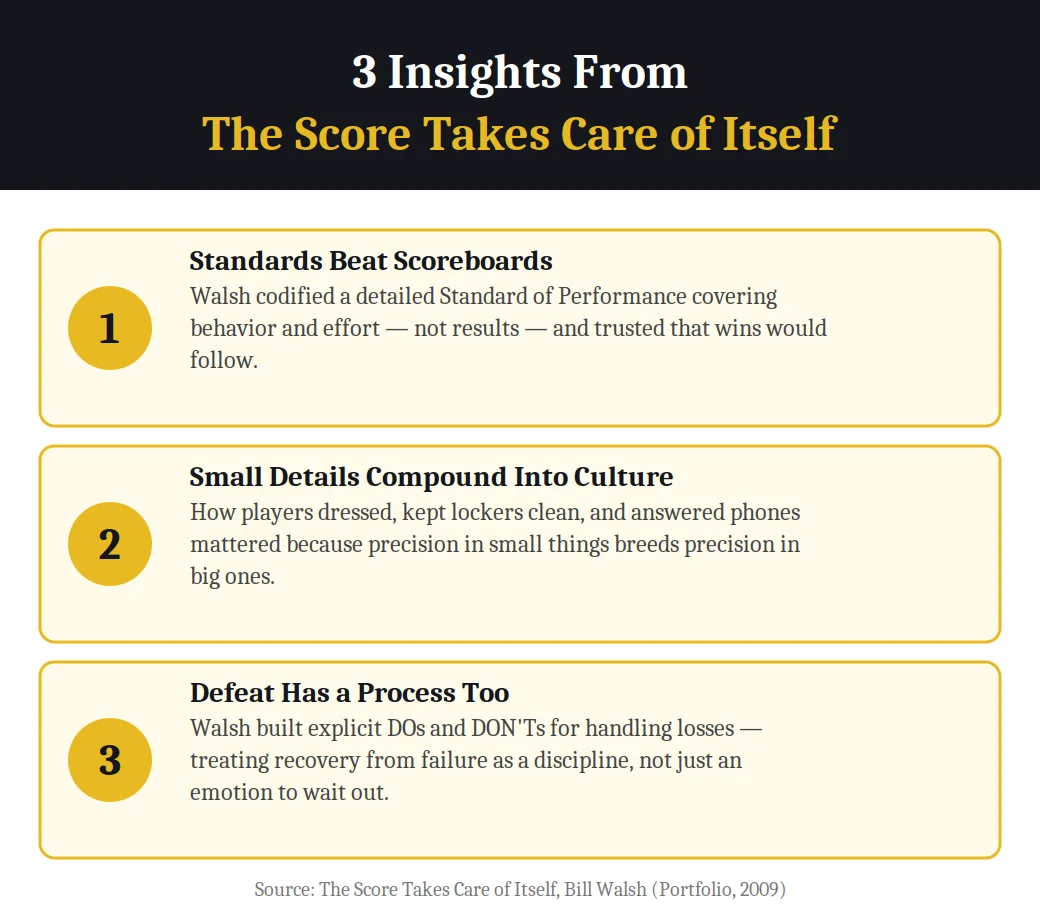
- The Standard of Performance was a written document, not a slogan: a detailed list of behavioral and effort-based expectations — from work ethic to how phones were answered — applied to everyone in the organization.
- Small details compound into culture: Walsh believed precision in minor things, like dress code and locker-room cleanliness, built the habits of precision that mattered in big moments.
- Pride belongs in the effort, not just the result: the Standard explicitly treats effort as something worth taking pride in “as an entity separate from the result of that effort.”
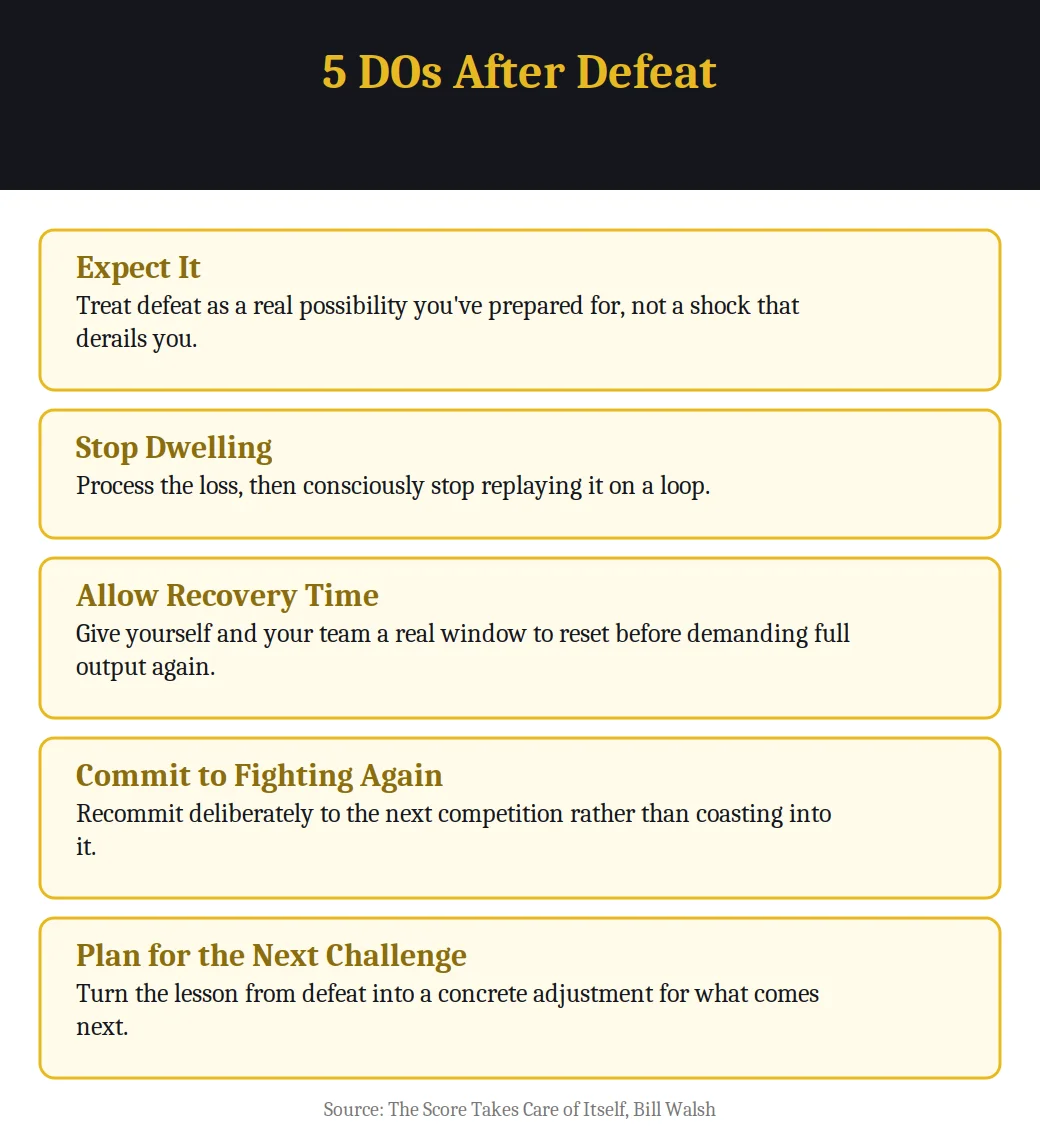
- Losing is a discipline too: Walsh built explicit DOs (expect defeat, stop dwelling, allow recovery time, commit to fighting again, plan for the next challenge) and DON’Ts for handling losses.
- Turnarounds take longer than a season: the 49ers stayed 2-14 in year one under the new standard — the culture took root before the wins did.
- Leadership includes developing your successors: Walsh treated growing future head coaches, not just winning games, as a genuine leadership output — his coaching tree includes George Seifert, Mike Holmgren, and later Pete Carroll and Mike Shanahan.
- “Teacher” was the identity Walsh valued most: he described the ability to help people around him self-actualize their own goals as the leadership label he prized above all others.
- Treating people right outperforms money as a motivator: Walsh was blunt that “money talks,” but that treating people with respect and fairness “talks louder.”
What is The Score Takes Care of Itself about?
The Score Takes Care of Itself is Bill Walsh’s leadership philosophy, built around the Standard of Performance he wrote and enforced while transforming the San Francisco 49ers from a 2-14 team into three-time Super Bowl champions. Rather than chasing wins directly, Walsh codified detailed expectations for behavior, effort, and even minor operational details, arguing that disciplined process — not talk about winning — is what actually produces winning results. Completed posthumously from Walsh’s notes by co-author Steve Jamison and Walsh’s son Craig after Walsh’s 2007 death, the book blends coaching memoir with a transferable leadership framework used well beyond football.
About the author
Bill Walsh (1931–2007) coached the Cincinnati Bengals as an assistant under Paul Brown, where he helped develop the timing-based passing attack that became known as the West Coast offense, before becoming head coach at Stanford. He then led the San Francisco 49ers from 1979 to 1988, going 102-63-1 and winning Super Bowls XVI, XIX, and XXIII after inheriting a team coming off a 2-14 season. His coaching tree — including George Seifert, Mike Holmgren, and later branches through Pete Carroll, Mike Shanahan, and Jon Gruden — became one of the most influential in NFL history. Walsh died of leukemia in 2007 before finishing this book, which Steve Jamison and Walsh’s son Craig Walsh completed from his notes and interviews. Explore all Bill Walsh book summaries →
Key concepts at a glance
| Concept | What it means | Use it when |
|---|---|---|
| Standard of Performance | A written, codified set of behavioral and effort expectations applied to everyone in the organization | Your team has a vague culture but no concrete, enforceable standard |
| The Score Takes Care of Itself | Focusing on controllable process and preparation rather than directly on outcomes | You or your team are anxiously fixated on results you can’t directly control |
| Details Compound Into Culture | Precision in small operational things builds the habits that matter in big moments | You’re tempted to let “minor” lapses slide because the big picture looks fine |
| Pride in Effort | Valuing effort as worthwhile in itself, independent of whether the result was a win or a loss | Your team’s morale swings entirely with the scoreboard |
| DOs After Defeat | A deliberate process for recovering from loss: expect it, stop dwelling, recover, recommit, plan ahead | A setback has knocked your team’s confidence and momentum |
Part 1: The Standard of Performance
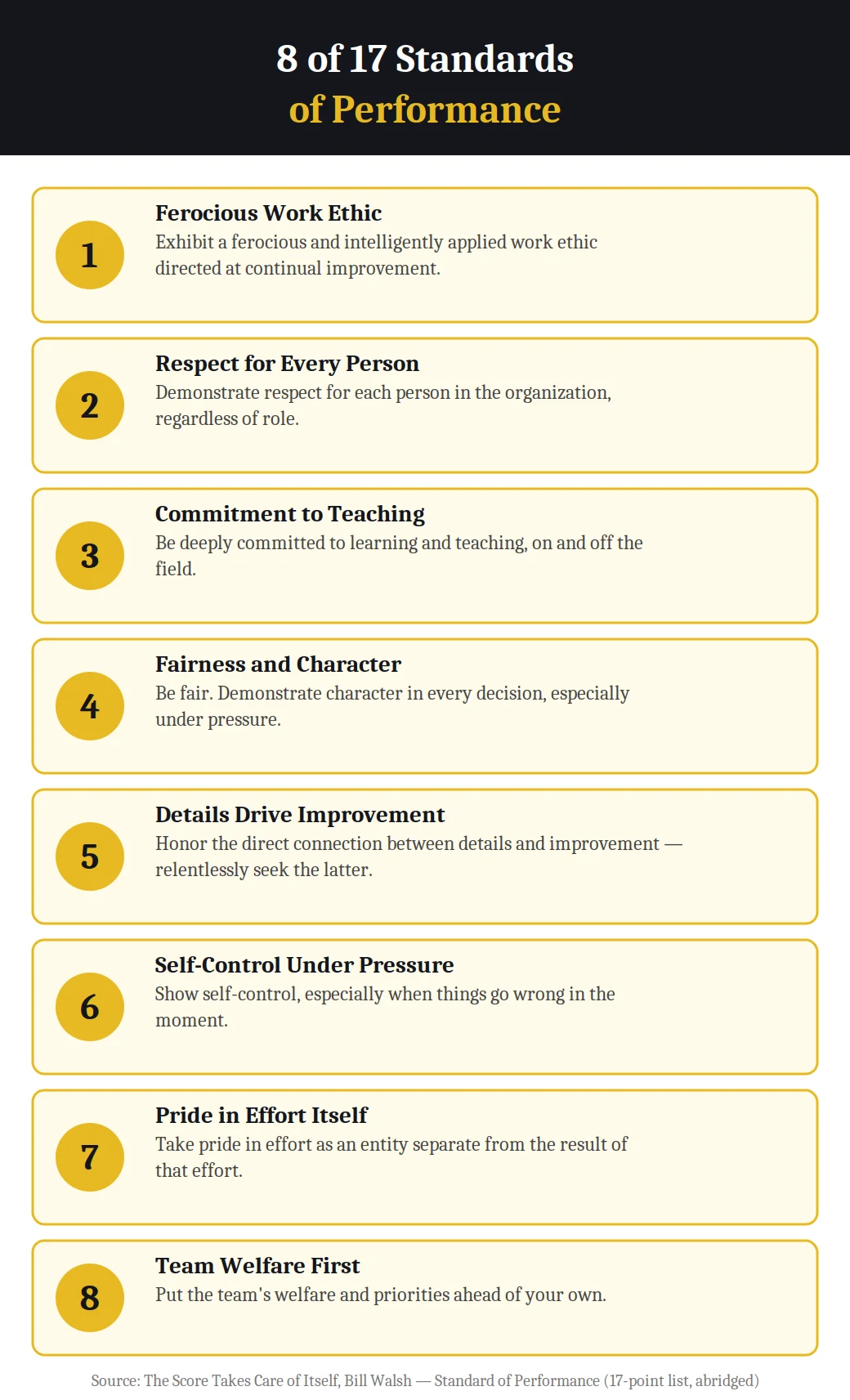
When Walsh took over the 49ers, he didn’t promise the team it would win. Instead, he wrote down, in detail, how everyone in the organization was expected to behave: exhibit a ferocious and intelligently applied work ethic, demonstrate respect for each person regardless of role, be deeply committed to learning and teaching, be fair, demonstrate character, and honor the direct connection between details and improvement. The standard extended into territory that had nothing obviously to do with football — how players dressed, how clean the locker room was kept, how phones in the building were answered — because Walsh believed precision in small things breeds precision in the moments that actually matter.
TGR Note: This idea that codified, lived standards — not posters on a wall — build lasting culture connects directly to The Advantage, where Patrick Lencioni argues organizational health beats raw talent precisely because health is built from consistently reinforced behavioral norms.
Part 2: Process Over Outcome
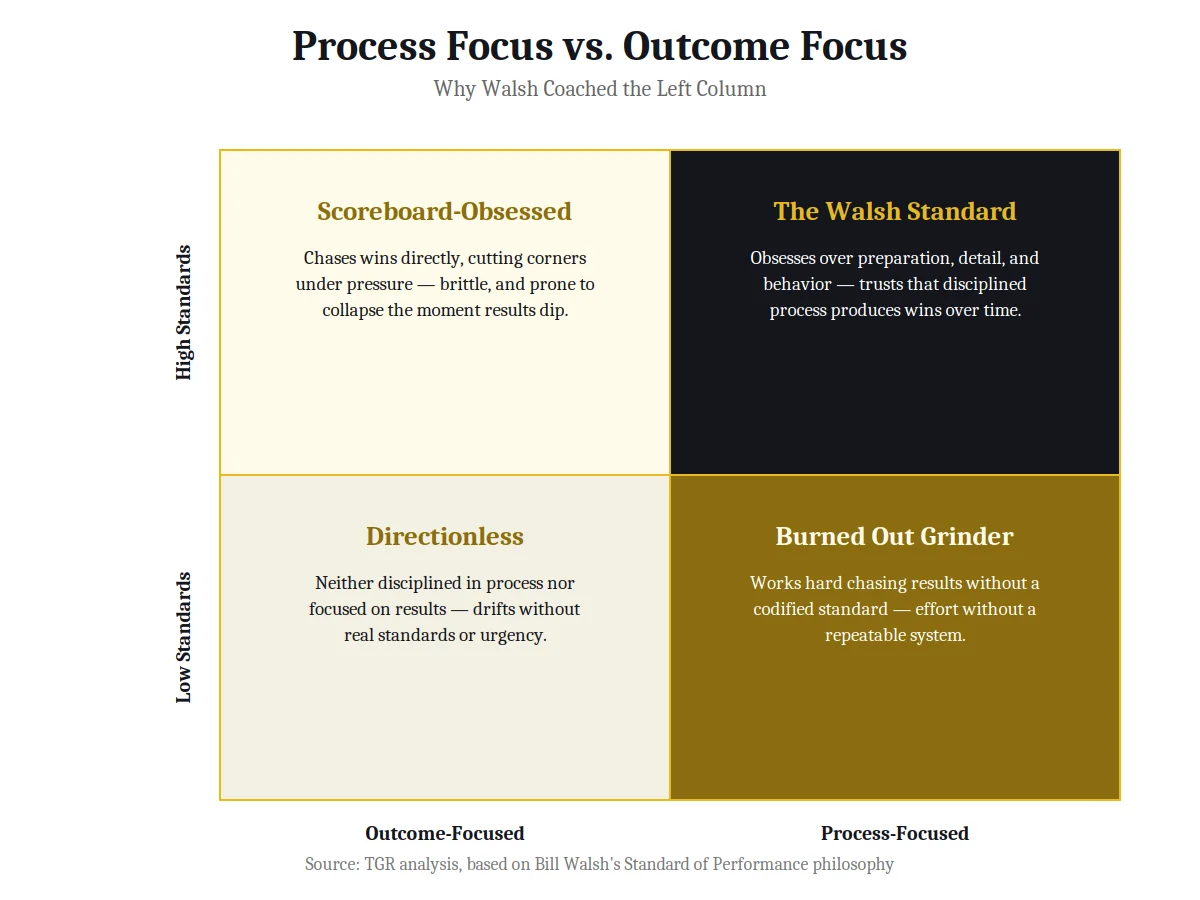
The book’s title captures its central discipline: you cannot control whether you win a given game, but you can completely control how thoroughly you prepare for it. Walsh’s first season under the new standard ended exactly like the one before it — 2-14. The difference was invisible on the scoreboard: the culture and process were taking root. Two seasons later, the 49ers won the Super Bowl. Walsh took this so seriously that he built the Standard to explicitly value “pride in effort as an entity separate from the result of that effort” — because a team that only feels good when it wins will collapse the moment it doesn’t.
TGR Note: This process-over-outcome discipline pairs naturally with The Leadership Challenge‘s emphasis on credibility as the foundation of leadership — both books argue that consistent behavior, sustained over time, is what actually earns results, not any single dramatic gesture.
Part 3: Handling Defeat and Building Successors
Walsh was unusually candid about failure — both the team’s and his own. He wrote explicit DOs for dealing with defeat: expect it, stop dwelling on it, allow real recovery time, commit to fighting again, and plan for the next challenge, paired with DON’Ts like avoiding self-pity, complaints, and blame. He was equally candid that coaching the 49ers took a real toll on his own health and composure, at points making him consider stepping away entirely.
He also treated developing future head coaches as a genuine measure of his own leadership, not an accidental byproduct of it — his coaching tree, running through George Seifert and Mike Holmgren to later branches like Pete Carroll and Mike Shanahan, became one of the most influential in NFL history, a legacy Walsh described in terms closer to teaching than to competing.
Who is The Score Takes Care of Itself best for — and who should read something else first?
This book is best for leaders who want a concrete, written standard of behavior they can actually enforce, rather than an abstract vision statement — team leads, coaches in any domain, and executives rebuilding a struggling culture from the ground up. Its sports-memoir format also makes it an accessible entry point for readers who find business-case-study books dry.
If you want the philosophical foundation of leadership as self-knowledge rather than codified standards, On Becoming a Leader covers related ground with a more introspective lens. If organizational health at the company level, rather than a single team turnaround, is your focus, The Advantage applies related thinking more broadly. And if you want the behavioral-practices angle in a non-sports context, The Leadership Challenge offers a close parallel.
Questions to reflect on
- If you wrote down your own Standard of Performance today, what would be on it — and are you actually living up to it right now?
- Which small, seemingly minor detail in your organization have you been letting slide because the bigger picture looks fine?
- Do you take real pride in effort when the result doesn’t go your way, or does your morale live and die with the scoreboard?
- What’s your actual process for recovering from a setback — or do you just wait for the bad feeling to pass?
- Are you actively developing people who could eventually replace you, or holding onto everything yourself?
🔥 Ready to build your own Standard of Performance?
This guide covers the core philosophy — the book gives you Walsh’s full story, the complete standard, and his personal reflections on failure and leadership.
How to apply The Score Takes Care of Itself (7-day plan)
- Day 1: Write your own Standard of Performance — five to ten specific, observable behaviors you expect from yourself and your team.
- Day 2: Pick one “minor” detail in your workspace or process that’s been slipping, and fix it today.
- Day 3: Identify one thing you’ve been chasing as an outcome, and reframe it as a process you can control instead.
- Day 4: Recognize one person’s effort explicitly, independent of whether their project succeeded or failed.
- Day 5: Revisit a recent setback using Walsh’s DOs: acknowledge it, stop dwelling, and write one concrete next step.
- Day 6: Identify one person you could be developing as a future leader, and delegate something real to them.
- Day 7: Reread your Standard of Performance from Day 1 and honestly assess whether you lived up to it this week.
Frequently asked questions
What is the main idea of The Score Takes Care of Itself?
You can’t control outcomes directly — only the standard of preparation and behavior you bring to them. Get that standard right, and results follow.
What is the Standard of Performance?
A written, detailed list of behavioral and effort-based expectations Bill Walsh created and enforced for everyone in the 49ers organization, covering everything from work ethic to how phones were answered.
Did Walsh’s approach work immediately?
No — the 49ers went 2-14 in Walsh’s first season under the new standard, the same record as before. They won the Super Bowl two seasons later.
Who finished the book after Bill Walsh’s death?
Co-author Steve Jamison and Walsh’s son Craig Walsh completed the book from Walsh’s notes and interviews after he died of leukemia in 2007.
What are the DOs after defeat in the book?
Expect defeat, stop dwelling on the loss, allow recovery time, commit to fighting again, and plan for the next challenge.
Is this book only useful for sports coaches?
No — while it’s framed as a football memoir, the Standard of Performance and process-over-outcome philosophy are widely applied in business and other team-leadership contexts.
How is this different from On Becoming a Leader?
On Becoming a Leader is introspective and built on self-knowledge; The Score Takes Care of Itself is a concrete, codified standard built from a single team turnaround.
Related summaries
If The Score Takes Care of Itself resonated, these dig further into related territory: The Advantage on organizational health, The Leadership Challenge on the five practices of exemplary leadership, and On Becoming a Leader on leadership as self-knowledge. For more, see our best leadership books pillar page.
How we analyze books: We work from the full book — reconstructing its core arguments in our own words, adding commentary that connects it to related research and other books in our library, and pressure-testing the advice in a practical 7-day plan. Ratings weigh usefulness, readability, and evidence quality. Read our full methodology.