

★★★★☆ 4.4/5 — Decades of research distilled into five learnable practices, backed by a validated 360-degree assessment tool used by organizations worldwide.
Best for: managers at every level who want an evidence-based, practice-driven model rather than an inspirational personality profile · Reading time: ~9 hrs (this guide: ~15 min) · Difficulty to apply: Moderate — the five practices are simple to name, building genuine credibility and consistency takes sustained effort
The Leadership Challenge in one minute
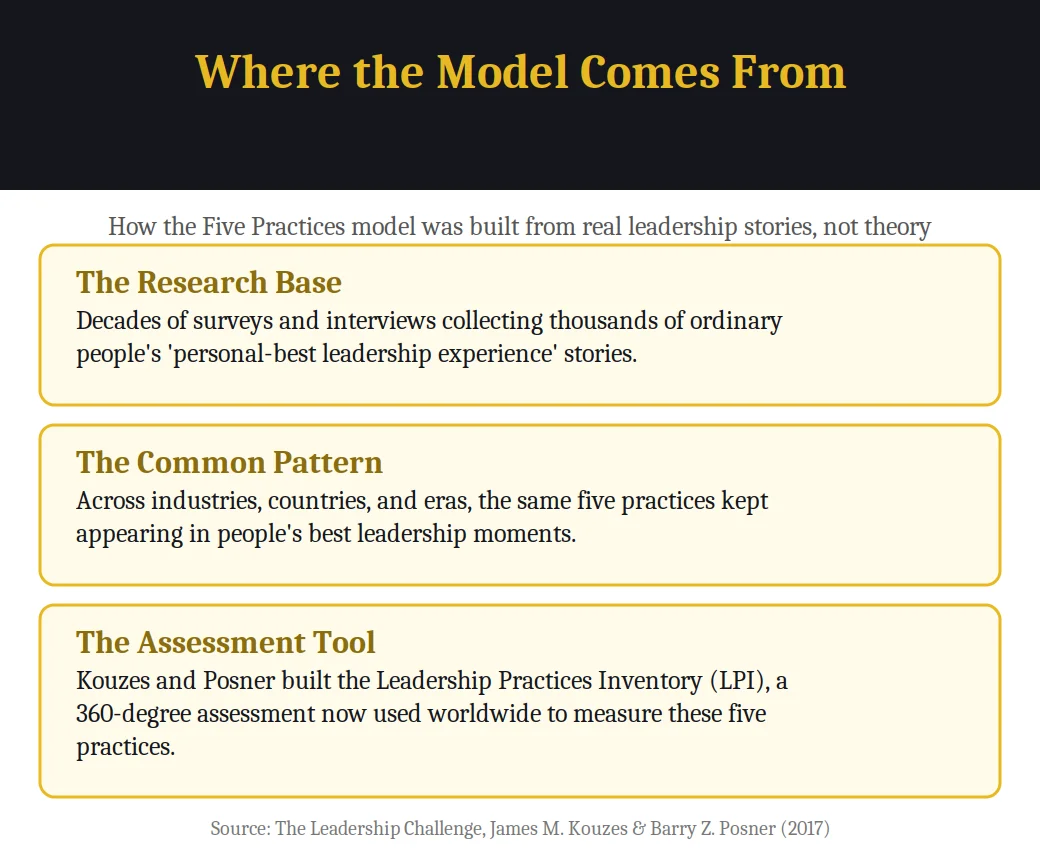
Leadership isn’t a position or a personality trait — it’s a set of five learnable practices, drawn from decades of studying people’s own personal-best leadership moments. James M. Kouzes and Barry Z. Posner began their research in the early 1980s by collecting thousands of stories from ordinary people, at every organizational level and across industries and countries, describing their own best leadership experience. Rather than studying famous executives, they looked for the common behaviors that showed up across all these different personal-best stories — and found the same five practices appearing again and again: modeling the way, inspiring a shared vision, challenging the process, enabling others to act, and encouraging the heart. First published in 1987 and now in its seventh edition, the book argues that leadership is fundamentally about behavior, not charisma or title, which means it can be learned, measured, and improved by anyone willing to practice it.
Key takeaways
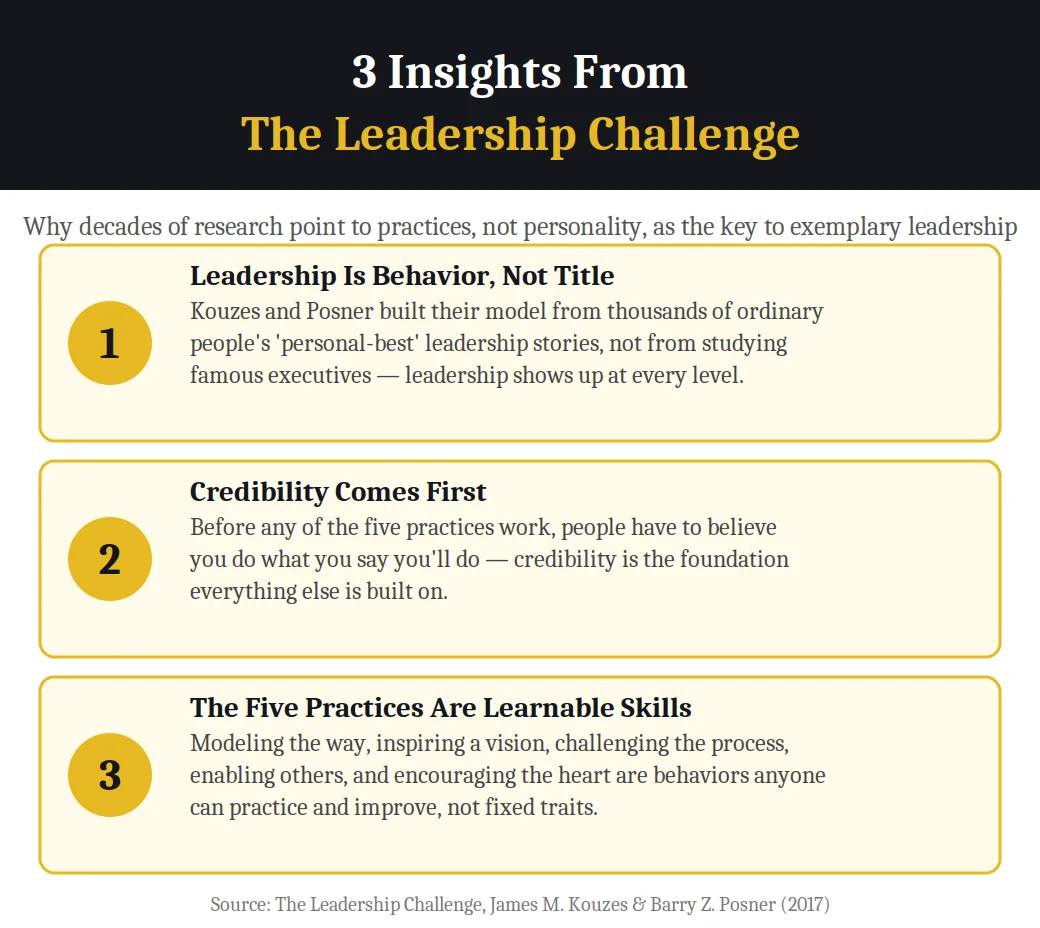
- Leadership shows up at every level, not just the top: Kouzes and Posner’s research draws from ordinary people’s own best leadership stories, not famous executives, showing leadership is broadly distributed rather than concentrated in formal titles.
- Credibility is the foundation: before any of the five practices can work, people have to believe a leader actually does what they say they’ll do — without that trust, none of the practices land.
- Model the Way means clarifying values and setting the example: leaders have to be specific about what they stand for and then visibly act consistently with it.
- Inspire a Shared Vision means painting a compelling future and enlisting others in it: a vision only motivates when people can see themselves genuinely part of the future being described.
- Challenge the Process means actively seeking opportunities and taking risks: exemplary leaders don’t wait for change to be forced on them — they search it out and experiment deliberately.
- Enable Others to Act means fostering collaboration and sharing power: leadership isn’t about personally doing more — it’s about strengthening others’ capability and giving them real ownership.
- Encourage the Heart means recognizing contributions and celebrating shared values: sustained effort under difficult conditions requires more than instructions — it requires genuine recognition along the way.
- The Five Practices are supported by a validated assessment: the Leadership Practices Inventory (LPI), a 360-degree tool built from the same research, lets individuals and organizations measure how consistently they practice each behavior.
- Leadership development is self-development: because the five practices are behaviors rather than fixed traits, Kouzes and Posner argue that anyone genuinely committed to practicing them can become measurably more effective over time.
What is The Leadership Challenge about?
The Leadership Challenge is James M. Kouzes and Barry Z. Posner’s research-based argument that leadership is a set of five learnable practices rather than a fixed personality trait or a function of formal title. Built from decades of surveys and interviews collecting thousands of ordinary people’s own “personal-best leadership experience” stories, the book identifies five practices that consistently appeared across leaders at every level, industry, and country: modeling the way, inspiring a shared vision, challenging the process, enabling others to act, and encouraging the heart. First published in 1987 and now in its seventh edition, the model is supported by the Leadership Practices Inventory (LPI), a 360-degree assessment tool used by organizations worldwide.
About the author
James M. Kouzes and Barry Z. Posner are longtime leadership researchers who have studied leadership together since the early 1980s, both affiliated with Santa Clara University’s Leavey School of Business. Rather than studying famous executives, they collected thousands of personal-best leadership stories from people at every organizational level, finding the same five practices recurring across all of them regardless of title or industry. Their model is supported by the Leadership Practices Inventory, a 360-degree assessment now used by organizations worldwide to measure how consistently leaders practice each of the five behaviors. Explore all James M. Kouzes & Barry Z. Posner book summaries →
Key concepts at a glance
| Concept | What it means | Use it when |
|---|---|---|
| Credibility | The foundational belief that a leader does what they say they will do | People aren’t following through on a leader’s vision or direction |
| Model the Way | Clarifying personal values and visibly acting consistently with them | A leader’s words and actions seem misaligned to others |
| Inspire a Shared Vision | Painting a compelling future and enlisting others in pursuing it together | A team lacks a sense of shared direction or purpose |
| Challenge the Process | Actively searching for opportunities to innovate and taking calculated risks | An organization has become complacent or resistant to change |
| Encourage the Heart | Recognizing contributions and celebrating shared values and victories | People are showing signs of fatigue or disengagement during sustained effort |
Part 1: Credibility as the foundation
Before detailing the five practices, Kouzes and Posner establish what they call the foundation of leadership: credibility. Across their research, the single quality followers consistently demanded most from leaders was that leaders do what they say they will do — a simple but demanding standard that requires consistency between words and actions over time. Without this baseline trust, none of the five practices can function effectively, since followers won’t invest genuine effort in a vision or process led by someone they don’t believe.
TGR Note: This foundation echoes Servant Leadership‘s argument that legitimate influence has to be earned through consistent, trustworthy behavior rather than claimed through position or authority alone.
Part 2: The five practices in detail
With credibility established, Kouzes and Posner lay out the five practices their research found in common across exemplary leadership stories. Model the Way means clarifying your own values and then setting a visible example consistent with them — leaders can’t ask others to embrace values they don’t visibly embody themselves. Inspire a Shared Vision means envisioning an exciting, specific future and enlisting others in genuinely wanting to pursue it, rather than dictating direction from above. Challenge the Process means actively searching for opportunities to innovate and treating experimentation and calculated risk-taking as a normal part of leadership, not an exception to it.
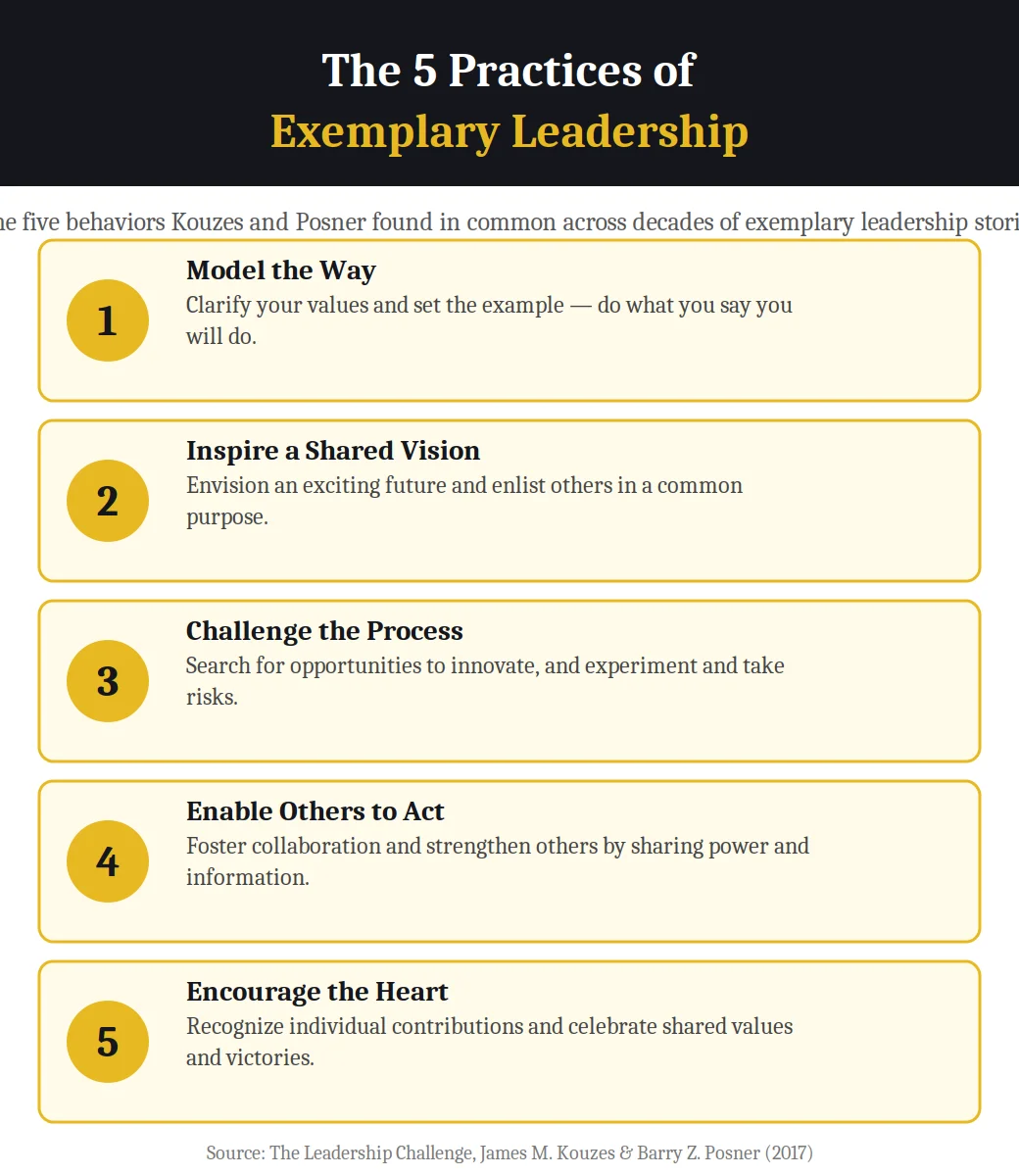
Enable Others to Act means fostering genuine collaboration and sharing power and information, since exemplary leadership research consistently shows that strengthening others’ capability produces better results than a leader personally trying to do everything. Encourage the Heart means recognizing individual contributions and celebrating shared values and victories along the way, because sustained extraordinary effort requires more than clear direction — it requires people to feel genuinely seen and appreciated for what they’re contributing.
TGR Note: The Enable Others to Act practice connects directly to The Advantage‘s emphasis on building a cohesive leadership team through trust and shared commitment, rather than a single leader retaining all the decision-making power.
Part 3: Credibility and vision working together
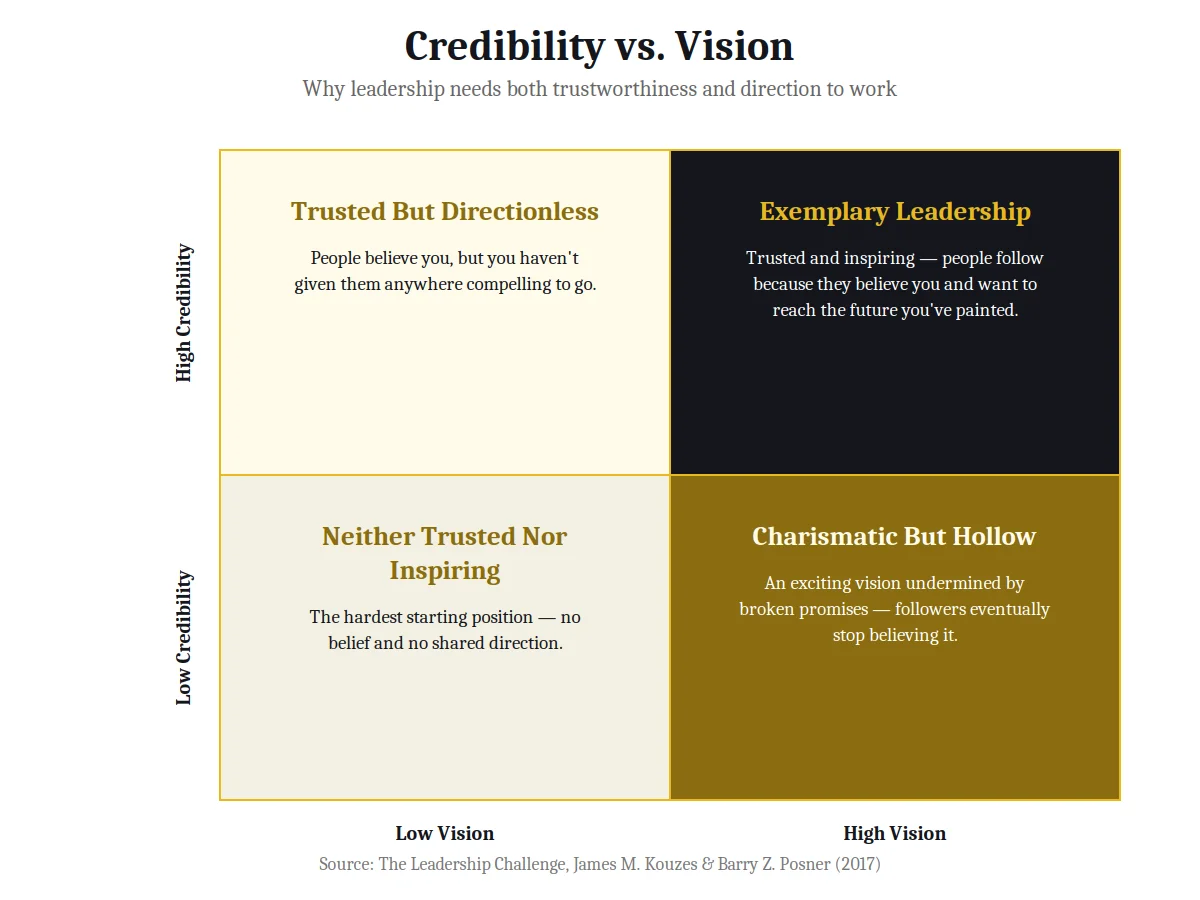
Kouzes and Posner emphasize that credibility and vision aren’t independent — a leader needs both simultaneously for exemplary leadership to emerge. A highly credible leader who fails to articulate a compelling direction leaves people trusting but directionless. A charismatic leader with an exciting vision but a track record of broken promises eventually loses followers who stop believing the vision will actually materialize. Only the combination of genuine trustworthiness and a genuinely inspiring shared direction produces the kind of leadership that gets people to willingly follow into uncertain or difficult territory.
The book closes by reinforcing its central claim that leadership development is self-development: because the five practices are observable behaviors rather than fixed personality traits, anyone genuinely committed to practicing them — and honestly assessing their own consistency, ideally through tools like the LPI — can become measurably more effective over time, regardless of their starting title or personality.
Who is The Leadership Challenge best for — and who should read something else first?
This book is best for managers at every level who want an evidence-based, practice-driven model of leadership rather than an inspirational personality profile or a collection of famous-executive anecdotes. It rewards readers open to a research-grounded, somewhat academic tone paired with concrete behavioral practices.
If your interest is more specifically in the ethical foundation of leadership as service, Servant Leadership offers a complementary philosophical grounding. If you want a clearer staged progression of how leadership influence is earned over time, The 5 Levels of Leadership covers related ground with a different structure. And if organizational-level health, rather than individual leadership behavior, is your focus, The Advantage applies related thinking at the team and company level.
Questions to reflect on
- Do the people you lead genuinely believe you do what you say you’ll do — and how would you know if they didn’t?
- Which of the five practices — Model the Way, Inspire a Shared Vision, Challenge the Process, Enable Others to Act, Encourage the Heart — do you practice most naturally, and which do you avoid?
- Can you describe a specific, compelling future you’re inviting others to pursue with you, or is your direction vague?
- When did you last actively search for an opportunity to innovate, rather than waiting for change to be forced on you?
- How recently have you genuinely recognized someone’s contribution, rather than just moving on to the next task?
🔥 Ready to practice the five behaviors of exemplary leadership?
This guide covers the core model — the book gives you Kouzes and Posner’s full research, case studies, and self-assessment tools.
How to apply The Leadership Challenge (7-day plan)
- Day 1: Write down one value you claim to hold as a leader, and honestly assess whether your recent actions have modeled it consistently.
- Day 2: Draft a specific, vivid description of the future you want your team to pursue with you.
- Day 3: Identify one opportunity to innovate or improve a process that you’ve been avoiding, and take a small experimental step.
- Day 4: Delegate one piece of real ownership to someone else this week, rather than holding onto it yourself.
- Day 5: Genuinely recognize one person’s specific contribution, in detail, rather than a generic “good job.”
- Day 6: Ask one person you lead for honest feedback on whether they believe you do what you say you’ll do.
- Day 7: Reflect on which of the five practices needs the most deliberate work, and plan one concrete way to practice it next week.
Frequently asked questions
What is the main idea of The Leadership Challenge?
Leadership is a set of five learnable practices, not a fixed personality trait or a function of formal title, drawn from decades of research into ordinary people’s own best leadership experiences.
What are the Five Practices of Exemplary Leadership?
Model the Way, Inspire a Shared Vision, Challenge the Process, Enable Others to Act, and Encourage the Heart.
What is the Leadership Practices Inventory (LPI)?
A 360-degree assessment tool Kouzes and Posner built from their research, used to measure how consistently a leader practices each of the five behaviors.
Why is credibility considered the foundation of leadership?
Followers consistently demanded that leaders do what they say they will do; without that baseline trust, none of the five practices can function effectively.
How was the Five Practices model developed?
Kouzes and Posner collected thousands of personal-best leadership experience stories from ordinary people across industries and countries, finding the same five practices recurring regardless of title.
Is leadership a personality trait according to this book?
No — Kouzes and Posner argue leadership is behavior, not personality, meaning it can be learned and improved through deliberate practice.
How is this book different from Servant Leadership?
Servant Leadership offers a philosophical framework centered on serving others’ growth, while The Leadership Challenge offers an empirically derived set of five observable practices with a validated assessment tool.
Related summaries
If The Leadership Challenge resonated, these dig further into related territory: Servant Leadership on leading through service, The Advantage on building organizational health, and The 5 Levels of Leadership on how leadership influence is earned over time. For more, see our best leadership books pillar page.
How we analyze books: We work from the full book — reconstructing its core arguments in our own words, adding commentary that connects it to related research and other books in our library, and pressure-testing the advice in a practical 7-day plan. Ratings weigh usefulness, readability, and evidence quality. Read our full methodology.