

★★★★☆ 4.4/5 — Lencioni’s case that organizational health, not raw intelligence or strategy, is the rarest and most durable competitive advantage a business can build.
Best for: executives, founders, and leadership teams struggling to execute despite having good strategy and talent · Reading time: ~5 hrs (this guide: ~14 min) · Difficulty to apply: Moderate — the four disciplines are simple to state, building genuine team cohesion takes sustained effort
The Advantage in one minute
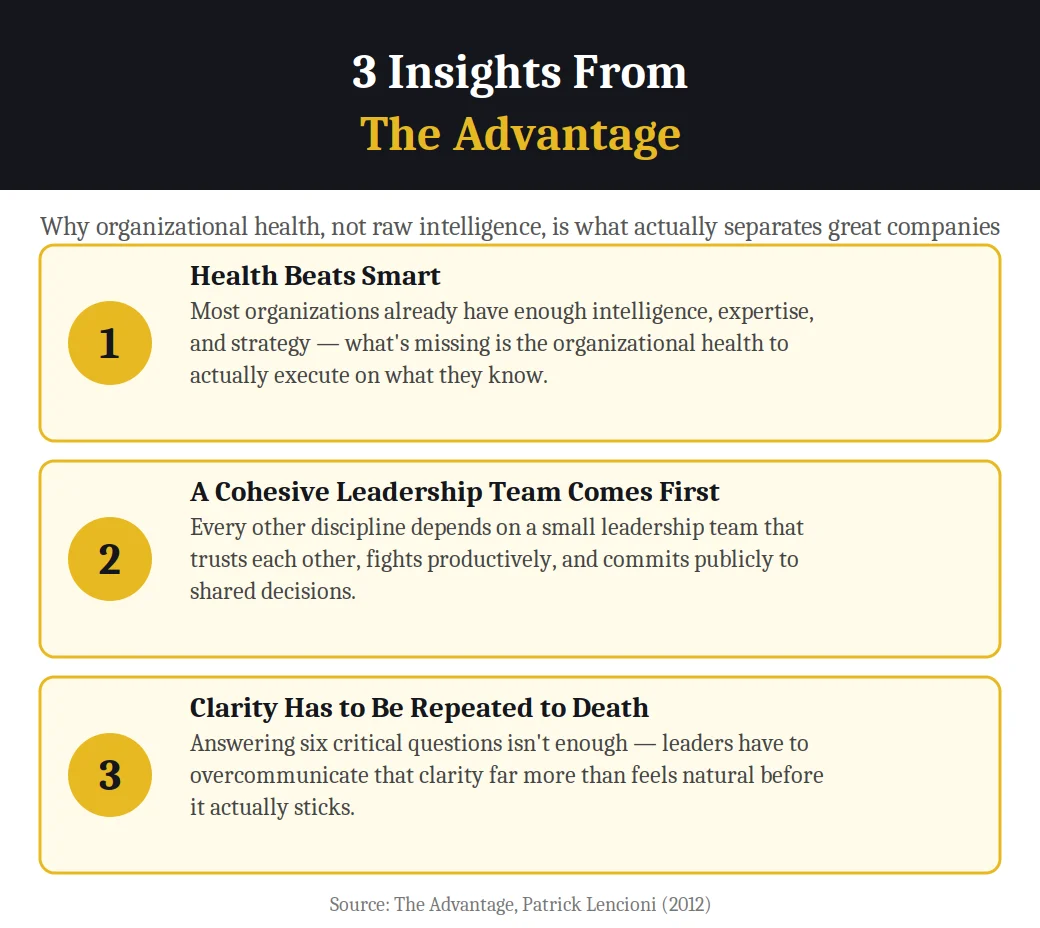
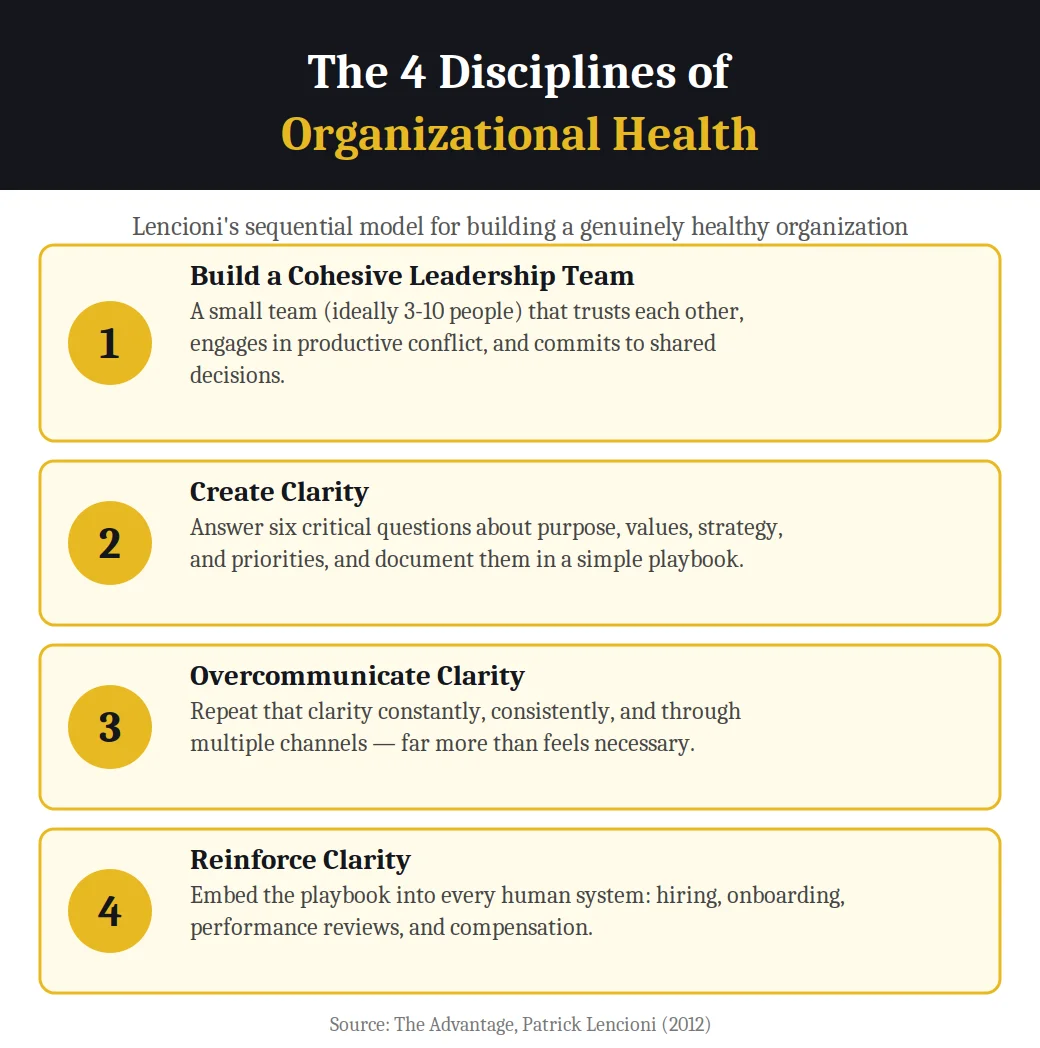
Smart companies lose to healthy ones — organizational health, not strategy or intelligence, is the single biggest competitive advantage most businesses ignore. Patrick Lencioni, the consultant behind The Five Dysfunctions of a Team, argues in this 2012 book that most organizations already possess enough intelligence, expertise, and strategic insight to succeed — what’s actually missing is the organizational health required to execute consistently on what they already know. Lencioni lays out four sequential disciplines for building that health: assembling a cohesive leadership team, creating clarity around six critical questions, overcommunicating that clarity far more than feels natural, and reinforcing it through every human system in the company. Because organizational health is hard to build and even harder to copy, Lencioni argues it’s the most sustainable advantage available to any business, regardless of industry or size.
Key takeaways
- Most organizations aren’t short on smarts: they already have enough strategy, expertise, and market intelligence — what’s missing is the organizational health to actually execute on it.
- A cohesive leadership team is the foundation: every other discipline depends on a small team (ideally three to ten people) who trust each other, engage in real conflict, and commit publicly to decisions.
- Clarity means answering six specific questions: why you exist, how you behave, what you do, how you’ll succeed, what’s most important right now, and who must do what.
- A simple playbook beats a long strategy document: the six answers should be documented briefly enough that every employee can recall and repeat them.
- Clarity has to be overcommunicated: leaders consistently underestimate how many times a message must be repeated, through how many channels, before it actually sinks in across an organization.
- Reinforcement embeds clarity into systems: hiring, onboarding, performance reviews, and compensation all need to reflect the same six answers, or the playbook stays theoretical.
- Organizational health is rare because it’s hard: unlike a clever strategy, which competitors can often copy, genuine team cohesion and organizational clarity are difficult to fake or replicate quickly.
- Meetings are where health either shows up or doesn’t: Lencioni argues that most organizations run meetings poorly, mixing different types of discussion together in ways that prevent real decisions from being made.
- Health without strategy still fails: Lencioni is clear that a cohesive, healthy team still needs sound strategic thinking — health is necessary but not sufficient on its own.
What is The Advantage about?
The Advantage is Patrick Lencioni’s argument that organizational health — not intelligence, strategy, finance, or technology — is the single most durable competitive advantage a business can build, precisely because it’s rare and difficult to copy. Building on the team dynamics he explored in The Five Dysfunctions of a Team, Lencioni lays out four sequential disciplines for creating that health: building a cohesive leadership team, creating clarity by answering six critical questions, overcommunicating that clarity throughout the organization, and reinforcing it through hiring, performance management, and every other human system. The book argues that most companies already have enough smart people and good ideas — what separates the best from the rest is whether the organization is healthy enough to actually execute on them.
About the author
Patrick Lencioni is a management consultant and founder of The Table Group, best known for The Five Dysfunctions of a Team, a business fable laying out a pyramid of five interrelated breakdowns that prevent teams from performing well together. In The Advantage, Lencioni extends that team-level thinking to the entire organization, arguing that most companies already have sufficient intelligence and strategy, and that organizational health — built through a cohesive leadership team and radical clarity — is what actually separates consistently successful businesses from the rest. Explore all Patrick Lencioni book summaries →
Key concepts at a glance
| Concept | What it means | Use it when |
|---|---|---|
| Organizational health | How well an organization’s leadership, culture, and systems align to execute on what it already knows | Good strategy isn’t translating into consistent results |
| Cohesive leadership team | A small team that trusts each other, engages in real conflict, and commits publicly to decisions | Leadership meetings feel political, guarded, or unproductive |
| The six critical questions | Why you exist, how you behave, what you do, how you’ll succeed, what’s most important now, and who does what | Different parts of the organization give inconsistent answers about direction and priorities |
| Overcommunication | Repeating clarity far more often and through more channels than feels natural | Employees can’t consistently repeat the company’s stated priorities |
| Reinforcement | Embedding the playbook into hiring, onboarding, reviews, and compensation | The stated values and priorities don’t show up in how people are actually managed |
Part 1: Building a cohesive leadership team
Lencioni argues that every other discipline in the book depends on getting this first one right: a small leadership team, ideally between three and ten people, who genuinely trust one another, engage in unfiltered, productive conflict, and commit publicly to decisions even when they initially disagreed. Without this foundation, clarity created at the top rarely survives contact with the rest of the organization, since a divided or guarded leadership team leaks its dysfunction into every layer below it.
TGR Note: This builds directly on The Five Dysfunctions of a Team‘s pyramid — the same trust-conflict-commitment sequence Lencioni first laid out for a single team becomes, in this book, the entry point for an entire organization’s health.
Part 2: Smart versus healthy
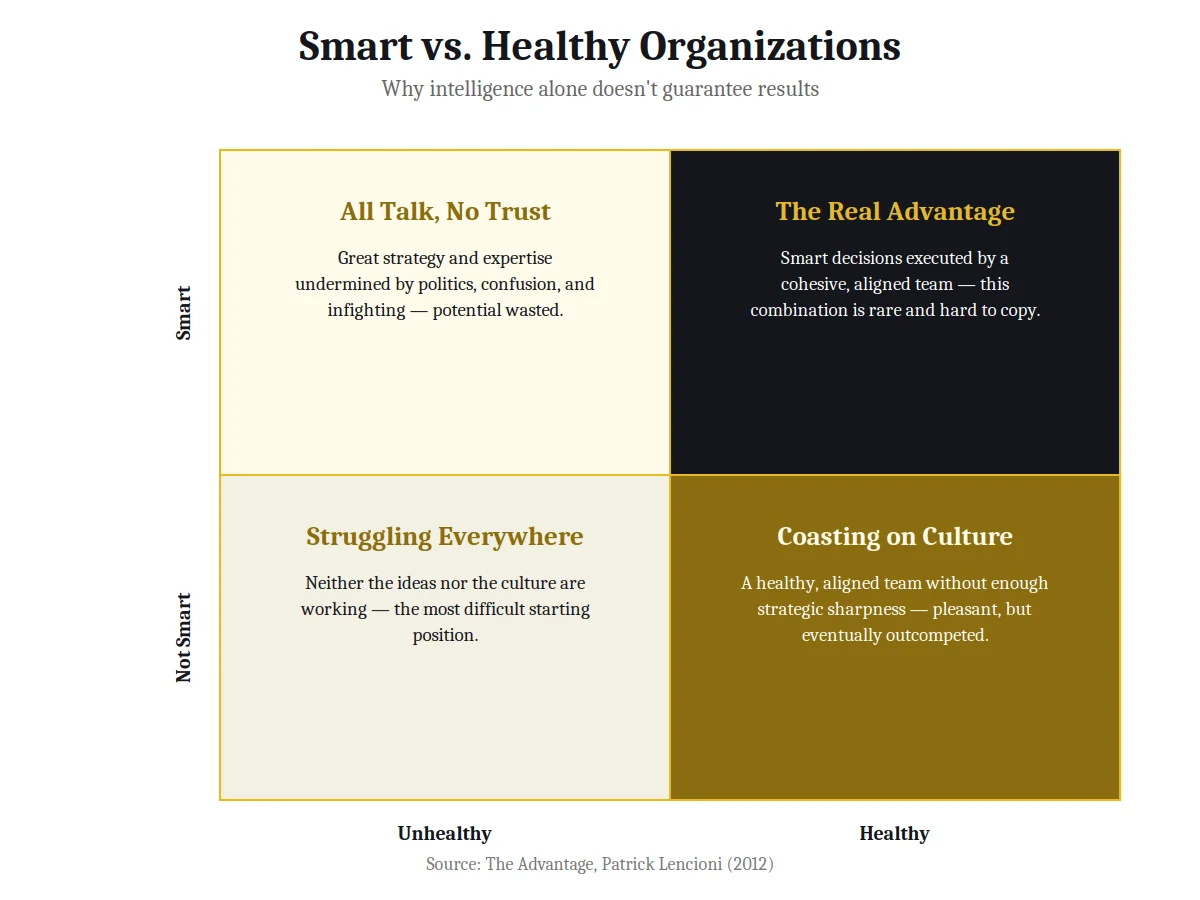
Lencioni draws a sharp distinction between organizations that are “smart” — possessing strong strategy, finance, marketing, and technology — and those that are genuinely “healthy,” meaning minimally political, low on confusion, and high on morale and productivity. His central claim is that most organizations have already invested heavily in getting smarter, while comparatively few have invested in getting healthier, even though health is what determines whether smart decisions actually get executed. A smart but unhealthy organization wastes its own potential through politics and confusion; a healthy but not particularly smart one can still coast for a while but eventually loses to genuine strategic thinking. The rare combination of both is what Lencioni calls the real advantage.
TGR Note: This distinction pairs well with Good to Great‘s emphasis on disciplined people and disciplined thought as prerequisites for disciplined action — both books argue that the “soft” organizational factors are what actually determine whether good strategy translates into results.
Part 3: Creating, overcommunicating, and reinforcing clarity
The second discipline is creating clarity by having the leadership team explicitly answer six critical questions: why the organization exists, how it expects people to behave, what business it’s actually in, how it plans to succeed, what’s most important right now, and who is responsible for each priority. Lencioni insists these answers need to be simple and specific enough to fit in a short internal playbook, not a lengthy strategy document that no one actually reads or remembers.
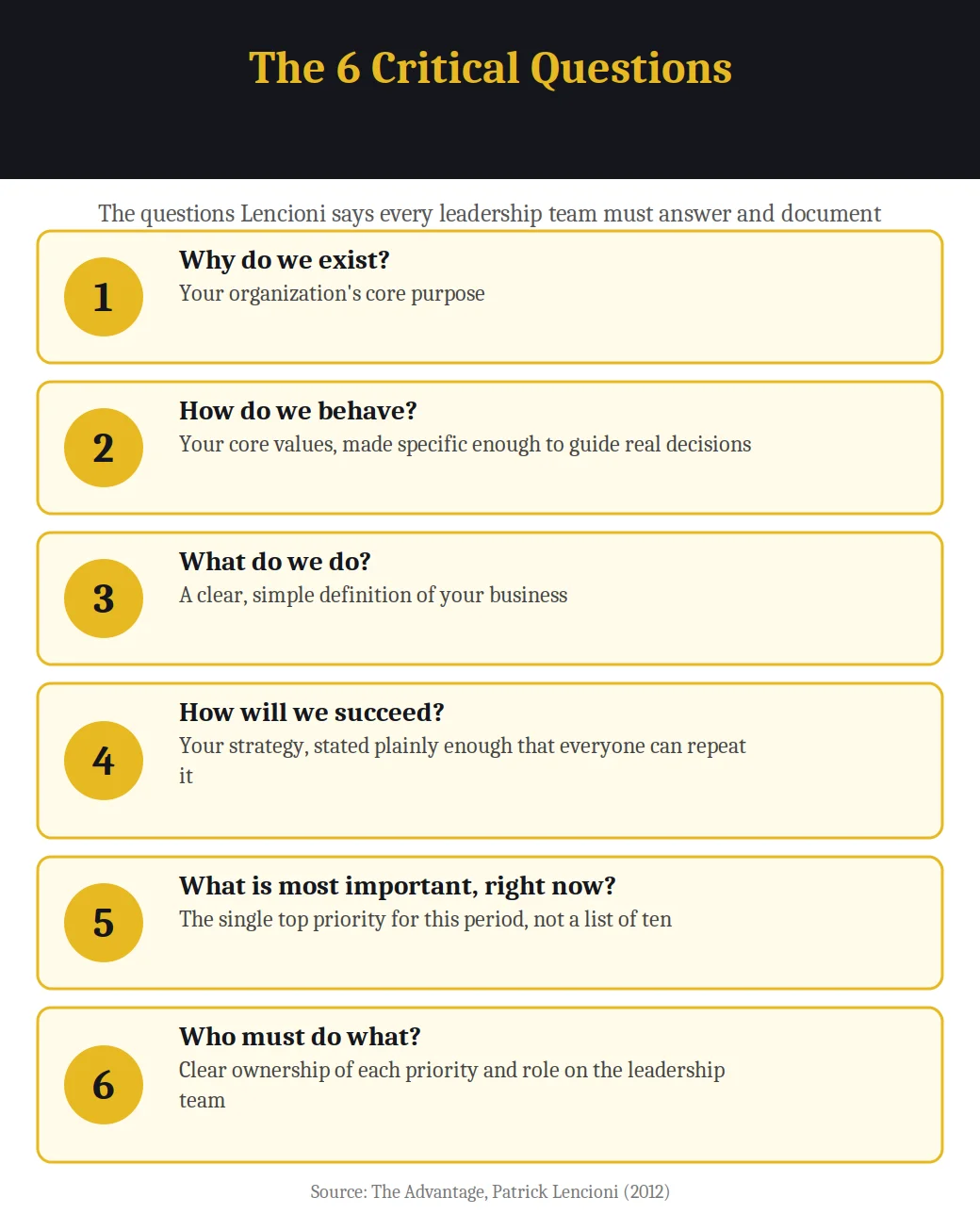
Creating the answers is only the second discipline; Lencioni argues the third and fourth — overcommunicating and reinforcing that clarity — are where most organizations actually fail. Leaders routinely underestimate how many times a message needs to be repeated, and through how many different channels, before it genuinely sinks in across a growing organization. And even repeated messaging fails if it isn’t reinforced structurally: hiring decisions, onboarding, performance reviews, and compensation all need to visibly reflect the same six answers, or employees quickly learn that the playbook is aspirational rather than real.
TGR Note: The emphasis on a simple, repeatable purpose connects to Start with Why‘s case that a clear, consistently communicated purpose is what aligns an organization’s decisions far more reliably than detailed top-down instructions.
Who is The Advantage best for — and who should read something else first?
This book is best for executives, founders, and leadership teams who have good strategy and talented people but still struggle with consistent execution, alignment, or morale. It rewards readers open to a practical, discipline-by-discipline framework over abstract leadership theory.
If your struggle is more specifically at the individual team level rather than the whole organization, Lencioni’s own The Five Dysfunctions of a Team is the natural starting point this book builds on. If you want a broader look at the disciplined habits that separate great companies from good ones, Good to Great covers related territory with a different research base. And if your organization’s core problem is an unclear or poorly communicated purpose specifically, Start with Why digs deeper into that first critical question.
Questions to reflect on
- Is your leadership team genuinely cohesive — do members trust each other enough to engage in real conflict, or does harmony mask real disagreement?
- Could every person in your organization answer all six critical questions consistently, right now, without checking a document?
- How many times, and through how many channels, have you actually repeated your organization’s top priority this quarter?
- Do your hiring, onboarding, and performance review processes visibly reflect your stated values, or do they run on autopilot separate from them?
- Would you describe your organization as smarter than it is healthy, healthier than it is smart, or genuinely both?
🔥 Ready to build the advantage competitors can’t copy?
This guide covers the four disciplines — the book gives you Lencioni’s full framework, case studies, and practical exercises.
How to apply The Advantage (7-day plan)
- Day 1: Honestly assess your leadership team’s cohesion — is there real trust and productive conflict, or guarded harmony?
- Day 2: Draft your organization’s answer to “why do we exist?” in one clear sentence.
- Day 3: Draft answers to “how do we behave?” and “what do we do?” — specific enough to guide a real decision.
- Day 4: Draft your answers to “how will we succeed?” and “what’s most important right now?”
- Day 5: Assign clear ownership by answering “who must do what?” for your top priority.
- Day 6: Identify one channel you could use to overcommunicate this clarity that you aren’t currently using.
- Day 7: Review whether your hiring or performance review process currently reflects these six answers, and identify one change to reinforce them.
Frequently asked questions
What is the main idea of The Advantage?
Organizational health — not strategy, intelligence, or technology — is the rarest and most durable competitive advantage a business can build, because it’s difficult for competitors to copy.
What are the four disciplines of organizational health?
Build a cohesive leadership team, create clarity by answering six critical questions, overcommunicate that clarity, and reinforce it through hiring, onboarding, reviews, and compensation.
What are the six critical questions?
Why do we exist, how do we behave, what do we do, how will we succeed, what is most important right now, and who must do what.
How is The Advantage different from The Five Dysfunctions of a Team?
The Five Dysfunctions of a Team focuses on building trust and cohesion within a single leadership team, while The Advantage extends that thinking to building health across an entire organization.
Does organizational health matter more than strategy?
Lencioni argues health is necessary but not sufficient — a healthy organization still needs sound strategy, but most organizations already have enough strategy and are missing the health to execute on it.
Why is overcommunication necessary?
Leaders consistently underestimate how many times a message must be repeated, and through how many channels, before it genuinely sinks in across a growing organization.
Who is The Advantage written for?
Executives, founders, and leadership teams at organizations of any size or industry who want a practical framework for building organizational health.
Related summaries
If The Advantage resonated, these dig further into related territory: The Five Dysfunctions of a Team on building trust within a single team, Good to Great on the disciplines behind consistently great companies, and Start with Why on clarifying organizational purpose. For more, see our best leadership books pillar page.
How we analyze books: We work from the full book — reconstructing its core arguments in our own words, adding commentary that connects it to related research and other books in our library, and pressure-testing the advice in a practical 7-day plan. Ratings weigh usefulness, readability, and evidence quality. Read our full methodology.